Copyright © 2018 The Korean Society for Bone and Mineral Research
This is an Open Access article distributed under the terms of the Creative Commons Attribution Non-Commercial Li- cense (http://creativecommons.org/licenses/by-nc/4.0/) which permits unrestricted non-commercial use, distribu- tion, and reproduction in any medium, provided the original work is properly cited.
Measurement of Uncertainty Using Standardized Protocol of Hand Grip Strength Measurement in Patients with Sarcopenia
Yong-Chan Ha1, Jun-Il Yoo2, Young-Jin Park2, Chang Han Lee3, Ki-Soo Park4
1Department of Orthopaedic Surgery, Chung-Ang University College of Medicine, Seoul;
2Department of Orthopaedic Surgery, Gyeongsang National University Hospital, Jinju;
3Department of Rehabilitation Medicine, Gyeongsang National University Hospital, Jinju;
4Department of Preventive Medicine, Gyeongsang National University Hospital, Jinju, Korea
Background: The aim of this study was to determine the accuracy and error range of hand grip strength measurement using various methods. Methods: Methods used for measurement of hand grip strength in 34 epidemiologic studies on sarcopenia were an- alyzed. Maximum grip strength was measured in a sitting position with the elbow flexed at 90 degrees, the shoulder in 0 degrees flexion, and the wrist in neutral position (0 de- grees). Maximum grip strength in standing position was measured with the shoulder in 180 degrees flexion, the elbow fully extended, and the wrist in neutral position (0 de- grees). Three measurements were taken on each side at 30 sec intervals. The uncertainty of measurement was calculated. Results: The combined uncertainty in sitting position on the right and left sides was 1.14% and 0.38%, respectively, and the combined uncer- tainty in standing position on the right and left sides was 0.35 and 1.20, respectively. The expanded uncertainty in sitting position on the right and left sides was 2.28 and 0.79, respectively, and the expanded uncertainty in standing position on the right and left sides was 0.71 and 2.41, respectively (k=2). Conclusions: Uncertainty of hand grip strength measurement was identified in this study, and a significant difference was ob- served between measurement. For more precise diagnosis of sarcopenia, dynamometers need to be corrected to overcome uncertainty.
Key Words: Hand · Hand strength · Sarcopenia · Uncertainty
INTRODUCTION
While the hand grip strength has been mainly used to evaluate the function of the hand when injured, it has recently been widely used for the diagnosis and eval- uation of physical activity in sarcopenia.[1,2]
The hand grip strength method is relatively simple and has the advantage of being able to cost-effectively measure the skeletal muscle strength of the patient.
[3] However, the measurement results of the hand grip strength are influenced by the subjects' conditions such as the measurement posture, the dominant side of the hand, the size of the hand, the number of repeated measurements, their height and weight, etc.[4-7] In addition, various measuring methods can be used, such Corresponding author
Jun-Il Yoo
Department of Orthopaedic Surgery, School of Medicine, Gyeongsang National University Hospital, 79 Gangnam-ro, Jinju 52727, Korea Tel: +82-55-750-8688
Fax: +82-55-754-0477 E-mail: [email protected] Received: September 9, 2018 Revised: November 7, 2018 Accepted: November 15, 2018
No potential conflict of interest relevant to this article was reported.
Original Article
pISSN 2287-6375 eISSN 2287-7029
as digital, analog, hydraulic, and Smedley types. This differ- ence among the measurement methods and measuring machines can induce a discrepancy among the results.[8,9]
In our previous study, a systematic review was performed of the hand grip strength measurement method used in sarcopenia related epidemiologic studies. It was suggested that the most frequently used hand grip strength measure- ment methods.[6]
Therefore, the aim of this study was to present the accu- racy and error range of hand grip strength measurement by measuring the errors of the machine and of the meth- ods presented in the previous study. In addition, in this study, the measurement uncertainty of the measurement for hand grip strength was calculated using a hand dyna- mometer with traceability.
METHODS 1. Participants
The design and protocol of this prospective study were approved by the Institutional Review Board (IRB) of our hos- pital (IRB No. GNUH 2017-09-004). A 30-year-old male vol- unteer without disease or injury on both sides of his hands was enrolled in this study.
2. Searching for protocols by systematic review
A comprehensive search for relevant randomized con- trolled trials and comparative studies was conducted through PubMed, OVID Medline, Cochrane Collaboration Library, Web of Science, EMBASE, KoreaMed, and AHRQ between January 2009 and December 2016 with English language restriction. Studies were selected based on the following inclusion criteria: (1) community dwelling participants aged 65 years and older using population based sampling approach; (2) hand grip strength was assessed according to the European Working Group on Sarcopenia in Older People, the Asian Working Group for Sarcopenia, or the In- ternational Working Group on Sarcopenia definitions of sarcopenia; (3) studies were published as full reports, not conference abstracts, and letters to editors, or case-report studies. Studies were excluded if they failed to meet these inclusion criteria.Thirty-four sarcopenia-related epidemiologic studies were reviewed and methods for measuring grip strength
3. Measurements of hand grip strength
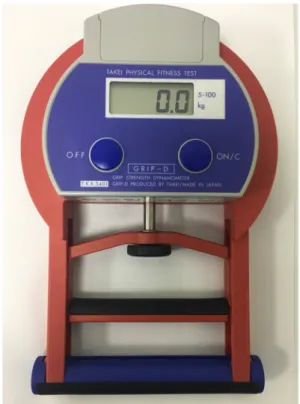
The measurement of hand grip strength of the left and right hands (kgf) was performed using a Smedley type dy- namometer (Takei, Japan) (Fig. 1).
The selection of the 2 most commonly used postures (sitting and standing) was based on the review of the re- lated literature.[4,6] In the sitting position, the elbow was flexed at 90 degrees with the shoulder attached to the tor- so, with the wrist maintaining a neutral posture (0 degrees) and the grip with maximal strength was measured (Fig. 2).
In a standing position, the shoulder was aligned with the torso, with the elbow fully extended, with the wrist main- taining a neutral position (0 degrees), and the grip with max- Table 1. Measurement protocol of hand grip strength by systematic review
Protocols No. of studies
Choice of the hand dynamometer
Smedley type 13
Hydraulic type 9
Digital type 1
NS 11
Calibration of the hand dynamometer
Only two studies descried, NS 32
Hand dominance
Both hands 14
Dominant hand 12
NS 8
Assessments and summary measures reported
Maximal grip strength from two or three attempts 20
Mean of two or three trials 4
NS 7
Body position
Standing 5
Sitting 2
NS 27
Position
Shoulder adduction and elbow flexed 90° 3
Fully extended elbow 3
Wrist and forearm neutral position 3
NS 25
Interval between measurements
30 sec 1
6 sec 1
NS 32
NS, not stated.
4. Calibration of hand dynamometer
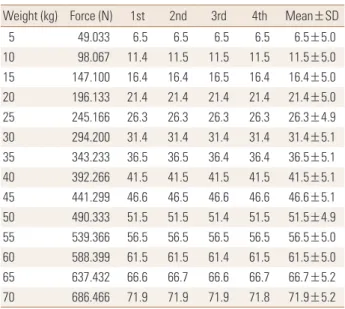
Using the deadweight force standard specified by the Korea Research Institute of Standards and Science (KRISS), 4 calibrations were performed with a unit of 5 kgf loaded up to 70 kgf (Fig. 4). A jig conforming to the deadweight force standard was applied so that the weight could be loaded consistently (Supplemental Fig. 1).
Fig. 1. Hand dynamometer used in the study.
Fig. 2. Sitting position.
Fig. 3. Standing position.
Fig. 4. Calibration by Actual Load Force Standard.
The measurements were taken 3 times on each side (left and right sides), and the interval between measurements was 30 sec.
5. Calculation of uncertainty
The uncertainty of the grip strength measurement value (Ur) is calculated by statistically analyzing the observed val- ues derived from measuring the 4 different measurement positions (Sitting_Rt, Sitting_Lt, Standing_Rt, Sitting_Lt), 3 times on each side (left and right hand) in each sitting po- sition and standing position.
The calibration uncertainty of the dynamometer (Us) is obtained by comparing the observed values obtained by the 4 measurements of the 14 actual load values of 5 kgf according to the deadweight force standard. The relative expansion uncertainty obtained through the procedure is 0.002%, and the correction uncertainty for each of the 4 measurements (Sitting_Rt, Sitting_Lt, Standing_Rt, Sitting_
Lt) is obtained from the average value and standard uncer- tainty: (standard uncertainty/measurement value)×2=
0.002%.[10]
Also, the result of the grip strength measurement is shown up to the second decimal place. Therefore, uncertainties arising from minimal resolution should be included in the uncertainty calculation. The uncertainty was calculated as- suming a minimum resolution of 0.1 kgf and a probability distribution as a square distribution.[10]
6. Measurement uncertainty
Relational expression of the model was based on Guide to the Expression of Uncertainty in Measurements and Eura- chem and the uncertainty from each of the factors was evaluated. Based on relational expression of the model, we selected 4 factors of uncertainty of measurement. Stan- dard uncertainty and combined uncertainty of measure- ment were also calculated. Standard uncertainties of cali- bration curve, internal quality control and inspector preci- sion were measured. Resolution of the equipment was de- cided to be ignored in the measurements of standard un- certainty. Mean value and standard deviation were calcu- lated after performing repeated measurements of grip
strength. Regression analysis was conducted. When mea- surements are from multiple entry values, the standard uncertainty of the results of the measurements is called combined standard uncertainty, which is acquired by us- ing the law of propagation of uncertainty. In order to ob- tain the coverage factor k, the effective degree of freedom of the combined standard uncertainty needed to be esti- mated. Expanded uncertainty was obtained by multiplying the calculated combined standard uncertainty and the in- clusion factor k equivalent to confidence level.
7. Statistical analysis
Basic calculation for the measurement uncertainty and correlation coefficient were performed using Microsoft Ex- cel 2010 software (Microsoft Corporation, Redmond, WA, USA).
RESULTS
According to the uncertainty calculation formula, stan- dard uncertainty and combined uncertainty for one healthy 30-year-old man were acquired.
Table 2 shows the repeated measurements of grip strength while maintaining traceability. Calibration measurements using a force standard meter are shown in Table 3. The com- bined uncertainty in the sitting position on the right side and the left side was 1.14 and 0.38, respectively, and the combined uncertainty in the standing position on the right
Table 2. Repetitive measurement value of hand grip strength
Position Hand 1st 2nd 3rd Mean±SD
Sitting Rt. 44.5 42.0 45.9 44.1±1.98
Lt. 46.9 48.1 47.0 47.3±0.67
Standing Rt. 52.5 51.3 51.7 51.8±0.61
Lt. 47.2 51.2 48.2 48.9±2.08
Table 3. Calibration measurement value using force standard meter Weight (kg) Force (N) 1st 2nd 3rd 4th Mean±SD
5 49.033 6.5 6.5 6.5 6.5 6.5±5.0
10 98.067 11.4 11.5 11.5 11.5 11.5±5.0
15 147.100 16.4 16.4 16.5 16.4 16.4±5.0
20 196.133 21.4 21.4 21.4 21.4 21.4±5.0
25 245.166 26.3 26.3 26.3 26.3 26.3±4.9
30 294.200 31.4 31.4 31.4 31.4 31.4±5.1
35 343.233 36.5 36.5 36.4 36.4 36.5±5.1
40 392.266 41.5 41.5 41.5 41.5 41.5±5.1
45 441.299 46.6 46.5 46.6 46.6 46.6±5.1
50 490.333 51.5 51.5 51.4 51.5 51.5±4.9
55 539.366 56.5 56.5 56.5 56.5 56.5±5.0
60 588.399 61.5 61.5 61.4 61.5 61.5±5.0
65 637.432 66.6 66.7 66.6 66.7 66.7±5.2
70 686.466 71.9 71.9 71.9 71.8 71.9±5.2
side and the left side was 0.35 and 1.20, respectively. The expanded uncertainty in the sitting position on the right side and the left side was 2.28 and 0.79, respectively, and the expanded uncertainty in the standing position on the right side and the left side was 0.71 and 2.41, respectively (k=2) (Table 4).
DISCUSSION
According to the uncertainty calculation formula, the standard uncertainty and combined uncertainty for the healthy 30-year-old man were determined. The combined uncertainty in the sitting position on the right side and the left side was 1.14 and 0.38, respectively, and the combined
uncertainty in the standing position on the right side and the left side was 0.35 and 1.20, respectively. The expanded uncertainty in the sitting position on the right side and the left side was 2.28 and 0.79, respectively, and the expanded uncertainty in the standing position on the right side and the left side was 0.71 and 2.41, respectively (k=2).
Fess [11] stated that, by utilizing an adjustable top work- bench, positioning blocks, force collar, standardized test weights, and a careful testing procedure, accurate and con- sistent measurements using the dynamometer can be achi- eved, and if calibrated correctly, the dynamometer can be a highly reliable assessment instrument.
Amaral et al.[12] compared the accuracy and precision of measurements of the grip strength of 3 different dyna- mometers. They stated that the Takei® and Transducer dy- namometers demonstrated similar grip strengths in the sample studied. The influence of the formats of handles on the measurement of grip strength was noted as well as the need for prior calibration of this type of instrument. Fess [11] also stated that dynamometers with a correlation co- efficient of 0.9994 or better and a difference between the means of 1.5 pounds (0.68 kg) or less do not need recali- bration.
Ha et al.[6] conducted a systematic review of the stan- dardized protocol by which the various methods for mea- suring hand grip strength are compared and analyzed. They stated that a standardized method is needed to enable more consistent measurement of grip strength, and found that other epidemiologic studies measured the hand grip strength in various ways. For consistent measurement and accurate diagnosis of sarcopenia, this study adopted the method suggested by Ha et al.[6] in which the subject uses the Sme- dley-type dynamometer while in a standing position, achi- eving maximum grip strength 3 times with both the left and right hands.
Roberts et al.[4] stated that the Jamar® hand dynamom- eter, which is the most widely cited instrument in the liter- ature, appears to be generally accepted as the gold stan- dard by which other dynamometers are evaluated and has the most normative data.
A standardized method for measurement of hand grip strength needs to be established and adopted. Setting up a standardized protocol for measuring hand grip strength can be explained in 2 ways: (1) correctly calibrating the dy- namometer; and (2) taking measurements such as posture Table 4. Uncertainty summary
Variables of measurement uncertainty Standard uncertainty Measurement uncertainty
Sitting
Rt. 1.14066
Lt. 0.38442
Standing
Rt. 0.35276684
Lt. 1.201850425
Calibration uncertainty 0.002%
Sitting
Rt. 0.0426
Lt. 0.0458
Standing
Rt. 0.0503
Lt. 0.0474
Resolution 0.0289
Combined uncertainty Sitting
Rt. 1.141825
Lt. 0.388216
Standing
Rt. 0.357505
Lt. 1.203132
Expanded uncertainty Sitting
Rt. 2.28
Lt. 0.79
Standing
Rt. 0.71
Lt. 2.41
Rt., right; Lt., left.
or the side of the hand of the subjects. This study suggests the presence of uncertainty in terms of the standardization of both the dynamometer and the protocol, and empha- sizes the need to standardize the method. A more appro- priate device for measurement of hand grip strength for sarcopenic patients also needs to be developed, consider- ing that most sarcopenic patients can barely sustain a hand grip in a consistent position or are often not able to apply grip strength for the sufficient amount of time need- ed for evaluation.
According to Robert et al.[4], the Jamar® hand dynamo- meter is the most commonly selected tool for assessment of grip strength, as it has the most normative data. They also state that an adequate number of epidemiologic stud- ies must be performed concerning hand size, hand domi- nance, position, joint condition, effort and encouragement, frequency of the test, time of day, and proficiency of the assessor in order to establish normative data to develop a dynamometer for sarcopenia patients.
In October 2016, the disease classification code (Interna- tional Classification of Diseases, 10th revision code) was prescribed for sarcopenia.[13] While this introduced the need for more established criteria for diagnosis, these cri- teria have not yet been clarified. Although hand grip strength measurement is the most important criterion in the diag- nosis of sarcopenia, this study shows a significant differ- ence between the actual measured value and the indicat- ed value. In the future, calibration and standardization work will be carried out for a large number of force measuring devices. Furthermore, various muscle strength measuring devices need to be standardized in order to accurately di- agnose and treat sarcopenia.
This study has several limitations. First, to calculate the uncertainty, only a representative process critical to quality control was applied in the process of measuring the hand grip strength. Using the uncertainty calculation formula provided, future studies will need to calculate the uncer- tainty with the standard values from all processes. Second, a direct comparison was difficult due to the limited avail- able medical data for calculating the uncertainty. Since the importance of standard values and calculation of uncer- tainty are emphasized in the medical and industrial sec- tors, these study findings will become increasingly more valuable.
grip strength was identified in this study, and a significant difference between measurement and indication was ob- served. For more precise establishment of an index for di- agnosis of sarcopenia, dynamometers will need to be cor- rectly calibrated to address such uncertainty.
ACKNOWLEDGMENTS
This research was supported (in part) by the Ministry of Trade, Industry and Energy (MTIE) through the Standard Reference Data Program.
REFERENCES
1. Lin DC, Chang JH, Shieh SJ, et al. Prediction of hand strength by hand injury severity scoring system in hand injured pa- tients. Disabil Rehabil 2012;34:423-8.
2. Eriksen CS, Garde E, Reislev NL, et al. Physical activity as intervention for age-related loss of muscle mass and func- tion: protocol for a randomised controlled trial (the LISA study). BMJ Open 2016;6:e012951.
3. Beseler MR, Rubio C, Duarte E, et al. Clinical effectiveness of grip strength in predicting ambulation of elderly inpa- tients. Clin Interv Aging 2014;9:1873-7.
4. Roberts HC, Denison HJ, Martin HJ, et al. A review of the measurement of grip strength in clinical and epidemio- logical studies: towards a standardised approach. Age Ageing 2011;40:423-9.
5. Petersen P, Petrick M, Connor H, et al. Grip strength and hand dominance: challenging the 10% rule. Am J Occup Ther 1989;43:444-7.
6. Ha YC, Hwang SC, Song SY, et al. Hand grip strength mea- surement in different epidemiologic studies using various methods for diagnosis of sarcopenia: a systematic review.
Eur Geriatr Med 2018;9:277-88.
7. Hamilton A, Balnave R, Adams R. Grip strength testing re- liability. J Hand Ther 1994;7:163-70.
8. Dodds RM, Syddall HE, Cooper R, et al. Global variation in grip strength: a systematic review and meta-analysis of normative data. Age Ageing 2016;45:209-16.
9. Beaton DE, O'Driscoll SW, Richards RR. Grip strength test- ing using the BTE work simulator and the Jamar dynamom- eter: a comparative study. Baltimore Therapeutic Equip- ment. J Hand Surg Am 1995;20:293-8.
surement: point/counterpoint. Clin Chem 2004;50:977-8.
11. Fess EE. A method for checking Jamar dynamometer cali- bration. J Hand Ther 1987;1:28-32.
12. Amaral JF, Mancini M, Novo Júnior JM. Comparison of three hand dynamometers in relation to the accuracy and pre- cision of the measurements. Rev Bras Fisioter 2012;16:216-
24.
13. Chen LK, Lee WJ, Peng LN, et al. Recent advances in sarco- penia research in Asia: 2016 update from the Asian work- ing group for sarcopenia. J Am Med Dir Assoc 2016;17:
767.e1-7.