Copyright © 2016 The Korean Society for Bone and Mineral Research
This is an Open Access article distributed under the terms of the Creative Commons Attribution Non-Commercial Li- cense (http://creativecommons.org/licenses/by-nc/3.0/) which permits unrestricted non-commercial use, distribu- tion, and reproduction in any medium, provided the original work is properly cited.
High Levels of Heavy Metals Increase the Prevalence of Sarcopenia in the Elderly Population
Jun-Il Yoo1, Yong-Chan Ha2, Young-Kyun Lee1, Kyung-Hoi Koo1
1Department of Orthopaedic Surgery, Seoul National University Bundang Hospital, Seoul National University College of Medicine, Seongnam;
2Department of Orthopaedic Surgery, Chung-Ang University College of Medicine, Seoul, Korea
Background: Despite increasing concern regarding health problems as a result of envi- ronmental pollutants, no association of toxic heavy metals with sarcopenia has been demonstrated in the general population. We investigated the association of heavy met- als, including lead, mercury and cadmium, with sarcopenia in the Korean population.
Methods: Participants included 344 males and 360 females older than 65 years based on data from the fourth and fifth Korea National Health and Nutritional Examination Surveys. Measurements of blood lead, mercury and cadmium levels were performed. To evaluate the cumulative effect of the three heavy metals, subjects were categorized into quartiles. Sarcopenia was defined according to the criteria for the Asia Working Group for Sarcopenia (AWGS) (SMI<5.4 kg/m2 in females and <7.0 kg/m2 in males). Results: Of 704 elderly persons (344 in males and 360 in females), prevalences of sarcopenia were 26.7% (92/344) in male and 7.5% (27/360) in female. Mean serum levels of lead in sarco- penia group were significantly higher than non-sarcopenia males (P=0.03). After adjust- ment for confounding factors, odds ratio for sarcopenia were increased with concentra- tion category of lead (P=0.005 and P<0.001), mercury (P=0.001 and P<0.001) and cadmium (P=0.010 and P<0.001) in males and females, respectively. Conclusions: This study demonstrates that high levels of blood lead, mercury and cadmium increase the prevalence of sarcopenia in both genders of elderly populations.
Key Words: Cadmium, Lead, Mercury, Metals heavy, Sarcopenia
INTRODUCTION
There has been growing concern worldwide regarding health problems result- ing from exposure to heavy metals, such as lead, mercury and cadmium. Because toxic heavy metals such as lead, mercury and cadmium are widely dispersed in the environment,[1-3] members of the general population, not only those in con- taminated areas, are exposed to low doses of heavy metals during their lifetime.
These heavy metals are accumulated in the human body due to no mechanism for active excretion of toxic heavy metals.[4]
Long-term exposures of heavy metals are known to associate with development and progression of bone disease.[5-7] Although pathogenic mechanisms of lead, mercury and cadmium are still investigating, these heavy metals are toxic to the human body by increasing oxidative stress. This mechanism is possible to explain Corresponding author
Yong-Chan Ha
Department of Orthopaedic Surgery, Chung-Ang University College of Medicine, 102 Heukseok-ro, Dongjak-gu, Seoul 06973, Korea
Tel: +82-2-6299-1577 Fax: +82-2-822-1710 E-mail: [email protected] Received: April 28, 2016 Revised: May 16, 2016 Accepted: May 16, 2016
No potential conflict of interest relevant to this article was reported.
The authors thank the Korea Centers for Disease Control and Prevention, who performed the KNHANES.
the relationship between exposure of heavy metals and various metabolic disorders such as hypertension and dia- betes.[8] Toxic heavy metals also are known to relate with increasing the risk of osteoporosis.[9-13] Several studies demonstrate that osteoporosis and sarcopenia have simi- lar pathophysiology and risk factors. Therefore, long-term accumulations of these heavy metals may be related with bone and muscles weakness.
Recently, sarcopenia in the elderly is representative dis- ease in muscular changes and an independent risk factor for falls, disability, morbidity, and mortality.[14-17] As path- ophysiologic mechanisms, sarcopenia generally results from a complex bone-muscle interaction in relation to chronic disease and aging. However, there was no report to study relationship of heavy metals and sarcopenia.
Therefore, the purpose of this cross sectional study was to assess the relationship of blood lead, mercury and cad- mium levels with sarcopenia and their cumulative effect on skeletal muscles in elderly populations using Korea Na- tional Health and Nutritional Examination Surveys.
METHODS
1. Ethics statement
This study’s protocol for analysis of the 2008-2011 Korea National Health and Nutritional Examination Surveys (KN- HANES) data was reviewed and approved by the Institu- tional Review Board (Approval No. 2008–04EXP-01-C, 2009–
01CON-03-C, 2010–02CON-21-C and 2011–02CON-06-C) of the Korea Centers for Disease Control and Prevention (KCDC). Informed consent was obtained from all of the par- ticipants when the 2008, 2009, 2010, and 2011 KNHANES were conducted.
2. Participants
This study was based on data from the KNHANES 2008- 2011, which was conducted by the Korea Ministry of Health and Welfare. KNHANES is a nationwide representative cross- sectional survey for the Korean population with a clustered, multistage, stratified, and rolling sampling design. KNHANES comprises three sections: a health interview, a health ex- amination, and a dietary survey. The survey data are col- lected via household interviews and by direct standardized physical examinations conducted in specially equipped mobile examination centers. We collected data from 37,753
participants from 2008 (n=9,744), 2009 (n=10,533), 2010 (n=8,958), and 2011 (n=8,518). Participants were exclud- ed if they were under the age of 65 years, or if data were not available to evaluate skeletal muscle mass, and serum lead, mercury and cadmium levels. After these exclusions, a total of 704 participants (males 344, females 360) were analyzed in the present study (Fig. 1).
3. Health examination survey
A health questionnaire was used to obtain information on age, gender, socioeconomic status, educational status, smoking status (current, former, or never smoker), alcohol intake and moderate physical activity and walking activity (yes or no). Moderate physical activity was 5 or more days of moderate-intensity activity for at least 30 min per day.
Walking physical activity was 5 or more days of walking for at least 30 min per day. Body weight and height were mea- sured in light clothing with no shoes, and body mass index (BMI) was calculated as weight (kg) divided by height squar- ed (m2). Information on diabetes as a potential confound- ing factor was examined through the health interview survey.
4. Measurement of lead, mercury and cadmium levels in whole blood
We measured total lead, mercury and cadmium levels in blood. For measurements of blood heavy metal levels, blood Fig. 1. Selection process of study subjects, KNHANES IV, V (2008- 2011). KNHANES, Korea National Health and Nutrition Examination Survey.
Total n=37,753 assessed for eligibility KNHANES IV-2 (2008, n=9,744) KNHANES IV-3 (2009, n=10,533) KNHANES V-1 (2010, n=8,958) KNHANES V-2 (2011, n=8,518)
Exclude those with age
<65 years (n=31,383) n=6,370, age ≥65 years
Men (n=2,647) Women (n=3,732)
n=704, age ≥65 years Men (n=344) Women (n=360)
E xclude those with no data of skeletal muscle mass, serum lead, mercury and cadmium levels
samples of individual subjects were collected in standard commercial evacuated tubes containing sodium heparin (Vacutainer; Becton, Dickinson & Co, Franklin Lakes, NJ, USA).
Graphite-furnace atomic absorption spectrometry with Zee- man background correction (AAnalyst 600; Perkin Elmer, Wilton, CT, USA) was used for measurement of blood lead and cadmium levels. A gold-amalgam collection me thod with a DMA-80 (Milestone, Sorisole, Italy) was used for mea- surement of blood mercury levels. All blood metal analyses were performed at the Neodin Medical Institute, a laborato- ry certified by the Korean Ministry of Health and Welfare.
5. Measurements of appendicular skeletal muscle mass and definition of sarcopenia
Body composition was measured by whole-body dual energy X-ray absorptiometry (DXA; QDR 4500A, Hologic Inc., Bedford, MA, USA). Bone mineral content, fat mass and lean soft-tissue mass were measured separately for each part of the body, including the arms and legs. The lean soft-tissue masses of the arms and legs were almost equal to the skeletal muscle mass. As absolute muscle mass correlates with height, the skeletal muscle mass index was calculated by the following formula: lean mass (kg)/height2 (m2), which is directly analogous to BMI (weight [kg]/height2 [m2]). Arm skeletal muscle mass index was defined as (arm lean mass [kg]/height2 [m2]). Leg skeletal muscle mass in- dex was defined as (leg lean mass [kg]/height2 [m2]). Ap- pendicular skeletal muscle mass index (SMI) was defined as the sum of the arm SMI and the leg SMI. Sarcopenia was defined according to the criteria for the Asia Working Group for Sarcopenia (AWGS) (SMI <5.4 kg/m2 in females and <7.0 kg/m2 in males).[18]6. Dietary intake measurement
Dietary intake was assessed by trained staff using a com- plete 24-hr recall method. Daily intake of energy and pro- tein were calculated by referencing nutrient concentrations in foods according to the Korean Food Composition Table.
7. Biochemical analyses
Blood and urine samples were collected the morning af- ter fasting for at least 8 hr. Collected samples were imme- diately refrigerated and transported in cold storage (4°C- 8°C) to the central laboratory of Neodin Medical Institute (Seoul, Korea) within 24 hr. Transported samples were sep-
arated into small aliquots and stored at -70°C.
Serum 25-hydroxy-vitamin D (25-[OH]D), parathyroid hormone, and alkaline phosphatase levels were measured using a gamma counter (1470 Wizard; Perkin Elmer, Turku, Finland), Hitachi Automatic Analyzer 7600 (Hitachi Ltd., To- kyo, Japan) and LIAISON (DiaSorin, Stillwater, MN, USA) with radioimmunoassay (25-hydroxy-vitamin D 125I RIA Kit;
DiaSorin), enzymatic (Pureauto S ALP; Sekisui Medical Co., Ltd, Tokyo, Japan) and chemiluminescence immunoassay (N-tact PTH Assay kit; DiaSorin), respectively.
8. Statistical analysis
Complex sample analysis was used in this study to cor- rect the distributions of the cluster sample regarding the primary sampling unit, covariance and significance to cor- respond with those of the general Korean population. All analyses were carried out using the sample weights of KN- HANES.
To compare means between the non-sarcopenia and sarcopenia groups, Student’s t-test was used and to com- pare proportions, the χ2 test was used. Multiple logistic re- gression analysis was conducted to calculate odds ratio and 95% confidence intervals (Cis) for the association be- tween frequency of binge drinking and the presence of sarcopenia after adjustment for demographic variables (age, waist circumference and BMI), which served as co- variates. Spearman correlation analysis was performed to investigate the association between heavy metals and variables. The geometric means with standard errors of heavy metals were calculated according to their quartiles.
For each heavy metal, subjects were categorized into quar- tiles. To evaluate the cumulative effect of the three heavy metals, each heavy metal was categorized into 10 groups using the 10th percentiles. The category number of each heavy metal (1-10 assigned to successively increasing cat- egories) was added to make the sum of heavy metal levels, producing a value of 3 to 30, which was itself categorized into quartiles, generating four groups.
Multivariate logistic regression analysis was used to cal- culate individual heavy metals or sum of heavy metal ef- fects on sarcopenia, adjusting for BMI, waist circumference, and energy intake. All statistical tests were two-tailed, and statistical significance was defined as P<0.05. The statisti- cal analysis was performed using SPSS 22.0 for Windows (SPSS Inc., Chicago, IL, USA).
RESULTS
1. Baseline characteristics of elderly
populations according to the presence of sarcopenia
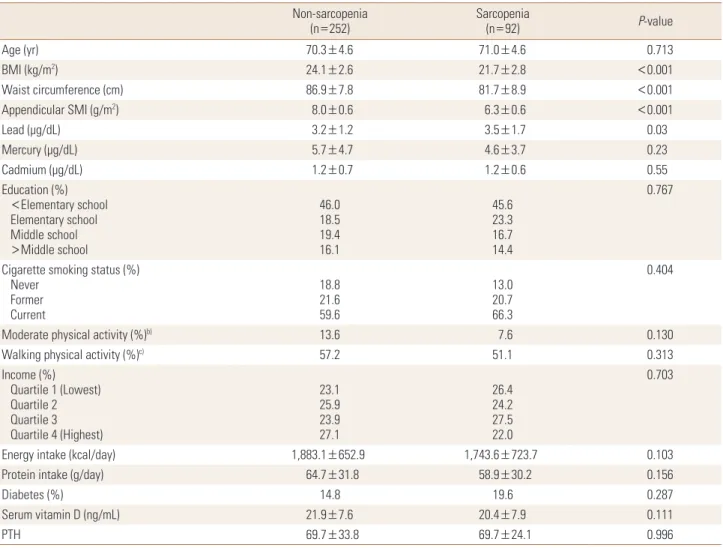
Seven hundreds four persons (344 in male and 360 in fe- male) were enrolled in this study. The mean age were 70.5 years (range, 65-87 years) in male and 72.5 years (range, 65-85 years) in females. Prevalences of sarcopenia were 26.7% (92/344) in male and 7.5% (27/360) in female and baseline values for the elderly populations according to the presence of sarcopenia are shown in Table 1 and 2. BMI (P<0.001), waist circumference (P<0.001), and appendic- ular SMI (P<0.001) differed significantly between non-sar-
copenia and sarcopenia in both genders. Mean serum lev- els of lead in sarcopenia group were significantly higher than non-sarcopenia males (P=0.03).
2. Correlations of lead, mercury and cadmium levels with clinical variables
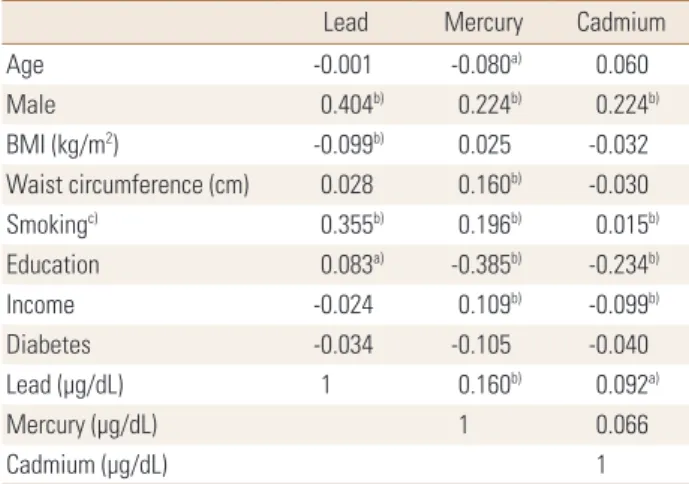
Most variables showed correlations with lead, mercury and cadmium levels. Males showed higher concentrations of blood lead, mercury and cadmium than females. Smok- ing was closely correlated with blood lead (r=0.355) and mercury (r=0.196) levels. Correlations were observed among the three heavy metals: r=0.160 and r=0.092 for lead and mercury, lead and cadmium, respectively (Table 3).
Table 1. Baseline characteristics and heavy metal levels of elderly males according to the presence of sarcopeniaa) Non-sarcopenia
(n=252) Sarcopenia
(n=92) P-value
Age (yr) 70.3±4.6 71.0±4.6 0.713
BMI (kg/m2) 24.1±2.6 21.7±2.8 <0.001
Waist circumference (cm) 86.9±7.8 81.7±8.9 <0.001
Appendicular SMI (g/m2) 8.0±0.6 6.3±0.6 <0.001
Lead (µg/dL) 3.2±1.2 3.5±1.7 0.03
Mercury (µg/dL) 5.7±4.7 4.6±3.7 0.23
Cadmium (µg/dL) 1.2±0.7 1.2±0.6 0.55
Education (%) <Elementary school Elementary school Middle school >Middle school
46.018.5 19.416.1
45.623.3 16.714.4
0.767
Cigarette smoking status (%) Never
Former Current
18.821.6 59.6
13.020.7 66.3
0.404
Moderate physical activity (%)b) 13.6 7.6 0.130
Walking physical activity (%)c) 57.2 51.1 0.313
Income (%) Quartile 1 (Lowest) Quartile 2 Quartile 3 Quartile 4 (Highest)
23.125.9 23.927.1
26.424.2 27.522.0
0.703
Energy intake (kcal/day) 1,883.1±652.9 1,743.6±723.7 0.103
Protein intake (g/day) 64.7±31.8 58.9±30.2 0.156
Diabetes (%) 14.8 19.6 0.287
Serum vitamin D (ng/mL) 21.9±7.6 20.4±7.9 0.111
PTH 69.7±33.8 69.7±24.1 0.996
a)All values are presented as means±standard deviation and percentage distribution of participant, as appropriate. Significance was compared between non-sarcopenia and sarcopenia using Student’s t-test or Chi-square test. The unweighted sample size was presented in the table, but the results pre- sented reflect the weighted sample. b)Moderate physical activity was 5 or more days of moderate-intensity activity of at least 30 min per day. c)Walking physical activity was 5 or more days of walking of at least 30 min per day.
BMI, body mass index; SMI, skeletal muscle index; BMD, bone mass density; PTH, parathyroid hormone.
3. Prevalence of sarcopenia according to heavy metal category
When no variable was adjusted, the prevalence of sarco- penia increased with increasing lead concentration cate- gory. However, the prevalence of sarcopenia decreased with increasing mercury and cadmium concentration category.
In male, after adjustment for BMI and waist circumference, odds ratios were increased with increasing lead (P=0.005), mercury (P=0.001) and cadmium (P=0.010) concentration.
However, the sum of heavy metals showed no association with the prevalence of sarcopenia (Table 4).
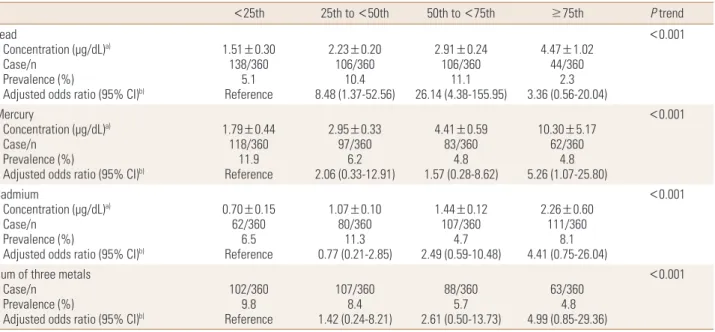
In female, after adjustment for BMI, waist circumference and energy intake, the odds ratios were increased with in- creasing concentration category of lead (P<0.001), mercu-
ry (P<0.001) and cadmium (P<0.001), and the sum of the three heavy metals (P<0.001) (Table 5).
DISCUSSION
Accumulations of heavy metals in human body are known to cause of public health problems. Of heavy metals, lead, mercury and cadmium are representative toxic metals and related researches have been reported. This study shows that odds ratio for sarcopenia, after adjustment, were in- creased with concentration category of lead (P=0.005 and P<0.001), mercury (P=0.001 and P<0.001) and cadmium (P=0.001 and P<0.001) in males and females, respectively.
Therefore, we found that elderly populations with sarcope- Table 2. Baseline characteristics and heavy metal levels of elderly females according to the presence of sarcopeniaa)
Non-sarcopenia
(n=333 ) Sarcopenia
(n=27) P-value
Age (yr) 70.1±4.2 70.8±5.5 0.413
BMI (kg/m2) 24.8±3.2 20.9±2.4 <0.001
Waist circumference (cm) 84.2±8.9 77.7±7.9 <0.001
Appendicular SMI (g/m2) 6.5±1.0 5.1±0.2 <0.001
Lead (µg/dL) 2.4±1.1 2.2±0.8 0.528
Mercury (µg/dL) 4.2±3.6 3.6±4.8 0.363
Cadmium (µg/dL) 1.5±0.7 1.5±0.6 0.949
Education (%) <Elementary school Elementary school Middle school >Middle school
82.57.9 7.62.1
77.811.1 7.43.7
0.879
Cigarette smoking status (%) Never
Former Current
91.91.2 6.9
81.53.7 14.8
0.175
Moderate physical activity (%)b) 14.2 3.7 0.123
Walking physical activity (%)c) 43.0 44.4 0.887
Income (%) Quartile 1 (Lowest) Quartile 2 Quartile 3 Quartile 4 (Highest)
25.427.2 23.923.5
14.822.2 25.937.0
0.354
Energy intake (kcal/day) 1,459.1±533.4 1,243.1± 450.8 0.046
Protein intake (g/day) 46.1±22.5 40.4±23.3 0.217
Diabetes (%) 18.1 11.1 0.570
Serum vitamin D (ng/mL) 18.7±7.8 20.3±8.0 0.309
PTH 70.0±32.6 64..9±20.3 0.424
a)All values are presented as means±SD and percentage distribution of participant, as appropriate. Significance was compared between non-sarcope- nia and sarcopenia using Student’s t-test or Chi-square test. The unweighted sample size was presented in the table, but the results presented reflect the weighted sample. b)Moderate physical activity was 5 or more days of moderate-intensity activity of at least 30 min per day. c)Walking physical activ- ity was 5 or more days of walking of at least 30 min per day.
BMI, body mass index; SMI, skeletal muscle index; BMD, bone mass density; PTH, parathyroid hormone.
Table 4. Adjusted odds ratios and 95% confidence intervals (CI) of prevalent sarcopenia in males according to heavy metal category
<25th 25th to <50th 50th to <75th ≥75th P trend
Lead Concentration (µg/dL)a) Case/n
Prevalence (%)
Adjusted odds ratio (95% CI)b)
1.57±0.24 38/344 Reference18.4
2.27±0.19 70/344 0.57 (0.26-1.23)28.6
2.93±0.22 104/344 0.96 (0.45-2.03)22.1
4.54±1.24 132/344 1.32 (0.47-3.68)31.8
0.005
Mercury
Concentration (µg/dL)a) Case/n
Prevalence (%)
Adjusted odds ratio (95% CI)b)
1.79±0.45 58/344 Reference39.7
2.95±0.29 79/344 1.39 (0.62-3.12)27.8
4.48±0.54 93/344 1.29 (0.61-2.75)25.8
9.69±5.44 114/344 3.25 (1.42-7.44)20.2
0.001
Cadmium
Concentration (µg/dL)a) Case/n
Prevalence (%)
Adjusted odds ratio (95% CI)b)
0.66±0.17 114/344 Reference26.3
1.07±0.09 95/344 0.92 (0.37-2.32)28.4
1.41±0.13 70/344 1.24 (0.52-2.94)27.1
2.33±0.69 65/344 1.42 (0.64-3.16)24.6
0.010
Sum of three metals Case/n
Prevalence (%)
Adjusted odds ratio (95% CI)b)
65/344 Reference24.6
83/344 0.54 (0.03-8.53)34.9
89/344 1.32 (0.08-22.48)21.3
107/344 26.2 0.69 (0.04-10.89)
0.745
a)Concentration, geometric mean±standard error. b)Adjusted for body mass index and waist circumference.
Table 3. Correlation coefficients between heavy metals and clinical variables
Lead Mercury Cadmium
Age -0.001 -0.080a) 0.060
Male 0.404b) 0.224b) 0.224b)
BMI (kg/m2) -0.099b) 0.025 -0.032
Waist circumference (cm) 0.028 0.160b) -0.030
Smokingc) 0.355b) 0.196b) 0.015b)
Education 0.083a) -0.385b) -0.234b)
Income -0.024 0.109b) -0.099b)
Diabetes -0.034 -0.105 -0.040
Lead (µg/dL) 1 0.160b) 0.092a)
Mercury (µg/dL) 1 0.066
Cadmium (µg/dL) 1
Age, BMI, waist circumference, blood lead, mercury and cadmium level are continuous variables.
a)P<0.05. b)P<0.01. c)Smoking status was divided into three categories:
never, former and current smokers.
BMI, body mass index.
nia had high serum levels of heavy metals in both genders.
Recently, sarcopenia, which is defined as the age-related decrease in muscle mass, have been widely investigated in a variety of fields because sarcopenia is known to a major cause of impairment of physical function, limitation of mo- bility, falls, osteoporosis, and hospitalization.[14-17,19,20]
Although its cause is not completely understood, sarcope- nia generally results from a complex bone-muscle interac-
tion in relation to chronic disease and aging.[21-23] There- fore, effects of heavy metals in bone metabolism are also important to muscular metabolism in elderly populations.
Of three representative heavy metals, relationship be- tween bone metabolism and lead are well established, which is accumulated more than 90% of lead in bone.[24, 25] Several human studies have demonstrated that lead interfered with bone formation and bone strength and in- crease the risk of osteoporosis and bone fracture.[26-29]
Campbell and Auinger [30] reported negative association between lead exposure and BMD and resulted in osteopo- rosis in adult humans using data from the Third National Health and Nutrition Examination Survey (NHANES III) in the USA. Several animal studies confirmed that lead affects osteoblast and osteoclast function.[11,31-33] In addition, mercury influences calcium metabolism and affects bone.
[10] Suzuki et al. [34] conducted an animal study to exam- ine the effects of heavy metals such as cadmium and mer- cury on calcium homeostasis, plasma calcium and calcito- nin in goldfish. They found that mercury influenced calci- um metabolism and affected bone. However, effect of Mer- cury in bone metabolism are still controversial.[35]
Recently, exposure to cadmium has attracted increasing attention as a risk factor for osteoporosis. Wallin et al.[13]
examined the associations between low-level cadmium exposure, from diet and smoking, and BMD and incident
Table 5. Adjusted odds ratios and 95% confidence interval (CI) of prevalent sarcopenia in females according to heavy metal category
<25th 25th to <50th 50th to <75th ≥75th P trend
Lead Concentration (µg/dL)a) Case/n
Prevalence (%)
Adjusted odds ratio (95% CI)b)
1.51±0.30 138/360 Reference5.1
2.23±0.20 106/360 8.48 (1.37-52.56)10.4
2.91±0.24 106/360 26.14 (4.38-155.95)11.1
4.47±1.02 44/360 3.36 (0.56-20.04)2.3
<0.001
Mercury
Concentration (µg/dL)a) Case/n
Prevalence (%)
Adjusted odds ratio (95% CI)b)
1.79±0.44 118/360 Reference11.9
2.95±0.33 97/360 2.06 (0.33-12.91)6.2
4.41±0.59 83/360 1.57 (0.28-8.62)4.8
10.30±5.17 62/360 5.26 (1.07-25.80)4.8
<0.001
Cadmium
Concentration (µg/dL)a) Case/n
Prevalence (%)
Adjusted odds ratio (95% CI)b)
0.70±0.15 62/360 Reference6.5
1.07±0.10 80/360 0.77 (0.21-2.85)11.3
1.44±0.12 107/360 2.49 (0.59-10.48)4.7
2.26±0.60 111/360 4.41 (0.75-26.04)8.1
<0.001
Sum of three metals Case/n
Prevalence (%)
Adjusted odds ratio (95% CI)b)
102/360 Reference9.8
107/360 1.42 (0.24-8.21)8.4
88/360 2.61 (0.50-13.73)5.7
63/360 4.99 (0.85-29.36) 4.8
<0.001
a)Concentration, geometric mean±standard error. b)Adjusted for body mass index, waist circumference and energy intake.
fractures in 936 elderly males from the Swedish cohort of the Osteoporotic Fractures in Men (MrOS) study. They found that even a relatively low cadmium level increases the risk of low BMD and osteoporosis-related fractures in elderly males. Engström et al.[9] investigated the association be- tween low environmental cadmium exposure and BMD and fracture risk in 2,688 elderly females using a Swedish Mammography cohort. They found that long-term, low- level exposure to Cd from food (mainly cereals, vegetables and potatoes), is associated with a higher risk of osteopo- rosis and fractures. Chen et al.[36] found a strong relation- ship between blood Cd level and decreased BMD, espe- cially in females. In addition, they determined that blood Pb level might be related to low BMD in males. They sug- gested that Cd and Pb might have an interactive effect on bone.
These effects of bone metabolism by accumulations of three heavy metals in human body are also affect in mus- cular mechanism and resulted in sarcopenia. Although no direct study between toxic heavy metals and sarcopenia has been conducted, the findings of this cross sectional study might be one of explanations of relationship between heavy metals and sarcopenia.
This study had several limitations. First, it did not evalu- ate the causality between heavy metal exposure and sar- copenia. Prospectively designed studies are mandatory to clarify this relationship. Second, because blood levels of
lead, mercury and cadmium differ among ethnic groups, this result might not be able to be extrapolated to other ethnic groups. Third, although lead, mercury and cadmium levels in blood are widely used and well-established bio- markers of exposure, and those blood concentrations may be correlated with chronic accumulated exposure in the general population with stable environmental exposure to heavy metals, they reflect mainly recent exposure. There- fore, they could underestimate cumulative exposure. In particular, we measured total mercury only in whole blood, including both the inorganic and organic forms, without differentiating other forms of mercury. Although total mer- cury in blood may be a reliable biomarker of mercury ex- posure, we could not infer which form is the major con- tributor to blood mercury and by which route exposure occurs. Fourth, we did not measure all environmental ex- posure to heavy metals; thus, the possibility of a positive relationship between other heavy metals with sarcopenia remains. Therefore, the relationship between heavy metals and sarcopenia should be verified in further longitudinal studies. Finally, although a definition of sarcopenia has been established, debate is ongoing. We used the definition of the AWGS group.[18]
In conclusion, this study demonstrates that high levels of blood lead, mercury and cadmium increase the preva- lence of sarcopenia in both genders of elderly populations.
REFERENCES
1. Henson MC, Chedrese PJ. Endocrine disruption by cadmi- um, a common environmental toxicant with paradoxical effects on reproduction. Exp Biol Med (Maywood) 2004;
229:383-92.
2. Kumar A, Scott Clark C. Lead loadings in household dust in Delhi, India. Indoor Air 2009;19:414-20.
3. Rosin A. The long-term consequences of exposure to lead.
Isr Med Assoc J 2009;11:689-94.
4. Mercier M. International approach of the assessment of chemical risks. J Hyg Epidemiol Microbiol Immunol 1990;
34:1-7.
5. Nogawa K, Kido T. Biological monitoring of cadmium ex- posure in itai-itai disease epidemiology. Int Arch Occup Environ Health 1993;65:S43-6.
6. Harada M. Minamata disease: methylmercury poisoning in Japan caused by environmental pollution. Crit Rev Toxi- col 1995;25:1-24.
7. Vig EK, Hu H. Lead toxicity in older adults. J Am Geriatr Soc 2000;48:1501-6.
8. Jomova K, Valko M. Advances in metal-induced oxidative stress and human disease. Toxicology 2011;283:65-87.
9. Engström A, Michaëlsson K, Vahter M, et al. Associations between dietary cadmium exposure and bone mineral density and risk of osteoporosis and fractures among wo- men. Bone 2012;50:1372-8.
10. Jin GB, Inoue S, Urano T, et al. Induction of anti-metallo- thionein antibody and mercury treatment decreases bone mineral density in mice. Toxicol Appl Pharmacol 2002;185:
98-110.
11. Klein RF, Wiren KM. Regulation of osteoblastic gene ex- pression by lead. Endocrinology 1993;132:2531-7.
12. Suzuki H, Asakawa A, Li JB, et al. Zinc as an appetite stimu- lator - the possible role of zinc in the progression of dis- eases such as cachexia and sarcopenia. Recent Pat Food Nutr Agric 2011;3:226-31.
13. Wallin M, Barregard L, Sallsten G, et al. Low-level cadmium exposure is associated with decreased bone mineral den- sity and increased risk of incident fractures in elderly men:
the MrOS Sweden study. J Bone Miner Res 2016;31:732- 41.
14. Vanitallie TB. Frailty in the elderly: contributions of sarco- penia and visceral protein depletion. Metabolism 2003;
52:22-6.
15. Lloyd BD, Williamson DA, Singh NA, et al. Recurrent and injurious falls in the year following hip fracture: a prospec- tive study of incidence and risk factors from the Sarcope- nia and Hip Fracture study. J Gerontol A Biol Sci Med Sci 2009;64:599-609.
16. Yoon HK, Park C, Jang S, et al. Incidence and mortality fol- lowing hip fracture in Korea. J Korean Med Sci 2011;26:1087- 92.
17. Frisoli A Jr, Chaves PH, Ingham SJ, et al. Severe osteopenia and osteoporosis, sarcopenia, and frailty status in commu- nity-dwelling older women: results from the Women’s Health and Aging Study (WHAS) II. Bone 2011;48:952-7.
18. Chen LK, Liu LK, Woo J, et al. Sarcopenia in Asia: consen- sus report of the Asian Working Group for Sarcopenia. J Am Med Dir Assoc 2014;15:95-101.
19. Kwon HJ, Ha YC, Park HM. Prevalence of sarcopenia in the Korean woman based on the Korean national health and nutritional examination surveys. J Bone Metab 2016;23:
23-6.
20. Rosenberg IH. Sarcopenia: origins and clinical relevance. J Nutr 1997;127:990s-1s.
21. Kaji H. Interaction between muscle and bone. J Bone Metab 2014;21:29-40.
22. Patil R, Uusi-Rasi K, Pasanen M, et al. Sarcopenia and os- teopenia among 70-80-year-old home-dwelling Finnish women: prevalence and association with functional per- formance. Osteoporos Int 2013;24:787-96.
23. Verschueren S, Gielen E, O'Neill TW, et al. Sarcopenia and its relationship with bone mineral density in middle-aged and elderly European men. Osteoporos Int 2013;24:87-98.
24. Alfvén T, Järup L, Elinder CG. Cadmium and lead in blood in relation to low bone mineral density and tubular pro- teinuria. Environ Health Perspect 2002;110:699-702.
25. Barry PS. A comparison of concentrations of lead in human tissues. Br J Ind Med 1975;32:119-39.
26. Hamilton JD, O'Flaherty EJ. Effects of lead exposure on skel- etal development in rats. Fundam Appl Toxicol 1994;22:
594-604.
27. Goyer RA, Epstein S, Bhattacharyya M, et al. Environmen- tal risk factors for osteoporosis. Environ Health Perspect 1994;102:390-4.
28. Escribano A, Revilla M, Hernández ER, et al. Effect of lead on bone development and bone mass: a morphometric, densitometric, and histomorphometric study in growing rats. Calcif Tissue Int 1997;60:200-3.
29. Potula V, Kleinbaum D, Kaye W. Lead exposure and spine bone mineral density. J Occup Environ Med 2006;48:556- 64.
30. Campbell JR, Auinger P. The association between blood lead levels and osteoporosis among adults--results from the third national health and nutrition examination sur- vey (NHANES III). Environ Health Perspect 2007;115:1018- 22.
31. Ma Y, Fu D, Liu Z. Effect of lead on apoptosis in cultured rat primary osteoblasts. Toxicol Ind Health 2012;28:136-46.
32. Pounds JG, Long GJ, Rosen JF. Cellular and molecular tox- icity of lead in bone. Environ Health Perspect 1991;91:17- 32.
33. Puzas JE, Sickel MJ, Felter ME. Osteoblasts and chondro-
cytes are important target cells for the toxic effects of lead.
Neurotoxicology 1992;13:783-8.
34. Suzuki N, Yamamoto M, Watanabe K, et al. Both mercury and cadmium directly influence calcium homeostasis re- sulting from the suppression of scale bone cells: the scale is a good model for the evaluation of heavy metals in bone metabolism. J Bone Miner Metab 2004;22:439-46.
35. Cho GJ, Park HT, Shin JH, et al. The relationship between blood mercury level and osteoporosis in postmenopausal women. Menopause 2012;19:576-81.
36. Chen X, Wang K, Wang Z, et al. Effects of lead and cadmi- um co-exposure on bone mineral density in a Chinese po- pulation. Bone 2014;63:76-80.