ISSN 2234-3806 • eISSN 2234-3814
https://doi.org/10.3343/alm.2019.39.6.561
POEMS Syndrome: Bone Marrow, Laboratory, and Clinical Findings in 24 Korean Patients
Hyoeun Shim , M.D.1*, Chang Ahn Seol , M.D.2*, Chan-Jeoung Park , M.D.2, Young-Uk Cho , M.D.2,
Eul-Ju Seo , M.D.2, Jung-Hee Lee, M.D.3, Dok Hyun Yoon , M.D.3, Cheol Won Suh, M.D.3, Sang Hyuk Park , M.D.4, and Seongsoo Jang , M.D.2
1Department of Laboratory Medicine, National Cancer Center, Goyang, Korea; Departments of 2Laboratory Medicine and 3Medicine, University of Ulsan College of Medicine and Asan Medical Center, Seoul, Korea; 4Department of Laboratory Medicine, University of Ulsan College of Medicine, Ulsan University Hospital, Ulsan, Korea
POEMS syndrome is a rare paraneoplastic syndrome, which includes polyneuropathy, or- ganomegaly, endocrinopathy, M-protein, and skin changes due to plasma cell (PC) neo- plasm. Diagnosis of this disease is challenging because of its rarity and complex clinical manifestations. We attempted to identify the key clinical features and characteristic bone marrow (BM) findings of POEMS syndrome, by reviewing the medical records and BM analyses of 24 Korean patients. Frequent clinical manifestations included polyneuropathy (100%), monoclonal gammopathy (100%), organomegaly (92%), extravascular volume overload (79%), and endocrinopathy (63%). The BM analyses revealed mild PC hyper- plasia (median PCs: 5.5%) and frequent megakaryocytic hyperplasia (88%), megakaryo- cyte clusters (88%), and hyperlobation (100%). Flow cytometry of BM aspirates using CD138/CD38/CD45/CD19/CD56 showed normal (67%, 4/6) or neoplastic PC immuno- phenotypes (33%, 2/6). A diagnosis of POEMS syndrome must be considered when a pa- tient suspected of having PC dyscrasia shows the above clinical presentation and BM findings.
Key Words: POEMS syndrome, Clinical manifestations, Plasma cell, Flow cytometry, Bone marrow
Received: December 20, 2018 Revision received: April 19, 2019 Accepted: May 28, 2019 Corresponding author:
Chan-Jeoung Park, M.D.
Department of Laboratory Medicine, University of Ulsan College of Medicine and Asan Medical Center, 88 Olympic-ro 43-gil, Songpa-gu, Seoul 05505, Korea Tel: +82-2-3010-4508
Fax: +82-2-478-0884 E-mail: [email protected]
* These authors contributed equally to this work.
POEMS syndrome is a rare paraneoplastic syndrome caused by plasma cell (PC) neoplasm, characterized by polyneuropathy, organomegaly, endocrinopathy, M-protein, and skin changes.
Other important clinical features include papilledema, extravas- cular volume overload, sclerotic bone lesions, Castleman dis- ease, thrombocytosis/erythrocytosis, elevated vascular endothe- lial growth factor (VEGF) levels, thrombotic diatheses, and ab- normal pulmonary function tests [1]. This disease comprises 1–2% of PC dyscrasias [2]. Although the pathogenesis is un- clear, disease activity may be related to increased VEGF levels [3].
Its diagnosis is challenging because this is a rare disease and the clinical presentation may be complex. This disease can be misdiagnosed as chronic inflammatory demyelinating polyradic- uloneuropathy, monoclonal gammopathy of undetermined sig- nificance (MGUS), or neuropathy and immunoglobulin light chain amyloid neuropathy [4, 5]. Correct diagnosis is important because the treatment regimens differ for these diseases, which can be critical for patient outcomes [6]. Although the character- istic bone marrow (BM) findings of POEMS have not been es- tablished, a recent study has reported PC rimming around lym- phoid aggregates and megakaryocytic hyperplasia in BM biop-
2017-03-16 https://crossmark-cdn.crossref.org/widget/v2.0/logos/CROSSMARK_Color_square.svg
© Korean Society for Laboratory Medicine This is an Open Access article distributed under the terms of the Creative Commons Attribution Non-Commercial License (http://creativecom- mons.org/licenses/by-nc/4.0) which permits unrestricted non-commercial use, distribution, and reproduction in any medium, provided the original work is properly cited.
sies of patients with POEMS syndrome [7]. We attempted to identify the key clinical features and characteristic BM findings of POEMS syndrome. To the best of our knowledge, this is the first comprehensive report on clinical and BM findings for such patients in Korea. This study was approved by the Institutional Review Board of Asan Medical Center, Seoul, Korea (IRB-2015- 0328).
We retrospectively reviewed the medical records and BM anal- yses of 24 patients diagnosed as having POEMS syndrome at Asan Medical Center between December 2002 and July 2016.
Their median age was 55 (range: 24–84) years, and the male- to-female ratio was 1.3:1. Clinical factors, such as polyneuropa- thy (peripheral and sensory or sensorimotor), extravascular vol- ume overload (edema, ascites, or pleural effusion), organomeg- aly (lymphadenopathy, splenomegaly, or hepatomegaly), endo- crinopathy (hypothyroidism, adrenal insufficiency, diabetes mel- litus, or hypogonadism), skin changes (hyperpigmentation or hypertrichosis), and associated laboratory and imaging analyses findings were extracted from the medical records and analyzed considering the diagnostic criteria of POEMS syndrome [1]. Four patients who lacked data such as X-ray scans were included because they were highly suspicious of POEMS syndrome clini- cally.
BM analysis included peripheral blood smear, BM aspirate smear, touch print, clot section, and biopsy section. The periph- eral blood smear, BM aspirate smear, and touch print were pre- pared by Wright-Giemsa stain, and the clot and biopsy sections were prepared by hematoxylin and eosin stain. Immunohisto- chemistry (IHC) stains were performed on the clot or biopsy sec- tions using monoclonal antibodies specific for CD138, κ, and λ (DAKO, Glostrup, Denmark), according to routine protocols for automated IHC using Ventana Benchmark XT (Ventana Medical Systems, Tucson, AZ, USA). We performed additional IHC stains on the remaining BM biopsy or clot sections for patients without IHC findings and reviewed the BM analyses again. Visual detec- tion of a monoclonal band following serum protein electrophore- sis (PEP) was used to confirm the presence of monoclonal pro- tein. The percentage of monoclonal protein was quantified using a densitometer, and the absolute concentrations of monoclonal protein (g/L) were calculated from total serum protein concen- trations. The five color-flow cytometric BM aspirate findings us- ing CD138/CD38/CD19/CD45/CD56 were included for six pa- tients. Quantitative data were summarized as median (range) or count and percentage.
The clinical, laboratory, and BM findings are summarized in Tables 1 and 2. The most frequent clinical manifestations in-
Table 1. Clinical findings of 24 Korean patients with POEMS syn- drome
Clinical manifestation N %
Polyneuropathy 24 100
Organomegaly 22 92
Lymphadenopathy 21 88
Splenomegaly 18 75
Hepatomegaly 11 46
Extravascular volume overload 19 79
Edema 15 63
Ascites 11 46
Pleural effusion 9 38
Endocrinopathy 15 63
Hypothyroidism 15 63
Adrenal insufficiency 3 13
Diabetes mellitus 2 8
Hypogonadism 2 8
Skin change 11 46
Hyperpigmentation 11 46
Hypertrichosis 4 17
Osteosclerosis 11 46
Hematologic abnormalities
Polycythemia 1 4
Anemia 11 48
Leukocytosis 2 8
Leukopenia 3 13
Thrombocytosis 7 29
Thrombocytopenia 6 25
Monoclonal gammopathy 24 100
IgA λ 10 42
IgG λ 8 33
Free λ 6 25
cluded polyneuropathy, monoclonal gammopathy with λ clonal- ity, organomegaly, extravascular volume overload, endocrinopa- thy, skin changes, and osteosclerotic changes of the bone based on the X-ray or computed tomography scan. Anemia was the most common hematologic abnormality.
The patients showed variable complete blood counts. M-pro- teins on serum PEP were found in 18 patients (75%). Serum and urine immunofixation electrophoresis (IFE) revealed mono- clonal gammopathy in 22 patients (IgA λ type in 10 patients, IgG λ type in eight patients, and free λ type in four patients).
One of the two patients who showed no restriction in serum or
urine IFE showed a λ type monoclonal band in cerebrospinal fluid immunoelectrophoresis, and the other patient showed in- creased serum free κ (34.8 mg/L) and λ chain (86.6 mg/L) and λ clonality in IHC of the BM biopsy. Urine PEP or IFE showed Bence-Jones proteinuria in 13 patients (54%). Serum VEGF lev- els were checked in four patients, with a median level of 4,070 pg/mL (3,330–6,230 pg/mL; reference range: <500 pg/mL).
In BM analyses, the median proportion of PCs was 5.5% (0.6–
23.4) on BM aspirate smears and 8.0% (3.0–81.0; N=17) in the BM biopsies or clot sections (CD138). PC hyperplasia (>3%
in BM nucleated cells) was found in 19 patients (79%), PC clus- ters (at least three PCs localized in a cluster) were found in all patients (100%), and PC atypia, such as multinucleation, was found in 13 patients (54%). Lymphoid aggregates were found in
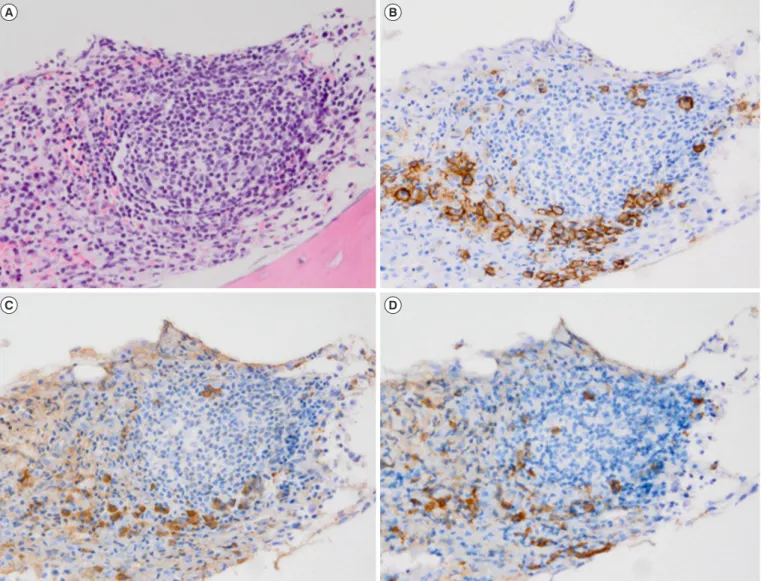
three patients (13%), and PC rimming around the lymphoid ag- gregate was found in two patients (8%), which did not show any restricted λ or κ clonality (Fig. 1). The myeloid:erythroid (M:E) ratio and cellularity were variable. Megakaryocytic hyperplasia ( >4/high-power field [HPF]) was found in 20 patients (83%), including a slight increase (4–6/HPF) in 13 patients (54%) and an overt increase ( >6/HPF) in seven patients (29%). Mega- karyocyte clusters (at least three megakaryocytes localized in a cluster) were found in 21 patients (88%), megakaryocyte hyper- lobation (>8 lobes in the nucleus) in all patients (100%), and megakaryocyte atypia, such as separated nuclei, in five patients (21%).
Flow cytometry of the BM aspirate from six patients revealed a neoplastic immunophenotype (CD138+/CD38+/CD19-/CD45-/
CD56+) in two patients and a normal immunophenotype (CD138+/
CD38+/CD19+/CD45+/CD56-) in the other four patients. The cytogenetic analyses of the BM aspirates (N =22) showed no chromosomal abnormalities, except for loss of the Y chromo- some in one patient, which was probably an age-related event.
A lymph node biopsy was performed in six patients:Castleman disease was found in two patients (33%), while the other pa- tients showed reactive hyperplasia.
Management of POEMS syndrome depends on the presence of disseminated BM involvement [8]. BM analysis can be re- quested to evaluate the extent of POEMS syndrome, but it can also be requested when MGUS needs to be ruled out or a workup for other myeloproliferative conditions, such as erythrocytosis or thrombocytosis, needs to be conducted.
Plasmacytosis (median 5.5% in BM nucleated cells) was mild on BM aspirate smears, consistent with previous reports [7, 9].
The PC counts on BM aspirate smears were lower than that in BM biopsies or clot sections, implying that BM aspirates can be diluted with peripheral blood during the procedure. Lymphoid aggregates (13%, 3/24) were infrequent, and PC rimming around the lymphoid aggregate was polyclonal (8%, 2/24), compared with a previous report in which approximately half of the patients showed monoclonal and polyclonal PC rimming around the lym- phoid aggregates [7]. The unusual distribution of clonal PCs rel- ative to the lymphoid aggregates may be the result of immune dysfunction or dysregulation. This finding is unique to POEMS among the PC dyscrasias; various cytokines, other than para- protein, surrounding the clonal PCs are hypothesized to cause the characteristic distribution [3, 10, 11].
VEGF appears to play a pathogenic role in this disorder by in- creasing vascular permeability, angiogenesis, and monocyte/
macrophage migration, potentially resulting in arterial oblitera- Table 2. Laboratory and BM findings of 24 Korean patients with
POEMS syndrome
Laboratory and BM findings Median or N (Range) or (%) CBC
WBC 6.2×10⁹/L (2.5–14.2)
Hb 120 g/L (80–167)
Platelet 274×109/L (41–739)
M protein
Serum protein electrophoresis 2 g/L (0.0–1.5)
Serum FLC ratio (κ/λ) 0.67 (0.01–1.04)
Serum κ FLC 45.6 mg/L (18.7–261)
Serum λ FLC 78.8 mg/L (26.1–5,310)
BM findings
M:E ratio 2.2:1 (1.0–6.2:1)
Cellularity 47.5% (20–90)
PCs (BM aspirate) 5.5% (0.6–23.4)
PCs (BM biopsy or clot, CD138) 8.0% (3.0–81.0)
Megakaryocyte number 4.8/HPF (1.5–9.0)
Megakaryocytic hyperplasia 20/24 (83)
Megakaryocytic clustering 21/24 (88)
Megakaryocytic hyperlobation 24/24 (100)
Megakaryocytic atypia 5/24 (21)
PC hyperplasia 19/24 (79)
PC cluster 24/24 (100)
PC atypia 13/24 (54)
PC rimming 2/24 (8)
Lymphoid aggregates 3/24 (13)
Abbreviations: BM, bone marrow; FLC, free light chain; HPF, high-power field; CBC, complete blood count; WBC, white blood cell; M:E, myeloid:ery- throid ratio; PC, plasma cell.
Fig. 1. Bone marrow finding of PCs rimming around a lymphocyte aggregate. (A) The lymphocytic aggregates show a germinal center (H&E stain, ×400). PCs form a rim around the lymphocytic collection detected by immunohistochemistry of (B) CD138, (C) κ, and (D) λ.
Abbreviations: H&E, hematoxylin and eosin; PC, plasma cell.
A
C
B
D
tion, which is responsible for several findings such as organo- megaly, edema, and skin changes in patients with POEMS [10].
Platelets contain numerous proteins that regulate angiogenesis and are a major source of VEGF [12]; megakaryocytic hyperpla- sia might be related to increased VEGF levels.
Additional characteristic BM findings included megakaryo- cytic hyperlobation (100%), cluster formation (87%), and hy- perplasia (83%). These findings were differentiated from myelo- proliferative neoplasm (MPN) due to negative JAK2 V617F [7].
In our study, only two patients had a JAK2 analysis, and the findings were wild-type. Increased VEGF level may affect the maturation and redistribution of megakaryocytes in BM [13].
However, megakaryocytic hyperplasia did not lead to peripheral thrombocytosis in our study, as only 29% showed peripheral
thrombocytosis compared with 83% with megakaryocytic hy- perplasia in BM.
Our study showed 100% λ clonality, similar to the findings of Dispenzieri [8] (100%), Nakanishi, et al. [14] (95%), and Li, et al. [9] (97%). Monoclonal gammopathy is almost always restrict ed to λ type monoclonal protein. However, the pathognomonic rela- tionship is yet to be elucidated.
In summary, the characteristic BM findings of POEMS syn- drome are mild plasmacytosis and megakaryocytic hyperplasia, hyperlobation, and cluster formation. POEMS syndrome should be considered when a BM analysis is requested for a patient showing clinical symptoms with monoclonal gammopathy.
Authors’ Disclosures of Potential Conflicts of Interest
No potential conflicts of interest relevant to this article were re- ported.
ORCID
Hyoeun Shim https://orcid.org/0000-0002-8985-0882 Chang Ahn Seol https://orcid.org/0000-0001-8470-7633 Chan-Jeoung Park https://orcid.org/0000-0003-4396-8348 Young-Uk Cho https://orcid.org/0000-0002-4403-8989 Eul-Ju Seo https://orcid.org/0000-0002-8247-3746 Dok Hyun Yoon https://orcid.org/0000-0002-8289-3548 Sang Hyuk Park https://orcid.org/0000-0001-7284-6273 Seongsoo Jang https://orcid.org/0000-0002-0045-1747
REFERENCES
1. Dispenzieri A. POEMS syndrome. Blood Rev 2007;21:285-99.
2. Swerdlow SH, Campo E, et al. eds. WHO classification of tumors of hae- matopoietic and lymphoid tissues. Lyon: IARC Press, 2017.
3. Soubrier M, Dubost JJ, Serre AF, Ristori JM, Sauvezie B, Cathebras P, et al. Growth factors in POEMS syndrome: evidence for a marked in- crease in circulating vascular endothelial growth factor. Arthritis Rheum 1997;40:786-7.
4. Chacko JM and Spinner WD. Paraproteinemic neuropathies. J Clin Neu-
romuscul Dis 2006;7:185-97.
5. Lozeron P and Adams D. Monoclonal gammopathy and neuropathy.
Curr Opin Neurol 2007;20:536-41.
6. Dispenzieri A. POEMS syndrome: update on diagnosis, risk-stratifica- tion, and management. Am J Hematol 2012;87:804-14.
7. Dao LN, Hanson CA, Dispenzieri A, Morice WG, Kurtin PJ, Hoyer JD.
Bone marrow histopathology in POEMS syndrome: a distinctive combi- nation of plasma cell, lymphoid, and myeloid findings in 87 patients.
Blood 2011;117:6438-44.
8. Dispenzieri A. POEMS syndrome: 2014 update on diagnosis, risk-strati- fication, and management. Am J Hematol 2014;89:214-23.
9. Li J, Zhou DB, Huang Z, Jiao L, Duan MH, Zhang W, et al. Clinical char- acteristics and long-term outcome of patients with POEMS syndrome in China. Ann Hematol 2011;90:819-26.
10. Gherardi RK, Bélec L, Fromont G, Divine M, Malapert D, Gaulard P, et al. Elevated levels of interleukin-1 beta (IL-1 beta) and IL-6 in serum and increased production of IL-1 beta mRNA in lymph nodes of pa- tients with polyneuropathy, organomegaly, endocrinopathy, M protein, and skin changes (POEMS) syndrome. Blood 1994;83:2587-93.
11. Feinberg L, Temple D, de Marchena E, Patarca R, Mitrani A. Soluble immune mediators in POEMS syndrome with pulmonary hypertension:
case report and review of the literature. Crit Rev Oncog 1999;10:293- 302.
12. Koga H, Tokunaga Y, Hisamoto T, Sujaku K, Mitsuyama K, Matsuo K, et al. Ratio of serum vascular endothelial growth factor to platelet count correlates with disease activity in a patient with POEMS syndrome. Eur J Intern Med 2002;13:70-4.
13. Pitchford SC, Lodie T, Rankin SM. VEGFR1 stimulates a CXCR4-depen- dent translocation of megakaryocytes to the vascular niche, enhancing platelet production in mice. Blood 2012;120:2787-95.
14. Nakanishi T, Sobue I, Toyokura Y, Nishitani H, Kuroiwa Y, Satoyoshi E, et al. The Crow-Fukase syndrome: a study of 102 cases in Japan. Neu- rology 1984;34:712-20.