ISSN 2234-3806 • eISSN 2234-3814
https://doi.org/10.3343/alm.2021.41.4.439 www.annlabmed.org 439
Ann Lab Med 2021;41:439-442
https://doi.org/10.3343/alm.2021.41.4.439
Letter to the Editor
Clinical Microbiology
Human Pneumonia Caused by Bordetella hinzii: First Case in Asia and Literature Review
Dongke Chen , M.A.1,*, Han Wang , M.D.2,*, Xianlei Lu , M.A.3, Yao Cui , M.A.4, Xiaohan Ma , M.A.4, Jing Lou , M.M.4 and Haijian Zhou , M.M.4
1Department of Laboratory Medicine, Beijing Hospital, National Center of Gerontology; Institute of Geriatric Medicine, Chinese Academy of Medical Sciences, Beijing, the People’s Republic of China; 2Department of Clinical Diagnostic Centre, the Fifth Medical Centre, Chinese PLA (People’s Liberation Army) General Hospital, Beijing, The People’s Republic of China; 3Chengdu Fifth People’s Hospital, Chengdu, The People’s Republic of China; 4National Institute for Communicable Disease Control and Prevention, Chinese Center for Disease Control and Prevention and State Key Laboratory for Infectious Disease Prevention and Control, Beijing, The People’s Republic of China
Dear Editor,
The genus Bordetella comprises 12 species, some of which cause human diseases. Bordetella hinzii widely exists in poultry and rodents and has occasionally been reported in humans wherein it has been confirmed as a causative agent of pulmo
nary and digestive infection, and bacteremia, almost invariably in patients with immunodeficiency [1,2]. Only 11 cases of hu
man B. hinzii infection have been reported to date, and none has been found in Asia (Table 1). However, the clinical and epi
demiologic characteristics of B. hinzii infection remain to be de
termined. Here, we describe the first Asian case of B. hinzii pneu
monia to highlight the pathogenicity of this bacterium. As this case was identified during a routine surveillance organized by the Centers for Disease Control and Prevention, the need for ethical approval for the present study was exempted by the In
stitutional Review Board of Chengdu Fifth People’s Hospital, China; verbal consent was obtained from the patient for case presentation.
A 67yearold woman was admitted to the Neurological Inten
sive Care Unit in Chengdu Fifth People’s Hospital on January 8, 2013 because of fatigue and loss of the abilities to stand, walk, and speak clearly. Computed tomography (CT) showed sponta
neous intracerebral hemorrhage involving the ventricles of the brain. The patient had been suffering from type 2 diabetes in the past year but had no other remarkable medical history. After admission, she received symptomatic treatment, supplementary fluids, and antihypertensive treatment. She developed fever on the third day. Her vital signs included a temperature of 38°C;
blood pressure, 148/70 mm Hg; pulse, 84 beats/min; and re
spiratory rate, 27 breaths/min. Routine blood examination showed a leukocyte count of 9.27×10⁹/L; neutrophil percentage, 88.1%, lymphocyte percentage, 6.5%; platelet count, 91 ×109/L; and high sensitive Creactive protein level, 28.9 mg/L. Chest CT ex
amination showed scattered turbidity in both lungs. Therefore, a pulmonary infection was suspected and intravenous cefmetazole (1.5 g daily) was empirically selected and initiated. The patient’s
Received: July 3, 2020
Revision received: September 4, 2020 Accepted: January 6, 2021
Corresponding author: Jing Lou, M.M.
National Institute for Communicable Disease Control and Prevention, Chinese Center for Disease Control and Prevention, No. 155 Changbai Road, Beijing 102206, People’s Republic of China
Tel: +861058900713, Fax: +861058900700, Email: [email protected] Co-corresponding author: Haijian Zhou, M.M.
National Institute for Communicable Disease Control and Prevention, Chinese Center for Disease Control and Prevention, No. 155 Changbai Road, Beijing 102206, People’s Republic of China
Tel: +861058900784, Fax: +861058900700, Email: [email protected]
*These authors contributed equally to this study.
© Korean Society for Laboratory Medicine
This is an Open Access article distributed under the terms of the Creative Commons Attribution NonCommercial License (https://creativecommons.org/licenses/bync/4.0) which permits unrestricted noncommercial use, distribution, and reproduction in any medium, provided the original work is properly cited.
1 / 1 CROSSMARK_logo_3_Test
2017-03-16 https://crossmark-cdn.crossref.org/widget/v2.0/logos/CROSSMARK_Color_square.svg
Chen D, et al.
First B. hinzii pneumonia case in Asia
440 www.annlabmed.org https://doi.org/10.3343/alm.2021.41.4.439 Table 1. Previous cases of human infection caused by Bordetella hinzii YearCountryClinical diagnosisGen derAgeEpidemiologyImmunosuppression status Method of strain identificationAntibiotics treatedOutcomeRefer ence 1957FranceNRNRNRNRNRIdentification of new species through PAGE of wholecell proteins, Fatty acid methyl ester analysis, DNADNA and DNArRNA hybridization
NRNR[2] 1992SwitzerlandPulmonary symptomsMale51NRNoneAPI 20 NFT (NE) system, alkali production from malonate and PAGE of wholecell proteins
Amoxicillinclavulanic acid, ciprofloxacinRecovered[3] 1994United StatesBacteremiaMale42NRImmunosuppressed (AIDS)API NFT, wholecell fatty acid analysis and DNADNA hybridizationVancomycin; ceftriaxone; ceftriaxone, rifampinRecovered[4] 1999United StatesCholestasis and bacteremiaMale69Had attended a cookout at a farm 2 weeks before admission
NoneTraditional biochemical testing and 16S rRNA gene sequence analysisAmpicillinsulbactam, cefotetan; ampicillin, gentamicin, metronidazole; ticarcillin sulbactam, ciprofloxacin
Died[5] 2000SpainRespiratory tract infectionNRNRNo avian exposureImmunosuppressed (AIDS)Traditional biochemical testing and 16S rRNA gene sequence analysisNRNR[6] 2001GermanyChronic cholangitisMale29NRImmunosuppressed (liver transplant recipient)Traditional biochemical testing and 16S rRNA gene sequence analysisPiperacillintazobactam, gentamicin; amphotericin B, flucytosine, vancomycin, and meropenem
Died[7] 2007United KingdomFlulike symptomsMale79NRImmunosuppressed (myelodysplastic syndrome)Genotypic methods and gene sequence analysis (ompA, 16S rRNA gene) Amoxicillin, clavulanic acid; vancomycin, ceftazidimeRecovered[8] 2008United StatesFevers, fullbody rash, fatigue; respiratory distress
Female36NRImmunosuppressed (Epstein–Barr virus viremia and lymphoma)Cellular fatty acid analysis and 16S rRNA gene sequence analysisAmoxicillinclavulanic acid, oxacillin, vancomycin, trimethoprim– sulfamethoxazole, doxycycline, linezolid, meropenem, itraconazole.
Died[9] 2013SpainRespiratory symptomsFemale85NRNRMALDITOF–MS; 16S rRNA gene sequence analysisAmoxicillinclavulanateUnclear[10] 2013FrancePulmonary infectionMale43Avian exposureImmunosuppressed (leukemia, diabetes, vascular hypertension, and nonsymptomatic chronic bronchiectasis before the allograft)
MALDITOFMS; 16S rRNA gene sequence analysisCiprofloxacin; trimethoprim/ sulfamethoxazole; piperacillin/ tazobactam, ciprofloxacin; vancomycin
Recovered[1] 2014FranceChronic obstructive pulmonary disease
Male74No recent exposure to pets and poultry Immunosuppressed (vascular hypertension, dyslipidemia, prostate cancer, ischemic heart disease)
MALDITOFMS; 16S rRNA gene sequence analysisPiperacillin/tazobactam, vancomycinRecovered[1] 2013ChinaPneumoniaFemale67No avian exposureCerebral hemorrhageMALDITOFMS; 16S rRNA gene sequence analysisCefmetazoleRecoveredThis study Abbreviations: NR, not reported; PAGE, polyacrylamide gel electrophoresis; AIDS, acquired immune deficiency syndrome; MALDITOF–MS, matrixassisted laser desorption/ionizationtime of flight mass spectrometry; rRNA, ribosomal RNA.
Chen D, et al.
First B. hinzii pneumonia case in Asia
https://doi.org/10.3343/alm.2021.41.4.439 www.annlabmed.org 441
condition improved, and she was discharged on January 15, 2013.
The blood culture result was negative. Direct gram staining and microscopic examination of the sputum revealed gramnegative rods in the neutrophils. After 18 hours incubation at 35°C, col
orless colonies were detected on blood, chocolate, and MacCo
nkey agar plates, which were all gramnegative rods. One isolate from each plate was selected for identification. Initial identifica
tion performed using the API 20NE strip (bioMérieux, Lyons, France) classified the isolate as Bordetella avium with a 96.6%
confidence, which could not be used to distinguish species in the genus Bordetella. The selected isolate from the blood agar plate, designated strain A2799, was subject to further identifica
tion using matrixassisted laser desorption/ionization timeofflight mass spectrometry (MALDITOFMS) (Bruker, Leipzig, Germany) and 16S rRNA gene sequencing. Both methods classified this strain as B. hinzii. Antibiotic susceptibility testing was performed using the KirbyBauer method. The strain was found to be sus
ceptible to the most commonly used antibiotics, and our patient recovered well through therapy with cefmetazole, which is simi
lar to cefoxitin and ceftazidime, to which the strain was found to be susceptible.
Furthermore, the wholegenome sequence of A2799 (Gen
Bank accession no. SRP081450) was obtained. Phylogenetic trees were constructed using a distance matrix based on the
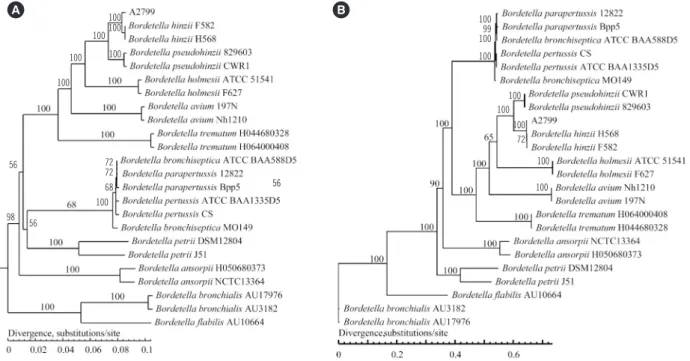
Fig. 1. Phylogenetic trees based on wholegenome sequencing and analysis. (A) Phylogenetic tree based on the gene content (pange
nome tree). (B) Phylogenetic tree based on 810 coregenome single nucleotide polymorphisms (coregenome tree).
A B
presence or absence of genes (pangenome tree) and single nucleotide polymorphisms in the core genome (coregenome tree) for A2799 and 27 other Bordetella strains (Fig. 1). In both trees, A2799 clustered with two B. hinzii strains and with B. pseu
dohinzii, further suggesting that A2799 is B. hinzii. The three
“classical” Bordetella species, B. pertussis, B. parapertussis, and B. bronchiseptica, were closely associated in both the pan
genome and coregenome phylogenetic trees, indicating that these three species were derived from a recent common ances
tor (Fig. 1).
Our patient had been suffering from cerebral hemorrhage but had no history of physical injury or trauma on admission. In pa
tients with B. hinzii infections, the medical history often reveals a recent exposure to poultry. However, there was a history of avian exposure for this patient. Thus, the exact nature of the ex
posure in our patient remains unknown.
The identification of B. hinzii was inconclusive or inaccurate with a biochemical identification system, consistent with a previ
ous case [1]. 16S rRNA gene sequencing and routine MALDI
TOFMS are reliable for identifying B. hinzii [1]. Furthermore, wholegenome sequencing is increasingly being applied to iden
tify clinical microorganisms. Therefore, it is likely that some spe
cies that could not previously be identified by traditional biochem
ical methods will increasingly be discovered. B. hinzii infection is rare but potentially fatal. However, antibiotic therapy often re
100100 100 100 100 100
56 72
72 68 100 98 56
56
10099 100 100
100 100
100
100 100 72
Chen D, et al.
First B. hinzii pneumonia case in Asia
442 www.annlabmed.org https://doi.org/10.3343/alm.2021.41.4.439 sults in a favorable outcome.
AUTHOR CONTRIBUTIONS
Zhou H designed the study. Chen D, wang H, Lu X performed the data collection and sampling and carried out the experiments.
Cui Y, Ma X, Lou J, Zhou H carried out the sequencing and data analysis. Chen D, Lou J and Zhou H wrote the manuscript. All authors read and approved the final version of the manuscript.
CONFLICTS OF INTEREST
No potential conflicts of interest relevant to this article were re
ported.
RESEARCH FUNDING
This work was supported by grants from the Priority Project on Infectious Disease Control and Prevention (grant numbers 2017
ZX10303405002 and 2018ZX10201002005) from the Minis
try of Science and Technology of the People’s Republic of China.
ORCID
Dongke Chen https://orcid.org/0000000226475499 Han Wang https://orcid.org/0000000331024235 Xianlei Lu https://orcid.org/0000000288218754 Yao Cui https://orcid.org/0000000194065419 Xiaohan Ma https://orcid.org/0000000265331658 Jing Lou https://orcid.org/0000000318558945
Haijian Zhou https://orcid.org/0000000287425399
REFERENCES
1. Fabre A, Dupin C, Bénézit F, Goret J, Piau C, Jouneau S, et al. Oppor
tunistic pulmonary Bordetella hinzii infection after avian exposure. Emerg Infect Dis 2015; 21:21226.
2. Vandamme P, Hommez J, Vancanneyt M, Monsieurs M, Hoste B, Cook
son B, et al. Bordetella hinzii sp. nov., isolated from poultry and humans.
Int J Syst Bacteriol 1995;45:3745.
3. Funke G, Hess T, von Graevenitz A, Vandamme P. Characteristics of Bordetella hinzii strains isolated from a cystic fibrosis patient over a 3year period. J Clin Microbiol 1996;34:9669.
4. Cookson BT, Vandamme P, Carlson LC, Larson AM, Sheffield JV, Kersters K, et al. Bacteremia caused by a novel Bordetella species, “B. hinzii”. J Clin Microbiol 1994;32:256971.
5. Kattar MM, Chavez JF, Limaye AP, RassoulianBarrett SL, Yarfitz SL, Carlson LC, et al. Application of 16S rRNA gene sequencing to identify Bordetella hinzii as the causative agent of fatal septicemia. J Clin Micro
biol 2000;38:78994.
6. Gadea I, CuencaEstrella M, Benito N, Blanco A, FernandezGuerrero ML, ValeroGuillen PL, et al. Bordetella hinzii, a “new” opportunistic pathogen to think about. J Infect 2000;40:2989.
7. Arvand M, Feldhues R, Mieth M, Kraus T, Vandamme P. Chronic chol
angitis caused by Bordetella hinzii in a liver transplant recipient. J Clin Microbiol 2004;42:23357.
8. Fry NK, Duncan J, Edwards MT, Tilley RE, Chitnavis D, Harman R, et al.
A UK clinical isolate of Bordetella hinzii from a patient with myelodys
plastic syndrome. J Med Microbiol 2007;56:17003.
9. Hristov AC, Auwaerter PG, Romagnoli M, Carroll KC. Bordetella hinzii septicemia in association with EpsteinBarr virus viremia and an Ep
steinBarr virus–associated diffuse large Bcell lymphoma. Diagn Micro
biol Infect Dis 2008;61:4846.
10. Palacián Ruiz MP, Vasquez Martinez MA, Lopez Calleja AI. Respiratory infection caused by Bordetella hinzii. Arch Bronconeumol 2013;49:409
10.