Relationship between Mobile Phone Addiction and the Incidence of Poor and Short Sleep among Korean Adolescents:
a Longitudinal Study of the Korean Children & Youth Panel Survey
Three of ten teenagers in Korea are addicted to mobile phones. The aim of this study was to examine the relationship between mobile phone addiction and the incidence of poor sleep quality and short sleep duration in adolescents. We used longitudinal data from the Korean Children & Youth Panel Survey conducted by the National Youth Policy Institute in Korea (2011–2013). A total of 1,125 students at baseline were included in this study after excluding those who already had poor sleep quality or short sleep duration in the previous year. A generalized estimating equation was used to analyze the data. High mobile phone addiction (mobile phone addiction score > 20) increased the risk of poor sleep quality but not short sleep duration. We suggest that consistent monitoring and effective intervention programs are required to prevent mobile phone addiction and improve adolescents’ sleep quality.
Keywords: Mobile Phone Addiction; Sleep Quality; Sleep Duration; Adolescents; Sleep Problems
Joo Eun Lee,1,2 Sung-In Jang,2,3 Yeong Jun Ju,1,2 Woorim Kim,1,2 Hyo Jung Lee,1,2 and Eun-Cheol Park2,3
1Department of Public Health, Yonsei University College of Medicine, Seoul, Korea; 2Institute of Health Services Research, Yonsei University College of Medicine, Seoul, Korea; 3Department of Preventive Medicine, Yonsei University College of Medicine, Seoul, Korea
Received: 1 February 2017 Accepted: 2 April 2017 Address for Correspondence:
Eun-Cheol Park, MD, PhD
Department of Preventive Medicine, Yonsei University College of Medicine, 50-1 Yonsei-ro, Seodaemun-gu, Seoul 03722, Korea E-mail: [email protected]
https://doi.org/10.3346/jkms.2017.32.7.1166 • J Korean Med Sci 2017; 32: 1166-1172
INTRODUCTION
Mobile phones are now an integral part of people’s everyday life, especially young people. Mobile phone overuse and addic- tion is a critical social issue in many societies. Korea has one of the world’s highest mobile phone distribution rates. Approxi- mately 90% of 13-year-old Korean adolescents own their own mobile phone according to a 2010 international comparison report from the Groupe Speciale Mobile Association (1). This rate is higher than those in other Asian countries, China, Japan, and India (from 40% to 60%). Along with the high rate of mobile phone ownership, excessive or uncontrollable use of mobile phones has become a serious social concern for Korean ado- lescents. Three out of ten teenagers are addicted to their mobile phone according to the Ministry of Science, ICT and Future Plan- ning of Korea. Compared with adults (11.3%), adolescents have a higher mobile phone addiction rate (29.2%) (2). Because teen- agers have lower level of self-control, they may be vulnerable to mobile phone addiction (3).
Mobile phone addiction is a rapidly increasing factor that impacts physical and psychological health. Poor sleep quality and insufficient sleep duration are internationally recognized crucial health concerns. In adolescents, sleep is regarded as es- pecially important, as poor or insufficient sleep may cause poor
academic performance or negatively impact growth and devel- opment (4-7). Nevertheless, sleep problems are increasingly re- ported in school-aged children and tend to become worse with age (8). It is well known that there is an inverse relationship be- tween sleep duration and age (9,10). In East Asian cultures, many adolescents have insufficient sleep durations because of a com- petitive academic environment that forces them to study. Along with insufficient sleep duration, problems related to poor sleep quality have also increased in adolescents (11,12). Furthermore, sleep problems established in childhood tend to continue into adulthood (13).
Many factors impact quality and duration of sleep in adoles- cents, and one rapidly emerging factor may be the increased use of technology, more specifically mobile phone addiction.
There are various reasons why mobile phone addiction may lead to shorter sleep duration or poor sleep (14). Mobile phones are now used not only for calling but also for text messaging, surfing the Internet, playing mobile games, or using social net- work services. These behaviors may cause short night sleep and disturbed sleep among adolescents who are addicted to mobile phones.
Mobile phone addiction may lead to less and poorer sleep.
Several studies show that the use of mobile phones is associat- ed with insufficient sleep duration (14,15). A more recent study, Psychiatry & Psychology
2017-03-16 https://crossmark-cdn.crossref.org/widget/v2.0/logos/CROSSMARK_Color_square.svg
however, shows no significant association between mobile phone addiction and sleep duration (16). Some researchers found that mobile phone overuse or use in the dark is associated with poor sleep (17,18). On the other hand, other researchers found no significant relationship between mobile phone use and sleep disturbances (19). Most studies have examined hours or fre- quency of mobile phone use and sleep problems but not mo- bile phone addiction (18,20,21). Furthermore, few studies, es- pecially longitudinal epidemiologic studies based on nation- wide representative samples, have been conducted to examine the relationship between mobile phone addiction and sleep quantity and quality in adolescents. Due to the controversy about the relationship between mobile phone addiction and sleep quan- tity and quality, more longitudinal studies using a representa- tive sample are required.
Therefore, we performed a longitudinal study using a repre- sentative sample of Korean adolescents to examine the relation- ship between mobile phone addiction and sleep quality and duration. Furthermore, to clarify the nature of the relationship between mobile phone addiction and sleep problems, we ex- amined the incidence of poor sleep quality and short sleep du- ration and performed subgroup analysis according to mobile phone addiction in the past year.
MATERIALS AND METHODS Participants
For this study, data from the 3 waves of the Korean Children &
Youth Panel Survey (KCYPS) (2011–2013) were analyzed. The National Youth Policy Institute has conducted the KCYPS since 2010. The sample for the KCYPS was selected using stratified multi-stage clustering and was a nationally representative sam- ple of Korean youth. First-year middle school students were strat- ified into 16 administrative districts relative to the number of students in middle schools in each administrative district. Ran- dom sampling was performed using random integers. Expect- ing that sample attrition would be very slight due to the student study population, we performed a single-subject research de- sign without panel substitution. The panel survey was adminis- tered to middle school students and their parents. Group inter- views were performed at school for students, and questionnaires were administered to their parents. In total, 2,351 students and their parents were selected as the final sample in the first wave (2010). The sleep quality questionnaire was administered in the second wave (2011). The subjects were 15 years old in 2011 and were followed up until 17 years old. Only 1,125 subjects who did not experience poor sleep quality or short sleep duration in 2011 were analyzed in 2012 as a baseline. We excluded 256 stu- dents who had poor sleep quality in the prior year (2012) in the 2013 sleep quality analysis and 288 students who had short sleep duration in the prior year (2012) in the 2013 sleep duration anal-
ysis (Fig. 1).
Outcome variables
The outcome variables were the incidence of poor sleep quality and short sleep duration. Subjects were asked to rate how well they sleep, with poor quality sleep defined as follows: “You can- not fall asleep deeply and wake up often during the night.” Pos- sible responses were: very well, well, poorly, or very poorly. If the answer was “poorly” or “very poorly,” the response was con- sidered to indicate poor sleep quality. Incidence of poor sleep quality was defined as the number of students reporting poor sleep quality in the current year but not in the prior year. Short sleep duration was measured by the inquiry “What time did you go to sleep and get up on average on a weekday (Monday to Friday) this semester?” The number of sleep hours reported by subjects in this study were consistent with those reported in previous studies, which show that a minority of adolescents sleep 8–10 hours (22,23). Only 29.1% of subjects in 2011 slept 8 hours or longer, which is recommended for adolescents (24).
As a result, the short sleep duration cutoff was defined as less than 7 hours of sleep in this study.
Mobile phone addiction
Mobile phone addiction was measured by inquiries composed through discussion with a specialist and systematic review: “The amount of time using my cell phone is increasing,” “I feel ner- vous without my cell phone,” “I feel nervous when I have not received any message or call in some time,” “I’m easily unaware of the passing of time when I’m using my cell phone,” “I feel isolated when I don’t have my cell phone with me,” and “I feel too uncomfortable to live even a day when I don’t have my cell phone with me.” Answers ranged from 1 to 4 on a 4-point Lik- ert-type scale. Mobile phone addiction level was categorized into 3 groups: low (mobile phone addiction score ≤ 15), middle (mobile phone addiction score > 15 and ≤ 20), and high (mo- bile phone addiction score > 20).
Covariates
The survey was composed of questions for adolescents and their parents. Questions for children included computer use time (< 2 hours or ≥ 2 hours), television viewing (< 2 hours or ≥ 2 Fig. 1. Flow chart of study participants.
2011 (n = 1,644)
Poor sleep quality 451 Short sleep duration 276
Poor sleep quality 256 Short sleep duration 288 2012 (n = 1,125)
2013 (n = 638)
hours), studying outside school hours (low, < 2.5 hours; mid- dle, < 4.5 hours; or high, ≥ 4.5 hours), gender (male or female), year of school (3rd year in middle school or 1st year in high school), health status (good or bad), and academic record (high, middle, or low). Questions for parents included residency area (capital city, metropolitan area, or other), household income (very low, low, high, or very high), father’s education level (high school/
lower or college/higher), and mother’s education level (high school/lower or college/higher).
Statistical analysis
Chi-square tests were used to analyze baseline characteristics according to the occurrence poor sleep quality and short sleep
duration. A generalized estimating equation (GEE) model was used to examine the relationship between mobile phone ad- diction and the incidence of poor sleep quality and short sleep duration. We performed subgroup analysis stratifying the sub- jects by gender, household income, and mobile phone addic- tion in the past year.
Ethics statement
The data source used in this study was anonymized prior to pub- lic release. Therefore, this study was exempted review by the In- ternational Review Board of Yonsei University College of Medi- cine.
Table 1. Baseline subject characteristics according to new onset of poor sleep quality and short sleep duration
Variables Total Poor sleep quality Short sleep duration
No. (%) P value No. (%) P value
Mobile phone addiction score 0.002 0.207
Low ( ≤ 15) 489 93 (19.0) 113 (23.1)
Middle ( > 15 and ≤ 20) 418 95 (22.7) 112 (26.8)
High ( > 20) 218 68 (31.2) 63 (28.9)
Computer use time, hr 0.001 0.126
< 2 786 157 (20.0) 212 (27.0)
≥ 2 339 99 (29.2) 76 (22.4)
Television viewing, hr 0.006 0.137
< 2 751 152 (20.2) 203 (27.0)
≥ 2 374 104 (27.8) 85 (22.7)
Study outside school, hr 0.114 < 0.001
Low ( < 2.5) 303 81 (26.7) 44 (14.5)
Middle ( ≥ 2.5 and < 4.5) 412 83 (20.2) 111 (26.9)
High ( ≥ 4.5) 410 92 (22.4) 133 (32.4)
Gender 0.705 < 0.001
Male 572 127 (22.2) 113 (19.8)
Female 553 129 (23.3) 175 (31.7)
Health status 0.010 0.786
Good 1,045 228 (21.8) 266 (25.5)
Bad 80 28 (35.0) 22 (27.5)
Academic record 0.098 < 0.001
Low 236 65 (27.5) 53 (22.5)
Middle 624 139 (22.3) 142 (22.8)
High 265 52 (19.6) 93 (35.1)
Residency region 0.981 0.697
Capital city (Seoul or Gyeonggi) 244 56 (23.0) 65 (26.6)
Metropolitan area 396 91 (23.0) 105 (26.5)
Other 485 109 (22.5) 118 (24.3)
Household income 0.764 < 0.001
Very low 136 32 (23.5) 27 (19.9)
Low 227 54 (23.8) 44 (19.4)
High 424 100 (23.6) 103 (24.3)
Very high 338 70 (20.7) 114 (33.7)
Father’s education 0.152 0.001
High school/lower 490 122 (24.9) 101 (20.6)
College/higher 635 134 (21.1) 187 (29.5)
Mother’s education 0.069 0.001
High school/lower 623 155 (24.9) 135 (21.7)
College/higher 502 101 (20.1) 153 (30.5)
Total 1,125 256 (22.8) 288 (25.6)
RESULTS
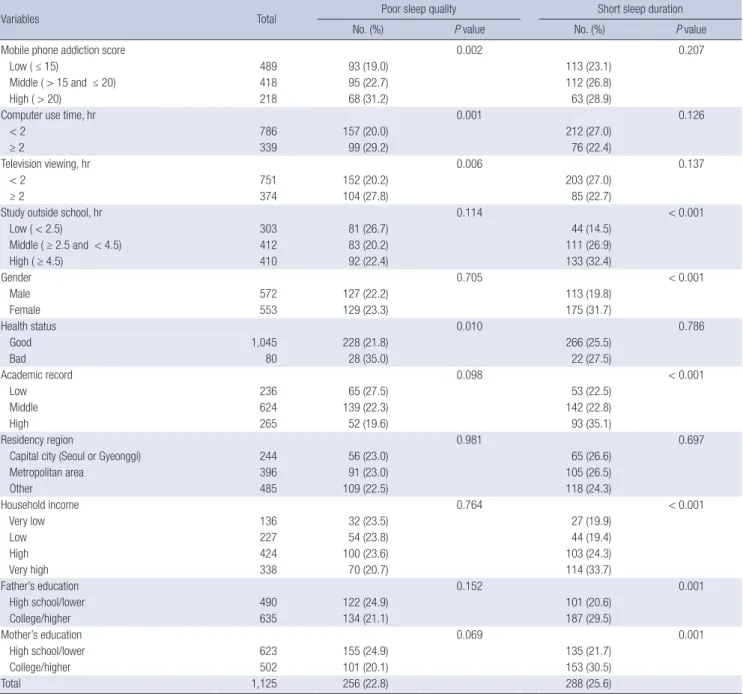
Descriptive statistics of characteristics of the baseline sample according to the occurrence of poor sleep quality and short sleep duration are shown in Table 1. In total, there were 1,125 subjects at baseline after excluding those who had experienced poor sleep quality or short sleep duration in the prior year. At base- line, the number of students who had poor sleep quality was 256 (22.8%), and the number of students who had short sleep duration was 288 (25.6%). Considering mobile phone addic- Table 2. Generalized linear model with new onset of poor sleep quality and short sleep duration in 2012–2013
Variables Poor sleep quality Short sleep duration
OR 95% CI OR 95% CI
Mobile phone addiction score
Low ( ≤ 15) 1.000 - 1.000 -
Middle ( > 15 and ≤ 20) 1.313 0.991–1.740 1.030 0.819–1.295 High ( > 20) 2.009 1.443–2.796 1.021 0.767–1.360 Computer use time, hr
< 2 1.000 - 1.000 -
≥ 2 1.393 0.897–2.164 0.866 0.594–1.263
Television viewing, hr
< 2 1.000 - 1.000 -
≥ 2 1.034 0.668–1.599 0.737 0.514–1.057
Study outside school, hr
Low ( < 2.5) 1.000 - 1.000 -
Middle ( ≥ 2.5 and < 4.5) 0.644 0.467–0.888 1.903 1.465–2.472 High ( ≥ 4.5) 0.890 0.635–1.247 2.243 1.683–2.990 Gender
Male 1.000 - 1.000 -
Female 0.995 0.771–1.284 1.551 1.257–1.915
Year of school
3rd year of middle school 1.000 - 1.000 -
1st year of high school 0.378 0.283–0.504 10.621 8.573–13.156 Health status
Good 1.000 - 1.000 -
Bad 1.568 1.005–2.447 1.061 0.725–1.552
Academic record
Low 1.317 0.877–1.975 0.907 0.647–1.273
Middle 1.094 0.786–1.522 0.755 0.576–0.989
High 1.000 - 1.000 -
Residency region
Capital city (Seoul or Gyeonggi) 1.000 - 1.000 - Metropolitan area 1.089 0.772–1.538 1.047 0.781–1.404
Other 1.001 0.712–1.408 0.910 0.684–1.212
Household income
Very low 0.950 0.599–1.505 0.605 0.407–0.900
Low 1.128 0.776–1.639 0.664 0.484–0.912
High 1.187 0.863–1.633 0.794 0.615–1.024
Very high 1.000 - 1.000 -
Father’s education
High school/lower 1.000 - 1.000 -
College/higher 0.897 0.642–1.252 1.135 0.858–1.502 Mother’s education
High school/lower 1.000 - 1.000 -
College/higher 0.937 0.669–1.312 0.958 0.731–1.257 OR = odds ratio, CI = confidence interval.
Fig. 2. Association between mobile phone addiction and new onset of poor sleep quality according to gender. Reference category: low mobile phone addiction score.
LCL = lower confidence limit, UCL = upper confidence limit, OR = odds ratio.
*P value < 0.05.
Middle High* Middle High*
5 4 3 2 1 0
Poor sleep quality
Male Female
Gender
LCL 0.994 1.061 0.764 1.392
UCL 2.108 2.806 1.807 3.543
OR 1.448 1.726 1.175 2.221
tion, students with greater mobile phone addiction showed a significantly higher probability of poor sleep quality (19.0% for mobile phone addiction score ≤ 15, 22.7% for mobile phone addiction score > 15 and ≤ 20, and 31.2% for mobile phone addiction score > 20). When analyzed by study outside school hours, those in the high category had a higher probability of short sleep duration than those in the low or middle categories (14.5%
for low, 26.9% for middle, and 32.4% for high).
Results of a GEE model for incidence of poor sleep quality and short sleep duration are shown in Table 2. The incidence of poor sleep quality was significantly higher for children with high mobile phone addiction (mobile phone addiction score > 20) than for those with low mobile phone addiction (mobile phone addiction score ≤ 15) after adjusting for possible confounders (odds ratio [OR], 2.009; 95% confidence interval [CI], 1.443–2.796).
For sleep duration, students who studied ≥ 4.5 hours outside of class had a higher risk of short sleep duration than those who studied < 2.5 hours (OR, 2.243; 95% CI, 1.683–2.990). When sub- jects became high school students, they were likely to have bet- ter sleep quality but shorter sleep duration than when they were middle school students (OR, 0.387; 95% CI, 0.283–0.504 for poor sleep quality; OR, 10.621; 95% CI, 8.573–13.156 for short sleep duration).
Fig. 2 shows data for mobile phone addiction and sleep qual- ity according to gender. Using the low mobile phone addiction group as the reference group, we found that high mobile phone addiction was significantly associated with poor sleep quality for both genders. Female students with high mobile phone ad- diction were more likely to have poor sleep than male students with high mobile phone addiction (OR, 1.726; 95% CI, 1.061–
2.806 for males; OR, 2.221; 95% CI, 1.392–3.543 for females).
Results of a GEE model stratified by household income are shown in Fig. 3. Among students with high mobile phone ad- diction, those in a lower household income group had a higher
risk of poor sleep quality than those in a higher household in- come group (OR, 2.864; 95% CI, 1.705–7.630 for very low group;
OR, 2.010; 95% CI, 0.962–4.198 for low group; OR, 2.084; 95% CI, 1.218–3.567 for high group; OR, 1.879; 95% CI, 1.014–3.482 for very high group).
Fig. 4 shows the association between mobile phone addiction and sleep quality according to mobile phone addiction score in the past year. Students with a worsening mobile phone addic- tion were more likely to have poor sleep quality than those with a consistent low mobile phone addiction or improving mobile phone addiction (OR, 2.256; 95% CI, 1.253–4.064 for low mobile phone addiction score in the past year and high mobile phone addiction score in the current year; OR, 2.179; 95% CI, 1.177–
4.032 for middle mobile phone addiction score in the past year and high mobile phone addiction score in the current year).
DISCUSSION
The importance of sleep for health is well known. Unfortunate- ly, a considerable number of people have insufficient or poor sleep. More than just recognizing the importance of sleep, it is necessary to identify and improve the factors disturbing sleep.
There are many factors that interrupt good sleep, and one of these may be mobile phone addiction, especially among ado- lescents. One possible explanation for this is that individuals who are obsessed with their mobile phone do not want to miss any text messages or social network posts, and this might dis- turb their deep sleep. Also, mobile phone overuse might reduce physical activities leading to good sleep.
Using longitudinal data, the current study examined whether mobile phone addiction is related to the incidence of poor sleep quality and insufficient sleep duration in adolescents. We found that adolescents who were highly addicted to mobile phones
had a higher risk of poor sleep quality but not a significantly short- er sleep duration after excluding those with poor sleep quality or short sleep duration in the prior year. It is well known that media use differs by gender (25-27). We also found gender dif- ferences in the magnitude of the relationship between mobile phone addiction and sleep quality. When students with high mobile phone addiction were stratified by household income, those in the lower household income group were more likely to have poor sleep quality than those in the higher household in- come group. Considering mobile phone addiction in the past year, students with a worsening mobile phone addiction had a higher risk of poor sleep quality than those with a consistently low mobile phone addiction or improving mobile phone addic- tion.
The results of this study are accordance with those of previ- ous studies, which show a relationship between mobile phone use and sleep quality in college students (28,29). However, we did not find a significant relationship between mobile phone addiction and sleep duration. Therefore, these results are con- sistent with those of other studies suggesting that mobile phone addiction has no direct effect on sleep duration in adolescents (16,30). The majority of research on the relationship between mobile phone use and sleep characteristics has been performed using cross-sectional data or studies with small sample sizes in spite of large variability at this age. It is possible that adolescents are addicted to their mobile phone because they cannot sleep well in their sleep environment or because they already have poor sleep. Thus, we aimed to overcome the limitations of pre- vious research by conducting a longitudinal study using a rep- resentative Korean youth sample to examine the relationship between mobile phone addiction and sleep quality and dura- tion among middle school students. Furthermore, as the asso- ciations between mobile phone addiction and sleep character- Fig. 4. Association between mobile phone addiction and new onset of poor sleep qual- ity according to mobile phone addiction score in the past year. Reference category: low mobile phone addiction score.
LCL = lower confidence limit, UCL = upper confidence limit, OR = odds ratio.
*P value < 0.05.
Middle High* Middle High* Middle High 5
4 3 2 1 0
Poor sleep quality
Low Middle High
Mobile phone addiction score in the past year
LCL 0.704 1.253 0.913 1.177 0.595 0.841
UCL 1.583 4.064 2.590 4.032 4.542 6.020
OR 1.056 2.256 1.537 2.179 1.644 2.250
Fig. 3. Association between mobile phone addiction and new onset of poor sleep qual- ity according to household income. Reference category: low mobile phone addiction score.
LCL = lower confidence limit, UCL = upper confidence limit, OR = odds ratio.
*P value < 0.05.
Middle High* Middle High Middle High* Middle High*
5 4 3 2 1 0
Poor sleep quality
Very low Low High Very high
Household income
LCL 0.514 1.075 0.658 0.962 0.949 1.218 0.681 1.014 UCL 2.795 7.630 2.342 4.198 2.346 3.567 2.010 3.482 OR 1.199 2.864 1.241 2.010 1.492 2.084 1.170 1.879
istics are complex and bidirectional, we assessed the incidence of poor sleep quality and insufficient sleep duration to examine whether mobile phone addiction is associated with decreased sleep quality and sleep duration.
There are several limitations of this study. First, mobile phone addiction was measured by items developed in Korea. There- fore, a comparative analysis of Korea and other countries is lim- ited. Second, as the data used in this study did not include in- formation on the type of mobile phones, we could not consider differences between smartphones and feature phones. Howev- er, we assume that most youths used smartphones, as the sur- vey was conducted in 2011–2013. Third, sleep-related variables in this study were assessed by self-reported measurements and not by objective measurements such as polysomnogram or ac- tigraphy. However, previous studies suggest that self-reported features of sleep are highly associated with electrophysiological measures of sleep (31). Fourth, sleep quality was measured by a single question. More thorough approaches such as the Pitts- burgh Sleep Quality Index are a more appropriate method of measuring the quality of sleep. Fifth, a comparison between Ko- rea and other countries might provide more useful insights into the association between mobile phone addiction and sleep prob- lems and strategies for reducing the adverse effects of mobile phone use on sleep in youth. Finally, residual confounders were not investigated in this study, such as depression, anxiety, par- ents’ sleep patterns or sleep circumstances, because of lack of information in the data used in this study.
Despite these limitations, this study has several strengths. First, stratified, randomly sampled, national data were used in this study. Using this community-based large-scale sample increas- es the external validity of this study and provides more repre- sentative results than prior studies with small sample sizes. This large-scale sample also made it possible to conduct well-pol- ished analyses and control potential confounders. Second, this study used longitudinal data instead of cross-sectional data. As most studies of mobile phone addiction and sleep quality in school-aged children are cross-sectional, longitudinal studies in this area are relatively rare. Third, we investigated both ado- lescents and their parents. Surveying both types of individuals enabled us to obtain more precise information and consider family background. Finally, we excluded students who had sleep problems in the prior year and analyzed the incidence of sleep problems. We found that high mobile phone addiction was a risk factor for poor sleep in school-aged children, even though a bidirectional and more complex relationship may exist between mobile phone addiction and sleep problems.
The current study shows the longitudinal relationship between mobile phone addiction and sleep quality in adolescents. Ado- lescents tend to be more easily addicted to mobile phones than adults, and this addiction may persist and influence sleep dis- orders in adulthood. Although teenagers at risk of mobile phone
addiction report that family or friends’ support is the most help- ful factor for decreasing their mobile phone use (2), Korean par- ents do not care much about their children’s use of mobile phones (1). Therefore, we should raise awareness of mobile phone ad- diction and associated sleep problem among adolescents and their parents. Monitoring mobile phone addiction in adoles- cents is important, and parents should pay attention to whether their children’s mobile phone addiction leads to sleep problem, which in turn may cause physical and psychological health prob- lems. For teenagers, education programs concerning the suit- able use of mobile phones and ways of controlling mobile phone use time and counseling programs for those who are already addicted to their mobile phone are required. The findings of this research provide good information to improve youth’s sleep quality, which is a crucial worldwide issue.
DISCLOSURE
The authors have no potential conflicts of interest to disclose.
AUTHOR CONTRIBUTION
Conceptualization: Lee JE, Jang SI, Park EC. Formal analysis:
Lee JE, Lee HJ. Investigation: Lee JE, Kim W. Writing - original draft: Lee JE. Writing - review & editing: Jang SI, Park EC.
ORCID
Joo Eun Lee https://orcid.org/0000-0002-3684-4892 Sung-In Jang https://orcid.org/0000-0002-0760-2878 Yeong Jun Ju https://orcid.org/0000-0003-4891-0524 Woorim Kim https://orcid.org/0000-0002-1199-6822 Hyo Jung Lee https://orcid.org/0000-0001-9026-4584 Eun-Cheol Park https://orcid.org/0000-0002-2306-5398 REFERENCES
1. Groupe Speciale Mobile Association (JP). Children’s use of mobile phones and personal relationships: an international comparison 2011 [Internet].
Available at http://www.gsma.com/publicpolicy/wp-content/uploads/
2012/03/Childrensuseofmobilephones2011.pdf [accessed on 8 May 2017].
2. Ministry of Science, ICT and Future Planning (KR). Internet addiction survey 2014 [Internet]. Available at http://msip.go.kr/SYNAP/skin/doc.ht ml?fn=7d3b3733d68811084a78cc79d78a38bd&rs=/SYNAP/sn3hcv/re- sult/201704/ [accessed on 8 May 2017].
3. Gogtay N, Giedd JN, Lusk L, Hayashi KM, Greenstein D, Vaituzis AC, Nu- gent TF 3rd, Herman DH, Clasen LS, Toga AW, et al. Dynamic mapping of human cortical development during childhood through early adult- hood. Proc Natl Acad Sci USA 2004; 101: 8174-9.
4. Curcio G, Ferrara M, De Gennaro L. Sleep loss, learning capacity and aca- demic performance. Sleep Med Rev 2006; 10: 323-37.
5. Carskadon MA, Acebo C, Jenni OG. Regulation of adolescent sleep: im-
plications for behavior. Ann N Y Acad Sci 2004; 1021: 276-91.
6. Kwon JA, Lee M, Yoo KB, Park EC. Does the duration and time of sleep increase the risk of allergic rhinitis? Results of the 6-year nationwide Ko- rea youth risk behavior web-based survey. PLoS One 2013; 8: e72507.
7. Kim JH, Park EC, Lee SG, Yoo KB. Associations between time in bed and suicidal thoughts, plans and attempts in Korean adolescents. BMJ Open 2015; 5: e008766.
8. Gradisar M, Gardner G, Dohnt H. Recent worldwide sleep patterns and problems during adolescence: a review and meta-analysis of age, region, and sleep. Sleep Med 2011; 12: 110-8.
9. Dollman J, Ridley K, Olds T, Lowe E. Trends in the duration of school-day sleep among 10- to 15-year-old South Australians between 1985 and 2004.
Acta Paediatr 2007; 96: 1011-4.
10. Iglowstein I, Jenni OG, Molinari L, Largo RH. Sleep duration from infancy to adolescence: reference values and generational trends. Pediatrics 2003;
111: 302-7.
11. Schmidt AT, Li X, Hanten GR, McCauley SR, Faber J, Levin HS. A longitu- dinal investigation of sleep quality in adolescents and young adults after mild traumatic brain injury. Cogn Behav Neurol 2015; 28: 53-62.
12. Kronholm E, Puusniekka R, Jokela J, Villberg J, Urrila AS, Paunio T, Väli- maa R, Tynjälä J. Trends in self-reported sleep problems, tiredness and related school performance among Finnish adolescents from 1984 to 2011.
J Sleep Res 2015; 24: 3-10.
13. Jenni OG, Molinari L, Caflisch JA, Largo RH. Sleep duration from ages 1 to 10 years: variability and stability in comparison with growth. Pediatrics 2007; 120: e769-76.
14. Punamäki RL, Wallenius M, Nygård CH, Saarni L, Rimpelä A. Use of in- formation and communication technology (ICT) and perceived health in adolescence: the role of sleeping habits and waking-time tiredness. J Adolesc 2007; 30: 569-85.
15. Harada T, Morikuni M, Yoshii S, Yamashita Y, Takeuchi H. Usage of mo- bile phone in the evening or at night makes Japanese students evening- typed and night sleep uncomfortable. Sleep Hypn 2002; 4: 149-53.
16. Yen CF, Ko CH, Yen JY, Cheng CP. The multidimensional correlates asso- ciated with short nocturnal sleep duration and subjective insomnia among Taiwanese adolescents. Sleep 2008; 31: 1515-25.
17. Thomée S, Härenstam A, Hagberg M. Mobile phone use and stress, sleep disturbances, and symptoms of depression among young adults--a pro- spective cohort study. BMC Public Health 2011; 11: 66.
18. Arora T, Broglia E, Thomas GN, Taheri S. Associations between specific technologies and adolescent sleep quantity, sleep quality, and parasom- nias. Sleep Med 2014; 15: 240-7.
19. Söderqvist F, Carlberg M, Hardell L. Use of wireless telephones and self- reported health symptoms: a population-based study among Swedish adolescents aged 15–19 years. Environ Health 2008; 7: 18.
20. Lemola S, Perkinson-Gloor N, Brand S, Dewald-Kaufmann JF, Grob A. Ad- olescents’ electronic media use at night, sleep disturbance, and depres- sive symptoms in the smartphone age. J Youth Adolesc 2015; 44: 405-18.
21. Murdock KK. Texting while stressed: implications for students’ burnout, sleep, and well-being. Psychol Pop Media Cult 2013; 2: 207-21.
22. Maslowsky J, Ozer EJ. Developmental trends in sleep duration in adoles- cence and young adulthood: evidence from a national United States sam- ple. J Adolesc Health 2014; 54: 691-7.
23. Tagaya H, Uchiyama M, Ohida T, Kamei Y, Shibui K, Ozaki A, Tan X, Su- zuki H, Aritake S, Li L, et al. Sleep habits and factors associated with short sleep duration among Japanese high-school students: a community study.
Sleep Biol Rhythms 2004; 2: 57-64.
24. Hirshkowitz M, Whiton K, Albert SM, Alessi C, Bruni O, DonCarlos L, Ha- zen N, Herman J, Hillard PJ, Katz ES, et al. National Sleep Foundation’s up- dated sleep duration recommendations: final report. Sleep Health 2015;
1: 233-43.
25. Van den Bulck J, Van den Bergh B. The influence of perceived parental guidance patterns on children’s media use: gender differences and me- dia displacement. J Broadcast Electron Media 2000; 44: 329-48.
26. Igarashi T, Takai J, Yoshida T. Gender differences in social network devel- opment via mobile phone text messages: a longitudinal study. J Soc Pers Relat 2005; 22: 691-713.
27. Lee SY, Park EC, Han KT, Kim SJ, Chun SY, Park S. The association of level of internet use with suicidal ideation and suicide attempts in South Kore- an adolescents: a focus on family structure and household economic sta- tus. Can J Psychiatry 2016; 61: 243-51.
28. White AG, Buboltz W, Igou F. Mobile phone use and sleep quality and length in college students. Int J Humanit Soc Sci 2011; 1: 51-8.
29. Li J, Lepp A, Barkley JE. Locus of control and cell phone use: implications for sleep quality, academic performance, and subjective well-being. Com- put Human Behav 2015; 52: 450-7.
30. Gaina A, Sekine M, Kanayama H, Sengoku K, Yamagami T, Kagamimori S.
Short–long sleep latency and associated factors in Japanese junior high school children. Sleep Biol Rhythms 2005; 3: 162-5.
31. Bertocci MA, Dahl RE, Williamson DE, Iosif AM, Birmaher B, Axelson D, Ryan ND. Subjective sleep complaints in pediatric depression: a controlled study and comparison with EEG measures of sleep and waking. J Am Acad Child Adolesc Psychiatry 2005; 44: 1158-66.