
ABSTRACT
Background: To examine survival rates and renal function after partial nephrectomy (PN) and radical nephrectomy (RN) in patients with chronic kidney disease (CKD).
Methods: We studied 4,332 patients who underwent PN or RN for pathological T1a-T2N0M0 renal cell carcinoma from 1988 to 2014. Patients were divided into two subgroups of CKD stage I–II and stage III. Kidney function, and survival outcomes were compared between groups.
Results: We included 1,756 patients with CKD I–II and 276 patients with CKD III in the final pair-matched analysis. Kidney function was significantly better preserved in the PN than in the RN group among all patients. However, the beneficial effect of PN on kidney function gradually disappeared over time in CKD III patients. The 5-year overall survival (OS) rates after PN and RN differed in patients with CKD I–II disease (99.4% vs. 96.5%, respectively, P = 0.015). The 5-year OS rates after surgery were not affected by mode of nephrectomy in CKD III patients (97.8% vs. 93.5%, P = 0.103). The 5-year cancer-specific survival rates did not differ between treatment groups in all CKD stage. Cox hazard analysis showed that the operative method was a significant factor for OS in CKD I–II patients (hazard ratio [HR], 0.320; confidence interval [CI], 0.122–0.840; P = 0.021). However, PN was not beneficial in terms of OS in CKD III patients (HR, 0.395; CI, 0.086–1.172; P = 0.117).
Conclusion: PN is associated with a higher OS rate and better kidney function in patients with preoperative CKD stage I and II, but not in those with CKD stage III.
Keywords: Carcinoma, Renal Cell; Survival; Nephrectomy; Renal Insufficiency
Original Article
Jae-Seung Chung ,1 Nak Hoon Son ,2 Sang Eun Lee,3 Sung Kyu Hong ,3 Chang Wook Jeong ,4 Cheol Kwak ,4 Hyeon Hoe Kim ,4 Sung Hoo Hong ,5 Yong June Kim ,6 Seok Ho Kang ,7 Jinsoo Chung ,8 Tae Gyun Kwon ,9 Eu Chang Hwang ,10 and Seok-Soo Byun 3
1Department of Urology, Inje University Haeundae Paik Hospital, Busan, Korea
2Department of Biostatistics, Yonsei University, Seoul, Korea
3Department of Urology, Seoul National University Bundang Hospital, Seongnam, Korea
4Department of Urology, Seoul National University Hospital, Seoul, Korea
5 Department of Urology, Seoul St. Mary's Hospital, The Catholic University of Korea College of Medicine, Seoul, Korea
6Department of Urology, Chungbuk National University Hospital, Cheongju, Korea
7Department of Urology, Korea University Anam Hospital, Seoul, Korea
8Department of Urology, National Cancer Center, Goyang, Korea
9Department of Urology, Kyungpook National University Medical Center, Daegu, Korea
10Department of Urology, Chonnam National University Hwasun Hospital, Hwasun, Korea
Partial versus Radical Nephrectomy for T1-T2 Renal Cell Carcinoma in
Patients with Chronic Kidney Disease Stage III: a Multiinstitutional Analysis of Kidney Function and Survival Rate
Received: Mar 11, 2018 Accepted: Jun 29, 2018 Address for Correspondence:
Seok-Soo Byun, MD, PhD
Department of Urology, Seoul National University Bundang Hospital, 82 Gumi-ro, 173 beon-gil, Bundang-gu, Seongnam 13620, Republic of Korea.
E-mail: [email protected]
© 2018 The Korean Academy of Medical Sciences.
This is an Open Access article distributed under the terms of the Creative Commons Attribution Non-Commercial License (https://
creativecommons.org/licenses/by-nc/4.0/) which permits unrestricted non-commercial use, distribution, and reproduction in any medium, provided the original work is properly cited.
ORCID iDs Jae-Seung Chung
https://orcid.org/0000-0001-9672-2216 Nak Hoon Son
https://orcid.org/0000-0002-6192-8852 Sung Kyu Hong
https://orcid.org/0000-0002-8344-6774 Chang Wook Jeong
https://orcid.org/0000-0002-2200-5019 Cheol Kwak
https://orcid.org/0000-0002-1987-2111 Hyeon Hoe Kim
https://orcid.org/0000-0001-6600-4539 Sung Hoo Hong
https://orcid.org/0000-0002-1952-4010 Yong June Kim
https://orcid.org/0000-0002-7021-2450
Urology
Seok Ho Kang
https://orcid.org/0000-0002-1524-5233 Jinsoo Chung
https://orcid.org/0000-0003-2251-5331 Tae Gyun Kwon
https://orcid.org/0000-0002-4390-0952 Eu Chang Hwang
https://orcid.org/0000-0002-2031-124X Seok-Soo Byun
https://orcid.org/0000-0001-9356-9500 Disclosure
The authors have no potential conflicts of interest to disclose.
Author Contributions
Conceptualization: Chung JS, Byun SS. Data curation: Lee SE, Hong SK, Jeong CW, Kwak C, Kim HH, Hong SH, Kim YJ, Kang SH, Chung J, Kwon TG, Hwang EC, Byun SS. Formal analysis:
Chung JS, Son NH. Methodology: Chung JS, Son NK. Supervision: Byun SS. Writing - original draft: Chung JS. Writing - review &
editing: Chung JS, Chung J, Byun SS.
INTRODUCTION
Chronic kidney disease (CKD) is a well-known risk factor for cardiovascular disease and mortality.1 CKD caused by nephrectomy may increase mortality by inducing cardiovascular disease; thus, to preserve kidney function, partial nephrectomy (PN) has become the standard surgical care for small renal masses.2-5 However, the benefits of partial versus radical nephrectomy (RN) are still under debate, particularly as they relate to the survival advantage of PN.6-15
PN is the preferred treatment modality for renal cell carcinoma (RCC) in patients with pre- existing CKD, when technically feasible. However, little is known about differences in overall survival (OS) and postoperative renal function between patients undergoing RN and PN for the treatment of RCC in patients with pre-existing CKD. To address this gap in the literature, we evaluated the impact of PN over RN on survival rate and kidney function in patients with stage III CKD.
METHODS
Study population
We retrospectively collected data from 5,916 patients who underwent RN or PN for localized RCC from January 1988 through December 2014 at eight institutions in Korea.16 After excluding 1,584 patients with solitary kidney, bilateral RCC, stage pT3 or greater, lymph node or distant metastases, preoperative hemodialysis, or pre-existing stage IV CKD (estimated glomerular filtration rate [eGFR] < 30 mL/min/1.73 m2) and those with missing preoperative kidney function records, we finally analyzed 4,332 patients who underwent PN or RN for pathological T1a-T2N0M0 RCC in this study. To evaluate the effects of PN on survival rate according to CKD stage, we divided patients into two subgroups: CKD I–II (eGFR ≥ 60 mL/min/1.73 m2) and CKD III (30 ≤ eGFR < 60 mL/min/1.73 m2). Data included age, sex, body mass index (BMI), preoperative nutritional status (albumin and hemoglobin levels), comorbidities (diabetes and hypertension), American Society of Anesthesiologists (ASA) score, tumor size, pathologic stage, Fuhrman grade, tumor histology, and preoperative kidney function (eGFR).
Primary outcomes
The primary outcome was difference in postoperative kidney function and OS between the PN and RN arm according to baseline kidney function. OS was calculated by death from any cause after surgery. Cancer-specific survival (CSS) was assessed by the cancer-related death rate. Data regarding death and the cause were obtained from the database of every participating center and updated by the office for Korean National Statistics. The follow-up period was calculated from the date of surgery to the date of the last known contact with the patient or the date of death. To assess the longitudinal change in kidney function after nephrectomy, serial serum creatinine data were collected annually for each patient. The eGFR was calculated using the Modification of Diet in Renal Disease equation.17
Statistical analysis
Differences between groups of patients receiving PN and RN in baseline clinical and pathological characteristics were compared using the Mann-Whitney test for continuous variables and the χ2 test for categorical variables. To reduce the impact of treatment selection
bias, we performed rigorous adjustment for significant differences in characteristics of patients by use of the propensity score. Patients were pair-matched by age, sex, BMI,
preoperative nutritional status (albumin and hemoglobin levels), comorbidities (diabetes and hypertension), ASA score, tumor size, pathologic stage, Fuhrman grade, tumor histology, and preoperative kidney function (eGFR). OS and CSS were estimated by the Kaplan-Meier method and compared by the log-rank test. OS represents the time from surgery to death from any cause. CSS represents the time from surgery to death by cancer. Cox proportional hazards regression models were used to assess the relation of surgery type with survival rate or new onset of stage IV CKD. In the descriptive analyses of kidney function, the mean eGFR in each group was evaluated separately and plotted against each follow-up point. Probabilities of freedom from new onset of stage IV CKD after nephrectomy were also compared using Kaplan-Meier plots. To study the relationship between nephrectomy type and repeated longitudinal measurements of eGFR, and to obtain the slope of the kidney function decline over time and reliable confidence intervals (CIs) of nephrectomy type effects on the renal function trajectory, linear mixed models (with random intercepts and slopes specific to each participant) were used. We calculated a separate regression line with time slopes to compare the differences in the slopes of eGFR decline according to the nephrectomy type. Two- sided tests were performed, and P values < 0.05 were considered statistically significant. All statistical analyses were conducted using the Statistical Package for the Social Sciences (SPSS version 24.0; IBM, Chicago, IL, USA).
Ethics statement
This study was approved by the Institutional Review Board (IRB) of Seoul National University Bundang Hospital (B-1202/145-102) and each participating institution.
RESULTS
Patient demographic and clinical characteristics
Table 1 shows the baseline characteristics of patients. Before propensity matching analysis, there were significant differences in tumor size, diabetes distribution ratio, Fuhrman grade, pathologic stage, and tumor histology type between RN and PN arms. These differences were eliminated by matching. In the CKD I–II group, 878 RN patients were matched with 878 PN patients. The median pre-eGFRs were 77.1 and 78.7 mL/min/1.73 m2 in each arm (RN vs. PN), respectively. The median follow-up durations in the RN and PN arms were 52 (interquartile range [IQR], 18–81) and 43 (IQR, 12–62) months, respectively. In the CKD III group, 138 RN patients were matched with 138 PN patients. The median pre-eGFRs were 54.1 and 53.8 mL/
min/1.73 m2 in each arm (RN vs. PN), respectively. The median follow-up durations in the RN and PN arms were 56 (IQR, 18–78) and 52 (IQR, 20–72) months, respectively.
Kidney function after radical or PN
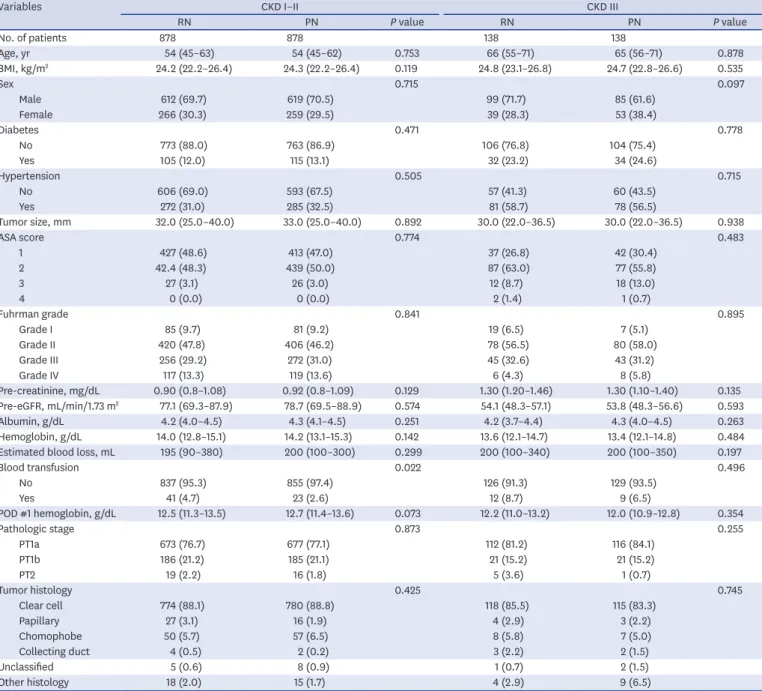
Among patients with CKD stage I–II, kidney function was significantly better preserved in the PN group than in the RN group regardless of the postoperative period (Fig. 1A). Also, PN showed better kidney function compared with RN in the early postoperative period among patients with CKD stage III. However, the beneficial effect of PN on kidney function was not sustained (Fig. 1B). There was a significant difference in the decreasing eGFR between the PN and RN groups among patients with CKD stage I–II (−0.039 vs. −0.302 mL/min/1.73 m2/ mon, respectively, P < 0.001; Fig. 2A). However, RN was not associated with a higher eGFR decrease compared to PN among patients with stage III CKD (−0.077 vs. −0.073 mL/min/1.73
m2/mon, respectively, P = 0.589; Fig. 2B). Kaplan-Meier analysis showed that the 5-year CKD IV-free survival rates after surgery were not significantly different among patients with CKD stage I–II and stage III. (Fig. 2C and D). The incidences of new onset CKD stage IV after RN and PN were 3.6% (five patients) and 1.4% (two patients). However, in Cox hazards models for CKD stage IV, patients who underwent PN were not significantly different compared with their RN-treated counterparts (hazard ratio [HR], 0.573; 95% CI, 0.137–2.400; P = 0.446).
Only one patient in the RN arm required dialysis.
Table 1. Baseline characteristics of patients who underwent PN or RN after propensity score matching
Variables CKD I–II CKD III
RN PN P value RN PN P value
No. of patients 878 878 138 138
Age, yr 54 (45–63) 54 (45–62) 0.753 66 (55–71) 65 (56–71) 0.878
BMI, kg/m2 24.2 (22.2–26.4) 24.3 (22.2–26.4) 0.119 24.8 (23.1–26.8) 24.7 (22.8–26.6) 0.535
Sex 0.715 0.097
Male 612 (69.7) 619 (70.5) 99 (71.7) 85 (61.6)
Female 266 (30.3) 259 (29.5) 39 (28.3) 53 (38.4)
Diabetes 0.471 0.778
No 773 (88.0) 763 (86.9) 106 (76.8) 104 (75.4)
Yes 105 (12.0) 115 (13.1) 32 (23.2) 34 (24.6)
Hypertension 0.505 0.715
No 606 (69.0) 593 (67.5) 57 (41.3) 60 (43.5)
Yes 272 (31.0) 285 (32.5) 81 (58.7) 78 (56.5)
Tumor size, mm 32.0 (25.0–40.0) 33.0 (25.0–40.0) 0.892 30.0 (22.0–36.5) 30.0 (22.0–36.5) 0.938
ASA score 0.774 0.483
1 427 (48.6) 413 (47.0) 37 (26.8) 42 (30.4)
2 42.4 (48.3) 439 (50.0) 87 (63.0) 77 (55.8)
3 27 (3.1) 26 (3.0) 12 (8.7) 18 (13.0)
4 0 (0.0) 0 (0.0) 2 (1.4) 1 (0.7)
Fuhrman grade 0.841 0.895
Grade I 85 (9.7) 81 (9.2) 19 (6.5) 7 (5.1)
Grade II 420 (47.8) 406 (46.2) 78 (56.5) 80 (58.0)
Grade III 256 (29.2) 272 (31.0) 45 (32.6) 43 (31.2)
Grade IV 117 (13.3) 119 (13.6) 6 (4.3) 8 (5.8)
Pre-creatinine, mg/dL 0.90 (0.8–1.08) 0.92 (0.8–1.09) 0.129 1.30 (1.20–1.46) 1.30 (1.10–1.40) 0.135
Pre-eGFR, mL/min/1.73 m2 77.1 (69.3–87.9) 78.7 (69.5–88.9) 0.574 54.1 (48.3–57.1) 53.8 (48.3–56.6) 0.593
Albumin, g/dL 4.2 (4.0–4.5) 4.3 (4.1–4.5) 0.251 4.2 (3.7–4.4) 4.3 (4.0–4.5) 0.263
Hemoglobin, g/dL 14.0 (12.8–15.1) 14.2 (13.1–15.3) 0.142 13.6 (12.1–14.7) 13.4 (12.1–14.8) 0.484
Estimated blood loss, mL 195 (90–380) 200 (100–300) 0.299 200 (100–340) 200 (100–350) 0.197
Blood transfusion 0.022 0.496
No 837 (95.3) 855 (97.4) 126 (91.3) 129 (93.5)
Yes 41 (4.7) 23 (2.6) 12 (8.7) 9 (6.5)
POD #1 hemoglobin, g/dL 12.5 (11.3–13.5) 12.7 (11.4–13.6) 0.073 12.2 (11.0–13.2) 12.0 (10.9–12.8) 0.354
Pathologic stage 0.873 0.255
PT1a 673 (76.7) 677 (77.1) 112 (81.2) 116 (84.1)
PT1b 186 (21.2) 185 (21.1) 21 (15.2) 21 (15.2)
PT2 19 (2.2) 16 (1.8) 5 (3.6) 1 (0.7)
Tumor histology 0.425 0.745
Clear cell 774 (88.1) 780 (88.8) 118 (85.5) 115 (83.3)
Papillary 27 (3.1) 16 (1.9) 4 (2.9) 3 (2.2)
Chomophobe 50 (5.7) 57 (6.5) 8 (5.8) 7 (5.0)
Collecting duct 4 (0.5) 2 (0.2) 3 (2.2) 2 (1.5)
Unclassified 5 (0.6) 8 (0.9) 1 (0.7) 2 (1.5)
Other histology 18 (2.0) 15 (1.7) 4 (2.9) 9 (6.5)
Values are presented as number of patients (%) or median (IQR).
RN = redical nephrectomy, PN = partial nephrectomy, CKD = chronic kidney disease, IQR = interquartile range, BMI = body mass index, ASA = American Society of Anesthesiologists, POD = postoperative day, eGFR = estimated glomerular filtration rate.
Patients at risk
PN 878 481 546 402 319 269 201 150 RN 878 475 704 586 557 425 317 238
Patients at risk
PN 138 72 80 94 69 57 51 48
RN 138 75 83 93 71 65 58 53
0 100 80 60 40 20 Mean eGFR (mL/min/1.73m2)
Time after surgery, mon A
Preop 3 12 24 36 48 60 72
P < 0.001, PN (3 mon eGFR vs 72 mon eGFR)
P = 0.094, RN (3 mon eGFR vs 72 mon eGFR)
0 100 80 60 40 20 Mean eGFR (mL/min/1.73m2)
Time after surgery, mon B
Preop 3 12 24 36 48 60 72 Radical Nx
Partial Nx
Radical Nx Partial Nx
P = 0.354, PN (3 mon eGFR vs 72 mon eGFR)
P < 0.001, RN (3 mon eGFR vs 72 mon eGFR) P < 0.001
(3 mon RN vs 3 mon PN)
P = 0.335 (72 mon RN vs
72 mon PN) P < 0.001
(72 mon RN vs 72 mon PN)
P < 0.001 (3 mon RN vs
3 mon PN)
Fig. 1. Changes in eGFR over time after RN and PN. (A) Patients with CKD I–II and (B) patients with CKD III.
eGFR = estimated glomerular filtration rate, RN = radical nephrectomy, PN = partial nephrectomy, CKD = chronic kidney disease.
No. at risk
RN 878 594 498 384 200 104 46 12 4 2 PN 878 514 335 207 73 33 12 2 1 0
No. at risk
RN 138 102 84 64 39 11 2 1 1 1
PN 138 114 98 63 35 11 1 0 0 0
0 100 80 60 40 20 eGFR (mL/min/1.73m2)
Time after surgery, mon
Slope B = −0.039 (95% CI: −0.073, −0.005)
B = −0.302 (95% CI: −0.338, −0.265) Slope B = −0.077 (95% CI: −0.126, −0.028)
B = −0.073 (95% CI: −0.118, −0.028)
A
Preop 3 12 24 36 48 60 72 0
100 80 60 40 20 eGFR (mL/min/1.73m2)
Time after surgery, mon B
Preop 3 12 24 36 48 60 72
Log rank test: P = 0.440 Log rank test: P = 0.461
0 1.0
0.8
0.6
0.4
ee survivalCKD IV fr 0.2
Time after surgery, mon C
00 20 40 60 80 100 120 140 160 180 200 200
180 160 140 120 80 100 60
40 20 0
1.0
0.8
0.6
0.4
ee survivalCKD IV fr 0.2
Time after surgery, mon D
RN PN RN
PN
P = 0.589 P < 0.001
Fig. 2. Changes in the eGFR over time after PN (red line) and RN (blue line) stratified by CKD stage (A, B). Slopes are based on regression coefficients from the linear mixed models. Solid line: regression line, dotted line: 95% CI. (A) Patients with CKD I–II. (B) Patients with CKD III. Kaplan-Meier survival curves for CKD IV free survival stratified by nephrectomy type (C, D). (C) Patients with CKD I–II. (D) Patients with CKD III. Red line: PN; Blue line: RN.
eGFR = estimated glomerular filtration rate, CKD = chronic kidney disease, PN = partial nephrectomy, RN = radical nephrectomy, CI = confidence interval.
Survival rate after radical or PN
In the CKD I–II group, the 5-year OS rates after surgery were 99.4% for PN versus 96.5%
for RN (P = 0.015; Fig. 3A). The 5-year CSS rates were 99.7% for PN versus 99.5% for RN (P = 0.492; Fig. 3C). Table 2 summarizes the adjusted HRs for clinical end points in the PN arm versus the RN arm. Patients undergoing PN were at a significantly lower risk of kidney function decrease and death from any cause. In Cox hazards models for OS and CSS, although patients who underwent PN did not have a significantly different CSS rate compared with their RN-treated counterparts, the OS rate was different (OS: HR, 0.320; 95% CI, 0.122–0.840;
P = 0.021; CSS: HR, 0.466; 95% CI, 0.050–4.311; P = 0.501). In the CKD III group, the 5-year OS rates after surgery were 97.8% for PN versus 93.5% for RN (P = 0.103; Fig. 3B). The 5-year CSS rates were 99.3% for PN versus 98.5% for RN (P = 0.287; Fig. 3D). OS and CSS were not significantly different between the two arms (OS: HR, 0.395; 95% CI, 0.124–1.260; P = 0.117;
CSS: HR, 0.313; 95% CI, 0.033–3.008, respectively, P = 0.314).
Log rank test: P = 0.287 Log rank test: P = 0.492
0 1.0
0.8
0.6
0.4
fic survivalCancer speci 0.2
Time after surgery, mon C
00 20 40 60 80 100 120 140 160 180 200 200
180 160 140 120 80 100 60
40 20 0
1.0
0.8
0.6
0.4
fic survivalCancer speci 0.2
Time after surgery, mon D
RN PN RN
PN
Log rank test: P = 0.103 Log rank test: P = 0.015
0 1.0
0.8
0.6
0.4
0.2
Overall survival
Time after surgery, mon A
00 20 40 60 80 100 120 140 160 180 200 200
180 160 140 120 80 100 60
40 20 0
1.0
0.8
0.6
0.4
0.2
Overall survival
Time after surgery, mon B
RN PN RN
PN
No. at risk
RN 878 667 514 409 251 104 46 12 4 2 PN 878 602 503 398 184 53 12 2 1 0
No. at risk
RN 878 667 514 409 251 104 46 12 4 2 PN 878 602 503 398 184 53 12 2 1 0
No. at risk
RN 138 111 87 65 42 15 3 1 1 1
PN 138 107 82 59 38 10 1 0 0 0
No. at risk
RN 138 111 87 65 42 15 3 1 1 1
PN 138 107 82 59 38 10 1 0 0 0
Fig. 3. Survival rate stratified by CKD stage and nephrectomy type. Kaplan-Meier estimating curves for overall survival (A, B), and cancer specific survival (C, D) according to nephrectomy type (PN [red line] versus RN [blue line]). CKD I–II patients: (A) and (C); CKD III patients: (B) and (D).
PN = partial nephrectomy, RN = radical nephrectomy, CKD = chronic kidney disease.
DISCUSSION
The effects of PN and RN on survival rate and renal function in patients with stage III CKD have not been evaluated in detail. Compared to RN, PN is thought to have a more favorable effect on OS in patients with deteriorated preoperative kidney function. In our previous study, we observed that the renal function of patients with CKD stage I or II recovered after RN and that the same phenomenon occurred in patients with CKD III.18 However, the level of renal function recovery was lower in patients with CKD stage III than in those with CKD stage I or II. We hypothesized that among patients with CKD III, RN would be more detrimental to kidney function than PN, and expected to see a greater survival benefit following PN among patients with CKD III than among those with CKD I or II. However, the results of this study contradicts our hypothesis.
The major findings of this study were: 1) there was no difference between PN and RN arms in the rate of eGFR decrease among CKD stage III patients, although the superior benefit of PN over RN was consistently maintained between the two nephrectomy types in CKD stage I–II patients; 2) the 5-year OS and CSS survival rates in the RN arm were comparable to those of the PN arm in patients with pre-existing CKD III; and 3) the OS was higher after PN than after RN in patients with preoperative normal kidney function. The results obtained for CKD stage III patients are seemingly counterintuitive because it is conceivable that in pre-existing CKD, the functional recovery capacity is not maintained by physiological compensation.
Several underlying mechanisms may explain this phenomenon. First, a similar kidney function after nephrectomy may affect the OS rate. After surgery, kidney function was significantly better preserved in the PN arm than in the RN arm in the early period after surgery. The eGFR drops sharply by 20 mL/min/1.73 m2 on average when RN is performed in CKD I–II patients, whereas it decreases by approximately 10 mL/min/1.73 m2 on average Table 2. Cox regression analyses for OS, CSS, and new onset of CKD IV survival
Parameters Propensity score matched cohort
HR 95% CI P value
(A) CKD I–II OS
PN 0.320 0.122–0.840 0.021
RN (Ref) -
CSS
PN 0.466 0.050–4.311 0.501
RN (Ref) -
New onset CKD IV free survival
PN 0.445 0.049–4.045 0.472
RN (Ref) -
(B) CKD III OS
PN 0.395 0.124–1.260 0.117
RN (Ref) -
CSS
PN 0.313 0.033–3.008 0.314
RN (Ref) -
New onset CKD IV free survival
PN 0.573 0.137–2.400 0.446
RN (Ref) -
OS = overall survival, CSS = cancer-specific survival, CKD = chronic kidney disease, HR = hazard ratio, CI = confidence interval, PN = partial nephrectomy, RN = radical nephrectomy.
in CKD III patients. In the CKD III group, patients who underwent PN maintained their postoperative kidney function up to a certain level while the postoperative kidney function of patients that underwent RN recovered gradually over time; therefore, statistically significant differences in the postoperative eGFR of PN and RN groups disappeared with time. Kidney ischemia in PN may have irreparable damage to operated kidney in CKD III patients. These changes may be associated with the survival rate of patients. Furthermore, it is possible that RN may not affect survival unless the eGFR reaches the cutoff value for dialysis (30 mL/
min/1.73 m2), a variable which did not differ between groups.
Second, PN may not increase OS compared to RN in certain patients. Recent studies reported that the benefits of PN with regard to OS or kidney function can vary depending on the patient's preoperative kidney function, age, comorbidity, and tumor size and anatomy.19-24 Woldu et al.19 found that the benefits of PN on kidney function were observed only in patients with CKD stage II, and not in those with CKD stage III, despite the fact that most urologists would prioritize PN in the latter group in daily clinical practice. Sun et al.20 reported that compared to RN, PN was not protective of other-cause mortality in elderly patients (aged ≥ 75) with localized RCC or those with multiple comorbidities at diagnosis. Meanwhile, Larcher et al.21 argued that PN was beneficial only to patients with significant comorbidities. However, the authors also contended that PN decreased other cause mortality over RN only in specific subgroup of patients with RCC. An et al.22 and Chung et al.23 also reported that PN was not more favorable than RN in terms of OS in elderly patients. Kopp et al.24 compared survival differences to investigate the prognostic impact of tumor anatomical variation or stage, and found that the benefits of PN might fade away for complex tumors. Another study also confirmed no survival difference between PN and RN in a propensity adjusted cohort of patients with T1b RCC.25 The current study demonstrated that the differences between OS rates after PN and RN disappeared in patients with pre-existing CKD.
We found that the relative benefit of PN over RN in reducing mortality and preserving kidney function was consistently observed in patients with preoperatively normal kidney function. Furthermore, given that the kidney function and survival outcomes were
comparable for the two nephrectomy types, RN may be selected as a relatively safe treatment for RCC in specific patients with pre-existing CKD stage III. The remarkable finding in this study is that the benefits following PN were not sustained in patients with pre-existing CKD stage III. However, given the significant risks associated with RN, PN should still be the method of choice in this patient group. Also, it should not be overinterpreted that RN would not completely cause severe cardiovascular disease or fatal mortality in patients with preexisting CKD.
Our study has several limitations. First, this was a retrospective study, and this design may have affected the results owing to unmeasured confounders. No statistical method of adjustment can completely abolish this limitation. Second, only a small number of patients were followed up. It is possible that the lack of difference in OS between the two arms in stage III CKD may have been affected by the limited number of patients throughout follow-up.
Third, only healthy patients with available contact information and relatively better baseline kidney function (CKD IIIA) who were still alive were included as CKD stage III patients.
The choice of PN versus RN should be made based on a variety of clinical factors. When considering PN in a patient with pre-existing CKD, the issue of potential morbidity in relation to the patient's health condition needs to be discussed, because the decision to
perform RN versus PN is influenced by preoperative renal function. Our study adds to the current knowledge about the beneficial effect of PN on survival rate and kidney function in patients with pre-existing CKD. Our use of a large consecutive patients recruited at multiple centers may be a good reference indicator of real world outcomes.
In conclusion, PN is associated with a higher OS rate in patients with preoperative CKD stages I and II. However, compared with RN, PN did not show a better 5-year risk of death and kidney function in patients with pre-existing CKD stage III. Additional studies should be conducted to investigate the patient characteristics for which the benefit of PN may be maximized.
REFERENCES
1. Go AS, Chertow GM, Fan D, McCulloch CE, Hsu CY. Chronic kidney disease and the risks of death, cardiovascular events, and hospitalization. N Engl J Med 2004;351(13):1296-305.
PUBMED | CROSSREF
2. Huang WC, Levey AS, Serio AM, Snyder M, Vickers AJ, Raj GV, et al. Chronic kidney disease after nephrectomy in patients with renal cortical tumours: a retrospective cohort study. Lancet Oncol 2006;7(9):735-40.
PUBMED | CROSSREF
3. Campbell SC, Novick AC, Belldegrun A, Blute ML, Chow GK, Derweesh IH, et al. Guideline for management of the clinical T1 renal mass. J Urol 2009;182(4):1271-9.
PUBMED | CROSSREF
4. Ljungberg B, Cowan NC, Hanbury DC, Hora M, Kuczyk MA, Merseburger AS, et al. EAU guidelines on renal cell carcinoma: the 2010 update. Eur Urol 2010;58(3):398-406.
PUBMED | CROSSREF
5. Motzer RJ, Agarwal N, Beard C, Bolger GB, Boston B, Carducci MA, et al. NCCN clinical practice guidelines in oncology: kidney cancer. J Natl Compr Canc Netw 2009;7(6):618-30.
PUBMED | CROSSREF
6. Huang WC, Elkin EB, Levey AS, Jang TL, Russo P. Partial nephrectomy versus radical nephrectomy in patients with small renal tumors--is there a difference in mortality and cardiovascular outcomes? J Urol 2009;181(1):55-61.
PUBMED | CROSSREF
7. Sun M, Trinh QD, Bianchi M, Hansen J, Hanna N, Abdollah F, et al. A non-cancer-related survival benefit is associated with partial nephrectomy. Eur Urol 2012;61(4):725-31.
PUBMED | CROSSREF
8. Kim SP, Thompson RH, Boorjian SA, Weight CJ, Han LC, Murad MH, et al. Comparative effectiveness for survival and renal function of partial and radical nephrectomy for localized renal tumors: a systematic review and meta-analysis. J Urol 2012;188(1):51-7.
PUBMED | CROSSREF
9. Zini L, Perrotte P, Capitanio U, Jeldres C, Shariat SF, Antebi E, et al. Radical versus partial nephrectomy:
effect on overall and noncancer mortality. Cancer 2009;115(7):1465-71.
PUBMED | CROSSREF
10. Tan HJ, Norton EC, Ye Z, Hafez KS, Gore JL, Miller DC. Long-term survival following partial vs radical nephrectomy among older patients with early-stage kidney cancer. JAMA 2012;307(15):1629-35.
PUBMED | CROSSREF
11. Capitanio U, Terrone C, Antonelli A, Minervini A, Volpe A, Furlan M, et al. Nephron-sparing techniques independently decrease the risk of cardiovascular events relative to radical nephrectomy in patients with a T1a-T1b renal mass and normal preoperative renal function. Eur Urol 2015;67(4):683-9.
PUBMED | CROSSREF
12. Scosyrev E, Messing EM, Sylvester R, Campbell S, Van Poppel H. Renal function after nephron-sparing surgery versus radical nephrectomy: results from EORTC randomized trial 30904. Eur Urol 2014;65(2):372-7.
PUBMED | CROSSREF
13. Shuch B, Hanley J, Lai J, Vourganti S, Kim SP, Setodji CM, et al. Overall survival advantage with partial nephrectomy: a bias of observational data? Cancer 2013;119(16):2981-9.
PUBMED | CROSSREF
14. Lane BR, Campbell SC, Demirjian S, Fergany AF. Surgically induced chronic kidney disease may be associated with a lower risk of progression and mortality than medical chronic kidney disease. J Urol 2013;189(5):1649-55.
PUBMED | CROSSREF
15. Van Poppel H, Da Pozzo L, Albrecht W, Matveev V, Bono A, Borkowski A, et al. A prospective, randomised EORTC intergroup phase 3 study comparing the oncologic outcome of elective nephron-sparing surgery and radical nephrectomy for low-stage renal cell carcinoma. Eur Urol 2011;59(4):543-52.
PUBMED | CROSSREF
16. Byun SS, Hong SK, Lee S, Kook HR, Lee E, Kim HH, et al. The establishment of KORCC (KOrean Renal Cell Carcinoma) database. Investig Clin Urol 2016;57(1):50-7.
PUBMED | CROSSREF
17. Levey AS, Bosch JP, Lewis JB, Greene T, Rogers N, Roth D, et al. A more accurate method to estimate glomerular filtration rate from serum creatinine: a new prediction equation. Ann Intern Med 1999;130(6):461-70.
PUBMED | CROSSREF
18. Chung JS, Son NH, Byun SS, Lee SE, Hong SK, Jeong CW, et al. Trends in renal function after radical nephrectomy: a multicentre analysis. BJU Int 2014;113(3):408-15.
PUBMED | CROSSREF
19. Woldu SL, Weinberg AC, Korets R, Ghandour R, Danzig MR, RoyChoudhury A, et al. Who really benefits from nephron-sparing surgery? Urology 2014;84(4):860-7.
PUBMED | CROSSREF
20. Sun M, Bianchi M, Trinh QD, Hansen J, Abdollah F, Hanna N, et al. Comparison of partial vs radical nephrectomy with regard to other-cause mortality in T1 renal cell carcinoma among patients aged ≥75 years with multiple comorbidities. BJU Int 2013;111(1):67-73.
PUBMED | CROSSREF
21. Larcher A, Capitanio U, Terrone C, Volpe A, De Angelis P, Dehó F, et al. Elective nephron sparing surgery decreases other cause mortality relative to radical nephrectomy only in specific subgroups of patients with renal cell carcinoma. J Urol 2016;196(4):1008-13.
PUBMED | CROSSREF
22. An JY, Ball MW, Gorin MA, Hong JJ, Johnson MH, Pavlovich CP, et al. Partial vs radical nephrectomy for T1-T2 renal masses in the elderly: comparison of complications, renal function, and oncologic outcomes.
Urology 2017;100:151-7.
PUBMED | CROSSREF
23. Chung JS, Son NH, Lee SE, Hong SK, Lee SC, Kwak C, et al. Overall survival and renal function after partial and radical nephrectomy among older patients with localised renal cell carcinoma: a propensity- matched multicentre study. Eur J Cancer 2015;51(4):489-97.
PUBMED | CROSSREF
24. Kopp RP, Mehrazin R, Palazzi KL, Liss MA, Jabaji R, Mirheydar HS, et al. Survival outcomes after radical and partial nephrectomy for clinical T2 renal tumours categorised by R.E.N.A.L. nephrometry score. BJU Int 2014;114(5):708-18.
PUBMED | CROSSREF
25. Badalato GM, Kates M, Wisnivesky JP, Choudhury AR, McKiernan JM. Survival after partial and radical nephrectomy for the treatment of stage T1bN0M0 renal cell carcinoma (RCC) in the USA: a propensity scoring approach. BJU Int 2012;109(10):1457-62.
PUBMED | CROSSREF
![Fig. 3. Survival rate stratified by CKD stage and nephrectomy type. Kaplan-Meier estimating curves for overall survival (A, B), and cancer specific survival (C, D) according to nephrectomy type (PN [red line] versus RN [blue line])](https://thumb-ap.123doks.com/thumbv2/123dokinfo/5142106.94365/6.892.71.830.409.1045/survival-stratified-nephrectomy-estimating-specific-survival-according-nephrectomy.webp)
