Journal of the Korean Chemical Society 2011, Vol. 55, No. 6
Printed in the Republic of Korea
http://dx.doi.org/10.5012/jkcs.2011.55.6.936
-936-
Microwave-Assisted One-Pot Synthesis of Octahydroquinazolinone Derivatives Catalyzed by Thiamine Hydrochloride Under Solvent-free Condition
Pravin V Badadhe, Asha V. Chate, Dattatraya G. Hingane, Pravin S. Mahajan, Namdev M. Chavhan, and Charansingh H. Gill*
Department of Chemistry, Dr. Babasaheb Ambedkar Marathwada University, Aurangabad-431004.
*E-mail: [email protected]
(Received June 29, 2011; Accepted August 4, 2011)
ABSTRACT. Thiamine hydrochloride (VB1) has been used as an acid catalyst in organic synthesis. One pot three component Biginelli condensation of dimedone, urea/thiourea and substituted aromatic aldehydes catalyzed by 10 mol % of thiamine hydrochloride (VB1) in solvent free condition under microwave irradiation in good to excellent yields has been investigated.
Utilization of microwave irradiation, simple reaction conditions, short reaction time, ease of product isolation, and purification makes this manipulation very interesting from an economic and environmental perspective.
Key words: Thiamine hydrochloride, Biginelli reaction, Octahydroquinazolinone derivatives, Microwave-irradiation, Solvent-free
INTRODUCTION
In recent years, Octahydroquinazolinone derivatives have attracted considerable attention in recent years owing to their potential antibacterial activity against Sta- phylococcus aureus, Escherichia coli, pseudomonas aeruginosa1 and also as a calcium antagonist.2 Methods employed for their synthesis are the variant classical one pot multi-component Biginelli reaction involving dime- done, aromatic aldehydes and urea/thiourea3 There are very few reports for the synthesis of octahydroquinazoli- none derivatives using catalysts such as TMSCl,4 Nafion- H,5 Conc.H2SO46 and ionic liquid [tbmim]Cl2/AlCl3.7 Octahydroquinazolinone derivatives also synthesized in absolute ethanol but with low yields of products (19-69
%). However many of these procedures suffer from one or more disadvantages such as harsh reaction conditions, prolonged reaction period, poor yields, use of hazardous and expensive catalysts, strongly acidic conditions and also suffer from the formation of many side products.8 So the development of clean, high-yielding and environmen- tally friendly approaches is still desirable and much in demand. Nowadays, an important development in the chemical industry is that many traditional chemical pro- cessing techniques are reaching their optimum perfor- mance, while consumer’s demands stretch and governmental regulations tighten. Within the past 20 years, there has been a growing interest in new reaction conditions and activation methods, including 'dry conditions' (reactions
without solvent) and reactions under extreme or noncon- ventional conditions (high pressure, ultrasound or micro- wave irradiation). The effects usually expected are rate enhancements, yield and selectivity improvements, easier work-ups or less environmental polluting processes.
Microwave heating makes it convenient to perform reac- tions very efficiently in the absence of any organic solvents, under so-called dry media conditions. The advantages of using dry media conditions go from faster reactions with different selectivity to more economical conditions due to the absence of organic solvents.9 They clearly constitute an eco-friendly ‘green’ approach.10 Literature survey reveals that a number of octahydroquinazolinone derivatives have been synthesized by Biginelli reaction conditions using various aldehydes but not a single reference have been found where microwave irradiation has been used for the synthesis of octahydroquinazolinone. The use of solid acid catalysts has gained a vast importance in organic syn- thesis due to their several advantages such as, operation- ally simplicity, no toxicity, reusability, low cost, and ease of isolation after completion of the reaction. And so, we report an eco-friendly, facile and efficient methodology for the synthesis of octahydroquinazolinone by using thi- amine hydrochloride (VB1). It is well known that vitamin (VB1) is a cheap and non-toxic reagent. The structure of (VB1) contains a Pyrimidine ring and a thiazole ring linked by a methylene bridge (Fig. 1). The use of (VB1) analogs as powerful catalysts for various organic trans- formations has been reported.11 Recently, we reported the
2011, Vol. 55, No. 6
Microwave-Assisted One-Pot Synthesis of Octahydroquinazolinone 937
thiamine hydrochloride catalyzed greener synthesis of octahydroquinazolinone in solvent free condition under MW irradiation (Scheme 1). Compared with those meth- ods mentioned above, the present procedure using VB1 as catalyst provides an efficient one-pot synthesis of octahy- droquinazolinone in solvent free condition under mw irra- diation. The advantages of this procedure are operational simplicity, eco-friendly, availability of catalyst, cost effec- tive and high yields. We believe that this method presents a practical alternative to existing procedures for the syn- thesis of octahydroquinazolinone.
RESULT AND DISCUSSION
In continuation of our research work on the develop- ment of novel methodologies12 using ultrasonication and microwave irradiation techniques, herein we have devel- oped methodology for the synthesis of octahydro- quinazolinone in presence of thiamine hydrochloride (VB1) under microwave irradiation and solvent free con- dition (Scheme 1).
Here we carried out the reaction of benzaldehyde (1a),
dimedone (2) and urea/thiourea (3) catalyzed by thiamine hydrochloride (VB1) under solvent free condition and microwave irradiation has been considered as a standard model reaction. We have studied the different reaction condition on model reaction. The result revels that when the reaction was carried out at room temperature and reflux condition it gave lower yield of product even after prolonged reaction time. On the other hand when the reac- tion was carried out under microwave irradiation we obtained the desired product in high yields (82-92%) in short time (Table 3).
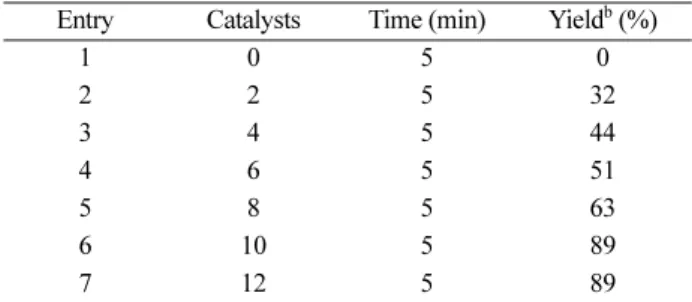
Firstly, we have studied the effect of catalyst concen- tration on model reaction. We have varied the concentra- tion of catalyst to 2, 4, 6, 8, 10 and 12 mol%. The results revealed that, when the reaction was carried out in the absence of catalyst, the reaction did not proceeded at all, whereas in the presence of 2, 4, 6, 8 mol% of catalyst it gave lower yield of product even after prolonged reaction time. At the same time when the concentration of catalyst was 10 mol% then we obtained the excellent yields of products in a short span. Even after increasing the catalyst concentration to 12 mol%, the yields of the products were found to be constant. So, the use of 10 mol% of catalyst appears to be optimal. The results obtained are summa- rized in (Table 1).
Scheme 1. Synthesis of Octahydroquinazolinone.
Fig. 1. Structure of thiamine hydrochloride (VB1).
Table 1. Screening of catalysts concentration on the model reac- tiona
Entry Catalysts Time (min) Yieldb (%)
1 0 5 0
2 2 5 32
3 4 5 44
4 6 5 51
5 8 5 63
6 10 5 89
7 12 5 89
aReaction of benzaldehyde, dimedone and urea in presence of thia- mine hydrochloride under microwave-irradiation and solvent-free condition. bIsolated yield.
Table 2. Optimization of solvent effect on the model reaction
Entry Solvent With MWa Without MWb
Time (min) Yieldc (%) Time (min) Yieldc (%)
1 Water 5 25 120 20
2 Toluene 5 34 120 28
3 Dimethyl formamide 5 65 120 53
4 Acetonitrile 5 72 120 60
5 Solvent free 5 89 120 65
aReaction of benzaldehyde, dimedone and urea in presence of thiamine hydrochloride (10 mol %) under microwave-irradiation for 5 minute.
bReaction of benzaldehyde, dimedone and urea in presence of thiamine hydrochloride (10 mol %) under reflux condition for 120 minutes.
cIsolated yield.
938 Pravin V Badadhe, Asha V. Chate, Dattatraya G. Hingane, Pravin S. Mahajan, Namdev M. Chavhan, and Charansingh H. Gill
Journal of the Korean Chemical Society
Furthermore, we studied the effect of catalyst on dif- ferent solvents for the synthesis of octahydroquinazoli- none using thiamine hydrochloride and the results are summarized in (Table 2).
The result revealed that solvent free approach gives bet- ter results as compared to the reaction carried out in pres- ence of various solvents. After optimizing the reaction conditions, the generality of this method was examined by the reaction of several substituted aldehydes, dimedone and urea/thiourea using thiamine hydrochloride as a cat- alyst in solvent free condition under microwave-irradia- tion; the results are shown in (Table 3).
Here, we have found that the reaction of aromatic alde- hydes having electron-withdrawing groups reacted at faster rate as compared to aromatics aldehydes with elec- tron releasing groups, unlike those of urea, the reaction of thiourea proceeded at lower rate, to give octahydro- quinazolinone. The results obtained in the current method are illustrated in (Table 3. entry 4i-l). We have tried this reaction on aliphatic aldehyde but we did not got satis- factory results. All the products thus obtained were fully characterized by spectroscopic methods such as IR, 1H NMR and mass spectroscopy and also compared with the reference compound.14 As can be seen from (Table 3) it was found that the microwave irradiation was very simple and convenient for the synthesis of octahydroquinazoli- none. It was observed that, the irradiation at low power requires longer time and at high power suffering from lower yield. So the irradiation at 360 W gives better results. The proposed reaction mechanism of the thiamine hydrochloride catalyzed Biginelli reaction includes the reaction of urea with aromatic aldehyde gives N-acylimin-
ium ion as a intermediate Then the interception of the imi- nium ion by dimedone presumably through its enol tautomer produces an open chain ureide which subse- quently cyclized to hexahydroquinazolinones. Finally VB1 catalyzed elimination of water from hexahydro- quinazolinones ultimately leads to the octahydroquinazoli- none.13
CONCLUSIONS
In conclusion, thiamine hydrochloride is a readily avail- able, non-toxic, inexpensive, and efficient catalyst for the synthesis of octahydroquinazolinone derivatives. The advantages offered by this method are solvent-free reac- tion conditions, short reaction times, ease of product iso- lation, and high yields. We believe that this environmental benign method is a useful addition to the present meth- odology for the synthesis of octahydroquinazolinone derivatives.
EXPERIMENTAL SECTION
All reagents were obtained from commercial suppliers and used without further purification. All melting points were determined in open capillaries and are uncorrected.
Reactions were monitored by thin-layer chromatography (TLC) on precoated silica gel F254 plates from Merck and compounds visualized in UV light or either by exposure to iodine. Microwave oven (LG Smart Chef MS-255R oper- ating at 2450 MHz having maximum out put power of 960 W) was used for microwave irradiation. 1H NMR spectra were recorded on Mercury plus Varian at 400 MHz in Table 3. Synthesis of octahydroquinazolinone derivatives catalyzed by thiamine hydrochloride under microwave-irradiationa
Entry Aldehydes X Time (min) Yieldb (%) M.P. oC
4a Benzaldehyde O 3.5 89 291-292
4b 4-Chlorobenzaldehyde O 4 82 >300
4c 4-Hydroxy-3-methoxy benzaldehyde O 3 88 191-192
4d 4-Nitrobenzaldehyde O 6 92 295-296
4e 4- Methoxybenzaldehyde O 2.5 86 246-247
4f 3-Chlorobenzaldehyde O 5 85 284-285
4g 4-Nitrobenzaldehyde O 7 83 299-300
4h 4-Flurobenzaldehyde O 4.5 88 135-136
4i Benzaldehyde S 11 87 281-282
4j 4- Methoxybenzaldehyde S 13 83 271-272
4k 3-Chlorobenzaldehyde S 14.5 85 277-278
4l 4-Bromobenzaldehyde S 16 86 283-284
aReaction Condition: 1 (a-l) (1 mmol), 2 (1 mmol), 3 (1.5 mmol) thiamine hydrochloride (10 mol%), under microwave-irradiation.
bIsolated yield. All the products obtained were fully characterized by spectroscopic methods such as IR, 1H NMR and mass14 and also com- prised with the reference compounds.14
2011, Vol. 55, No. 6
Microwave-Assisted One-Pot Synthesis of Octahydroquinazolinone 939
CDCl3 as a solvent and TMS as an internal standard.
Chemical shifts are reported in ppm (d) and coupling con- stants (J) are given in Hz. IR spectra were recorded on a Perkin Elmer FTIR using KBr discs. Mass spectra were recorded on Micromass Quattro II using electrospray Ion- ization technique.
Acknowledgements. We are grateful to the Head, Department of Chemistry, Dr. Babasaheb Ambedkar Mar- athwada University, Aurangabad and the principal, M. J.
S. College, Shrigonda, Ahmednagar. Authors also express their thanks to SAIF, Panjab University and University of Pune, India for recording spectral data for providing the laboratory facilities.
REFERENCES
1. Kidwai, M.; Saxena, S.; Khan, M. K. R.; Thukral, S. S.
Eur. J. Med. Chem. 2005, 40, 816.
2. (a) Yarim, M.; Sarac, S.; Kilic, K.; ErolS, F. II Farmaco.
2003, 58, 17; (b) Yarim, M.; Sarac, S.; Ertan, M.; Kilic, S. F.; Erol, K. Arzneim-Forsch. 2002, 52, 27.
3. Hassani, Z.; Islami, M. R.; Kalantari, M. Bio. Org. Med.
Chem. Lett. 2006, 16, 4479.
4. Kantevari, S.; Bantu, R.; Nagarapu, L. Arkivoc. 2006, xvi, 136.
5. Lin, H.; Zhao, Q.; Xu, B.; Wang, X. J. Mol. Catal. A:
Chemical. 2007, 268, 221.
6. Hassani, Z.; Islami, M. R.; Kalantari, M. Bioorg. Med.
Chem. Letts. 2006, 16, 4479.
7. Niralwad, K. S.; Shingate, B. B.; Shingare, M. S. J. Chin.
Chem. Soc. 2010, 57, 1.
8. Tonkikh, N. N.; Strakovs, A.; Petrova, M. V. Chem. Het- erocycl. Compds. 2004, 40, 43.
9. Loupy, A. Microwaves in organic synthesis, 2nd ed.; Wiley- VCH: Weinheim, 2006.
10. Varma, R. S. Green Chemistry. 1999, 1, 43.
11. (a) Yasuhara, A.; Suzuki, N.; Sakamoto, T. Chem.Pharm.
Bull. 2002, 50, 143. (b) Amantini, D.; Beleggia, R.;
Fringuelli, F.; Pizzo, F.; Vaccaro, L. J. Org. Chem. 2004, 69, 2896. (c) Hiyama, T.; Hatanaka, Y. Pure & App. Chem.
1994, 66(7), 1471. (d) Sharma, R. K.; Fry, J. L. J. Org.
Chem. 1983. 48(12), 2113. (e) Sun, H.; Di Magno, S. G.
J. Am. Chem. Soc. 2005, 127, 2050.
12. (a) Mandhane, P. G.; Joshi, R. S.; Nagargoje, D. R.; Gill, C. H. Tetrahedron Lett. 2010, 51, 1490. (b) Mandhane, P.
G.; Joshi, R. S.; Nagargoje, D. R.; Gill, C. H. Tetrahedron Lett. 2010, 51, 3138. (c) Joshi, R. S.; Mandhane, P. G.;
Diwakar, S. D.; Gill, C. H. Ultrason. Sonochem. 2009, 17, 298. (d) Joshi, R. S.; Mandhane, P. G.; Shaikh, M. U.;
Kale, R. P.; Gill, C. H. Chin. Chem. Lett. 2010, 21, 429.
(e) Jadhav, G. R.; Shaikh, M. U.; Kale, R. P.; Gill, C. H.
Chin. Chem. Lett. 2009, 20, 292. (f) Jadhav, G. R.; Kale, R. P.; Shaikh, M. U.; Gill, C. H. Chin. Chem. Lett. 2009, 20, 535. (g) Mandhane, P. G.; Joshi, R. S.; Ghawalkar, A.
R.; Jadhav, G. R.; Gill, C. H. Bull. Korean Chem. Soc.
2009, 30(12), 2969.
13. Falsone F. S.; Kappe, C. O. Arikivoc. 2001, (II), 122.
14. Typical experimental procedure for octahydroquinazoli- none: A mixture of aromatic aldehydes. 1(a-l): (1 mmol), dimedone. 2: (1mmol) urea/thiourea. 3: (1.5 mmol), and thiamine hydrochloride (10 mol%) was mixed properly with the help of glass rod and irradiated in a microwave oven for appropriate time as indicated in Table 3. The progress of the reaction was monitored by TLC (ethyl acetate: hexane, 6:4). After completion of the reaction, the reaction mixture was cooled and ice cold water (25 mL) was added. The solid compound thus obtained was fil- tered and crystallized from absolute ethanol to afford the pure corresponding octahydroquinazolinone derivatives.
4(a-l): in excellent yields. All the products were charac- terized from their spectral data. Spectroscopic data. (4a):
IR (KBr) νmax 3324 (br), 3254 (br), 2960 (br), 1708 (s), 1677 (s), 1610 (vs), 1447 (w), 1370 (s), 1230 (s), 763 (s), 689 (w), 564 (w), 486 (w), 429 (w) cm-1. 1H NMR (400MHz, DMSO, d6), δ 0.94 (s, 3H, Me); 1.10 (s, 3H, Me); 2.20 (q, J = 16.0Hz, 2H, CH2); 2.38 (q, J = 16.7 Hz, 2H, CH2 ); 5.25 (d, J = 2.8 Hz,1H, CH); 7.32-7.21 (m, 5H, Ar ); 7.46 (s, 1H, NH); 9.38 (s, 1H, NH); MS (ESI) m/z 271 (M+1). (4b): IR (KBr) νmax 3247 (br), 2960 (br), 1697 (vs), 1612 (vs), 1487 (s), 1375 (s), 1239 (s), 807 (w), 763 (w), 566 (s), 509 (w) cm-1; 1H NMR (400 MHz, CDCl3, d6), δ 0.95 (s, 3H, CH3); 1.08 (s, 3H, Me); 2.19 (q, J = 17.5 Hz, 2H, CH2); 2.37 (q, J = 17.5 Hz, 2H, CH2); 5.30 (d, J = 2.8 Hz, 1H, CH); 7.19-7.30 (m, 4H, Ar); 7.54 (s, 1H, NH); 9.36 (s, 1H, NH); MS (ESI) m/z 305 (M+1). (4j): IR (KBr) νmax 3259 (br), 3160 (br), 2956 (br), 1642 (vs), 1584 (vs), 1376 (s), 1252 (m), 1170 (s), 1023 (m), 825 (w), 768 (w), 551 cm-1; 1H NMR (400 MHz, CDCl3, d6), δ 0.97 (s, 3H, Me); 1.10 (s, 3H, CH3);
2.16 (q, J = 16.0 Hz, 2H, CH2); 3.11 (s, 2H, CH2); 3.70 (s, 3H, OCH3), 5.17 (d, J = 2.7 Hz, 1H, CH); 6.81 (d, J = 8.7Hz, 2H, Ar); 7.25 (d, J = 8.6 Hz, 2H, Ar); 9.42 (s, 1H, NH); 10.34 (s, 1H, NH); MS (ESI) m/z 317 (M+1).