submit.radiology.or.kr J Korean Soc Radiol 2012;66(6):547-550
547 INTRODUCTION
Lymphangiomas are a heterogeneous group of vascular mal- formations of the lymphatic channels and are composed of cys- tically dilated lymphatics. According to Landing and Farber, these benign malformations are classified into four subtypes:
capillary lymphangiomas, cavernous lymphangiomas, cystic lymphangiomas (hygromas) and hemolymphangiomas (com- bination of hemangiomas and lymphangiomas).
Hemolymphangiomas are extremely rare and in most cases, detected at birth or within 2 years of life. Lymphangiomas are rare in the extremities, and to the best of our knowledge, only four cases affecting the extremities have been reported in the literature to date (1-3). Prenatal ultrasonography can detect rel- atively large lesions as early as the second trimester (4).
We report a case of a hemolymphangioma arising in the up- per extremity, and we also describe the radiological findings of
this disease and discuss the relevant literature review.
CASE REPORT
A 7-year-old male patient presented to our orthopedic exam- ination room with a palpable, painless mass on the anteromedi- al side of his right elbow. Clinically, the lesion was found to be oval in shape, soft, compressible and painless. There was no history of trauma, previous infection or constitutional symp- toms.
Anteroposterior and lateral plain radiographs demonstrated a well-defined soft tissue mass with focal calcification regarded as a phlebolith (Fig. 1). The lesion was confined to subcutane- ous tissue without signs of bony erosion.
Magnetic resonance imaging of the affected area was per- formed pre-operatively in order to characterize the tumor, estab- lish the extent of the tumor, and define the relationship to the
Case Report
pISSN 1738-2637
J Korean Soc Radiol 2012;66(6):547-550
Received February 8, 2012; Accepted April 4, 2012 Corresponding author: Yong Hoon Kim, MD Department of Radiology, Ilsan Paik Hospital, Inje University College of Medicine, 170 Juhwa-ro, Ilsanseo-gu, Goyang 411-706, Korea.
Tel. 82-31-910-7395 Fax. 82-31-910-7369 E-mail: [email protected]
This work was supported by Grant from Inje University, 2007.
Copyrights © 2012 The Korean Society of Radiology
Hemolymphangiomas are rare benign soft tissue tumors that arise from congenital malformations of the vascular system. The malformations are usually diagnosed at birth or early in childhood and cases in the extremities have been scarcely reported.
We present a very rare case of hemolymphangioma of the right upper extremity in a 7-year-old male. The diagnosis was made by plain radiography and magnetic res- onance imaging and finally confirmed by histopathology of the resected specimen.
The hemolymphangioma showed a well-defined soft tissue mass with a phlebolith on plain radiography, and a multilocular cystic mass with peripheral and septal en- hancement on magnetic resonance imaging.
Index terms Hemolymphangioma Lymphangioma Vascular Malformations Upper Extremity
Magnetic Resonance Imaging
Upper Extremity Hemolymphangiomas in Children: A Case Report
1 소아의 상지에서 발생한 혈관림프관종: 증례 보고 1예1Hyo Jin Kang, MD
1, Yong Hoon Kim, MD
1, Yoon Joon Hwang, MD
1, Su Young Kim, MD
1, Han Seong Kim, MD
2Departments of 1Radiology, 2Pathology, Ilsan Paik Hospital, Inje University College of Medicine, Goyang, Korea
Upper Extremity Hemolymphangiomas in Children
submit.radiology.or.kr
J Korean Soc Radiol 2012;66(6):547-550
548
on plain radiographs. Peripheral and septal enhancement of the tumor was observed after administration of gadolinium. The le- sion had fine adhesions to the surrounding tissue, and the cortex of the bone was found intact. The imaging findings were suspi- cious for the diagnosis of a hemangioma, cystic lymphangioma, unusual peripheral nerve sheath tumor or Kimura’s disease.
An excisional biopsy of the lesion was performed to release the specimen from the adhesion to subcutaneous tissue. A his- tological examination described the resected tumor as a fibro- lipomatous mass containing lymphatic and blood vessels with the stroma being infiltrated by lymphocytes (Fig. 3). The histo- pathological diagnosis following a complete surgical resection was a hemolymphangioma.
DISCUSSION
Lymphangiomas are considered to be a congenital malfor- mation of the lymphatic system. The greatest impediment for the diagnosis and treatment of vascular anomalies has been the confusing terminology. A biologic classification system intro- duced in 1982 based on studies correlating physical findings, natural history, and cellular features has clarified most of the surrounding structures. The mass was seen to be a well circum-
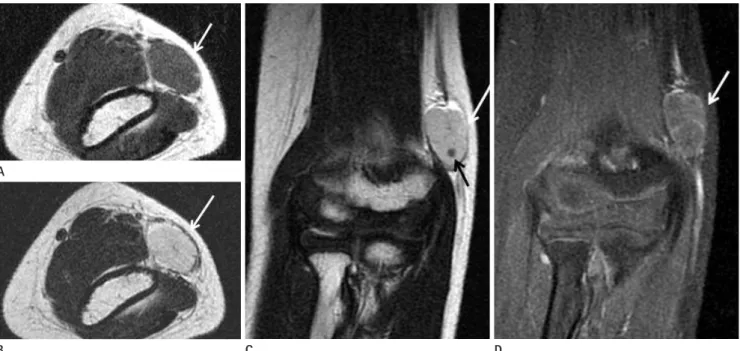
scribed, lobulated, multilocular cystic mass with a maximum di- ameter of 19 mm, localized in the prefascial subcutaneous tis- sues, and anteromedial aspect of the right medial epicondyle of humerus (Fig. 2). The mass had an intermediate to slightly high signal intensity on T1-weighted sequences and hyperintense signal intensity with internal thin septae on T2-weighted se- quences. Focal dot-like dark signal intensity was noted within the mass for all sequences that corresponded to the phlebolith
Fig. 1. Anteroposterior plain radiographic finding for case. Antero- posterior plain radiograph of the right elbow shows a phlebolith (ar- rowhead) within the soft tissue mass (arrows).
Fig. 2. MR imaging findings for the case study. Axial (A) T1-weighted SE image (TR: 450, TE: 11) shows an isointense mass (arrow). Axial (B) and coronal (C) T2-weighted SE image (TR: 2967, TE: 88 ms) shows homogeneous high signal intensity of the entire mass (white arrow) with thin hy- pointense septae and a focal dark signal intensity (black arrow). A coronal (D) contrast-enhanced T1-weighted image shows peripheral and sep- tal enhancement of the tumor (arrow).
Note.-MR = magnetic resonance, SE = spin echo, TE = echo time, TR = repetition time
D C
B A
Hyo Jin Kang, et al
submit.radiology.or.kr J Korean Soc Radiol 2012;66(6):547-550
549
Histologically, hemolymphangiomas consist of dense fibrous tissue that grows in bands between the numerous vascular spaces and invades the subcutaneous fat. Some of those are blood ves- sels, while others are lymphatic.
Its occurrence in the extremities is very rare, although two cases have been reported in the literature as hemolymphangio- mas of the lower extremities in children (2). In two cases dem- onstrated to be a soft tissue mass in a subcutaneous fat layer of the proximal tibia, the masses demonstrated cystic mass with blood flow on ultrasound sonography and hyperintense signal intensity on T2-weighted images. Two other cases reported in the literature as cystic lymphangiomas affecting the extremities (1, 3), showed soft tissue masses in the forearm and plantar as- pect of foot, respectively. In all cases, the masses showed a mul- tilocular cystic mass without remarkable blood flow on ultra- sound sonography and intermediate to low signal intensity on T1-weighted images and high signal intensity on T2-weighted images. Gadolinium-enhanced T1-weighted images showed rim enhancement of the mass in all cases. Our report is one of the first clinical descriptions by plain radiograph and magnetic resonance imaging findings of a hemolymphangioma located in an extremity.
Plain radiographs show a soft tissue mass with an intact un- derlying bony cortex. Some cases have a phlebolith, and are commonly misdiagnosed as hemangiomas.
Radiologic documentation is best performed by magnetic resonance imaging; where, lymphangiomas are characterized by the absence of feeding vessels and lack of intense contrast terminologic disorder. There are two major types of vascular
anomalies: tumors and malformations. Vascular tumors are en- dothelial neoplasms characterized by increased cellular prolif- eration. Hemangiomas are the most common and are almost exclusive to infants. Vascular malformations are the result of the abnormal development of vascular elements during embryogen- esis and fetal life. These may be single formations (capillary, arte- rial, lymphatic or venous) or in combination. Vascular malfor- mations do not generally demonstrate increased endothelial turnover; they are designated according to the predominant channel type as capillary malformations, lymphatic malforma- tions, venous malformations, arteriovenous malformations, and complex forms such as capillary-lymphatico-venous malforma- tions. Malformations with an arterial component are fast-flow while all others are slow-flow (5-7).
Lymphangiomas are slow-flow vascular malformations and are histologically classified as capillary (formed by small thin walled lymphatic vessels), cavernous (formed by large lymphat- ic vessels with a fibrous adventitia), cystic (composed of macro- scopic lymphatic spaces) and hemolymphangioma (combina- tion of a hemangioma and lymphangioma).
Hemolymphangiomas are mostly presented as cystic or cavern- ous lesions. It generally occurs as a solitary or multiple mass in the cervicofacial region (75-90%) or in the axilla, or even in the tho- racic, abdominal, retroperitoneal or mesenteric regions (1).
The incidence of hemolymphangiomas varies from 1.2 to 2.8 per 1000 newborns. However, only 6.5% of them are located at the extremities and both sexes get equally affected (2). The di- agnosis in most cases (90%) is made before the age of two years, while 60% of those are present at the time of birth. In a clinical examination, they are usually described as soft and compressible masses, loculated in pattern.
The formation of the tumor may be explained by the obstruc- tion of the venolymphatic communication, between dysembrio- plastic vascular tissue and the systemic circulation during em- bryologic development (8). A segmentation of the outbudding of the primary lymphatic sacs is thought to be the basis of the de- velopment of this anomaly.
Takahashi et al. (9) demonstrated that during the proliferating phase, many growth factors such as vascular endothelial growth factor, basic fibroblast growth factor, proteases, and E-selectin (an adhesion molecule), may be involved.
Fig. 3. Histological finding for case. Low power (H&E stain, × 10) ex- amination reveals a mixed hemangioma and lymphangioma area.
Hemangiomas have thin walls and contain blood cells in the lumina (arrowheads). The lymphangioma area shows irregularly-contoured vessels with lymphoid cells (arrows).
Upper Extremity Hemolymphangiomas in Children
submit.radiology.or.kr
J Korean Soc Radiol 2012;66(6):547-550
550
Cystic lymphangioma of the upper extremity: US and MRI correlation (2004:11b). Eur Radiol 2005;15:400-402 2. Kosmidis I, Vlachou M, Koutroufinis A, Filiopoulos K. He-
molymphangioma of the lower extremities in children:
two case reports. J Orthop Surg Res 2010;5:56
3. Ly JQ, Gilbert BC, Davis SW, Beall DP, Richardson RR.
Lymphangioma of the foot. AJR Am J Roentgenol 2005;
184:205-206
4. Suzuki N, Tsuchida Y, Takahashi A, Kuroiwa M, Ikeda H, Mohara J, et al. Prenatally diagnosed cystic lymphangioma in infants. J Pediatr Surg 1998;33:1599-1604
5. Christison-Lagay ER, Fishman SJ. Vascular anomalies. Surg Clin North Am 2006;86:393-425, x
6. Marler JJ, Mulliken JB. Current management of hemangi- omas and vascular malformations. Clin Plast Surg 2005;
32:99-116, ix
7. Dohil MA, Baugh WP, Eichenfield LF. Vascular and pig- mented birthmarks. Pediatr Clin North Am 2000;47:783- 812, v-vi
8. Balderramo DC, Di Tada C, de Ditter AB, Mondino JC. He- molymphangioma of the pancreas: case report and review of the literature. Pancreas 2003;27:197-199
9. Takahashi K, Mulliken JB, Kozakewich HP, Rogers RA, Folk- man J, Ezekowitz RA. Cellular markers that distinguish the phases of hemangioma during infancy and childhood. J Clin Invest 1994;93:2357-2364
enhancement. Hemolymphangiomas, like lymphangiomas and most vascular malformations, demonstrate hyperintense signal intensity on T2-weighted and turbo short T1 inversion recov- ery images. The masses demonstrate peripheral and septal en- hancement after administration of gadolinium. Conventional contrast lymphangiography is rarely performed.
While the lesion is regarded a benign soft tissue tumor, the clinical and radiologic findings overlap. Differential diagnosis includes hemangioma, cystic lymphangioma, peripheral nerve sheath tumor and Kimura’s disease. Kimura’s disease, which is characterized as a partially or poorly defined subcutaneous mass involving the upper extremities, is very rare. Its signal in- tensities on T1- and T2-weighted images are similar to hemo- lymphangioma, but have moderate to good homogeneous en- hancement, variable stranding in the surrounding subcutaneous tissue, and serpentine signal voids within the mass.
Complete surgical excision gave the best results along with a lower recurrence rate. On the contrary, aspiration and injection of sclerotic agents gave the highest risk of recurrence.
In conclusion, hemolymphangiomas are rare, especially in an extremity. It is important for the radiologist to be aware of the diagnosis. Surgical resection of the mass is recommended as part of the treatment with the goal of complete excision.
REFERENCES
1. Rossi G, Iannicelli E, Almberger M, Innocenzi D, David V.
소아의 상지에서 발생한 혈관림프관종: 증례 보고 1예1
강효진
1· 김용훈
1· 황윤준
1· 김수영
1· 김한성
2혈관림프관종은 드문 양성 연부조직종양으로 혈관계에서 발생하는 선천적인 기형이다. 이 질환은 대부분 출생시나 소아 에서 진단되고, 특히 사지에서 발생하는 경우는 극히 드물게 보고되고 있다. 이에 저자들은 보기 드문 위치인 상지에서 발 생한 혈관림프관종 1예를 영상의학적 소견 및 병리 소견과 함께 보고하고자 한다. 진단은 단순촬영과 MRI 그리고 최종 적으로 병리학적으로 확인되었다. 본 증례는 단순촬영에서 경계가 좋은 연부조직종양으로 정맥석을 보였고, MRI에서 다 방성낭종으로 주변부 및 격막의 조영증강을 보였다.
인제대학교 의과대학 일산백병원 1영상의학과학교실, 2병리과학교실