361
Preparation of Highly Tough Ethylene Vinyl Acetate (EVA) Heterogeneous Cation Exchange Membranes and Their Properties of Desalination
In Sik Kim, Dae Young Ko, Ali Canlier and Taek Sung Hwang†
Department of Chemical Engineering and Applied Chemistry, College of Engineering, Chungnam National University, 99, Daehak-ro, Yuseong-gu, Daejeon, 34134, Korea
(Received 22 February 2018; Received in revised form 19 March 2018; accepted 21 March 2018)
Abstract − A manufacturing method has been devised to prepare novel heterogeneous cation exchange membranes by mixing ethylene vinyl acetate (EVA) copolymers with a commercial cation exchange resin. Optimum material charac- teristics, mixture ratios and manufacturing conditions have been worked out for achieving favorable membrane perfor- mance. Ion exchange capacity, electrical resistance, water uptake, swelling ratio and tensile strength properties were measured. SEM analysis was used to monitor morphology. Effects of vinyl acetate (VA) content, melt index (MI) and ion exchange resin content on properties of heterogeneous cation exchange membranes have been discussed. An appli- cation test was carried out by mounting a selected membrane in a membrane capacitive deionization (MCDI) system to investigate its desalination capability. 0.92 meq/g of ion exchange capacity, 8.7 Ω.cm2 of electrical resistance, 40 kgf/
cm2 of tensile strength, 19% of swelling ratio, 42% of water uptake, and 56.4% salt removal rate were achieved at best.
VA content plays a leading role on the extent of physical properties and performance; however, MI is important for hav- ing uniform distribution of resin grains and achieving better ionic conductivity. Overall, manufacturing cost has been suppressed to 5-10% of that of homogeneous ion exchange membranes.
Key words: Heterogeneous Membrane, Ethylene Vinyl Acetate, Cation Exchange Membrane, MCDI
1. Introduction
With recent industrial developments, sentiment and interest in environmental pollution and exhaustion of water resources have been growing in advanced countries, hence development of new technologies to cope with related issues has become crucial. In par- ticular, desalination of seawater and ground water, in which various ions are dissolved, has become a requirement to resolve the world- wide water shortage. Desalination technology includes techniques such as electrodialysis, reverse osmosis, multi-stage flash distilla- tion and multiple-effect distillation. In these technologies, crystalli- zation, ion exchanging, solution extraction and pressure adsorption methods are employed [1-5]. Besides desalination of seawater, removal of heavy metals, purification of dairy products and bever- ages are other application examples which are addressed by similar technologies [6-8].
Among several desalination approaches, electrodialysis (ED) technology has been employed for more than 60 years as a process that separates salt with ion exchange membranes [9-11]. In addition to electrodialysis, various relevant technologies and devices, such as diffusion dialysis and capacitive deionization (CDI) have been intro- duced. Membrane capacitive deionization (MCDI) is a capacitive
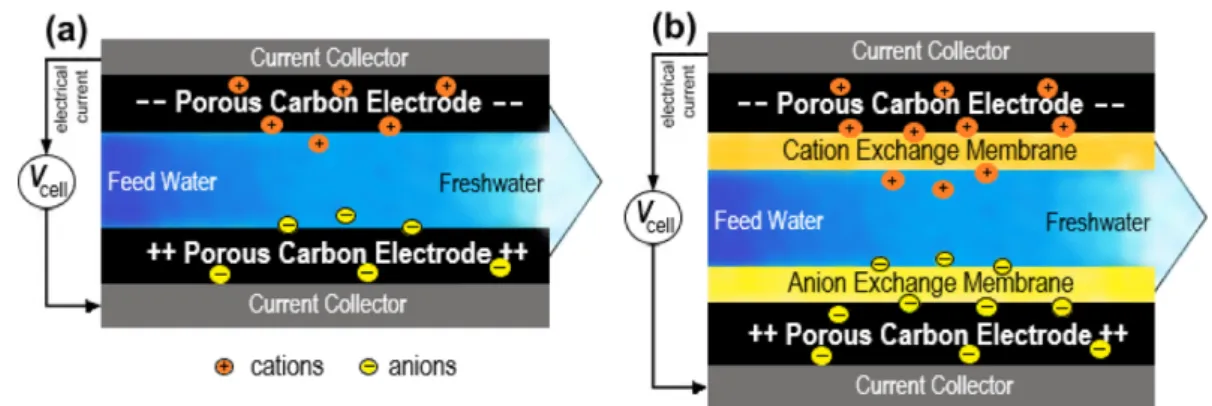
deionization method which incorporates one or more ion exchange membranes additionally. It is drawing attention for highly selective and energy efficient separation capability. As in CDI, ionic materials are separated from mixture by assistance of an electric field, but with higher efficiency, selectivity and electrode durability in MCDI. The system absorbs solutes selectively in one time and desorbs in another time when the direction of the electric field is reversed (Fig. 1).
Desorption step is the main difference from electrodialysis method and it affects the cell design greatly. Similar to electrodialysis, only substances with electric charge are drawn towards electrodes and permeated through ion exchange membranes selectively [12,13], but the desorption helps in keeping electrodes less contaminated and more capable in next cycles. As an advantage of MCDI method, energy consumption is lower compared to reverse osmosis in case of lower salinities (<2 g/L) [14,15].
Recently, membrane based separation process has been drawing attention due to its wider application scope, including energy pro- duction and storage systems. Performance of membranes used in MCDI and other membrane systems is the key factor that deter- mines the overall quality of the system. Mostly, the cost of the mem- brane is also one of the gross constituents of the overall manufacturing cost. Membranes can be mainly categorized as homogeneous and heterogeneous. For homogeneous ion exchange membranes, although their electrochemical characteristic is excellent, the mechanical strength is usually weaker compared to heterogeneous ones [16-18]. On the other hand, heterogeneous ion exchange membranes may exhibit rel- atively lower electrochemical characteristics but excellent mechani-
†To whom correspondence should be addressed.
E-mail: [email protected]
This is an Open-Access article distributed under the terms of the Creative Com- mons Attribution Non-Commercial License (http://creativecommons.org/licenses/by- nc/3.0) which permits unrestricted non-commercial use, distribution, and reproduc- tion in any medium, provided the original work is properly cited.
cal strength [19-21].
Among widely adopted commercial ion exchange membranes, Nafion brand supplied by Dupont, Aciplex by Asahi Chemical, and CMS by Tokuyama can be counted. However, the price of these products is not much competitive (1,000-4,000 USD/m2), hence, cost remains as a longtime challenge. Therefore, development of het- erogeneous membranes with lower cost and extra mechanical strength has been investigated to replace these commercial homogeneous membranes. Heterogeneous membranes are inexpensive, durable, and also manufacturing and marketing require less effort [22].
Currently, some known heterogeneous ion exchange membranes are prepared by dispersing and fixing an ion exchange resin in poly- vinylidene fluoride (PVDF) polymer matrix. Although these materi- als exhibit excellent ion exchange performance, they exhibit weak membrane strength [23]. Therefore, our aim was to address such mechan- ical weakness using materials that can supplement the matrix drawbacks of such heterogeneous ion exchange membranes. New heterogeneous membranes have been designed using ethylene vinyl acetate (EVA) copolymer resin of varying vinyl acetate content and a sulfonated cation exchange resin (TRILITE® SCR-B type) (Fig. 2).
EVA materials exhibit strong durability, high flexibility, stress-crack resistance, hot-melt adhesive waterproof properties, and also low- temperature toughness [24]. Both components of the membrane can be purchased at reasonable price so that the overall manufacturing cost can be reduced to 5-20 USD/m2 for such heterogeneous membranes.
In this study, outputs of mechanical strength and electrochemical behavior of heterogeneous cation exchange membranes were inves-
tigated mainly as functions of vinyl acetate (VA) content of EVA copolymers and their melt index (MI). In addition, some optimum mixing conditions and weight ratios for the mixture with ion exchange resin were worked out. Ion exchange capacity, swelling ratio, water uptake, electrical resistance and mechanical strength properties of new membranes were measured. Based on these results, optimum manufacturing conditions have been established. Also, a desalina- tion test was demonstrated by mounting into an MCDI system one of the new heterogeneous EVA-cation exchange membranes of best ion exchange capacity and tensile strength performances.
2. Experimental
2-1. Materials
Ethylene vinyl acetate (EVA) resins, which possesses varying physical properties as listed in Table 1 (VA content and MFIs reported by manufacturer), were purchased from Hanwha Chemical Co. Ltd., Korea to manufacture the heterogeneous membrane. TRILITE SCR- B type (IEC < 1.7 meq/mL, particle size: 0.3~1.2 mm) was purchased from Samyang Corporation, Korea and used as cation exchange resin.
2-2. Preparation of EVA heterogeneous cation exchange mem- brane
Moisture content within the ion exchange resin was made uni- form by drying it at 323 K for 48 hours to achieve physicochemical uniformity and adequate dryness in the ion exchange resin, which is a key factor in manufacturing the membranes in this work. The cat- Fig. 1. Schemes for (a) capacitive deionization (CDI) and (b) Membrane capacitive deionization (MCDI) systems.
Fig. 2. (a) Structure of ethylene vinyl acetate copolymer. (b) TRILITE® SCR-B cation exchange resin. And (c) Scheme of a heterogeneous cat- ion exchange membrane.
ion exchange resin was ground to a particle size smaller than 50 μm using a pin mill. X1030D model high molecular weight homoge- nizer (CAT, Ingeniurburo M. Zipperer GmbH) was used to uni- formly disperse resin powder. Heterogeneous membranes were prepared by addition of the mixture components in a two-roll mill (KOM, Mastercam, Korea) under the conditions listed in Table 2.
The process was repeated five times for uniform dispersion and thickness of 0.4 mm.
2-3. SEM analysis
SEM (JEOKL Instrument, JSM-6700, Thermo NORAN) was used to monitor the morphology of the prepared heterogeneous mem- branes. Accelerating voltage was set to 10 kV for surface and 5 kV for cross section, and the samples were coated with platinum by ion sputtering method in advance.
2-4. Measurement of water uptake and swelling ratio The specimens were prepared by cutting the membrane into a spe- cific size (3 cm×3 cm) to measure the water uptake of the prepared EVA heterogeneous cation exchange membranes. These specimens were first weighed when dry and then immersed in distilled water for 24 hours to achieve sufficient swelling of the membrane. Membrane specimens were removed and weighed to calculate the water uptake using Eq. 1.
Water uptake (%) = (Wwet – Wdry)/Wdry × 100 (1) where Wdry and Wwet are the masses of the membrane before and after swelling, respectively.
Furthermore, the cross-sectional area of the cut membrane was
measured, and then the swelling ratio of the membrane was calcu- lated using Eq. 2.
Swelling ratio (%) = (Awet – Adry)/Adry × 100 (2) where Adry and Awet are the areas of the membrane before and after swelling, respectively.
2-5. Electrical resistance
The electrical resistance of the prepared heterogeneous mem- brane was measured using a 3522-50 Hitester LCR meter (HIOKI Co. Japan) at 500 Hz. After the heterogeneous membrane was cut into a 1.5 cm×1.5 cm specimen, this sample was immersed in a 1.0 M NaCl standard solution for 24 hours, and then the electrical resis- tance was measured using a 2-compartment cell. The cut membrane was fixed to the cell. Here, a 1.0 M NaCl solution was used as the electrolyte solution. The electrical resistance of the membrane was calculated using Eq. 3.
ER (Ω · cm2) = (R1 – R2) · A (3)
where R1 is the electrical resistance after installing the membrane, R2 is the electrical resistance prior to installing the membrane, and A is the effective area (cm2) of the membrane (1 cm×1 cm in this study).
2-6. Ion exchange capacity
Ion exchange capacities of prepared EVA heterogeneous cation exchange membranes were measured using an acid-base titration method. A membrane was cut into a 3 cm×3 cm specimen, weighed and immersed in a 1 M HCl standard solution for 24 hours to con- vert any salt form of sulfonate groups to SO3H, followed by washing with distilled water. The membrane was then impregnated in 300 mL of 0.1 M NaOH standard solution and stirred for 24 hours. After adsorption equilibrium was achieved, the supernatant was collected.
Phenolphthalein indicator was added and titration was carried out with a 0.1 N HCl standard solution. Ion exchange capacity of the het- erogeneous cation exchange membrane was determined using Eq. 4.
IEC (meq/g) = [(VNaOH × CNaOH) – (VHCl × CHCl)] / Wdry (4) where VNaOH and VHCl are the volumes of NaOH and HCl, respec- tively, and CNaOH and CHCl are the concentrations of NaOH and HCl, respectively. Wdry is the weight of the dry membrane.
2-7. Measurement of Tensile Strength and Elongation To determine the tensile strength of the membrane, a specimen Table 1. Physicochemical properties of various EVA copolymers
Matrix VA content (wt%) Density (g/cm3) Melt index (g/10 min) Melting Point (K) Tensile Strength (kgf/cm2) Elongation (%)
EVA 1828 28 0.960 4.0 348 190 800
EVA 1159 28 0.949 18 344 140 920
EVA 1157 18 0.939 16 358 138 860
EVA 2815 15 0.935 6.5 361 180 780
Table 2. Preparation conditions of the heterogeneous EVA cation exchange membranes
Batch No. EVA (wt%) IERa (wt%) Temperature (K)
EVA1828-1 30 70 353
EVA1828-2 40 60 353
EVA1828-3 50 50 353
EVA1159-1 30 70 353
EVA1159-2 40 60 353
EVA1159-3 50 50 353
EVA1157-1 30 70 343
EVA1157-2 40 60 343
EVA1157-3 50 50 343
EVA2815-1 30 70 343
EVA2815-2 40 60 343
EVA2815-3 50 50 343
aIER: Ion exchange resin
was prepared according to the test method described in ASTM D638. Tensile strength of the heterogeneous membrane was mea- sured using a universal testing machine (UTM) at a 5 cm/min speed.
The measurement was carried out five times for the same specimen to decrease the deviation in the measurement values.
2-8. Desalination characteristics in membrane capacitive deion- ization (MCDI)
EVA heterogeneous membranes were employed in an MCDI cell, and the changes in the efficiency were observed. Electrochemical cells consisted of a nylon spacer, a silicone barrier, a heterogeneous cation exchange membrane of EVA 1159, an anion exchange mem- brane (aminated polyvinylidene fluoride-graft-vinyl chloride: A- PVDF-g-VBC) which was reported in Ref. [25], and porous carbon electrodes (anode and cathode). A working electrode (WE) and a sensor electrode (SE) were connected to the cathode, and a counter electrode (CE) and a standard electrode (SE) were connected to the anode. An NaCl aqueous solution with a concentration of 250 mg/L was supplied to the cell at a flow rate of 20 mL/min using a peristal- tic pump, and a constant electrical potential was supplied using a potentiostat (WEIS 500, WonA Tech Corp.). The changes in the con- centration were measured as an electrical potential of +1.5 V was sup- plied to the electrodes using the potentiostat. This voltage input was applied for 180 s, and it was reversed to -1.5 V for 120 s to desorb the ions. This cycle was repeated four times. Concentration of NaCl solution was measured using the total desolved solubility (here we
refer to it as TDS) sensor, and the results were recorded using a midi Logger GL220 (GraphTech) at one-second intervals. The obtained salt removal speed (%) was calculated by using Eq. 5.
Salt removal rate (%) = (Cf – Cp) / Cf × 100 (5) where Cf is the initial concentration of the solution, Cp is the low- est concentration of the solution.
3. Results and Discussion
3-1. SEM analysis
Properties of prepared membranes are significantly related to their structure, especially the spatial distribution of ionic sites [26,27].
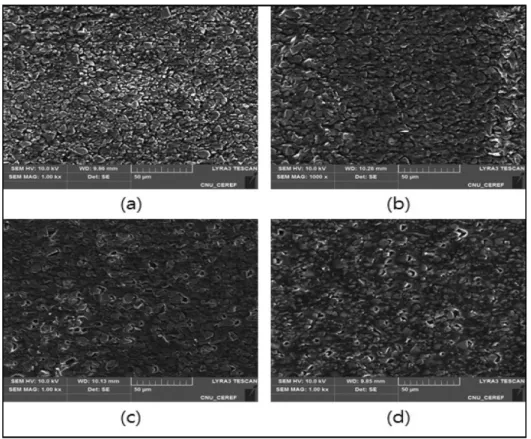
SEM analysis was used to investigate the surface and cross section morphology of heterogeneous membranes, and the results are shown in Fig. 3, 4. Fig. 3 shows the surface of heterogeneous membranes.
As shown, resin grains in the EVA matrix are laid on the surface of membranes uniformly. For heterogeneous membranes of EVA 1159 and EVA 1157, which have similar MIs, ion exchange resin (IER) grains are dispersed on the surface of membrane with tight and smooth packing. However, in EVA 1828 and EVA 2815, a rather disordered packing and occasional vacancies can be seen on the surface. This trend may be due to difference in MIs depending on the type of EVA (Table 1). For EVA 1157 and EVA 1159, MI values are higher than 10, which indicates very good fluidity. However, for EVA 2815 and EVA 1828, MI values are lower than 10, which resulted in ion exchange
Fig. 3. SEM image of membrane surface (×1000 magnified): (a) EVA 1159/IER (3:7), (b) EVA 1157/IER (3:7), (c) EVA 1828/IER (3:7), (d) EVA 2815/IER (3:7).
resin being insufficiently dispersed in the matrix, and pores uniformly distributed. These channels up to 10 μm-size may assist easy flow and transportation of counter-ions and improve electrochemical prop- erty of membranes [28]. Contrary to this, uniform dispersion of smaller size grains may favor better ionic conductivity, which is a result of higher MI.
Fig. 4 shows the cross-sectional area of two heterogeneous mem- branes, a commercial one and one prepared with EVA 1157, at a magnification rate of 250 times. In case of commercial heteroge- neous membrane, ion exchange resin grains are embedded less uni- formly. However, in the heterogeneous membrane prepared with EVA 1157, grains of ion exchange resin are almost evenly distrib- uted within the matrix throughout the cross-section. Such even dis- persion of grains may result in a higher elongation rate. In addition, finer size of resin grain may bolster electrochemical properties of membranes.
3-2. Water uptake and swelling ratio
For heterogeneous membranes, water uptake and swelling ratio are very important parameters. If swelling ratio is too high, the mem- brane may deform. In addition, for heterogeneous membranes with high water uptake, the required force increases excessively during membrane capacitive deionization and electrodialysis due to the increase in the weight of membranes, which sets a limit on the appli- cation of these processes. Therefore, manufacturing heterogeneous ion exchange membranes with moderate water uptake and swelling ratio is of great importance for achieving good performance.
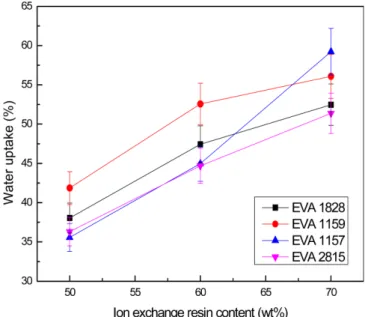
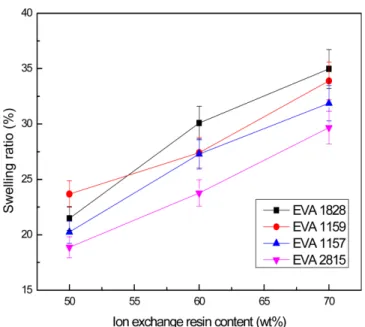
Water uptake and swelling ratio of the prepared EVA heteroge- neous membranes were measured, and the results are shown in Fig. 5, 6, respectively. As the ion exchange resin (IER) content increases, water uptake and swelling ratio increase accordingly as expected [29].
While higher EVA/IER ratio fosters the mechanical properties of membranes, it brings about a resistance to the absorption of water since EVA contains mainly highly hydrophobic ethylene groups and hydrophobic acetate groups [30,31]. In spite of its hydrophobicity, the acetate group has polar sites and may interact with polar solvents
better than ethylene does. On the other hand, an increase in vinyl ace- tate (VA) content in EVA copolymer results in a disordered packing of chains and decrease in rigidity, which also means more polar sites exist and thus interaction with a polar solvent may become more effective. These may give rise to a higher swelling effect since intro- duction of a polar solvent may force polymer chains to a micellar behavior due to the polarity difference of VA and ethylene groups.
The fact that swelling ratio is lowest for membrane of EVA 2815 (VA content: 15%), and highest for membranes of EVA 1159 and EVA 1828 supports these deductions.
Ion exchange resin used in this study can exhibit 43~50% mois- ture retention by itself, and this adds to the overall water uptake of the heterogeneous membrane, where highest values range between 42%-59%, and lowest values range between 35%-51% (Fig. 5).
Lowest water uptake is exhibited by EVA 2815, so this result also reinforces the importance of VA content factor. However, there is not a strict correlation between water uptake and VA content when the Fig. 4. SEM image of membrane cross-section (×250 magnified): (a) IONAC® MC-3470 by LANXESS Sybron Chemicals Inc. (Birmingham,
NJ, USA), (b) EVA 1157/IER (3:7).
Fig. 5. Water uptake of EVA heterogeneous membranes as ion exchange resin content.
mixture composition changes. Higher MI factor, which facilitates the uniformity of the matrix, and other factors may have caused higher water uptake by membrane of EVA 1157, when EVA ratio was low- ered (30%). Values of observed water uptake and swelling ratio are within adoptable ranges of practical applications as compared to the results of Jeong et al [23].
3-3. Electrical Resistance
VA content significantly influences general properties of EVA. By manipulating VA content, a number of quality products have been manufactured and commercialized so far [32]. Electrical resistance is also influenced by VA content when EVA/IER ratio is above cer- tain values. Electrical resistance values of the heterogeneous cation exchange membranes are summarized in Fig. 7. Above 40% EVA content (50%) in the mixture, VA content acts as the determining fac- tor for electrical resistance, and its effect is greater than that of MI as electrical resistance is almost proportional to VA content. In case of 40% EVA content and below, VA or MI has minor influence on elec- trical resistance. At 50% ion exchange resin content, membranes prepared with higher VA content, i.e., EVA 1828 and EVA 1159, showed higher electrical resistance. Hydrophobicity, geometrical alignment and disordering effect of VA groups in the polymer matrix may render a relatively unfavorable media for transportation of ions even though polar carbonyl groups are expected to aide it. Surpris- ingly, even though EVA 1159 membrane possesses a more uniform and orderly distribution of resin grains due to high MI, VA content dominates its effect and electrical resistance rises consequently.
Membrane of EV 1157, on the other hand, exhibits lowest electrical resistance (130 Ω.cm2) at 50% EVA use.
At higher IER and lower EVA content (>60%), electrical resis- tance decreases tremendously so that it becomes almost independent from both VA content and MI. At the ion exchange resin content of
70%, most of the membranes except EVA 1828 showed less than 10 Ω·cm2 (>8.7 Ω·cm2) electrical resistance, which is similar to that of a commercial heterogeneous membrane (ExcellionTM : 7.5~12.5 Ω·cm2). According to Vyas’ report [21], higher ion exchange resin content leads to outstanding electrical property due to increase of functional groups. Therefore, as the content of the ion exchange resin rises, the electoral resistance decreases due to the ability to transport more ions.
3-4. Ion exchange capacity
Ion exchange capacity (IEC) of heterogeneous membranes is expected to be roughly proportional to the ion exchange resin ratio in the mixture. Measured IEC values of the prepared heterogeneous Fig. 6. Swelling ratio of EVA heterogeneous membranes as ion exchange
resin content.
Fig. 7. Electrical resistance of EVA heterogeneous membranes as ion exchange resin content.
Fig. 8. Ion exchange capacity of EVA heterogeneous membranes ion exchange resin content.
membranes shown in Fig. 8. As the content of ion exchange resin increases, ion exchange capacity increases as well, almost in direct proportion. As discussed in the previous section, this is attributed to the increasing density of ionic functional groups when the ratio of ion exchange resin is higher. At 70% of ion exchange resin content, EVA 1159 showed maximum ion exchange capacity of 0.92 meq/g, which is comparable to that of homogeneous membrane, e.g. Nafion 117 (0.9 meq/g). Values for a certain EVA/IER ratio are close, yet EVA 1159 alone shows some deviation from others at 50% IER and 70% IER ratios.
Membranes of EVA 1159 and EVA 1157, which possess higher MI, showed higher ion exchange capacity, especially when IER ratio was 60%. This result indicates that influence of MI seems to be greater on ion exchange capacity with respect to VA content. Higher MI provides EVA polymers with fluidity to facilitate distribution of ion exchange resin grains widely and uniformly in the membrane structure. Increase of ion exchange capacity in case of high MI value can be explained in terms of a projection that more uniform distribu- tion of ion exchange resin allows smoother migration of ions across the membrane. It was ascertained that although the overall amount of ion exchange functional groups in different membranes is similar, their effectiveness differs due to the physical properties of matrix.
3-5. Tensile strength
Mechanical properties of heterogeneous membranes can be out- standingly favorable compared to those of homogeneous mem- branes. Binding force depends on the ratio of EVA binder to IER. As a result, tensile strength decreases with increasing ion exchange resin content (Fig. 9). Although tensile strength of membranes decreases so, the lowest value has become 40 kgf/cm2 which is much higher than that of many commercial heterogeneous membranes, e.g., Ionac® MC-3470 (tensile strength: 13 kgf/cm2). Membranes prepared in this work exhibit remarkable mechanical properties.
Huang et al. reported that tensile strength is dominated by VA con- tent [33]. The same trend was observed in this study. Membranes of EVA 1828 and EVA 1159, which contain the same and highest VA content among the four, had higher tensile strength than other mem- branes. At the same VA content, EVA 1159, which has a higher MI, offered slightly less tensile strength than EVA 1828 under the ion exchange resin content of 50%. These results accord well with find- ings of Huang et al [33]. On the contrary, at 70% of ion exchange resin content, EVA 1159 showed stronger tensile resistance than EVA 1828. This may be so because higher melt index aides more fluidity during manufacturing so as to enable more uniform mixing of IER and EVA binder. Uniform mixing may result in a stronger binding force at lower matrix content.
There is not a strong correlation between tensile strength of EVA polymer types and tensile strength of their derived membranes.
Especially, membrane of EVA 1159 stands out in the tensile strength test. Pristine EVA 1159 has a relatively low tensile strength, but it performs better almost at all mixture ratios. High VA content seems
to be playing an important role to form a stronger matrix by display- ing a cement-like binding character when mixed with something else. Also, higher MI may be assisting this phenomenon by provid- ing more uniform mixing. Therefore, it can also be concluded that mixing characteristics, which depend on melt index and process con- ditions, are highly influential on tensile strength of heterogeneous membranes.
3-6. MCDI process application test for EVA 1159 membrane A CDI unit was set without the membrane, and a desalination test was run first for comparison. EVA 1159 heterogeneous cation exchange membrane, which exhibited excellent ion exchange capac- ity at 3:7 EVA/IER ratio, was mounted in an MCDI unit and a desali- nation test was implemented. Electrical resistance and tensile strength performance of EVA 1159 were also favorable so that it was picked.
Fig. 9. Tensile strength of EVA heterogeneous membranes as ion exchange resin content.
Fig. 10. TDS concentration variation in CDI unit process.
Fig. 10 shows the experiment result for the TDS removal rate of the CDI unit without the prepared membrane under same conditions.
TDS absorption-desorption cycle results indicate that salt removal rate declines after the first cycle sharply due to the saturation of elec- trodes by ions. Salt removal rate was lower at all cycles than those of MCDI process.
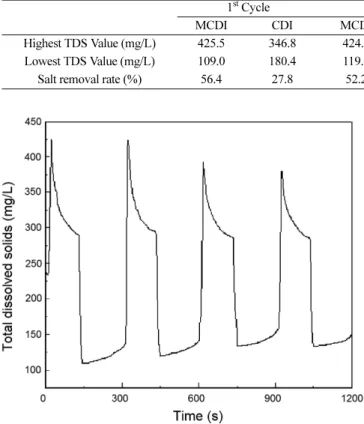
As shown in Fig. 11, MCDI graph shows sharper peaks and deeper troughs. This can be attributed to the fact that ions are adsorbed more onto the membrane and desorbed more rapidly than in CDI process.
Actually, the membrane acts as a barrier for permeated ions so that they do not mix back to the fluent easily. When a voltage of +1.5 V is applied, salt is adsorbed by membranes and electrodes; thus TDS concentration drops till 109.0 mg/L at the end of first cycle. Maxi- mum salt removal rate becomes 56.4% at this cycle. After the sys- tem roughly reaches equilibrium, minimum TDS concentration rises to 130.5 mg/L after the fourth cycle, and salt removal rate drops to 47.8%. At the desorption cycle, maximum TDS concentration increases from 250 mg/L to 425.5 mg/L. Desorption continues until the con- centrations drops about 300 mg/L when the voltage is reversed.
Potential reversal causes sharp rises and drops in the MCDI process where changes are relatively moderate and less intense in the case of CDI. Use of EVA 1159 heterogeneous membrane in MCDI process brings along an advantage of 19.9-28.6% higher salt removal rate compared to the CDI process. Furthermore, salt removal rate of first cycle (56.4%) is 16.4% higher than that of Jeong’s PVDF heteroge- neous membrane under the same conditions [23]. These results indi- cate that salt removal performance of EVA 1159 heterogeneous
cation exchange membrane is fairly satisfactory. Nevertheless, high water uptake and swelling ratio are disadvantages of the membrane.
These may be reasons why salt removal rate changed after each cycle.
4. Conclusions
An ion exchange resin and four types of EVA resin were mixed at different ratios in a two-roll mill to prepare heterogeneous cation exchange membranes with excellent physical properties. Ion exchange resin was evenly dispersed in the polymer binder during the mixing process by using a two-roll mill, which was confirmed by SEM images.
SEM surface images indicated that dispersion of IER differs depending on MI factor. Water uptake and swelling ratio of the mem- branes were between 35.0%-59.0% and 18.8%-35.0%, respectively.
Electrical resistance ranged between 8.7 Ω·cm2 and 22.5 Ω·cm2. Electrical resistance is lowest when lower VA content and higher melt index are in a balance. However VA content is the main factor affecting water uptake, swelling ratio and electrical resistance. Ion exchange capacity was 0.92 meq/g at best, which is a competitive value against that of Nafion 117. Lowest tensile strength was 40 kgf/
cm2, which indicates a highly improved mechanical performance compared to commercial membranes. Desalination experiment using the EVA 1159 heterogeneous membrane exhibited a maximum TDS removal rate of 56.4%. This is 16.4% higher than that of the PVDF heterogeneous membrane investigated in a previous study of this group.
Acknowledgments
This work was supported by research fund of Chungnam National University.
References
1. Khawaji, A. D., Kutubkhanah, I. K. and Wie, J. M., “Advances in Seawater Desalination Technologies,” Desalination, 221(1-3), 47-69(2008).
2. Kim, Y. M., Kim, S. J., Kim, Y. S., Lee, S., Kim, I. S. and Kim, J. H., “Overview of Systems Engineering Approaches for a Large-scale Seawater Desalination Plant with a Reverse Osmo- sis Network,” Desalination, 238(1-3), 312-332(2009).
3. Charcosset, C., “A Review of Membrane Processes and Renew- able Energies for Desalination,” Desalination, 245(1-3), 214-231 (2009).
4. Lee, K. P., Arnot, T. C. and Mattia, D., “A Review of Reverse Fig. 11. TDS concentration variation in MCDI unit process.
Table 3. Values of TDS and salt removal rates for MCDI and CDI
1st Cycle 2nd Cycle 3rd Cycle 4th Cycle
MCDI CDI MCDI CDI MCDI CDI MCDI CDI
Highest TDS Value (mg/L) 425.5 346.8 424.4 304.4 392.7 296.9 379.9 293.8
Lowest TDS Value (mg/L) 109.0 180.4 119.6 181.9 129.8 180.2 130.5 180.3
Salt removal rate (%) 56.4 27.8 52.2 27.2 48.1 27.9 47.8 27.9
Osmosis Membrane Materials for Desalination - development to Date and Future Potential,” J. Membrane Science, 370(1-2), 1- 22(2011).
5. Cho, C. H., Oh, K. Y., Kim, S. K., Yeo, J. G. and Sharma, P.,
“Pervaporative Seawater Desalination Using NaA Zeolite Mem- brane: Mechanisms of High Water Flux and High Salt Rejec- tion,” J. Membrane Science, 371(1-2), 226-238(2011).
6. Zhong, P. S., Widjojo, N., Chung, T. S., Weber, M. and Maletzko, C., “Positively Charged Nanofiltration (NF) Membranes via UV Grafting on Sulfonated Polyphenylenesulfone (sPPSU) for Effec- tive Removal of Textile Dyes from Wastewater,” J. Membrane Science, 417, 52-60(2012).
7. Al-Rashdi, B. A. M., Johnson, D. J. and Hilal, N., “Removal of Heavy Metal Ions by Nanofiltration,” Desalination, 315, 2-17(2013).
8. Cheng, S., Oatley, D. L., Williams, P. M. and Wright, C. J.,
“Characterisation and Application of a Novel Positively Charged Nanofiltration Membrane for the Treatment of Textile Industry Wastewaters,” Water Research, 46(1), 33-42(2012).
9. Strathmann, H., “Electrodialysis, a Mature Technology with a Multitude of New Applications,” Desalination, 264(3), 268-288 (2010).
10. Jones, R. J., Massanet-Nicolau, J., Guwy, A., Premier, G. C., Dinsdale, R. M. and Reilly, M., “Removal and Recovery of Inhib- itory Volatile Fatty Acids from Mixed Acid Fermentations by Con- ventional Electrodialysis,” Bioresource Technology, 189, 279- 284(2015).
11. Bulejko, P., Stránská, E. and Weinertová, K., “Properties and Structure of Heterogeneous Ion-exchange Membranes after Expo- sure to Chemical Agents,” J. Solid State Electrochemistry, 21(1), 111-124(2017).
12. Koresh, J. and Soffer, A., “Double Layer Capacitance and Charging Rate of Ultramicroporous Carbon Electrodes,” J. Electrochemi- cal Society, 124(9), 1379-1385(1977).
13. Mitani, S., Lee, S. I., Yoon, S. H., Korai, Y. and Mochida, I.,
“Activation of Raw Pitch Coke with Alkali Hydroxide to Pre- pare High Performance Carbon for Electric Double Layer Capaci- tor,” J. Power Sources, 133(2), 298-301(2004).
14. Zhao, R., Porada, S., Biesheuvel, P. M. and Van der Wal, A.,
“Energy Consumption in Membrane Capacitive Deionization for Different Water Recoveries and Flow Rates, and Comparison with Reverse Osmosis,” Desalination, 330, 35-41(2013).
15. Hassanvand, A., Wei, K., Talebi, S., Chen, G. Q. and Kentish, S.
E., “The Role of Ion Exchange Membranes in Membrane Capaci- tive Deionisation,” Membranes, 7(3), 54(2017).
16. Ramon, G. Z., Feinberg, B. J., and Hoek, E. M., “Membrane-based Production of Salinity-gradient Power,” Energy & Environmen- tal Science, 4(11), 4423-4434(2011).
17. Hosseini, S. M., Madaeni, S. S. and Khodabakhshi, A. R., “Prepa- ration and Characterization of ABS/HIPS Heterogeneous Cat- ion Exchange Membranes with Various Blend Ratios of Polymer Binder,” J. Membrane Science, 351(1-2), 178-188(2010).
18. Sen, U., Usta, H., Acar, O., Citir, M., Canlier, A., Bozkurt, A.
and Ata, A., “Enhancement of Anhydrous Proton Conductivity of Poly (vinylphosphonic acid)-Poly (2, 5-benzimidazole) Membranes via In Situ Polymerization,” Macromolecular Chemistry and Phys- ics, 216(1), 106-112(2015).
19. Bouzek, K., Moravcová, S., Schauer, J., Brožová, L. and Pientka, Z., “Heterogeneous Ion-selective Membranes: the Influence of
the Inert Matrix Polymer on the Membrane Properties,” J. Applied Electrochemistry, 40(5), 1005-1018(2010).
20. Gohil, G. S., Shahi, V. K. and Rangarajan, R., “Comparative Stud- ies on Electrochemical Characterization of Homogeneous and Heterogeneous Type of Ion-exchange Membranes,” J. Mem- brane Science, 240(1-2), 211-219(2004).
21. Vyas, P. V., Shah, B. G., Trivedi, G. S., Ray, P., Adhikary, S. K.
and Rangarajan, R., “Characterization of Heterogeneous Anion- exchange Membrane,” J. of Membrane Science, 187(1-2), 39-46 (2004).
22. Kim, K. S., Kim, S. H. and Jung, I. H., “Preparation of a Het- erogeneous Ion Exchange Membranes for Nickel Plating Rinse Waters Treatment by Electrodialysis,” J. Ind. Eng. Chem. 12, 560(2001).
23. Jeong, M. H., Ko, D. Y. and Hwang, T. S., “Preparation of Novel Polyvinylidene Fluoride (PVdF) Cation Exchange Heterogeneous Membrane and Their Adsorption Properties of Ion Selectivity,”
Membr. J. 25, 431(2015).
24. Stael, G. C., Rocha, M. C. G., d'Almeida, J. R. M. and Ruiz, N.
M. D. S., “Analysis of the Mechanical Properties and Character- ization by Solid State 13C NMR of Recycled EVA Copolymer/
silica Composites,” Materials Research, 8(3), 269-273 (2005).
25. Jeong, K. S., Hwang, W. C. and Hwang, T. S., “Synthesis of an Aminated Poly(vinylidene fluride-g-4-vinyl benzyl chloride) Anion Exchange Membrane for Membrane Capacitive Deion- ization (MCDI),” J. Membrane Science, 495, 316-321(2015).
26. Fu, R. Q., Woo, J. J., Seo, S. J., Lee, J. S. and Moon, S. H., “Sul- fonated Polystyrene/polyvinyl Chloride Composite Membranes for PEMFC Applications,” J. Membrane Science, 309(1-2), 156- 164(2008).
27. Li, X., Wang, Z., Lu, H., Zhao, C., Na, H. and Zhao, C., Electro- chemical Properties of Sulfonated PEEK Used for Ion Exchange Membranes,” J. Membrane Science, 254(1-2), 147-155(2005).
28. Hosseini, S. M., Madaeni, S. S., Khodabakhshi, A. R. and Zen- dehnam, A., “Preparation and Surface Modification of PVC/SBR Heterogeneous Cation Exchange Membrane with Silver Nanopar- ticles by Plasma Treatment,” J. Membrane Science, 365(1-2), 438-446(2010).
29. Kumar, P., Dutta, K., Das, S. and Kundu, P. P., “Membrane Pre- pared by Incorporation of Crosslinked Sulfonated Polystyrene in the Blend of PVdF-co-HFP/Nafion: a Preliminary Evaluation for Application in DMFC,” Applied Energy, 123, 66-74(2014).
30. Espert, A., Vilaplana, F. and Karlsson, S., “Comparison of Water Absorption in Natural Cellulosic Fibres from Wood and One- year Crops in Polypropylene Composites and its Influence on Their Mechanical Properties,” Composites Part A: Applied Sci- ence and Manufacturing, 35(11), 1267-1276(2004).
31. Chen, S. X. and Lostritto, R. T., “Diffusion of Benzocaine in Poly(ethylene-vinyl acetate) Membranes: Effects of Vehicle Eth- anol Concentration and Membrane Vinyl Acetate content,” J.
Controlled Release, 38(2-3), 185-191(1996).
32. Jamroz, N. U., “Determination of Vinyl Acetate (VA) Content of Ethylene-vinyl Acetate (EVA) Copolymers in Thick Films by Infrared Spectroscopy,” J. Chem. Soe. Pak. 25(2), 84-87(2003).
33. Huang, J. C. and Wu, C. L., “Processability, Mechanical Prop- erties, and Electrical Conductivities of Carbon Black-filled Eth- ylene-vinyl Acetate Copolymers,” Advances in Polymer Technology, 19(2), 132-139(2000).