서 론
우울증은 전세계의 10%–20%의 인구가 경험하는 흔한 정신 질환 이다.1) 우리나라의 경우 건강보험심사평가원의 자료에 의하면 2009–
2013년까지 우울증으로 진료한 환자는 2009년 약 55.6만 명에서 2013 년 약 66.5만 명으로 집계되고 5년간 19.6% 증가하였고, 연평균 4.6%
증가 추세를 보이고 있다.2) 이에 따라 우울증으로 인한 총 진료비의 경우도 2009년부터 2013년까지 연평균 6.2% 증가하였고2) 세계적으
로 질병부담이 큰 질환이다.3-5)
이제까지 연구들을 보았을 때 성별, 나이, 정신적 또는 육체적 건 강상태, 흡연, 음주와 같은 건강행태 등과 같은 주요 변수와 관련성 을 보이고 있어6-8) 이로 인해 일반인 전체를 대상으로 하기보다는 여 성 혹은 노인 등과 같이 특정 층에 혹은 특정 질병 군에 대해 많은 연 구가 보고되고 있다.7,9)
우울증 치료의 방법으로 심리치료, 약물치료 이외에 여러 대안이 고안되고 있으며 운동도 그중 하나이다. 운동과 우울증과의 연관성
Received September 30, 2016 Accepted October 10, 2016 Corresponding author Jung Im Gwak
Tel: +82-31-467-9161, Fax: +82-31-449-0151 E-mail: [email protected]
ORCID: http://orcid.org/0000-0002-8874-0518
Copyright © 2018 The Korean Academy of Family Medicine
This is an open-access article distributed under the terms of the Creative Commons At- tribution Non-Commercial License (http://creativecommons.org/licenses/by-nc/4.0) which permits unrestricted noncommercial use, distribution, and reproduction in any medium, provided the original work is properly cited.
Brief
Communication
https://doi.org/10.21215/kjfp.2018.8.2.322 eISSN 2233-9116
Korean J Fam Pract. 2018;8(2):322-326
Korean Journal of Family Practice
KJFP
운동의 강도, 형태와 우울증상과의 관계
신준섭, 곽정임*, 안형준, 최현정, 윤소정
안양 샘병원 가정의학과
The Association between Intensity, Types of Exercise, and Depressive Symptoms
Jun Seob Shin, Jung Im Gwak*, Hyung Joon An, Hyun Jung Choi, So-Jung Yun Department of Family Medicine, Anyang SAM Hospital, Anyang, Korea
Background: Exercise is among the many alternatives to psychotherapy or medical treatment for depression. Many studies have suggested a relationship between exercise and improvement of depressive disorder. However, the types of exercise or exercise intensity that have more positive effects on depression could not be determined. Thus, we examined which type of exercise effectively reduces depressive symptoms by using data from the sixth Korea National Health and Nutrition Examination Survey.
Methods: Data were obtained from the sixth Korea National Health and Nutrition Examination Survey conducted by the Korea Centers for Disease Control and Prevention in 2013. Among 8,018 participants of the survey, 5,660 adults (≥19 years old) who answered the question about having a depressive symptom experience for ≥2 weeks were enrolled. The difference in depressive symptom experience between the kinds of exercise group was assessed by performing a chi-square test. For the multivariate analysis, a binary logistic regression was performed to evaluate the factors that showed significance in the univariate analysis.
Results: Among 2,580 men and 3,080 women, 369 men (14.3%) and 445 women (14.4%) experienced depressive symptoms for ≥2 weeks, respectively.
According to the sex of the individual, subjects in both the male and female groups who performed walking exercise showed significantly decreased incidence of depressive symptoms (P<0.001).
Conclusion: The incidence of experiencing depressive symptom was significantly decreased among the groups of men and women who walking exercise.
Keywords: Exercise; Depressive Symptoms
신준섭 외. 운동의 강도, 형태와 우울증상과의 관계 Korean Journal of Family Practice
KJFP
에 대한 여러 국외 연구에서 신체활동이 많을수록 우울증의 증상 발현이 줄어들고 약물치료에도 효과적이며10-12) 우울증을 호소하는 환자들에서 신체활동이 줄어들었음을 보였고,13) 우리나라에서도 운동이 우울증을 줄이는데 연관 있다는 연구 결과가 있다.9) 그러나 어떤 종류의 운동을 얼마나 하는 것이 좋은지, 어느 정도까지 증상 의 호전을 보일 수 있는지는 아직 확실하지 않다.11)
그래서 국민건강영양조사 자료를 이용해서 최근 생활환경에서는 과거에 비해 어떤 형태의 운동이 우울증 감소에 효과적인지 알아보 기 위해 이 연구를 고안하였다.
방 법
1. 연구 대상
질병관리본부의 주관으로 2013년 실시된 제6기 1차 국민건강영 양조사 자료를 이용하였다.14) 국민건강영양조사에 참여한 8,018명 가운데 2주간 우울 지속 여부에 응답한 만 19세 이상 남자 2,580명, 여자 3,080명, 총 5,660명을 대상으로 하였다.
2. 연구 방법
본 연구에서 우울증상은 대상자 개인들이 느끼고 있는 정서상태 를 기준으로 국민건강영양조사 설문을 토대로 지난 1년 동안 지속 적으로 2주 이상 일상생활에 지장이 있을 정도로 슬프거나 절망감 등을 느낀 적이 있는지 유무로 나누어 두 군의 인구 사회학적인 요 인, 경제적 요인, 건강요인, 건강 관련 행위 요인을 비교하였고, 운동 형태와 강도는 격렬한 신체활동 여부, 중등도 신체활동 여부, 걷기실 천 여부, 근력운동 일수와 유연성 운동 일수로 나누어 통계적으로 유의한 항목에 대하여 로지스틱 회귀분석을 하여 통계적 유의성을 보았다.
1) 일반적 특성
국민건강영양조사 설문의 2주 이상 우울증상의 유무에 대해 답 한 성인 남녀를 대상으로 교육수준은 같은 설문 상의 조사항목을 통해 초등학교 졸업 이하, 중학교 졸업, 고등학교 졸업, 대학교 졸업 이상 4개의 군으로 나누었다. 경제적 요인은 직업 유무와 소득사분 위수 항목에 하, 중하, 중상, 상으로 구분하였다. 건강요인은 만성질 환으로 암, 고혈압, 심근경색증 또는 협심, 당뇨, 이상지질혈증, 관절 염 유무를 설문의 해당 항목에서 유, 무 여부로 나누어 살펴보았고 주관적 건강상태를 좋음, 중간, 나쁨 세 군으로 분류하였다. 또한, 건 강 관련 행위로는 흡연과 음주를 비교하였고 흡연은 현재 흡연 군과 비흡연 군(금연군, 평생 담배를 피우지 않은 군)으로, 음주는 세 군으
로 나누어 비교하였다.
2) 운동의 종류와 시간
운동 실천 상태는 설문조사의 격렬한 신체활동 여부, 중등도 신체 활동 여부, 걷기 여부, 근력운동 일수와 유연성 운동 일수를 바탕으 로 남, 여 따로 분류하여 범주화하였다. 격렬한 신체활동은 최근 일 주일간을 바탕으로 평소보다 몸이 매우 힘들거나 숨이 매우 가쁜 신 체활동을 주 3일, 한번 시행에 20분 이상 시행 여부로 하였고 중등도 신체활동은 최근 일주일간 몸이 약간 힘들거나 숨이 약간 가쁜 신체 활동을 일주일에 5일 이상, 한 번 시행에 30분 이상 시행 여부로, 걷 기 여부는 일주일에 5일 이상 한 번에 30분 이상 시행 여부로 분석하 였다. 근력운동 일수와 유연성 일수는 1회 시행 시간이 고려되지 않 아 시행 일수만 고려하여 분석하였다.
3. 통계 분석
우울증상을 종속변수로, 각각의 항목을 독립변수로 하여 자료 분석을 시행하였다. 조사 대상자의 각 특성별 분포를 빈도 분석하였 고, 조사 대상자의 각 특성별 우울증 경험 여부 차이는 카이제곱 검 정을 하였다. 단변량 분석에서 유의성을 보인 요인들에 대하여 이분 형 로지스틱 회귀분석 시행하여 다변량 분석하였다. 모든 분석은 IBM SPSS Statistics 20.0 (IBM Co., Armonk, NY, USA)을 사용하였고, 통계적 유의성은 P<0.05로 하였다.
결 과
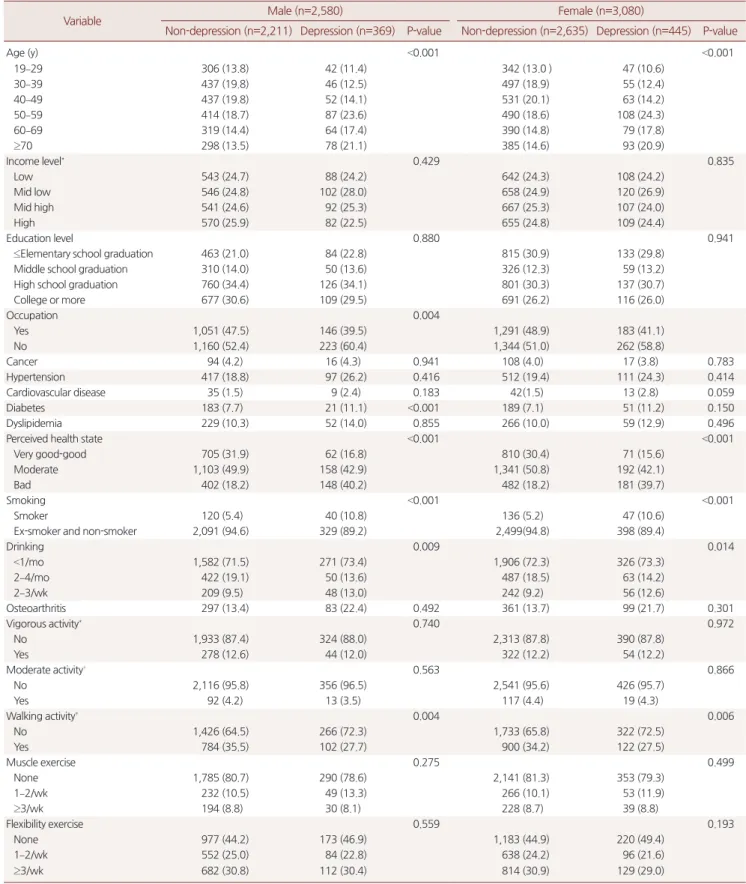
1. 대상자의 일반적 특성과 2주 이상 우울증상 경험 여부 대상자는 남자 2,580명, 여자 3,080명, 총 5,660명이다. 우울증은 남 녀의 유병률이 차이가 있어 따로 분석하였다. 남자 2,580명, 여자 3,080명 중 2주 이상 우울증상을 경험한 대상은 남자 369명(14.3%), 여자 445명(14.4%)이었다. 남자의 경우 나이가 많거나, 직업이 없을 때 우울증상 경험 비율이 높았고, 당뇨 질환이 있거나 흡연, 음주 시, 주 관적으로 건강상태가 나쁘다고 인식할 시 우울증상 경험 비율이 높 았다. 여자의 경우 나이가 많거나 직업이 없을 때, 흡연, 음주, 주관적 건강상태가 나쁠 시 우울증상이 유의하게 증가하였다(Table 1).
2. 대상자의 운동형태, 강도 특성과 2주 이상 우울증상 경험 여부 대상자 중 남자의 경우 격렬한 신체활동, 중등도 신체활동, 근력 운동, 유연성 운동과 2주 이상 우울증상 경험 여부와는 통계적으로 유의하지 않았고 걷기 운동을 한 경우 우울증상이 유의하게 감소하 였다(P=0.004) (Table 1). 여자의 경우 남자와 같이 격렬한 신체활동,
Brief
Communication
Korean Journal of Family Practice
Jun Seob Shin, et al. The Association between Intensity, Types of Exercise, and Depressive Symptoms
Korean Journal of Family Practice
KJFP
Table 1. Characteristics according to depressive symptom
Variable Male (n=2,580) Female (n=3,080)
Non-depression (n=2,211) Depression (n=369) P-value Non-depression (n=2,635) Depression (n=445) P-value
Age (y) <0.001 <0.001
19–29 306 (13.8) 42 (11.4) 342 (13.0 ) 47 (10.6)
30–39 437 (19.8) 46 (12.5) 497 (18.9) 55 (12.4)
40–49 437 (19.8) 52 (14.1) 531 (20.1) 63 (14.2)
50–59 414 (18.7) 87 (23.6) 490 (18.6) 108 (24.3)
60–69 319 (14.4) 64 (17.4) 390 (14.8) 79 (17.8)
≥70 298 (13.5) 78 (21.1) 385 (14.6) 93 (20.9)
Income level* 0.429 0.835
Low 543 (24.7) 88 (24.2) 642 (24.3) 108 (24.2)
Mid low 546 (24.8) 102 (28.0) 658 (24.9) 120 (26.9)
Mid high 541 (24.6) 92 (25.3) 667 (25.3) 107 (24.0)
High 570 (25.9) 82 (22.5) 655 (24.8) 109 (24.4)
Education level 0.880 0.941
≤Elementary school graduation 463 (21.0) 84 (22.8) 815 (30.9) 133 (29.8)
Middle school graduation 310 (14.0) 50 (13.6) 326 (12.3) 59 (13.2)
High school graduation 760 (34.4) 126 (34.1) 801 (30.3) 137 (30.7)
College or more 677 (30.6) 109 (29.5) 691 (26.2) 116 (26.0)
Occupation 0.004
Yes 1,051 (47.5) 146 (39.5) 1,291 (48.9) 183 (41.1)
No 1,160 (52.4) 223 (60.4) 1,344 (51.0) 262 (58.8)
Cancer 94 (4.2) 16 (4.3) 0.941 108 (4.0) 17 (3.8) 0.783
Hypertension 417 (18.8) 97 (26.2) 0.416 512 (19.4) 111 (24.3) 0.414
Cardiovascular disease 35 (1.5) 9 (2.4) 0.183 42(1.5) 13 (2.8) 0.059
Diabetes 183 (7.7) 21 (11.1) <0.001 189 (7.1) 51 (11.2) 0.150
Dyslipidemia 229 (10.3) 52 (14.0) 0.855 266 (10.0) 59 (12.9) 0.496
Perceived health state <0.001 <0.001
Very good-good 705 (31.9) 62 (16.8) 810 (30.4) 71 (15.6)
Moderate 1,103 (49.9) 158 (42.9) 1,341 (50.8) 192 (42.1)
Bad 402 (18.2) 148 (40.2) 482 (18.2) 181 (39.7)
Smoking <0.001 <0.001
Smoker 120 (5.4) 40 (10.8) 136 (5.2) 47 (10.6)
Ex-smoker and non-smoker 2,091 (94.6) 329 (89.2) 2,499(94.8) 398 (89.4)
Drinking 0.009 0.014
<1/mo 1,582 (71.5) 271 (73.4) 1,906 (72.3) 326 (73.3)
2–4/mo 422 (19.1) 50 (13.6) 487 (18.5) 63 (14.2)
2–3/wk 209 (9.5) 48 (13.0) 242 (9.2) 56 (12.6)
Osteoarthritis 297 (13.4) 83 (22.4) 0.492 361 (13.7) 99 (21.7) 0.301
Vigorous activity* 0.740 0.972
No 1,933 (87.4) 324 (88.0) 2,313 (87.8) 390 (87.8)
Yes 278 (12.6) 44 (12.0) 322 (12.2) 54 (12.2)
Moderate activity† 0.563 0.866
No 2,116 (95.8) 356 (96.5) 2,541 (95.6) 426 (95.7)
Yes 92 (4.2) 13 (3.5) 117 (4.4) 19 (4.3)
Walking activity‡ 0.004 0.006
No 1,426 (64.5) 266 (72.3) 1,733 (65.8) 322 (72.5)
Yes 784 (35.5) 102 (27.7) 900 (34.2) 122 (27.5)
Muscle exercise 0.275 0.499
None 1,785 (80.7) 290 (78.6) 2,141 (81.3) 353 (79.3)
1–2/wk 232 (10.5) 49 (13.3) 266 (10.1) 53 (11.9)
≥3/wk 194 (8.8) 30 (8.1) 228 (8.7) 39 (8.8)
Flexibility exercise 0.559 0.193
None 977 (44.2) 173 (46.9) 1,183 (44.9) 220 (49.4)
1–2/wk 552 (25.0) 84 (22.8) 638 (24.2) 96 (21.6)
≥3/wk 682 (30.8) 112 (30.4) 814 (30.9) 129 (29.0)
Values are presented as number (%).
P-values were obtained by analysis of chi-square test.
*Vigorous activity: activity more than 3 times a week for 20 minutes per day; †moderate activity; activity more than 5 times a week for 30 minutes per day; ‡walking;
walking more than 5 times a week for 30 minutes per day.
신준섭 외. 운동의 강도, 형태와 우울증상과의 관계 Korean Journal of Family Practice
KJFP
중등도 신체활동, 근력 운동, 유연성 운동은 통계적으로 유의하지 않았고 걷기 운동을 시행한 군에서 우울증상이 유의하게 감소하였 다(P=0.006) (Table 1).
3. 운동형태, 강도와 2주 이상 우울증상 경험 여부와의 연관성 운동형태, 강도와 우울증상 경험 여부와의 단변량 분석에서 통계 적으로 유의한 걷기 실천운동을 한 군을 대상으로 다변량 분석한 결과 남자에서 걷기 실천 운동을 한 군에서 우울증상이 유의하게 감소하였고(P<0.001), 여자에서도 걷기 실천 운동을 한 군에서 우울 증상이 유의하게 감소하였다(P<0.001) (Table 2).
고 찰
본 연구는 최근 생활환경에서 우울증상 경험과 관계 있는 변수들 을 파악하고 운동의 형태와 강도에 따라 2주 이상 우울증상 경험하 는데 연관성이 있는지 분석하는 것이다. 이전의 많은 연구에서 남자 에서 보다 여자에서 우울증의 유병률이 더 높게 나타나고 있어2,6,7,15) 본 연구에서는 남자와 여자를 따로 분류하여 분석하였다.
이전에 우울증과의 연관성을 남자, 여자로 분류하여 여러 요인과 의 연관성에 대해 조사한 연구 중 남자의 경우 운동량이 많은 사람 이 우울증 유병률이 적었으나 여자의 경우 운동과 우울증 간에 유 의한 차이가 없었다는 연구 결과5)도 있었고 운동이 우울증과 관련 없거나 우울증 척도를 증가 시켰다는16,17) 보고도 있으나, 그럼에도 불구하고 많은 연구들에서 운동량이 늘어날수록 우울증상은 감소 한다는 결과를 보고하였다.8,9,18-20) 걷기 운동의 경우 이전 연구에서 우울증을 감소시킨다는 연구 결과가 있어21-23) 남녀 모두에서 걷기 운동을 한 군에서 우울증상이 유의하게 감소하였다는 본 연구의 결 과를 뒷받침한다.
그러나 본 연구는 국민건강영양조사를 바탕으로 한 단면조사 연 구로 각 변수와 우울증상 경험 여부 간에 시간적 선후관계를 알 수 없어 정확한 인과관계를 설명하기 어렵고, 우울증상 경험 여부도 의 사의 진단이나 임상적 선별검사를 사용한 것이 아니라 주관적으로 느끼는 것을 바탕으로 하여 한계가 있다. 또한, 운동 형태와 강도도 주관적 설문조사를 바탕으로 하여 기본적인 측정오류를 배제할 수
없고 우울증상에 영향을 미치는 부가적 교란변수를 모두 고려하지 못했다는 제한점이 있다.
이러한 제한점에도 불구하고 본 연구는 최근의 생활환경에서 남 녀 모두에게 다른 형태의 운동보다 걷기 운동이 우울증상 감소에 효과적이라는 것을 보여주고 있어 향후 걷기 운동이 우울증상을 어 느 정도 감소시키는지 연구가 더 필요하다 보인다.
요 약
연구배경:
우울증 치료의 방법으로 심리치료, 약물치료 이외에 여 러 대안이 고안되고 있으며 운동도 그중 하나이다. 여러 연구들에서 운동이 우울증과 연관 있다고 조사되었으나 어떤 종류의 운동을 얼 마나 하는 것이 좋은지, 어느 정도까지 증상의 호전을 보일 수 있는 지 아직 확실하지 않다. 그래서 이번 연구에서 국민건강영양조사 자 료를 이용해서 최근 생활환경에서는 과거에 비해 어떤 형태의 운동 이 우울증 감소에 효과적인지 알아보기 위해 이 연구를 고안하였다.방법:
질병관리본부의 주관으로 2013년 실시된 제6기 1차 국민건강 영양조사 자료를 이용하였다. 국민건강영양조사에 참여한 8,018명 가운데 2주간 우울 지속 여부에 응답한 만19세 이상 성인 5,660명을 최종 대상으로 하였다. 조사 대상자의 각 특성별 우울증 경험 여부 차이는 카이제곱 검정을 하였으며, 단변량 분석에서 유의성을 보인 요인들에 대하여 이분형 로지스틱 회귀분석 시행하여 다변량 분석 하였다.결과:
대상자 남자 2,580명, 여자 3,080명 중 2주 이상 우울증상을 경 험한 대상은 남자 369명(14.3%), 여자 445명(14.4%)이었다. 우울증상 이 남녀에 따른 유병률 차이 있어 성별에 따라 따로 분석한 결과, 남 자의 경우 걷기 운동을 한 군에서 우울증상이 유의하게 감소하였고 (P<0.001), 여자에서도 걷기 운동을 한 군에서 우울증상이 유의하게 감소하였다(P<0.001).결론:
남, 여 모두 걷기 운동을 한 경우 우울증상이 유의하게 감소하 였다.중심단어:
운동; 우울증상 Table 2. Analysis of correlation of depressive symptom and walking activity by logistic regressionWalking activity P-value Unadjusted OR (95% CI) P-value Adjusted OR (95% CI)
Male* <0.001 0.187 (0.546–0.890) <0.001 0.159 (0.062–0.997)*
Female† <0.001 0.186 (0.584–0.912) <0.001 0.154 (0.653–1.037)†
OR, odds ratio; CI, confidential interval.
*Adjusted for age, occupation, diabetes, alcohol, smoking, perceived health status. †Adjusted for age, occupation, alcohol, smoking, perceived health status.
Jun Seob Shin, et al. The Association between Intensity, Types of Exercise, and Depressive Symptoms
Korean Journal of Family Practice
KJFP
REFERENCES
1. Riolo SA, Nguyen TA, Greden JF, King CA. Prevalence of depression by race/ethnicity: findings from the National Health and Nutrition Examina- tion Survey III. Am J Public Health 2005; 95: 998-1000.
2. Health Insurance Review and Assessment service. Depression [Internet].
Seoul: Health Insurance Review and Assessment service; 2015. Available from: http://www.hira.or.kr/re/stcIlnsInfm/stcIlnsInfmView.do?pgmid=HI RAA030502000000&sortSno=179.
3. Schoenbaum M, Unützer J, Sherbourne C, Duan N, Rubenstein LV, Miran- da J, et al. Cost-effectiveness of practice-initiated quality improvement for depression: results of a randomized controlled trial. JAMA 2001; 286: 1325- 30.
4. Katon WJ, Lin E, Russo J, Unutzer J. Increased medical costs of a population- based sample of depressed elderly patients. Arch Gen Psychiatry 2003; 60:
897-903.
5. Han B. Depressive symptoms and self-rated health in community-dwelling older adults: a longitudinal study. J Am Geriatr Soc 2002; 50: 1549-56.
6. Park E, Kim MD, Son YJ, Song HJ, Hong SC. The prevalence of depression and related factors among adults. J Korean Acad Community Health Nurs 2009; 20: 277-84.
7. Lee YH, Shin MH, Kweon SS, Choi SW, Ryu SY, Rhee JA, et al. Prevalence and correlates of depression among the elderly in an urban community. J Agric Med Community Health 2008; 33: 303-15.
8. Kim RB, Park KS, Lee JH, Kim BJ, Chun JH. Factors related to depression symptom and the influence of depression symptom on self-rated health sta- tus, outpatient health service utilization and quality of life. Korean Journal of Health Education and Promotion 2011; 28: 81-92.
9. Heun R, Hein S. Risk factors of major depression in the elderly. Eur Psychia- try 2005; 20: 199-204.
10. Durstine JL, Moore GE. ACSM’s exercise management for persons with chronic diseases and disabilities. Champaign (IL): Human Kinetics; 2002. p.
293-300.
11. Mead GE, Morley W, Campbell P, Greig CA, McMurdo M, Lawlor DA. Ex- ercise for depression (Review). Cochrane Database Syst Rev 2010;49.
12. Peveler R, Carson A, Rodin G. Depression in medical patients. BMJ 2002;
325: 149-52.
13. Harris AH, Cronkite R, Moos R. Physical activity, exercise coping, and de- pression in a 10-year cohort study of depressed patients. J Affect Disord 2006; 93: 79-85.
14. Ministry of Health and Welfare, Korea Center for Disease Control and Pre- vention. Guideline for using raw data of Korean National Health and Nutri- tion Examination Survey, the first survey of six phase (KNHANES VI-1) [Internet]. Cheonju: Korea Center for Disease Control and Prevention;
2013. Available from: http://knhanes.cdc.go.kr.
15. Martín-Merino E, Ruigómez A, Johansson S, Wallander MA, García-Rodri- guez LA. Study of a cohort of patients newly diagnosed with depression in general practice: prevalence, incidence, comorbidity, and treatment patterns.
Prim Care Companion J Clin Psychiatry 2010; 12: PCC.08m00764.
16. McCann IL, Holmes DS. Influence of aerobic exercise on depression. J Pers Soc Psychol 1984; 46: 1142-7.
17. Stein PN, Motta RW. Effects of aerobic and nonaerobic exercise on depres- sion and self-concept. Percept Mot Skills 1992; 74: 79-89.
18. Martinsen EW, Medhus A. Adherence to exercise and patients’ evaluation of physical exercise in a comprehensive treatment programme for depression.
Nordic Journal of Psychiatry 1989; 43: 411-5.
19. Dunn AL, Trivedi MH, O’Neal HA. Physical activity dose-response effects on outcomes of depression and anxiety. Med Sci Sports Exerc 2001; 33(6 Suppl): S587-97.
20. Bahk HJ, Roh HR, Lee JA, Kim YS, Kim JH, Kang HC, et al. The lifestyle of patients with depressive symptoms for couples in primary care. Korean J Fam Pract 2015; 5(3 Suppl 2): 812-8.
21. Dimeo F, Bauer M, Varahram I, Proest G, Halter U. Benefits from aerobic exercise in patients with major depression: a pilot study. Br J Sports Med 2001; 35: 114-7.
22. Mobily KE, Rubenstein LM, Lemke JH, O’Hara MW, Wallace RB. Walking and depression in a cohort of older adults: The Iowa 65+ rural health study.
Jounal of Aging and Physical Activity 1996; 4: 119-35.
23. Doyne EJ, Ossip-Klein DJ, Bowman ED, Osborn KM, McDougall-Wilson IB, Neimeyer RA. Running versus weight lifting in the treatment of depres- sion. J Consult Clin Psychol 1987; 55: 748-54.