1. Introduction
Photovoltaic technology based on crystalline silicon(c-Si) solar cells has been widely developed for high efficiency and reliability. Currently, c-Si solar cells account for about 80% to 90% of photovoltaic market. However, the complicated process of the conventional c-Si technology might be seen as a sign of its limitation to cost-effective and higher efficiency. For this reason, many researcher and scientists have intensively proposed new and novel concepts such as quantum dot
1), plasmonic effect
2)and nano-structure
3)for overcoming its limitation. Among them, silicon nanostructure have been intensively investigated for their potential use in cost-effective third-generation high efficiency solar cells due to their unique optical and electrical characteristics
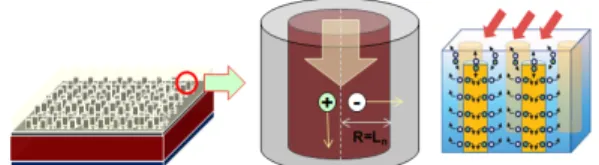
4-7). There are two big advantages of getting higher efficiency. One is radial p-n junction, which can be theoretically explained that diffused minority carriers are not oppositely but orthogonally separated for reduction of material consumption
8, 9). The other is anti-reflection effect due to strong light trapping by multiple scattering of the incident light
10).
Microwires(MWs) can be contributing to radial p-n junction and nanowires(NWs) to anti-reflection effect. Figure 1 shows schematic illustration of microstructre silicon and radial junction effect due to orthogonal separation in directions. The combined micro and nanowires(CNMWs) silicon solar cells has been particularly suggested for taking all the good points.
Atwater et al
11). reported that CNMWs Si solar cells would be expected for achieving 14.5% of conversion efficiency based on simulation results. CNMWs Si solar cells, recently fabricated by J. H. Lee group
12), showed 8.45% of conversion efficiency from spin on doping(SOD) method for emitter process. Several alter- natives to improvement of low efficiency should be suggested from a processing perspective such as emitter process, metalliza- tion and feasibility of transparent conducting oxide (TCO) thin films.
As a first step, we fabricated CNMWs Si solar cells using POCl
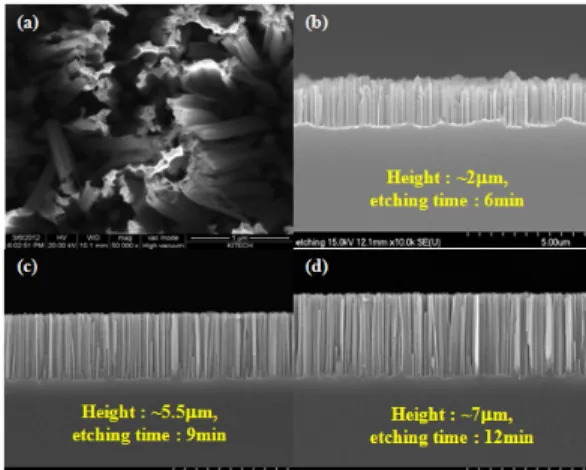
3emitter process after Ag assisted electroless etching
Current Photovoltaic Research 1(1) 69-72 (2013) pISSN 2288-3274
Characterization of Combined Micro ‐ and Nano‐structure Silicon Solar Cells using a POCl 3 Doping Process
Chaehwan Jeong
1)* ․ Changheon Kim
1, 3)․ Jonghwan Lee
1)․ Junsin Yi
2)․ Sangwoo Lim
3)․ Suk-Ho Lee
4)1)
Energy and Applied Optics Research Group, Korea Institute of Industrial Technology, Gwangju 500-480, Korea
2)
Department of Electronic Electronical Engineering, Sungkyunkwan University, Suwon 440-756, Korea
3)
Department of Chemical and Biomolecular Engineering, Yonsei University, Seoul 120-749, Korea
4)