• 검색 결과가 없습니다.

Differences between Korea and Japan in Physician Decision Making Regarding Permanent Pacemaker Implantation

N/A
N/A
Protected

Academic year: 2022

Share "Differences between Korea and Japan in Physician Decision Making Regarding Permanent Pacemaker Implantation"

Copied!
4
0
0

로드 중.... (전체 텍스트 보기)

전체 글

(1)

654 Copyright © 2016 The Korean Society of Cardiology Korean Circulation Journal

Original Article

http://dx.doi.org/10.4070/kcj.2016.46.5.654 Print ISSN 1738-5520 • On-line ISSN 1738-5555

Introduction

Different countries appear to differ significantly with respect to rates of permanent pacemaker (PPM) implantations. For example, the number of PPM implantations per capita is much lower in the populations of Asian countries than in Western populations.

According to the 2009 11th World Survey of Arrhythmias Project,

1)

the number of new PPM implantations in 2009 was 927 per million in Germany and 767 per million in the United States. In contrast, in Japan, PPMs were implanted in 272 patients per million as opposed to only 35 per million in Korea – an eight-fold difference in the rates of per capita PPM implantations. Possible explanations for the differences between two countries may include (1) differences in reimbursement policies, (2) differences in the incidence of sinus node or conduction disorders, and (3) cultural differences regarding the acceptance of device implantation among physicians and patients that may serve as barriers to PPM implantation.

We conducted a survey among physicians in Japan and Korea to determine what factors may be influencing their decision to implant PPMs.

Materials and Methods

A survey was created that included 15 different clinical case

Differences between Korea and Japan in Physician Decision Making Regarding Permanent Pacemaker Implantation

Sung-Won Jang, MD 1 , Robert W Rho, MD 2 , Tae-Seok Kim, MD 1 , Sung-Hwan Kim, MD 1 , Woo-Seung Shin, MD 3 , Ji-Hoon Kim, MD 1 , Yong-Seog Oh, MD 1 , Man Young Lee, MD 1 , Eiwa Zen, MD 4 , and Tai-Ho Rho, MD 1

1
The Catholic University of Korea, Seoul, Korea,

2

Virginia Mason Medical Center, WA, USA,

3

Gimhae Jungang Hospital, Busan, Korea

4

Takeda Hospital, Kyoto, Japan

Background and Objectives: The number of permanent pacemakers (PPMs) implanted in patients in Japan and Korea differs significantly. We aimed to investigate the differences in decision making processes of implanting a PPM.

Materials and Methods: Our survey included 15 clinical case scenarios based on the 2008 AHA/ACC/HRS guidelines for device-based therapy of cardiac rhythm abnormalities (class unspecified). Members of the Korean and Japanese Societies of Cardiology were asked to rate each scenario according to a 5-point scale and to indicate their decisions for or against implantation.

Results: Eighty-nine Korean physicians and 192 Japanese physicians replied to the questionnaire. For the case scenarios in which there was a class I indication for PPM implantation, the decision to implant a PPM did not differ significantly between the two physician groups. However, the Japanese physicians were significantly more likely than the Korean physicians to choose implantation in class IIa scenarios (48% vs. 37%, p<0.001), class IIb scenarios (40% vs. 19%, p<0.001), and class III scenarios (36% vs. 18%, p<0.001). These results did not change when the cases were categorized based on disease entity, such as sinus node dysfunction and conduction abnormality.

Conclusion: Korean physicians are less likely than Japanese physicians to favor a PPM implantation when considering a variety of clinical case scenarios, which probably contributes to the relatively small number of PPMs implanted in patients in Korea as compared with those in Japan. (Korean Circ J 2016;46(5):654-657)

KEY WORDS: Pacemaker, artificial; Sick sinus syndrome; Atrioventricular block; Physicians; Guidelines.

Received: October 15, 2015

Revision Received: December 15, 2015 Accepted: February 2, 2016

Correspondence: Tai-Ho Rho, MD, St. Paul’s Hospital, The Catholic Uni- versity of Korea, 180 Wangsan-ro, Dongdaemun-gu, Seoul 02559, Korea Tel: 82-2-958-2480, Fax: 82-2-968-7250

E-mail: [email protected]

• The authors have no financial conflicts of interest.

This is an Open Access article distributed under the terms of the Creative Commons Attribution Non-Commercial License (http://creativecommons.

org/licenses/by-nc/3.0) which permits unrestricted non-commercial use,

distribution, and reproduction in any medium, provided the original work

is properly cited.

(2)

655 Sung-Won Jang, et al.

http://dx.doi.org/10.4070/kcj.2016.46.5.654 www.e-kcj.org

scenarios representative of the class I, IIa, IIb, and III indications for PPM implantation stated in the 2008 AHA/ACC/HRS guidelines.

2)

Members of the Korean and Japanese Societies of Cardiology (including electrophysiologists, non-electrophysiologists, and cardiac surgeons) were asked to respond to a questionnaire to determine whether or not they would implant a PPM in each of the clinical scenarios presented to them.

Although the classes were not indicated in the questionnaire, they could be broken down as follows: five in class I (group 1), 6 in class IIa (group 2), 2 in class IIb (group 3), and 2 in class III (group 4). (The questionnaire can be found in Table 1 of the supplemental data.) Respondents, who remained anonymous, were asked to rate each scenario according to a 5-point scale; a score of 5 signified that the respondent was confident that a PPM should be implanted and a score of 1 signified that the physician was confident that it should not be implanted.

For the purpose of our analysis, scores of 4 and 5 were considered to be positive for the decision to implant a PPM. Survey results were compiled and analyzed using SPSS software version 15.0 (SPSS Inc., Chicago, IL, USA). p values of less than 0.05 were considered statistically significant.

Results

The surveys were sent to 330 Korean physicians and 390

Japanese physicians, of whom 89 (27%) and 192 (49%) returned the completed questionnaires. Table 1 lists the characteristics of the respondents, and the responses to each questionnaire from the two physician groups are presented in Supplemental Table 2.

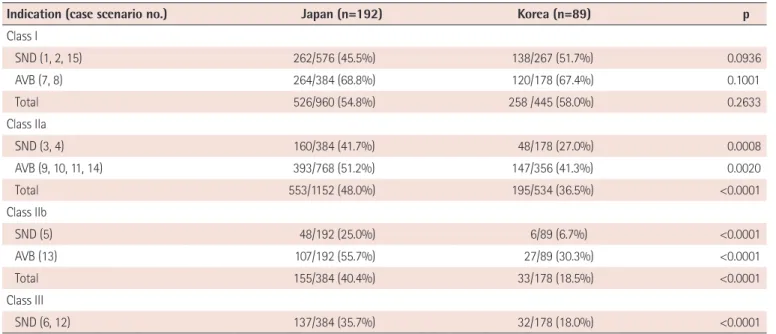
Results were analyzed according to either class indications or disease entities (Table 2 and Fig. 1). For the scenarios described in the group 1, there was no significant difference in the decision to implant a PPM between Korean and Japanese physicians. However, for the group 2, the Japanese physicians were significantly more likely than the Korean physicians to implant a PPM (48% vs. 37%, p<0.001); corresponding rates were 40% vs. 19% (p<0.001) for group 3 and 36% vs. 18% (p<0.001) for the group 4 scenarios.

These results did not change when the cases were categorized based on disease entity, such as sinus node dysfunction and conduction abnormality.

Discussion

This study demonstrates significant differences in the clinical decisions made by Korean and Japanese physicians based on various indications for PPM implantation. Most likely, these differences are not simply due to relative conservatism among Korean electrophysiologists compared with their Japanese counterparts.

Other factors such as national reimbursement policies and cultural differences with respect to patient acceptance of PPM implantation may also influence their decisions.

Both countries have mandatory health insurance systems, but their reimbursement processes differ. The Korean government is in charge of the single health insurance organization in the country, and all medical practices are monitored by the Health Insurance Review and Assessment (HIRA) service. The Japanese government runs two health insurance organizations but does not impose the additional level of regulation found in Korea (Korean HIRA). In general, the reimbursement environment is more strict in Korea than in Japan. In Japan, all the procedures and treatments are reimbursed by the insurance system regardless of the class indications stated in the AHA/ACC/HRS guidelines. In contrast, physicians in Korea can be reimbursed only for class I and selective class IIa indications in implanting a PPM. This difference in reimbursement systems between the two countries is likely to play a major role in physician decisions about whether or not to implant a PPM.

According to our survey analysis, Korean and Japanese physicians differed mainly in their decisions regarding class II PPM indication scenarios (groups 2 and 3). In both countries, the majority of respondents did not favor implantation of PPMs for class III indication scenarios (group 4), although Japanese physicians Table 1. Characteristics of survey respondents

Characteristic Japan (n=192) Korea (n=89)

Operator

EP 100 (52.1) 58 (65.2)

Non-EP 83 (43.2) 28 (31.5)

Cardiac surgeons 9 (4.7) 2 (2.2)

Others 0 (0) 1 (1.1)

Age of operator (in years)

<40 61 (31.8) 26 (29.2)

40-49 90 (46.9) 41 (46.1)

50-59 39 (20.3) 20 (22.5)

≥60 2 (1.0) 2 (2.2)

PPM procedures per year

<10 13 (6.8) 25 (28.1)

10-49 88 (45.8) 34 (38.2)

50-99 59 (30.7) 23 (25.8)

≥100 32 (16.7) 7 (7.9)

Values are presented as n (%). EP: electrophysiologist, PPM: permanent

pacemakers

(3)

656 Physician’s Attitude on Pacemaker Implantation

http://dx.doi.org/10.4070/kcj.2016.46.5.654 www.e-kcj.org

Fig. 1. Rate of positive responses for the PPM implantation. PPM: permanent pacemaker, SND: sinus node dysfunction, AVB: atrioventricular block.

80

60

40

20

0 SND AVB Total

Japan

Positive response (%)

p=0.0936 p=0.1001 p=0.2633

Korea

Class I

80

60

40

20

0 SND AVB Total

Japan

Positive response (%)

p=0.0008 p=0.0020 p<0.0001

Korea

Class IIa

80

60

40

20

0 SND AVB Total

Japan

Positive response (%)

p<0.0001 p<0.0001 p<0.0001

Korea

Class IIb

80

60

40

20

0 SND AVB Total

Japan

Positive response (%)

p<0.0001 p<0.0001

Korea

Class III Table 2. Rates of positive responses regarding PPM implantation

Indication (case scenario no.) Japan (n=192) Korea (n=89) p

Class I

SND (1, 2, 15) 262/576 (45.5%) 138/267 (51.7%) 0.0936

AVB (7, 8) 264/384 (68.8%) 120/178 (67.4%) 0.1001

Total 526/960 (54.8%) 258 /445 (58.0%) 0.2633

Class IIa

SND (3, 4) 160/384 (41.7%) 48/178 (27.0%) 0.0008

AVB (9, 10, 11, 14) 393/768 (51.2%) 147/356 (41.3%) 0.0020

Total 553/1152 (48.0%) 195/534 (36.5%) <0.0001

Class IIb

SND (5) 48/192 (25.0%) 6/89 (6.7%) <0.0001

AVB (13) 107/192 (55.7%) 27/89 (30.3%) <0.0001

Total 155/384 (40.4%) 33/178 (18.5%) <0.0001

Class III

SND (6, 12) 137/384 (35.7%) 32/178 (18.0%) <0.0001

PPM: permanent pacemaker, SND: sinus node dysfunction, AVB: atrioventricular block

(4)

657 Sung-Won Jang, et al.

http://dx.doi.org/10.4070/kcj.2016.46.5.654 www.e-kcj.org

responded more positively to these scenarios. Japanese physicians have their own guidelines for pacemaker implantation

3)

that do not include class III indications in patients with sinus node dysfunction or atrioventricular block, and this could explain the difference in their decisions regarding the group 4 scenarios.

It is well known that racial differences can affect decisions about the utilization of certain medical procedures.

4-6)

This discrepancy may be due in part to cultural factors regarding the acceptance of innovative medical technologies.

7)

Differences in the relative acceptance of pacemaker implantation by patients in Korea and Japan may also influence physician decision making processes.

Limitations

The present study has several limitations. The response rate was lower in Korea (27%) than in Japan (49%). In studies with this type of methodological design, response bias can be an important limitation. We believe that this is partially adjusted by keeping the names of respondents anonymous. In addition, in order to increase participation in this survey, we limited the number of questions and made each question as simple as possible. Our case scenarios were carefully designed to represent scenarios for which a divergence of opinion was likely, thus disclosing subtle differences in physician decision making. Furthermore, during the design of the questionnaire, each case scenario required consensus among three electrophysiologists in the assignment of appropriate class indications.

Conclusions

Korean physicians are generally less likely to favor implantation of a PPM than are Japanese physicians for class IIa and IIb PPM indications. These differences in physician decision making probably contribute to the small number of PPMs implanted in Korea, as compared with Japan. Insurance reimbursement systems as well as cultural differences might influence physicians’ decision

in implanting a PPM.

References

1. Mond HG, Proclemer A. The 11th world survey of cardiac pacing and implantable cardioverter-defibrillators: calendar year 2009-A World Society of Arrhythmia’s project. Pacing Clin Electrophysiol 2011;

34:1013-27.

2. Epstein AE, DiMarco JP, Ellenbogen KA, et al. ACC/AHA/HRS 2008 Guidelines for Device-Based Therapy of Cardiac Rhythm Abnormalities: a report of the American College of Cardiology/

American Heart Association Task Force on Practice Guidelines (Writing Committee to Revise the ACC/AHA/NASPE 2002 Guideline Update for Implantation of Cardiac Pacemakers and Antiarrhythmia Devices) developed in collaboration with the American Association for Thoracic Surgery and Society of Thoracic Surgeons. J Am Coll Cardiol 2008;51:e1-62.

3. JCS Joint Working Group. Guidelines for Non-Pharmacotherapy of Cardiac Arrhythmias (JCS 2011). Circ J 2013;77:249-74.

4. Barnhart JM, Fang J, Alderman MH. Differential use of coronary revascularization and hospital mortality following acute myocardial infarction. Arch Intern Med 2003;163:461-6.

5. Groeneveld PW, Heidenreich PA, Garber AM. Trends in implantable cardioverter-defibrillator racial disparity: the importance of geography. J Am Coll Cardiol 2005;45:72-8.

6. Thomas KL, Al-Khatib SM, Kelsey RC 2nd, et al. Racial disparity in the utilization of implantable-cardioverter defibrillators among patients with prior myocardial infarction and an ejection fraction of

<or=35%. Am J Cardiol 2007;100:924-9.

7. Groeneveld PW, Sonnad SS, Lee AK, Asch DA, Shea JE. Racial

differences in attitudes toward innovative medical technology. J Gen

Intern Med 2006;21:559-63.

수치

Fig. 1. Rate of positive responses for the PPM implantation. PPM: permanent pacemaker, SND: sinus node dysfunction, AVB: atrioventricular block.

참조

관련 문서

- decision making at the operating level time element often does not allow decision making

The Effects of Career Group Counseling Based Upon Multiple Intelligence Theory on Career Decision-Making, Career Self-Efficacy, and Career Maturity for

Since the two countries have established diplomatic relations in 1992, the trade between Korea and China has been developing rapidly, By the end of 2006, Korea

The metal biopsy test of both specimens did not show any microscopic cracks in the heat affected zone and the base metal, and both samples were free from

In Korea, the two countries were liberated from the postwar international order, not from the victorious or defeated countries, and the division of the

In the change in body composition, body weight did not show a statistically significant change in all items in the exercise group and the control group,

Diagnosis and Treatment of Oral admidstrated Bisphosphonate-related osteonecrosis of the jaw.. and implantation

First, for the different learning attitude between pre-post tests regarding the self-evaluation of dance expression activity in class at elementary school,