Original Articles 순환기:순환기:순환기:순환기:제제제 2 7 권제 권권권 제제제제 1 0 호호호 1997호
Cordis 스텐트 시술의 장기 임상 경과 및 성적:
혈관내 초음파를 이용한 스텐트 시술 후 재협착에 대한 비교 연구
울산대학교 의과대학 서울중앙병원, 내과학교실, Washington Hospital Center*
홍명기·박성욱·정상식·이철환·김영학·김재중·박승정·홍문경
*Gary S. Mintz
*·Martin B. Leon
*=
=
=
= Abstract = = = =
Late Clinical Outcomes of Cordis Tantalum Coronary Stenting without Anticoagulation: : : :Validation of Angiographic Measurement
and In-stent Restenosis by Intravascular Ultrasound
Myeong-Ki Hong, M.D., Seong-Wook Park, M.D., Sang-Sig Cheong, M.D., Cheol-Whan Lee, M.D., Young-Hak Kim, M.D., Jae-Joong Kim, M.D.,
Seung-Jung Park, M.D., Mun K. Hong, M.D., F.A.C.C.,*
Gary S. Mintz, M.D., F.A.C.C.,* Martin B. Leon, M.D., F.A.C.C.*
Department of Internal Medicine, College of Medicine, University of Ulsan, Cardiovascular Center, Asan Medical Center, Seoul, Korea
Washington Hospital Center, Washington, DC, USA*
Background:The Cordis coronary stent is a flexible, balloon expandable, radiopaque tantalum stent. Previous reports have shown excellent initial clinical outcomes. To our knowledge, there is no report of the long-term clinical outcomes. The intensely radiopaque tantalum may interfere with the angiographic assessment. We intended to evaluate long-term clinical and angiographic restenosis rates after successful implantation of the Cordis tantalum coronary stent.
Methods:Two hundred and eighty-five consecutive patients with 300 lesions were treated with 366 Cordis stents. An angiographic follow-up substudy was performed in 190 lesions;6 month follow-up angiograms were available in 167(88%). At follow-up, intravascular ultrasound(IVUS) was performed to(1) determine the pattern of restenosis and(2) to validate the quan-titative coronary angiographic(QCA) caliper measurements.
Results : IVUS and QCA caliper measurement of minimal luminal diameter correlated
reliably(r=0.767, p<0.0001). The QCA analysis detected diffuse in-stent restenosis more reliably
than focal in-stent restenosis(p<0.01). The overall angiographic restenosis rate was 19%. The factors
affecting angiographic restenosis were post-stent minimum lumen diameter, type C lesion, and
reference vessel size.
Conclusion:We concluded 1) The angiographic restenosis rate of Cordis stent was com-parable to that of other slotted-tube stent. 2) The QCA caliper method is reliable for the assessment of Cordis in-stent restenosis, especially in the detection of diffuse in-stent restenosis. However, QCA may miss focal in-stent restenosis only detectable by IVUS.
KEY WORDS:Cordis stent·Restenosis·Coronary artery disease.
서 론
경피적 관동맥확장술(percutaneous transluminal coronary angioplasty, 이하 PTCA)의 성공율이 90%
까지 향상되었으나1), 이에 따른 제한점으로 급성 폐쇄 (acute closure)가 2~10%2), 후기 재협착율은 30~
45%에서 보고되고 있다3). 스텐트 시술은 관동맥확장 술의 제한점인 급성 폐쇄 및 임박 폐쇄(threatened closure) 등의 구제시술이나4) 재협착을 줄이기 위한5,6) 유용한 방법으로 제시되고 있다. 그래서 현재 다양한 모양과 조성을 가진 스텐트들이 이러한 목적으로 이 용되고 있거나 연구중이다. Cordis스텐트는 유연성이 있고 풍선으로 확장되며 방사선 비투과적인 tantalum 으로 된 스텐트로서7,8), Cordis 스텐트 시술후 단기 성적은 알려져 있으나 장기 성적에 대해서는 잘 알려 지지 않았다.
따라서 본 연구에서는 Cordis스텐트 시술후 단, 장 기 임상 경과 및 혈관 조영상 재협착율을 알아보고자 하였다. 또한 Cordis스텐트가 방사선 비투과적이므로 추적 혈관조영술 검사시 혈관 내경의 측정을 어렵게 할 가능성이 있어 일부 환자군에서는 혈관내 심초음 파(intravascular ultrasound, 이하 IVUS)와 혈관조 영술의 결과를 비교하였다.
연구대상 및 방법
1. 연구 대상
연속된 285명의 환자를 대상으로 300병변에서 366 개의 스텐트를 시술하였다. 스텐트 시술의 적응증은 선택적 시술(elective stenting), 급성 폐쇄, 임박 폐 쇄 및 PTCA결과가 충분하지 못할 때였다. 급성 심근 경색증에서 경색 관련 혈관에의 스텐트 시술은 증상 발현후 7~10일 후에 시행하였다9). 대상군은1) 증상 이 있고 운동 부하 검사나 thallium SPECT를 통해
객관적인 심근 허혈의 증거가 있으며 2) 관동맥 조영 술상 내경의 70% 이상 협착 병변이 있고 3) 시술에 동의한 경우로 하였다. 모든 환자를 대상으로 시술후 1, 3 및 6개월에 외래에서 임상적 경과를 관찰하였으 며, 6개월되는 시점에 추적 혈관 조영술을 권유하였다.
현재까지 190병변에 대해 혈관 조영상 경과 관찰을 하 였으며 나머지 110 병변에 대해서도 스텐트 시술후 6 개월되는 시점에 추적 혈관조영술을 시행할 예정이다.
2. 스텐트 삽입술
헤파린을 10,000단위 정주후 시술도중 activated clotting time이 250초 이상 유지되도록 필요하면 헤 파린 5,000단위를 추가로 정주하였다. 풍선과 혈관 내경의 비는 1:1이 되도록 스텐트 삽입전 혈관 확장 (predilation)을 시도하였다. 스텐트와 혈관 내경의 비 가 1.15:1이 되도록 스텐트의 크기를 선택하였으며, 따라서 대개는 참조 혈관(reference vessel)에 비해 스텐트의 크기가 0.5mm 큰 것을 사용하였다. 스텐트 가 3.5mm이상인 경우가 병변의 77% 였으며 두개 이상의 스텐트가 삽입된 경우가 20% 였다.
풍선위에 입혀진 상태(premounted)의 Cordis 스 텐트를 병변부에 삽입하였고, 확장 압력은 약 12~14 기압이었다. 스텐트 시술후 추가적인 고압력 확장술은 필요하지 않았다. 단 한번의 고압력 풍선확장술을 이 용한 Cordis스텐트 시술법은 본 교실에서 보고한 이 전의 연구와 같다8).
모든 환자는 항혈전제로 aspirin과 ticlopidine을 복 용하였다. 헤파린은 시술후 24시간 까지 사용하고 중 단하였다. Ticlopidine은 적어도 시술 하루전부터 하 루 250mg씩 두차례 투여하여 시술후 한달까지 투여 하였고 aspirin은 연구 기간 내내 모든 환자에게 하루 200 mg씩 투여하였다.
3. 혈관 조영상 분석
혈관 조영은 관동맥으로 nitroglycerin 0.2mg을 정
주후 시행하였다. 혈관 조영상 분석은 스텐트 시술에 참여하지 않은 두 명의 전문의에 의해 이루어졌다. 유 도 도관(guiding catheter)의 굵기를 내경 측정을 위 한 표준으로 사용하였다. 병변은 American College of Cardiology-American Heart Association(ACC/
AHA)분류에 의해 구분하였다10). 컴파스(caliper)를 이용한 정량적 혈관 조영 분석법[quantitative coro- nary angiographic analysis(QCA), 이하 QCA]에 따 라 혈관 내경 협착 정도, 최소 혈관 내경 및 참조 혈관 내경(reference diameter)을 구하였다. 측정은 시술 전, 시술후 및 추적 경과 관찰시에 측정하였고 확장기 에 여러 방향에서 보아 가장 좁은 경우의 직경으로 하 였다. 초기 이득(acute gain)은 시술후 최소 내경과 시술전 최소 내경의 차이로 하였고 후기 손실(late loss)은 추적 경과 관찰시 최소 내경과 스텐트 시술직 후 최소 내경의 차이로 정의하였다. 혈관 조영상 재협 착은 추적 혈관 조영술시 혈관 내경의 50%이상 협착 이 있는 경우로 정의하였다.
4. 혈관내 초음파(IVUS) 촬영
Cordis스텐트가 방사선 비투과성이므로 혈관 조영술로 재협착을 진단하는데 약간의 어려움이 동반된다11). 따 라서 본 연구에서는 46명 환자, 49병변을 대상으로 추적 혈관 조영술시 QCA와 IVUS를 같이 시행하여 얻은 결과를 비교하였다. IVUS는 0.2mg nitro- glycerin 투여후에 영상을 얻었으며 초음파도자를 병 변 부위보다 원위부로 10mm이상 지난 지점까지 삽 입한 후 손으로 서서히 조심스럽게 당기면서 병변부 를 지나 관동맥 개구부까지 관찰하였다. 사용한 IVUS 는 Cardiovascular Imaging System 회사 제품으로 말단 부위에 30-MHz의 변환기(transducer)가 달리 고 360° 회전이 가능한 유연한 몸체(2.9F/3.2F)를 가 진 도관으로 되어있다12). 초음파 검사는 1/2고해상도 의 VHS 테이프에 기록하였다.
5. IVUS를 이용한 정량적 분석
컴퓨터 프로그램을 이용하여 근위부 및 원위부 참 조 혈관에서 혈관 내강(lumen)의 단면적, 최소 및 최 대 혈관 내경을 구하였다. 스텐트 삽입부에서는 최소 스텐트 단면적(stent cross sectional area), 혈관의 단면적(lumen cross sectional area)과 최대 및 최소 내경(major and minor diameter)을 구하였다. 정량
적 수치는 2~4차례 측정후 평균값으로 정하였다.
IVUS에 의한 재협착의 정의는 내피증식(intimal hy- perplasia)의 면적이 최소 스텐트 단면적(stent cross sectional area)의 75% 이상인 경우로 하였다 [% 내 피증식량(intimal hyperplasia burden)]. 국소 재협착 (focal restenosis)은 스텐트 길이의 1/2 이하에서 내 피증식이 75%이상인 경우로 하였으며, 미만성 재협 착(diffuse restenosis)은 스텐트 길이의 1/2이상에 서 내피증식이 75%이상인 경우로 하였다.
6. 통계 분석
연속 변수는 평균값±표준 편차로 표시하였고 범주 변수는 빈도로 표시하였다. 연속 변수의 비교는 two- tailed t test를 이용하였으며 범주 변수의 비교는 chisquare test를 사용하였다. 연속적인 변수의 상관 관계 분석은 선상 회귀 분석을 이용하였고 혈관 조영 상 재협착의 예측 인자에 대한 분석은 다변량 회귀 분 석을 사용하였다. 통계적으로 유의한 결과는 p값이 0.05 이하인 경우로 하였다.
결 과
1. 시술 성적
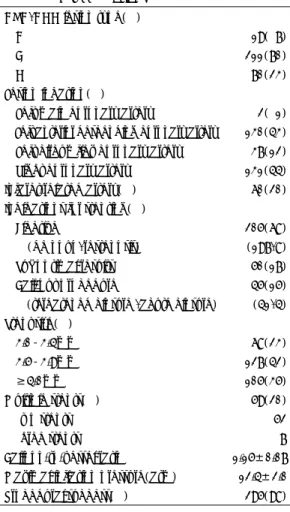
대상 환자 285명의 임상적 특성은 Table 1과 같고 대상 병변 300부위의 특성은 Table 2와 같다. 시술 성공율은 98% 였으며 대상 병변의 68%에서 선택적 Table 1. Baseline clinical characteristics of the 285
patients
Age(years) 58.3±9.1
Gender(Male/Female) 220/65 Risk Factors(%)
Hypertension 97(34) Diabetes mellitus 47(17) Hypercholesterolemia 20( 7) Current smoker 110(39) Myocardial infarction(%)
Healed 34(12) Acute 70(25) Unstable angina(%ㅍ 131(46) Number of narrowed coronary arteries(%)
1 149(52) 2 81(28) 3 55(19)
스텐트 시술이 시행되었다. 대상 병변 부위에서 혈관 이 분지되는 경우가 51% 였으며, 스텐트 시술후 혈관 이 분지되는 경우의 7%에서 분지 혈관의 협착이 발 생하였다. 스텐트 삽입전, 직후 및 추적 경과 관찰시 의 QCA에 의한 혈관 내경 측정치는 Table 3과 같다.
평균 참조 혈관의 내경은 3.4mm였고 스텐트 삽입 직 후 내경 협착은 평균 78%에서 -9%로 감소하였으며, 최소내경은 0.8mm에서 3.7mm로 증가하였다. 입원 중 합병증으로 급성 폐쇄는 없었고 아급성 스텐트 혈 전증이 2명(0.7 %)에서 발생하였으나 두명 모두 성 공적인 PTCA후 퇴원하였다(Table 4).
추적 경과 관찰시 혈관내경 협착의 정도는 평균 21%
였으며 평균 최소내경은 2.8mm 였다.
2. IVUS 분석
IVUS측정 결과는 Table 5와 같다. IVUS와 QCA
결과 비교에서 추적 경과 관찰시 최소 혈관 내경에 대 한 두 방법의 측정치는 통계학적으로 서로 유의한 상 관 관계가 있었다(r=0.767, p<0.0001, Fig. 1). IVUS 에서 재협착이 없었던 34병변 모두에서 QCA상 재협 착이 없었다. IVUS에서 국소 재협착이 있었던 5병변 중에서 QCA로는 1병변에서만 재협착이 있었으며 나머 지 4병변에서는 재협착을 발견할 수 없었다. 그리고 IVUS상 미만성 재협착이 있는 10병변 모두에서 QCA 상에도 재협착을 발견할 수 있었다(p<0.001, Table 6).
Table 2. Angiographic and procedural characteristics of the 300 lesions
AHA/ACC lesion type(%)
A 19( 7) B 211(70) C 70(23) Lesion location(%)
Left main coronary artery 2( 1) Left anterior descending coronary artery 130(43) Left circumflex coronary artery 37(12) Right coronary artery 131(44) Infarct-related artery(%) 60(20) Indications for stenting(%)
Elective 205(68) (de novo/restenosis) (197/8) Suboptimal results 50(17) Bail-out procedure 45(15) (threatened closure /acute closure) (41/4) Stent size(%)
3.0-3.4mm 68(23) 3.5-3.9mm 127(42)
≥4.0mm 105(35) Multiple stents(%) 59(20) Two stents 52 Three stents 7 Balloon-to-vessel ratio 1.15±0.07 Maximal inflation pressure(atm) 12.4±2.0 Procedural success(%) 295(98)
Table 3. Quantitative angiographic measurements pr- eintervention, post-stent implantation, and at follow-up
Reference vessel diameter(mm) 3.4±0.4 Diameter stenosis(%)
Baseline 78±13
Final -9±5
Follow-up 21±12 Minimum lumen diameter(mm)
Baseline 0.8±0.4 Final 3.7±0.4 Follow-up 2.8±0.7 Acute gain(mm) 2.9±0.5 Late loss(mm) 0.9±0.8
Table 4. In-hospital outcomes of 285 patients(%)
Acute closure 0(0)
Subacute thrombosis 2(0.7) Death 0(0)
Q-wave MI 2(0.7)
Non Q-wave MI 5(1.7)
Bypass graft surgery 2(0.7)
Table 5. IVUS measurements Proximal reference
Stented segment
Distal reference Lumen
Cross-sectional area (mm2)
7.2±2.5 4.1±1.7 6.5±2.1 Minimum diameter
(mm)
2.5±0.4 2.4±0.6 2.5±0.4 Maximum diameter
(mm)
3.2±0.6 2.5±0.5 3.1±0.4 Stent cross-sectional
area(mm2)
7.6±1.6 Lumen/stent
cross-sectional area(%)
54.0±8.8
3. 장기 성적
추적 혈관 조영술은 대상이 되는 190병변중 88%
에서 이루어졌다. 혈관 조영상 재협착율은 19%였고 병변 부위의 혈관재개율(revascularization rate)은 16%였다. 혈관 조영상 각 변수와 재협착율과의 관계 는 Table 7과 같다. 추적 혈관 조영술이 시행된 병변 중에서 스텐트 시술전 병변 부위에 분지 혈관이 있는 경우가 77병변(46%)으로, 이중 72병변(93%)에서 추적 경과 관찰시 분지 혈관의 협착은 관찰되지 않았 다. 추적 경과 관찰 기간중 사망은 없었으며 선택적 관동맥 우회로술이 4명(2%)의 환자에서 시행되었고 23명(14%)의 환자에서 재차 PTCA가 시행되었다.
재협착이 있는 31병변과 재협착이 없는 136병변을 비교하였을때 재협착이 있는 군에서 참조 혈관의 내 경, 스텐트 시술후 최소 혈관 내경 및 초기 이득이 의 미있게 작고(p<0.01), 스텐트 시술후 잔여 협착 및 후기 손실이 의미있게 컸다(p<0.01)(Table 8).
재협착의 예측 인자를 파악하기 위한 다변량 분석
을 시행하였을 때 스텐트 시술후 최소 혈관내경이 재 협착의 가장 강력한 예측 인자로 나타났다(Table 9).
고 안
Cordis 스텐트는 protective sheath가 없고 유연성 (flexibility)이 좋아서 기술적으로 안전하고 쉽게 사 용할 수 있어 높은 시술 성공율을 얻을 수 있다8). 본 연구에서는 단 한차례의 고압력 과확장 스텐트 시술 (single high-pressure overdilation stent inflation) 후 병변 부위의 최소 내경이 참조 혈관의 내경보다 더 크게 되었다. 이는 고압력 풍선 확장술과 IVUS를 이 용한 격자형 관 스텐트(slotted tube stent) 시술의 이전 결과와 일치하였다13). 또한 시술 성공율 및 아급 성 혈전증 등의 원내 합병증(inhospital complication) Table 7. Restenosis rate of the 167 lesions studied at
follow-up
Follow-up rate(%) 167/190(88) Overall restenosis rate(%) 31(19) AHA/ACC lesion type(%)
A 1/ 10(10)
B 15/118(13)
C 15/ 39(38)*
Lesion location(%)
Left anterior descending coronary artery 19/ 83(23) Left circumflex coronary artery 2/ 19(11) Right coronary artery 10/ 65(15)
Infarct-related artery(%) 6/ 30(20) Indications for stenting(%)
Elective 20/115(17) Suboptimal results 5/ 28(18) Bail-out procedure 6/ 24(25) Stent size(%)
3.0-3.4mm 18/ 43(42)#
3.5-3.9mm 10/ 75(13)
≥4.0mm 3/ 49( 6)
Size of reference vessel(%)
≤3.0mm 9/ 21(43)**
3.0-3.5mm 15/ 89(17)
3.5mm 7/ 57(12)
Multiple stents(%) 8/ 33(24)
*p<0.01:type C lesion vs non-type C lesion
#p<0.0001:stent size <3.5mm vs ≥3.5mm
*p<0.01:size of reference vessel ≤3.0mm vs >3.0mm Table 6. Comparison between IVUS and QCA
IVUS No
restenosis
Focal restenosis
Diffuse restenosis QCA Restenosis 0 1 10 No restenosis 34 4 0 Fig. 1. The comparison of the measurement of minim-
um lumen diameter by IVUS and caliper QCA.
빈도도 비슷하였다. 따라서 Cordis 스텐트 시술시 단 한차례의 고압력 과확장 스텐트 시술 방법은 격 자형 관 스텐트(slotted tube stent) 시술시의 고압 력 풍선확장술에 버금가는 치료 방법으로 사료된다.
또한, Cordis 스텐트의 또 다른 장점으로는 분지 혈 관의 폐쇄 없이 성공적 시술이 가능하다는 점도 있 다고 하겠다.
1. IVUS와 QCA의 비교
Tantalum이 방사선 비투과적이므로 혈관 조영상 재협착을 진단하는데 약간의 어려움이 있다11). 그러나 IVUS는 방사선 투과성에 영향을 받지 않으므로 QCA 법의 유용성을 평가하는데 사용될 수 있다고 하겠다.
본 연구에서 IVUS와 QCA에 의해 측정된 최소 혈관 내경치간에는 유의한 상관관계가 관찰되었는데(r=
0.767), 이는 이전의 연구와 일치하는 결과이다11). 스텐트 시술후 재협착의 가장 중요한 기전은 스텐트 내의 신내피 증식(neointimal proliferation)이다14-16). 본 연구에서 혈관 조영술을 이용한 재협착의 분석에 서 국소 재협착보다 미만성 재협착을 좀 더 용이하게 진단하였는데 이는 혈관 안에 조영제가 찬 경우에 혈
관 내막과 방사선 비투과적인 스텐트의 경계를 구분하 기가 다소 힘들었기 때문으로 사료된다. 그러므로 QCA 로 진단하지 못한 국소 재협착을 진단하는데 IVUS가 유용할 것으로 사료된다.
2. Cordis 스텐트 시술의 장기 성적 및 혈관 조영상 재협착율
Cordis 스텐트의 재협착율과 병변의 혈관재개율(re- vascularization rate)은, 특히 3.5mm이상의 혈관에서 격자형 관 스텐트의 결과와 유사하다. Palmaz-Sc- hatz 스텐트를 이용한 두 무작위 연구에서는 재협착 율이 22~32%라고 보고하였다5,6). 또한, 고압력 확장 술과 IVUS를 이용한 연구에서는 병변의 혈관재개율 (revascularization rate)이 15%미만이라고 보고하였 다13). 본 연구에서는 스텐트 시술전의 적극적인 병변 의 확장과 고압력 확장술을 이용한 스텐트 시술로 시 술후 혈관 내경을 크게 할 수 있어서 좋은 결과를 얻 었다고 생각된다.
3.5mm이상의 스텐트를 사용하였을 때보다 3.0mm 이하의 스텐트를 사용하였을 때 재협착율이 높았는데 (42%), 이는 작은 스텐트(3.0mm)는 혈관의 내경이 작은 경우(즉, 참조 혈관의 내경이 3.0mm 이하인 경 우)에 사용되었기 때문으로 사료된다. 이는 참조 혈관 의 내경이 작은 것이 재협착의 예측 인자 중 하나라는 이전의 연구와 일치하는 결과이다17).
임상적, 해부학적 여러 인자가 재협착에 영향을 미 친다고 알려져 있다. 좌전하행지 병변, 당뇨, 시술후 Table 8. QCA measurements of the restenotic vs nonrestenotic lesions
Restenosis(n=31) No restenosis(n=136) p
Maximal inflation pressure(atm) 13.1 ± 1.7 12.5 ± 1.7
Reference vessel d iameter(mm) 3.3 ± 0.4 3.5 ± 0.4 <0.05 Balloon-to-vessel ratio 1.15± 0.08 1.14± 0.04
Diameter stenosis
Baseline(%) 70.4 ±10.6 74.9 ±10.9
Final(%) -4.4 ±10.4 -9.7 ±5.9 <0.01
Follow-up(%) 46.3 ±28.9 15.1 ±14.9 <0.01 Minimum lumen diameter
Baseline(mm) 1.0 ± 0.3 0.9 ± 0.4
Final(mm) 3.4 ± 0.4 3.8 ± 0.3 <0.01
Follow-up(mm) 1.8 ± 1.0 3.0 ± 0.5 <0.01 Acute gain(mm) 2.4 ± 0.4 2.9 ± 0.5 <0.01
Late loss(mm) 1.7 ± 1.0 0.8 ± 0.5 <0.01
Table 9. Independent predictors of angiographic res- tenosis
p Post-stent minimum lumen diameter(mm) 0.0043
Type C lesion 0.016
Reference vessel diameter(mm) 0.03
병변 내경이 3.31mm 이하인 경우에 재협착이 많다 고 보고하였다18). 본 연구에 의하면 시술후 최소 혈관 내경, 참조 혈관의 내경, C형 병변 등이 재협착을 예 측 할 수 있는 인자였으나 스텐트 시술후 최소 혈관 내경이 가장 강력한 예측 인자였다. 이는 STRESS연 구와도 일치하는 결과이다6).
본 연구에 의하면 C형 병변에서 재협착율이 높았다.
이전의 연구처럼 높은 재협착이 발생하였는데19) 본 연구에서는 삽입된 스텐트의 수가 재협착의 예측 인 자임을 증명할 수는 없었다.
3. 한계점
(1) 모든 환자에서 추적 혈관 조영술을 시행하지는 못하였다.
(2) 추적 혈관 조영술을 시행한 환자중 일부에서만 IVUS를 시행하였다.
요 약
연구배경:
Cordis tantalum 스텐트는 유연하며, 풍선으로 확 장 가능하고, 방사선 비투과성으로 비교적 쉽게 사용 가능한 스텐트이다. 저자들은 Cordis 스텐트 시술후 장기 임상 경과 및 혈관 조영상 재협착율을 알아보고 자 하였다.
방 법:
285명의 대상 환자, 300 대상 병변에서 366개의 스텐트가 시술되었다. 스텐트 시술후 6개월이 지난 190명의 대상 환자들중 167명(88%)에서 추적 관동 맥 조영술이 시행되었다. IVUS는 (1) 재협착의 여부 를 파악하고, 재협착의 형태를 구분하거나 (2) IVUS 와 QCA를 이용하여 측정한 혈관 내경의 측정치를 비 교하기 위해서 시행되었다.
결 과:
IVUS와 QCA를 이용하여 측정한 최소 혈관 내경치 간에는 서로 상관관계가 있었다(r=0.767, p<0.0001).
혈관 조영술로는 국소적인 재협착보다 미만성 재협착 이 보다 쉽게 관찰되었다(p<0.01). 혈관 조영상 재협 착율은 19% 였다. 혈관 조영상 재협착을 예측할 수 있는 인자는 스텐트 시술후 최소 혈관 내경, C형 병변, 참조 혈관의 크기 였다.
결 론:
1) Cordis스텐트의 혈관 조영상 재협착율은 격자형 관 스텐트의 재협착율과 비교하여 차이가 없었다. 2) 추적 관동맥 조영술시에 QCA를 사용하여 최소 혈관 내경을 유용하게 측정할 수 있다. 특히 재협착 병변이 미만성 병변인 경우에는 IVUS와 비교하여 관찰하여 도 정확하게 진단할 수 있다. 하지만 재협착 병변이 IVUS를 시행하여 발견된 국소적인 병변인 경우에는 QCA를 이용하여 진단할 경우에 재협착 여부를 정확 히 진단하지 못할 수 있다.
References
1) Detre K, Holubkob R, Kelsey S, Cowley M, Kent K, Williams D, Myler R, Faxon D, Holmes D, Bourassa M, Block P, Gosselin A, Bentivoglio L, Leatherman L, Dor- ros G, King S, Galichia J, Al-Bassam M, Leon M, Ro- bertson T, Passamani E and the co-investigators of the National Heart, Lung, and Blood institutes percutaneous transluminal coronary angioplasty registry:Percutaneous transluminal angioplasty in 1985-1986 and 1977-1981: the National Heart, Lung and Blood Institute Registry. N Engl J Med 318:265-70, 1988
2) De Feyter PJ, de Jaegere PPT, Murphy ES, Serruys PW:
Abrupt coronary artery occlusion during percutaneous transluminal coronary angioplasty. Am Heart J 123: 1633-42, 1992
3) Nobuyoshi M, Kimura T, Nosaka H, Mioka S, Ueno K, Yokoi H, Hamasaki N, Horiuchi H:Restenosis after successful percutaneous transluminal coronary angiop- lasty;serial angiographic follow-up of 229 patients. J Am Coll Cardiol 12:616-623, 1988
4) Sutton JM, Ellis SG, Roubin GS, Pinkerton CA, King SB, Raizner AE, Holmes DR, Kereiakes DJ, Topol EJ for the Gianturco-Roubin Intracoronary Stent Investigator Group:Major clinical events after coronary stenting. The multicenter registry of acute and elective Gianturco-Rou- bin stent placement. Circulation 89:1126-37, 1994 5) Serruys PW, Jaegere PD, Kiemeneij F, Macaya C, Rutsch
W, Heyndrickx G, Emanuelsson H, Marco J, Legrand V, Materne P, Belardi J, Sigwart U, Colombo A, Goy JJ, Heuvel PVN, Delcan J, Morel MA for the Benestent Study Group:A comparison of balloon expandable stent impl- antation with balloon angioplasty in patients with cor- onary artery disease. N Engl J Med 331:489-495, 1994 6) Fischman DL, Leon MB, Baim DS, Schatz RA, Savage
MP, Penn I, Detre K, Veltri L, Ricci D, Nobuyoshi M, Cleman M, Heuser R, Almond D, Teirstein PS, Fish RD, Colombo A, Brinker J, Moses J, Shaknovich A, Hirsh-
feld J, Bailey S, Ellis S, Rake R for the Stent Restenosis Study Investigators:A randomized comparison of cor- onary-stent placement and balloon angioplasty in the treatment of coronary artery disease. N Engl J Med 331:496-501, 1994
7) Eeckhout E, Kappenberger L, Goy JJ:Stents for intrac- oronary placement:current status and future directions.
J Am Coll Cardiol 27:757-65, 1996
8) Park SW, Park SJ, Hong MK, Kim JJ, Cho SY, Jang YS, Kim KB, Kim KS, Oh DJ, Oh BH, Kang JC:Coronary stenting(Cordis) without anticoagulation. Am J Cardiol 79:901-904, 1997
9) 홍명기·박성욱·김재중·정상식·이철환·김진우·
이일수·박승정:급성 심근 경색 환자에서의 관동 맥내 스텐트 시술. 순환기 27:49-55, 1997 10) Ryan TJ, Faxon DP, Gunnar RM, Kennedy JW, King SB,
Loop FD, Peterson KL, Reeves TJ, Williams DO, Winters WL Jr:Guideline for percuta-neous transluminal coro- nary angioplasty:a report of American College of Car- diology/ American Heart Association Task Force on ass- essment of diagnostic and therapeutic cardiovascular pr- ocedures. Circulation 78:486-502, 1988
11) Ozaki Y, Keane D, Nobuyoshi M, Manasaki N, Popma JJ, Serruys P:Coronary lumen at six-month follow-up of a new radiopaque Cordis tantalum stent using quantitative angiography and intracoronary ultrasound. Am J Cardiol 76:1135-43, 1995
12) Mintz GS, Popma JJ, Pichard AD, Kent KM, Satler LF, Wong SC, Hong MK, Kovach JA, Leon MB:Arterial remodeling after coronary angioplasty;serial intrav- ascular ultrasound study. Circulation 94:35-43, 1996 13) Colombo A, Hall P, Nakamura S, Almagor Y, Maiello L,
Martini G, Ganglione A, Goldberg SL, Tobis JM:Intr- acoronary stenting without anticoagulation accomplished with intravascular ultrasound guidance. Circulation 91: 1676-1688, 1995
14) Dussaillant GR, Mintz GS, Pichard AD, Kent KM, Satler LF, Popma JJ, Wong SC, Leon MB:Small stent size and intimal hyperplasia contribute to restenosis;a volu- metric intravascular ultrasound analysis. J Am Coll Car-
diol 26:720-724, 1995
15) Hoffmann R, Mintz GS, Dussaillant GR, Popma JJ, Pichard AD, Satler LF, Kent KM, Griffin J, Leon MB:
Patterns and mechanism on in-stent restenosis;a serial intravascular ultrasound study. Circulation 94:1247-54, 1996
16) Kuntz RE, Gibson CM, Nobuyoshi M, Baim DS:Gene- ralized model of restenosis after conventional balloon angioplasty, stenting, and directional atherectomy. J Am Coll Cardiol 21:15-25, 1993
17) Wong SC, Baim DS, Schatz RA, Teirstein PS, King SB, Curry RC, Heuser RR, Ellis SG, Cleman MW, Overlie P, Hirshfeld JW, Walker CM, Litvack F, Fish D, Brinker JA, Buchbinder M, Goldberg S, Chuang YC, Leon MB, for the Palmaz-Schatz Stent Study Group:Immediate res- ults and late outcomes after stent implantation in saph- enous vein graft lesions:the multicenter U.S. Palmaz- Schatz stent experience. J Am Coll Cardiol 26:704-12, 1995
18) Gordon PC, Gibson IM, Cohen DJ, Kuntz RE, Baim DS, Carrozza JP, Levine MJ:Angiographic and clinical out come of intracoronary stenting:immediate and long-term results from a large singlecenter experience. J Am Coll Cardiol 20:328-37, 1992
19) Ellis SG, Savage M, Fischman D, Baim DS, Leon M, Goldberg S, Hirshfeld JW, Cleman MW, Teirstein PS, Walker C, Bailey S, Buchbinder M, Topol EJ, Schatz RA:Restenosis after placement of Palmaz-Schatz stents in native coronary arteries:initial results of a multice- nter experience. Circulation 86:1836-44, 1992 20) Maiello L, Colombo A, Gianrossi R, McCanny R, Finci
L:Coronary stenting for treatment of acute or threa- tened closure following dissection after coronary balloon angioplasty. Am Heart J 126:23-31, 1993
21) Colombo A, Goldberg SL, Almagor Y, Maiello L, Finci L:A novel strategy for stent deployment in the treatment of acute or threatened closure complicating balloon cor- onary angioplasty. Use of short or standard(or both) single or multiple Palmaz-Schatz stent. J Am Coll Cardiol 22: 1887-91, 1993