Perceptual Similarity between English and Korean:
Evidence from Online Adaptation
Jungyeon Kim (Stony Brook University)
Kim, Jungyeon. (2018). Perceptual similarity between English and Korean:
Evidence from online adaptation. The Linguistic Association of Korea Journal, 26(4), 21-35. Korean loanwords borrowed from English that end in voiceless stops frequently undergo vowel insertion. This vowel insertion is interesting since voiceless stops are permissible in final position in Korean native words. The perceptual similarity approach claims that this seemingly unnecessary vowel insertion is motivated by perceptual similarity between English and Korean forms.
The current study reports on a perception experiment designed to examine whether Korean listeners actually judge English forms to be similar to Korean forms. In an AXB similarity judgment experiment, Korean learners of English listened to a triplet, consisting of an English stop-final form (CVC) and two Korean forms, one ending in a stop (CVC) and the other ending in stop-vowel (CVCV), and indicated which of the two Korean forms the English form sounded more similar to. The experimental result showed that Korean listeners were more likely to judge Korean CVCV as more similar to English CVC than Korean CVC when the English form ended in a released stop, and that final stress did not have a significant effect. This finding turns out to be consistent with the perceptual similarity approach, indicating that the English form could be acoustically similar to the Korean pronunciation.
Key Words: stop release, final stress, perceptual similarity, similarity judgments
1. Introduction
One puzzle in loanword adaptation involves what Peperkamp (2005) calls
“unnecessary adaptation.” This is a situation in which loanword adaptations
occur even when there is no ill-formed phonotactic structure that needs to be repaired. For example, Korean loanwords from English that end in voiceless stops are frequently adapted with vowel insertion (e.g., peak → [phikhɨ]).1) This vowel insertion is surprising because voiceless stops are allowed in coda position in Korean native words (e.g., /mok/ → [mok˺] ‘neck’).
Korean has a three-way laryngeal contrast in stops: voiceless unaspirated, voiceless aspirated, and voiceless tense. As shown in (1), only voiceless unaspirated stops are allowed in final position, with all three categories realized as voiceless unaspirated in this position.
(1) Neutralization in final position /aph/ → [ap˺] ‘front’
/path/ → [pat˺] ‘field’
/puʌkh/ → [puʌk˺] ‘kitchen’
/pak’/ → [pak˺] ‘outside’
Kang (2003) argues that this seemingly unmotivated vowel insertion is motivated by perceptual similarity between English and Korean forms. Kang discusses stop release as a perceptual factor promoting vowel insertion after English word-final postvocalic stops. English word-final stops are variably released (Crystal & House, 1988; Byrd, 1992) while word-final stops in Korean are never released (Sohn, 1999). Kang claims that vowel epenthesis makes the Korean output perceptually similar to an English final released stop, noting the fact that stop release in English and an epenthetic vowel in Korean are acoustically similar.
In addition, Jun (2002) has identified another factor that affects the likelihood of vowel insertion by Korean speakers adapting English words as final stress. In an experiment where Korean participants heard auditory stimuli and wrote what they heard on a response sheet, Jun found that vowel insertion was more likely when the final syllable was stressed than when it was unstressed. This finding is also consistent with Kang’s loanword list, where the frequency of vowel
1) Since the focus of the present study is on unnecessary vowel insertion, the pattern of no vowel insertion (e.g., technique → [thɛkhɨnik˺]) is not discussed here. For discussion about variable patterns of vowel insertion in Korean, see Boersma & Hamann (2009).
insertion in polysyllabic words with final postvocalic stops was higher when the final syllable was stressed than when it was unstressed. Kang (2003) claims that final stress is correlated with vowel insertion in that the presence of stress in the syllable containing the final stop contributes to the likelihood that the stop will be released in English. That is, final stress is related to vowel insertion not because it contributes to the perceptual similarity between final C and final CV but because it increases the possibility that Korean adapters will have heard pronunciations with a final released consonant. For example, since English speakers are more likely to release a stop that occurs in a stressed final syllable, Korean speakers are more likely to hear a released stop in a stressed final syllable.
Kang (2003) has provided evidence that acoustic details of the recipient language are relevant in the process of loanword adaptations. However, her study did not directly investigate the perception of English postvocalic word-final stops by Korean listeners. In this study, I report on the results of a perception experiment that is directly related to their conscious judgments of perceptual similarity. A similarity judgment task was designed to investigate how Korean speakers judged English stop-final forms in a forced choice experiment in which they were asked whether the form sounded more similar to a Korean stop-final form or to a Korean vowel-final form. The contribution of this study is that it provides evidence that supports the perceptual similarity view from an online adaptation task where Korean L2 speakers were asked to compare nonce forms of English vs. Korean.
2. Experiment
The similarity judgment task is designed to examine how Korean speakers judge an English word-final stop. This task tests whether an English final stop sounds similar to a stop followed by a vowel to Korean speakers when the final stop is released, as argued by Kang (2003). The experiment investigates the effects of stop release and final stress identified as contributing to vowel insertion.
2.1. Participants
Thirty Korean native speakers who were undergraduate and graduate students at Sogang University in Seoul, Korea participated in the similarity judgment task. The participants, 12 male and 18 female, ranged in age from 20 to 29, with an average age of 26.8 at the time of participation (SD = 11.6). The average age of first exposure to English study was 10.2 years (SD = 1.4). No participants majored in English related fields or had lived in an English-speaking country at the time of the experiment. No participants reported any speech or hearing disorders. All participants volunteered to participate in the experiment and were paid a monetary compensation upon completing the task.
2.2. Stimuli and procedure
The 30 Korean participants each listened to two sets of auditory target items.
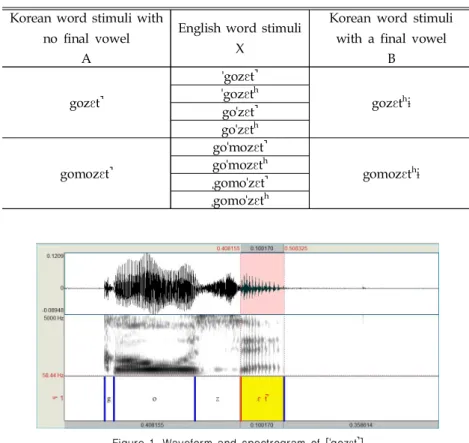
Each set consisted of three forms, in the following order: a Korean nonce form, an English nonce form, and a second Korean nonce form (e.g., Korean [gozɛt˺] - English [goˈzɛt˺] - Korean [gozɛthɨ]). The English nonce form was recorded by an English native speaker, and the first and third forms were recorded by a Korean native speaker. All the English non-words ended in a stop; one of the Korean non-words ended in a consonant and the other Korean non-word ended in a lexical final vowel. Experimental items are given in IPA in Table 1.2) Figures 1 through 4 show waveforms and spectrograms for the representative examples [ˈ gozɛth], [ˈgozɛt˺], [gozɛt˺], and [gozɛthɨ]. As shown in the figures, visible release was observed for each stimulus classified as having final stop release, and stimuli classified as unreleased did not contain evidence of visible release on waveform and spectrogram.
2) The number of English stimuli does not match that of Korean stimuli due to the following reasons: first, since Korean final stops do not have a release burst, Korean stimuli corresponding to English stimuli ending in either a released or an unreleased stop had either an unreleased coda or a released onset followed by a vowel. For example, English stimuli [gozɛth] and [gozɛt˺] corresponded to either [gozɛt˺] or [gozɛthɨ] in Korean. Second, because Korean does not allow lexical stress, English stimuli [ˈgozɛt˺] and [goˈzɛt˺]
corresponded to either [gozɛt˺] or [gozɛthɨ] in Korean.
Table 1. Test items for the AXB similarity judgment task3) Korean word stimuli with
no final vowel A
English word stimuli X
Korean word stimuli with a final vowel
B
gozɛt˺
ˈgozɛt˺
gozɛthɨ ˈgozɛth
goˈzɛt˺
goˈzɛth
gomozɛt˺
goˈmozɛt˺
gomozɛthɨ goˈmozɛth
ˌgomoˈzɛt˺ ˌgomoˈzɛth
Figure 1. Waveform and spectrogram of [ˈgozɛt˺]
ending in unreleased [t˺] produced by English speaker
3) Since the main purpose of the current study was to test if stop release and final stress of English forms would affect Korean listeners' perception, other linguistic variables were strictly controlled in the stimuli of the experiment. For example, every stimulus ending in a stop has a final voiceless coronal stop to exclude the possible effects of voicing and place for the final stop. A voiceless coronal stop is permissible and pronounceable in Korean native words (e.g., [kot] 'place', [pat] 'field') and thus Korean nonce forms ending in a voiceless coronal stop are perceivable to Korean listeners with no difficulty. In addition, no word size effect was assumed to influence the result of this task since previous studies reported that there was no significant difference between disyllabic and trisyllabic words although a size effect was found between monosyllabic and polysyllabic words (Rhee &
Choi, 2001; Kang, 2003).
Figure 2. Waveform and spectrogram of [ˈgozɛth] ending in released [th] produced by English speaker
Figure 3. Waveform and spectrogram of [gozɛt˺] produced by Korean speaker
Figure 4. Waveform and spectrogram of [gozɛthɨ] produced by Korean speaker
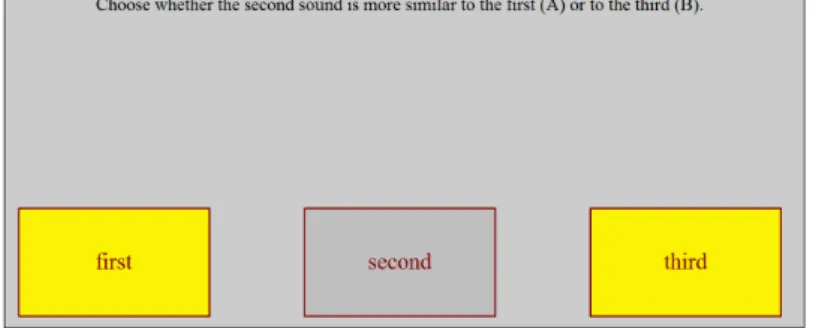
The participants were asked to decide whether the second word sounded more similar to the first word or to the third word for each set. They had to
choose one of the forms as most similar. Every set was presented in a randomized order for each subject. The order of the two types of Korean forms, CVC and CVCV, was also randomized for each participant. Participants listened to the stimuli through a laptop computer using a headphone in a sound-attenuated room.
Figure 5. Response screen for the similarity judgment experiment
A multiple forced choice listening experiment was run using Praat for the similarity judgment task.4) Participants saw three buttons, labeled first, second, and third, but the second button was not clickable. A new stimulus was presented when participants made their choice. Listeners heard each stimulus only once and could not go back to listen again. The inter-stimulus interval was 0.3 seconds.
2.3. Predictions
The perceptual similarity approach, proposed by Kang (2003) following Steriade (2001), assumes that although Korean speakers accurately perceive the English forms, they insert a vowel in their production to maintain perceptual similarity between the English and Korean forms.5) This approach predicts that
4) This methodology has been widely used as a reliable task in the literature in order to examine how listeners perceive a series of ordered sounds in terms of perceptual similarity/discrimination (Repp et al., 1983; Pegg & Werker, 1997; Whalen et al., 1997;
Boomershine et al., 2008; Kwon & Chitoran, 2016; among others).
5) The perceptual similarity hypothesis assumes that loan adaptation is done by sophisticated adapters who have the ability to accurately perceive foreign sounds and choose the closest
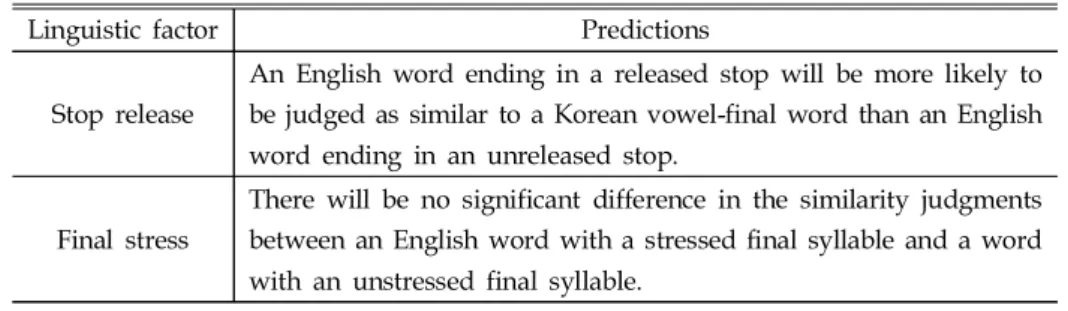
Korean participants will judge an English CVC form ending in a released stop as more similar to Korean CVCV than Korean CVC. However, this approach predicts no significant effect of final stress because release was strictly controlled in the similarity judgment task to eliminate any correlation between release and stress although Kang (2003) points out that final stress is associated in English with greater likelihood of release. The predictions of the perceptual similarity approach are given in Table 2 below.
Table 2. Predictions for the similarity judgment task
Linguistic factor Predictions
Stop release
An English word ending in a released stop will be more likely to be judged as similar to a Korean vowel-final word than an English word ending in an unreleased stop.
Final stress
There will be no significant difference in the similarity judgments between an English word with a stressed final syllable and a word with an unstressed final syllable.
2.4. Results
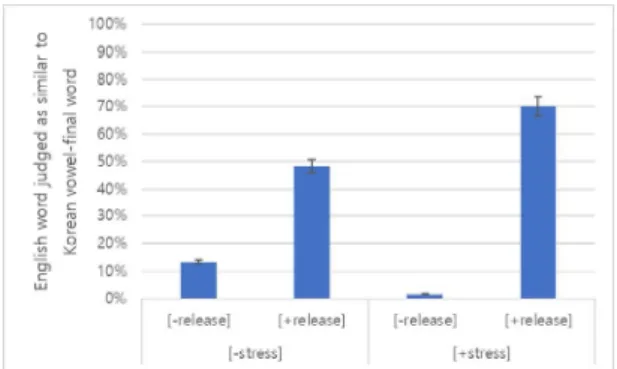
The result from the similarity judgment experiment indicated that Korean participants were more likely to judge an English final stop as similar to a stop plus vowel when the stop was released than when it was unreleased. Figure 6 visually summarizes the release effect, which was found in a statistical model built for the task. The experimental result also showed that the interaction of release and stress was significant in the model (see Table 3).
native language structure by means of knowledge of perceptual similarity (P-map) which exists as a component of their grammar (Steriade, 2001).
Figure 6. Similarity judgment choices by stress and release (Error bars indicate 95% confidence intervals)
The presence/absence of an epenthetic vowel reflected in the choice of responses was modeled using a mixed effects logistics regression model, implemented in the lme4 package (Bates et al., 2015) in R (R Development Core Team, 2018). I built a model for the two acoustic factors (release and stress), where the dependent variable was the participants’ answers (whether participants’ response was Korean consonant-final or Korean vowel-final), and it was coded as 0 for responses of ‘English word judged as similar to Korean consonant-final word’ and 1 for responses of ‘English word judged as similar to Korean vowel-final word’.
Fixed effects included two factors, release (unreleased or released) and stress of final syllable (unstressed or stressed). Interactions of the acoustic factors (release and stress) were also included in the model. Predictors including Release and Stress were deviation-coded. Random effects included participants and items; random intercept model converged and only a random intercept was included for both participants and items. Follow up post-hoc comparisons were conducted using Tukey’s HSD tests of multcomp package (Hothorn et al., 2008).
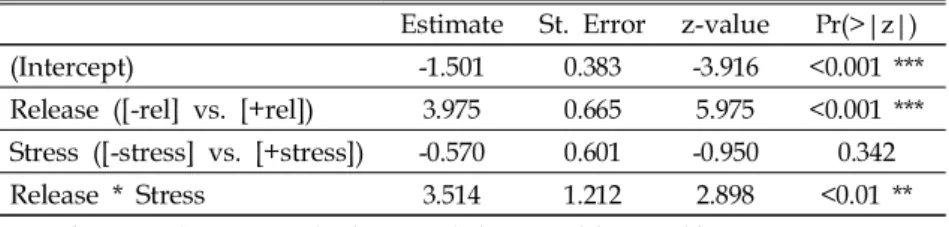
The output of the regression model is summarized in Table 3.
As shown in Table 3, a main effect of Release was significant (z = 5.975, p <
0.001), indicating that Korean participants were more likely to judge an English final stop as similar to a stop followed by a vowel when the final stop was released than when it was unreleased. This result is consistent with the prediction of the perceptual similarity approach.
Table 3. The output of logistic mixed effects model of Korean speakers’ similarity judgment choice
Estimate St. Error z-value Pr(>|z|)
(Intercept) -1.501 0.383 -3.916 <0.001 ***
Release ([-rel] vs. [+rel]) 3.975 0.665 5.975 <0.001 ***
Stress ([-stress] vs. [+stress]) -0.570 0.601 -0.950 0.342
Release * Stress 3.514 1.212 2.898 <0.01 **
Significant codes: <0.001 ‘***’; <0.01 ‘**’; <0.05 ‘*’; <0.1 ‘.’
The model showed that Stress did not have a significant main effect (p = 0.342), which is also consistent with the prediction of the perceptual similarity approach. However, there was a significant interaction between Release*Stress (z = 2.898, p < 0.01). Figure 7 shows similarity judgment choices based on release of the English final stop and final stress. As shown in Figure 7, unstressed syllables had higher rate of vowel-final responses in unreleased stops while stressed syllables induced more vowel-final responses than unstressed syllables in released stops.
Figure 7. Similarity judgment choices by release and stress (Error bars indicate 95% confidence intervals)
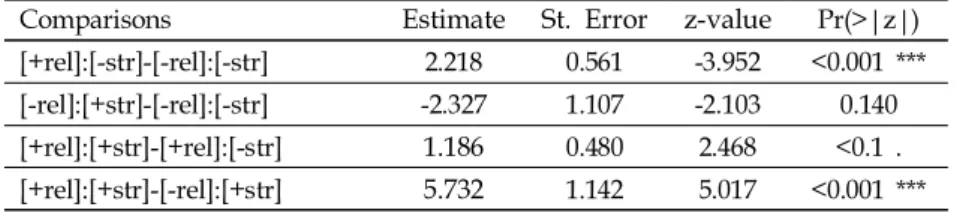
Tukey’s HSD post-hoc comparisons of Release*Stress interaction showed that there was no significant difference between unstressed and stressed items in unreleased condition (z = -2.103, p = 0.140) whereas a marginal stress effect was found when release was present (z = 2.468, p < 0.1), as shown in Table 4. Here, release makes a CV percept much more likely for both unstressed and stressed
items, as shown in Figure 7 above, and the results of the pairwise comparisons given in Table 4 confirmed that more CV response was induced both when the final stop occurred in an unstressed syllable (z = -3.952, p < 0.001) and when it occurred in a stressed syllable (z = 5.017, p < 0.001).
Table 4. Pairwise comparisons: results from Tukey HSD post-hoc analyses on the model of interaction of release*stress
Comparisons Estimate St. Error z-value Pr(>|z|) [+rel]:[-str]-[-rel]:[-str] 2.218 0.561 -3.952 <0.001 ***
[-rel]:[+str]-[-rel]:[-str] -2.327 1.107 -2.103 0.140 [+rel]:[+str]-[+rel]:[-str] 1.186 0.480 2.468 <0.1 . [+rel]:[+str]-[-rel]:[+str] 5.732 1.142 5.017 <0.001 ***
Significant codes: <0.001 ‘***’; <0.01 ‘**’; <0.05 ‘*’; <0.1 ‘.’
In sum, the statistical analysis of the result showed that there was a significant main effect of stop release. Also, the interaction of release*stress was significant in the similarity judgment experiment.
3. Discussion
In the current study, we looked at similarity judgment choices in terms of two linguistic factors and the predictions of the perceptual similarity approach.
The perceptual similarity approach predicted that although participants accurately perceive English CVC, Korean CVCV would be judged as more similar to English CVC than Korean CVC when the English final stop is released due to the phonetic similarity between English final release and the Korean vowel. This approach predicted no significant effect in final stress because release was balanced across each category of stress for the task.
First, we found in the similarity judgment task that stop release had a significant effect, indicating that a greater likelihood of vowel-final responses was more likely after released stops than unreleased stops. This release effect is consistent with the prediction of the perceptual similarity approach. The fact that stop release was a significant effect in the experiment suggests that the
release factor could be important in Korean loan phonology. As mentioned earlier in the introduction, Korean final stops must be unreleased (Sohn, 1999), while English postvocalic final stops may or may not be released (Crystal &
House, 1988; Byrd, 1992). Parker (1977) observes that an English released voiceless stop consists of release burst plus aspiration noise. This phonetic event in English is similar to that found in Korean CV sequences consisting of a voiceless stop followed by a high vowel, where high vowels are devoiced after a voiceless stop. Jun and Beckman (1994) examined a corpus containing CVCV words where the two stops were voiceless and the first vowel was high, and found that the high vowels [i, u, ɨ] in Korean were devoiced 60-70% of the time after aspirated voiceless stops. Song (2002) found a similar devoicing in her study of Korean spontaneous speech based on recordings of ten speakers from live television programs. Her results confirm that high vowels [i, u, ɨ] are likely to be devoiced when they follow aspirated stops or affricates. Her data also suggest that vowels are significantly shorter when they follow aspirated stops [kh, th, ph] than when they follow lax [k, t, p] or tense [k’, t’, p’] stops. Based on these phonetic characteristics of English stop release and Korean vowel devoicing, we can suppose that a vowel inserted after an aspirated stop in Korean is not likely to be realized as a fully voiced segment. Thus, the release portion of English stops could be phonetically similar to a devoiced vowel in Korean.
Regarding the presence of stress in the syllable containing the English final stop, the experimental result showed that there was no stress effect, which is compatible with the perceptual similarity hypothesis. According to Kang (2003), final stress increases the likelihood that Korean speakers hear pronunciations with a final released stop, and release was predicted to lead to vowel insertion.
However, in the similairty judgment task, participants heard an equal number of unreleased stops with unstressed vowels vs. unreleased stops with stressed vowels and released stops with unstressed vowels vs. released stops with stressed vowels. Thus, it is reasonable that both unreleased and released stops found no significant stress effect although there was a marginal effect in released stops.
All in all, we found from the result of the similarity judgment task that Korean listeners were more likely to judge Korean CVCV as more similar to
English CVC than Korean CVC when the English final stop was released than when it was unreleased. This result turned out to be compatible with the prediction of the perceptual similarity approach proposed by Kang (2003).
However, it is entirely possible that the reason for a greater likelihood of vowel-final responses is because Korean listeners “inaccurately” heard the English final stop as being CV from the very beginning of their perception (misperception approach, Silverman, 1992; Dupoux et al., 1999; Boersma &
Hamann, 2009; Broselow, 2009; de Jong & Park, 2012; Kwon, 2017; among others). This approach is similar to the perceptual similarity view in that loanword mapping is essentially perceptually based and that phonetic details crucially play a role in matching foreign forms with native forms. However, unlike the perceptual similarity view, this approach claims that loanword adaptations take place during the perception of foreign inputs and not in the production grammar. More direct investigation will be conducted in future research regarding these different hypotheses on unnecessary adaptation.
References
Bates, D., Maechler, M., Bolker, B., & Walker, S. (2015). Fitting linear mixed-effects models using lme4. Journal of Statistical Software, 67(1), 1-48.
Boersma, P., & Hamann, S. (2009). Loanword adaptation as first-language phonological perception. In A. Calabrese & W. L. Wetzels (Eds.), Loanword phonology (pp. 11-58). Amsterdam/ Philadelphia: John Benjamins Publishing Company.
Boomershine, A., Currie Hall, K., Hume, E., & Johnson, K. (2008). The impact of allophony versus contrast on speech perception. In P. Avery, B. E. Dresher,
& K. Rice (Eds.), Contrast in phonology: Theory, perception, acquisition, volume 13 of Phonology & Phonetics (pp. 145-171). Mouton de Gruyter.
Broselow, E. (2009). Stress adaptation in loanword phonology: perception and learnability. In P. Boersma & S. Hamann (Eds.), Phonology in perception (pp.
191-234). Berlin and New York: Mouton de Gruyter.
Byrd, D. (1992). A note on English sentence-final stops. UCLA Working Papers in Phonetics, 81, 37-38.
Crystal, T., & House, A. (1988). The duration of American-English stop consonants: an overview. Journal of Phonetics, 16, 285-294.
de Jong, K., & Park, H. (2012). Vowel epenthesis and segment identity in Korean learners of English. Studies in Second Language Acquisition, 34, 127-155.
Dupoux, E., Kakehi, K., Hirose, Y., Pallier, C., & Mehler, J. (1999). Epenthetic vowels in Japanese: A perceptual illusion? Journal of Experimental Psychology: Human Perception and Performance, 25, 1568-1578.
Hothorn, T., Bretz, R., & Westfall, P. (2008). Simultaneous inference in general parametric models. Biometrical Journal, 50(3), 346-363.
Jun, E. (2002). Yeongeo chayongeo eumjeol mal pyeswaeeumui payeol yeobuwa moeum sabibe gwanhan silheomjeok yeongu (‘An experimental study of the effect of release of English syllable final stops on vowel epenthesis in English loanwords’). Eumseong eumun hyeongtaeron yeongu (‘Studies in Phonetics, Phonology and Morphology’), 8, 117-134.
Jun, S.-A., & Beckman, M. (1994). Distribution of devoiced high vowels in Korean. Proceedings of the International Conference on Spoken Language Processing, Volume 2, 479-482.
Kang, Y. (2003). Perceptual similarity in loanword adaptation: English postvocalic word-final stops in Korean. Phonology, 20, 219-273.
Kwon, H. (2017). Language experience, speech perception and loanword adaptation: variable adaptation of English word-final plosives into Korean.
Journal of Phonetics, 60, 1-19.
Kwon, H., Chitoran, I., Pouplier, M., Lentz, T., & Hoole, P. (2016).
Cross-linguistic differences in articulatory timing lag in consonant cluster perception. The Journal of the Acoustical Society of Amercia, 140, 3217-3217.
Parker, F. (1977). Perceptual cues and phonological change. Journal of Phonetics, 5, 97-105.
Pegg, J., & Werker, J. F. (1997). Adult and infant perception of two English phones. The Journal of the Acoustical Society of America, 102, 3742-3753.
Peperkamp, S. (2005). A psycholinguistic theory of loanword adaptation. In M.
Ettlinger, N. Fleischer, & M. Park-Doob (Eds.), Proceedings of the 30th Annual Meeting of the Berkeley Linguistics Society, 30 (pp. 341-352). Berkeley:
Berkeley Linguistic Society.
R Core Team. (2018). R: A language and environment for statistical computing.
Vienna, Austria: the R Foundation for Statistical Computing.
Repp, B., Milburn, C., & Ashkenas, J. (1983). Duplex perception: confirmation of fusion. Perception and Psychophysics, 33(4), 333-337.
Rhee, S.-J., & Choi, Y.-K. (2001). Yeongeo chayongeoui moeum sabibe daehan tonggyegwanchalgwa geu uiui (‘A statistical observation of vowel insertion in English loanwords in Korean and its significance’). Eumseong eumun hyeongtaeron yeongu (‘Studies in Phonetics, Phonology and Morphology’), 7, 153-176.
Silverman, D. (1992). Multiple scansions in loanword phonology: evidence from Cantonese. Phonology, 9, 289-328.
Sohn, H.-M. (1999). The Korean Language. Cambridge University Press.
Steriade, D. (2001). Directional asymmetries in place assimilation: A perceptual account. In E. Hume & K. Johnson (Eds.), The role of speech perception in phonology (pp. 219-250). San Diego: Academic Press.
Whalen, D., Best, C., & Irwin, J. (1997). Lexical effects in the perception and production of American English /p/ allophones. Journal of Phonetics, 25, 501-528.
Jungyeon Kim Ph.D. Alumna
Department of Linguistics Stony Brook University 100 Nicolls Road, Stony Brook NY 11794, USA
Phone: +1-631-632-7774
Email: [email protected]
Received on November 15, 2018
Revised version received on December 23, 2018 Accepted on December 31, 2018
![Figure 2. Waveform and spectrogram of [ˈgozɛt h ] ending in released [t h ] produced by English speaker](https://thumb-ap.123doks.com/thumbv2/123dokinfo/5428370.645989/6.739.164.560.136.321/figure-waveform-spectrogram-ˈgozɛt-released-produced-english-speaker.webp)