
경피적
5
0
0
전체 글
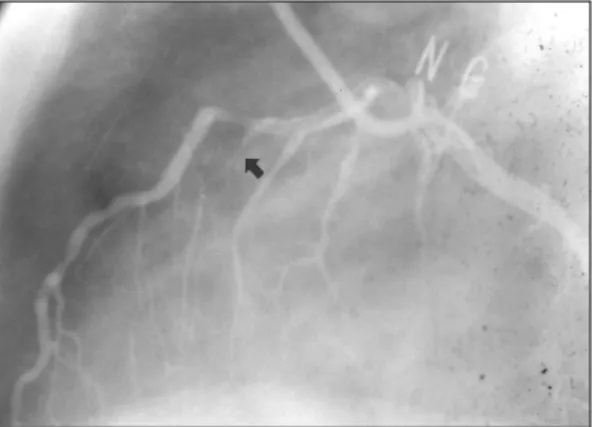
(2) 심실 조영술상 전측벽에 운동저하(hypokinesia) 소견을. 증. 례. 보였으나, 좌심실 구혈률은 약 60%로 수축기능 장애는 없었다. 관동맥 조영술상 좌전하행지(Left anterior dec-. 환 자:조○길, 남자, 56세.. ending artery, LAD) 원위부의 50%의 협착과 제1대각. 주 소:안정시 전흉부 동통.. 지(Diagonal branch, D1) 근위부의 국소적 99%의 협. 현병력:환자는 내원 4일전에 골프를 치던 도중 누르. 착소견을 보였다(Fig. 1).. 는 듯한 흉통이 30분이상 지속되었고, 그후로도 하루. 치료 및 경과:관동맥 조영술로 병변을 확인한 직후. 3~4차례 흉통의 재발이 있다가 내원당일에는 안정시에. 제1대각지 근위부의 폐쇄부위에 대해 경피적 관동맥 확. 도 발생되어 약 1시간정도 지속되는 전흉부 동통을 주소. 장술을 시행하였다. PTCA 직전에 heparin 10,000단위. 로 본원 응급실을 방문하였다. 흉통의 성격은 누르는 듯. 를 정맥주사 하였으나 ACT를 측정하지는 않았다.. 한 통증이었고 양어깨로 방사되었으며 nitroglycerin 설 하 투여에 의해 소실되었다.. 8 French Judkins 좌관동맥 4 cm 굴곡 유도 도자(8F, Guiding JL4)를 좌관동맥 개구부에 위치시키고 0.014. 과거력:3년전에 고혈압 진단받고 1년전부터 약국을 통. 인치 유도철선을 통과시킨후, 이를 따라 제1대각지 병변. 해 간헐적으로 항고혈압제를 복용하였다(Atenolol 50. 에 VIVA 2.0 mm 풍선 도자를 위치시켜 10기압으로. mg/day).. 30초간 1회 확장하였다.. 가족력:특이사항 없음.. 풍선확장 후 환자는 흉통을 호소하였고, 이후 시행한. 사회력:30 pack-year의 흡연력이 있었다.. 관동맥 조영술상 제1대각지 근위부의 폐쇄부위는 소실되. 이학적 소견:응급실 내원 당시 혈압은 170/110 mmHg,. 었으나, 제1대각지가 분지되는 직하의 직경 3 mm의 좌. 맥박수는 분당 60회, 호흡수는 분당 20회, 체온은 36.5℃. 전하행지 중간부에 혈전으로 생각되는 0.3×0.2 cm의 음. 였다. 외견상 비교적 건강하게 보였고, 의식도 명료하였. 성음영이 관찰되었고 원위부 혈류는 TIMI 2로 감소되었. 다. 흉부청진상 호흡음은 정상이었고, 심박동은 규칙적이. 다(Fig. 2).. 었으며 심잡음은 들리지 않았다. 복부검사와 신경학적 검 사상 이상소견은 없었다.. 우선 관동맥내로 직접 nitroglycerin 200 mcg를 두 차례 주입하였고, 이어 Urokinase 25만 단위를 폐쇄부. 검사소견:혈액 검사상 혈색소 15.4 g/dl, 백혈구 11,. 위에 주입하였으나 20분후 시행한 관동맥 조영술상 혈전. 600/mm3, 혈소판 298,000/mm3이었으며, CPK(Crea-. 크기의 변화는 없었다(Fig. 3). 환자는 지속적으로 흉통. tinine phosphokinase)치가 68 IU/L(26~200 IU/L),. 을 호소하였고 심전도 monitoring상 ST분절의 상승이. LDH(lactate dehydrogenase)치가 436 IU/L(150~. 있는 불안정한 상태에서 저자들은 원위부 색전을 유발할. 480 IU/L)CK-MB치는 2.4 ng/ml(<9 ng/ml)이었다.. 수 있는 유도철선의 삽입이 필요한 반복 PTCA나 스텐. 환자의 지단백은 총 콜레스테롤 284 mg/dl, 중성지방 268. 트시술 대신 흡입 혈전제거술을 시행하기로 결정하였다.. mg/dl, HDL-콜레스테롤 46 mg/dl, LDL-콜레스테롤 184 mg/dl이었다. 그외 혈청전해질, 뇨검사, 간 기능 검 사는 모두 정상이었다. 흉부 X-선 검사는 정상소견이었고 심전도 검사상 정상 동율동이었고, QRS 전기축은 +60°였으며, 유도 aVL에 서만 QS의 소견을 보여 수직위치의 심장이었다. 경흉심초 음파 검사상 좌심실 구혈률은 60%였으며 경한 좌심실 비 대소견과 함게 좌심실 중간부와 기저부의 전측벽(anterolateral wall)에서 운동저하(hypokinesia)의 소견을 보였다. 환자는 nitrate, 아스피린 및 티클로피딘, 베타 수용체 차단제, 칼슘 길항제를 복용하였고, 혈압이 조절된 제9병 일에 좌심실 조영술과 관동맥 조영술을 시행받았다. 좌 1906. Fig. 1. Left coronary arteriography in the left lateral projection.. Korean Circulation J 1998;28(11):1905-1909.
(3) Fig. 2. Left coronary arteriography in RAO cranial view shows a globular filling defect in LAD just after origin of the 1st Diagonal a following to angioplasty of D1.. Fig. 4. Left coronary arteriography in RAO cranial view shows disappearance of filling defect immediately after coronary thromboembolectomy.. Fig. 3. Left coronary arteriography in RAO cranial view shows remained intracoronarythrombus in LAD inspite of infusion of urokinase.. Fig. 5. Left coronary arteriography in RAO caudal view shows successful thromboembolectomy for dislodgement of thrombus after angioplasty of D1.. 먼저 0.014인치 유도철선 2개를 각각 제1대각지와 제. ronary angioplasty)은 1977년 Gruentzig에 의해 성공. 1중격지에 삽입시킨 상태에서, 미리 후단쪽 3 cm정도를. 적으로 시행된 이후, 시술 경험의 축적 및 기술과 기자재. 절단한 8F GJL4 속으로 5French Judkins 우관동맥. 의 발달등으로 초기와는 달리 단일혈관질환뿐만 아니라. 도자를 삽입시키고, 이 끝에 Y-connector을 연결하였다.. 다혈관질환 및 급성 심근경색증의 재관류 목적으로 널리. Y-connector의 한쪽 끝에 조영제가 들어있는 50cc. 이용되고 있으나,1) 급성 관동맥 폐쇄와 재협착이 해결되. 주사기를 부착하고, 5 F.JR4 도자선단을 음성음영 바로. 어야 할 문제로 남아있다.2)9). 전에 위치시킨후 혈전을흡인하였다(Fig. 4).. 특히 급성 관동맥폐쇄는 경피적 관동맥확장술의 가장. 이 후 육안적으로 아직 완전히 조직화되지 않은 혈. 흔하고 중요한 합병증으로 그 발생빈도는 1.2~12% 정. 전(Blood clot)을 발견하였고, 관동맥 조영술에서도 혈전. 도로 보고되어 있으며10-15) 급성 심근경색증과 응급. 이 소실됨으로써 원위부 혈류가 TIMI 3로 증가되어 성. 관동맥 우회로술을 요하는 위험인자로서,16) 대상 환자들. 공적인 시술을 마칠수 있었다(Fig. 5).. 의 시술과 관련된 사망 원인의 대부분을 차지한다.3) 경피적 관동맥확장술의 혈관확장 기전은 동맥경화성 반. 고. 안. (atherosclerotic plaque)의 균열 및 파열로 인한 혈관 내벽의 손상과 혈관외벽의 확장에 의해 이루어지는데17). 경피적 관동맥확장술(percutaneous transluminal co-. 혈관내벽의 손상이 심한 경우에는 관동맥의 급성 박리성 1907.
(4) 혈류차단을 초래하고 혈소판의 활성화와 유착 및 혈전 6)18). 데 별 효과가 없었으며, 다음에 선택할 수 있는 반복 PTCA 및 스텐트 시술과 수술적 요법 대신 시술시 사용한 유. 형성을 촉진시킨다.. PTCA와 관련된 급성 관동맥 폐쇄에 관여하는 시술전. 도도자보다 작은 도자를 이용하여 흡입 혈전제거술을 성. 인자로는 불안정형 협심증 환자, 여성인 경우, 병변혈관. 공적으로 시행함으로써 좌전하행지의 혈류를 재개시킬 수. 이 45°이상 구부러진 병변, 분지점에 위치한 협착병변. 있었다.. 23). 등을 들 수 있는데 , 특히 시술전 관동맥내 혈전이 있. 본 경험의 원형(Model)이라고 할 수 있는 경피적 흡. 는 경우에 급성 폐쇄의 발생률이 높다.9) 그리고 관동맥 조. 입 혈전제거술(percutaneous aspiration thromboemb-. 영상 완전폐쇄 병변, 병변의 길이가 긴 경우(특히 1.5 cm. olectomy, PAT)은 1968년 Greenfield에 의해 폐색전. 이상인 병변), 시술후에 병변의 잔여협착이 25%이상 남. 증의 치료에 처음으로 시도된 이래24) 말초동맥 폐쇄증의. 아있는 경우도 급성 관동맥폐쇄의 위험 요인으로 알려져. 치료에 혈관조영술 시행과 함께 선택적으로 사용되고 있. 18). 있다.. 는데, 음압을 이용함으로써 혈관손상을 감소시키며, 풍선. 따라서 급성폐쇄가 예상되는 병변의 경우에는 예방이. 도자(balloon catheter)를 이용하여 딱딱하거나 크기가. 중요한데, 그 방법으로는 아스피린, 티클로피딘, c7E3같. 큰 혈전을 조각내거나 혈전용해제를 사용하여 흡입을 용. 은 항혈소판제제의 사전 투여, heparin과 같은 항응고제. 이하게 하여 시행할 수 있는 장점이 있다.25)26) 따라서 관. 투여와 함께 PTCA시 기술적인 문제로서 풍선/혈관 비. 동맥내 혈전색전증(thromboembolism)에 의하여 비교적. 를 1.1:1 미만으로 하고, 긴 병변에는 긴 풍선을 이용. 근위부에 발생한 관동맥폐쇄의 치료에 있어 고식적인 치. 하며 풍선확장후에는 신속한 강압(deflation)이 필요하다.. 료와 함께 흡입 혈전제거술(coronary aspiration thro-. 급성 관동맥폐쇄의 원인으로는 관동맥 박리, 관동맥 경. mboembolectomy)을 선택적으로 시행할 수 있을 것으. 련, 관동맥내 혈전 형성, 그리고 죽상종 및 혈전성 물질의. 로 사료된다.. 전위(dislodgement)등이 복합적으로 관여하는 것으로. 요. 보인다.19). 약. 이러한 급성 관동맥폐쇄의 치료로는 heparin 투여, 관 동맥내 혈전용해제 치료, 반복 PTCA 및 스텐트 시술, 응 7)8)20)21)29-31). 급 관동맥 우회로술등이 이용되어져 왔다.. 저자들은 불안정형 협심증 환자에서 제1대각지의 99% 국소적 폐쇄 병변에 대해 경피적 관동맥확장술 도중, 혈. 급성관동맥 폐쇄가 확인되면 우선적으로 nitroglyce-. 전의 전위에 의해 좌전하행지 중간부에 발생한 급성 관동. rin을 관동맥내로 투여하고 ACT가 300초이상이 되도. 맥폐쇄를 재관류시킬 목적으로 반복 PTCA나 스텐트 시. 록 heparin을 투여하는 것이 급선무이며, 그 이후 반복. 술 대신 흡인 혈전제거술을 이용하여 좋은 결과를 경험. PTCA 및 스텐트 시술로 혈류를 재개통하는 것을 고려. 하였기에 문헌고찰과 함께 보고하는 바이다.. 하고 그 결과에 따라 응급 관동맥 우회로술, 혹은 내과적 치료를 결정하게 된다. 급성 폐쇄의 주원인인 관동맥 박. REFERENCES. 리나 혈전이 중요한 역할을 할 때는 반복 PTCA와 함. 1) Gruentzig AR, Senning A, Siegenthaler WE. Nonopera-. 께 관동맥내로 혈전용해제를 투여한다. 사용되는 혈전용 해제로는 보통 urokinase 100,000~250,000 단위를. 2). 15~30분에 걸쳐서 투여하거나 tPA 20 mg을 5분에 걸 쳐서 투여한다. 최근에는 c7E3를 정맥주사하는 방법도. 3). 27)28). 보고 되어 있다.. 저자들은 불안정형 협심증 환자에서 관동맥조영술로 확 인한 제1대각지의 99% 국소적 폐쇄 병변에 대해 PTCA. 4). 를 시행하던 도중 전위된 혈전으로 인해 발생한 좌전하 행지 중간부의 급성 폐쇄를 재관류시킬 목적으로 urokinase를 이용한 관동맥내 혈전용해제 치료를 시행하였는 1908. 5). tive dilatation of coronary-artery stenosis; percutaneous transluminal angioplasty. N Engl J Med 1979;301:61. Holmes DR Jr, Vliestra RE, Kelsey S, et al. Comparison of current and earlier complication of angioplasty, NHLBI PTCA registry. J Am Coll Cardiol 1987;9:19A. Ellis SG, Rubin GS, King SB III, et al. Inhospital morbidity and mortality following acute closure after percutaneous transluminal coronary angioplasty-analysis of risk factors from 8207 procedures. J Am Coll Cardiol 1988;11:211. Barnathan ES, Schwartz JS, Taylor L, Laskey WK, Kleaveland JP, Kussmaul WG, et al. Aspirin and dypiridamole in the prevention of acute coronary thrombosis complicating coronary angioplasty. Circulation 1987;76:125. Hackett D, Davies G, Chierchia S, Maseri A. Intermittent coronary occlusion in acute myocardial infarction; Value. Korean Circulation J 1998;28(11):1905-1909.
(5) 6). 7). 8). 9). 10). 11). 12) 13). 14). 15) 16). 17). of combinated thrombolytic and vasodilator therapy. N Engl J Med 1987;317:1055. Steele PM, Cheseboro JH, Stanson AW, Holmes DR, Dewanajee MK, Badimon L, et al. Balloon angioplasty; Natural history of pathophysiological response to injury in a pig model. Cire Res 1985;57:105. Schoffer J, Krebber H, Bletteld W, Mathey DG. Acute coronary artery occlusion during percutaneous transluminal coronary angioplasty; Reopening by intracoronary streptokinase before emergency coronary artery surgery to prevent myocardial infarction. Circulation 1982;66:1325. Ischinger T, Zack P, Aker U. acute coronary occlusion during balloon angioplasty due to intracoronary thrombus and coronary spasm: A reversible complication. Am Heart J 1984;107:127. De Feyter PJ, Suryapranata H, Serruys PW, Beatt K, van Domburg R, van der Brand M, et al. Coronary angioplasty for unstable angina: Immediate and late results in 200 consecutive patients with identification of risk factor for unfavorable early and late outcome. J Am Coll Cardiol 1988;12:324-33. Kent KM, Bentivoglio LG, Block PC, Cowley MJ, Dorros G, Gosselin AJ, et al. Percutaneous transluminal coronary angio-plasty; Report from the registry of the National Heart. Lung and blood Institute. Am J Cardiol 1982; 49:2011. Dorros G, Cowley MJ, Simpson J, Bentivoglio LG, Block PC, Bourassa M, et al. Percutaneous transluminal coronary angioplasty; Report of complication from the National Heart. Lung and blood Institute. PTCA Registry. Circulation 1983;67:723. Shiu MF, Silverton NP, Oakeley D, Cumberland D. Acute coronary occlusion during percutaneous transluminal coronary angioplasty. Br Heart J 1985;54:129. Holman J, Gruentzig AR, Douglas JS, King SD, Ischinger T, Meier B. Acute occlusion after percutaneous transluminal coronary angioplasty; A new approach. Circulation 1983;68:725. Mabin TA, Holmes DR, Smith HC, Vliestra RE, Bove AA, Reeder S, et al. Intracoronary thrombus: Role in coronary occlusion complicating percutaneous transluminal coronary angioplasty. J Am Coll Cardiol 1985;5:198. MacDonald RG, Feldman RL, Conti CR, Pepine CJ. Thromboembolic complication of coronary angioplasty. Am J Cardiol 1984;54:916. Verna E, Repetto S, Boscarini M, Onofri M., Qing LG, Binaghi G. Management of complicated coronary angioplasty by intracoronary urokinase and immediate reangioplaty. Cathet Cardiovasc Diagn 1990;19:116-22. Waller BF. Crackers, breakers, stretchers, drillers, scrapers, shavers, burners, welders and melters-the future treatment of arterosclerotic coronary artery disease? A clinical-morphologic assessment. J Am Coll Cardiol 1989;13:969-87.. 18) Black AJ, Namay DL, Niederman AL, et al. Tear or dis-. 19). 20). 21). 22). 23). 24) 25) 26). 27). 28). 29). 30) 31). seaction after coronary angioplasty; morphologic correlates of an ischemic complication. Circulation 1989;79: 1035-42 Fishell TA, Derby G, Tse TM, Standius ML. Coronary artery vasoconstriction routinely occurs after percutaneous transluminal coronary angioplasty; A quantiatative arteriographic analysis. Circulation 1988;78:1323-34. Murphy DA, Craver JM, Jones EL, Gruentzig AR, King SB III, Hatcher CR Jr. Surgical revascularization following unsuccessful percutaneous tranluminal coronary angioplasty. J Thorac Cardiovasc Surg 1982;84:342-8. Cowly MJ, Dorros G, Kelsey S, Van Raden M, Detre KM. Emergency coronary bypass surgery after coronary angioplasty; the National Heart Lung and Blood Institute’s Percutaneous Transluminal Coronary Angioplasty Registry experience. Am J Cordiol 1984;53:22C-26C. Suryapranata H, de Feyter P, Serruys P. Coronary angioplasty in patients with unstable angina pectoris; Is there a role for thrombolysis ? J Am Coll Coll Cardiol 1988; 12:69A-77A. Ellis SG, Roubin GS, King SB III, Douglas JS, Weintraub WS, Thomas RG, et al. Angiographic and clinical predictors of acute closure after native vessel coronary angioplasty. Circulation 1988;77:373. Greenfield LJ, Kimmell GO, Mccurdy WC II. Transvenous removal of pulmonary emboli by vaccumcup catheter technic. J Surg Res 1969;9:347. Kwak SJ, Park CW, Yoo HJ, Park SH, Kim KS, Kim JS. et al. A case of percutaneous aspiration thromboembolectomy (PAT). Korean Circulation J 1995;25(6):1247-52. Turnipseed WD, Srarck EE, McDermott JC, et al. Percutaneous aspiration thromboembolectomy (PAT) An alternative to surgical balloon techniques for clot retrieval. J Vasc Surg 1986;3:437. Muhlestein JB, Gomez MA, Karagounis LA, Anderson JL. Rescue ReoPro: Acute utilization of abciximab for the dissolution of coronary thrombus developing as a complication of coronary angioplasty. Circulation 1995;92:I-607. Muhlestein JB, Karagounis LA, Treehan S, Anderson JL. Rescue utilization of abciximab for the dissolution of coronary thrombus developing as a complication of coronary angioplasty. J Am Coll Cardiol 1997;30:1729-34, Walton AS, Oesterle SN, Yeung AC. Coronary artery stenting for acute closure complicating primary angioplasty for acute myocardial infarction. Catht Cardiovasc Diagn 1995;34:142-6. Kaul U, Agarwal R, Jain P, Wasir HS. Safty and efficacy of intracoronary stenting for thrombus-containing lesions. Am J Cardiol 1996;77:425-7. Ahmad T, Webb JG, Carere RR, Dodek A. Coronary stenting for acute myocardial infarction. Am J Cardiol 1995; 76:77-80.. 1909.
(6)
수치

관련 문서
Therefore, cTnT is a recommended biomarker for use in the detection of myocardial infarction (MI) and in acute coronary syndromes.[8] Indeed, several authors
The locations of aneurysms were middle cerebral artery in 15 patients, cerebral artery in 15 patients, cerebral artery in 15 patients, cerebral artery in
Temperature sensor Angioplasty for canine common carotid artery. 0.6
Incident major cardiovascular events (coronary artery disease, ischemic stroke, hemorrhagic stroke and cardiovascular mortality) were set as primary end points.
The major findings of the present study include the fol- lowing: (1) EM-seq-based methylation profiling produced good quality data, even with limited human cfDNA quan-
최대정수함수가 극댓값을 갖는 점과 극솟값을 갖는 점을 모두 구하고, 그 점에서 극값을 구하 시오.. 함수가 미분 가능하면 극값을
그러므로 이러한 표현은 함수의 이름과 미분계수를 구하는 점이 명확하여 혼동할 염려가 없을
최대정수함수가 극댓값을 갖는 점과 극솟값을 갖는 점을 모두 구하고, 그 점에서
