JDCS Vol. 19, No. 2, pp. 309-318, Feb. 2018
실감콘텐츠를 활용한 공연장 마케팅 방안 연구
임 영 준 1 · 이 영 숙2*
1
동국대학교 일반대학원 연극학과 박사과정
2
동국대학교 영상문화콘텐츠연구원
A Study on Marketing Revitalization Plan of Performing Arts Theatre Using Realistic Contents
Young-June Lim
1· Young-Suk Lee
2*1
Ph. D Student, Theatrical Production, Dongguk University, Seoul Korea
2
*Institute of Image and Cultural Contents, Dongguk University, Seoul Korea
[요 약]
본 연구에서는 실감콘텐츠(VR·AR·MR)를 활용한 공연장 마케팅 방안을 제안하였다. 공연장은 관객이 직접 체감할 수 있는 공 간이며, 공연장 마케팅 방안은 다음과 같다. 첫째, 공연장 좌석의 배치를 활용한 마케팅전략이다. 이는 가상현실(VR)을 통해 관객에게 원하는 관람석에서 공연이 어떤 각도와 시야로 관람되는지에 대한 예상이 가능하며 몰입감이 높은 좌석을 예매하도 록 유도한다. 둘째, 혼합현실(MR)을 통해 공연 홍보 및 광고물을 활용한 콘텐츠 마케팅이다. 기존의 정적인 홍보수단에 비해 공연 예술의 현장감을 살린 동적 홍보가 가능하다. 셋째, 등장 캐릭터를 활용한 마케팅전략이다. 공연은 1회성 예술이다. 이를 보완하 도록 등장캐릭터가 공연의 한 장면을 증강현실(AR)콘텐츠로 사전에 제공하여 공연에 대한 흥미를 유발하도록 한다. 넷째, VR 소셜 네트워크를 구축하여 고객과 직접 소통하는 방법이다. 이를 통해 공연장 활성화를 위한 관객 유치에 도움이 되고자 한다.
[Abstract]
We proposed a marketing plan for the performing arts venue using realistic contents(VR, AR, and MR). The venue is a place where the audience can experience the performance directly. The marketing plan of the performance venue is as follows. Firstly, it is a marketing strategy that utilizes an arrangement of venue seats. It is possible to predict for watching a performance at angle and sight in performance venue seats that audience want through VR. This allows the theatre seats to be experienced in advance with the VR contents inducing the reservation of the seats with a high sense of immersion. Secondly, it is a marketing using PR and AD of performing arts through MR in the space with a large transient population. It is possible to promote dynamic promotion utilizing the sense of the presence of performing arts compared with existing static promotion means. Thirdly, it is a marketing strategy that utilizes actor characters in performance. The audience could be interested in the performing arts in advance via a preview of the AR contents of the pamphlet. Fourthly, it is a way to communicate with customers directly by establishing a VR social network to manage venue members. This will help attract an audience to revitalize the theatre venue.
색인어 :
실감콘텐츠, 공연장 마케팅, 가상현실, 증강현실, 혼합현실
Key word : Realistic Contents, Marketing of Performing Arts Theatre, Virtual Reality, Augmented Reality, Mixed Reality
http://dx.doi.org/10.9728/dcs.2018.19.2.309
This is an Open Access article distributed under the terms of the Creative Commons Attribution Non-CommercialLicense(http://creativecommons .org/licenses/by-nc/3.0/) which permits unrestricted non-commercial use, distribution, and reproduction in any medium, provided the original work is properly cited.
Received 25 January 2018; Revised 09 February 2018 Accepted 26 February 2018
*Corresponding Author; Young-Suk Lee Tel: +82-10-8313-9825
E-mail: [email protected]
Ⅰ. Introduction
The opening ceremony of the Pyeong Chang Winter Olympics held on the 9th Feb. 2018 was a fantastic combination of traditional culture and future technology for 6 billion people around the world. Astronomical constellations were placed on the head with augmented reality(AR) technology, and 1218 drones embarked on the night sky. In other words, the opening ceremony of the Pyeong Chang Winter Olympic Games is meaningful because the 4th industrial revolution technology created by the 'Drone Show' and the cutting edge 'Digital Art' played a part. Song Seung-hwan who have been preparing for the opening ceremony from 2015 said "We focused on imagination and technology to overcome the limitations of small budgets"[1].
ICT use in the field of performing arts has already been utilized in various performing arts genres including theater and musical, ahead of the 4th industry era. In particular, ICT is used a lot of images that can maximize the visual effect because the image is convenient and useful value rather than the actual stage set in the musical performance. For example, in the musical "Miss Saigon," there is a scene in which US troops ride on a helicopter just before being fallen to Saigon in Vietnam.
However, in the case of overseas tour performances, it is replaced with images due to the effectiveness of the maintenance and maintenance costs on the stage set. In the musical 'Vincent Van Gogh' which was premiered in 2014, the '3D projection mapping technology' was used as the core of performance directing. At this time, it was used as a conversation topic, unlike the existing musicals that 3D projection mapping used only as the background of the stage set.
Of course, there are also many changes in the field of performing arts due to the Fourth Industrial Revolution. Virtual reality(VR) and augmented reality(AR) are rapidly evolving with the development of platforms and KT Economic Research Institute reports that the market of AI, virtual reality(VR), and augmented reality(AR) reaches 170 trillion won in 2020[2].
Notably, this virtual reality and augmented reality are used in the fields of game industry, medical industry, education, tourism, distribution and marketing. In particular, performing arts emphasize realism. The audience will go to the theatre directly and enjoy the performance on there. The venue is based on the performance seats and is marketing the performances without separate marketing strategy depending on the seats. In terms of performing arts, performing arts marketing attracts loyal audiences. Performing arts are not merely selling tickets (goods), but engaging in the minds of consumers (audience)
through concepts or benefits differentiated from those of other brands. Recently, in the field of the culture and art industry, virtual reality, augmented reality, and mixed reality is used in brand marketing and product marketing. It is time to be necessary to have a strategy for marketing to loyal audiences in fields of performing arts.
It will be an opportunity to illuminate promising business fields related to virtual reality and augmented reality in preparation for a full-fledged fourth-generation industry, and this will serve as an opportunity to develop the performing arts industry. Therefore, this study suggests ways to activate the marketing of the performing arts using VR, AR, MR. This paper is organized as follows. In Chapter 2, it explores the concepts and examples of VR, AR, and MR, and the change of performing arts marketing with a definition of Space Marketing and Experiential Marketing. In Chapter 3, it describes the current marketing strategy of a theatre and examines the limitations of the existing marketing system. In Chapter 4, it presents a marketing plan that can utilize VR, AR, MR in performing arts field. Finally, this article concludes in Chapter 5.
Ⅱ. Literature Review
2-1 Definition and Concept of Mixed Reality(MR)
With the advent of the 4th Industrial Revolution, keywords such as artificial intelligence, drones, virtual reality, augmented reality, 3D printer, big data wearable, etc are made into modern society. In the field of contents, contents technologies combining virtual reality augmented reality, and mixed reality is being developed. In the film industry, technologies for film and production efficiency using virtual reality have been developed[3]. In the game, Pokemon Go which already utilizes the augmented reality had already attracted popularity[4].
그림 1. 혼합현실
Fig. 1. Mixed Reality(MR)
The term virtual reality was first proposed by Jaron Lannier
(1989)[5]. It means a specific environment or situation or
technology made by artificial technologies including computer
and it is not a real. To put it another way, it is possible to experience similar experiences through interaction through the five senses. Attempts are still being made to implement a virtual reality that provides a complete immersion experience as well. The virtual reality(VR) can be experienced through the VR device, and the immersion is high because the virtual reality is implemented 360 degrees forward. Augmented Reality(AR) is a technology that superimposes a 3D virtual image on a realistic image or background and displays it as a single image.
The recently released mobile game Pokémon GO uses augmented reality. It has the merit that user can interact with user's environment. Mixed reality(MR) is a technology combining reality of AR and reality of virtual reality(VR) as shown in Figure 1[6]. A Mixed reality(MR) is a technology that combines the real world and virtual world information to create a space that fuses the two worlds. Mixed reality(MR) developed by Magic Leap realizes 3D stereoscopic images maximizing realism in real space with users[7]. Recently, global IT companies (Google, Microsoft, Apple, Intel, Facebook, etc.) are interested in mixed reality(MR). According to data from the KT Economic Research Institute, the MR market is expected to grow more than double from 458 billion won in 2015 to 1.98 trillion won in 2021[8]. Microsoft and Intel are actively pursuing the market by introducing 'HoloLens' and 'Project Alloy' MR devices, respectively. Microsoft introduced a device that could interact with reality through Hollolens. (AR) that can interact with reality and virtual reality(VR) which provides a sense of immersion by breaking the boundaries between real and virtual through equipment can be utilized in various fields.
In this way, there is a need to combine VR, AR, and MR with marketing activities of performing arts products.
2-2 Change of Performing Arts Marketing
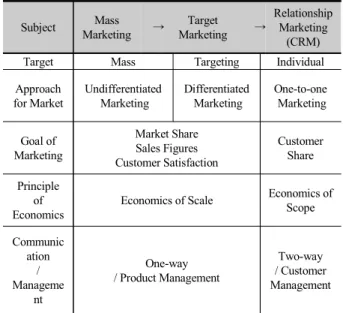
According to Philip Kotler(1975), marketing is to examine customer's needs of companies, nonprofit organizations, government organizations and to provide goods and services to develop value-added products and services to create value that will earn maximum profits at a minimum cost[9]. Marketing strategies can be divided into three different marketing approaches[10]. Firstly, it is Mass Marketing based on changes in market and consumer with changes of approaches. Secondly, it is Target Marketing which targets differentiated marketing strategies targeting groups. Lastly, it is Relationship Marketing approaching individual customers based on customer and transaction information. In other words, the change of marketing has shifted from unilateral product sales into keeping
current customers, minimizing past customers, and attracting loyal customers (Table 1).
In the 2000s, systematic performing arts marketing has been carried out by combining arts management. As the importance of audience development has become more important, management methods that utilize customer relationship management(CRM) are required. However, unlike general companies, CRM in the performing arts is mainly used for large venues or professional art organizations with a relatively large scale, and it remains at a basic stage such as membership management, point system, and venue operating system[11].
Customer Relationship Management(CRM) is mostly used in the member management system of performing arts venue or a museum[12]. Customer Relationship Management(CRM) is a marketing strategy that optimizes communication with customers in order to attract more loyal customers by analyzing and integrating internal and external data about customers. In particular, it can be defined as a strategy for collecting information about customers and effectively accumulating and utilizing collected information to maintain and improve customer relations and maximize customer value[13].
Performing arts products have characteristics of service industry aspects[14][15][16].
2-3 Definition of Space Marketing and Experiential Marketing
The term 'space marketing' can not be defined through Internet Subject Mass
Marketing → Target Marketing →
Relationship Marketing
(CRM) Target Mass Targeting Individual Approach
for Market
Undifferentiated Marketing
Differentiated Marketing
One-to-one Marketing
Goal of Marketing
Market Share Sales Figures Customer Satisfaction
Customer Share Principle
of Economics
Economics of Scale Economics of Scope
Communic ation
/ Manageme
nt
One-way / Product Management
Two-way / Customer Management 표 1. 마케팅의 변화
Table 1. Change of Marketing
search or dictionaries. However, it is defined as 'space marketing' simply as space utilization[17]. It means various economic effects created by space utilization. The building of a company in the city has the meaning of the space in which the company exists, but it becomes a space for marketing the image(brand) of the company, and it becomes a meeting place and a reclaimed place of memory. In other words, the biggest premise of space marketing is to convey the impression to people who use it regardless of the size and nature of the space.
This is because the effect that users gain by visiting and recognizing space is the main purpose of space marketing. It is to utilize the memory of the 'experience' that stimulates the human sense of the five senses. Therefore, experiential memory can be a key element of space marketing. In general, habits and behaviors are based on a variety of information, memories, and experiences, rather than individual responses to specific situations. In terms of experience, Sense, Feel, Think, Act, and Relate appear as a mixed image of individual, individual, and shared experiences[18].
Experience is an important part in defining space marketing(Fig. 2). Therefore, it seems that it will examine experiential marketing theory. Experience creates awareness and memory. Recognition and memory are the results of an identity, which is created by associations that are repeatedly common to objects. As a result, it is advantageous to maintain an iterative and continuous association. Good experiences, good perceptions, good memories stimulate a desire to do again it. This is the first word that comes to mind for everyone who designs modern space. It is a word that covers everything from national projects to trivial details, and it is the direct or indirect pursuit of all businesses seeking or reflecting economic viability or economic benefits. From this point of view, the marketing method through advertising is becoming clearer as it becomes a three-dimensional space from a two-dimensional object such as television, magazine, movie, and signboard. The three-dimensional space refers to 'showroom' or 'experience hall', and the identity of such space is imprinted through
'experience' as a three-dimensional experience and recognized for a long time. In other words, by inviting customers to the sales site of the product, the company can directly see, feel and use it, stimulating the experiences and senses that have not been experienced in the existing marketing and imprinting the image of the product or brand to the consumers. Therefore, the experiential marketing space is not formed objectively but is formed by the subjective interpretation of the experiential subject[19]. In the producer-centered space emphasizing only the former form and purpose, the change to the user-centered space emphasizing the emotional and psychological aspects . In recent years, experiential marketing space, which is user-centered space emphasizing emotional and psychological aspects on the premise of experiencing, is appearing as a square plan for collecting tourists and urban residents in the urban resting spaces, and a space planning for shopping. In other words, it can be said that the scope of the experiential marketing space that a very experimental and innovative 21st century which enables the image marketing of the corporate brand and the city, and the new interpretation of the relationship between the body and the space extends from the individual unit space to the urban space. This is a key element of space marketing and is a factor that actively reflects changing consumption patterns.
Ⅲ. Existing Marketing Strategy of Performing Arts Venue
3-1 Marketing Meaning of Performing Arts Venue:
Branding Value
In general, many companies are investing heavily in marketing costs to engage in brand globalization. In particular, promoting a brand in an international big sports event like the Olympics and the World Cup is like a war. Why do companies get caught up in a fierce brand war? This is because the criteria that customers determine the preference of a company has been changed from land, products, and capital to intangible assets such as a brand[20].
Although there is same product depending on the presence or absence of the brand, a consumer could be recognized as a clear difference, consequently, many companies make an effort to increase brand equity in their products, such as product pricing, quality, and sales activities. In addition, these brand assets depend on the loyalty of the consumers' brands, and are built on high brand awareness and strong and favorable brand image.
This applies equally to products in the fields of performing 그림 2. 공간마케팅과 경험마케팅의 관계
Fig. 2 Relationship of Space Marketing and Experiential
Marketing
arts. In other words, the venue is only an empty space in which only physical reality exists, and the performing arts products produced in these spaces are only extinctive products that disappear with time as mentioned above. New products are constantly being produced and consumed, and consumers (audiences) change accordingly. In particular, this will be influenced by the image of performances performed in the theatres. Because the performing arts products are not consumed according to the utility value as the general products, the image of the theatre is complex and diverse. For example, an image of nonprofit theatre is generally 'the public', it is wrong if it had 'an image of fun theatre[21]. The reason is that the non-profit theater has a public image, so it should give a satisfactory image to both direct and indirect visitors to the theatre. If not, it seems that the theatre management is failed[22].
As the domestic performance market grows in size , the number of venues has also increased, reaching 1,026 at present[23]. In this situation, it is certain that the brand power of the more competitive performing arts venue is important, due to the fact the place where the performing arts is produced and consumed is the performance hall. In particular, because brands can create new added value not only in the venue of performing arts but also in products of performing arts, the theaters must try to attract the loyal audience by increasing the brand value while grasping the needs of the customers[24]. Also, Kim Yu-Ri(2012) said that the venue is necessary to make the theater more effectively than the functional space which simply plays the works on the stage via not marketing for attracting good works but brand marketing for itself venue[25].
If so, why should the arts manager increase the value of the venue, that is, the brand value of the venue? Of course, as mentioned before, it needs to look at it comprehensively. By increasing the value of a brand, performing arts venue can achieve the following benefits and benefits[26]. Firstly, it helps attract the audience. Programs that are planned at the venues preferred by consumers will help attract audiences with charged and free performances. Secondly, it helps to attract good performing arts. It is not solely solved by the planning and operating staff of the performance hall to put the performance on the stage. Externally, it is natural that the domestic performance team and the overseas performance team want to perform in the performance venue because of the reputation and the favourable feeling that the performance hall has. Thirdly, good performances and many audiences increase the revenue of the theatre. It is easy to fundraise like sponsorships with ticket profits. Fourth, it is also helpful to secure public subsidies.
Public subsidies have a stable nature, and it is highly unlikely
they will be unsupported for theaters with low awareness and preference. Finally, a venue with a high brand value can secure a good workforce and contribute to the stable development of the venue in the long term.
In this way, it can be argued that securing the brand value of the venue can attract a loyal customer for the brand in the short term, and it can be stable management of the venue in the medium to long-term. In order to do this, the venue needs to establish various marketing strategies to enhance the value of its own brand, rather than simply promoting and marketing it for performance.
3-2 Marketing Strategies of Performing Arts Venue:
Customer Relationship Management(CRM)
Customer relationship management(CRM) marketing in the performing arts theatre is increasing the share of customers on a high priority and emphasizes customer's position in product management as well as interactive communication with customers. Philip Kotler and Joanne Scheff Bernstein stated in the book 'Standing Room Only' that the core of art was communication with the audience[27]. In other words, communication with audiences has continued from the exploration process that audiences examine the performing arts product to the purchase, viewing, and after the show. In all these processes, communication with customers is the core of relationship marketing.
The purpose of CRM can be divided into three as follows[28].
Firstly, it is securing new customers. Customers can be divided into existing customers and potential customers depending on transaction information. In the past, mass marketing activities such as advertisements and campaigns were conducted with the unspecified number of people who did not have a single transaction in the past. However, marketing strategies were changed in response to changes in the market environment.
Target marketing which sets the most similar group among the unspecified number as the target has been started via analysis of the information about the tendency of the existing customers.
Secondly, it is keeping current customers. In a study of the
positive effects of maintaining relationships with customers,
65% of the company's revenues are from customer satisfaction
and the top 20% means sales 80% of royal customer[29]. In
addition, since companies are experiencing 15-20% of
secession customer each year, corporate profits can be kept
stable through customer secession prevention. Finally, it is to
promote customer value. The customer value is the contribution
of the customer to the enterprise, and the companies are using
with the introduction of RFM(Recency, Frequency,
Monetary)and CLV(Customer Lifetime Value) in order to measure the customer's value.
According to Kim So-Young (2013), the National Theater performs the following key activities for CRM activities[30].
Firstly, the National Theater promotes membership by participating in events for securing customers and securing the convenience of membership through the home page. Secondly, the National Theater provides performance promotion and discount information by mailing to each member and preference for existing customer. In addition, the company promotes the annual program of the National Theater by selecting fifteen members of the power-blogger for culture and SNS facebook advertising for continuous publicity. Lastly, the National Theater gives NTOK members a 10% to 20% discount on membership for customer loyalty activities.
Ⅳ. Revitalization of Performing Arts Venue Marketing using VR, AR, MR
4-1 Marketing Using Performing Arts Venue Seating:
Attracting Audience for Space and Experiential Marketing
In general, the performing arts venue can be divided according to the size of the audience. For example, there are less than 300 seats in a minority theatre, 300-1000 seats in a middle venue, and more than 1,000 seats in a major theatre[31]. In particular, the major theaters in Seoul are as follows.
In the case of a grand venue with more than 1,000 seats, the satisfaction of audience in performing arts greatly depends on the rank of the seats. Of course, depending on the genre of the performance, it is possible to enjoy the performances comfort- ably according to the grade of the seat and the position of the seat, and watching environment of the performing arts itself is
often inconvenient. After watching performing arts, there is a lot of complaints about the seats, so ticket officer has to explain the exact seat position and visibility for the audience before purchasing the ticket.
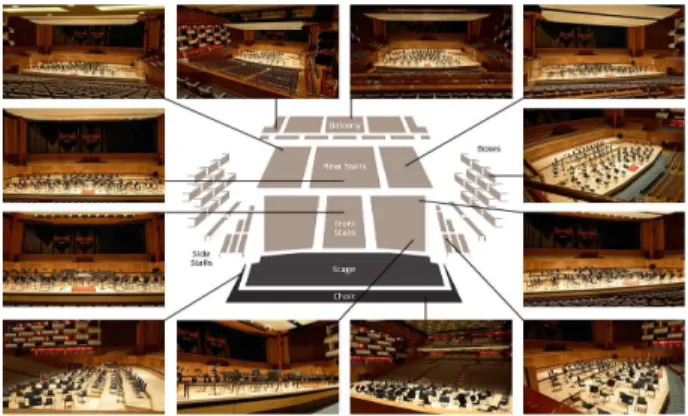
Therefore, it is necessary to propose a system for promoting the seats for PR in the performing arts venue using virtual real- ity(VR). In other words, after watching the actual performance scenes of the venues depending on their seat classes by using the virtual reality(VR) program and then they can easily select the seat class. In this VR image, it is important not only to watch the performance video but also to sit around the audience so that the distance to the audience in front of them can be measured.
First of all, virtual reality equipment that can be immersed ac- cording to the class of the seat is provided in the ticket box of the performance theatre for visitors who visit the performance venue, and the image of the actual performance is displayed, thereby facilitating the selection of the seat of the audience. In addition, QR code and Google cardboard are paid to download VR video according to the seat class and set it on the smart- phone to check the view of the seat for the audience who does the visit to the Internet without visiting the performance theatre.
Of course, this QR code and Google cardboard will only be sent to those who make a reservation, and it will be possible to pro- vide services that will allow the consumer to check VR seats and change them even without changing the fee.
4-2 Marketing Using Public Relations Promotion and Advertisement for Space and Experiential Marketing
Seoul is very large and theatres are distributed in various areas. In fact, it is meaningless for modern people to watch performances only at the theatres in terms of time and distance.
Therefore, it is possible to promote VR booths and AR ads that Name of the venue Capacity
Sejong Center Chamber Hall 3,022 Seoul Arts Center: Opera House 2,283 Blue
Square
Samsung Electric Hall 1,766 Samsung Card Hall 1,012
National Theatre 1,563
Dcube Art Center 1,242
Charlotte Theater 1,241
Chungmu Art Center 1,231
LG Art Center 1,103
표 2. 공연장별 관객 수용 규모
Table 2. Capacity Depending on Performing Arts Venue
그림 3. 공연장의 가상현실(VR) 좌석(예시)
Fig. 3. VR Seat of Performing Arts Venue (Example)
are performed in theatre or concert halls in a region where the floating population in Seoul is large, for example, Seoul Station or Airport. To put it another way, it can be useful space for PR of performing arts venue in long terms aim. Of course, this should be not a temporary space but a permanent public space
Anyone is able to experience VR and AR without reservation and marketers can receive new members of potential customers who have not visited the venue directly on there. It can solely be the experiential room for performing arts by using wearable devices suitable for the proper environment in order to experience Virtual Reality with ICT system[32]. In particular, in the case of rental performance team, they can pay PR fee for using the VR booth or space so that the performing arts venue can be a source of income.
4-3 Marketing Using Characters to Appear on the Stage for Branding value
It is possible that PR materials of performing arts can be used as marketing by means of VR and AR. The most basis for public relations is the performance program (brochure) book and poster. In terms of a performing arts program book, it should be produced with a high quality due to the fact that the audience purchase for the collection it. At this time, it would be a more interesting production if it programs the contents corresponding to each page to be viewed as AR image. For example, in case of introduction page of actors' characters, the audience can see actor's interviews via AR and the performance practice scenes can be shown through AR work. In addition, it can be a kind of participatory marketing that enables the audience to enjoy the AR contents browsing the posters for confirming two AR contents, since posters of performing arts are produced as at least two types. In particular, the audience is able to arouse their interest, since AR video can be inserted according to the characteristics of each actor and inserted into the promotional material if the main actor is double casting or more than three people.
In the case of MD(Merchandising) products, the choice of AR or VR will vary depending on the type of product, but it is possible to encourage the participation of the audience by maximizing the advantage that the performance can be viewed through various devices.
Through this participation, the consumer can be also carried out customer events, so it can make more effective marketing.
The audience can enjoy more AR contents from newspaper or magazine advertisement by using current poster without producing for the exclusively advertising image. Of course, a producer has to create various types of AR contents depending
on the type of posters. Lastly, it may be good to simply show performers and related people or images, but it is also a great thing to be able to offer stories outside the performances by adding some sort of storytelling.
4-4 VR Social Network for Customer Relationship Management
It can be an effective way to develop VR Social Network according to the membership level for the management of the performance venue and CRM. Currently, the theatre members' operation team receives complaints of the customer through SNS and communities related to performance venue. After that, customer service team make an effort to deal with their complaints with communications. But, customer thinks that it is not two-ways communication but one-way communication. It seems that the communication way under operation team may be boring and uninteresting for customers due to the fact that complaints itself have already negative factors. In order to overcome this problem, it can be possible to have two-ways communicate effectively customer's complaints in the virtual space due to the fact that the role of the VR Social Network is to support social network that is characteristic of SNS and the spatial interaction.
Therefore, building a platform through the VR Social Network will be more effective. The audience can communicate staff with a clear meaning via VR Social Network thanks to the fact that consumers use not writing but word when they complain inconvenient issue. This will solve the various inconveniences caused by misunderstanding more quickly, which will help to prevent members of existing venues from leaving and secure new customers.
In particular, it seems that the audience will increase their loyalty with the satisfaction of the venue when the customer and staff communicate with each other by means of VR Social Network. Consequently, the brand value of performing arts venue will have an increase with the growth of the royalty. Of course, in addition to membership management, the VR Social Network can also be used as an event for various venues, as well as socializing beyond simple membership management.
Ⅴ. Conclusion
In this study, VR, AR, and MR were suggested to promote
the marketing of the performing arts. This paper describes the
concepts and examples of VR, AR, and MR, the concept and
characteristics of marketing, and the marketing strategies of
venues, and discusses limitations of existing marketing systems.
In addition, the marketing plan that can utilize VR, AR, MR in performing arts field is as follows. Firstly, it is a marketing strategy that uses venues seats. This is an anticipated marketing strategy for the place where the audience is expected to see the performing arts in a certain seat that the audience wants in advance through the VR. This allows the theatre seats to be experienced in advance with the VR contents, thereby inducing the reservation of the seats with a high sense of immersion.
Secondly, it contents marketing using public relations promotion and advertisement through MR in the same space as a bus stop. This is a way to publicize the work that is planned and performed at the performance hall by installing the MR booth. Thirdly, it is a marketing strategy that utilizes emerging characters. AR contents should be provided in advance so that the characters appearing in the pamphlets like the actual characters will be introduced in advance to induce interest in the performing arts. Fourth, it is a way to communicate directly with customers by establishing a VR Social Network for the management of performance venue members. This is a way for venues to make customer relationship management (CRM) more smooth. Finally, a platform should be developed to allow visitors to view performances as VR or AR in terms of audience development or cultural welfare.
Therefore, there are expected effects, in terms of audience and performing arts venue. Considering customer, strong brand equity not only assures superior quality but also can lead to the purchase of customers by becoming a means of social self-expression. In other words, it is the performance product that is produced at the performance hall, but the consumer purchases the 'brand'.
Regarding corporate like performing arts venue, according to the 'Brand Value Chain', the marketing program of the company forms a friendly attitude of the customers to the brand, which leads to the corporate performance and ultimately maximizes the enterprise value in the market. Therefore, strong brand assets can enhance customer acceptance of marketing activities at venues and contribute to securing high brand loyal customers. In addition, the company can increase its business value by increasing profit through price premiums and building entry barriers.
REFERENCES