Remediation of Heavy Metal Polluted Agricultural Field with Spent Mushroom Media
Hee Je Chang, Young-Kyu Hong, Soon-Oh Kim
1, Sang-Woo Lee
1, Byung-Tae Lee
2, Sang-Hwan Lee
3, Mi-Jung Park
3, and Sung-Chul Kim*
Department of Bio-Environmental Chemistry, Chungnam National University, Daejeon, 34134, Korea
1
Department of geology, Gyeongsang National University, Jinju, 52828, Korea
2
School of Environmental Science and Engineering, Gwangju Institute of Science and Technology, Gwangju, 61005, Korea
3
Mine Reclamation Corporation, Wonju, 26464, Korea
(Received: December 27 2015, Revised: January 20 2016, Accepted: February 26 2016)
Environmental pollution from abandoned metal mines has been awarded as serious problem and many techniques have been applied to remediate pollutants. Main objective of this research was to evaluate efficiency of heavy metal sorption capacity of spent mushroom media (SMM) in aqueous and soil matrix.
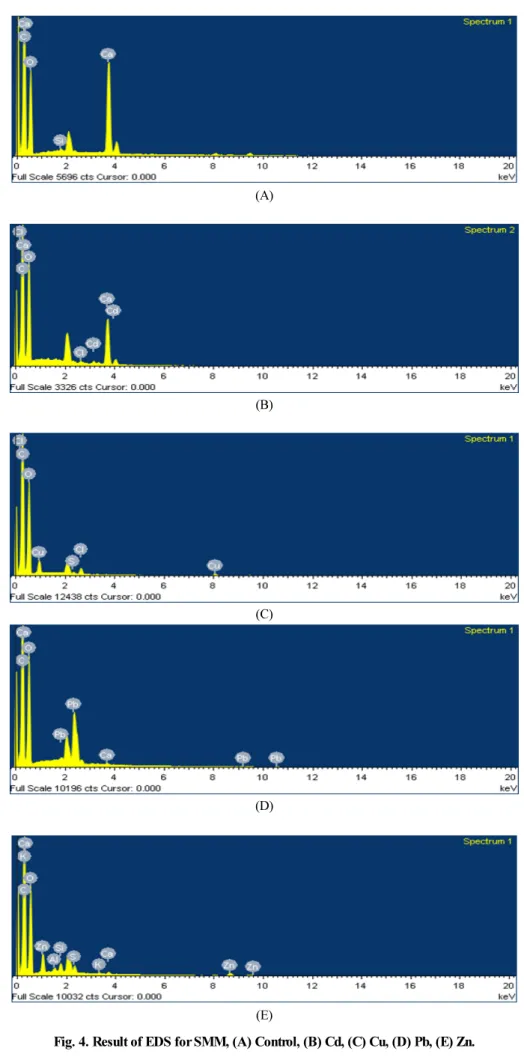
Laboratory batch experiment was conducted and 4 different heavy metals (Cd, Pb, Cu, Zn) were evaluated. In aqueous phase, all 4 heavy metals showed high reduction efficiency ranged from 60-99% and Pb showed the highest sorption efficiency. In case of soil phase, much lower sorption efficiency was observed compared to aqueous phase. The highest reduction efficiency was observed in Cd (average of 38%). With scanning electron microscopy energy dispersive detector (SED-EDS) analysis, we confirmed sorption of heavy metals at the surface of SMM. Overall, SMM can be used as sorption materials for heavy metals in both aqueous and soil matrix and more research should be conducted to increase sorption efficiency of SMM in soil.
Key words: Heavy metals, Spent mushroom media, Sorption, Soil
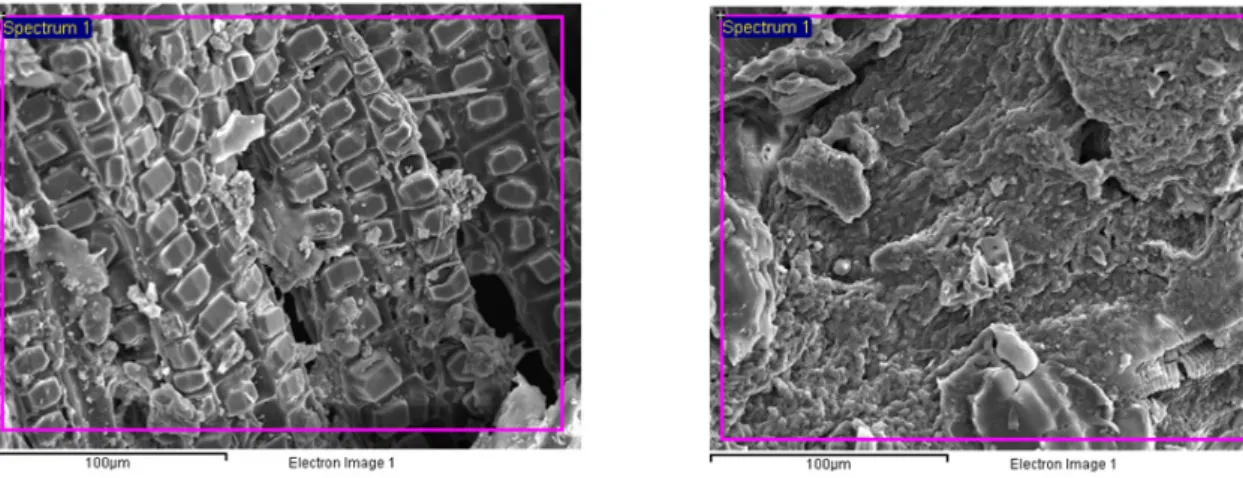
SEM-EDS image of spent mushroom media after Zn sorption batch experiment (Upper-control, Below-after Zn sorption).
1)
*Corresponding author: Phone: +82428216737, Fax: +82428216731, E-mail: [email protected]
§