229
This is an Open-Access article distributed under the terms of the Creative Commons Attribution Non-Commercial License
(http://creativecommons.org/licenses/by-nc/3.0) which permits unrestricted non-commercial use, distribution, and reproduction in any medium, provided the original work is properly cited.
I. Introduction
The rapid development of the electric motor and battery technologies has promoted the use of EV (Electric vehicle). The demand of EV sharply increases in order to solve the problem of fossil fuel energy in recent years. Especially, Jeju special self-governing province has a plan, namely Carbon Free Island Jeju by 2030, to reduce CO2 emission from fossil fuel energy. In
this plan, the local government will supply 371,000 EVs by 2030 in order to replace 100% of conventional cars. Therefore, the EV must be designed to meet special need of consumers such as cost, driving distance and lifetime. [1]
The electricity pricing policy provides guides for power demand and consumption mode of customers. Customers will respond to variable electricity prices, decide whether they prefer charging or discharging, and actively adjust
Charging Control Strategy of Electric Vehicles Based on Particle Swarm Optimization
Chang-Jin Boo
*Abstract
In this paper, proposed a multi-channel charging control strategy for electric vehicle. This control strategy can adjust the charging power according to the calculated state-of-charge (SOC). Electric vehicle (EV) charging system using Particle Swarm Optimization (PSO) algorithm is proposed. A stochastic optimization algorithm technique such as PSO in the time-of-use (TOU) price used for the energy cost minimization. Simulation results show that the energy cost can be reduced using proposed method.
Key words: Electric vehicle, Charging system, Particle Swarm Optimization, Time of use, State of charge.
---
* Dept. of Electrical Engineering, Jeju International University
★Corresponding author
E-mail: [email protected], Tel: +82-64-754-0294
※ Acknowledgment
This study was supported by the research grant of Jeju International University in 2015 Manuscript received Jun. 25, 2018; revised Jun. 26, 2018; accepted Jun. 29, 2018
charging rate and time. For countries with mature electricity market environment, research has been focused in this area. For instances, Cao et al. used TOU price to find optimal charging loads, which minimize the charging cost in a regulated market. [2]
This paper presents a multi-channel charging control strategy for electric vehicle. This control strategy can adjust the charging power according to the calculated state-of-charge (SOC). A multi-channel charging system with PSO(Particle Swarm Optimization) algorithm was designed and presented in Matlab/Simulink. Finally, we consider the multi-channel charging system that can charge an electric vehicle with four simultaneous connections.
II. Electric Vehicle Charging System Using PSO Algorithm
Kennedy and Eberhart[3] developed a PSO algorithm based on the behavior of individuals (i.e., particles or agents) of a swarm. Its roots are in zoologist’s modeling of the movement of individuals (e.g., fishes, birds, or insects) within a group. It has been noticed that members within a group seem to share information among them, a fact that leads to increased efficiency of the group. The PSO algorithm searches in parallel using a group of individuals similar to other AI-based heuristic optimization techniques. An individual in a swarm approaches to the optimum or a
quasi-optimum through its present velocity, previous experience, and the experience of its neighbors. The main advantages of the PSO algorithm are summarized as: simple concept, easy implementation, robustness to control parameters, and computational efficiency when compared with mathematical algorithm and other heuristic optimization techniques.
In a physical n-dimensional search space, the position and velocity of individual i are represented as the vectors
( 1, , )
i i in
X = x ⋅⋅⋅ x , andVi=(vi1,⋅⋅⋅,vin) , respectively, in the PSO algorithm. Let
( Pb1 , , Gb) ,
i i in
Pb = x ⋅⋅⋅ x and ( Pb1, , Gb) ,
i i in
Gb = x ⋅⋅⋅ x respectively, be the best position of individual i and its neighbors best position so far. Using the information, the updated velocity of individual i is modified under the following equation in the PSO algorithm.
1
1 1 ( ) 2 2( )
k k k k k k
i i i i i i
V + =ωV +c r× Pb −X +c r Gb −X (1)
where k1
Vi + is velocity of individual i at iteration, ω is weight parameter,
c1 and c2
are weight factors,
r1 and
r2 are random number even distribution in 0 and 1. k
Xi is position of individual i at iteration k, k
Pbi is best position of individual i until iteration k
k
Gbi is best position of the group until iteration k . Each individual move from the current position to the next one by the modified
velocity in (6) using the following equation:
1 1
k k k
i i i
X + =X +V + (2)
In this velocity updating process, the values of parameters such as ω,
c1and
c2 should be determined in advance. In general, the weight ω is set according to the following equation.
[4]
max min
max
max
Iter Iter
ω ω
ω ω= − − × (3)
where
ωmax is initial weight,
ωmin is final weight, Itermaxis maximum iteration number and Iter is current iteration number.
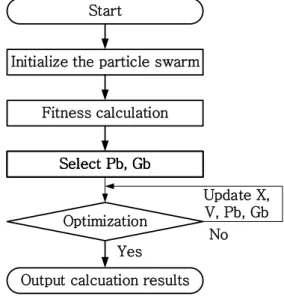
The step-by-step process of the proposed PSO algorithm can be summarized as follows.
Start
Initialize the particle swarm
Fitness calculation
Select Pb, Gb
Optimization
Output calcuation results Select Pb, Gb Select Pb, Gb Select Pb, Gb
Yes
No Update X, V, Pb, Gb
Fig. 1. PSO algorithm flowchart
Electric vehicle charging with TOU tariff, the proposed cost function minimizes energy consumption, subject to constraints on SOC.
This formulation being linear, allows the use of the PSO method for solving the optimization problem. We used the following object function to represent the daily time electricity expense, which is a combination of energy and demand costs.
1
min ( ) ( ) ( )
N M
i i
j i
S u j p j c j
=
= ⋅ ⋅
∑ ∑
(4)where
ui need to be solved by the optimization algorithm over the control horizon,
pjis the power consumption at the time j, M is the number of charging stations, and c j( ) accounts for the TOU electricity rates in the k-th switching interval. If a control horizon of daytime is divided into 15 minutes switching intervals, then, N = 36 is the total number of time steps per daytime.
SoC was defined as the remaining capacity of a battery and it is affected by its operating conditions such as load current and temperature. The time duration
Ti in minutes of the charging process can be derives as. [5]
(
, arg ,)
,
i t et i inital i
i
c j
SoC SoC E
T εP
− ⋅
= (5)
where
, i inital
SoC and
, arg i t et
SoC are represent the initial and target SoC of EV battery.
Ei is the battery capacity in kWh,
,
Pc i is the power level
of charging stations in kW and ε is the charging efficiency. The conventional charging strategy of the EV systems is based on the revised switching levels, and it is defined as
, arg , arg
1 ( )
( ) 0 ( )
i i t et
i
i i t et
when SoC j SoC u j when SoC j SoC
≤
= >
(6)
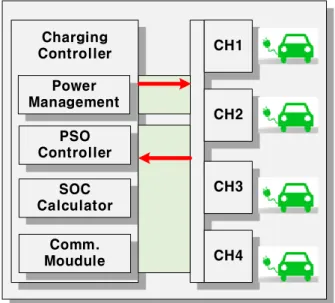
This paper consider the multi-channel charging case for performance comparison. It is assumed that the initial SoC of 4 EVs at 09:00 are 40, 50, 60, 60[%] and the target SOC of all vehicles is set to 80[%] at 18:00. The total battery capacity of all EVs with 28kWh and the power level of charging stations have 28kW(7kW*4ea). Figure 2 shows electric vehicle charging system with four channels.
CH1
CH2
CH3
CH4 Power
Management Charging Controller
PSO Controller
SOC Calculator
Comm.
Moudule
Fig. 2 Four channel electric vehicle charging system
Fig. 3 show the simulation results of the control algorithms. The loads are moved out of the peak periods and the energy
Fig. 3 SoC of battery for on-off and controlled strategies
Ⅲ. Conclusion
This paper proposed the multi-channel EV charging system and PSO control algorithm for saving energy cost and reducing peak demand.
The optimization problem with constraints is transformed into a PSO algorithm and solved in each time step. Future works include the applications for various types of EVs when the simulation is mature.
References
[1] Jeju Special Self-governing Province,
“Carbon Free Island Jeju by 2030” Policy Report 2012.
[2] Cao, Y., Tang, S., Li, C., Zhang, P., Tan, Y., Zhang, Z., Li, J., “An optimized EV charging model considering TOU price and SOC curve,” IEEE Trans. on Smart Grid. 3, pp. 388-393, 2012. DOI:
10.1109/TSG.2011.2159630
[3] Kennedy, J., Eberhart, R., “Swarm Intelligence,”Morgan Kaufmann Publishers, Inc.
2001.
[4] Park, J.B., Lee, K.S., Lee, K.Y., “A Particle Swarm Optimization for Economic Dispatch with Nonsmooth Cost Functions,” IEEE Trans. on Power Systems 20, pp. 34-42, 2005. DOI:
10.1109/TPWRS.2004.831275
[5] Hong, K.D., Son, Y., “A Study on the Smart Virtual Machine for Executing Virtual Machine Codes on Smart Platforms,” Oxford University Press, pp. 93-106, 2012.
BIOGRAPHY
Chang-Jin Boo (Member)
2001 : BS degree in Electrical Engineering, Jeju National University.
2003 : MS degree in Electrical Engineering, Jeju National University.
2007 : PhD degree in Electrical Engineering, Jeju National University.
2003~2005 : Research Engineer, Samsung Electronics.