JKSCI
Exploring the Feature Selection Method for Effective Opinion Mining:
Emphasis on Particle Swarm Optimization Algorithms
1)
Kyun Sun Eo*, Kun Chang Lee**
*PhD Student, SKK Business School, Sungkyunkwan University, Seoul, Korea
**Professor, SKK Business School/SAIHST (Samsung Advanced Institute of Health Sciences & Technology), Sungkyunkwan University, Seoul, Korea
[Abstract]
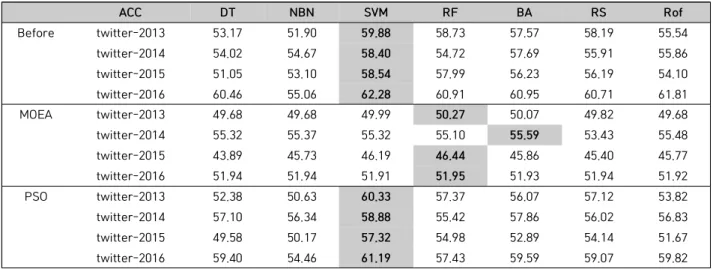
Sentimental analysis begins with the search for words that determine the sentimentality inherent in data. Managers can understand market sentimentality by analyzing a number of relevant sentiment words which consumers usually tend to use. In this study, we propose exploring performance of feature selection methods embedded with Particle Swarm Optimization Multi Objectives Evolutionary Algorithms. The performance of the feature selection methods was benchmarked with machine learning classifiers such as Decision Tree, Naive Bayesian Network, Support Vector Machine, Random Forest, Bagging, Random Subspace, and Rotation Forest. Our empirical results of opinion mining revealed that the number of features was significantly reduced and the performance was not hurt. In specific, the Support Vector Machine showed the highest accuracy. Random subspace produced the best AUC results.
▸Key words: Sentiment analysis, Feature selection, Particle Swarm Optimization, Multi Objective Evolutionary Algorithm, Machine learning
[요 약]
감성분석 연구에서는 문장에 내포된 감성을 결정짓는 단어를 찾는 것으로부터 시작된다 . 경영자 는 소비자가 주로 사용하는 단어를 분석함으로써 시장의 반응을 이해할 수 있다. 본 연구에서는 감 성분류의 성능에 영향을 미치는 단어를 찾기 위하여 입자군집최적화 탐색방법과 다목적진화 알고리 즘이 적용된 속성선택 방법을 제안한다. 속성선택 방법은 기존 머신러닝 분류기를 벤치마킹함으로 써 성능이 비교된다 . 벤치마킹된 분류기는 의사결정나무, 나이브 베이지안 네트워크, 서포터 벡터 머 신 , 랜덤포레스트, 배깅, 랜덤 서브스페이스, 로테이션 포레스트이다. 연구결과에 따르면, 입자군집 최적화 알고리즘이 적용된 속성선택방법으로 선택된 속성을 사용한 경우에 속성의 수를 상당히 줄 일 수 있었고 , 분류기의 성능을 유지시킬 수 있었다. 특히, 정확도 결과에서는 입자군집 최적화 탐색 방법으로 선택된 속성을 사용한 경우의 서포터 벡터 머신의 성능이 가장 높게 나타났다 . AUC 결과 에서는 랜덤 서브스페이스가 가장 높게 나타났다. 본 연구의 결과는 해당 탐색방법과 분류기를 적용 함으로써 오피니언 마이닝 모델의 성능을 효율적으로 유지 및 개선시키도록 도움을 준다 .
▸주제어: 감성분석, 속성선택, 입자군집최적화, 다목적진화알고리즘, 머신러닝
∙First Author: Kyun Sun Eo, Corresponding Author: Kun Chang Lee
*Kyun Sun Eo ([email protected]), SKK Business School, Sungkyunkwan University
**Kun Chang Lee ([email protected]), SKK Business School/SAIHST (Samsung Advanced Institute of Health Sciences & Technology), Sungkyunkwan University
∙Received: 2020. 10. 13, Revised: 2020. 11. 09, Accepted: 2020. 11. 10.
Copyright ⓒ 2020 The Korea Society of Computer and Information http://www.ksci.re.kr pISSN:1598-849X | eISSN:2383-9945