Research Article
Consensus Achievement of Decentralized Sensors Using Adapted
Particle Swarm Optimization Algorithm
Hyunseok Kim,
1Seongju Chang,
2and Jinsul Kim
31IT Convergence Technology Research Laboratory, Electronics and Telecommunications Research Institute,
Daejeon 305-700, Republic of Korea
2Department of Civil and Environmental Engineering, Korea Advanced Institute of Science and Technology,
Daejeon 305-701, Republic of Korea
3School of Electronics and Computer Engineering, Chonnam National University, Gwangju 500-757, Republic of Korea
Correspondence should be addressed to Seongju Chang; [email protected] and Jinsul Kim; [email protected] Received 3 January 2014; Accepted 19 March 2014; Published 27 April 2014
Academic Editor: Sabah Mohammed
Copyright © 2014 Hyunseok Kim et al. This is an open access article distributed under the Creative Commons Attribution License, which permits unrestricted use, distribution, and reproduction in any medium, provided the original work is properly cited. This paper explores the possibility of enhancing consensus achievement of decentralized sensors by establishing cooperative behavior between sensor agents. To these ends, a novel particle swarm optimization framework to achieve robust consensus of decentralized sensors is devised to distribute sensing information via local fusing with neighbors rather than through centralized control; the new framework showed a 16.5 percent improvement in consensus achievement as compared to the classic majority rule method. Noteworthy enhancements in consensus achievement are also pertinent to the comparable situation of decentralized sensor systems.
1. Introduction
The distributed deployment of multiple sensors is designed to establish cooperative behavior between sensors, thus pro-viding sufficient local information with different focuses and from different viewpoints relative to a given environment. In such a deployment, peer-to-peer communications between adjacent sensors are enabled to avoid the communication bottlenecks possible in a centralized network [1]. In a decen-tralized sensor system, sensing information of neighbors is fused locally rather than via central control as enabled by a distribution of intelligent agents with some degree of decision-making autonomy. A major research objective is to establish cooperative behavior between sensors with no external supervision.
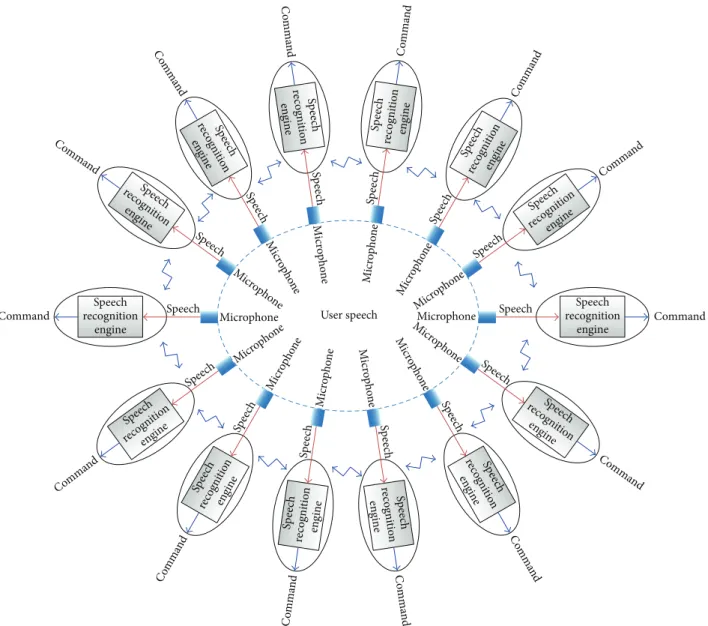
Where each sensing mechanism among multiple sensor agents concurrently perceives environmental changes, each can derive an opinion in accordance with the sensing results. For example, when a user gives a speech command to the sensor agent, as shown inFigure 1, decentralized microphone of multiple sensor agents runs their speech recognition engines and derives an opinion. Furthermore, these opinions
are shared with neighbors and are spread. As the technology has developed to date, when a conflict of nominal opinion arises and a central system cannot intervene, the system is unable to execute any service for the user. To address that failure, this paper proposes a scheme for consensus achievement of decentralized sensors (CADS) based on the particle swarm optimization (PSO) framework for decision-making among decentralized multiple sensor agents.
The rest of the paper is organized as follows.Section 2 discusses about the decision problem and precedent methods to solve it. We then introduce the scheme of consensus achievement using decentralized sensors based on the PSO framework inSection 3.Section 4describes how performance evaluation is progressed for validating the proposed method with the independent simulations.Section 5concludes the research and describes the possibilities for future work.
2. Decision Problem and Multiple-Agent
Perception Capability
2.1. Collective Decision-Making in a Decentralized Sensor System. As another way to deploy a set of sensors into the
Volume 2014, Article ID 950683, 13 pages http://dx.doi.org/10.1155/2014/950683
User speech Microphone Micr opho ne Micr opho ne Micr op ho ne Micr opho ne Micr opho ne Micr op ho ne Microphone Micr ophone Micr opho ne Micr op ho ne Micr opho ne Micr opho ne Micr op ho ne Speech Speec h Speec h Speec h Command Comma nd C omma nd C omma n d Speec h Speec h Sp eec h Comma nd Comma nd Co mma nd Speech Speec h Speec h Speec h Speec h Speec h Sp eec h Command Comma nd C omma nd C o mma n d Comma nd Comma nd Co mma nd Speech recognition engine Speec h recogni tio n en gine Speec h recogni tio n en gine Speec h recogni tio n en gine Speec h recogni tion engine Speec h recogni tion engine Sp eec h recogni tio n en gine Speech recognition engine Speec h recogni tio n en gine Speec h recogni tio n en gine Speec h recogni tio n en gine Speec h recogni tion engine Speec h recogni tion engine Sp eec h recogni tio n engine
Figure 1: User speech recognition on decentralized sensor system.
environment, this section discusses a decentralized sensor system. As shown in Figure 1, that approach treats sensors in the network as distributed intelligent agents capable of autonomous decision-making. A major research objective is to establish cooperative behavior between sensors with no external supervision. The three criteria for contrasting collective and small group behaviors were revealed in [2]. In the first, psychological criterion, large groups convey a sense of transcending power that serves to reinforce or sup-press individual activity. In collective behaviors, the second criterion, new forms of communications and interactions arise, such as uncontrolled circular reactions related to crowd psychology or one-way communication of the mass media. How participants are mobilized for action is the third criterion, with larger groups using such new devices as incitation, agitation, and morale development to that end.
Meanwhile, collective behaviors, especially in the field of collective robotics, have been classified into several
main categories: spatially organizing behaviors, navigation behaviors, and collective decision-making [3]. The first area focuses on how to organize and distribute robots in space via the following approaches: aggregation, pattern forma-tion, chain formaforma-tion, and self-assembly and morphogenesis. Navigation behaviors include collective exploration, coor-dinated motion, and collective transport, while collective decision-making denotes collective behavior in which a swarm of robots collectively makes a decision. In addi-tion, two key processes underlie most collective behaviors: agreement and specialization. The former denotes consensus achievement that converges toward a single decision among possible alternatives, whereas the latter denotes task allo-cation to distribute the roles of participating agents over various possible tasks to maximize overall performance. This paper explores the collective decision-making under-lying consensus achievement in a decentralized sensor sys-tem.
1 8 2 9 3 10 4 11 5 12 6 13 7 14
Figure 2: Example of an undirected graph used in this paper.
2.2. Approaches to Achieving Linear Consensus. Computer
scientists have long studied consensus problems, especially in such areas as pervasive computing [4,5], sensor network systems [6,7], and multiagent systems [8,9]. Olfati-Saber et al. [10] defined consensus and consensus algorithm as follows: consensus is a process to reach an agreement regarding a certain quantity of interest that depends on the state of all agents, whereas the consensus algorithm is an interaction rule specifying the information exchange between an agent and all of its neighbors on the network. A communication topology of interactions can be represented by a directed graph based on graph theory [10,11].
As shown inFigure 2, given an undirected graph, which can be viewed as a special case of a directed graph, the set of nodes in the graph can exchange information with their neighbors𝐺 = (𝑉, 𝐸) with vertices 𝑉 and edges 𝐸, where 𝑉 = {1, 2, . . . , 𝑛} and (𝑖, 𝑗) ∈ 𝐸. In this graph the adjacency matrix 𝐴 is defined as (1), where the weight𝑎𝑖𝑗= 1 of the edge (𝑖, 𝑗) denotes that node𝑗 can obtain information from node 𝑖:
𝐴 = [[ [ 𝑎11 ⋅ ⋅ ⋅ 𝑎𝑖1 .. . d ... 𝑎1𝑗 ⋅ ⋅ ⋅ 𝑎𝑖𝑗 ] ] ] = [ [ [ [ [ [ [ [ [ [ [ [ [ [ [ [ [ [ [ [ [ [ [ 0 1 0 0 0 0 0 1 1 0 0 0 0 0 1 0 1 0 0 0 0 1 1 1 0 0 0 0 0 1 0 1 0 0 0 0 1 1 1 0 0 0 0 0 1 0 1 0 0 0 0 1 1 1 0 0 0 0 0 1 0 1 0 0 0 0 1 1 1 0 0 0 0 0 1 0 1 0 0 0 0 1 1 1 0 0 0 0 0 1 0 0 0 0 0 0 1 1 1 1 0 0 0 0 0 0 1 0 0 0 0 0 1 1 1 0 0 0 0 1 0 1 0 0 0 0 0 1 1 1 0 0 0 0 1 0 1 0 0 0 0 0 1 1 1 0 0 0 0 1 0 1 0 0 0 0 0 1 1 1 0 0 0 0 1 0 1 0 0 0 0 0 1 1 1 0 0 0 0 1 0 1 0 0 0 0 0 1 1 0 0 0 0 0 1 0 ] ] ] ] ] ] ] ] ] ] ] ] ] ] ] ] ] ] ] ] ] ] ] . (1)
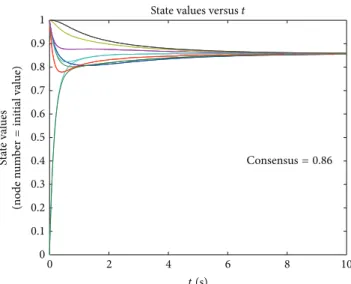
A convergence toward collective decision-making through local interactions among nodes is defined as (2) in [10,11]. A diagonal matrix, meaning the degree matrix𝐷, is defined as (3) where diagonal elements are calculated by the row sum of the adjacency matrix. Then, node consensus can be asymptotically converged with the set of neighbors of a node𝑖 and the Laplacian graph given as (4).Figure 3shows an application of a consensus algorithm in a continuous-time system. For instance, the initial condition of nodes is given as x = {1, 1, 1, 0, 1, 1, 1, 1, 0, 1, 1, 1, 1, 1}; thus, it is shown that
0 2 4 6 8 10 1 0.9 0.8 0.7 0.6 0.5 0.4 0.3 0.2 0.1 0 t (s) St at e val ues (n od e n u m be r = ini tial val u e)
State values versust
Consensus= 0.86
Figure 3: Results for the example undirected graph under the consensus algorithm.
the consensus graph asymptotically converges, as shown in
Figure 3. Consider ̇𝑥 𝑖= 𝑢𝑖= 𝑛 ∑ 𝑗 𝑎𝑖𝑗(𝑥𝑗− 𝑥𝑖) =∑𝑛 𝑗 𝑎𝑖𝑗𝑥𝑗−∑𝑛 𝑗 𝑎𝑖𝑗𝑥𝑖, 𝑖 = 1, . . . , 𝑛, (2) 𝐷 = [ [ [ [ [ [ [ 𝑑1 0 ⋅ ⋅ ⋅ 0 0 0 d ⋅ ⋅ ⋅ d 0 .. . d 𝑑𝑖 d ... 0 d ⋅ ⋅ ⋅ 𝑑𝑛−1 0 0 0 ⋅ ⋅ ⋅ 0 𝑑𝑛 ] ] ] ] ] ] ] , where 𝑑𝑖=∑𝑛 𝑗 𝑎𝑖𝑗, (3) ̇x = − (𝐷 − 𝐴) x = −𝐿x. (4) Recently, a gossip protocol inspired by the form of gossip seen in social networks is emerging as an alternative approach to the above Laplacian-based consensus algorithm [12]. The concept of the gossip-based consensus algorithm can be illustrated by the analogy of spreading rumors. In [13], the goal of gossiping is described as for the𝑛 agents to reach a consensus in the sense that all𝑛 gossip variables ultimately reach the same value at the average of the initial values: x in the limit as𝑡 → ∞. As an application of the algorithm, Lu et al. [14] proposed a pairwise equalizing as a gossip-style distributed asynchronous iterative algorithm for achieving convex consensus optimization over undirected networks.
2.3. Majority Rule Approach. Such historical decision rules
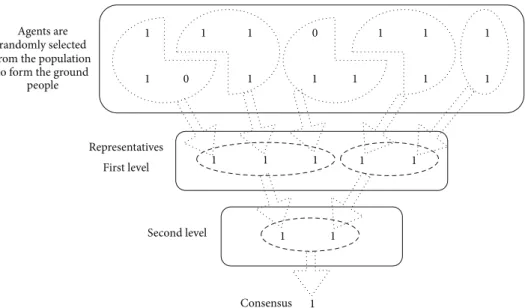
as unanimous agreement and unanimous consent minus one or two votes have long existed. The main scheme of the majority rule (MR) model [15], originally proposed to achieve consensus formation in public debates, is shown inFigure 4. At the first stage each agent has an opinion, and these agents are distributed randomly in a series of groups. Then, each group elects a representative according to majority rule. As
1 1 1 0 1 1 0 1 1 1 1 1 1 1 1 1 1 1 1 1 1 1 Agents are randomly selected from the population
to form the ground people
Representatives First level
Second level
Consensus
Figure 4: Galam: a three-level hierarchy with groups of multiple agents.
this process is repeated until a single group remains, the hierarchy presidents thus elected constitute one upper level.
In statistics, the mode of a set of data, or its most frequent value [16], can be a way of expressing important information about a random variable. Unlike the arithmetic mean and median, the mode is not necessarily unique, and a set with more than two modes may be described as multimodal. Given the above example dataset x, the mode is 1.
In the statistical physics community, the bounded con-fidence models have recently received much attention from the community [17]. When the possible opinion states are more than two, one can introduce bounded confidence to each other. In [18] the effects of agents’ confidence have been analyzed in conflict resolution of a multiagent system. The proposed confidence model used the confidence and reputation of the agent, which depends on past experiences, and could be used to determine the best strategy for conflict resolution.Table 1shows a comparison of the three represen-tative methods and the result of convergences toward a single decision among the possible alternatives.
2.4. Decision Problem in Conflict of Opinion. Our study uses
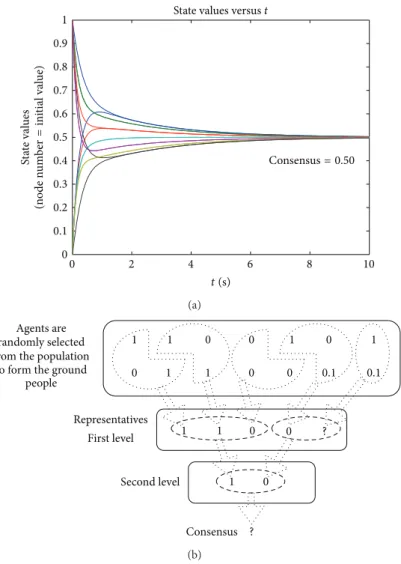
the number of statistical modes as alternative decisions. For example, given the opinion of dataset x = {1, 1, 0, 0, 1, 0, 1, 0, 1, 1, 0, 1, 0, 0}, the mode of the dataset is not unique so that it may be said to be bimodal or in a tie. In this case, the number of statistical modes is two, and the mode values are M = {0, 1}. The previous consensus algorithm, the standard average consensus algorithm [10,11], finds nearly the mean value among the dataset shown in Figure 5(a). However, general majority rule could not work in the collision state as shown inFigure 5(b)because there exists the same number of instances of 0 and 1. In such a tie case, Galam’s model [15,19– 21] used “local bias” by which the group adopts one or another opinion with respective probabilities𝑘 and (1 − 𝑘). The value of𝑘 accounts for the average of individual biases driven by the
existence of heterogeneous beliefs within the corresponding class.
3. Proposed PSO CADS Mechanism
3.1. Particle Swarm Optimization. The PSO is an evolutionary
computation algorithm proposed by Kennedy and Eberhart in 1995 [22], and it has been used in the simulations of bird flocking and fish schooling and swarming. The main idea of PSO is to use particles which are randomly located in a search space that can converge toward the global best position at every iteration [22]. PSO utilizes individual particles moving around the search space according to (5) and (6) over their velocity and position [23–27]. Each particle position is adjusted to the best position found and is updated as better positions are found by other particles. As the model is iterated, the particles can ascertain the best position found thus far. Consider
V𝑖[𝑛] = 𝜒 ⋅ { { { { { 𝜔 ⋅ V𝑖[𝑛 − 1] + 𝑐1⋅ rand1⋅ (𝑝𝑖best[𝑛 − 1] − 𝑥𝑖[𝑛 − 1]) + 𝑐2⋅ rand2⋅ (𝑔best[𝑛 − 1] − 𝑥𝑖[𝑛 − 1]) } } } } } , (5) 𝑥𝑖[𝑛] = 𝑥𝑖[𝑛 − 1] + V𝑖[𝑛] . (6)
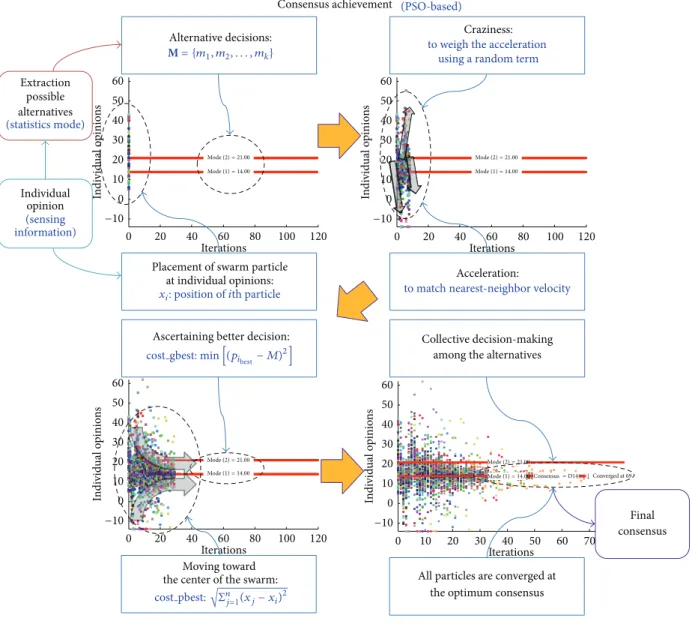
3.2. Proposed CADS Algorithm. The proposed CADS is
based on the two main concepts of PSO: to match nearest-neighbor velocity (acceleration) and to weigh acceleration using a random term (craziness). Under the former con-cept, individual opinion moves toward a matching nearest-neighbor consensus. Under the latter concept, swarm opinion converges from alternatives, accelerating toward a better decision. As the model iterates, individual opinions conspire to achieve optimal consensus. Figure 6 details the process of PSO-based consensus achievement. First, each sensor agent requests neighbors’ opinions via a static or dynamic
0 2 4 6 8 10 1 0.9 0.8 0.7 0.6 0.5 0.4 0.3 0.2 0.1 0 t (s) St at e val ues (n od e n u m be r = ini tial val u e)
State values versust
Consensus= 0.50
(a)
Agents are randomly selected from the population
to form the ground people Representatives First level Second level Consensus ? ? 0.1 0 0 0 0 0 0.1 1 1 0 1 1 1 1 1 0 1 1 0 0 (b)
Figure 5: Example of consensus achievement based on (a) the average consensus algorithm and (b) the majority rule among the bimodal opinions.
Table 1: Comparison of the three methods.
Initial condition Methods
Consensus algorithm Majority rule Statistic mode
x ={1, 1, 1, 0, 1, 1, 1, 1, 0, 1, 1, 1, 1, 1} 0.86 1 1
adjacent link, the individual opinions gathered are coordi-nated, and swarm particles thus are initiated according to these opinions and statistical mode values are extracted as alternative decisions. Second, swarm particles move follow-ing the two main concepts. Third, swarm particles move toward a consensus position and ascertain better decision. Fourth, all particles converge at an optimum consensus and the collective decision-making is underlying CADS. Finally, the above consensus process iterates until it meets the stop conditions.
To detail this process concretely, let the opinion of node𝑖 be𝑥𝑖,1 ≤ 𝑖 ≤ 𝑛, and the length of vectors 𝑥𝑖and V𝑖equal the
dimensionality of the opinion. In addition, let the alternative set among the opinions be M = {𝑚1, 𝑚2, . . . , 𝑚𝑗}, 1 ≤ 𝑗 ≤ 𝑘,
where statistical mode values are extracted as alternatives values. The swarm size can be determined as the number of nodes multiplied by the number of alternatives. The terms 𝑐1 and 𝑐2 are cognitive and social constants, respectively, changing the velocity of particles toward the previous best position and the global best position. The velocity of the𝑖th particle at iteration𝑡 is followed to (5) and its next position is determined by (6), where uniform random numbers rand1 and rand2are stochastic variables, called “craziness,” to avoid the unfortunate state of all particles quickly settling into a unanimous, unchanging direction. This paper defines the cost function for the previous best position, cost pbest(), for moving toward the center of the swarm as (7), where the difference from particle 𝑥𝑖 to all particles X is calculated,
Iterations 80 Iterations Iterations 0 10 20 30 40 50 60 70 −10 In di vid u al o p inio n s Consensus= D14 0 20 40 60 80 100 120 0 10 20 30 40 50 60 −10 In di vid u al o p inio n s 0 20 40 60 80 100 120 Iterations 0 10 20 30 40 50 60 −10 In di vid u al o p inio n s 0 10 20 30 40 50 60 0 10 20 30 40 50 60 −10 In di vid u al o p inio n s 0 20 40 60 80 100 120 Mode(1) = 14.00 Mode(2) = 21.00 Mode(1) = 14.00 Mode(2) = 21.00 Mode(1) = 14.00 Mode(2) = 21.00
Consensus achievement (PSO-based)
Individual opinion (sensing information) Mode(1) = 14.00 Mode(2) = 21.00 Extraction possible alternatives (statistics mode)
Ascertaining better decision:
All particles are converged at the optimum consensus Collective decision-making
among the alternatives Acceleration:
to match nearest-neighbor velocity
Craziness:
to weigh the acceleration using a random term
Final consensus Moving toward
the center of the swarm:
√Σn
j=1(xj− xi)2
cost gbest: min (p] ibest− M)2]
Placement of swarm particle at individual opinions:
xi: position ofith particle
Alternative decisions:
↓ Converged at 69
M = {m1, m2, . . . , mk}
cost pbest:
Figure 6: Detailed process of PSO-based consensus achievement.
and derives the previous best position, 𝑝𝑖best, through the cost function for its own previous best positions as in (8). Consider cost𝑝best(𝑥𝑖)≡ √ 𝑛 ∑ 𝑙=1 (𝑥𝑙− 𝑥𝑖)2, (𝑙 = 1, . . . , 𝑛) , (7) 𝑝𝑖best[𝑡] ={{{{ { 𝑥𝑖[𝑡] if cost𝑝best (𝑥𝑖[𝑡]) ≤ cost 𝑝best (𝑝𝑖best[𝑡 − 1]) 𝑝𝑖best[𝑡 − 1] otherwise.
(8)
The cost function for the global best position, cost𝑔best(), for ascertaining the best decision is (9), where the minimum of square error compared to each alternative is calculated, and the global best position,𝑔best, is determined
by (10). Finally, a consensus is derived by (11), where the
closest alternative to the global best position is selected as the final consensus. Consider
cost𝑔best(𝑝
𝑖best)≡ min𝑗 𝑝𝑖best− 𝑚𝑗 , (𝑗 = 1, . . . , 𝑘) , (9)
𝑔best[𝑡] = arg min
𝑝𝑖best cost𝑔best (𝑝𝑖best) , (𝑖 = 1, . . . , 𝑛) ,
(10) consensus[𝑡] = arg min
𝑚𝑗
(𝑔best[𝑡] − 𝑚𝑗)2, (𝑗 = 1, . . . , 𝑘) .
(11) The algorithm is implemented as in Algorithm 1. In addition to the use of the algorithm, line 12 of the algorithm is used to decide when to stop consensus achieving; for this the norm value of swarm velocity is less than a predefined minimum value of velocity. On the other hand, if the algo-rithm could not find an optimum consensus, the statistical
Node1 Node2 Node3 Node4 Node5 Node6 Node7 Node8 Node9 Node10 Node11 Node12 Node13 Node14 Node15 Node16 Node17 Node18 Node19 Node20 Node21 Node22 Node23 Node24 Node25 Node26 Node27 Node28 Node29 Node30 Node31 Node32 Node33 Node34 Node35 Node36 Node37 Node38 Node39 Node40 Node41 Node42 Node43 Node44 Node45 Node46
Figure 7: A predefined network with 46 nodes (sensor agents) and 347 links.
5 10 15 20 25 30 35 40 45 4.5 4 3.5 3 2.5 2 1.5 1 0.5 0 Individual opinions Co u n t (a) 0 1 2 3 4 5 6 7 8 0 1 2 3 4 5 6 7 8 9 10 11 Initial alternative:22 Initial alternative:36 D32 D35 D15 D42 D39 D31 D42 D02 D13 D22 D21 D36 D22 D22 D07 D10 D03 D36 D38 D02 D33 D08 D25 D44 D39 D14 D41 D20 D10 D12 D38 D08 D37 D19 D37 D03 D32 D22 D19 D14 D06 D36 D16 D36 D28 D40 (b)
Figure 8: Initial opinions in the 46-sensor agent example.
mode𝑚 for which the difference between swarm particle and alternative set attains its smallest value is selected as arbitrated consensus, as shown in the line 18 of the algorithm.
4. Evaluation
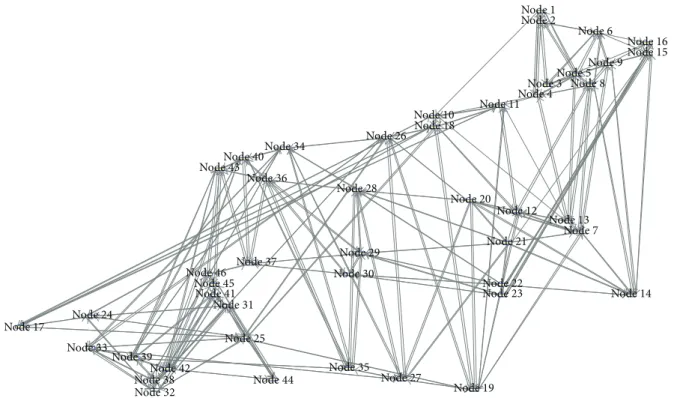
4.1. Predefined Network Topology. Our study used the
num-ber of statistical modes as alternative decisions. For example, given a predefined network of 46 nodes and 347 links, as shown inFigure 7, and given the initial opinion of dataset
X = {32, 42, 42, 35, 39, 2, 15, 31, 13, 22, 22, 36, 8, 14, 12, 19, 21, 7, 38, 25, 41, 38, 37, 36, 10, 2, 44, 20, 8, 3, 22, 3, 33, 39, 10, 37, 32, 22, 6, 36, 19, 36, 28, 14, 16,40} the mode of the dataset is not unique and may be said to be bimodal, as illustrated in
Figure 8. In this case, the number of statistical modes is two
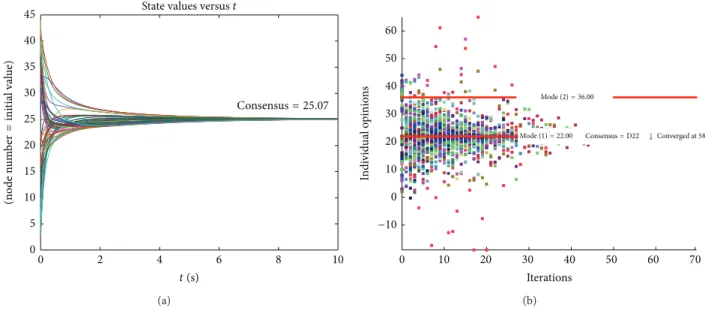
and the mode values are 22 and 36; thus, M = {22, 36}. The previous consensus algorithm, the standard average consensus algorithm [10,11], derives a value near the mean value from the dataset, as shown inFigure 9(a). By compari-son, the proposed framework is able to reach a decision using
0 2 4 6 8 10 45 40 35 30 25 20 15 10 5 0 t (s) Consensus= 25.07 St at e val ues (n od e n u m be r = ini tial val u e)
State values versust
(a) 0 10 20 30 40 50 60 70 60 50 40 30 20 −10 10 0 Iterations In di vid u al o p inio n s Consensus= D22 ↓ Converged at 58 Mode(1) = 22.00 Mode(2) = 36.00 (b)
Figure 9: The results of (a) linear averaging consensus algorithm and (b) global consensus using the proposed framework with global knowledge and centralized communication.
Smart block number5
Smart block number6
Smart block number4
Smart block number1
A consensus Smart block number3
Smart block number2 HAI
Opinions
Opinions Opinions
Opinions Opinions
Smart block numbern SIMP agent OS Network Sensor Display HAI SIMP agent OS Network Sensor Display HAI SIMP agent OS Network Sensor Display HAI SIMP agent OS Network Sensor Display HAI SIMP agent OS Network Sensor Display HAI SIMP agent OS Network Sensor Display HAI SIMP agent OS Network Sensor Display A consensus A consensus A consensus A consensus Neighbor{1, 2, 3} Neighbor{2, 4} Neighbor{1, 2, 3, 4, 5} Neighbor{5, 6, n} Neighbor{2, 5, 6, n}
Figure 10: Example of consensus achievement with decentralized sensors of multiple sensor agents.
global knowledge and centralized communication given a conflict of opinion, as shown in Figure 9(b). As shown in
Figure 10, the results of the two CADS simulations among
multiple sensor agents use no global knowledge or centralized communication but rely solely on local interaction with
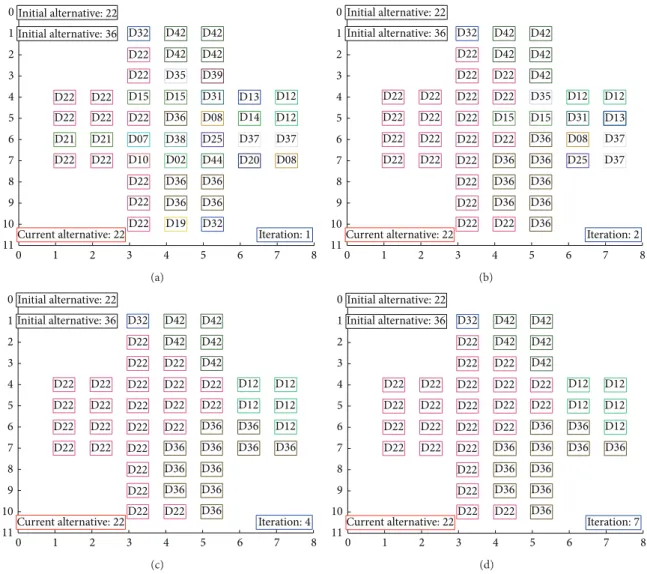
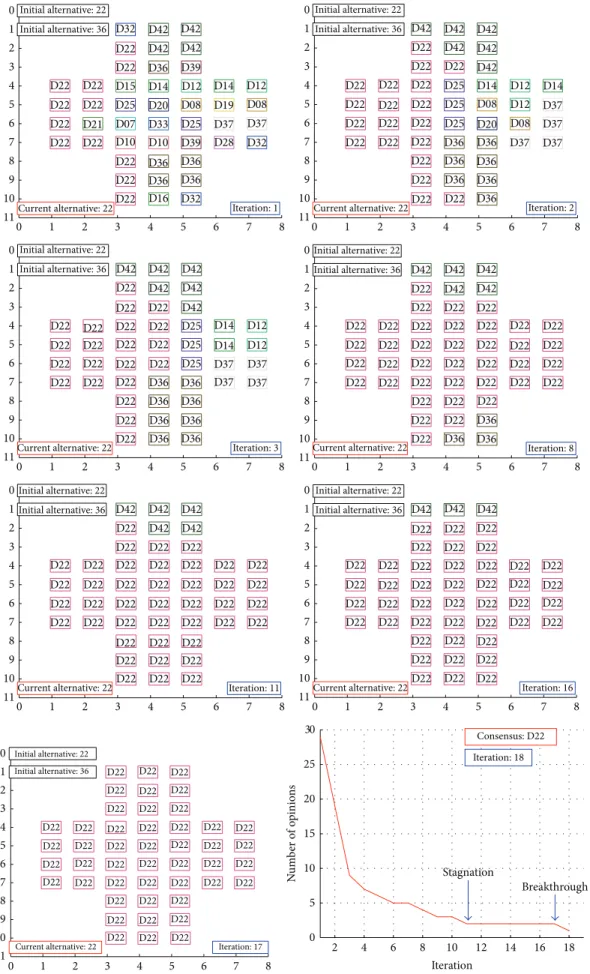
neighbors.Figure 11shows that the majority rule based on statistical modes cannot advance the process, given a conflict of opinions.
On the other hand, it also shows that the proposed PSO-based CADS can make a decision only through local
0 1 2 3 4 5 6 7 8 0 1 2 3 4 5 6 7 8 9 10 11 Initial alternative:22 Initial alternative:36
Current alternative:22 Iteration:1 D22 D22 D22 D21 D22 D22 D22 D42 D42 D42 D42 D22 D22 D22 D22 D22 D22 D21 D32 D32 D15 D07 D10 D35 D15 D36 D36 D36 D36 D36 D38 D02 D19 D31 D08 D08 D25 D44 D39 D13 D14 D37 D37 D20 D12 D12 (a) 0 1 2 3 4 5 6 7 8 0 1 2 3 4 5 6 7 8 9 10 11 Initial alternative:22 Initial alternative:36
Current alternative:22 Iteration:2 D22 D22 D22 D22 D22 D22 D22 D22 D22 D22 D22 D22 D22 D22 D22 D22 D22 D22 D22 D22 D22 D32 D42 D42 D42 D42 D42 D15 D36 D36 D36 D36 D36 D36 D36 D36 D35 D15 D31 D08 D12 D25 D13 D37 D37 D12 (b) 0 1 2 3 4 5 6 7 8 0 1 2 3 4 5 6 7 8 9 10 11 Initial alternative:22 Initial alternative:36
Current alternative:22 Iteration:4 D22 D22 D22 D22 D22 D22 D22 D22 D22 D22 D22 D22 D22 D22 D22 D22 D22 D22 D22 D22 D22 D22 D22 D22 D32 D42 D42 D42 D42 D42 D36 D36 D36 D36 D36 D36 D36 D36 D36 D36 D36 D12 D12 D12 D12 D12 (c) 0 1 2 3 4 5 6 7 8 0 1 2 3 4 5 6 7 8 9 10 11 Initial alternative:22 Initial alternative:36
Current alternative:22 Iteration:7 D22 D22 D22 D22 D22 D22 D22 D22 D22 D22 D22 D22 D22 D22 D22 D22 D22 D22 D22 D22 D22 D22 D22 D22 D32 D42 D42 D42 D42 D42 D36 D36 D36 D36 D36 D36 D36 D36 D36 D36 D36 D12 D12 D12 D12 D12 (d)
Figure 11: Majority rule cannot further the process in a conflict of opinions.
Table 2: Parameters of PSO-based consensus achievement.
Parameters Value
Swarm size (Zk) Size(input data)× number of alternatives
Initial global best position 0
Initial particle position Input data
Minimum position (min pos) (−max(input data) + 3 × min(input data))/2
Maximum position (max pos) (3× max(input data) – min(input data))/2
Minimum norm of velocity (max pos− min pos)/100
Inertial constant (𝜔) 1
Cognitive constant (𝑐1) 2.05
Social constant (𝑐2) 2.05
Use constriction factor True
Clip the particle position True
Maximum initial velocity 1
D22 D22 D22 D22 D22 D22 D22 D22 D22 D22 D22 D22 0 1 2 3 4 5 6 7 8 0 1 2 3 4 5 6 7 8 9 10 11 D32 D32 D32 D15 D07 D08 D10 D25 D28 D25 D42 D42 D36 D42 D42 D39 D39 D14 D14 D19 D12 D08 D12 D10 D20 D33 D37 D37 D21 D36 D36 D36 D36 D16 Initial alternative:22 Initial alternative:36
Current alternative:22 Iteration:1
D22 D22 D22 D22 D22 D22 D22 D22 D22 D22 D22 D22 D22 D22 D22 D22 D22 D22 D22 0 1 2 3 4 5 6 7 8 0 1 2 3 4 5 6 7 8 9 10 11 D42 D42 D42 D42 D42 D42 D25 D25 D25 D36 D37 D37 D37 D37 D36 D36 D36 D36 D36 D36 D08 D08 D14 D12 D14 D12 D20 Initial alternative:22 Initial alternative:36
Current alternative:22 Iteration:2
0 1 2 3 4 5 6 7 8 0 1 2 3 4 5 6 7 8 9 10 11 D22 D22 D22 D22 D22 D22 D22 D22 D22 D22 D22 D22 D22 D22 D22 D22 D22 D22 D22 D22 D22 D42 D42 D42 D42 D42 D42 D25 D25 D25 D36 D36 D36 D36 D36 D36 D36 D36 D37 D37 D37 D37 D14 D14 D12 D12 Initial alternative:22 Initial alternative:36
Current alternative:22 Iteration:3
0 1 2 3 4 5 6 7 8 0 1 2 3 4 5 6 7 8 9 10 11 D22 D22 D22 D22 D22 D22 D22 D22 D22 D22 D22 D22 D22 D22 D22 D22 D22 D22 D22 D22 D22 D22 D22 D22 D22 D22 D22 D22 D22 D22 D22 D22 D22 D22 D22 D22 D22 D22 D42 D42 D42 D42 D42 D36 D36 D36 Initial alternative:22 Initial alternative:36
Current alternative:22 Iteration:8
0 1 2 3 4 5 6 7 8 0 1 2 3 4 5 6 7 8 9 10 11 D22 D22 D22 D22 D22 D22 D22 D22 D22 D22 D22 D22 D22 D22 D22 D22 D22 D22 D22 D22 D22 D22 D22 D22 D22 D22 D22 D22 D22 D22 D22 D22 D22 D22 D22 D22 D22 D22 D22 D22 D22 D42 D42 D42 D42 D42 Initial alternative:22 Initial alternative:36
Current alternative:22 Iteration:11
D22 D22 D22 D22 D22 D22 D22 D22 D22 D22 D22 D22 D22 D22 D22 D22 D22 D22 D22 D22 D22 D22 D22 D22 D22 D22 D22 D22 D22 D22 D22 D22 D22 D22 D22 D22 D22 D22 D22 D22 D22 D22 D22 D42 D42 D42 0 1 2 3 4 5 6 7 8 0 1 2 3 4 5 6 7 8 9 10 11 Initial alternative:22 Initial alternative:36
Current alternative:22 Iteration:16
0 1 2 3 4 5 6 7 8 0 1 2 3 4 5 6 7 8 9 10 11 D22 D22 D22 D22 D22 D22 D22 D22 D22 D22 D22 D22 D22 D22 D22 D22 D22 D22 D22 D22 D22 D22 D22 D22 D22 D22 D22 D22 D22 D22 D22 D22 D22 D22 D22 D22 D22 D22 D22 D22 D22 D22 D22 D22 D22 D22 Initial alternative:22 Initial alternative:36
Current alternative:22 Iteration:17 2 4 6 8 10 12 14 16 18 30 25 20 15 10 5 0 Iteration N u m b er o f o p inio n s Stagnation Breakthrough Consensus: D22 Iteration:18
260 280 300 320 340 360 380 250 200 150 100 50 0 Number of links F req uenc y (a) 0 1 2 3 4 5 6 7 8 9 10 11 12 13 14 15 16 700 600 500 400 300 200 100 0 Number of alternatives F req uenc y (b)
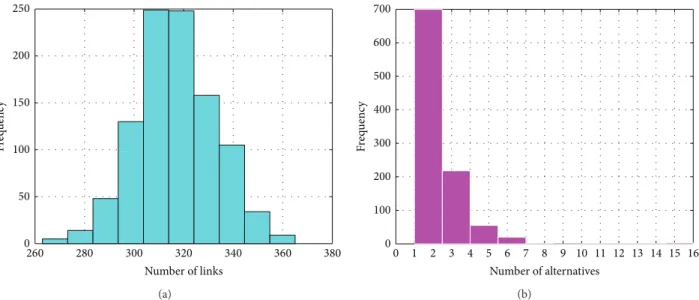
Figure 13: The information for randomly generated networks in 1000 independent trials. (a) The histogram of the number of links. (b) The histogram of the number of alternatives (= the number of statistic mode values).
4 5 6 7 8 9 10 11 12 13 14 15 16 17 18 350 300 250 200 150 100 50 0 Each iteration N u m b er o f i tera tio n s
Majority- (mode) based CADS success rate:0.748%
(a) 0 10 20 30 40 50 60 70 80 90 100 800 700 600 500 400 300 200 100 0 Each iteration N u m b er o f i tera tio n s
PSO-based CADS success rate: 0.872%
(b)
Figure 14: The histogram of each iteration successfully finding consensus in 1000 independent trials. (a) The majority rule approach. (b) The proposed PSO-based CADS approach.
interactions absent from a conflict of opinions, as shown
in Figure 12. Table 2 shows the parameters of PSO-based
consensus achievement.
4.2. Randomly Generated Network Topology. Additional
ex-periments applied two approaches for simulating experi-mental network topologies for 46 sensor agents randomly generated 1000 times.Figure 13shows the histogram for the number of links and the number of alternatives, respec-tively. In this experiment, the success indicates when final consensus belongs to the initial alternatives found by the global consensus with global knowledge and centralized communication. Figure 14 shows that traditional majority rule using the statistical mode achieved consensus in 748
of the 1000 independent trials, while the proposed PSO-based CADS approach achieved consensus in 872 of 1000 independent trials. Therefore, the baseline for the comparison is 748; then the percent improvement is(872 − 748)/748 = 16.577%.
5. Conclusion
This paper has explored a possible new way to enhance the decision-making capability of a decentralized sensor system through a consensus mechanism that distributes sensing information through local fusing with neighbors rather than through centralized control. For that purpose, this dissertation has proposed a novel PSO framework to
Algorithm [𝑐𝑜𝑛𝑠𝑒𝑛𝑠𝑢𝑠] = PSO ConsensusFunction(opinion set of itself and its adjacent nodes) (1) Set M as alternative set extracted as statistical mode value from the opinion set
(2) Place initial particles x at individual opinion of each node (3) for 𝑡:= 1 to 𝑚𝑎𝑥𝑖𝑚𝑢𝑚 𝑖𝑡𝑒𝑟𝑎𝑡𝑖𝑜𝑛𝑠
(4) for 𝑖:= 1 to the number of 𝑠𝑤𝑎𝑟𝑚 𝑠𝑖𝑧𝑒 (= number of nodes × number of alternatives)
(5) Find pbest(𝑥𝑖) by (18)
(6) end
(7) for 𝑖 := 1 to the number of 𝑠𝑤𝑎𝑟𝑚 𝑠𝑖𝑧𝑒 (= number of nodes × number of alternatives)
(8) Find gbest(pbest(𝑥𝑖)) by (10)
(9) end
(10) Calculate𝑠𝑤𝑎𝑟𝑚 V𝑒𝑙𝑜𝑐𝑖𝑡𝑦 by ordinary PSO algorithm as (5)
(11) Update𝑠𝑤𝑎𝑟𝑚 𝑝𝑜𝑠𝑖𝑡𝑖𝑜𝑛 by ordinary PSO algorithm as (6)
(12) if ‖swarm velocity‖2< 𝑚𝑖𝑛𝑖𝑚𝑢𝑚 V𝑒𝑙𝑜𝑐𝑖𝑡𝑦 𝑛𝑜𝑟𝑚
(13) Optimum consensus is selected by (11)
(14) Stop iteration and exit the function
(15) end (16) end
(17) if optimum consensus is not selected
(18) return 𝑎𝑟𝑏𝑖𝑡𝑟𝑎𝑡𝑒𝑑 𝑐𝑜𝑛𝑠𝑒𝑛𝑠𝑢𝑠 := arg min𝑚∈M√∑𝑛𝑖=1(𝑥𝑖− 𝑚)2
(19) end
Algorithm 1: PSO-based consensus achievement algorithm.
achieve robust consensus of decentralized sensors. The new framework shows about 16.5 percent improvement in con-sensus achievement as compared to the general majority rule method. Therefore, a system using the proposed framework is expected to offer little or no delay in executing user service requests. The method will help establish cooperative behavior between sensor agents with no external supervision and may be expected to occasion remarkable enhancements in consensus achievement that are also pertinent to the comparable situation of decentralized sensor systems.
Acknowledgment
This research was supported by the MSIP (Ministry of Science, ICT and Future Planning), Korea, under the ITRC (Information Technology Research Center) support pro-gram (NIPA-2014-H0301-14-1014) supervised by the NIPA (National IT Industry Promotion Agency).
Conflict of Interests
The authors declare that there is no conflict of interests regarding the publication of this paper.
References
[1] N. Xiong and P. Svensson, “Multi-sensor management for information fusion: Issues and approaches,” Information Fusion, vol. 3, no. 2, pp. 163–186, 2002.
[2] N. J. Smelser, Theory of Collective Behavior, Taylor & Francis, 1962.
[3] M. Brambilla, E. Ferrante, M. Birattari, and M. Dorigo, “Swarm robotics: a review from the swarm engineering perspective,” IRIDIA-Technical Report Series, 2012.
[4] I. Chun, J. Park, H. Lee, W. Kim, S. Park, and E. Lee, “An agent-based self-adaptation architecture for implementing smart devices in Smart Space,” Telecommunication Systems, vol. 52, pp. 2335–2346, 2013.
[5] G. Han, H. Xu, T. Q. Duong, J. Jiang, and T. Hara, “Localization algorithms of Wireless Sensor Networks: a survey,”
Telecommu-nication Systems, vol. 52, pp. 2419–2436, 2013.
[6] Y. Meng, K. Johnson, B. Simms, and M. Conforth, “A modular-based miniature mobile robot for pervasive computing,”
Inter-national Journal of Hybrid Information Technology, vol. 1, no. 1,
2008.
[7] J. Ahn, “Lightweight message logging protocol for distributed sensor networks,” International Journal of Smart Home, vol. 6, no. 2, 2012.
[8] P. M. Papazoglou, D. A. Karras, and R. C. Papademetriou, “On Multi Agent based modeling and control in large scale wireless communication systems for improved resource allocation per-formance,” Telecommunication Systems, vol. 52, pp. 1657–1675, 2013.
[9] S. A. Benlazaar and R. Berry, “Cybernetic society concept for a decision-making MAS model,” International Journal of Software
Engineering and its Applications, vol. 5, no. 2, 2011.
[10] R. Olfati-Saber, J. A. Fax, and R. M. Murray, “Consensus and cooperation in networked multi-agent systems,” Proceedings of
the IEEE, vol. 95, no. 1, pp. 215–233, 2007.
[11] W. Ren, R. W. Beard, and E. M. Atkins, “Information consensus in multivehicle cooperative control,” IEEE Control Systems
Magazine, vol. 27, no. 2, pp. 71–82, 2007.
[12] S. Boyd, A. Ghosh, B. Prabhakar, and D. Shah, “Randomized gossip algorithms,” IEEE Transactions on Information Theory, vol. 52, no. 6, pp. 2508–2530, 2006.
[13] J. Liu, B. D. O. Anderson, M. Cao, and A. S. Morse, “Analysis of accelerated gossip algorithms,” in Proceedings of the 48th
IEEE Conference on Decision and Control, 28th Chinese Control Conference (CDC/CCC ’09), pp. 871–876, Shanghai, China,
[14] J. Lu, C. Y. Tang, P. R. Regier, and T. D. Bow, “A gossip algorithm for convex consensus optimization over networks,” in Proceedings of the American Control Conference (ACC ’10), pp. 301–308, July 2010.
[15] S. Galam, “Sociophysics: a review of galam models,”
Interna-tional Journal of Modern Physics C, vol. 19, no. 3, pp. 409–440,
2008.
[16] Mode (Statistics), Wikipedia,http://en.wikipedia.org/wiki/Mode
(statistics).
[17] C. Castellano, S. Fortunato, and V. Loreto, “Statistical physics of social dynamics,” Reviews of Modern Physics, vol. 81, no. 2, pp. 591–646, 2009.
[18] G. S. Basheer, M. S. Ahmad, and A. Y. Tang, “A framework for conflict resolution in multi-agent systems,” in Computational
Collective Intelligence. Technologies and Applications, pp. 195–
204, Springer, 2013.
[19] S. Galam, Sociophysics: A Physicist’s Modeling of Psycho-Political
Phenomena, Springer, 2012.
[20] S. Galam, “Heterogeneous beliefs, segregation, and extremism in the making of public opinions,” Physical Review E, vol. 71, no. 4, Article ID 046123, 2005.
[21] S. Galam, “Minority opinion spreading in random geometry,”
The European Physical Journal B, vol. 25, no. 4, pp. 403–406,
2002.
[22] J. K. Kennedy and R. Eberhart, “Particle swarm optimization,” in Proceedings of the IEEE International Conference on Neural
Networks, pp. 1942–1948, December 1995.
[23] Y. Shi and R. Eberhart, “Parameter selection in particle swarm optimization,” in Evolutionary Programming VI, pp. 591–600, 1998.
[24] R. C. Eberhart and Y. Shi, “Particle swarm optimization: developments, applications and resources,” in Proceedings of the
Congress on Evolutionary Computation, pp. 81–86, May 2001.
[25] M. Clerc, “The swarm and the queen: towards a deterministic and adaptive particle swarm optimization,” in Proceedings of
the Congress on Evolutionary Computation (CEC ’99), vol. 3, pp.
1951–1957, 1999.
[26] I. C. Trelea, “The particle swarm optimization algorithm: convergence analysis and parameter selection,” Information
Processing Letters, vol. 85, no. 6, pp. 317–325, 2003.
[27] H. Kim, S. Chang, and T.-G. Kang, “Enhancement of particle swarm optimization by stabilizing particle movement,” ETRI
Submit your manuscripts at
http://www.hindawi.com
VLSI Design
Hindawi Publishing Corporation
http://www.hindawi.com Volume 2014
Machinery
Hindawi Publishing Corporation
http://www.hindawi.com Volume 2014 Hindawi Publishing Corporation http://www.hindawi.com
Journal of
Engineering
Volume 2014
Hindawi Publishing Corporation
http://www.hindawi.com Volume 2014 Shock and Vibration
Hindawi Publishing Corporation
http://www.hindawi.com Volume 2014
Mechanical Engineering
Advances in
Hindawi Publishing Corporation
http://www.hindawi.com Volume 2014
Civil Engineering
Advances inAcoustics and VibrationAdvances in
Hindawi Publishing Corporation
http://www.hindawi.com Volume 2014
Hindawi Publishing Corporation
http://www.hindawi.com Volume 2014
Electrical and Computer Engineering
Journal of Hindawi Publishing Corporation
http://www.hindawi.com Volume 2014 Distributed Sensor Networks International Journal of
The Scientific
World Journal
Hindawi Publishing Corporation
http://www.hindawi.com Volume 2014
Sensors
Journal ofHindawi Publishing Corporation
http://www.hindawi.com Volume 2014
Modelling & Simulation in Engineering
Hindawi Publishing Corporation
http://www.hindawi.com Volume 2014
Hindawi Publishing Corporation
http://www.hindawi.com Volume 2014
Active and Passive Electronic Components Hindawi Publishing Corporation
http://www.hindawi.com Volume 2014 Chemical Engineering International Journal of Control Science and Engineering Journal of
Hindawi Publishing Corporation
http://www.hindawi.com Volume 2014
Antennas and Propagation International Journal of
Hindawi Publishing Corporation
http://www.hindawi.com Volume 2014
Hindawi Publishing Corporation
http://www.hindawi.com Volume 2014 Navigation and Observation International Journal of Advances in OptoElectronics
Hindawi Publishing Corporation
http://www.hindawi.com Volume 2014
Robotics
Journal ofHindawi Publishing Corporation