알칼라인 연료전지용 다른 작용기들을 갖는 두 종류의 음이온 교환 막들의 특성 비교
이승연1⋅유동진1,2,†
1전북대학교 대학원 공과대학교 에너지저장‧변환공학과 및 수소·연료전지 연구센터, 2전북대학교 자연과학대학 생명과학과
Comparison of Properties of Two Kinds of Anion Exchange Membranes with Different Functional Group for Alkaline Fuel Cells
SEUNGYEON LEE1, DONG JIN YOO1,2,†
1Department of Energy Storage/Conversion Engineering of Graduate School, Hydrogen and Fuel Cell Research Center, Chonbuk National University, 567 Baekje-daero, Deokjin-gu, Jeonju 54896, Korea
2Department of Life Sciences, Chonbuk National University, 567 Baekje-daero, Deokjin-gu, Jeonju 54896, Korea
†Corresponding author : [email protected]
Received 4 September, 2018 Revised 25 October, 2018 Accepted 30 October, 2018
Abstract >>
This study reports the fabrication of anion exchange membranes (AEMs) containing two kinds of functional groups: i) trimethylphosphite (TMP) and ii) trimethylamine (TMA). We carried out the synthesis of polymers to en- hance thermal stability and ion conductivity. The alternative polymer was pre- pared using 2,2-bis(4-hydroxy-3-methylphenyl)propane and decafluorobiphenyl.
The membrane was fabricated by solution casting method. The thermal stability of membranes was examined by TGA. The physiochemical properties of mem- branes were also investigated in terms of water uptake, swelling ratio, ion ex- change capacity, and ion conductivity. The hydroxide ion conductivity of the mem- branes reached about 20.2 mS/cm for quaternary ammonium poly(arylene ether) (QA-PAE) containing TMA moiety and 5.1 mS/cm for quaternary phospho- nium PAE (QP-PAE) containing TMP moiety at 90℃.
Key words :
Alkaline fuel cell(알칼라인 연료전지), Anion exchange membrane(음이 온 교환 막 ), Quaternarization (4차화반응), Thermal stability(열적 안정 성 ), Hydroxide ion(수산화이온)
1. 서 론
오늘날 지구 온난화 및 미세먼지의 발생과 같이 환경오염 문제의 방지와 전 세계적으로 에너지의 급 증한 소비를 충당해야 한다. 에너지 생산과 관련된
온실가스 배출을 낮추고 신‧재생 에너지를 개발해 대
체 에너지원으로 사용하려는 연구가 진행되고 있다 .
풍부한 자원일 뿐만 아니라 질량 에너지 밀도가 높
고 에너지 효율이 높은 수소를 이용하는 연구가 증
가함에 따라 , 연료전지의 기술의 개발 또한 유망한
Fig 1. A schematic diagram of alkaline fuel cell
HO OH
F +
F F
F F
F
F F
F F
O O
F F
F F
F
F F
F F F
F F
F F
F
F F
F
x K2CO3 DMAc 150oC
NBS, BPO TCE 130oC
O O
F F
F F
F
F F
F F F
F F
F F
F
F F
F
x
i) TMA, RT f or QA-PAE or ii) TMP, RT for QP-PAE Br
Br
O O
F F
F F
F
F F
F F F
F F
F F
F
F F
F R
R x
(a) R = N+ , (b) R = O P+
O O
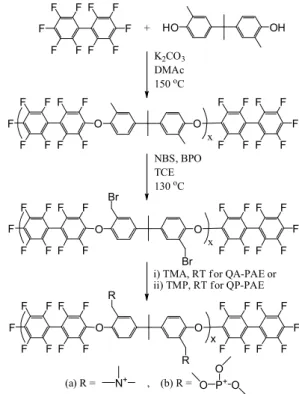
Scheme 1. Synthesis of (a) QA-PAE and (b) QP-PAE
기술로 주목받고 있다
1,2).
연료전지의 종류는 전해질의 차이로 분류된다. 그 중 수소이온 교환 막 연료전지(PEMFC)는 낮은 작동 온도에서 빠른 시동, 고체 전해질 막과 촉매의 사용 으로 인한 안정성 및 소형의 구조에서 장점을 갖고 있다
3-8). 고체 고분자막 기반 셀 시스템은 막 전극 접 합체(MEA), 가스 확산층, 유로판 등으로 구성되어 있다. MEA는 촉매와 이오노머 또는 바인더의 혼합 물로 구성된 촉매가 섞여 있는 이온 전도 막으로 구
성된다
9,10). 전기 화학 반응이 일어나는 전기 화학 장
치 시스템의 핵심으로서 막 전극 접합체의 최적화는 높은 전지의 성능을 얻기 위하여 필요하다.
다양한 연료전지 중 알칼라인 연료전지 (AFC)의 간단한 작동 메커니즘은 공기극의 산소는 공기극에 서 환원되어 수산화 이온을 생성한다. 수산화 이온은 전해질을 통하여 양극으로 전달되고 수소가 물로 산 화되어 배출된다. Fig. 1은 AFC의 모식도이다.
AFC는 알칼라인 환경에서 동작하기 때문에 산소 환원 속도와 연료 산화 속도가 빨라 값싼 금속 촉매 를 사용할 수 있다
11). 또한 이온의 흐름이 연료가 흐 르는 방향과 반대이기 때문에 연료투과가 낮은 장점 을 가지고 있다
12,13).
AFC는 알칼리성 수산화물 중에 가장 전도성이 있 는 KOH의 액체 전해질을 사용하였다. 기존의 AFC 의 주요 문제점은 이산화탄소 (CO
2)와 이온의 반응에
의한 탄산염의 형성으로 인하여 전해질 및 전극에 영향을 준다는 것이다. 탄산염의 생성은 수산화 이온 의 수를 감소시켜 이온 전도도를 낮게 한다
14,15). 이 문제를 해결하기 위해서 , 고분자 전해질 막 연료전지 (PEMFC)에서 사용하고 있는 고분자 전해질 막을 도 입하였다
16-18).
현재 AEM에 결합하는 양이온 작용기에 대한 많 은 연구가 진행 중에 있다 . 그중 사차 암모늄기를 작 용기로 사용하는 AEM이 가장 많은 연구가 진행되 었다. 그러나 높은 pH와 높은 온도에서 불안정하다 고 보고되었다
19,20). 이러한 문제점을 보완하기 위하여 포스포늄을 도입하여 내열성을 강화할 필요가 있다 .
본 논문에서는 Scheme 1과 같이 poly(arylene ether)
(PAE)에 이온 전도도가 높을 것으로 예상되는 아민
을 포함한 음이온 교환 막 그리고 내열성이 강할 것
으로 예상되는 포스포늄을 도입한 음이온 교환 막들
을 각각 합성한 후 , 이들의 열적 안정성과 이온 전도
도 등의 특성을 비교 연구하고자 한다
21-24).
2. 실 험
2.1 시약
2,2-bis(4-hydroxy-3-methylphenyl)propane은 Tokyo chemical industry에서, decafluorobiphenyl과 trimethylamine (TMA)은 Alfa Aesar에서, N-bromo- succimide (NBS), N,N-dimethylacetamide (DMAc)와 trimethylphosphite (TMP)는 Sigma-Aldrich에서 구입 하였다. 또한 benzoyl peroxide (BPO)는 Fluka에서, tetrachloroethane (TCE)은 덕산약품에서 구입하였고 탄산칼륨(K
2CO
3)은 삼천화학에서 구입하였다.
2.2 고분자 PAE의 합성
1구 둥근바닥 플라스크에 2,2-bis(4-hydroxy-3- methylphenyl)prorane (5.0 g, 14.8 mmol), deca- fluorobiphenyl (6.46 g, 19.3 mmol), K
2CO
3(4.11 g, 29.7 mmol) 그리고 DMAc (70 mL)를 첨가하였다
25,26). 혼합물을 충분히 용해시키기 위하여 120℃에서 3시 간 동안 교반하였다. 이후 150℃까지 온도를 높이고 혼합물에 점성이 생길 때까지 24시간 동안 반응시켰 다 . 반응이 종료되면 혼합물의 온도를 서서히 상온까 지 냉각시킨 후 혼합 용매(메탄올/3차 증류수, 5:2, v/v)에 천천히 부어서 결정화시켰다. 여과를 통하여 분리한 후 70℃ 오븐에서 24시간 건조하였다(수율:
95%) (PAE: FT-IR [KBr, cm
-1] 2968, 2927, 2865, 1647, 1477, 1398, 1212, 1174, 1118, 1065, 976, 887, 741, 600, 438).
2.3 PAE의 브롬화 반응
PAE의 브롬화 반응은 라디칼 치환을 통하여 NBS 와 개시제인 BPO를 첨가하여 TCE 용매 하에서 진 행하였다. PAE (1.0 g, 1.75 mmol)와 TCE (20 mL) 를 넣고 1구 둥근 플라스크에 질소 조건으로 교반시 킨다. 완전히 녹은 후에, NBS (0.5 g, 2.81 mmol)와 BPO (0.43 g, 1.75 mmol)를 넣어 110℃에서 4시간
반응시켰다
27-29). 반응 후, 실온으로 천천히 냉각시킨 후에 메탄올을 이용하여 재결정한다 . 여과를 통하여 분리한 후 70℃ 오븐에서 12시간 건조하여 브롬화된 PAE (Br-PAE)를 만들었다(Br-PAE: FT-IR [KBr, cm
-1] 2974, 1714, 1604, 1481, 1402, 1282, 1211, 1162, 1089, 1061, 1002, 978, 822, 789, 723, 644, 582, 544).
2.4 Br-PAE의 막 제조 및 PAE의 4차화 반응
Br-PAE를 TCE (10 mL)에 녹여 점도 있는 용액을 만든다. 평평한 유리판에 붓고 80℃ 진공 오븐에서 12시간 동안 건조하였다. 건조된 막은 물로 닦아주고 4차화 물질로써 TMA와 TMP를 각각 사용하여 4차 화 반응을 각각 진행하였다. 33%의 TMA와 TMP 용 액에 막을 48시간 동안 실온에서 각각 담가둔다. 그 후, 각각의 막을 KOH 용액에 48시간 담가두어 OH
―형태로 바꿔준다 . 3차 증류수로 여러 번 세척 후에 물기가 있는 상태로 두 생성물, quaternary ammo- nium PAE (QA-PAE)와 quaternary phosphonium PAE (QP-PAE)를 보관하였다(QA-PAE: FT-IR [KBr, cm
-1] 2968, 1640, 1476, 1388, 1332, 1246, 1218, 1173, 1124, 1064, 976, 879, 818, 721, 671, 618, 447;
QP-PAE: FT-IR [KBr, cm
-1] 2970, 1648, 1606, 1477, 1401, 1250, 1214, 1177, 1146, 1111, 1092, 1061, 1001, 976, 894, 803, 722, 567, 525, 441).
2.5 측정 방법과 기기
Fourier transform infrared spectroscopy (FT-IR) 스 펙트럼은 KBr base의 pellet 형태로 Nicolet Impact 400 FT-IR spectrometer 기기를 사용하여 측정하였
다
30,31). 분자량 분석은 TOSOH Bioscience의 EcoSEC
Cel permeation chromatography (GPC)를 이용하여
고분자의 분자량 분포와 다분산 지수 (PDI)를 측정하
였다. 열 중량분석(TGA)은 TA instruments thermal
analysis system사의 Q50을 사용하여 질소 하에 측정
하였고 800℃까지 10℃/min 속도로 상승하면서 온
Table 1. Molecular weight distribution (Mn, Mw, and PDI) of poly(arylene ether)
Polymer Mn Mw PDI
Poly(arylene ether) 9,000 41,000 4.5 Fig. 2. FT-IR spectra of PAE, Br-PAE, QA-PAE, and QP-PAE
도에 따른 시료의 무게 감소를 측정하였다
32,33). 건조 된 막과 젖은 막의 무게를 비교하여 물을 함유하는 지표로 함수율을 측정하였다
34). 또한 함수율을 토대 로 이온교환능 (ion exchange capacity)을 통하여 1 M KOH 용액에 48시간 동안 담가 막의 Cl
-의 형태를 OH
-로 바꿔주었다. 3차 증류수에 24시간 동안 담가 두어 막에 붙어있는 KOH를 제거하였다. 오븐을 이 용해 하루 동안 충분하게 건조된 막을 0.01 M HCl 수용액에 20 mL에 담가 상온에서 48시간 동안 방치 한 후, 수용액내 존재하는 양성자를 적정하기 위하여 페놀프탈레인 용액을 지시약으로 사용하였다. 수용액 의 pH가 7-8이 될 때까지 0.01 M NaOH 수용액을 첨가 하여 IEC 값을 계산하였다. 이온전도도는 2.5×0.5 cm 크기의 전해질 막을 Bekk Tech conductivity test cell 을 사용하여 측정하였다 . 모든 고분자 전해질 막은 100% 가습 조건에서 30℃, 50℃, 70℃ 및 90℃로 온 도 조건을 변화시키면서 측정하였다 .
3. 결과 및 고찰
3.1 화학 구조 분석
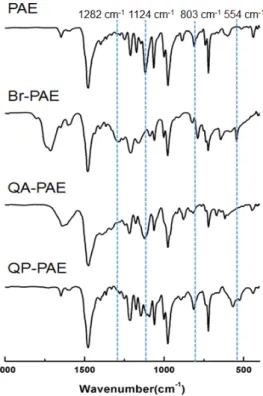
합성된 PAE, Br-PAE, QA-PAE와 QP-PAE의 화학 구조를 분석하기 위해서 고분자를 FT-IR 스펙트럼을 이용하여 확인하였다 (Fig. 2). 브롬화 반응을 통하여 1,282 cm
-1, 554 cm
-1에서 작용기 C-Br 두 피크를 확인 하였으며 , QA-PAE에서는 1,124 cm
-1에서 아민의 피 크인 C-N 결합의 진동수를 확인하였다. QP-PAE에 서는 803 cm
-1에서 포스파이트의 피크인 C-P 결합의 진동수를 확인하여 합성이 잘되었음을 확인하였다 .
3.2 분자량 측정합성한 고분자에 대한 수평균분자량 (M
n), 중량평 균분자량(M
w), 다분산지수(PDI) 등의 분자량과 관련 된 특성을 측정하고 이의 결과를 아래의 Table 1에 나타내었다. GPC를 이용해서 측정하였을 때, PAE의 수평균분자량은 9,000 g/mol이며, 중량평균분자량은 41,000 g/mol로 각각 나타났다. PDI의 값은 4.5였다.
3.3 용해도 테스트
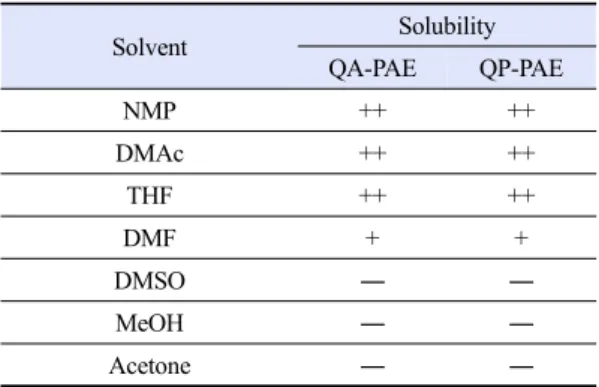
Table 2는 합성한 고분자의 용해도를 요약한 것이 다. 여러 유기 용매에서 용해도 시험을 시행하였다.
각 시험 조건은 용매 2 mL에 0.01 g씩 넣어 녹여보 았다. NMP, DMAc와 THF에는 매우 잘 녹았으며, DMF에는 녹이는데 조금 시간이 소모되었다. 아세톤 과 메탄올 및 DMSO에는 녹지 않는 특성을 보였다.
3.4 열적 안정성
각 고분자의 열적 특성은 TGA를 통하여 측정하였
Fig. 3. TGA curves of PAE membranes under nitrogen at- mosphere
Table 3. Water uptake and swelling ratio of membranes Sample Water uptake (%) STa)
(%) SLb)
30℃ 50℃ 70℃ 90℃ (%)
QA-PAE 10.5 15.8 23.3 24.6 6.8 7.6
QP-PAE 1.5 1.7 2.3 4.8 3.1 3.4
a)Thickness swelling ratio.
b)Length swelling ratio.
Table 4. Ion exchange capacity and ion conductivity of mem- branes
Sample IEC
(meq/g)
Ion conductivity (mS/cm)
30℃ 50℃ 70℃ 90℃
QA-PAE 0.25 3.1 6.1 13.6 20.2
QP-PAE 0.20 1.0 1.1 3.3 5.1
Table 2. Solubility of QA-PAE and QP-PAE
Solvent Solubility
QA-PAE QP-PAE
NMP ++ ++
DMAc ++ ++
THF ++ ++
DMF + +
DMSO ― ―
MeOH ― ―
Acetone ― ―
++, very soluble; +, soluble; ―, insoluble.
다(Fig. 3). QA-PAE의 처음 떨어지기 시작한 온도는 190℃로 작용기의 분해로 진행되고 450℃ 이후 주사 슬이 분해되었다. QP-PAE의 경우 250℃에서 작용기 가 분해되고 450℃에서 주사슬이 분해되기 시작하였 다. QP-PAE가 QA-PAE보다 주사슬에 붙은 작용기가 분해되는 온도가 높은 것을 확인하였다 .
3.5 함수율 및 팽창률
합성된 고분자의 물 함수율은 막의 고유특성으로 이온교환능과 큰 연관이 있다. 이외에도 치수 안정 성, 기계적 특성에도 영향을 준다. 함수율이 높으면 확산 속도가 높아지기 때문에 이온이 빠르게 이동하 여 이온교환능도 높아진다 . 그러나 지나치게 높은 함
수율은 막의 형태를 유지하는데 어려움을 겪기 때문 에 막의 기계적 강도가 중요하다 . 이러한 이유로 인 해 높은 함수율을 가지면서 물로 인한 팽창에 대한 저항성을 보이는 막의 개발이 중요하다 . 팽창률을 측 정하기 위하여 건조된 막과 24시간 동안 90℃의 물 에서 보관한 막을 꺼내 표면의 물을 제거 후에 두께 나 길이를 재어 비교하여 Table 3에 나타내었다. 4차 암모늄이 포스포늄보다 물과 쉽게 결합하기 때문에 QA-PAE가 QP-PAE에 비하여 함수율과 팽창률이 높 은 것을 확인할 수 있었다 .
3.6 전기화학적 테스트
이온교환능은 음이온 교환 막의 작용기가 수산화 이온을 교환하는 양을 적정을 통하여 알아내는 방법 이다 . 함수율이 높을수록 수산화 이온의 이동이 용이 하기 때문에 이온교환능이 증가하게 된다. Table 4에 서와 같이 QA-PAE와 QA-PAE의 이온교환능은 각 각 0.25 및 0.2 meq/g으로 QA-PAE가 더 이온교환이 용이함을 알 수 있다.
음이온전도도는 막의 수산화 이온 운반 능력과 수
산화 이온의 정도에 따라 결정되는 매우 중요한 요
소이다. 막의 주사슬은 소수성을 띄기 때문에 막의
친수성 부분을 맡은 곁사슬의 작용기가 물을 흡수하
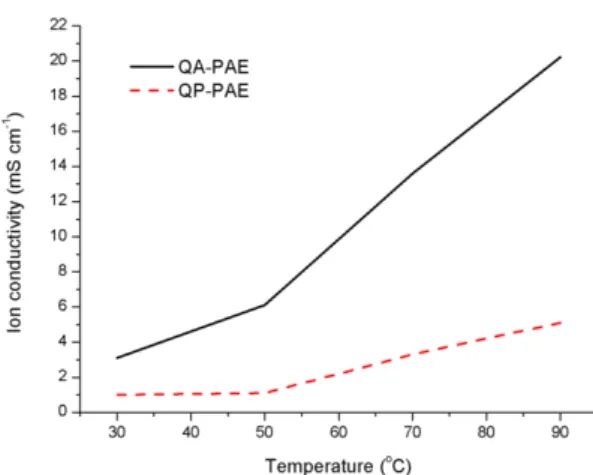
Fig. 4. Temperature dependence of ionic conductivity for anion exchange membranes
Table 5. Ionic conductivity values comparison with previously reported literatures
Sample Ionic conductivity
(mS/cm) Reference
QA-PAE 20.2a) This work
QP-PAE 5.1a) This work
C-QAPPESK/OH-5 17.5b) 35)
PSf-Im-76% 19.7a) 36)
a)Measured at 90℃under 100% RH.
b)Measured at 70℃ under 100% RH.
거나 이온 덩어리를 만드는 정도에 따라 전도도 값 이 정해진다. TMA와 TMP를 사용하였을 때의 막의 전도도 차이를 확인하고자 하였다 . 음이온전도도는 온도가 올라갈수록 오르게 된다. 그렇기 때문에 높은 온도에서의 안정성이 중요하게 요구된다. Table 4와 Fig. 4를 보면, QA-PAE는 90℃에서 20.2 mS/cm의 값을 나타내고 , QP-PAE는 90℃에서 5.1 mS/cm의 값을 보였다. 함수율과 이온교환능에서 나타난 것과 같이 QA-PAE가 물을 흡수하기 때문에 전도도가 더 높은 것을 확인하였다. 더 나아가 본 연구에서 합성 된 고분자막들의 이온 전도도와 기존에 이미 보고된 막들과 비교하여 Table 5에 나타내었다
35,36).
4. 결 론
본 연구에서는 알칼라인 연료전지용 고분자 전해 질말의 열적 안정성을 높이기 위하여 작용기로 인 을 도입하여 고분자 전해질 막을 개발하였다. 지금 까지 도입해보지 않은 TMP를 도입하여 기존에 많은 연구가 진행되는 TMA와 비교해 열적 안정성 및 전 기화학적 특성을 확인하였다. 함수율이 QA-PAE가 QP-PAE보다 높기 때문에 팽창률과 이온교환능 역 시 높은 값을 보였다. 수산화 이온 전도도는 QA-PAE 는 90℃에서 20.2 mS/cm의 값을 보이고, QP-PAE는 90℃에서 5.1 mS/cm의 성능을 보였다. 결론으로 우 리는 작용기가 다른 알칼라인 연료전지용 고분자 막을 합성하여 이들의 안정성과 전기화학적 특성을 연구한 결과, 열적 안정성은 QP-PAE가 좋은 반면, 이온 전도도는 QA-PAE가 더 우수한 경향을 갖음을 확인하였다.
후 기
본 연구는 산업통상지원부 (MOTIE)와 한국에너지 기술평가원(KETEP)의 지원을 받아 수행한 연구과제 이다(No. 20184030202210).
References
1. S. Bose, T. Kuila, T. X. H. Nguyen, N. H. Kim, K. T. Lau, and J. H. Lee, “Polymer membranes for high temperature pro- ton exchange membrane fuel cell: Recent advances and challenges”, Prog. Polym. Sci., Vol. 36, 2011, pp. 813-843.
2. B. Smitha, S. Sridhar, and A. A. Khan, “Solid polymer elec- trolyte membranes for fuel cell applications a review“, J.
Membr. Sci., Vol. 259, No. 1, 2005, pp. 10-26.
3. A. R. Kim, “Synthesis and characterization of di and tri- block copolymers containing a naphthalene unit for poly- mer electrolyte membranes”, Trans. of the Korean Hydrogen and New Energy Society, Vol. 27, No. 6, 2016, pp.
660-669.
4. J. Roziere and D. J. Jones, “Non-fluorinated polymer mate- rials for proton exchange membrane fuel cells”, Annu. Rev.
Mater. Res., Vol. 33, 2003, pp. 503-555.
5. A. R. Kim, “Preparation and characterization of block co-
polymer containing bisphenyl propane unit and nanosilica composite membrane for fuel cell electrolyte application”, Trans. of the Korean Hydrogen and New Energy Society, Vol. 28, No. 2, 2017, pp. 144-149.
6. K. H. Lee, J. Y. Chu, A. R. K. S. Nahm, and D. J. Yoo, “Highly sulfonated poly(arylene biphemylsulfone ketone) block co- polymers prepared via postsulfonation for proton conduct- ing electrolyte membranes”, Bull. Korean. Chem. Soc., Vol.
6, No. 34, 2013, pp. 1763-1770.
7. R. Kannan, A. R. Kim, and D. J. Yoo, “Enhanced electro- oxidation of methanol, ethylene glycol, glycerol, and xylitol over a polypyrrole/manganese oxyhydroxide/palladium nanocomposite electrode”, J. Appl. Electrochem., Vol. 44, No. 8, 2014, pp. 893-902.
8. R. Kannan, A. R. Kim, K. S. Nahm, H. K. Lee, and D. J. Yoo,
“Synchronized synthesis of Pd@C-RGO carbocatalyst for improved anode and cathode performance for direct ethyl- ene glycol fuel cell”, Chem. Commun., Vol. 50, No. 93, pp.
14623-14626.
9. J. Liu and L. Jiang, “Electrostatic self-assembly of Pt nano- particles on hexagonal tungsten oxide as an active CO-tol- erant hydrogen oxidation electrocatalyst”, Int. J. Hydrogen Energy, Vol. 43, No. 18, 2018, pp. 8944-8952.
10. R. Shimizu, J. Tsuji, N. Sato, J. Takano, S. Itami, M.
Kusakabe, K. Miyatake, A. Iiyama, and M. Uchida,
“Durability and degradation analysis of hydrocarbon ion- omer membranes in polymer electrolyte fuel cells accel- erated stress evaluation”, J. Power Sources, Vol. 267, No.
1-2, 2017, pp. 243-251.
11. Y. J. Wang, J. Qiao, R. Baker, and J. Zhang, “Alkaline poly- mer electrolyte membranes for fuel cell application”, Vol.
42, No. 13, 2013, pp. 5768-5787.
12. B. Lin, L. Qiu, J. Lu, and F. Yan, “Cross-linked alkaline ionic liquid-based polymer electrolytes for alkaline fuel cell ap- plications”, Chem. Mater., Vol. 22, No. 24, 2010, pp.
6718-6725.
13. S. Lu, J. Pan, A. Huang, L. Zhuang, and J. Lu, “Alkaline poly- mer electrolyte fuel cells completely free from noble metal catalysts”, Proc. Natl. Acad. Sci. U. S. A., Vol. 105, No. 52, 2008, pp. 20611-20614.
14. E. Gulzow and M. Schulze, “Long-term operation of AFC electrodes with CO2 containing gases”, J. Power Sources, Vol. 127, No. 1-2, 2004, pp. 243-251.
15. G. F. McLean, T. Niet, S. Prince-Richard, and N. Djilali, “An assessment of alkaline fuel cell technology”, Int. J.
Hydrogen Energy, Vol. 27, No. 5, 2002, pp. 507-526.
16. M. A. Hickner, H. Ghassem, Y. S. Kim, B. R. Einsla, and J. E.
McGrath, “Alternative Polymer systems for Proton Exchange Membranes”, Chem. Rev., Vol. 104, No. 10, 2004, pp. 4587-4612.
17. H. Bai and W. S. W. Ho, “New sulfonated polybenzimidazole (SPBI) copolymer-based proton-exchange membranes for fuel cells”, J. Taiwan Inst. Chem. Eng., Vol. 40, 2009, pp.
260-267.
18. Z. Si, Z. Sun, F. Gu, L. Qiu, and F. Yan, “Alkaline stable imi- dazolium-based ionomers containing poly(arylene ether sulfone) side chains for alkaline anion exchange mem- branes”, J. Mater. Chem. A Mater., Vol. 2, No. 12, 2014, pp.
4413-4421.
19. A. D. Mohanty, S. E. Tignor, J. A. Krause, Y. K. Choe, and C.
S. Bae, “Systematic alkaline stability study of polymer back- bones for anion exchange membrane applications”, Macromolecules, Vol. 49, No. 9, 2016, pp. 3361-3372.
20. C. M. Tuan and D. Kim, “Anion-exchange membranes based on poly(arylene ether ketone) with pendant quater- nary ammonium groups for alkaline fuel cell application”, J. Membr. Sci., Vol. 511, 2016, pp. 143-150.
21. Y. Zhang, C. Li, Z. Yang, X. Liu, J. Dong, Y. Liu, W. Cai, and H. Cheng, “A robust pendant type crosslinked anion ex- change membrane (AEM) with high hydroxide con- ductivity at a moderate IEC value”, J. Mater, Sci., Vol. 52, No. 7, 2017, pp. 3846-3958.
22. L. Jiang, X. Lin, J. Ran, C. Li, L. Wu, and T. Xu, “Synthesis and properties of quaternary phosphonium-based anion exchange membrane for fuel cells”, Chin. J. Chem., Vol. 6, No. 9, 2012, pp. 2241-2246.
23. P. Papakonstantinou and V. Deimede, “Self crosslinked quaternary phosphonium based anion exchange mem- branes: Assessing the influence of quaternary phospho- nium groups on alkaline stability”, RSC Advances, Vol. 6, No. 115, 2016, pp. 114329-114343.
24. H. R. Jang, E. S. Yoo, R. Kannan, J. S. Kim, K. Lee, and D. J.
Yoo, “Facile tailor-made enhancement in proton con- ductivity of sulfonated poly(ether ether ketone) by gra- phene oxide nanosheet for polymer electrolyte membrane fuel cell applications”, Colloid. Polym. Sci., Vol. 6, No. 295, 2017, pp. 1059-1069.
25. B. Kim, R. Kannan, K. S. Nahm, and D. J. Yoo, “Development and characterization of highly conducting nonfluorinated di and triblock copolymers for polymer electrlyte mem- branes”, J. Dispers. Sci. Technol., Vol. 9, No. 295, 2016, pp.
1315-1323.
26. C. X. Lim, Y. Z. Zuo, A. N. Lai, Q. G. Zhang, A. M. Zhu, M.
L. Yem, and Q. L. Liu, “Side-chain-type anion exchange membranes bearing pendent imidazolium-functionalized poly(phenylene oxide) for fuel cells”, J. Membr. Sci., Vol.
513, 2016, pp. 206-216.
27. C. H. Zhao, Y. Gong, Q. L. Liu, Q. G. Zhang, and A. M. Zhu,
“Self-crosslinked anion exchange membranes by bromina- tion of benzylmethyl containing poly(sulfone)s for direct
methanol fuel cell”, Int. J. Hydrogen Energy, Vol. 37, No. 15, 2012, pp. 11383-11393.
28. G. Shukla and V. K. Shahi, “The improved ion clustering and conductivity of a diquaternaized poly(arylene ether ke- tone sulfone) based alkaline fuel cell membrane”, Sustainable Energy Fuels, Vol. 1, No. 4, 2017, pp. 932-940.
29. M. Vinothkannan, A. R. Kim, K. S. Nahm, and D. J. Yoo,
“Ternary hybrid (SPEEK/SPVdF-HDP/GO) based mem- brane electrolyte for the applications of fuel cells: profile of improved mechanical strength, thermal stability and pro- ton conductivity”, RSC Advances, Vol. 6, No. 110, 2016, pp.
108851-108863.
30. H. Liu, P. Bandyopadhyay, T. Kshetri, N. H. Kim, B. C. Ku, B. Moon, and J. H. Lee, “Layer-by-layer assembled poly- electrolyte-decorated graphene multilayer film for hydro- gen gas bariier application”, Composites Part B, Vol. 114, 2017, pp. 339-347.
31. J. Y. Chu, A. R. Kim, K. S. Nahm, H. K. Lee, and D. J. Yoo,
“Synthesis and characterization of partially fluorinated sul- fonated poly(arylene biphenyl sulfone ketone) block co- polymers containing 6F-BPA and perfluorobiphenylene units”, Int. J. Hydrogen Energ., Vol. 38, No. 14, 2013, pp.
6268-6274.
32. A. R. Kim, C. J. Park, M. Vinothkannan, and D. J. Yoo,
“Sulfonated poly ether sulfone/heteropoly acid composite membrane as electrolytes for the improved power gen- eration of proton exchange membrane fuel cells”, Composites Part B, Vol. 155, 2018, pp. 272-281.
33. S. Maurya, S. H. Shin. M. K. Kim, S. H. Yun, and S. H, Moon, “Stability of composite anion exchange membranes with various functional groups and their performance for energy conversion”, J. Membr. Sci., Vol. 443, 2013, pp.
28-35.
34. N. H. Kim, A. K. Mishra, D. Y. Kim, and J. H. Lee, “Synthesis of sulfonated poly(ether ether ketone)/layered double hy- droxide nanocomposite membranes for fuel cell applica- tions”, Chem. Eng. J., Vol. 272, 2015, pp. 119-127.
35. W. Lu, Z. Shao, G. Zhang, J. Li, Y. Zhao, and B. Yi,
“Proparation of anion exchange membranes by an efficient chloromethylation method and homogeneous quaterniza- tion/crosslinking strategy”, Solid State Ion., Vol. 245, 2013, pp. 8-18.
36. J. Li, X. Yan, Y. Zhang, B. Zhao, and G. He, “Enhanced hy- droxide conductivity of imidazolium functionalized poly- sulfone anion exchange membrane by doping imidazolium surface-functionalized nanocomposites”, RSC Adv., Vol. 6, 2016, pp. 58380-58386.