비천공 Breathable필름이 몇 가지 저장온도에서 ‘후지’ 사과의 MA 저장성에 미치는 영향
최인이1,2·홍성미1·정민재1·백준필2·강호민1,2*
1강원대학교 원예학과, 2강원대학교 농업과학연구원
Effect of Non-Perforated Breathable Films on the Storability of ‘Fuji’ Apples in Modified Atmosphere Condition in the Different Storage Temperature
Choi In-Lee1,2, Sung Mi Hong1, Min Jae Jeong1, Jun Pill Baek2, and Ho-Min Kang1,2*
1Dept. of Horticulture, Kangwon Nat’l. Univ., Chuncheon 200-701, Korea
2Agricultural and Life Science Research Institute, Kangwon Nat’l. Univ., Chuncheon 200-701, Korea
Abstract. These studies were conducted to identify the effects of non-perforated breathable package film on storabil- ity at 1oC, 8oC, and 20oC storage of ‘Fuji’ apples. The fresh weight loss rate was less than 2.0% in all non-perforated breathable films at three different storage periods and temperatures, 1oC; 210 days, 8oC; 75 days, and 20oC; 30 days except for the perforated film. 1,300 cc (1oC), 5,000 cc (8oC), and 10,000 cc (20oC) films were closed at the opti- mum MA storage condition by carbon dioxide and oxygen concentration. Ethylene concentration was lowest at the 40,000 cc film in every temperatures during storage. The 1,300 cc film established higher result in soluble solid and vitamin C content than any other films at 1oC, also showed higher in visual quality by panel test. The 5,000 cc film had the best results on soluble solid and off-flavor in 8oC. In the 20oC storage after 30 days of treatment the 10,000 cc film had highest firmness and visual quality. Following these results, it come to conclusion the suitable type of non-perforated breathable film such as 1,300 cc at 1oC, 5,000 cc at 8oC, and 10,000 cc at 20oC for MA stor- age in ‘Fuji’ apples.
Additional key words : carbon dioxide, ethylene, soluble solid, visual quality, vitamin C
서 론
사과는 우리나라 과수 재배 농가에서 감(Diospyros kaki THUNB)과 함께 가장 많이 재배되고 있는 과실이 다(KATI, 2013). 가을철 집중적으로 수확되는 사과를 대 상으로 저장에 의한 품질저하는 최소화하며 장기간 저장 및 유통 가능한 기술이 필요하다(Park 등, 2011). 현재 국내에서 생산된 사과는 주로 저온에서 저장되나, 장기 저장을 위해 CA 저장(Controlled atmosphere)을 이용하 기도 한다(Yoo 등, 2013). 사과의 저장성 향상에 관한 다양한 연구가 진행되어 왔는데, CA 저장 중 내부갈변 현상에 대한 연구(Park, 1996), CA 저장 전 에틸렌 가 스 생합성 억제제인 1-MCP와 aminoethoxyvinylglycine 그리고 열처리가 저장 기간 동안 과실 품질에 미치는 영향에 대한 연구(Kweon 등, 2012; Park 등, 2011) 등
이 있었다.
비용이 많이 드는 CA 저장을 대체할 수 있는 MA (Modified atmosphere) 저장에 대한 연구도 사과를 대상 으로 일부 진행된 바 있는데, Park 등(2007)은 에틸렌 흡착능력이 있다고 알려진 zeolite을 첨가한 두께 25, 35, 그리고 45µm 필름으로 포장하여 0oC에서 저장하였 을 때 25µm 필름이 선도 유지에 효과가 있다고 보고하 였다. 또한 Yoon 등(2001)은 ‘후지’ 사과를 1 ± 0.5oC에 서 30, 50, 그리고 100µm로 필름 두께가 서로 다른 폴 리에틸렌필름으로 포장하여 저장 하였을 때 100µm 필 름이 저장 후 180일까지 당도를 유지하며 장기저장에 적합하다고 하였다. 이와 같이 기존의 MAP 실험은 포 장재 종류나 두께에 의한 공기 투과율에 의존한 연구였 으나, 최근 산소투과도를 임의로 조절할 수 있는
breathable 필름이 개발되어 여러 원예작물을 대상으로
연구되고 있다(Baek 등, 2013; Islam 등, 2011). 이에 본 연구는 ‘후지’ 사과의 MA 저장성 향상을 위해 몇 가지 저장 온도별 적합한 비천공 breathable 필름 종류를 구 명하고자 실시하였다.
*Corresponding author: [email protected]
*Received February 28, 2014; Revised March 12, 2014;
*Accepted March 16, 2014
재료 및 방법
본 실험에서는 강원도 양구에서 재배한 ‘후지’ 사과를 이용하였으며, 포장재로는 PP(Polypropylene)필름을 레이 저로 가공하여 산소투과도를 각각 1,300cc, 5,000cc, 10,000cc, 20,000cc, 그리고 40,000cc · m−2· day · atm으로 조절한 비천공 breathable 필름과(대륭포장산업(주)), 대 조구로 천공필름(직경 8mm hole 8개/20cm2)을 사용하였 다. 포장한 사과는 1oC에서 210일, 8oC에서 75일 그리 고 상온(20oC)에서 30일간 저장하였다.
저장온도별 최적의 필름 종류를 알아보기 위해 저장 중 생체중 감소율과 포장내 이산화탄소, 산소 및 에틸렌 농도 변화를 조사하였는데, 이산화탄소 및 산소 농도는 infrared sensor(Checkmate, PBI, Denmark), 에틸렌 농도는 gas chromatography(GC-2010, Shimadzu, Japan)를 사용 하여 측정하였다(Park 등, 2000). 저장 최종일에 pocket refractometer(PAL-1, Atago, Japan)를 사용하여 당도를 측정하였고, penetrometer (DFT-01, TR, Italy)로 경도를 조사하였다. 비타민 C는 분석용 컬럼 ZORBAX Eclipse XDB-C18(4.6cm × 250mm, 5µm, Agilent, USA), 검출기 는 Tunable Absorbance detector(Waters486, Waters, USA)를 장착한 HPLC로 측정하였다(Kim 등, 2011). 외 관상 품질과 이취는 저장 최종일에 5명의 숙련된 패널 에 의한 관능평가로 조사하였는데 1부터 5까지 등급으 로 평가하였다. 외관상 품질의 등급은 저장전 가장 좋은 상태를 5점, 상품성이 유지된 상태를 3점, 그리고 완전 폐기 상태를 1점으로 하였다. 이취의 평가 등급은 이취 를 느끼지 못하는 수준을 0점, 이취가 매우 강한 수준을 5점으로 하였다. 모든 실험은 7반복으로 진행하였으며 통계분석은 Microsoft Excel 2007 program을 이용하여 표준편차와 SPSS 21.0 버전을 이용하여 95% 신뢰수준 에서 Duncan의 다중 검정으로 실시하였다.
결과 및 고찰
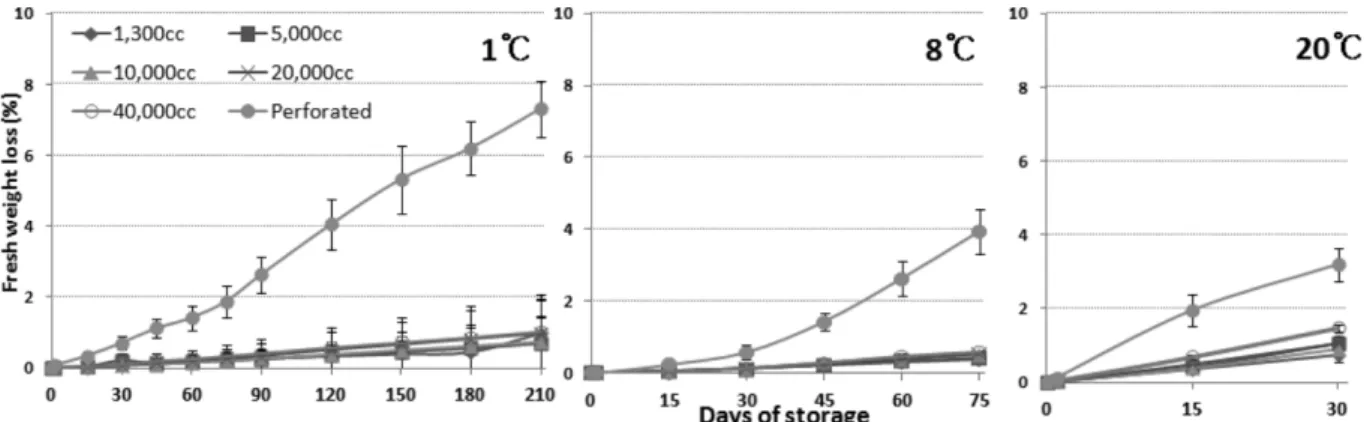
산소투과도가 각각 1,300cc, 5,000cc, 10,000cc, 20,000cc, 그리고 40,000cc · m−2· day · atm인 비천공 breathable 필 름으로 포장하여 1oC, 8oC, 그리고 20oC에서 저장한 사 과의 생체중 감소율은 저장 최종일에 2.0% 이하였고, 필름 처리간 차이에 통계적 유의성은 없었다. 그러나 천 공필름으로 포장한 사과의 생체중은 20oC 저장 최종일 인 저장 30일째 3.2% 감소하였으며, 같은 기간까지 저 온저장 1oC와 8oC에서는 각각 1.0%와 2.0%까지 감소하 였다. 또한 1oC에서 비천공 필름 처리구의 생체중 감소 는 저장 최종일(저장 210일)에 사과의 최대 수분 손실 허용 범위인 7.5% 수준(Kays와 Paull, 2004)까지 감소하 였다(Fig. 1).
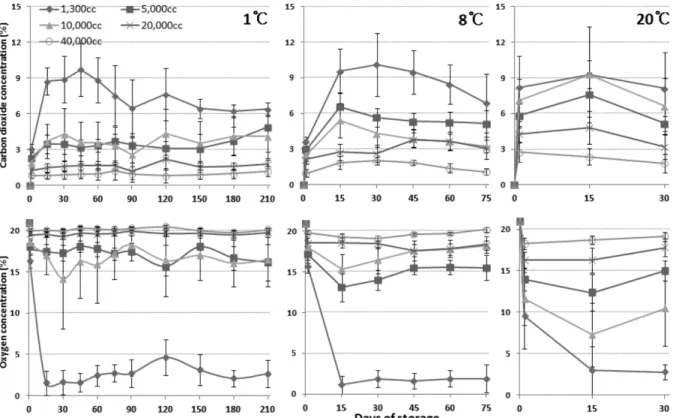
천공필름을 제외한 breathable 필름처리구의 포장내 이 산화탄소와 산소의 농도는 필름의 투과도가 증가할수록 이산화탄소는 감소하고, 산소는 증가하는 경향을 보였다 (Fig. 2). 포장내 이산화탄소 농도는 세가지 저장 온도 모두에서 산소투과도가 가장 높은 40,000cc 필름 처리구 가 1.0%~2.3%로 가장 낮게 유지되었고, 산소투과도가 가장 낮은 1,300cc 필름처리구에서 9.0~10.0%로 가장 높았다. 1,300cc 필름내 산소 농도는 모든 저장온도에서 가장 낮았는데, 이는 포장내 산소가 저장기간 중 호흡으 로 인해 소모되면서 이산화탄소로 전환되었기 때문이다 (Kader, 1986). Kader (2002)는 사과의 CA 저장시 최적 조건은 1~2%의 산소, 0~3%의 이산화탄소 농도이며, 대 부분의 사과 품종은 최소 산소 허용범위 2.0%, 최대 이 산화탄소 허용범위는 5.0%라고 보고하였다. 1oC에 저장 한 1,300cc 필름 처리구의 경우 저장중 이산화탄소와 산 소농도가 일시적으로 최대·최저허용범위를 벗어나기도 하였으나, 평균적으로 2.5%의 산소농도와 7.0%의 이산 화탄소 농도를 보이며 저장 120일 이후 최적 CA 조건에
Fig. 1. Changes of fresh weight loss of ‘Fuji’ apples packaged with several breathable films and perforated film stored at 1oC, 8oC, and 20oC. Vertical bars represent ± SD (n = 7).
근접하였고, 8oC와 20oC에서의 1,300cc 필름 처리구는 이산화탄소농도가 평균 8.0% 이상을 나타내어 CA 조건 에 부적합하다고 판단되었다. 포장내 대기조성으로 볼 때 8oC에서 이산화탄소 5.1%, 산소 14.7%를 보인 5,000cc, 그리고 20oC에선 이산화탄소 6.1%, 산소 13.7%를 보인 10,000cc가 최적 CA 조건에 가장 근접하였다.
비천공 breathable 필름 포장내 에틸렌 농도는 1oC와 8oC 저장에서 20µL/L 수준이었고, 20oC에서는 대체로 1oC와 8oC보다 높은 농도를 나타냈으나, 1,300cc 필름은
저장 30일에 60µL/L 이상으로 증가하였다(Fig. 3). 에틸 렌 농도는 모든 저장온도에서 산소투과도가 가장 높았던 40,000cc 필름이 저장 최종일까지 제일 낮게 유지되었다.
에틸렌은 과실의 숙성과 노화에 지대한 영향을 미치는데, 사과의 경우 매우 높은 에틸렌 생산량과 고민감도 작물 에 해당하기 때문에 MA 저장을 위한 소포장시 에틸렌 농도에 주의해야 한다(Brody 등, 2011).
외관 품질, 이취 그리고 경도, 당도, 비타민 C 등의 품 질 변화는 저장 최종일에 조사하였는데(Table 1), 외관 품 Fig. 2. Changes of carbon dioxide and oxygen concentration of ‘Fuji’ apples packaged with several breathable films and perforated film
stored at 1oC, 8oC, and 20oC. Vertical bars represent ± SD (n = 7).
Fig. 3. Changes of ethylene concentration of ‘Fuji’ apples packaged with several breathable films and perforated film stored at 1oC, 8oC, and 20oC. Vertical bars represent ± SD (n = 7).
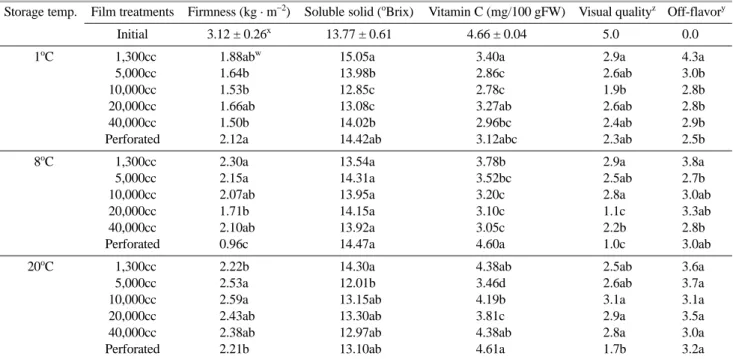
질은 1oC와 8oC에서 1,300cc 필름, 20oC에서는 10,000cc 필름이 가장 높게 유지되었다. 이취 발생은 1oC와 8oC 에서 1,300cc 필름이 많았으나, 20oC에서는 필름간 유의 적인 차이가 없었다.
경도는 1oC는 천공필름이, 8oC는 1,300cc 필름이, 그 리고 20oC에서는 10,000cc 필름이 가장 높게 유지되었 다. 농산물 경도는 수분손실로 인한 팽압 감소, 에틸렌 에 의한 세포벽 분해효소의 활성 등으로 저장 중 감소 하는데(Kays과 Paull, 2004), 본 실험에서는 생체중 감소 가 포장내 에틸렌 농도가 경도 변화와 일정한 경향 없 이 모든 처리구에서 저장전에 비해 27% 이상 감소하였 다. 당도는 1oC에서 1,300cc 필름이 15.1oBrix, 20oC에서 1,300cc 필름이 14.3oBrix로 가장 높았으며 8oC의 경우 유의적인 차이는 없었으나 5,000cc 필름이 14.3oBrix로 높은 경향을 보였다. 이들 필름은 저장전에 비해 4% 이 상 증가한 수치에 해당한다. 본 실험에서 저장 최종일까 지 모든 처리구의 당도는 12.0~15.0oBrix를 나타내어 소 비자의 기호도(12oBrix)에 부합하였다(NAPQMS, 1996).
비타민 C 함량은 다른 저장온도에 비해 저장기간이 월등히 길었던 1oC 저장(210일)에서 가장 많이 감소하였 으며, 저장기간이 가장 짧았던 20oC(30일)에서 가장 높 게 유지되었다. 원예작물의 비타민 C는 저장기간이 길어
질수록 저장 온도가 높을수록 많이 감소한다고 보고되었 는데(Kang과 Kim, 2007), 본 연구결과로 볼 때, 저장 중 비타민 C 감소는 저장온도보다 저장기간에 더 많은 영향을 받는 것으로 판단된다. 각 필름 처리별 비타민 C 함량은 1oC에서는 외관상 품질과 내부 품질이 우수하 였던 1,300cc 필름에서 가장 높았으나, 8oC와 20oC에서 는 천공필름이 가장 높게 유지되었고, breathable 필름 중에서는 1,300cc 필름에서 가장 높았다. 이와 같이 모 든 저장온도에서 1,300cc 필름의 비타민 C 함량이 높게 유지되었던 것은 포장내 낮은 산소 농도의 효과로 보여 진다. 저장 중 딸기와 블랙베리의 비타민 C도 1~3%의 낮은 O2 조건에서 높게 유지되었다고 한다(Agar 등, 1995).
저장 중 수분감소로 인한 내부 물질의 농축효과(Choi 등, 2013)가 저장중 가장 큰 생체중 감소를 보인 천공필 름에서 나타나, 저장 최종일에 8oC의 당도와 비타민 C 함량 그리고 20oC의 비타민 C 함량이 가장 높았으며 1oC에서도 당도와 비타민 C함량은 두 번째로 높았다.
이상의 결과로 볼 때, ‘후지’ 사과의 MA 저장시 포장 내 대기조성과 저장 최종일의 과실의 품질 등을 고려하 면 1oC는 1,300cc 필름, 8oC는 5,000cc 필름, 그리고 20oC에서는 10,000cc 필름이 적합하다고 판단된다.
Table 1. The firmness, soluble solid concentration, vitamin c, visual quality, and off-flavor, of ‘Fuji’ apples packaged 6 different films and stored at 1oC for 210 days, 8oC for 75 days, and 20oC for 30 days.
Storage temp. Film treatments Firmness (kg · m−2) Soluble solid (oBrix) Vitamin C (mg/100 gFW) Visual qualityz Off-flavory
Initial 3.12 ± 0.26x 13.77 ± 0.61 4.66 ± 0.04 5.0ab 0.0ab
01oC 01,300cc 1.88abw 15.05a 3.40a 2.9a 4.3a
05,000cc 1.64b 13.98b 2.86c 2.6ab 3.0b
10,000cc 1.53b 12.85c 2.78c 1.9b 2.8b
20,000cc 1.66ab 13.08c 3.27ab 2.6ab 2.8b
40,000cc 1.50b 14.02b 2.96bc 2.4ab 2.9b
Perforated 2.12a 14.42ab 3.12abc 2.3ab 2.5b
08oC 01,300cc 2.30a 13.54a 3.78b 2.9a 3.8a
05,000cc 2.15a 14.31a 3.52bc 2.5ab 2.7b
10,000cc 2.07ab 13.95a 3.20c 2.8a 3.0ab
20,000cc 1.71b 14.15a 3.10c 1.1c 3.3ab
40,000cc 2.10ab 13.92a 3.05c 2.2b 2.8b
Perforated 0.96c 14.47a 4.60a 1.0c 3.0ab
20oC 01,300cc 2.22b 14.30a 4.38ab 2.5ab 3.6a
05,000cc 2.53a 12.01b 3.46d 2.6ab 3.7a
10,000cc 2.59a 13.15ab 4.19b 3.1a 3.1a
20,000cc 2.43ab 13.30ab 3.81c 2.9a 3.5a
40,000cc 2.38ab 12.97ab 4.38ab 2.8a 3.0a
Perforated 2.21b 13.10ab 4.61a 1.7b 3.2a
zVisual quality was measured that 5 was fresh condition, 4 was good, 3 was moderate, 2 was bad, 1 was most severe; unmarketable.
yOff-flavor was measured that 5 was most severe; unmarketable, 4 was severe, 3 was moderate, 2 was traceable, 1 was little, 0 was fresh condition.
xMeans ± Standard Deviation (n = 7).
wMeans separation within columns by Duncan’s multiple range test, P = 0.05.
적 요
‘후지’ 사과의 MA 저장성 향상을 위해 저장 온도별로 적합한 비천공 breathable 필름 종류를 구명하고자 본 연구를 수행하였다. 저장중 생체중 감소율은 모든 저장 온도의 비천공 breathable 필름 처리구에서 저장 최종일 까지 약 2.0% 이하를 나타냈다. 포장내 대기조성으로 볼 때 1oC에서 1,300cc 필름, 8oC에서 5,000cc 필름, 그 리고 20oC에서 10,000cc 필름이 최적 MA 조건에 가장 근접하였다. 저장 중 포장내 에틸렌 농도는 모든 저장온 도에서 산소 투과도가 가장 높았던 40,000cc 필름 처리 구가 낮게 유지되었다. 저장 최종일의 1oC 1,300cc 필름 이 당도, 비타민 C 함량, 그리고 외관 품질이 우수하였 고, 8oC 5,000cc 필름이 당도와 이취 정도가 양호하였으 며, 그리고 20oC 10,000cc 필름이 경도와 외관상 품질이 높은 수치를 나타내었다. 이상의 결과로 포장내 대기조성 과 과실의 내외적 품질을 비교한 결과 ‘후지’ 사과의 MA 저장시 1oC는 1,300cc 필름, 8oC는 5,000cc 필름, 그 리고 20oC에서는 10,000cc 필름이 적합하다고 판단된다.
추가 주제어 : 당도, 비타민 C, 에틸렌, 외관 품질, 이산 화탄소
사 사
2013년 농림수산식품기술기획평가원의 생명산업기술개 발사업과제(111080-03)로 수행되었음.
Literature Cited
Agar, I.T., F. Bangerth, and J. Streif. 1995. Effect of high CO2
and controlled atmosphere concentrations on the ascorbic acid, dehydroascorbic acid and total vitamin C content of berry fruits. Acta Hort. (ISHS) 398:93-100.
Baek, J.P., H.J. Lee, I.L. Choi, H.J. Jung, J.S. Son, I.S. Kim, C.S. Jeong, and H.M. Kang. 2013. Effect of temperature and gas permeability of functional packing films on storability of fresh-cut Salicornia herbacea classified by size. Protected Horticulture and Plant Factory 22(2):175-181 (in Korean).
Brody, A.L., H. Zhuang, and J.H. Han. 2011. Modified atmo- sphere packaging for fresh-cut fruits and vegetables. Black- well Publishing Ltd. Oxford, UK. p. 144.
Choi, I.L., J.P. Baek, and H.M. Kang. 2013. Identification of suit- able film type and temperature for green and gold kiwifruit MA condition using non-perforated film. Journal of Agricultural, Life and Environmental Sciences 25(2):65-70 (in Korean).
Islam, M.Z., Y.S. Kim, and H.M. Kang. 2011. Effect of breathable film for modified atmosphere packaging mate-
rial on the quality and storability of tomato in long distance export condition. Journal of Bio-Environment Control.
20(3):221-226.
Kader, A.A. 1986. Biochemical and physiological basis for effects of controlled and modified atmospheres on fruits and vegetables. Food Technol. 40:99-104.
Kader, A.A. 2002. Postharvest technology of horticultural crops. 3rd Ed. University of California, Division of Agricul- ture and Natural Resources. USA. p. 138.
Kang, H.M. and I.S. Kim. 2007. Effect of vitamin c treatments on the storability of baby vegetables in MA storage. Journal of Bio-Environment Control. 16(4):420-425 (in Korean).
Kays, S.J. and E.R. Paull. 2004. Postharvest Biology. Exon Press, Athens, GA, USA. p. 327,376,453.
Kim, H.S., J.Y. Jung, H.K. Kim, K.M. Ku, J.K. Suh, Y. Park, and Y.H. Kang. 2011. Influences of meteorological condi- tions of harvest time on water-soluble vitamin contents and quality attributes of oriental melon. Journal of Bio-Environ- ment Control. 20(4):290-296 (in Korean).
Korea Agricultural Trade Information (KATI). 2013. The state of paprika industry in Korea. Korea Agro-Fisheries Trade Corporation, Seoul, Korea.
Kweon, H.J., M.J. Kim, J.W. Lee, C. Choi, T.M. Yoon, and I.K. Kang. 2012. Effects of aminoethoxyvinylglycine appli- cation and heat treatment on fruit quality of ‘Fuji’ apples during CA storage. Kor. J. Hort. Sci. Technol. 30(5):527- 533 (in Korean).
National Agricultural Products Quality Management Service (NAPQMS). 1996. Grade standards for agricultural prod- ucts. 1011. MAF, Korea.
Park, H.W., H.S. Cha, Y.H. Kim, S.A. Lee, and J.Y. Yoon.
2007. Change in the quality of ‘Fuji’ apples by using func- tional MA (modified atmosphere) film. Kor. J. Hort. Sci.
Technol. 25(1):37-41 (in Korean).
Park, K.W., H.M. Kang, and C.H. Kim. 2000. Comparison of storability on film sources and storage temperature for fresh Japanese mint in MA storage. J. Bio-Environ. Cont. 9:40-46 (in Korean).
Park, Y.M. 1996. Internal breakdown disorder of ‘Fuji’ apples during CA storage. Kor. J. Hort. Sci. Technol. 14(Suppl. I), p. 7-8.
Park, Y.M., H.G. Park, and B.S. Lim. 2011. Analysis of post- harvest 1-MCP treatment and CA storage effects on quality changes of ‘Fuji’ Apples during export simulation. Kor. J.
Hort. Sci. Technol. 29(3):224-231 (in Korean).
Yoo, J.G., D.H. Kim, J.W. Lee, D.G. Choi, J.S. Han, S.I. Kwon, H.J. Kweon, and I.K. Kang. 2013. Effect of preharvest spray- able 1-Methylcyclopropene (1-MCP) treatment on fruit qual- ity attributes in cold stored ‘Gamhong’ apples. Protected Horticulture and Plant Factory 22(3):279-283 (in Korean).
Yoon, C.K., S.K. Kim, Y.H. Kim, S.C. Lim, and T. Yoon.
2001. Effects of P.E film thickness on storage of ‘Fuji’ apple fruits. Kor. J. Hort. Sci. Technol. 19(Suppl. II), p. 71.