http://dx.doi.org/10.7840/kics.2015.40.2.408
Knowledge Driven Architectural Model to Support Smart Emergency Service in Web of Objects Based Iot Environment
Sheik Mohammad Mostakim Fattah
, Muhammad Golam Kibria
*, Kwanghyeon Jeong
*, Ilyoung Chong
°
Abstract
Virtualizing The Physical Devices And Resources As Well As Conceptual Entities Would Form Vos And Cvos, Which Provides Dynamicity And Intelligence Through Composition And Collaboration For Emergency Services In WoO Based Smart Shopping Mall (WSSM). Semantic Ontology In WoO Platform Supports Dynamic Composition And Collaboration Among Objects, VOs And CVOs To Provide Intelligent Services. This Paper Proposes An Architectural Model Of WoO Platform To Support The Smart Emergency Services In Shopping Mall. A Semantic Ontology Model For Wssm, And Information Reusability And Interoperability Among The Vos And Their Functional Models Have Been Presented.
Key Words : IoT, WoO, semantic ontology, smart emergency, VO, CVO
※ 본 연구는 2014년도 한국외국어대학교 학술연구비 지원에 의해 수행되었습니다.
First Author : Hankuk University of Foreign Studies, [email protected], 학생회원
° Corresponding Author : Hankuk University of Foreign Studies, [email protected], 종신회원
* Hankuk University of Foreign Studies, [email protected], [email protected], 학생회원
논문번호:KICS2014-12-494, Received December 17, 2014; Revised February 13, 2015; Accepted February 13, 2015
Ⅰ. Introduction
Recent advancement in the IoT
[1] accompanies a smart life where real world objects including sensing devices are interconnected with each other. The Web representation of smart objects empowers innovative applications and services for various domains. To accelerate this approach, Web of Objects (WoO)
[2]
focuses on the implementation aspects to bring the assorted real world objects with the web applications. In this paper, we present a smart emergency service for shopping mall in the WoO based IoT infrastructure.
The general goal of the WoO is to simplify object and application deployment, maintenance and operation of IoT infrastructures. WoO also aims to provide knowledge based IoT service by enabling object virtualization, semantic ontology based service composition and collaboration. In its
implementation WoO platform
[2] supports semantic modeling of objects, and plays a distinguished role to achieve thinking intelligence with objects of sensors, devices, resources and information.
The heterogeneity of objects in WSSM and its application leads to adapt itself with WoO platform.
WoO incorporates the application development and
flexibility of access from the Web and grips the
highly interconnected objects facility. [16] indicates
that WoO also provides common platform for IoT
applications. On the other hand WoO supports
semantic modeling of objects. Vast range of web
accessible information and services are exploited
efficiently using semantic ontology. A semantic
ontology defines common vocabulary to share
information in a domain that includes machine
interpretable definitions of basic concepts in the
domain and relations among them. In this paper, we
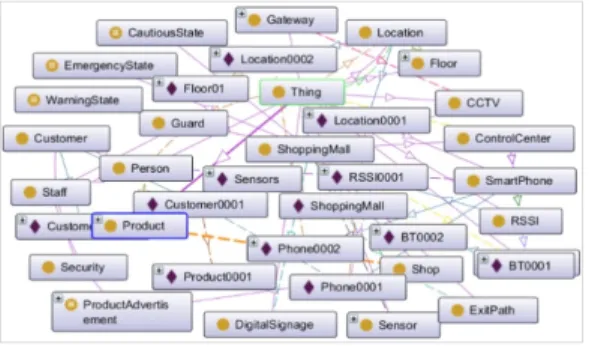
have developed the semantic ontology model for