• 검색 결과가 없습니다.

High-temperature Corrosion of CrAlSiN Films in Ar/1%SO<sub>2</sub> Gas

N/A
N/A
Protected

Academic year: 2021

Share "High-temperature Corrosion of CrAlSiN Films in Ar/1%SO<sub>2</sub> Gas"

Copied!
5
0
0

로드 중.... (전체 텍스트 보기)

전체 글

(1)

한국표면공학회지 J. Korean Inst. Surf. Eng.

Vol. 52, No. 5, 2019.

https://doi.org/10.5695/JKISE.2019.52.5.246

<연구논문>

ISSN 1225-8024(Print) ISSN 2288-8403(Online)

High-temperature Corrosion of CrAlSiN Films in Ar/1%SO 2 Gas

Dong Bok Lee

a

, Xiao Xiao

a

, Junhee Hahn

b

, Sewon Son

c

, and Shi Yuke

a*

a

School of Advanced Materials Science and Engineering, Sungkyunkwan University, Suwon 16419, Korea

b

Center for Materials and Energy Measurements, Korea Research Institute of Standards and Science, Daejon 34113, Korea

c

Department of Systems Management Engineering, Sungkyunkwan University, Suwon 16419, Korea (Received 1 October, 2018 ; revised 27 October, 2018 ; accepted 28 October, 2018)

Abstract

Nano-multilayered Cr

25.2

Al

19.5

Si

4.7

N

50.5

films were deposited on the steel substrate by cathodic arc plasma deposition. They were corroded at 900

o

C in Ar/1%SO

2

gas in order to study their corrosion behavior in sulfidizing/oxidizing environments. Despite the presence of sulfur in the gaseous environment, the corrosion was governed by oxidation, leading to formation of protective oxides such as Cr

2

O

3

and α-Al

2

O

3

, where Si was dissolved. Iron diffused outward from the substrate to the film surface, and oxidized to Fe

2

O

3

and Fe

3

O

4

. The films were corrosion-resistant up to 150 h owing to the formation of thin (Cr

2

O

3

and/or α-Al

2

O

3

)- rich oxide layers. However, they failed when corroded at 900

o

C for 300 h, resulting in the formation of layered oxide scales due to not only outward diffusion of Cr, Al, Si, Fe and N, but also inward movement of sulfur and oxygen.

Keywords: CrAlSiN thin film, Cathodic arc plasma deposition, SO

2

corrosion, Oxidation

1. Introduction

Hard CrN films are widely used on cutting tools, die molds, and machine components owing to their high hardness, good adhesion to most substrates, decorative color, and good resistance to wear, oxidation and corrosion. In order to further improve their mechanical properties and thermal stability, CrAlSiN films were developed [1-4]. The substitution of smaller, corrosion-resistant Si and Al atoms into the Cr sites of CrN led to grain refinement and increment of hardness, elastic modulus, and resistance to wear and oxidation. The high-temperature oxidation of CrAlSiN films resulted in the formation of protective Cr

2

O

3

, Al

2

O

3

and SiO

2

oxides owing to the thermodynamic stability of these oxides [3-6]. However, the high-temperature corrosion

of CrAlSiN films in SO

2

-containing environments has not yet been adequately studied, although structural components are frequently exposed to sulfur containing gases at high temperatures. Sulfur, which is one of the most common corrosive species in industrial processes, usually comes from fossil fuels, fluxes, or chemical feedstock. It reacts with oxygen to form SO

2

when combustion takes place.

Generally, sulfidation rates of most metals were several orders magnitude faster than corresponding oxidation rates, because sulfides have low melting points and are highly nonstoichiometric [7,8]. In this study, nano-multilayered CrAlSiN films were deposited by the cathodic arc plasma deposition (CAPD), and their corrosion behavior was investigated at 900

o

C up to 300 h in Ar/1%SO

2

. This corrosion condition was chosen to accelerate the corrosion of films. In practice, steels, which are used as the substrate material in this study, are usually used below 800

o

C for a long period, and SO

2

concentrations are typically below 0.1% in combustion environments. Nano-multilayered films

* Corresponding Author:Shi Yuke

School of Advanced Materials Science & Engineering, Sungkyunkwan University

Tel: +82-31-290-7355 ; Fax: +82-31-290-7371

E-mail: [email protected]

(2)

have unique merits, including their superior mechanical and lubrication properties in advanced tribological applications [9]. CAPD is attracting an enormous interest because of its capability to deposit dense, adherent films. The corrosion mechanism, the scale structure, and the role of film-constituting elements during corrosion were discussed. This study will provide valuable information about protecting metals from highly corrosive SO

2

-containing environments.

2. Experimental Details

CrAlSiN films were deposited on 10×5×2 mm

3

- size Fe-11.5% Cr steel substrate to 5 μm-thickness by CAPD under the following condition: nitrogen working pressure of 4 Pa, a temperature of 300

o

C, a bias voltage of -100 V, Al

0.88

Si

0.12

cathode arc current of 50 A, and Cr cathode arc current of 55 A [5,10,11]. During deposition, the substrate holder was rotated with a speed of 4.55 rpm between two opposite Al

0.88

Si

0.12

and Cr cathodes to make the films nano-multilayered. The average film composition was 25.2Cr-19.5Al-4.7Si-50.5N (at.%) according to the electron probe microanalysis (EPMA). The films were corroded at 900

o

C for 20-300 h in a flowing Ar/1%SO

2

gas inside a tube furnace. They were inspected by a field-emission EPMA, a field- emission scanning electron microscope (SEM), a high-power X-ray diffractometer (XRD) with Cu-Kα radiation at 40 kV and 150 mA, an X-ray photoelectron spectrometer (XPS), and a transmission electron microscope (TEM operated at 200 keV) equipped with an energy dispersive spectrometer (EDS with 5- nm φ spot size). The TEM sample was prepared by milling in a focused ion beam system after carbon coating. Hereafter, the compositions are denoted in atomic percentages (at%).

3. Results and Discussion

Fig. 1 shows XPS spectra of the film after corrosion at 900

o

C for 20 h. The binding energies, E

b

, were 577 eV for Cr

2p3/2

, and 74.2 eV for Al

2p

, which indicated the formation of Cr

2

O

3

and Al

2

O

3

[12,13]. The Si

2p

spectrum split into E

b

= 98.9 and 102 eV, which were different from E

b

= 103.3 eV that was standard E

b

of Si

2p

spectrum of SiO

2

[13]. Such deviation might be attributed to dissolution of dissimilar ions in SiO

2

formed. The XPS-analyzed composition of the surface scale was 8.4Cr-29.5Al-

6.2Si-54.3O-0.7S-0.9Fe (%), indicating that Al oxidized more than Cr or Si due to its higher oxygen affinity than Cr or Si. α-Al

2

O

3

grows by inward diffusion of of O

-2

ions, along with outward diffusion of Al

3+

ions to a lesser extent [14]. Sulfur was dissolved in a small amount in the oxides, because the solubility of sulfur in most oxides and metals was very low [15]. Nitrogen completely liberated from the film. The observed predominant oxidation of Al in the early corrosion stage was overridden by oxidation of Cr owing to the abundance Cr in the film as the corrosion progressed further, as shown below.

Fig. 2 shows XRD patterns of the film after corrosion at 900

o

C for 50 and 300 h. Before Fig. 1. XPS spectra taken from the surface of CrAlSiN film that corroded at 900

o

C for 20 h.

Fig. 2. XRD patterns of CrAlSiN film after corrosion at

900

o

C for (a) 50 h, (b) 300 h.

(3)

corrosion, the film consisted of fcc-CrN nanolayers originating from the Cr target, and hcp-AlSiN nanolayeres originating from the Al

0.88

Si

0.12

target [11]. In Fig. 2(a), the peak intensity decreased in the order of Fe-Cr substrate, CrN, and Cr

2

O

3

, indicating that the film partially oxidized to Cr

2

O

3

. In Fig. 2(b), the peak intensity decreased in the order of Fe-Cr substrate, Cr

2

O

3

, (α-Al

2

O

3

or Fe

3

O

4

), and Fe

2

O

3

, indicating that the film completely oxidized to Cr

2

O

3

as the major oxide and α-Al

2

O

3

as the minor one.

Silica was undetected owing to its amorphous structure or small amount. The formation of iron oxides indicated that iron diffused outwardly from the substrate to the film according to the concentration gradient. Peaks shown in Fig. 2(a) were somewhat diffuse and broad because the film was nanomultilayered, and corrosion progressed to a small extent. The corrosion in the SO

2

-mixed gas was governed by oxidation, because oxides were thermodynamically more stable than the corresponding sulfides.

Fig. 3 shows TEM/EDS results of the film after

corrosion at 900

o

C for 100 h. The uniform scale was

~30 nm-thick, while the protruded one was ~230 nm- thick (Fig. 3(a)). The film was only slightly oxidized, displaying good corrosion resistance. Alternating white and dark nanolayers in the film were previously found to be fcc-CrN and hcp-AlSiN, respectively [11]. The protruded scale at spot 1-5 consisted of Cr

2

O

3

grains that were dissolved with Al, Si, and Fe (Fig. 3(b)). It formed by the outward diffusion of Cr [16], along with a lesser amount of Al, Si, and Fe. Al

2

O

3

can dissolve in Cr

2

O

3

to a certain extent, because both oxides have the corundum structure. The subscale at spot 6 with a composition of 10.1Cr-26.7Al-7.5Si-35.9N-19.8O (%) was being oxidized by the inwardly diffusing oxygen. It was depleted in Cr, and thereby enriched in Al and Si owing to the consumption of Cr at spot 1-5. It is however noted that the Si concentration depicted in Fig. 3(b) was inaccurate because of the spurious Si signal that came out from the EDS detector owing to the internal fluorescence. Sulfur was virtually absent, because its ingress was deterred by the oxide scale.

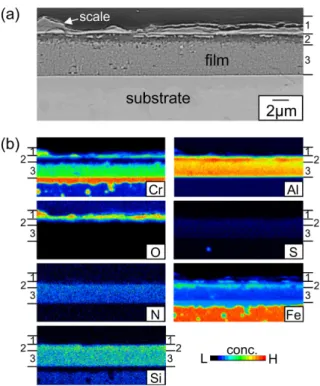
Fig. 4 shows EPMA results of the film after corrosion at 900

o

C for 150 h. The oxide scale grew to ~1 μm in thickness (Fig. 4(a)). It consisted

Fig. 3. CrAlSiN film after corrosion at 900

o

C for 100 h.

(a) cross-sectional TEM image, (b) EDS concentration profiles along spot 1-9 denoted in (a).

Fig. 4. CrAlSiN film after corrosion at 900

o

C for 150 h.

(a) EPMA cross-sectional back-scattered electron

(BSE) image, (b) EPMA maps. 1=Cr

2

O

3

scale, 2=Cr-

depleted zone, 3=uncorroded film.

(4)

primarily of Cr

2

O

3

, just below which the (Cr- depleted, Al-enriched)-zone formed (Fig. 4(b)). The Cr

2

O

3

scale effectively protected the film despite lengthy corrosion. Some iron diffused outward into the Cr

2

O

3

scale according to the concentration gradient. Al and Si diffused outwardly to a lesser extent, reflecting their limited diffusion rate due probably to the strong bonding energy of extremely slowly growing Al

2

O

3

and SiO

2

. The Cr

2

O

3

scale suppressed the ingress of sulfur significantly.

The SEM/EPMA results of the film in the final stage of corrosion are shown in Fig. 5. The surface was covered with fine oxide grains, reflecting the slow growth rate of protective oxides (Fig. 5(a)). The film corroded completely into several oxide layers owing to ensuing interdiffusion among the film, substrate, and corrosion gas. The total film thickness increased to ~7 μm (Fig. 5(b)). In this figure of the scale and the substrate, basically, the white region was (Cr, Fe)-rich, while the dark region was Al-rich, which came out owing to the atomic contrast.

Especially, the outermost oxide scale was rich in (Cr,

Fe, Si, N), suggesting that these elements diffused outward across the preformed Cr

2

O

3

scale (Fig. 5(c)).

The consumption of oxygen to form the scale led to the slight enrichment of sulfur in the lower part of the scale. Nonetheless, the detailed scale structure would depend on the concentration, diffusivity, and oxygen affinity of each element under the given corrosion condition.

4. Conclusion

The corrosion behavior of Cr

25.2

Al

19.5

Si

4.7

N

50.5

films that were deposited on steel was studied at 900

o

C for 20-300 h in Ar/1%SO

2

gas. Oxidation prevailed during corrosion, because oxides were thermodynamically more stable than the corresponding sulfides. The 20-h corrosion led to formation of Al

2

O

3

as the major oxide and Cr

2

O

3

was the minor one. During corrosion for more than 50 h, Cr

2

O

3

overgrew Al

2

O

3

, because there was more Cr available than Al in the film.

Although the films formed thin oxide scales up to 150 h, they became completely oxidized to the layered oxide scale when corroded for 300 h. During corrosion, Cr, Al, and Si from the film as well as Fe from the substrate continously diffused outwardly, while oxygen diffused inwardly. The formed oxides suppressed the ingress of sulfur significantly.

Acknowledgment

This work was supported by the National Research Council of Science & Technology (NST) grant by the Korea government (MSIT) (No. CRC-15-07- KIER).

References

[1] C. C. Chang and J. G. Duh, Duplex coating tech- nique to improve the adhesion and tribological properties of CrAlSiN nanocomposite coating, Surf.

Coat. Technol. 326 (2017) 375-381.

[2] I. W. Park, D. S. Kang, J. J. Moore, S. C. Kwon, J. J. Rha and K. H. Kim, Microstructures, mechanical properties, and tribological behaviors of Cr–Al–N, Cr–Si–N, and Cr–Al–Si–N coatings by a hybrid coating system, Surf. Coat. Technol.

201 (2007) 5223-5227.

[3] S. Zhang, L. Wang, Q. Wang and M. Li, A super- hard CrAlSiN superlattice coating deposited by a multi-arc ion plating: II. Thermal stability and oxidation resistance, Surf. Coat. Technol. 214 (2013) 153-159.

Fig. 5. CrAlSiN film after corrosion at 900

o

C for 300 h.

(a) SEM top view, (b) EPMA cross-sectional BSE

image, (c) EPMA maps.

(5)

[4] C. B. Liu, W. Pei, F. Huang and L. Chen, Improved mechanical and thermal properties of CrAlN coatings by Si solid solution, Vacuum 125 (2016) 180-184.

[5] D. B. Lee, T. D. Nguyen and S. K. Kim, Air- oxidation of nano-multilayered CrAlSiN thin films between 800 and 1000 °C, Surf. Coat. Technol.

203 (2009) 1199-1204.

[6] H. W. Chen, Y. C. Chan, J. W. Lee and J. G.

Duh, Oxidation resistance of nanocomposite CrAlSiN under long-time heat treatment, Surf.

Coat. Technol. 206 (2011) 1571-1576.

[7] M. Danielewski, S. Mrowec and A. Stołosa, Sulfidation of iron at high temperatures and diffusion kinetics in ferrous sulfide, Oxid. Met.

17 (1982) 77-97.

[8] S. Mrowec and K. Przybylski, Transport properties of sulfide scales and sulfidation of metals and alloys, Oxid. Met. 23 (1985) 107-139.

[9] Y. X. Wang and S. Zhang, Toward hard yet tough ceramic coatings, Surf. Coat. Technol. 258 (2014) 1-16.

[10] S. K. Kim, V. V. Le, P. V. Vinh and J. W. Lee, Effect of cathode arc current and bias voltage on the mechanical properties of CrAlSiN thin films,

Surf. Coat. Technol. 202 (2008) 5400-5404.

[11] M. A. Abro, J. Hahn and D. B. Lee, High-tem- perature corrosion of CrAlSiN thin films in N

2

/ 0.1%H

2

S gas, Korean J. Met. Mater. 56 (2018) 272-279.

[12] J. L. Endrino, G. S. Fox-Rabinovich, A. Reiter, S. V. Veldhuis, R. Escobar Galindo, J. M. Albella and J. F. Marco, Oxidation tuning in AlCrN coatings, Surf. Coat. Technol. 201 (2007) 4505- 4511.

[13] J. F. Moulder, W. F. Stickle, P. E. Sobol and K.

D. Bomben, Handbook of X-ray photoelectron spectroscopy, Physical Electronics, USA (1995).

[14] N. Birks, G. H. Meier and F. S. Pettit, Introduction to the high temperature oxidation of metals, 2nd ed., Cambridge University Press, England (2006).

[15] H. J. Grabke, in: High temperature materials corrosion in coal gasification atmospheres, edited by J. F. Norton, Elsevier Applied Science Publishers, England (1984) 59-82.

[16] B. Pieraggi, in: Shreir’s corrosion, 4th edn., Vol.

1, edited by R. A. Cottis, M. J. Graham, R. Lindsay,

S. B. Lyon, J. A. Richardson, J. D. Scantlebury

and F. H. Stott, Elsevier, USA (2010) 129.

수치

Fig. 1 shows XPS spectra of the film after corrosion at 900 o C for 20 h. The binding energies, E b , were 577 eV for Cr 2p3/2 , and 74.2 eV for Al 2p , which indicated the formation of Cr 2 O 3  and Al 2 O 3 [12,13]
Fig. 4 shows EPMA results of the film after corrosion at 900 o C for 150 h. The oxide scale grew to ~1 μm in thickness (Fig
Fig. 5. CrAlSiN film after corrosion at 900 o C for 300 h.

참조

관련 문서

SIMS depth profiling was used to determine the distribution of Na, Al, Si and other elements throughout the SiO 2 / PSG/SiO 2 /Al-1%Si and SiO 2 /TEOS/SiO 2 /Al-1%Si