한국표면공학회지 J. Korean Inst. Surf. Eng.
Vol. 52, No. 3, 2019.
https://doi.org/10.5695/JKISE.2019.52.3.111
<연구논문>
ISSN 1225-8024(Print) ISSN 2288-8403(Online)
High Temperature Corrosion of Cr(III) Coatings in N
2/0.1%H
2S Gas
Dong Bok Lee and Shi Yuke*
School of Advanced Materials Science and Engineering, Sungkyunkwan University, Suwon 16419, Republic of Korea
(Received 26 March, 2019 ; revised 26 April, 2019 ; accepted 9 May, 2019)
ABSTRACT
Chromium was coated on a steel substrate by the Cr(III) electroplating method, and corroded at 500-900
oC for 5 h in N2/0.1%H2S-mixed gas to study the high-temperature corrosion behavior of the Cr(III) coating in the highly corrosive H2S-environment. The coating consisted of (C, O)-supersaturated, nodular chromium grains with microcracks. Corrosion was dominated by oxidation owing to thermodynamic stability of oxides compared to sulfides and nitrides. Corrosion initially led to formation of the thin Cr2O3 layer, below which (S, O)-dissolved, thin, porous region developed. As corrosion progressed, a Fe2Cr2O4 layer formed below the Cr2O3 layer. The coating displayed relatively good corrosion resistance due to formation of the Cr2O3 scale and progressive sealing of microcracks.
Keywords : Chromium, carbon, electroplating, H2S corrosion, oxidation
1. Introduction
Chromium electroplating on metal substrates is widely used in industries owing to its decorative color, high hardness, and good corrosion resistance. It is usually performed in the hexavalent chromium (Cr+6) bath having CrO3. Shortcomings of Cr(VI) coating are however low cathode efficiency that results in bad throwing power, serious health and environmental problems. To overcome these shortcomings, trivalent chromium (Cr+3) plating is developed as an alternative [1]. Coatings of Cr(III) were previously investigated, including their electroplating condition [2], hardness [3], wear resistance [4], corrosion resistance [5,6], electrical contact resistance [7], and high-temperature oxidation behavior [8]. In this study, Cr(III) coating was electroplated onto a steel substrate, and corroded at high temperatures in N2/H2S-mixed gas in order to study the corrosion behavior of Cr(III) coating in the serious H2S-containing atmosphere. Since steels
corrodes fast in H2S gas, forming thick FeS scales incorporated with hydrogen, it is imperative to develop optimum corrosion-resistant coatings for steels. H2S comes off as a by-product during processing in oil refinery, chemical and petrochemical units, and gasification of fossil fuels [9]. It dissociates into sulfur and hydrogen. Sulfur reacts with metals to form nonprotective sulfides, while hydrogen ingresses into alloys interstitially, forms hydrogen clusters, increases corrosion rates, and causes hydrogen embrittlement [9,10]. This study aims to investigate the high-temperature corrosion behavior of Cr(III) coating in H2S-environment at high temperatures in order to find the feasibility of Cr(III) coating in protecting steels. The microstructural and compositional variation of the coating during corrosion was studied.
2. Experimental
Chromium was electroplated on a low carbon steel substrate (AISI 1024 with a nominal composition of Fe-0.2C-1.5Mn-0.05S-0.04P in wt%) with a size of 2×0.5×0.3 cm3 to a thickness of 30-100μm. The bath composition and electrolysis condition are listed in
*
Corresponding Author: Shi YukeSchool of Advanced Materials Science and Engineering, Sungkyunkwan University
Tel: +82-3411-290-7355 ; Fax: +82-290-7379 E-mail: [email protected]
Table 1. Bath solution consisted of chromium sulphate (Cr2(SO4)3·nH2O) as a source of Cr+3, complexing agent (HCOOK) that supersaturates carbon in the Cr coating with an amorphous structure [5,11], conductive improvement agent (KCl, NH4Cl), buffer agent (H3BO3), anti-oxidant agent (NH4Br), and an additive (polyethylene glycol). The surface area of the anode was twice than that of the cathode.
The prepared samples were charged into the quartz reaction tube, and corroded at 500-900oC for 5 h in N2/0.1%H2S-mixed gas in a horizontal tube furnace.
Employed N2 and H2S gases were 99.999% and 99.99% pure, respectively. The samples were characterized by a field-emission scanning electron microscope (SEM) equipped with an energy dispersive spectroscope (EDS), a field-emission electron probe microanalyzer (EPMA), an X-ray photoelectron spectrometer (XPS), and a high power X-ray diffractometer (XRD) with Cu-Kα radiation at 40 kV and 150 mA.
3. Results and Discussion
Figure 1 shows SEM/EDS/XRD/XPS analytical results of Cr(III) coating. This consisted of nodular grains with tens of micrometer in size (Fig. 1(a)).
Intense hydrogen evolution during electroplating generated microcracks inter- and intra-granularly.
Nodular grains grew bigger, and microcracks became wider and deeper with the increment of plating time and coating thickness [1,2]. Generation of microcracks is the major drawback of the Cr(III) coating. The EDS-analyzed composition of the spot 1, 2, and 3, which were marked in Fig. 1(b), was 69.7Cr-19.3O-11C, 68.5Cr-19.2O-12.3C, and 68.5Cr- 21.6O-10C in at%, respectively (Fig. 1(c)). Although the quantification of light element such as carbon
was notoriously difficult, Cr, O, and C seemed to be uniformly distributed in the adherent, microcracked coating. The amorphous Cr(III) coating displayed a diffuse pattern around 44o (Fig. 1(d)). It was reported that supersaturated carbon in the coating precipitated as chromium carbides such as Cr23C6 [2,11], Cr7C3 [12], and Cr3C2 [13] when annealed at 400-700oC, being accompanied with increment of the coating hardness. XPS spectra of Cr, C and O of the coating are shown in Fig. 1(e). The Cr2p spectrum indicates that the presence of metallic Cr and Cr2O3. The C1s spectrum indicated C-C bond (amorphous carbon) [12,14] and COOH bond [15]. The oxygen dissolution in the Cr(III) coating made the intensity of the O1s spectrum high.
Figure 2 shows SEM/EDS/XRD/XPS results of Cr(III) coating after corrosion at 500oC for 5 h.
Fig. 1. Cr(III) coating. (a) SEM top view, (b) SEM cross-sectional image, (c) EDS spectra of spot 1, 2 and 3, (d) XRD pattern, (e) XPS spectra of Cr2P, C1S, and O1S.
Table 1. Bath composition and electrolysis conditions Bath composition
Electrolysis condition Chemicals Content
Cr2(SO4)3·nH2O 140 g/l Temperature 30oC
HCOOK 1 M pH 2
KCl, NH4Cl 1 M, respectively
Current
density 20 A/dm2 H3BO3 0.65 M Anode graphite NH4Br 10 g/l Cathode low carbon
steel polyethylene
glycol 2 g/l Agitation air bubbling
Microcracks propagated across the coating surface consisting of nodular grains (Fig. 2(a)). The scale was hardly recognizable owing to good corrosion resistance of the coating (Fig. 2(b)). In Fig. 2(c), no oxides were detected, and the diffuse amorphous pattern changed to the crystalline Cr pattern. In order to identify the thin scale that formed on the surface, XPS analysis was performed, as shown in Fig. 2(d).
The XPS-analyzed composition of the thin scale was 54.7O-17.8Cr-16.7C-9.2Fe-1.3S-0.3N in at%. Here, the carbon concentration is particularly suspicious, because carbon signal can come out as a background noise. Sulfur and nitrogen that originated from N2/ 0.1%H2S-mixed gas were apparently dissolved in the chromia scale, together with Fe, to a small amount.
Iron diffused out from the substrate across the coating.
The Cr2P3/2 peak position was at 576.5 eV,
corresponding to Cr2O3. The C1S peak binding energy (Eb = 284.7 eV) corresponded to carbon. The O1s spectrum had a peak (Eb = 530.3 eV), corresponding to metal oxides. The Fe2P3/2 peak value corresponded to Fe2O3 (Eb = 710.9 eV). The N1S peak binding energy (Eb = 399.9 eV) shifted to a higher value than nitrides (Eb= 396.4-398.3 eV), probably to coexistence of oxygen and sulfur at the surface. The S1S peak binding energy (Eb= 168.7 eV) corresponded to sulfate (SO42−).
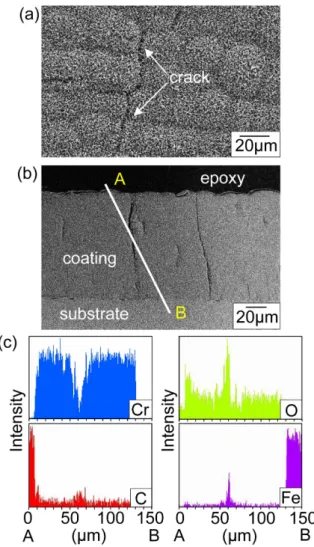
The corrosion at 600oC for 5 h formed a superficial scale on the Cr(III) coating (Fig. 3(a)). Here, microcracks were partially sealed. Figures 3(b-c) indicates that iron diffused outwardly along microcracks that were an easy diffusion path. This is responsible for the partial sealing of microcracks with oxides of iron and chromium. The oxygen source for this oxidation reaction was impurity oxygen in the employed N2/0.1%H2S gas. The Fig. 2. Cr(III) coating after corrosion at 500oC for 5 h in
N2/0.1%H2S gas. (a) SEM top view, (b) SEM cross- sectional image, (c) XRD pattern, (d) XPS spectra of Cr2P, C1S, O1S, Fe2P, N1S, and S2P.
Fig. 3. Cr(III) coating after corrosion at 600oC for 5 h in N2/0.1%H2S gas. (a) SEM top view, (b) SEM cross- sectional image, (c) EDS line profiles along A-B shown in (b).
carbon peak at the front of the carbon line profile shown in Fig. 3(c) came from carbon in the epoxy mount.
When the Cr(III) coating was corroded further at 700oC for 5 h, microcracks were partially sealed, and a thin scale covered the surface along the contours of the coating surface (Fig. 4(a)). A thin scale was shown in Fig. 4(b), indicating that the coating still had good corrosion resistance despite of microcracks in the coating. The scale consisted of slowly growing Cr2O3 (Fig. 4(c)). Here, neither sulfides nor nitrides, which could form owing to N2/0.1%H2S gas, were detected because of their thermodynamic nobility compared to the corresponding oxides.
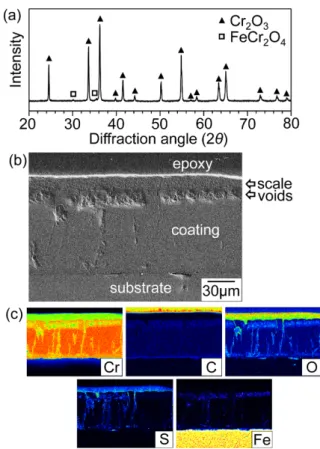
The scale consisting primarily of Cr2O3 grew thicker as the corrosion progressed, leading to detection of strong Cr2O3 peaks (Fig. 5(a)). Here, there was a faint indication of FeCr2O4 peaks, implying that Cr2O3 reacted with FeO to a small extent. In Fig. 5(b), microcracks were sealed further.
The scale was ~15μm-thick (Fig. 5(c)). Sulfur dissolved in Cr2O3. Its amount was not large enough to form any sulfides as shown in Fig. 5(a), because
the solubility of sulfur in Cr2O3 was limited [16,17].
Chromia grew by the outward diffusion of Cr3+ ions [18], which led to formation of Kirkendall voids beneath the scale (Fig. 5(b)). Oxygen and sulfur could diffuse easily along voids and along microcracks (Fig. 5(c)). Voids and mechanical weakness arisen by the dissolution of sulfur and oxygen were responsible for formation of cavernous area below the scale (Fig. 5(b)). A close look at the carbon map shown in Fig. 5(c) indicates the presence of carbon in the uncorroded coating. The Fe map shown in Fig. 5(c) indicates the outward diffusion of Fe especially along microcracks and toward voids.
The crack healing effect was similarly reported when Cr(III) coating was oxynitrocarburized and steam- oxidized in order to form Fe3O4, Fe2O3, and/or Fe4N [4]. Nitrogen in N2/0.1%H2S-mixed gas could not penetrate the scale due mainly to its negligible solubility in Cr2O3.
When the Cr(III) coating was corroded at 900oC for 5 h, the scale consisted of Cr2O3 as the major phase and FeCr2O4 as the minor one (Fig. 6(a)).
Microcracks were almost completely sealed off (Fig.
6(b)). The EPMA maps shown in Fig. 6(c) indicates Fig. 4. Cr(III) coating after corrosion at 700oC for 5 h in
N2/0.1%H2S gas. (a) SEM top view, (b) SEM cross- sectional image, (c) XRD pattern.
Fig. 5. Cr(III) coating after corrosion at 800oC for 5 h in N2/0.1%H2S gas. (a) XRD pattern, (b) EPMA cross- sectional image, (c) EPMA maps of (b).
that FeCr2O4 formed beneath the Cr2O3 scale, apparently suggesting that the outward migration of Fe was blocked by the Cr2O3 scale. Sulfur diffused inwardly to dissolve in the bi-layered scale with a thickness of ~30 µm. Oxygen also diffused inwardly, but to a large amount particularly along microcracks.
The inner FeCr2O4-containing scale was mechanically weak, because it formed around pre-formed voids that were outlined in Fig. 5(c). Additional factors that deteriorate the soundness of the matrix were anisotropic volume expansion owing to simultaneous formation of Cr2O3 and FeCr2O4, stress that accumulated owing to thickening of the scale, and hydrogen escape from H2S gas. The carbon map shown in Fig. 6(c) indicates that there still existed carbon in the uncorroded coating.
4. Conclusions
The amorphous Cr(III) coating consisted of oxygen-dissolved nodular grains with microcracks. Its corrosion behavior in N2/0.1%H2S gas for 5 h was studied. At 500oC, the coating crystallized to Cr. At 600oC, a superficial oxide scale formed. Microcracks
began to be filled with oxides of Cr and Fe. At 700oC, a thin Cr2O3 scale formed owing to thermodynamic stability of oxides compared to the corresponding sulfides or nitrides. When corroded at 800oC, a Cr2O3 scale formed through the outward diffusion of Cr, which formed voids underneath the Cr2O3 scale.
When corroded at 900oC, an outer Cr2O3 layer and inner (Cr2O3, FeCr2O4)-mixed layer formed. The increment of corrosion temperature resulted in the thickening of the scale, the progressive sealing of microcracks, and the enhancement of outward migration of Cr and Fe as well as the inward transport of oxygen and sulfur.
Acknowledgement
This research was supported by Basic Science Research Program through the National Research Foundation of Korea (NRF) funded by the Ministry of Education (2017R1D1A1B03028792).
References
[1] G. Hong, K.S. Siow, G. Zhiqiang, A.K. Hsieh, Hard chromium plating from trivalent chromium solution, Plat. Surf. Finish., 88 (2001) 69-75.
[2] S.C. Kwon, M. Kim, S.U. Park, D.Y. Kim, D.
Kim, K.S. Nam, Y. Choi, Characterization of intermediate Cr-C layer fabricated by electro- deposition in hexavalent and trivalent chromium baths, Surf. Coat. Technol., 183 (2004) 151-156.
[3] S. Hoshino, H.A. Laitinen, G.B. Hoflund, The electrodeposition and properties of amorphous chromium films prepared from chromic acid solutions, J. Electrochem. Soc., 133 (1986) 681- 685.
[4] A. Liang, Q. Liu, B. Zhang, L. Ni, J. Zhang, Preparation of crystalline chromium coating on Cu substrate directly by DC electrodepositing from wholly environmentally acceptable Cr(III) electrolyte, Mater. Lett., 119 (2014) 131-134.
[5] G.B. Hoflund, D.A. Asbury, S.J. Babb, A.L. Grogan, H.A. Laitinen, S. Hoshino, A surface study of amorphous chromium films electrodeposited from chromic acid solutions. Part I, J. Vac. Sci. Technol., A 4 (1986) 26-30.
[6] D. Kim, M. Kim, K.S. Nam, D. Chang, S.C. Kwon, Duplex coating for improvement of corrosion resistance in chromium deposit, Surf. Coat.
Technol. 169-170 (2003) 650-654.
[7] K.S. Nam, K.H. Lee, S.C. Kwon, D.Y. Lee, Y.S.
Song, Improved wear and corrosion resistance of Fig. 6. Cr(III) coating after corrosion at 900oC for 5 h in
N2/0.1%H2S gas. (a) XRD pattern, (b) EPMA cross- sectional image, (c) EPMA maps of (b).
chromium(III) plating by oxynitrocarburising and steam oxidation, Mater. Lett., 58 (2014) 3540- 3544.
[8] D.B. Lee, Oxidation of Cr–C electroplating between 400 and 900 ◦C in air, Mater. Corros., 59 (2008) 598-601.
[9] R. John, Sulfidation and mixed gas corrosion of alloys, in Shreir’s Corrosion (4th edn), Vol. 1, ed.
by R.A Cottis, M.J. Graham, R. Lindsay, S.B.
Lyon, J.A. Richardson, J.D. Scantlebury, F.H. Stott, Elsevier, USA (2010) 240-271.
[10] G.Y. Lai, High-Temperature Corrosion and Materials Applications, ASM International, USA (2007).
[11] M. Takaya, M. Matsunaga, T. Otaka, Electrodeposition of Cr-SiC composite coatings and their wear characteristics, Plat. Surf. Finish., 38 (1987) 97-101.
[12] M. Andersson, J. Hogstrom, S. Urbonaite, A.
Furlan, L. Nyholm, U. Jansson, Deposition and characterization of magnetron sputtered amorphous Cr–C films, Vacuum, 86 (2012) 1408-1416.
[13] V.A. Safonov, H. Habazaki, P. Glatzel, L. A.
Fishgoit, O.A. Drozhzhin, S. Lafuerza, O.V.
Safonova, Application of valence-to-core X-ray emission spectroscopy for identification and
estimation of amount of carbon covalently bonded to chromium in amorphous Cr-C coatings prepared by magnetron sputtering, Appl. Surf. Sci., 427 (2018) 566-572.
[14] L. Yate, L. Martinez-de-Olcoz, J. Esteve, A. Lousa, Ultra low nanowear in novel chromium/amorphous chromium carbide nanocomposite films, Appl. Surf.
Sci., 420 (2017) 707-713.
[15] A.A. Edigaryan, V.A. Safonov, E.N. Lubnin, L.N.
Vykhodtseva, G.E. Chusova, Y.M. Polukaov, Properties and preparation of amorphous chromium carbide electroplates, Electochem. Acta, 47 (2002) 2775-2786.
[16] R.E. Lobnig, H.J. Grabke, Mechanisms of simultaneous sulfidation and oxidation of Fe-Cr and Fe-Cr-Ni-alloys and of the failure of protective chromia scales, Corros. Sci., 30 (1990) 1045-1071.
[17] H.J. Grabke, High temperature corrosion in complex, multi-reactant gaseous environments, in:
J.F. Norton (Ed.) High Temperature Materials Corrosion in Coal Gasification Atmospheres, Elsevier Applied Science Publishers, England (1984) 59-82.
[18] G. Simkovich, The change in growth mechanism of scales due to reactive elements, Oxid. Met., 44 (1995) 501-504.
![Table 1. Bath solution consisted of chromium sulphate (Cr 2 (SO 4 ) 3 ·nH 2 O) as a source of Cr +3 , complexing agent (HCOOK) that supersaturates carbon in the Cr coating with an amorphous structure [5,11], conductive improvement agent (KCl, NH 4 Cl), buf](https://thumb-ap.123doks.com/thumbv2/123dokinfo/5300476.378808/2.892.488.798.132.718/solution-consisted-complexing-supersaturates-amorphous-structure-conductive-improvement.webp)