AJCPP 2008 March 6-8, 2008, Gyeongju, Korea
Development Status of Iridium Catalyst for Hydrazine Decomposition
S. K. Kim
(1), K. H. Lee
(1), M. J. Yu
(1), S. J. Cho
(2)and J. W. Lee
(3)(1) Korea Aerospace Research Institute, Deajeon 305-333, Korea
(2) Chonnam National University, Gwanju 500-757, Korea (3) Hanwha Corps, Daejeon, 305-156, Korea
Email: [email protected]
Keywords: Catalyst, Thruster, Hydrazine Decomposition Abstract
A development of hydrazine decomposition catalyst for monopropellant thruster has been performed by Korea Aerospace Research Institute (KARI). The goal of this development is to product a catalyst showing the equivalent performance with space-proven catalysts.
Catalyst production and physical/chemical analysis were conducted by Chonnam National University and the analysis result was compared with the result of other catalysts and our own specification. Using the developed prototype catalyst, short firing test was performed in a reactor to verify basic performance of catalyst. After the successful reactor test, hot firing tests were carried out in atmospheric and vacuum condition using 5N thruster to verify durability and safety of catalyst. In this paper, the catalyst development status will be presented.
Introduction
Development program of hydrazine decomposition catalyst for monopropellant thruster was started in 2004 by Korea Aerospace Research Institute with Chonnam National University and Hanwha Corps.
Hydrazine decomposition catalyst is one of the most important components for monopropellant thruster. But, only few companies produce hydrazine decomposition catalyst all over the world now and even some companies give up production of catalyst and transfer their facilities to other companies. In order to resolve these problems and set up technology for monopropellant thruster, catalyst development program was carried out.
Catalyst development includes manufacturing of catalyst, firing performance test, life test and proto- flight hot fire test, and Fig. 1 shows the procedure of catalyst development
1-5).
Fig. 1 Catalyst Verification Procedure
Catalyst Manufacturing
Usual catalyst is composed of carrier and active material. In this development, alumina was used as carrier and iridium metal was used as active material.
It is generally known that physical properties of alumina are very important factor to determine performance of catalyst, therefore, we spent a lot of time to find adequate alumina carrier to satisfy our own specification. After the selection of carrier, catalyst could be manufactured by impregnation using IrCl4 solution.
Catalyst was manufactured two times, first one was for 1st life test and second one was for 2nd life test and life test at the vacuum chamber. Table 1 shows characteristics of manufactured catalysts. Analysis results show that both catalysts satisfied our own specification
6).
Table 1 Characteristics of KARI Catalyst
Spec. Lot #30 Lot#40
Loading (wt%) ≤ 31 33 32 BET surface area (m2/g) ≥ 100 120 180
Pore volume (cm3/g) ≥ 0.09 0.20 0.17 H adsorption (mmol/g) ≥ 600 680 820
Reaction Performance Test
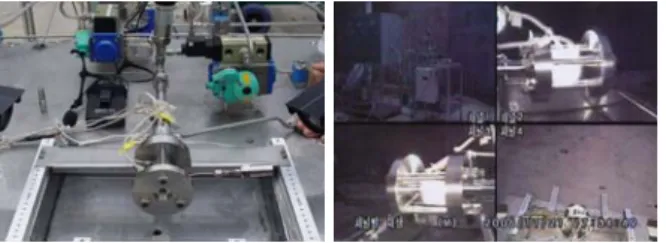
As a first step of performance verification, reaction test was conducted by reactor and catalyst test equipment. Fig. 2 shows the test set-up and firing test.
Bed temperature, chamber pressure, reaction delay and loss rate were measured by reactor test and test results could be used to estimate the suitability of catalyst.
Table 2 summarized the reactor firing test results.
All the measured properties keep within bounds of our specification
6).
Fig. 2 Catalyst Firing Test
272
AJCPP 2008 March 6-8, 2008, Gyeongju, Korea
Table 2 Catalyst Firing Test Results
Catalyst Size Max. Bed
Temp.
Chamber Pressure
Reaction Delay
Fine/
Loss 600-750℃ 160±15psig <80ms <3%
KARI Catalyst(1st)
18-20 695/748 160.61/160.33 <50 2.7 20-30 657/556* 156.23/156.52 <50 2.0 KARI
Catalyst(2nd) 20-30 660/667 163.18/162.93 <50 1.8
* Thermocouple Fail during Firing Test
Catalyst Life Test
For verification of catalyst performance, long firing test that can present the life of real satellite was carried out. Life test sequence consists of about 6 hours of steady state firing and about 80000 pulse mode firing. This sequence is based on the life of LEO satellite (about 10 years in this sequence)7).
Before the environmental firing test, firing test was conducted at ground condition using 5N thruster and catalyst test equipment in order to verify safety and durability of catalyst. The test set-up and firing test is presented in Fig. 3.
Fig. 3 Catalyst Life Test at Atmospheric Condition Vacuum thrust could not be measured during atmospheric life test, therefore, acceptance hot fire tests were carried out using vacuum chamber before and after life test in order to estimate thrust degradation during the life test.
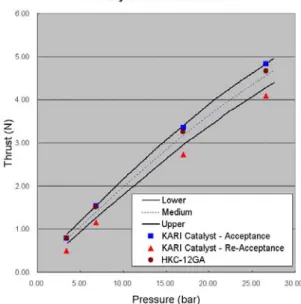
Fig. 4 Atmospheric Life Test Results (Thrust)
Fig. 4 shows the vacuum thrust before and after the life test. Before the life test, measured thrusts satisfied thruster specification very well and were very similar with the thruster using HKC-12GA catalyst but, after the life test, thrust decreased about 20-30% and drop below the lower limit of the thruster specification.
Even though test results did not satisfied thruster specification, we concluded durability and safety of catalyst were verified by life tests, because life tests were performed under extreme condition, for example, oxygen, moisture, sea level operation, many cold starts, and so on.
For verification of performance at the similar environment of satellite, firing test was conducted at the vacuum chamber also. Test sequence is almost same with the atmospheric life test.
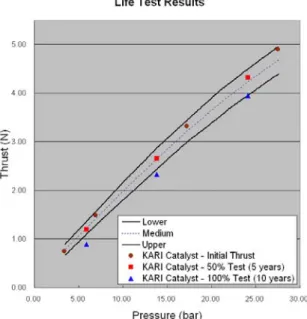
Fig. 5 Catalyst Life Test at Vacuum Chamber Fig. 6 and Fig. 7 show the results of steady state thrust and specific impulse. Initial thrust is within the limits and there is only small thrust degradation until 50% of firing test. But, thrust decreases rapidly after 50% of firing test and this means that the life of catalyst is about half of the test sequence (about 5 years).
On the other hand, specific impulse degradations are is very small and all the results satisfy the thruster specification from Fig. 7. From this result, we can conclude that catalyst performance for hydrazine decomposition almost did not changed through the life test because specific impulse degradation is very small throughout the test.
In the case of monopropellant thruster, Thrust degradation could be occurred when catalysts and fines are sintered each other at the catalyst bed by high temperature. If the catalyst strength is not enough to bear high temperature and reaction shock during test time, many catalyst fines would be created and condensed in the middle of catalyst bed and catalyst sintering could be occurred easily in this region. In order to improve the catalyst life, it is necessary to prevent the creation of catalyst fine from improving strength of catalyst.
273
AJCPP 2008 March 6-8, 2008, Gyeongju, Korea