• 검색 결과가 없습니다.

Effect of Deep Sea Water on Seed Germination, Photoperiod and Temperature on the Growth and Flowering of Buckwheat Species

N/A
N/A
Protected

Academic year: 2021

Share "Effect of Deep Sea Water on Seed Germination, Photoperiod and Temperature on the Growth and Flowering of Buckwheat Species"

Copied!
6
0
0

로드 중.... (전체 텍스트 보기)

전체 글

(1)

Effect of Deep Sea Water on Seed Germination, Photoperiod and Temperature on the Growth and Flowering of Buckwheat Species

Xoxiong Briatia

1

, Soon Kwan Hong

2

, In Je Sung

2

, Kwang Jin Chang

3

, Byoung Jae Park

4

and Cheol Ho Park

2*

1

Souphanouvong University, Luang Prabang, Lao PDR

2

Kangwon National University, Chunchon 200-701, Korea

3

Korea National University of Agricultural & Fisheries, Hwasung 445-893, Korea

4
Experimental Farm, Faculty of Agriculture, Kagoshima University, Kagoshima 890-0065, Japan

Abstract - This paper describes the potential use of deep sea water to stimulate seed germination in both common and Tartary buckwheat. Treatment of 10% deep sea water at 25 ℃ would slightly enhance germination of buckwheat seeds compared to non-DSW treatment and other temperature. In this study, the significant effects of photoperiod and temperature on seedling growth were also found in the HL treatment for the number of leaf, plant height, and plant fresh weight and LL treatment for root length and leaf size. Common buckwheat (Suwon No.1) showed higher rate (93%) of flowering plants in the HS and LL (93% of flowering rates) than those revealed in the HS and LS treatment, while the low percentage(67%) of plant flowering plants was shown in the LS treatment. All plants (100%) of a Korean landrace, Ahndong-jaerae showed flowers in the HS and LS treatment. HL and LL treatment status did not occur in the plant's flowering. Any Tartary buckwheat (KW45) plant did not yet flowered when it was 21 days-old.

Key words - Deep sea water, Germination, Photoperiod, Temperature, Seedling growth, Flowering

*Corresponding author. E-mail : [email protected]

Introduction

Buckwheat is an important crop in agricultural production worth reviewing. The crop can be cultivated after harvesting main crops and cultured in cool, dry and unfertile lands (Supot et al., 2001). It is useful in double cropping system as a cash crop where growing season is short and also useful as emergency crops (Choi et al., 2001). Buckwheat is an unusually fast-growing crop with a variety of uses; it is one of the quickest growing green manures crops, taking only 4-5 weeks from seedling to flowering. It has been also used widely as a cover crop to smother weeds, protect the soil from erosion, attract beneficial insects, and improve to build the soil organic matter. It can also increase phosphorus and micronutrient ability in the root zone for the following cash crop in a rotation and it is most useful for reduced-chemical or nonchemical weed suppression (Hector and Jody, 2002).

Buckwheat grows on a wide variety of soil types, including

infertile and acidic soil (pH 4-6). It does not appear in compacted, dry and excessively moist soils.

Buckwheat seeds can germinate and emerge rapidly when they are sown in warm soil, typically in 3 to 5 days after sowing (Myers, 2002). Based on the application of deep sea water to agricultural practices, it is meaningful to important deep sea water effects to germinate buckwheat seeds.

Buckwheat grows well at high altitudes with high sunlight intensity. Variation in growth and seed yield was found under the large difference between day and night temperatures.

Buckwheat species have three types of reactions to light, which were describe as sensitive, non sensitive and intermediate.

The length of daylight period affected flower formation.

Short day-length (less than 14 hours a day) promotes reproduction and 10-12 hours of light per day was optimum.

Long day-length promote vegetative growth. More than 16

hours of light per day delayed the formation of flower buds

but flower bud can still be formed under 24 hours of light per

day. The rate of fertilization significantly decreased when

temperature was higher than 30℃ and lower than 20℃. Days

(2)

from seeding to bud formation was reduced as temperature increased. Under a 12 hours day-length, temperature effects in minimum but under a longer day-length than 12 hours or shorter than 8 hours, temperature effects largely (Wang and Campbell, 2004). Buckwheat is suitable for the growing of 12~15 hours photoperiod. After buckwheat plants emerged, grow well by optimum photoperiod and temperature.

This paper was conducted to elucidate the effect of deep sea water on germination and also to clarify the effects of photoperiod and temperature on growth and flowering in the experiments of both common buckwheat and Tartary buckwheat.

Materials and Methods

Effect of deep sea water and temperature on seed germination Buckwheat cultivars used in this experiment were common buckwheat (Suwon No.1) and Tartary buckwheat (KW45).

Three treatments with four replications were designed for this experiment. Buckwheat seeds were washed with distilled water 2 to 3 times, and then washed

in deep sea water (DSW) about 1 to 2 times with the concentrations of 5% and 10%, and 0%(control) separately before seeding. Fifty seeds were placed on a filter paper (No.2 size 99mm) in a moisturized plastic petri-dish. All petri- dishes were transferred to a growth chamber under the dark condition and maintained at 20±2℃, 25±2℃ and 30±2℃ for 7 days. Germination characteristics were investigated according to the International Rules for Seed Testing Association for the Fagopyrum species (ISTA, 1993 and 2006). Deep sea water with concentrations 5% and 10% was supplied and water was supplied for the control. The number of seeds germinated per day (GD), seed germination vigor rate (GV) in the first of four days after seeding and total of seed germination rates (GR) seven days after seeding were investigated and then calculated on average.

Effects of photoperiod and temperature on seedling growth Three buckwheat cultivars, common buckwheat (Suwon No.1 and a landrace, Ahndong-jaerae) and Tartary buckwheat (KW45) were used for this experiment. The experiment was designed into three replications of four treatments. Buckwheat seeds were soaked with tap-water for 24 hours to clean and

remove the immature seed and dust. Seeds were sterilized with 6% of Sodium Hypochlorite solutions for 10 minutes and rinsed three times into distilled water before seeding.

Five seeds were collected from each cultivar and sown into the plastic pots sized 15×12 cm containing commercial bed soil. The pots were kept in the laboratory conditions for seed germination and seedling emergence. After seedlings emerged, different temperature and photoperiod were treated; high temperature and long day-length ‘HL’ (28±2℃/14h) in day times, high temperature and short day-length ‘HS’ (28±2℃

/8h) in day times, low temperature and long day-length ‘LL’

(20±1 ℃/14h) in day times and low temperature and short day-length ‘LS’ (20±1℃/8h) in day times, respectively. The day-length was controlled by using a paper box to cover after 8 hours in the day time, for a long day-length was according to the naturally of day-length about 14 hours in day times during June 12

th

to July 3

rd

, 2008. Temperature was controlled by using air conditioner for low temperature treatment at 20±1℃ and by maintaining room temperature (28±2℃) for high temperature treatment during the daytime from June 12

th

to July 3

rd

, 2008. Water was supplied by use of spray kettle when soil surface become dry. Data were collected 21days after seeding. Four plant samples were randomly selected from each treatment and investigated for the number of leaf per plant, leaf sizes (cm

2

), plant height (cm) and plant fresh weight (g), and the number of plant flowering in the each treatment.

Results and Discussion

Effect of deep sea water and temperature on seed germination

The effect of deep sea water and temperature on seed

germination was evaluated in Buckwheat (Suwon No.1) and

Tartary buckwheat (KW45). From the results, the number of

seeds germinated per day (GD), seed germination vigor rate

(GV) and total of seed germination rate (GR) of common

buckwheat were higher in the 10% deep sea water treatment

than those in the control and in the 5% deep sea water

treatment whereas Tartary buckwheat was found that the

number of seeds germinated per day (GD), seed germination

vigor rate (GV) and total of seed germination rate (GR) were

higher in the 10% deep sea water treatment at 25 ℃ than the

(3)

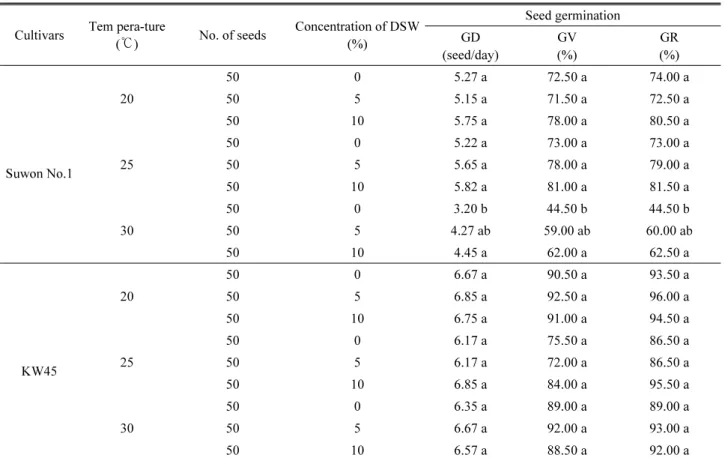
Table 1. Effects of temperature and deep sea water on seed germination of buckwheat species

Cultivars Tem pera-ture

( ℃) No. of seeds Concentration of DSW (%)

Seed germination GD

(seed/day)

GV (%)

GR (%)

Suwon No.1

50 0 5.27 a 72.50 a 74.00 a

20 50 5 5.15 a 71.50 a 72.50 a

50 10 5.75 a 78.00 a 80.50 a

50 0 5.22 a 73.00 a 73.00 a

25 50 5 5.65 a 78.00 a 79.00 a

50 10 5.82 a 81.00 a 81.50 a

50 0 3.20 b 44.50 b 44.50 b

30 50 5 4.27 ab 59.00 ab 60.00 ab

50 10 4.45 a 62.00 a 62.50 a

KW45

50 0 6.67 a 90.50 a 93.50 a

20 50 5 6.85 a 92.50 a 96.00 a

50 10 6.75 a 91.00 a 94.50 a

50 0 6.17 a 75.50 a 86.50 a

25 50 5 6.17 a 72.00 a 86.50 a

50 10 6.85 a 84.00 a 95.50 a

50 0 6.35 a 89.00 a 89.00 a

30 50 5 6.67 a 92.00 a 93.00 a

50 10 6.57 a 88.50 a 92.00 a

Means separation within ranks by Duncan’s multiple range tests at 5% level of significance and the mean followed by same letter are non-significantly at 5% level of significance.

Means of number seed germination per day (GD); mean of number seed germination vigor rate in the first 4 days (GV) and mean of total seed germination rate in the end of experiment ‘7 days’ (GR).

control. Seed germination (GD, GV and GR) at 20℃ and 3 0℃ were higher in the 5% deep sea water treatment than that in the control (Table 1). Enhancing seed germination and developing vigorous seedlings are crucial for this purpose.

The previous study reported that priming seeds in deep sea water improved germination rate compared to plain water, KNO

3

, and without priming treatment (Surendra et al., 2006).

The effects of germination on the chemical or biochemical constituents of seeds varied highly according to plant species, seed varieties or cultivars and the germination conditions (Hahm et al., 2009). Deep sea water at 30 ℃ decreased seed germination but treatment of deep sea water at 25 ℃ would slightly enhance germination of buckwheat seeds compared to non-DSW treatment and other temperature. No significance was statistically found between 20℃ and 25℃ even in different concentration of deep sea water.

Photoperiod and temperature on seedling growth

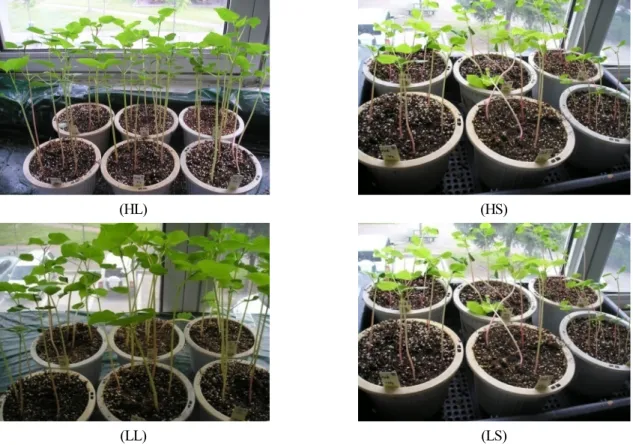
The effect of photoperiod and temperature on growing of buckwheat species was presented in Fig. 1 and Table 2. The effect of different photoperiod and temperature on seedling growth of Suwon No.1 cultivar was significantly different;

the numbers of leaf per plant, plant height and plant fresh

weight were higher in the treatments of high temperature and

long day-length (HL) than those in the high temperature and

short day-length (HS), low temperature and long day-length

(LL), and low temperature and short day-length (LS), while

root length and leaf size were revealed to be longer in the LL

treatments than those in the HS and LS treatments. For

Ahndong-jaerae cultivar, the effect of photoperiod and

temperature treatments on seedling growth was significantly

different; the number of leaf per plant, root length, plant

height, leaf size and plant fresh weight were higher in the HL

(4)

(HL) (HS)

(LL) (LS)

Fig. 1. The effect of photoperiod and temperature on seedling growth of common buckwheat (Suwon No.1). High temperature and long day-length (HL); high temperature and short day-length (HS); low temperature and long day-length (LL); and low temperature and short day-length (LS).

treatment than those in the HS, LL and LS treatments, respectively. In the previous study conducted by Hiroyasu et al. (2001) common buckwheat varieties showed the higher final stem length of the main stem and lateral branches under high temperature compared to those under low temperature.

Whereas a Tartary buckwheat cultivar, KW45 showed significantly higher fresh weight, number of leaf per plant, and root length in the HL treatment. Plant height, leaf size, and fresh weight were shown to be greater in the LL treatment rather than those in the HS and LS treatment (Table 2).

According to these results, it was indicated that HL and LL treatments affected more on plant growth and fresh weight than HS and LS treatment did. Choi et al. (2001) reported that for successful buckwheat seed sets, buckwheat should be grown under intermediate day length of 12 to 15 hours. Lee et al. (2001) also reported that the leaf length and width were higher under the natural light while they were intermediate under red-light and lowest under blue-light, respectively.

Effect of photoperiod and temperature on flowering 21 days after seeding

The effects of photoperiod and temperature on flowering of buckwheat plants are presented in Fig. 2 and Table 3. The plants initiated to bloom 21 days after seeds were sawn.

Common buckwheat (Suwon No.1) showed higher rate

(93%) of flowering plants in the HS and LL (93% of

flowering rates) than those revealed in the HS and LS

treatment, while the low percentage (67%) of plant flowering

plants was shown in the LS treatment. All plants (100%) of a

Korean landrace, Ahndong-jaerae showed flowers in the HS

and LS treatment. There was no plant flowering in the HL and

LL treatment. Any Tartary buckwheat (KW45) plant did not

yet flowered when it was 21 days-old. From these results, HS

and LS treatment influenced so positively on plant flowering

as to flower earlier than in HL and LL treatment. common

buckwheat is very sensitive to photoperiod and temperature

than Tartary buckwheat does. This results are similar to the

(5)

Table 2. Photoperiod and temperature on seedling growth of common buckwheat (Suwon No.1 and Ahndong-jaerae) and Tartary buckwheat (KW45)

Seedling characteristics Photoperiod&

temperatures

Cultivar

Suwon No.1 Ahndong Jaerae KW45

No. of leaves/plant

HL 5.66 a 6.33 a 5.00 a

HS 3.66 c 5.66 ab 4.33 b

LL 5.00 ab 5.00 bc 5.00 a

LS 4.33 b 4.66 c 4.00 b

Root length (cm)

HL 3.83 a 6.16 a 3.66 a

HS 3.50 a 3.00 b 3.50 a

LL 5.33 a 5.36 a 3.33 a

LS 4.66 a 2.33 b 2.83 a

Plant height (cm)

HL 34.00 a 34.67 a 19.17 b

HS 21.67 b 22.00 b 15.00 b

LL 32.67 a 34.50 a 24.50 a

LS 19.17 b 19.50 b 16.00 b

Leaf sizes (length × width)

(cm)

HL 4.5 × 4.8 a 4.9 × 4.9 a 2.1 × 2.2 b

HS 2.1 × 2.3 b 2.4 × 2.2 b 1.5 × 1.6 c

LL 4.9 × 4.9 a 5.6 × 5.2 a 3.0 × 3.5 a

LS 2.6 × 2.3 b 2.5 × 2.2 b 1.8 × 1.6 bc

Fresh weight/plant (g)

HL 3.30 a 2.96 a 0.53 b

HS 0.80 c 0.83 b 0.33 b

LL 2.56 b 2.90 a 1.23 a

LS 0.73 c 0.86 b 0.36 b

Means separation within ranks by Duncan’s multiple range tests at 5% level of significance and the mean followed by same letter are non-significantly at 5% level of significance.

High temperature & Long day-length “HL” (25-28) ±3 ℃ and 14±2 hours; High temperature & Short day-length “HS” (25-28) ±3℃

and 8±1hours; Low temperature & Long day-length “LL” 20±1 ℃ and 14±2 hours; Low temperature & Short day-length “LS” 20±1℃

and 8±1hours; and DAS, day after seeding.

(LL) (LL) (LL)

Suwon No.1 Ahndong Jaerae KW45

Fig. 2. Photoperiod and temperature on flowering of buckwheat species.

(LL : seedlings grown under low temperature and long day-length)

(6)

Table 3. The rate of plant flowering in different Photoperiod and temperature in buckwheat species Photoperiod &

Temperature

Cultivar

Suwon No.1 (%) Ahndong -jaerae(%) KW45 (%)

HL 80 none none

HS 93 100 none

LL 93 none none

LS 67 100 none

High temperature & Long day-length “HL” (25-28) ±3 ℃ and 14 hours; High temperature & Short day-length “HS” (25-28) ±3℃ and 8 hours; Low temperature & Long day-length “LL” 20±1 ℃ and 14 hours; Low temperature & Short day-length “LS” 20±1℃ and 8 hours.

experiment of Hiroyasu et al. (2001) reported that in common buckwheat species grown under high temperature, the start of flowering was earlier and the flowering period was prolonged with the numbers of flowered increased by high temperature and common buckwheat was very sensitive to the temperature and photoperiod than Tartary buckwheat. Lee et al. (2001) found that shorter photoperiod induced earlier flowering in common buckwheat.

Literature Cited

Choi, B.H., S.K. Kim, S.K. Oh, K.Y. Park and R.K. Park.

2001. Advanced Summer buckwheat Production Technology Development in Korea. The proceeding of the 8th International Symposium on Buckwheat. pp. 129-133.

Hahm T.S., S.J. Park and Y.M. Lo. 2009. Effects of germination on chemical composition and functional properties of sesame (Sesamum indicum L.) seeds. Bioresource Technol.

100:1643-1647.

International Seed Testing Association (ISTA). 1993. International rules for seed testing Rules 1993. Seed Sci. & Technology., 21, Supplement, Switzerland.

Lee, H.B., S.L. Kim and C.H. Park. 2001. Productivity of Whole plant and Rutin Content under the Different Photoperiods in Buckwheat. The proceeding of the 8th International Symposium on Buckwheat. pp.79-83.

Michiyama, H., M. Arikuni and T. Hirano. 2001. Effect of Air Temperature on the Growth, Flowering and Ripening in Common Buckwheat. The Procceeding of the 8th ISB:

138-142.

Myers, R.L. 2002. Buckwheat. A versatile Short-Season Crop.

Alternative Crop Guide. Thomas Jefferson Agricultural Institute, Colombia.

Ramchatogoen, S., Y. Kachonpadungkitti, Y. Wei, P. Yang, Y.

Li and S. Hisajima. 2001. Micropropagation of Buckwheat (Fagopyrum esculentum Moench.). Plant by Successive Shoot Multiplication and Rooting from Excised Single Shoots in vitro. The Proceeding of the 8

th

International Symposium on Buckwheat. pp. 344-350.

Shrestha, S.L., W.H. Kang and B.S. Yoon. 2006. Pre-sowing seed treatment: effect of deep sea water priming on germination of wild vegetables; Cirsium setidens, Adenophora triphylla var. Joponica Hara, and Codonopsis lanceolata Trautv. Poster Presentation. The 3

rd

International Joint Symposium between Korea and Japan. p. 192.

Stehno, Z., D. Janovska and Z. Wang. 2007. Comparison of selected traits of common and Tartary buckwheat originated from China and Czech Republic. Section D Physiology and Cultivation. Proceedings of the 10th International Symposium on Buckwheat. pp. 252-256.

Valenzuela, H and J. Smith. 2002. Buckwheat. Sustainable Agriculture Green Manure Crops. Cooperative Extension Service. College of Tropical Agriculture and Human Resources University of Hawwaii at Manoa.

Wang, Y.J. and C.G. Campbell. 2004. Buckwheat production, utilization, and research in China. Fagopyrum 21:123-133.

(Received 14 December 2011 ; Revised 20 June 2012 ; Accepted 27 June 2012)

수치

Table 1. Effects of temperature and deep sea water on seed germination of buckwheat species
Fig. 1. The effect of photoperiod and temperature on seedling growth of common buckwheat (Suwon No.1)
Table 2. Photoperiod and temperature on seedling growth of common buckwheat (Suwon No.1 and Ahndong-jaerae) and Tartary  buckwheat (KW45)
Table 3. The rate of plant flowering in different Photoperiod and temperature in buckwheat species Photoperiod &

참조

관련 문서

The growth and bolting characteristics of spring Chinese cabbage cultivars at two night-time temperature treatments such as 5 o C and 10 o C during seedling stage were investigated

Nitrogen contents in the leaf, stem, and root of two soybean cultivars grown at high temperature during the reproductive growth period.. 특히 황금콩에서는

Effect of leaf extracts on seed germination percentage of Picea jezoensis according to the various length of extraction time.. Extraction species Extraction

Effect of Light Intensity and Temperature on the Growth and Functional Compounds in the Baby Leaf Vegetable Plant Peucedanum japonicum Thunb.. Jae-Kyung Kim 1 , Ho-Min Kang 1