Effect of Temperature, Deep Sea Water and Seed Quality on Growth of Buckwheat Sprouts
Briatia Xoxiong, Kwang Jin Chang
1, Chul Hyun Ahn
1, Yong Sub Lim
2, Yeon Bok Kim
3, Sang Un Park
3, Byoung Jae Park
4, In Je Sung
5and Cheol Ho Park
5*
Department of Plant Science, Souphanouvong University, Luang Prabang, Lao P.D.R
1
Korea National University of Agricultural and Fisheries, Hwasung 445-893, Korea
2
Nami Tourism and Landscape Institute, Chuncheon 200-914, Korea
3
Department of Crop Science, Chungnam National University, Daejeon 305-754, Korea
4
Experimental Farm, Faculty of Agriculture, Kagoshima University, Kagoshima 890-0065, Japan
5
Department of Bio-Health Technology, Kangwon National University, Chuncheon 200-701, Korea
Abstract - With both common and Tartary buckwheat species, this study was aimed at producing new commercially useful bio-materials with higher nutritional and medicinal value due to higher components for health promotion and diseases care.
In common buckwheat sprouts, it was found that root length at 20℃ was longer (5.93 cm) than at 25 and 30℃, whereas the hypocotyls length, fresh weight of each sprout, and whole fresh weight showed the highest value at 30℃. For Tartary buckwheat, the root length, hypocotyl length and fresh weight of each sprout and whole fresh weight were also the highest at 30℃. Common buckwheat (Suwon No.1) and Tartary buckwheat (KW45) sprouts cultured at 20℃ showed that hypocotyl length, fresh weight of each sprout, and whole fresh weight in the control were higher than those sprouts treated with 5% and 10% deep sea water (DSW), while the sprouts cultured at 30℃ showed were significantly longer hypocotyls than the control or 5% DSW treatment.
Key words - Buckwheat sprouts, Common buckwheat, Tartary buckwheat, Hypocotyl length, Deep sea water
*Corresponding author. E-mail : [email protected]
Introduction
Sprouts supply the higher amount of vitamins, minerals, enzymes, etc per unit calorie than any other food. Sprouts nourish and strengthen the whole body including the vital immune system (Mumm, 2000). In addition to providing the greatest amount of these nutrients, sprouts deliver them in a form that is easily digested and assimilated. Lucie (1999) suggested home sprouting can supply delicious fresh food, without the environmental drawbacks of the Mega-farm produced fresh products, and at a fraction of the cost.
Sprouting takes only a few seconds a day and can produce a good part of daily requirements of the nutrients from fresh produce. Common seeds for sprouting include alfalfa, fenugreek, lentils, peas, radish, red cover, bean, buckwheat, sunflower, pea and others.
Sprouts are principally baby vegetables. At this stage of
development, they have a greater concentration of proteins, vitamins, minerals, enzymes, bio-flavonoids, T-cells, etc. than those of any other stages in the life of the plant, and there is virtually no loss of nutrients because they are eaten the day they are picked (Meyerowitz, 2004).
Sprouts also contain an abundance of highly active antioxidants that prevent DNA destruction and protect us from the ongoing effects of aging. Production practices for sprouts should be provided in terms of appropriate germination and growing conditions, moisture and temperatures that allow for harvesting sprouts at their optimal eating quality, and the efficient cleaning and packaging of sprouts (Schrader, 2002).
Temperature is the most important variable in producing different types of sprouts. Temperature manipulations may also be used to modify sprouts characteristics. Park et al.
(2006) reported that it took 2 days to germinate and another
7
thdays to grow sprouts long enough to be commercially
available.
With the increasing recognition of the nutritional value of sprouts, lots of studies on buckwheat sprouts were carried out in Korea. Kim et al. (2001) have introduced the buckwheat sprouts as a new vegetable and developed the mass production system for the buckwheat sprouts. However, they investigated only the effect of culture conditions on production of buckwheat sprout for its use as a health vegetable.
For the economic reason buckwheat vegetable’s quality and income were dependent upon planting season, seeding rate, growing duration and temperature and facilities of raising seedlings. Buckwheat attracts people attention as a functional food because buckwheat is only one (pseudo) cereal containing rutin, a flavonol glycoside compound (Minami et al, 2001). Even though nations and lineage of humans are different culture, buckwheat has been used as several kinds of dishes and method developed for food. Buckwheat sprouts are mainly used as a fresh vegetable, seasonings, and fresh juice (Lee et al., 2006). Eating the fresh sprouts is the best way of gaining all of the health benefits claimed for cruciferous sprouts because only minor losses in health-promoting components are likely to occur.
Recently, minerals and their physiological effect of deep sea water were elucidated for their agricultural use (Woo and Kang, 2006; Hong et al., 2006). Sub-irrigation of deep sea water was more effective for the inhibition of height and compactness of tomato seedlings (Hong et al., 2006). Higher concentration of deep sea water caused to improve fruit quality in tomato and content of ginsenoside in ginseng (Woo and Kang, 2006). We tried to know how much deep sea water affect yield and quality of buckwheat sprouts in this experiment.
For the production of new sprouts materials as a health food, we have developed sprouts and green seedlings as new vegetables by using common and Tartary buckwheat in this study.
Materials and Methods
Effect of temperature and deep sea water on growing of buckwheat sprouts
In order to sprout buckwheat seeds, they were cultured in a growth chamber under dark condition that was specially
manufactured to control the temperature. Seeds of common buckwheat (Suwon No.1) and Tartary buckwheat (KW45) were soaked with tap-water for 24 hours and washed several times with distilled water to remove dust and immature seeds.
The 50 g of washed seeds was weighed and put on the steel net (sizes 30 cm × 25 cm) seeding tray which was specially devised for sprouting buckwheat seeds, and kept in dark conditions for growing sprouts in a growth chambers adjusted with temperatures at 20 ± 2℃, 25 ± 2℃ and 30 ± 2℃. The seeds were soaked with deep sea water which contained 0.217 ㎍/L of Fe, 0.265 ㎍/L of Mn, 0.624 ㎍/L of Zn) given with concentrations 5 (EC 2 dS・m
-2) and 10% (EC 4 dS・m
-2).
The control was soaked in tap water for 12 hours at 20℃.
Water was supplied three times a day. The sprouts grew for 8 after seeding until when they are available for commercial use. For determining the morphological characteristics of buckwheat sprouts, thirty sprouts were randomly selected and root length, hypocotyls length and sprout fresh weight were investigated.
Effect of seed quality on sprouts production yield of buckwheat species
Two buckwheat species, common buckwheat (Suwon No.1) and Tartary buckwheat (KW45) were used in this experiment.
The buckwheat seeds were planted in a growth chamber that
was specially manufactured to control the temperature. The
cultural procedure for buckwheat sprouts was as follows: 1)
classify buckwheat seeds into two group, large seeds (larger
than 5 mm) and small seeds (smaller than 5 mm) by measuring
seed size, 2) wash buckwheat seeds to remove the dust and
soak seeds in distilled water for 12 hours, 3) weigh buckwheat
seeds about 30 g with 3 replications (10 g/replication). 4) placed
seeds on the steel tray with double layer steel net (47.5 cm ×
27.5 cm), 5) germinate buckwheat seeds at 25 ± 2℃ under
dark conditions and grow until 8 days after seeding, 6) supply
water (DSW) by spraying every 4 hours for 3 to 4 minutes
during day times for normal growth, 7) harvest buckwheat
sprouts at 9 days after seeding, and 8) measure total fresh
weight, the number of abnormal sprouts and the number of
non-germinated seeds in each replication.
Table 1. Effect of temperature on growth characteristics of buckwheat sprouts.
Cultivars Temperatures (℃)
Sprouts growth vegetative
Root length (cm) Hypocotyl length (cm) Fresh weight / sprout (g)
Suwon No.1
20℃ 5.93a 13.23b 1.66c
25℃ 4.80b 19.40a 2.73b
30℃ 5.23b 21.20a 3.30a
KW45
20℃ 4.86a 11.83b 1.06b
25℃ 4.90a 16.13a 1.86a
30℃ 5.13a 16.23a 1.90a
Means separation within ranks by Duncan’s multiple range tests at 5% level of significance and the mean followed by same letter are non-significantly at 5% level of significance.
Fig. 2. Seedlings of common buckwheat ‘Suwon No.1’ (A), and tartary buckwheat ‘KW45’ (B) treated with different DSW solutions, 0 (control), 5% and 10%.
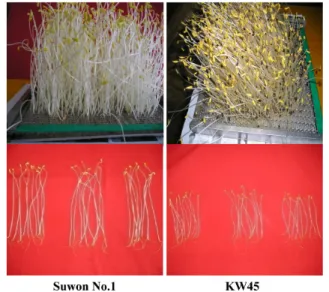
Fig. 1. 8 days-old buckwheat sprouts (common buckwheat- Suwon No.1 and Tartary buckwheat (KW45) at 25℃.
Results and Discussion
Effect of temperature on growth of buckwheat sprouts The sprouts of common buckwheat (Suwon No.1) and Tartary buckwheat (KW45) showed long and bright-white hypocotyl and light-yellow colored cotyledon as a typical buckwheat sprout, which were very similar to those of buckwheat sprouts developed by Kim et al. (2001). The effect of temperature on growth and fresh weight of common and Tartary buckwheat sprouts was shown in Table 1 and Fig. 1.
In common buckwheat sprouts, it was found that root length at 20℃ was longer (5.93 cm) than at 25 and 30℃, whereas the hypocotyls length, fresh weight of each sprout, and whole fresh weight showed the highest value at 30℃, and followed by 20 and 25℃.
Root length, hypocotyl length and fresh weight of each sprout and whole fresh weight of Tartary buckwheat were also the highest at 30℃, and followed by 20 and 25℃
respectively. These data indicated that high temperature of 30℃ affected positively growth of buckwheat sprouts rather
than lower temperatures, 20 and 25℃.
Temperature and deep sea water (5% and 10%) treatments
affected sprout growth and fresh weight as shown in Table 2
and Fig. 2. Hypocotyl length and fresh weight were measured
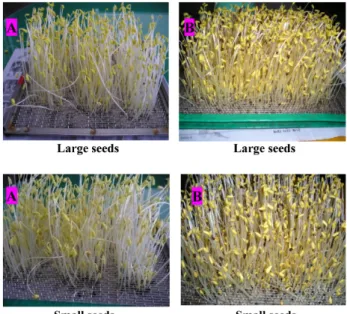
Fig. 3. Effect of seed quality on sprouts characteristics of buckwheat species. Common buckwheat ‘Suwon No.1’ (A), Tartary buckwheat ‘KW45’ (B).
Table 2. Effect of temperature and deep sea water on the growth and fresh weight of buckwheat sprouts.
Temperature (℃)
DSW concentrations (%)
CV. Suwon No.1 CV. KW45
Hypocotyl length (cm)
Fresh weight /sprout (g)
Hypocotyl length (cm)
Fresh weight /sprout (g)
20° Control 15.00a 0.31a 12.00a 0.16
5% 12.43b 0.23b 7.22b 0.08
10% 13.33b 0.24b
yND
xND
25° Control 18.37a 0.35b 13.13a 0.17
5% 14.77b 0.26c 9.03b 0.11
10% 14.80b 0.46a ND ND
30° Control 16.57b 0.31a 11.30a 0.15
5% 16.77b 0.32a 7.43b 0.10
10% 17.87a 0.33a ND ND
y
Means separation within ranks by Duncan’s multiple range tests at 5% level of significance and the mean followed by same letter are non-significantly at 5% level of significance.
x