참깨는 아프리카 사반나가 원산지로 고온단일 조건에서 개화가 촉진되는 대표적인 단일성 작물이다. 일반적으로 작물의 개화를 결정하는 요인은 기본영양생장성, 감온성과 감광성이다(Garner et al., 1920). 지금까지 참깨를 대상으 로 온도, 일장관련 연구는 매우적기 때문에 고온단일 조건 에서 개화가 촉진되는 콩에 관한 연구 결과를 활용할 수가 있 다. 콩의 경우 온도와 일장의 상호작용연구에서 저온(21°C)에 비해 고온(27°C)에서 개화일수가 감소되며 그 최대 효과는 장일보다 단일조건에서 크다고 하였다(Board et al., 1984).
또한 밤의 온도가 개화를 조절하는 일장반응에 영향을 미 칠 수 있다고 하였다(Parker et al., 1943; Van Schaik et al., 1958). 일반적으로 콩은 파종기가 늦어질 경우 수량은 짧아 진 생식생장기간에 의해 영향을 받지만 영양생장기간에는
영향을 미치지 않는다고 하였다(Boquet et al., 1983). 참깨 의 파종적기는 5월 중순인데 이보다 파종기가 늦어지면 고 온단일 조건으로 참깨 영양생육기간이 경과하기 때문에 최 초 개화까지 소요일수는 짧아진다고 하였다(Katoh et al., 1996; Kumazaki et al., 2002). 참깨 일장관련 연구에 의하 며 8시간 일장처리는 13시간에 비하여 최초 개화절위가 낮 아지고 최초 개화시기도 앞당겨진다고 하였다(Sinha et al., 1973; Kotecha et al., 1975; Suddihyyam et al., 1992). 주 간온도와 야간온도를 각각 27°C, 20°C로 설정하였을 경우 22°C, 15°C 조건에 비하여 최초 개화절위에는 영향을 미치 지 않지만 개화일수는 단축되었다(Suddihyyam et al., 1992).
또한 최초 개화절위가 1~3마디 낮아지고 개화일수가 5~10 일정도 단축이 되지만 이러한 결과는 개화 시에 일장과 온
온도와 일장조건에 따른 참깨 개화 및 생육특성 영향
심강보
1,†
・ 구본일2
・ 신명나2
・ 전원태1
Effect of Temperature and Daylength on Flowering and Growth Characteristics
Kang Bo Shim
1,†
, Bon Il Goo2
, Myoung Na Shin2
, and Won Tae Jeon1
ABSTRACT Sesame is typically a temperature- and day length-sensitive plant, as its flowering is promoted under high temperature and shorter day length conditions. The experiment carried out in the present study revealed that day length influenced sesame flowering to a much greater extent than temperature. The degree of day length influence differed depending on the sesame variety. Days from sowing to flowering was negatively correlated with yield-related characteristics such as stem length, capsule number per plant, 1,000 seed weight, and seed weight per 10a. In cases where the period from sowing to flowering was longer and flowering date was later, the reproductive growth period was shorter during maturity. Analysis of the effects of temperature and day length on seed yield production revealed that temperature was a much more influential factor than day length. However, day length was more influential than temperature under low temperatures, such as 22°C. All varieties apart from Ansan were shown to be primarily influenced by temperature. Sesame varieties were grouped in view of optimal seed sowing time through principal components analysis. The Poongsung and Sungboon varieties favored early sowing under low temperatures and short day lengths.
The DT45, Poongsung, 90 days, Ansan, and Sungboon varieties favored late sowing under high temperatures and long day lengths.
The Yangbaek and Arum varieties could be sown both early and late.
Keywords : day length, days from sowing to flowering, sesame, temperature
Original Research Article
ⓒ 본 학회지의 저작권은 한국작물학회지에 있으며, 이의 무단전재나 복제를 금합니다.
This is an Open-Access article distributed under the terms of the Creative Commons Attribution Non-Commercial License (http://creativecommons.org/licenses/by-nc/3.0) which permits unrestricted non-commercial use, distribution, and reproduction in any medium, provided the original work is properly cited.
1)농촌진흥청 국립식량과학원 중부작물부 농업연구관 (Senior Researcher, Department of Central Area Crop Science, National Institute of Crop Science, RDA, Suwon 16429, Korea)
2)농촌진흥청 국립식량과학원 중부작물부 농업연구사 (Junior Researcher, Department of Central Area Crop Science, National Institute of Crop Science, RDA, Suwon 16429, Korea)
†
Corresponding author: Kang Bo Shim; (Phone) +82-31-695-0642; (E-mail) [email protected]
<Received 25 April, 2020; Revised 2 July, 2020; Accepted 22 July, 2020>
도의 영향이 미미하다고 하였다. 참깨 파종기가 늦어지면 주당 꼬투리수가 감소되어 전체적으로 수량성이 감소하였 다(Katoh et al., 1996; Idea et al., 1999). 또한 참깨의 수량 은 꼬투리가 달려있는 마디수에 의해 결정되며 마디당 꼬 투리수는 품종이나 재배환경에 차이가 매우 적게 나타난다 고 한다(Idea et al., 1999). 참깨는 최하위 마디에서부터 매 일 1~2개 꽃이 개화하며 개화기간은 약 30일 정도이다. 참 깨 마디에 달려있는 꽃이 성숙하여 꼬투리가 형성되고 궁 극적으로는 수량성을 결정하게 되므로 온도와 일장에 따른 꽃이 핀 마디수를 조사하는 것은 매우 중요하다. 또한 참깨 는 단일조건에서는 꼬투리가 줄어든다는 연구결과를 얻은 바 있다(Shinha et al., 1973). 지금까지 온도와 일장에 따른 참깨 생육과 수량성에 미치는 영향에 대하여 보고된 논문 은 거의 없다. 국내에서는 1987년에 유사한 내용의 연구결 과를 학술대회에 발표를 하였으나 연구논문으로 보고된 바 가 없으며 일본에서 온도와 일장이 참깨 줄기 및 개화에 미 치는 영향에 관한 연구 결과를 보고하였다(Kumazaki et al., 2008). 본 연구는 다양한 온도와 일장 조건이 참깨 품 종의 개화일수, 꼬투리수, 천립중, 수량성에 미치는 영향을 분석하여 파종시기에 따른 적응성이 높은 품종을 구분하기 위한 기초자료를 얻고자 수행하였다.
재료 및 방법 시험재료 및 재배조건
본 연구는 2019년부터 2020년 3월까지 경기도 수원에서 기상조건을 인위적으로 조절할 수 있는 시설에서 수행하였 으며 분지형, 생육기간, 경장 등 생육특성이 다양한 안산깨, 성분깨, 풍성깨, 양백깨, DT45, 90일깨, 아름깨 등 7품종을 시험재료로 사용하였다. 12시간 일장 조건에서 온도를 22°C, 24°C, 26°C를 달리 설정하여 참깨 품종의 개화일수, 생육 및 수량에 미치는 온도 영향을 조사하였고 마찬가지로 28°C 조건에서 일장을 13시간, 14시간, 15시간 등 달리 설정하여 개화일수, 생육 및 수량에 미치는 일장 영향을 조사하였다.
일장은 오전 7시부터 오후 6시까지만 처리하였다. 1/50,000a 와그너 포트에 일정한 간격으로 품종별로 파종을 하였으며 기타 재배관리는 농촌진흥청 참깨 표준재배기술(RDA, 2003) 에 준하여 실시하였다. 난괴법 3반복으로 시험구를 배치하 였으며 전체 참깨 주수의 50% 이상이 개화하였을 때를 개 화기로 보았으며 기타 생육 및 수량성에 관한 기본조사요령 은 농촌진흥청 농업과학기술 연구조사분석기준(RDA, 2012) 에 준하여 실시하였다.
생육 및 수량특성 조사
개화일수(Days to flowering)는 파종 후 개화기(50% 개 화)까지의 기간으로 계산하였고, 경장(Stem length)은 지제 부에서 지상부 식물체 끝에까지 길이로, 주당삭수(Number of capsule per plant)는 1개 식물체에 달려있는 총 꼬투리 수로 계산하였으며 천립중(1,000 seed weight)은 참깨종자 1,000개의 무게이고 표준 재식거리(30 × 10 cm)로 심었을 때 소요되는 개체수(20,000주/10a)를 감안하여 개체당 종자 무게를 측정하여 10a 당 수량성을 환산하였다. 참깨는 무한 화서로서 우리나라 기상조건에서는 개화기간이 1개월 정도 지속되기 때문에 개화일수를 계산할 때 첫 꽃 개화시기와 50%, 80% 개화하였을 때를 비교하여 분석하였다.
통계분석
통계분석은 SAS 9.2 (Statistical Analysis Systems Inc., Raleigh, NC, USA)를 이용하여 분산분석(ANOVA)을 실시 하였으며 최소유의차검정(Fisher’s least significant difference test)과 던컨의 다중범위검정(Duncan’s multiple range test) 으로 5% 유의수준 검정하였다. 또한 주성분분석(principal component analysis)을 통하여 환경조건(온도, 일장)과 참 깨 품종간의 연관성을 분석하였다.
결과 및 고찰 온도 및 일장에 따른 개화반응
재배환경이 다른 조건에서 참깨 품종의 개화반응에 대한 차이를 통계분석(ANOVA)한 결과 온도 및 일장에 따라 참 깨 품종의 개화기간에 유의적 차이가 있었으며 온도와 일 장의 상호작용도 존재하는 것으로 분석되었다(Table 1).
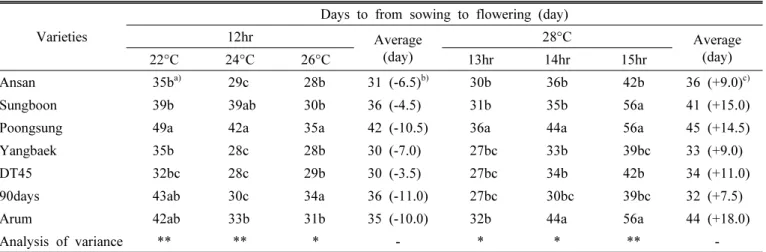
단일(12시간) 조건에서 온도를 22°C, 24°C, 26°C로 달리 처리하고 참깨 품종 간 평균 개화일수를 비교하였다. DT45 와 양백깨가 30일이었고, 안산깨가 31일로 상대적으로 짧 았으며, 성분깨와 90일깨는 36일였고 풍성깨는 42일로 상 대적으로 길었다(Table 2). 온도 증가에 따른 개화일수 단 축정도는 90일깨가 11일, 풍성깨가 10.5일, 아름깨가 10일 로 크게 나타났는데 이러한 품종간 차이는 개화에 필요한 온도 감응도나 소요 적산온도 등 조건이 다르기 때문이다.
고온(28°C) 조건에서 13시간, 14시간, 15시간 등 일장을 달 리 처리하고 참깨 품종 간 개화일수를 비교하여 보면 90일 깨가 32일, 양백깨가 33일, DT45가 34일로 상대적으로 짧 았으며 성분깨 41일, 아름깨 44일, 풍성깨 45일로 길었다.
일장이 길어질수록 참깨 개화는 늦어지는데 품종간 반응도 를 보면 90일깨가 7.5일, 안산깨와 양백깨가 각각 9.0일로
Table 1. ANOVA of days from sowing to flowering of sesame varieties depending on different temperatures and day lengths.
Source of variation df Sum of Sq Mean Sq F value Pr (>F)
Variety 61046 .9722 174.4954 249.57 <0.001**
Temperature 2 878.2218 439.1109 628.03 <0.001**
Day length 2 3202.6667 1601.3333 1834.25 <0.001**
Temperature × day length 4 320.1561 26.6797 38.16 <0.005*
**, *Significant at p < 0.01, 0.05 respectively
Table 2. Days to flowering of sesame varieties depending on different temperature and day length conditions.
Varieties
Days to from sowing to flowering (day)
12hr Average
(day)
28°C Average
(day)
22°C 24°C 26°C 13hr 14hr 15hr
Ansan 35b
a)29c 28b 31 (-6.5)
b)30b 36b 42b 36 (+9.0)
c)Sungboon 39b 39ab 30b 36 (-4.5) 31b 35b 56a 41 (+15.0)
Poongsung 49a 42a 35a 42 (-10.5) 36a 44a 56a 45 (+14.5)
Yangbaek 35b 28c 28b 30 (-7.0) 27bc 33b 39bc 33 (+9.0)
DT45 32bc 28c 29b 30 (-3.5) 27bc 34b 42b 34 (+11.0)
90days 43ab 30c 34a 36 (-11.0) 27bc 30bc 39bc 32 (+7.5)
Arum 42ab 33b 31b 35 (-10.0) 32b 44a 56a 44 (+18.0)
Analysis of variance ** ** * - * * ** -
a)
Means followed by different letters are significantly different at the 5% significance level according to Duncan’s multiple range test
b)
Numbers in parentheses represent the average difference in days between 22°C and the other two temperature treatments.
c)
Numbers in parentheses represent the average difference in days between 12 hr and the other two day length treatments.
**, * Significant at p < 0.01, 0.05 respectively
Fig. 1. Effects of temperature and day length on days to flowering in sesame varieties. The solid and dotted line indicate
regression curves of days to flowering under temperature and day length, respectively.
짧았으며 풍성깨가 14.5일, 성분깨가 15.0일, 아름깨가 18.0 일로 길었다. 이러한 결과는 개화일수에 대한 품종간 일장 감응도 차이로 볼 수 있으며 풍성깨, 성분깨, 아름깨는 일 장이 길어짐에 따라 개화일수가 크게 늘어나는 경향을 보 였으나 안산깨, 양백깨, 90일깨는 그 정도가 적게 나타났다.
우리나라 기상조건에서 참깨 파종기는 5월 상중순인데 이보다 파종기를 앞당길 경우 일장보다는 온도에 민감한 온도감응형이 수량성 확보에 유리하고 6월 이후 만파를 할 경우에는 일장감응형 품종을 활용하는 것이 생육 및 수량 성이 상대적으로 높게 나타났다. 온도 및 일장조건에 따른 참깨 품종간 개화반응성 추정식을 분석하였다(Fig. 1). 온 도반응성은 안산깨와 아름깨는 비슷한 양상을 보였으며 DT45와 90일깨도 서로 유사한 반응을 나타내었다. 전반적 으로 24°C까지는 개화일수가 단축되었으나 26°C에서는 품 종 간 개화반응이 달랐다. DT45와 90일깨는 26°C 조건에 서 개화단축 효과가 줄어들었으나 풍성깨와 성분깨는 개화 단축 효과가 크게 나타났다. 참깨 품종간 개화반응성은 풍성 깨가 가장 크게(R2=0.9977) 나타났으며 90일깨(R2=0.4568) 가 가장 적었다. 이러한 품종간 차이는 온도 감응성, 적산 온도나 온도와 일장의 상호작용 등 여러 요인이 복합적으 로 관여하는 것으로 판단되었다. 일장반응성을 보면 대부분 의 품종에서 일장과 개화일수는 정상관을 나타내었다. 성분 깨와 90일깨의 상관정도는 결정계수(R2)가 각각 0.8386과 0.9231로 다른 품중에 비하여 낮았지만 DT45와 안산깨의 결정계수(R2)가 각각 0.9980과 0.9973으로 높은 정의 상관
을 나타났다. 참깨 품종간에 일장 반응 차이는 개화 소요 최적 일장이 다르거나 일장 감응도, 온도와의 상호작용성 등 다른 요인이 관여하고 있는 것으로 판단된다.
온도와 일장에 따른 생육 및 수량성 반응
일반적으로 참깨는 단일조건에서 고온일수록 개화일수 가 짧아져 영양생장에서 생식생장으로 빨리 전환되어 개화 가 촉진된다. 개화일수와 참깨 생육 및 수량성 관련 형질간 의 상관관계를 살펴보면 Fig. 2와 같다. 개화일수와 경장, 주당삭수, 천립중, 10a당 수량과 개화일수 간에는 부의 상 관관계를 타내었는데 개화일수가 길어질수록 개화가 늦어 지게 되고 생식생장기간이 줄어들어 수량관련 형질들의 기 본특성을 충분히 확보할 수 있는 기간이 부족해진다. 참깨 파종기가 늦어지면 고온단일 조건에서 개화가 촉진되어 개 화일수가 줄어들지만 충분한 영양생장기간이 확보되지 않 은 상태에서 생식생장으로 전환되기 때문에 기본적인 생육 량이 확보가 되지 않아 주당 꼬투리수가 감소되어 전체적 으로 수량성이 감소된다는 연구결과(Katoh et al., 1996;
Idea et al., 1999)와 일치하였다.
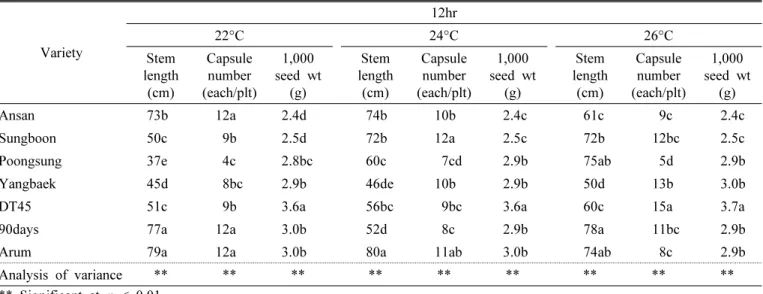
Table 3은 참깨 수량 구성요소인 경장, 주당삭수, 천립중 이 온도 및 일장을 달리한 조건에서 통계적으로 유의적인 차이가 있음을 나타내었다.
단일조건(12시간) 하에서 생육온도를 22°C, 24°C, 26°C 로 다르게 하였을 경우 참깨 생육특성 변화를 보면 경장은 온도가 올라갈수록 길어지나 90일깨와 아름깨는 오히려 줄
Fig. 2. Relationships among days from sowing to flowering and stem length, capsule number per plant, 1000 seed weight, and
seed weight of sesame varieties.
어들었다(Table 4). 개체당 꼬투리수는 온도가 올라갈수록 증가하였으나 안산깨, 90일깨, 아름깨는 오히려 감소하는 경향을 나타내었다. 천립중은 90일깨와 아름깨는 온도가
올라갈수록 줄어들었으나 나머지 품종들은 증가하는 경향 을 나타내었다. 이러한 생육반응 차이는 품종의 온도 감응 성 정도나 소요적산온도, 일장과의 상호작용 등에 기인한
Table 3. ANOVA of the agronomic characteristics of sesame varieties depending on different temperatures and day lengths.
Source of variation df Sum of Sq Mean Sq F value Pr (>F)
Variety 64907.0476 817.8413 9.77 <0.001**
Stem length 2 11435.7460 1905.9577 8.54 <0.001**
Capsule number 2 417.55566 9.5926 11.00 <0.001**
1,000 seed weight 2 20.6143 3.4357 34.96 <0.001**
** Significant at p < 0.01
Table 4. Agronomic characteristics of sesame varieties depending on different temperature conditions under a day length of 12 hours.
Variety
12hr
22°C 24°C 26°C
Stem length (cm)
Capsule number (each/plt)
1,000 seed wt
(g)
Stem length (cm)
Capsule number (each/plt)
1,000 seed wt
(g)
Stem length (cm)
Capsule number (each/plt)
1,000 seed wt
(g)
Ansan 73b 12a 2.4d 74b 10b 2.4c 61c 9c 2.4c
Sungboon 50c 9b 2.5d 72b 12a 2.5c 72b 12bc 2.5c
Poongsung 37e 4c 2.8bc 60c 7cd 2.9b 75ab 5d 2.9b
Yangbaek 45d 8bc 2.9b 46de 10b 2.9b 50d 13b 3.0b
DT45 51c 9b 3.6a 56bc 9bc 3.6a 60c 15a 3.7a
90days 77a 12a 3.0b 52d 8c 2.9b 78a 11bc 2.9b
Arum 79a 12a 3.0b 80a 11ab 3.0b 74ab 8c 2.9b
Analysis of variance ** ** ** ** ** ** ** ** **
** Significant at p < 0.01
Table 5. Agronomic characteristics of sesame varieties under different day length conditions at a growth temperature of 28°C.
Varieties
28°C
13 hr 14 hr 15 hr
Stem length (cm)
Capsule number (each/plt)
1,000 seed wt
(g)
Stem length (cm)
Capsule number (each/plt)
1,000 seed wt
(g)
Stem length (cm)
Capsule number (each/plt)
1,000 seed wt
(g)
Ansan 76bc 10ab 2.4c 75b 10a 2.4c 72d 9a 2.4c
Sungboon 79b 9b 2.5c 88ab 10a 2.5c 97c 2d 2.4c
Poongsung 84a 6c 2.9b 93a 6c 2.9b 99c 4c 2.8b
Yangbaek 48d 10ab 2.9b 53c 9ab 2.9b 60e 8ab 2.8b
DT45 71c 11a 3.7a 79b 7bc 3.5a 106b 7b 3.5a
90days 77b 12a 3.0b 75b 8b 2.9b 115a 9a 2.9b
Arum 81ab 7c 2.9b 94a 6c 2.8b 85d 4c 2.8b
Analysis of variance ** ** ** ** ** ** ** ** **
** Significant at p < 0.01
것으로 판단되었다.
참깨는 단일조건에서 개화가 촉진되는 것으로 알려져 있 다. 고온조건(28°C)에서 일장을 13시간, 14시간, 15시간으 로 달리하였을 경우 참깨 품종의 생육특성 변화를 보면 경 장은 일장이 길어질수록 증가하는 경향을 나타내었으나 안 산깨는 짧아졌으며 아름깨는 14시간 처리에서 길어졌다가 15시간 처리에서는 오히려 짧아지는 경향을 나타내었다 (Table 5). 개체당 꼬투리수는 일장이 길어질수록 줄어드는 경향을 보였으며 천립중도 일장이 길어질수록 가벼웠다.
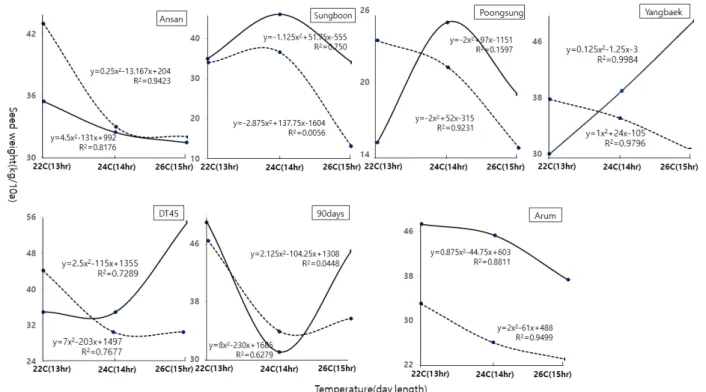
온도와 일장 조건이 참깨 수량에 미치는 영향을 비교하 여 보면 공시 품종 간에 다양한 양상을 나타내었다(Fig. 3).
일장과 온도에 따른 품종 간 수량성 변화를 보면 안산깨, 아름깨는 온도가 높을수록 수량이 감소하였으나 양백깨, DT45는 증가하는 경향을 나타내었다. 성분깨와 풍성깨는 24°C 조건에서 수량이 높았다가 26°C 조건에서 낮아졌다.
반면, 90일깨는 24°C 조건에서 수량이 가장 낮게 나타내었 다. 또한 일장이 길어질수록 수량은 감소하는 경향을 나타났 으며 일장 증가에 따른 품종간 반응을 다양하게 나타났다.
참깨 품종군 분류
참깨 생육특성 및 수량성에 따른 주성분 분석을 통하여 온도와 일장조합과 참깨 품종과의 연관성을 분석하였다
Fig. 3. Comparison of seed weights of sesame varieties under different temperature and day length conditions. The solid and dotted lines represent regression curves under temperature and day length, respectively.
Fig. 4. Principal components analysis of temperature/day length combinations and sesame varieties based on stem length, capsule number, 1000 seed weight, and seed weight data.
a
12 hr/22°C: A1, 12 hr/24°C: A2, 12 hr/26°C: A3, 28°C/13 hr: B1, 28°C/14 hr: B2, 28°C/15 hr: B3
b
an: Ansan, se: Sungboon, po: Poongsung, ya: Yangbaek, dt:
Dt45, nd: 90days, ar: Arum
(Fig. 4). 저온 단일조건과 연관성이 높은 품종군은 풍성깨, 성분깨로 참깨를 앞그루 작물로 하여 작부체계 재배를 할 경우 파종기를 앞당겨서 조기 파종이 가능한 품종으로 분 류되었다. 반면에 고온 장일조건과 연관성이 높은 품종군 으로는 DT45, 풍성깨, 90일깨, 안산깨, 성분깨로 작부체계 상 앞작물 재배기간을 충분히 확보기 위하여 참깨를 재배 할 경우 파종기를 늦추어 뒷그루로 만파에 적합한 품종으 로 분류되었다. 고온단일 조건에서는 DT45가 적합하였으 며 5월 하순에서 6월 상순에 참깨를 파종할 경우 적합한 품 종으로 분류되었다. 양백깨와 아름깨는 5월 상순부터 중순 까지 파종을 하였을 경우 수량성 확보에 유리한 품종군으 로 분류되었다.
적 요
온도와 일장처리를 달리하여 참깨 개화, 생육특성 및 수 량성에 미치는 영향을 구명하고자 2019~2020년 2년에 걸 쳐 수행하였으며, 그 결과를 요약하면 다음과 같다.
1. 단일조건(12시간)에서 온도 증가에 따른 참깨 품종의 개 화일수 단축정도는 90일깨가 11일, 풍성깨가 10.5일, 아 름깨가 10일이었으며 고온조건(28°C)에서 일장이 길어 질수록 참깨품종의 개화지연일수는 90일깨가 7.5일, 안 산깨와 양백깨가 각각 9일, 풍성깨가 14.5일, 성분깨가 15일, 아름깨가 18일로 나타났다.
2. 개화일수와 경장, 주당삭수, 천립중, 10a당 수량간에는 부의 상관관계를 나타내었는데 개화소요 일수가 길어 개화가 늦어지면 생식생장기간이 줄어들고 수량관련 형 질들의 기본특성을 확보할 수 있는 기간이 부족해진다.
3. 일장과 온도에 따른 품종 간 수량성 변화를 보면 안산 깨, 아름깨는 온도가 높아질수록 수량이 감소하였으나 양백깨, DT45는 증가하는 경향을 나타내었다. 일장이 길어질수록 수량은 감소하는 경향을 나타났으며 참깨 품종간 반응을 다양하게 나타났다.
4. 풍성깨, 성분깨는 파종기를 앞당겨서 조기파종에 적합 하였으며 DT45, 풍성깨, 90일깨, 안산깨, 성분깨는 파종 기를 늦추어 만파를 할 경우 적합하였다. 양백깨와 아름 깨는 5월 상순부터 중순까지 파종을 하였을 경우 수량 성 확보에 유리하였다.
사 사
본 논문은 농촌진흥청 작물시험연구사업(세부과제명 : 온도 및 일장에 따른 참깨 생리생태 특성 분석, 세부과제번 호 : PJ01427801)의 지원에 의해 수행되었다.
인용문헌(REFERENCES)