Received: June 3, 2020 Revised: July 27, 2020 Accepted: August 26, 2020
OPEN ACCESS
HORTICULTURAL SCIENCE and TECHNOLOGY 38(6):822-829, 2020
URL: http://www.hst-j.org pISSN : 1226-8763 eISSN : 2465-8588
This is an Open Access article distributed under the terms of the Creative Commons Attribution Non-Commercial License which permits unrestricted non-commercial use, distribution, and reproduction in any medium, provided the original work is properly cited.
Copyrightⓒ2020 Korean Society for Horticultural Science.
This research was supported by Korea Institute of Planning and Evaluation for Technology in Food, Agriculture, Forestry and Fisheries (IPET) through Agri-Bio Industry Technology Deve- lopment Program, funded by Ministry of Agriculture, Food and Rural Affairs (MAFRA;
114072-03, 117038-03).
Effect of Light Intensity and Temperature on the Growth and Functional Compounds in the Baby Leaf Vegetable Plant Peucedanum japonicum Thunb.
Jae-Kyung Kim 1 , Ho-Min Kang 1 , Dong-Chul Jang 1 , Jong-Kuk Na 2 , and Ki-Young Choi 2*
1
Department of Horticulture, Kangwon National University, Chuncheon 24341, Korea
2
Department of Controlled Agriculture, Kangwon National University, Chuncheon 24341, Korea
*Corresponding author: [email protected]
Abstract
This study was carried out to determine the optimal light intensity and temperature for cultivation of Peucedanum japonicum Thunb., a new baby leaf vegetable, and to improve the functional compounds through short-term stress just before harvesting. Plants were cultivated in a controlled environment at a temperature of 25 ± 1°C and relative humidity of 60 ± 5% for 16 days. Plants 3-5 cm high with 1
stand 2
ndtrue leaves were grown with different light intensities or temperatures. Treatments were 50, 100, 250, or 500 µmol·m
-2·s
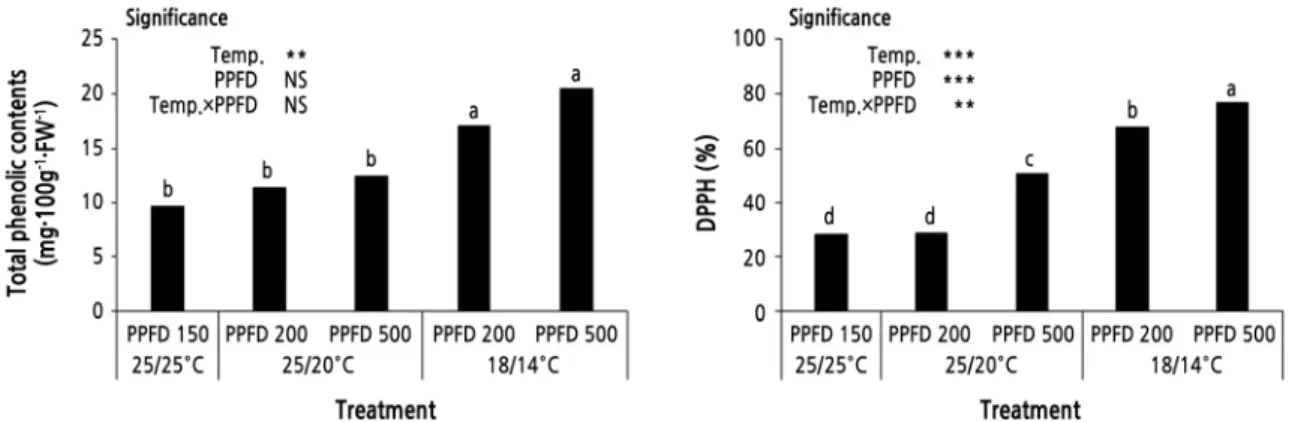
-1PPFD and 18/14°C, 24/20°C and 30/26°C of day and night temperature. At the harvest time of the baby leaf vegetables, growth, chlorophyll content, and functional compounds were investigated. The optimum light intensity for growth of P. japonicum Thunb. was PPFD 250 for 12 days, and the best temperature was 24/20°C. Total phenolic content was higher under high light intensity and low temperature treatment. When the plants were treated for 3 days with temperature (18/14°C and 25/20°C) and light intensity (PPFD 200 and 500) before harvesting, there was no difference in growth, but total phenolic content was high in PPFD 200 or 500 under 18/14°C treatments. Free radical activity (DPPH) was significant for temperature and light treatment. The highest free radical activity was in PPFD 500 under 18/14°C treatments. Therefore, after cultivation at optimal light and temperature, low-temperature treatment for three days before harvesting was effective for enhancing the functional contents.
Additional key words: chlorophyll, LED, phenolic contents, short-term stress, specific leaf area
Introduction
Since 2017, the sale of fresh-cut salads has increased 60% because of increased concern for health
and because of their convenience (KRCB, 2019). The consumption of baby leaf vegetables also has
increased. Baby leaf vegetables are about 10 cm high and contain 4 times more functional compounds,
such as phenolic compounds, flavonoids, and minerals, than normal leafy vegetables. However, baby
leaf vegetable varieties lack diversity because they use common leafy vegetables, such as lettuce, tat
soi, red beet, and amaranth.
Wild vegetables are edible grasses and leaves that grow in the ground and on mountains. There are 480 species of wild vegetables, and only 30 kinds of crops are used in South Korea (RDA, 2018). In the past 5 years, due to the increasing concern about health and well-being, wild vegetable production and output are steadily increasing (KOSIS, 2018).
Peucedanum japonicum Thunb. a wild vegetable, is a umbelligerae spp. and perennial herb that grows on the stream near the seashore. It is good for prevention and treatment of vascular dementia (Kim et al., 2013), lowering of blood pressure (Moon et al., 1983), and improvement of whitening and wrinkle (Kim et al., 2013). Okabe et al. (2011) reported that P.
japonicum Thunb. could aid in weight control. However, most P. japonicum Thunb. studies have been conducted for medical research. Studies on the cultivation of wild vegetables grown in open fields or plastic houses were insufficient due to the shading, planting density, and soil type used (Song et al., 2016; Suwa et al., 2018; Jin et al., 2019).
Environmental conditions, light, temperature, water conditions, and CO
2are very important for cultivating vegetables.
Among them, light intensity and temperature have a significant effect on the plant growth of functional material as well as on the growth (Savvas and Passam, 2002). Inadequate environmental stress produces reactive oxygen species (ROS) in plants, destroying plant DNA, RNA, proteins, and chlorophyll. To prevent destruction, plants produce natural antioxidants such as phenolic compounds to remove ROS. Therefore, environmental factors may be adjusted to increase functional substances. Lactuca indica L., a cultivated baby leaf vegetable, had increased total phenolic contents under high light levels (Kim et al., 2019), and lettuce can change its growth and functional contents with supplemental light (Li and Kubota, 2009). Lee et al. (2015) reported that the growth and functional contents of beet and Ssamchu were changed when the growth temperatures were 20°C, 25°C, and 30°C.
On the other hand, research is being conducted to increase the amount of functional substances in plants through short-term stress. Lee et al. (2014) reported that lettuce had increased total phenolic compounds without diminished growth when subjected to UV-a treatment for a short period of time. When 3-week-old kale was grown for 2 days at 4°C, a secondary metabolite production pathway was identified and phenolic compounds accumulated (Lee and Oh, 2015).
This study was conducted to investigate the growth responses and functional substance contents in P. japonicum Thunb.
in response to optimum light intensity and temperature. We tried to determine whether functional contents could be increased before harvest without affecting growth through light intensity and low-temperature stress for 3 days.
Materials and Methods
Culture Condition and Treatments
P. japonicum Thunb., bred by Gangwon Agricultural and Extension Services, was used as plant material in this
experiment. Before sowing, seeds were soaked in water over 6 hours and drained and stored in a 4°C refrigerator for 7
days. Thereafter, the seeds were sown in a 105-hole tray (hole size: W2.8× L2.8 × H4.0 cm) filled with horticultural soil
(Baroker, Seoul bio Ltd., Eumseong, Korea) and left to grow for 16 days. Environment conditions for seedlings were air
temperature of 25 ± 1°C with relative humidity of 60 ± 10% in a growth room using air conditioning (S-W138BAW, LG
Electronics, Seoul, Korea) and a humidifier (NH-6, Hwajeun ENG., Daegu, Korea). Light intensity was set to 100
µ mol·m
-2·s
-1photosynthetic photon flux density (PPFD) using bar type LEDs (ZVAS, Sunghyun Hightech Co. Ltd.,
Hwaseong, Korea) and set at 16 h light / 8 h dark periods. Seedlings (plant height 5.8 cm, leaf number 1.9, fresh weight
0.2 g) were transplanted into a 72-hole plastic tray (Hole size: W4.0 × L4.0 × H5.0 cm) and treated with various light intensity and temperature treatments.
Treatment 1. Light Intensity
The plants were treated with four different light intensities, PPFD 50, PPFD 100, PPFD 250, or PPFD 500 µ mol·m
-2·s
-1, using white LEDs with dimming control (NES-350-24, Mean Well Enterprises Co. Ltd., New Taipei, Taiwan) and a portable luxmeter (HD2102.2, Delta OHM, Padua, Italy). The light intensity was adjusted based on the plug tray. The cultivation temperature and relative humidity were maintained at 25 ± 1°C and 60 ± 10%, respectively, in a growth room.
At 12 days after treatment, the baby leaves reached full size, and growth, chlorophyll contents, and total phenolic contents were examined.
Treatment 2. Temperature
The plant was treated with three different growth temperatures (day/night), 18/14°C, 24/20°C, or 30/26°C using a closed-type plant production system (SJ-503PH, Sejong Scientific Co. Ltd., Bucheon, Korea). The cultivation relative humidity and light intensity were 60 ± 10% and 200 µ mol·m
-2·s
-1, respectively. At 16 days after treatment, the baby leaves reached full size, and growth, chlorophyll contents, and total phenolic contents were examined.
Treatment 3. Short-Term Temperature and Light Stress
Environmental conditions for cultivation were an air temperature of 25 ± 1°C and relative humidity of 60 ± 10% with PPFD 150 µ mol·m
-2·s
-1in a growth room. After 15 days of cultivation, 3 days before harvest, the plants were subjected to five different treatments in a closed-type plant production system: 25/20°C - PPFD 200, 25/20°C -PPFD 500, 18/14°C -PPFD 200, 18/14°C -PPFD 500, or control (25°C -PPFD 150). At 3 days after treatment, growth, total phenolic content, and free radical activity (DPPH) were examined.
Analysis of Growth Characteristics
We measured leaf length and width, number of leaves, leaf area (Li-3100c, Li-cor Inc. Lincoln, NE, USA), shoot fresh weight, and shoot dry weigh. Specific leaf area (SLA) was calculated using the following equation (Eq. 1).
·
(1)
Analysis of Chlorophyll & Functional Components
Chlorophyll (Chl) contents were determined according to the method described by Mackinney (1941) with minor
modifications. Briefly, torn fresh leaf (0.2 g) was used to extract Chl with 10 ml of 80% acetone at 4°C for 24 hours in dark
conditions. Absorbance of the extract solution was measured at wavelengths of 645 and 663 nm with a UV spectrometer
(UV-1800, Shimazu Corporation, Tokyo, Japan). Total Chl was calculated using Eq. 2. Total phenolic content (TPC) was
determined according to the Folin & Dennis method described by Li and Kubota (2009) with minor modification. Fresh
leaves (0.5 g) were used to extract TPC with 10 ml of 80% methanol at 4°C for 24 hours in dark conditions. Then 1 ml of the extract solution was mixed with 3 ml of distilled water, 1 ml of Folin & Ciocalteau’s phenol reagent, and 1 ml of water-saturated sodium carbonate solution. Fifty minutes later, absorbance of the mix solution was measured at a wavelength (WL) of 735 nm using a UV spectrometer. DPPH was determined according to the method described by Lee et al. (2003) with minor modifications. Fresh leaves (0.5 g) were used for extraction with 10 ml of methanol at 4°C for 24 hours in dark conditions. Then 0.9 ml of extract solution was mixed with 2.7 ml of 0.3 mM DPPH (2, 2-diphenyl- 1-picrylhydrazyl) solution. After incubation for 50 min in dark conditions at room temperature, absorbance of the solution was measured at a wavelength of 517 nm using a UV spectrometer. DPPH was calculated using Eq. 3.
×
×
(2)
× (3)
Statistical Analysis
The experiment was replicated two times for all treatments and used a completely randomized design. Data were obtained from eight plants for plant growth characteristics and from four plants for Chl, TPC, and DPPH. The SAS package (statistical analysis system, version 9.4, SAS Institute Inc., Cary, NC, USA) was used for ANOVA (analysis of variance) and Duncan’s multiple range test (DMRT) at 5% for data analysis.
Results and Discussion Light Intensity Effects
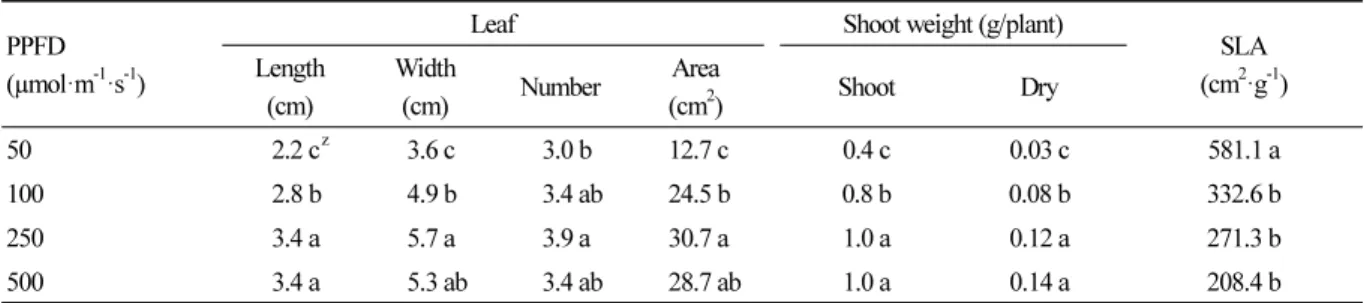
The optimum time for harvesting the P. japonicum Thunb. baby leaf vegetable was 12 days after treatments, and the plant height was 10 ‑ 12.7 cm (data not shown). In PPFD 250 and 500 treatments, leaf length and width were 3.4 cm and 5.3 ‑ 5.7 cm, respectively, larger than PPFD 50 and 100 treatments (Table 1) . The number of leaves was 0.4 ‑ 0.9 less in the PPFD 50 treatment than the other three treatments. Leaf area increased with increasing light intensity and decreased after PPFD 250 treatment. Each plant species has a suitable light intensity. Plants grown in low light intensity have reduced growth due to low photosynthesis, whereas under excessive light levels, plants adapt by reducing leaf area, thickening leaves, and other physiological changes (Lichtenthaler et al., 2007). Song et al. (2016) reported that P.
japonicum Thunb. had the best leaf growth at 35% shading treatment (PPFD 441.8 µ mol·m
-2·s
-1) and poor growth at 75%
shading treatment (139.5 µ mol·m
-2·s
-1), which showed the same tendency as in our study. The shoot fresh weight was 1.0
g in the PPFD 250 and 500 treatments, 2.5 times heavier than the PPFD 50 treatment. The same trend was observed for
shoot dry weight. Zha and Liu (2018) reported that chineses radish biomass is strongly dependent on light intensity, which
is because plants produce and fix carbohydrates throughout photosynthesis, thus increasing their dry weight. The shoot
dry weight of P. japonicum Thunb. increased when light intensity increased. SLA, meaning leaf thickness, was the
smallest in the PPFD 50 treatment (581.1 cm
2·g
-1), and the value decreased with higher light intensity. Fan et al. (2013)
Table 1. Effects of light intensity on leaf length, leaf width, number of leaves, shoot fresh weight, shoot dry weight, and specific leaf area (SLA) of Peucedanum japonicum Thunb.
PPFD (µmol·m
-1·s
-1)
Leaf Shoot weight (g/plant)
SLA (cm
2·g
-1) Length
(cm)
Width
(cm) Number Area
(cm
2) Shoot Dry
50 2.2 c
z3.6 c 3.0 b 12.7 c 0.4 c 0.03 c 581.1 a
100 2.8 b 4.9 b 3.4 ab 24.5 b 0.8 b 0.08 b 332.6 b
250 3.4 a 5.7 a 3.9 a 30.7 a 1.0 a 0.12 a 271.3 b
500 3.4 a 5.3 ab 3.4 ab 28.7 ab 1.0 a 0.14 a 208.4 b
z
Means with different letters in each column are significantly different by DMRT at p < 0.05 (n = 8).
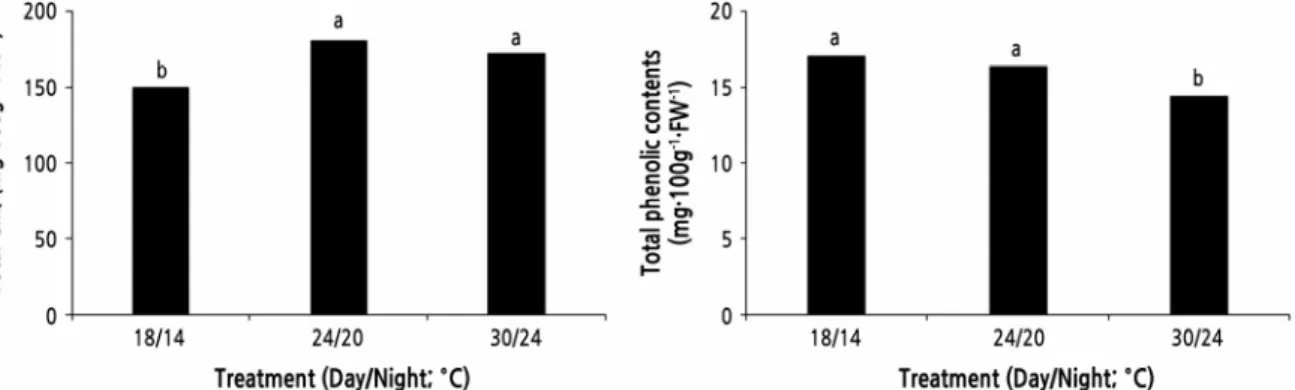
Fig. 1. Effect of light intensity on total chlorolphyll (Chl) and total phenolic content of Peucedanum japonicum Thunb. The different letters in each column indicate significant difference by DMRT at p < 0.05 (n = 4).
reported that SLA increased when the light intensity decreased during the tomato seedling process. This was to increase the light absorption in the plant by maximizing the leaf area by thinning the leaf thickness.
Total Chl and TPC differed according to light intensity treatments (Fig. 1) . Total Chl was highest in the PPFD 100 treatment and lowest in the PPFD 500 treatment. Chl tends to decrease when the plant is under stress (Iglesias et al., 2006).
Because the PPFD 100 treatment created the least light stress, the total Chl seemed to be high, and the PPFD 50 treatment, which is a very low light level to accumulate energy through photosynthesis, had low total Chl content. On the other hand, the TPC increased with higher light intensity. The maximum TPC was 15.6 mg·100g
-1·FW
-1in the PPFD 500 treatment, which was 2.2 times higher than the PPFD 50 treatment. When Indian lettuce ‘Sunhyang’ was grown for 12 days after light intensity treatments, the TPC was 2.1 times better than the PPFD 500 treatment (47.4 mg·100g
-1·FW
-1) compared to the PPFD 50 treatment (Kim et al., 2019). Pérez-López et al. (2018) reported that environmental stress, such as high light intensity, prevents the growth of lettuce but increases functional substances and enhances antioxidant capacity.
Temperature Effects
Sixteen days after temperature treatments, the leaf length, width, and number of the 24/20°C treatment were 4.4 cm, 7.1
cm, and 4.8 ea, respectively, larger than those of the other two treatments (Table 2) . Differences in leaf length, width, and
number also showed differences in leaf area. Shoot fresh weight and dry weight were higher in the 24/20°C treatment with
better leaf growth. Temperature affects plant growth by regulating the rate of enzymatic reactions in the plant, and growth
Table 2. Effects of growth temperature on leaf length, leaf width, number of leaves, shoot fresh weight, shoot dry weight and specific leaf area (SLA) of Peucedanum japonicum Thunb.
Temperature (Day/Night°C)
Leaf Shoot weight (g/plant)
SLA (cm
2·g
-1) Length
(cm)
Width
(cm) Number Area
(cm
2) Shoot Dry
18/14 3.6 b
z5.8 a 4.2 b 39.2 b 1.6 ab 0.19 b 207.3 b
24/20 4.4 a 7.1 a 4.8 a 61.2 a 2.1 a 0.27 a 224.7 a
30/26 3.1 b 5.5 a 4.6 b 40.4 b 1.4 b 0.20 b 206.5 b
z