42(1) : 38 45 (2011)
38
한국 산채류 8종 추출물의 폴리페놀 함량분석 및 Peroxynitrite 소거효과
누그로호 아궁·김명회·이진하1·김종대1·이강노2·최재수3·유영민4·박희준
*
상지대학교제약공학과
,
1강원대학교식품공학과,
2성균관대학교약학대학,
3부경대학교식품생명공학부
,
4연세대학교 보건과학대학Polyphenol Analysis and Peroxynitrite Scavenging Effect of the Extracts from Eight Korean Mountainous Vegetable
Nugroho Agung, Myung-Hoe Kim, Jin-Ha Lee
1, Jong-Dai Kim
1, Kang Ro Lee
2, Jae Sue Choi
3, Yeong-Min Yoo
4and Hee-Juhn Park
*Department of Pharmaceutical Engineering, Sangji University, Wonju 220-702, Korea
1
Department of Food Science & Biotechnology, Kangwon National University, Chuncheon200-701, Korea
2
College of Pharmacy, SungKyunKwan University, Suwon 440-736, Korea
3
Devision of Food Science and Biotechnology, Pukyong National University, Busan 608-737, Korea
4
Department of Biomedical Engineering, College of Health Science, Yonsei University, Wonju, Kangwon-do, 220-710, Korea
Abstract −
Mountainous vegetables are usually used in the early stage of plant growth. We attempted to identify the quantity of polyphenols (caffoeoylquinic acids (CQs) and flavonoids) and peroxynitrite scavenging effect (ONOO
-) of eight Korean mountainous vegetables. The prominent characteristics were as follows: Only the roots of two plants Taraxacum platycarpu m and Ixeris dentata contained chicoric acid. Five CQs were identified in the leaves of Cacalia firma whereas only 3- p -cou- maroylquinic acid in the petioles of the plant was shown. The quantities of polyphenols such as quinic acid or tartaric acid derivatives in the mountainous vegetables were generally high, though those of flavonoids were very low. The IC
50of chlo- rogenic acid, chicoric acid and kaempferol were 0.31, 0.12 and 0.25
µg/ml, respectively.
Key words −
Polyphenol, Peroxynitrite, Aster glehni , Ixeris dentata , Cacalia firma , HPLC
Peroxynitrite(ONOO
-)
는superoxide anion radical
과nitric oxide
의반응으로생성되어단백질의tyrosine residue
와결합하여독성을나타낸다
.
1)그러므로과량으로생성된per-
oxynitrite
는오히려지질과단백질을과산화시키고나아가세포독성을 야기할수있다
.
2)그 뿐아니라,
과량생성된peroxynitrite
는고콜레스테롤혈증,
동맥경화,
당뇨병및비만을일으킬수있다고한다
.
3-5)최근
polyphenol
화합물에대한peroxynitrite
소거효과가알려져있는바
chwinamul polyphenol, green tea polyphe- nol, wine polyphenol
의성분과peroxynitrite
소거효과가주로 보고되었다
. Peroynitrite scavenger
로는chwinamul
의caffeoylquinic acid
류가,
6)green tea
의epigallocatechin gallate (EGCG)
7)wine
의flavonoid
인catechin, epicatechin, myrice-
tin
과hydroxycinnamate
인caffeic acid, ferulic acid, chloro- genic acid
등이잘알려져있다.
8)저자들은 주로
Aster
속 식물을 위주로 취나물의caffeoylquinic acid(CQ)
류화합물분석과생리활성에대해보고해왔다
.
계속적인연구로서그외에한국에서자주산채류로사용되고있는
8
종의식물에대한페놀성화합물분석을하고자하였다
.
본연구에서는CQ
이외에도flavonoid
성분을
HPLC
로정성및정량하고자하였다.
보통성분함량이 높은 화합물이 기능성성분으로작용하기 때문에
flavonoid
성분과CQ
중어느쪽의함량이높은지를파악하려고하였다
.
분석을위하여
7
종의quinic acid
유도체인CQ
표준품이외에도
tartaric acid
유도체인chicoric acid(2,3-di-O- caffeoyltartaric acid)
를사용하였다.
플라보노이드화합물로는
6
종의화합물을지표물질로사용하여동시분석하고자*교신저자(E-mail):[email protected] (Tel): +82-33-730-0564
하였다
.
본연구에서분석에사용된산채로서섬쑥부쟁이,
씀바귀뿌리
,
개두릅,
민들레잎,
민들레뿌리,
병풍쌈의엽신및잎자루그리고두메부추를실험재료로사용하였다
. 재료 및 방법
기기 및 시약 −
HPLC
분석을위해사용한기기는Prostar 210 solvent delivery module, Prostar 325 UV-Vis detector
와
20
µL sample loop(Rheodyne, Rohnert Park, CA, USA)
으로구성된
Varian
사의HPLC
시스템(Walnut Creek, CA, USA)
이었다.
사용한HPLC
용 컬럼은Shiseido (Chuoku, Tokyo, Japan) Capcell Pak C18 column(5
µL, 250 mm×
4.6 mm I.D.)
이었다. HPLC
분석에사용된용매는모두HPLC
급용매를사용하였다
. Perxoynitrite
소거효과실험에사용된시약인
dihydrorhodamine 123(DHR 123)
과peroxynitrite
는각각
Molecular Probes (Eugene, OR, USA)
와Cayman Chemical Co. (Ann Arbor, MI, USA)
로부터구입한것을사용하였다
.
그리고 분석을 위해 사용된 표준 화합물인
3,4-di- O -
caffeoylquinic acid (3,4-DQ), 3,5-Di- O -dicaffeoyl- muco -quinic acid (3,5-DmQ), 3,5-di- O -caffeoylquinic acid (3,5-DQ), 4,5-
di- O -caffeoylquinic acid (4,5-DQ), 5- O -caffeoylquinic acid (5-CQ), 3- O -caffeoylquinic acid (3-CQ), 3- O - p -coumaroyl- caffeoylquinic acids (3-pCQ)
은성균관대학교약학대학의이강노교수에게서제공받은것을사용하였다
. flavonoid
성분은본실험실에서분리하여동정한표품이며
, chicoric acid
는
Sigma
사에서구입한것을사용하였다.
실험에사용한표준화합물의화학구조는
Fig. 1
에나타내었다.
식물재료 − 실험에사용한식물재료은섬쑥부쟁이
( Aster, glehni )
잎,
개두릅(the leaf shoot of Kalopanax pictus ),
씀바귀 잎
(the leaf of Ixeris dentata ),
민들레 잎과 뿌리(the leaf and root of Taraxacum platycarpum ),
병풍쌈의엽신과잎자루
(the blade and petioles of Cacalia firma )
및두메부추의잎
(the leaf of Allium senescens )
이었다.
이들은강원도원주시일대에서
5
월경채집하여건조하여세절한후실험에사용하였다
.
이들식물들은산림과학과김갑태교수의동정을받아실험에사용하였으며
,
표본은현재상지대학교제약공학과천연물화학실험실에보관중이다
.
추출 −
8
종의식물재료는500 ml
삼각플라스크에10 g
을각각 넣고
400 ml
의MeOH
을 넣어서ultrasonic cleaner (Branson 8510)
을이용하여60C
에서6
시간sonication
하였다
.
추출액을여과하여진공농축기를이용하여감압하에Fig. 1.
Structure of standard compounds used for HPLC analysis.
농축한다음이들을각각동결건조기를이용하여
24
시간동결건조하였다
.
HPLC 분석 −
8
종추출물과표준화합물을각각80%
메탄올에녹이고
HPLC
에주입하기전0.50
µm syringe filter
로여과하였다
.
자외선검출기의고정파장246 nm
를사용하여검출하였다
.
이동상으로solvent A
로서0.05% phosphoric acid
수용액을, solvent B
로서MeOH
를사용하여다음과같이기울기용리법으로용출하였다
. 0-15 min, 60% A : 40%
B; 15-20 min, 50% A : 50% B; 20-26 min, 45% A : 55%
B; 26-30 min, 60% A : 40% B
로설계하여전개하였으며흐름속도는
1.00 mL min
-1이었다. 50, 100 and 200
µg/mL
의세농도에서각각의피크면적을얻은회귀직선방정식 을얻었다
.
플라보노이드화합물6
종의회귀방정식은Table I
에나타내었고, chicoric acid
의회귀방정식은y = 235.0x + 35285
로나타났다.
여기서, y
는피크면적이며x
는농도(
µg/
ml)
이며r
2값은0.993
이었다.
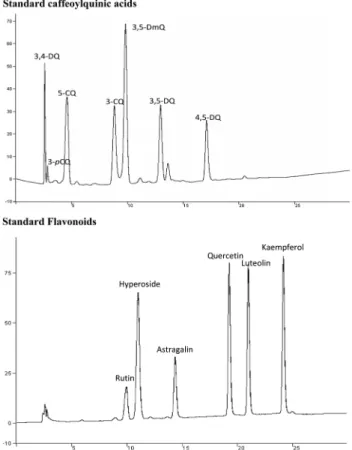
그리고CQ
와flavonoid
표준화합물을 이용해서얻은
HPLC chromatogram
은Fig. 2
에나타내었다
.
Peroxynitrite 소거효과 실험 −
Peroxynitrite (ONOO
-)
소거효과활성은변형된
Kooy
의방법을9)사용하여측정하였다
.
이방법은peroxynitrite
의존재하에비형광성의DHR 123
으로부터급속히생성되는강한형광성의rhodamine 123
을모니터링하는것이다
. Rhodamine buffer(pH 7.4)
는50mM sodium phosphate dibasic, 50 mM sodium phosphate monobasic, 90 mM sodium chloride, 5 mM potassium chloride, and 100
µM DTPA
로구성되어있다.
마지막DHR 123
용액농도는5 ìM
이다.
이검색법에서완충액은사용전에조제하였으며빙상에보관하고사용하였다
.
식물추출물은
10% DMSO(f.c. 5
µg/mL)
에녹여사용하였다. 0.3 N NaOH
용액에10
µM peroxynitrite
의추가여하에따른처리후최종의형광강도를측정하였다
.
산화된DHR 123
의형광강도는
microplate fluorescence reader FL 500 (Bio- Tek Instruments Inc., Winooski, VT, USA)
를이용하여 각각
480 nm
와530 nm
의excitation
과emission
에서측정하였다
. Peroxynitrite
소거활성은DHR 123
산화의검출을통하여 최종형광강도값에서
background fluorescence
값을빼서산출하였다
. L-Penicillamine
은양성대조약물로사용하였다
.
이활성실험의데이터를평균± SEM
으로나타내었다
.
결 과
CQ
는한국의산채인취나물에서높은함량으로나타나며,
이성분이나이를함유한추출물혹은분획물의
peroxynitrite
소거효과
,
6)항궤양효과,
10)항비만효과11)등에 대해보고해오고있다
.
특히취나물에이러한성분의함량이높은것으로나타났기때문에현
8
종산채에대하여CQ
뿐아니라플라보노이드함량을함께분석하였다
.
Table II
에나타낸바와같이섬쑥부쟁이는그함량이66.32 mg/g
에달하여가장CQ
함량이높았다. Fig. 3
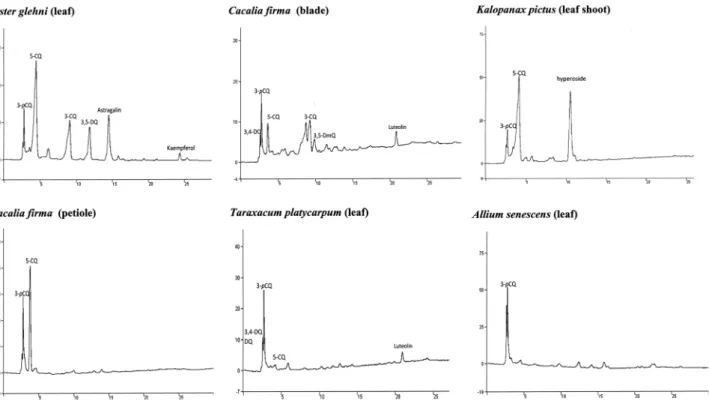
에나타내었듯이
,
섬쑥부쟁이의HPLC
분석결과3,5-DQ, 5-CQ, 3-CQ,
3-pCQ
가나타났다.
오갈피나무과식물인엄나무새순인개Table I.
Regression equation of flavonoids
No Flavonoid Retention time (min) Regretion Equation 1 Rutin 10.1 y=18.72x+32.50 R
2=0.997 2 Hyperoside 11.1 y=70.71x+71.00 R
2=0.999 3 Astragalin 14.4 y=27.10x+50.50 R
2=0.998 4 Quercetin 19.3 y=58.42x+72.00 R
2=0.999 5 Luteolin 21.1 y=55.44x+136.50 R
2=0.997 6 Kaempferol 24.3 y=54.85x+287.01 R
2=0.999 The UV detector was fixed at 246 nm. The mobile phase was a mixed solvent of 0.05% phosphoric acid in water (solvent A) and methanol (solvent B). The gradient system was: 0-15 min, 60% A : 40% B; 15-20 min, 50% A : 50%
B; 20-30min, 60% A : 40% B. Chromatography was performed at a flow rate of 1.00 mL min
-1. Regression equations were obtained by calculating peak areas for each concentration (18, 32 and 72
µg/mL).
Fig. 2.
HPLC chromatogram of standard compounds of
caffeoylquinic acids and flavonoids.
두릅은
5-CQ
와3-pCQ
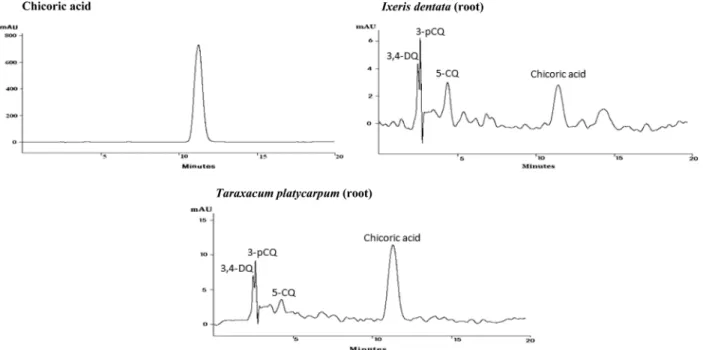
를함유하고있었다. Fig. 4
에나타내었듯이
,
씀바귀뿌리는3,4-DQ, 5-CQ, 3-pCQ
및chicoric acid
를함유하고있었다.
민들레잎은3-pCQ
만을함유하고나머지
6
종CQ
는확인되지않았던반면민들레뿌리는CQ
이외에도
chicoric acid
를함유하고있었다.
이러한실험결과는민들레의경우뿌리가
chicoric acid
를함유하며잎에는함유되어있지않음을나타내는것이다
.
본실험에서chicoric acid
가나타난식물은뿌리를사용한씀바귀와민들레였으며다른식물도뿌리에이화합물이함유되어있 는지확인해보는과정이필요하다고생각된다
.
병풍쌈의CQ
함량은이미이전에보고하였으나본연구에서는추가적으로 엽신과잎자루를나누어 분석할뿐아니라
CQ
와flavonoid
를동시에분석하고자하였다.
그결과,
병풍쌈엽신은
3,4-DQ, 3,5-DQ, 5-CQ, 3-CQ, 3-pCQ
를함유하고있Table II.
Content of caffeoylquinic acids and chicoric acid in eight Korean mountaious vegetables Compounds
Samples A. glehni (leaf shoot) K. pictus I. dentata (root)
platycarpum T.
(leaf)
platycarpum T.
(root)
C. firma
(blade) (petioles) C. firma A.
senescens 3,4-DQ (
1) 5.59±0.70
atrace 0.46±0.03 0.48±0.06 0.52±0.08 0.80±0.01 trace trace
3,5-DmQ (
2) ND ND ND ND ND 0.23±0.01 ND ND
3,5-DQ (
3) 12.1±0.64 ND ND ND ND ND ND ND
4,5-DQ (
4) 8.54±0.93 ND ND ND ND ND ND ND
5-CQ (
5) 18.81±0.63 14.61±0.30 8.36±0.09 0.90±0.07 7.64±0.42 19.5±0.49 55.20±1.09 trace
3-CQ (
6) 16.46±0.73 ND 3.43±0.05 ND ND 0.86±0.01 ND ND
3-pCQ (
7) 4.81±1.24 14.28±0.79 11.93±1.28 16.6±0.91 9.84±0.27 4.31±0.03 16.2±0.26 44.3±1.98
Chicoric acid (
8) ND ND 3.31±0.93 ND 4.85±0.14 ND ND ND
Sum (mg/g) 66.32±2.23 28.89±0.98 28.1±1.21 18.0±0.88 14.7±0.16 25.7±0.11 71.35±1.22 44.3±1.98
% of dried weight 6.63±0.23 2.89±0.1 2.81±0.12 1.80±0.09 1.47±0.02 2.57±0.01 7.14±0.12 4.43±0.20
% of extract 41.20±1.42 16.4±0.56 9.15±0.39 14.2±0.46 5.95±0.07 49.4±0.20 13.7±0.22 21.4±0.95
a
Values represent mean ± S.D. based on three experiments,
bND : not detected, trace: <0.10
Fig. 3.
HPLC chromatogam of six Korean mountainous vegetables that chicoric acid has not been detected.
음이나타났으나잎자루는
3-pCQ
만이나타났다. CQ
총함량으로서병풍쌈엽신은
25.7 mg/g
을나타낸반면잎자루는
71.3 mg/g
에달하였다.
한편,
단자엽식물의백합과에속하는두메부추는
3-pCQ
만이나타났으며그함량은44.3 mg/
g
으로서매우높았다.
이상에서특기할점은실험에사용된산채류
3-pCQ
는모두함유하고있었고chicoric acid
는뿌리를이용한식물에서만확인된점이었다
.
8
종식물재료에대한플라보노이드성분분석결과가Table III
이다.
산채로이용되고있는8
종식물재료는모두flavonoid
의함량이낮은것으로나타났다
. 6
종의플라보노이드성분으로분석하였을때가장총함유량이높은산채는섬쑥부
쟁이였으며
(8.38 mg/g),
개두릅은두번째로높았다(1.84 mg/
g).
섬쑥부쟁이는astragalin
과kaempferol
을함유하였으며개두릅은
hyperoside
를함유하였다.
민들레는뿌리에플라보노이드가확인되지않았으나잎에는소량함유되어있었다
(luteolin, 0.08 mg/g).
또,
병풍쌈은 엽신은luteolin
을0.08 mg/g
으로서매우소량이었고잎자루에서는검출되지않았다
.
이상과같은사실에서8
종식물재료만고려하면산채의생리활성성분으로서
CQ
함량이중요한것으로추측된다.
이에따라산채의폴리페놀함량에따른약리작용에서
CQ
는플라보노이드보다더중요하게작용할것으로예측된다
.
Table IV
에나타낸바와같이전반적으로8
종의산채류Fig. 4.
HPLC chromatogram of the extracts of a standard compound (chicoric acid), and I. dentata leaves, and T. platycarpum roots containing chicoric acid.
Table III.
Content of flavonoids in eight Korean mountaious vegetables Compounds
Samples Aster
glehni (leaf shoot) K. pictus I. dentat a (root)
platycarpum T.
(leaf)
platycarpum T.
(root)
C. firma
(blade) (petioles) C. firma A. senescens (leaf)
Rutin (
9) ND ND ND ND ND ND ND ND
Hyperoside (
10) ND 1.84±0.06 ND ND ND ND ND ND
Astragalin (
11) 8.18±0.55 ND ND ND ND ND ND ND
Quercetin (
12) ND ND ND ND ND ND ND ND
Luteolin (
13) ND ND ND 0.08±0.01 ND 0.08±0.01 ND ND
Kaempferol (
14) 0.2±0.01 ND ND ND ND ND ND ND
Sum (mg/g) 8.38±0.56 1.84±0.06 - 0.08±0.01 - 0.08±0.01 - -
% of dried weight 0.84±0.06 0.18±0.01 - 0.01±0.00 - 0.01±0.00 - -
% of extract 5.21±0.34 1.04±0.03 - 0.01±0.00 - 0.16±0.01 - -
a
Values represent mean±S.D. based on three experiments,
bND : not detected
추출물은그
IC
50값이20
µg/ml
이하로나타나산채류추출물은
peroxynitrite
를잘소거하는것으로생각된다.
효과가우수한추출물로는민들레뿌리
(IC
50, 1.35
µg/ml),
개두릅
(2.83
µg/ml),
두메부추(2.26
µg/ml)
이었다. Caffeoylquinic acid, caffeoyltartaric acid, flavonoid
간의활성비교를위하여
chlorogenic acid, chicoric acid, kaempferol
의활성검정을 했을 때
chicoric acid, kaemfperol, chlorogenic acid
의활성순서로나타났다
(Table V).
고 찰
본실험에서의분석에서
8
종의식물재료중섬쑥부쟁이의
CQ
함량이가장높은사실을알수있었다.
개두릅은산채로식용하는엄나무의순을지칭한다
.
엄나무잎과뿌리의성분들함량이비교된바있다
.
12)섬쑥부쟁이가여러종류의
CQ
화합물을함유하고있음에비해개두릅은5-CQ
와3-pCQ
만CQ
로서 함유하고 있는 점이 달랐고,
그 외hyperoside
란flavonoid
화합물을함유하였다.
씀바귀 뿌리는
5-CQ, 3-CQ, 3-pCQ
이외에도chicoric
acid
를함유하고있었다.
씀바귀추출물은뇌조직의산화적스트레스를예방하는특성이밝혀져있고13)흰씀바귀의라 디칼소거활성이보고되어있으므로
,
14)이식물중확인된이들폴리페놀성화합물이그러한작용을나타낼것으로예 상된다
.
서양에서는서양민들레
( Taraxacum officinale )
를질병치료에널리이용하며
dandelion
이라고불리고있다.
한국에도이서양민들레가전파하여귀화식물로야생하므로국산의 민들레
( T. platycarpum
혹은T. mongolicum )
과함께자생하고있다
.
민들레는포공영(Taraxaci Herba)
이라하여 건위,
진정
,
해열,
창종,
완하,
간질환 등에 이용해 왔다.
15)Taraxacum
속식물로부터steroid, sesquiterpenoid, triterpenoid, flavonoid, caffeoylquinic acid, caffeoyltartaric acid
성분이알려졌다
.
16,17)Liu
등은18)dandelion
이에탄올유도마우스간독성에 대한 보호효과를 보고하였고
, Park
등은19)T.
officinale
잎추출물이luteolin
과chicoric acid
가HPLC
분석중나타났다고보고하였다
. Heo
등은20)T. mongolicum
물추출물의라디칼소거능을보고하였다
.
그러나본연구결과에서보듯이민들레지상부에는
3,4-DQ, 5-CQ, 3-pCQ
만이확인되며지하부에서는이화합물이외에도
chicoric acid
를주로함유하고있음을알수있었다.
한편flavonoid
인
luteolin
은지상부에서만관찰되었으며지하부에는확인되지않았다
.
이상과같이민들레뿌리를이용한다면민들레지상부와는다른
chicoric acid
에의한생리활성이나타날 것으로 생각된다
. Chicoric acid
에 대해서는human immunodeficiency virus (HIV)-1
에대한억제효과21,22)이외에도인슐린분비증강효과
,
23)혈관이완작용,
24)항염및항산화작용이25)주로보고되어있다
.
본실험중뿌리를이용한분석에서만
chicoric acid
가나타난점이특이하다.
취나물중하나로이용되고있는병풍쌈의
CQ
화합물이동정된적이있지만26)본연구에서는그엽신과잎자루의
CQ
뿐아니라플라보노이드화합물을동시분석하고자하였다
.
그결과,
엽신은dicaffeoylquinic acid
류등CQ
와플라보노이드성분으로서
luteolin
을함유하였지만잎자루에는3-pCQ
만함유하므로엽신과잎자루의페놀성화합물조성이 상이함이 확인되었다
.
두메부추에 대한superoxide
Table IV.
Peroxynitrite scavenging effect of eight Koran mountainous vegetables
Treatment IC
50(
µg/ml) Treatment IC
50(
µg/ml)
T. platycarpum (root) 1.35±0.09 I. dentata (leaf) 10.83±1.32
T. platycarpum (leaf) 11.40±1.83 C. firma (blade) 12.53±1.06
A. senescens (leaf) 3.92±0.07 C. firma (petiole) 43.87±2.15
K. pictus (leaf shoot) 2.83±0.36 penicillamine 1.01±.15
A. glehni (leaf) 3.97±0.07
Data represent mean±S.D. (n=3).
Table V.
Peroxynitrte scavenging effect of chlorogenic acid, chicoric acid and kaempferol
Treatment Conc. % Scavenging effect IC
50(
µg/ml) Chlorogenic acid 2.00 85.8±0.55 0.31±0.02
0.40 61.0±3.33 0.08 21.3±3.18
Chicoric acid 2.00 85.5±0.71 0.12±0.01 0.40 70.1±1.07
0.06 46.6±1.11 0.016 21.0±1.66
Kaempferol 2.00 86.9±0.33 0.25±0.008
0.40 69.6±1.54 0.08 25.6±3.20
Penicillamine 5.00 78.0±0.88 1.30±0.21 1.00 48.4±2.35
0.20 15.7±0.21
Data represent mean ± S.D. (n=3).
dismutase (SOD)-like activity
등항산화효과가보고되었으나27)그활성성분은보고된바없다
.
본실험에서두메부추잎에서는
3-pCQ
가44.1 mg/g
에달하였으므로이성분이항산화작용을담당할것으로예측되었다
.
폴리페놀화합물의약리작용은취나물과
dandelion
성분에서알수있듯이항당뇨
,
항염,
고지혈증,
이뇨,
이담,
항산화,
진통,
해열,
항혈전
,
항알러지등일반적인약리작용을나타낸다.
17)그러므로
,
식물다양성에서따른산채의이용법모색을강구할수있을것이다
.
이상과같이산채종류혹은부위에따라페놀성화합물 조성이달랐으며
,
일반적으로산채는CQ
함량과플라보노이드등폴리페놀화합물함량이높은것으로나타났다
.
이중취나물로이용되는섬쑥부쟁이의
CQ
함량이가장높고,
민들레와씀바귀의경우뿌리에서
chicoric acid
가나타나며,
병풍쌈은엽신에비해잎자루에서
5-CQ
유도체의CQ
는확인되지않는것이특기할만한것이었다
.
산채의중요한일반적특성으로주로폴리페놀의높은함량인것으로제시 할수있었다
.
Peroxynitrite
소거활성은테스트한산채추출물의높은폴리페놀함량에기인한것으로생각된다
.
특히민들레뿌리,
개두릅
,
두메부추의활성이높아peroxynitrite
과다생성에따르는당뇨병
,
고지혈,
동맥경화,
비만및심혈관질환의예방과치료에이용될수있는기능성식품으로서의전망이 밝다고생각된다
.
또활성검색된3
종화합물중chicoric acid
는대조화합물로이용된
penicillamine
보다활성이크게나타난사실에따라상기질병치료에유익하게작용할것으 로예측된다
.
결 론
한국산
8
종의산채류에대해폴리페놀화합물의함량을비교했을때일반적으로
CQ
함량은높았으며상대적으로플라보노이드함량은낮았다
.
실험에사용된8
종산채류의추출물의
peroxynitrite
소거효과도높은편으로이는주로CQ
의높은함유량에따른것으로보인다.
특히, chicoric acid
는그IC
50값이평균치0.12
µg/ml
로서매우낮았으며이를함유하는산채는민들레뿌리와씀바귀뿌리였다
.
민들레뿌리의
peroxynitrite
소거활성이강하여이것과관련된비만
,
고지혈,
동맥경화,
당뇨병등에적용할수있는건강기능식품으로서전망이좋다고생각된다
.
사 사
본연구는농림수산식품부농림수산기술개발사업의지원 에의해이루어진것임
인용문헌
1. Radi, R., Beckman, J. S., Bush, K. M. and Freeman, B. A.
(1991) Peroxynitrite oxidation of sulfhydryls. The cytotoxic potential of superoxide and nitric oxide. J . Biol . Chem .
266: 4244-4250.
2. Haenen, G. R., Paquay, J. B., Korthouwer, R. E. and Bast, A.
(1997) Peroxynitrite scavenging by flavonoids. Biochem . Biophys . Res . Commun .
236: 591-593.
3. Korda, M., Kubant, R., Patton, S. and Malinski, T. (2008) Leptin-induced endothelial dysfunction in obesity. Am . J . Physiol . Heart Circ . Physiol .
295: 1514-1521.
4. Patcher, P., Obrosova, I. G., Mabley, J. G. and Szabo, C.
(2005) Role of nitrosative stress and peroxynitrite in the pathogenesis of diabetic complications. Emerging new ther- apeutical strategies. Curr . Med . Chem .
12: 267-275.
5. Drel, V. R., Patcher, P., Vareniuk, I., Pavlov, I., Lyzogulbov, V.
V., Grovez, J. T. and Obrosova, I. G. (2007) A peroxynitrite decomposition catalyst counteracts sensory neuropathy in streptozotocin-diabetic mice. Eup . J . Pharmacol .
569: 48-58.
6. Nugroho, A., Kim, K. H., Lee, K. R., Alam, M. B., Choi, J.
S., Kim, W. B. and Park, H. J. (2009) qualitative and quan- titative determination of the caffeoylquinic acids on the Korean mountainous vegetables used for chwinamul and their peroxynitrite-scavenging effect. Arch. Pharm. Res.
32: 1361-1367.
7. Tipce, G. L., Leung, T. M., Hung, M. W. and Fung, M. L.
(2007) Green tea polyphenols as an anti-oxidant and anti- inflammatory agent for cardiovascular protection. Cardivasc.
Hematol. Disord. Drug. Targets
7: 135-144.
8. Boveris, A., Validez, L. and Alvarez, S. (2002) Inhibition by wine polyphenols of peroxynitrite-initiated chemilumines- cence and NADH oxidation. Ann. N. Y. Acad. Sci.
957: 90- 9. Kooy, N. W., Royall, J. A., Ischiropoulos, H. and Beckman, 102.
J. S. (1994) Peroxynitrite-mediated oxidation of dihydror- hodamine 123. Free Radic. Biol. Med .
16: 149-156.
10. Nugroho, A., Choi, J., Lee, K. R., Bachri, M. S., Choi, J. S., Kim, W. B., Lee, K. T. and Park, H. J. (2010) Anti-ulcero- genic effect of the caffeoylquinic acid-rich extract from Ligu- laria stenocephala and HPLC analysis. Biol. Pharm. Bull.
33: 493-497.
11. Nugroho, A., Bachri, M. S., Choi, J., Choi, J. S., Kim, W. B., Lee, B. I., Kim, J. D. and Park, H. J. (2010) The inhibitory effect of the caffeoylquinic acid-rich extract of Ligularia stenocephala leaves on obesity in the high fat diet-induced rat. Nat. Prod. Sci.
16: 80-87.
12. Kim, M. Y., Yoo, Y. M., Nam, J. H., Choi, J. and Park, H. J.
(2007) Quantitative determination on the constituents of the stem bark and the leaf shoot of Kalopanax pictus by HPLC Analysis. Kor. J. Pharmacogn.
38: 270-276.
13. Oh, I. S., Sung, T. H. and Kim, M. R. (2003) Ixeris dentata
extract maintains glutathione concentrations in mouse brain tissue under oxidative stress induced by kainic acid. J. Med.
Food
6: 353-358.
14. Hong, S., Jeong, D., Kim, K. and Hwang, E. (2010) The com- position of the root of Ixeris dentate var. albiflora Nakai and cell viability and DPPH radical scavenging activities of its extract. Korean J. Nutr.
43, 105-113.
15. Ki, J.-W. (2006) Pharmacognosy, pp. 479-481, Dongmyungsa, Seoul.
16. Schütz, K., Kammerer, D. R., Carle, R. and Schieber, A.
(2005) Characterization of phenolic acids and flavonoids in dandelion (Taraxacum officinale Web. Ex Wigg.) root and herb by high-performance chromatography/electrospray ion- ization mass spectrometry. Rapid Commun. Mass Spectrum
19
: 179-186.
17. Schütz, K., Carle, R. and Schieber, A. (2006) Taraxacum-A review on its phytochemical and pharmacological profile. J.
Ethnopharmacol. ,
107: 313-323.
18. Liu, X.-Y, Ma, J., Park C.-M., Chang, H.–K. and Song, Y.-S.
(2008) Protective effect of dandelion extracts on ethanol- induced acute hepatotoxicity in C57BL/6 mice. J. Food Sci.
Nutr.
13: 269-275.
19. Park, C. M., Park, J. Y. and Song, Y. S. (2010) Luteolin and chicoric acid, two major constituents of dandelion leaf, inhibit nitric oxide and lipid peroxide formation in lipopolysac- charide-stimulated RAW 264.7 cells. J. Food Sci. Nutr.
15, 92-97.
20. Heo, S.-I. and Wang, M.-H. (2008) Antioxidant activity and cytotoxicity effect of extracts from Taraxacum mongolicum H.. Kor. J. Pharmacognosy
39: 255-259.
21. McDougall, B., King, P. J., Wu,B. W., Wu, B. W., Hos- tomsky, Z.,Reinecke, M. G. and Robinson, W. E. R.. (1998) Dicaffeoylquinic acid dicaffoyltartaric acids are selective inhibitors of human immunodeficiency virus type I integrase.
Antimicrob. Agents Chemother.
42: 140-146.
22. Lee, S. U., Shin, C.–G., Lee, C. K. and Lee, Y. S. (2007) Caf- feoylglycolic and caffeoylamino acid derivatives, halfmers of L-chicoric acid, as new HIV-1 integrase inhibitors. Eur. J.
Med. Chem.
42, 1309-1315.
23. Tousch, D., Lajoix, A.-D., Hosy, E., Azay-Milhau, J., Ferrare, K., Jahannault, C., Cros, G. and Petit, P. (2008) Chicoric acid, a new compound able to enhance insulin release and glucose uptake. Biochem. Biophys. Res. Commun.
377: 131-135.
24. Sakurai, N., Iizuka, T., Nakayama, S. and Funayama, H.
(2003) Vasorelaxant activity of caffeic acid derivatives from Cichorium intybus and Equisetum arvense . Yakugaku Zasshi
123
: 593-598.
25. Hu, W., Heo, S.-I. and Wang, M. H. (2009) Antioxidant and anti-inflammatory activity of Kalopanax pictus leaf. J.
Korean Soc. Appl. Biol. Chem.
52: 360-366.
26. Park, H.-J., Nugroho, A., Lee, J., Kim, J.-D., Kim, W.-B., Lee, K.-R. and Choi, J.-S. (2009) HPLC analysis of caf- feoylquinic acids in the extract of Cacalia firma and per- oxynitrite scavenging effect. Kor. J. Pharmacogn.
40: 365- 369.
27. Lim, T.-S., Oh, H.-J., Do, J. R. and Kim, H.-S. (2006) Phy- siological activities of leek extracts from Allium tuberosum and Allium senescens. J. Korean Soc. Food Sci. Nutr .
35: 301-306.
(2011. 1. 15 접수; 2011. 1. 31 심사; 2011. 2. 9 게재확정)