RADIOMETRIC RESTORATION OF SHADOW AREAS FROM KOMPSAT-2 IMAGERY
Jae Wan Choi, Hye Jin Kim, You Kyung Han, Yong Il Kim
Department of Civil and Environmental Engineering, Seoul National University [email protected], [email protected], [email protected], [email protected]
ABSTRACT ... In very high-spatial resolution remote sensing imagery, it is difficult to extract the feature information of various objects because of occlusion and shadows. Moreover, various and feeble information within shadows can be of use in GIS-based applications and remote sensing analysis. In this paper, we developed a radiometric restoration method for shadow areas using KOMPSAT-2 satellite image. After detecting the shadow, non-shadow pixels nearby are extracted using a morphological filter. An iterative linear regression method is applied to calculate the relationship between shadow and non-shadow pixels. The shadows are restored by the parameters of the linear regression algorithm.
Tests show that recovery of shadowed areas by our method leads to improved image quality.
KEY WORDS: Shadow, Radiometric Restoration, Morphological Filter, Linear Regression, KOMPSAT-2 1. INTRODUCTION
In various remote sensing applications, high-spatial resolution images provide useful spatial information to extract feature information about urban areas. The signals which are recorded in shadows are quite weak because there is little energy from the target objects or features.
Shadows remain an important obstacle to extracting useful data about features. Therefore, shadow analysis is essential for analyzing urban areas when using high- spatial remote sensing imagery such as IKONOS-2, QuickBird and KOMPSAT-2. Shadow analysis in remote sensing is classified into shadow detection and radiometric restoration of shadows. The radiometric restoration method helps to classify the land cover of complex urban areas and extract specific features such as buildings and roads. Y. Chen (2007) proposed a shadow information recovery algorithm from very high resolution satellite imagery by using the linear relationship between the illumination conditions in the shadow and in the non- shadow area. Q. Zhan (2005) analyzed the quantitative estimation of shadow effects in IKONOS-2 imagery of urban areas. It was an object-based approach using the linear regression and image processing method. Paul M.
Dare (2005) and P. Sarabandi (2004) compared various radiometric restoration methods, including gamma correction, and linear-correlation correction, and concluded that the linear algorithm performed the best.
Sohn (2008) developed the shadow-effect correction algorithm based on category by using equation between the amount of solar radiation impinging on the surface and image point to reflect light in aerial photo. In many algorithms, shadows turned into little dark or light color in contrast with ideal color transformation. Shadow boundaries occurred during shadow recovery, also. In this paper, we developed a radiometric restoration method for shadows using an iterative linear regression method to optimally calculate the relationship between shadow and non-shadow pixels. The shadows are restored by the parameters of the linear regression
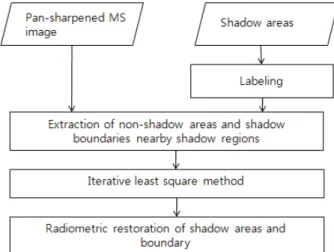
algorithm and shadow boundaries are restored by the smoothing parameters. We applied our experimental algorithm to pan-sharpened KOMPSAT-2 multispectral (MS) image. The entire workflow is illustrated in Figure 1.
Figure 1. Flowchart
2. EXTRACTION OF NON-SHADOW AREAS AND BOUNDARY
In the study, we first extracted the shadow areas manually. After labelling each shadow object, non- shadow pixels were extracted in order to calculate the relationship between the shadow pixels and nearby non- shadow pixels.
2.1 Labelling
The shadow objects extracted manually were rasterized to a binary image. The binary image is labelled in order to group all shadow pixels into independent object. A labelled image is used to represent image objects where pixels determined to be parts of an object will have the same object ID number (Zhan, 2003).
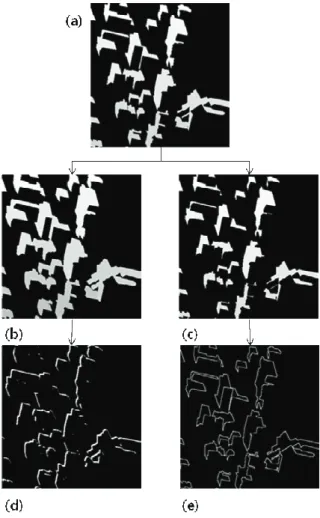
2.2 Extraction of non-shadow pixels and boundaries It is assumed that pixels of shadows a must have similar spectral characteristics to non-shadow pixels nearby. Therefore, non-shadow pixels adjacent to the shadow are needed to restore shadow pixels. In order to extract the non-shadow pixel nearby, labelled shadow objects and the direction of shadows are used. First, a dilation operation is applied to the labelled shadow objects image by using a morphological filter. Dilation of the binary image by a structuring element is the set of all displacements, such that the image and structuring element overlap by at least one element (R. C. Gonzalez, 2002). The result of the dilation operation is the binary image whose size of each object is expanded. The structuring element for applying the morphological filter is designed by considering the direction of the shadow, so it is organized by a bar shape toward the shadow direction in an image. By removing the shadow pixels from the dilation image, we can get the non-shadow areas nearby. In the shadow restoration, boundaries between the shadow and non-shadow area influence the shadow recover result because boundary pixels are brighter than ordinary shadow pixels. Boundary pixels are extracted by subtracting labelled shadow images from erosion images of morphological filtering, which are not inclusive of boundary.
3. RADIOMETRIC RESTORATION
Generally, the shadow recovery algorithm is accomplished by a simple linear regression or linear stretching based on the mean and standard deviation.
However, these methods could not optimally restore the shadow area to the original land cover color. To improve the restored image quality, we used the iterative linear regression method.
3.1 Iterative linear regression method
Throughout the procedures described above, non- shadow pixels and shadows, except shadow boundaries, were obtained for the iterative linear regression algorithm.
Each data is labelled to each corresponding shadow object. We could estimate the linear transformation between the non-shadow object and shadow object. The linear equation function is expressed by the following matrix equation (Q. Zhan, 2005):
⎥⎥
⎦
⎤
⎢⎢
⎣
⎡
⎥⎥
⎥⎥
⎥
⎦
⎤
⎢⎢
⎢⎢
⎢
⎣
⎡
=
⎥⎥
⎥⎥
⎥
⎦
⎤
⎢⎢
⎢⎢
⎢
⎣
⎡
i i
ni i i
ni i i
X X X
Y Y Y
α β 1 1 1
2 1 2
1
M M
M (1)
where Yin is the mean value of pixels on ith band at the
nth non-shadow object, Xin is the mean value of pixels on the ith band at nth shadow object, n is the object number,
and αi, βi are the linear regression coefficient. Equation (1) can be rewritten as follows:
i i
i AX
Y = (2) Therefore, the coefficients matrix, X, can be solved using the linear regression method as follows.
i T i i T i
i A A A Y
X =( )−1 (3) The shadow pixels of the entire image can be transformed to non-shadow pixels by the coefficients.
However, extracted non-shadow objects contained error terms that have properties that differ from the original shadow objects. If a difference between non-shadow pixels and adjusted shadow pixel at a given shadow object goes over a specific threshold, the mean values of the object are removed at the next linear regression iteration. The threshold value is decided by the standard deviation of error at a difference between the non- shadow and shadow pixels. After removing the mean value of the shadow object over the threshold, the linear regression method is applied again in order to calculate the optimal coefficients. Through iterative analysis, we can minimize the influence of the error term such as digitizing error or blurring of shadows and different land cover types between shadow and non-shadow area.
3.2 Radiometric restoration of shadows and boundaries
Radiometric restoration of shadows is accomplished by the coefficients of the iterative linear regression method.
It is applied to each multispectral band. According to the
kth object of the ith band, the shadow recovery equation can be described as in equation (4):
i k i
i i
k Shadow
Output =β +α ⋅ (4) where, k is the number of the shadow object, and i is the corresponding pan-sharpened multispectral band, and Shadowk is the kth shadow object. In the case of applying equation (4) at the boundary of the shadow object, restored values of shadow area have some light values than inner pixels restored shadow pixels because boundary pixels have brighter than inner-shadow pixels.
Even though image filtering is possible for shadow boundary revision, it will blur the surrounding area and distort the spectral characteristics of the original image.
When transforming the boundary of the shadow area, a modified coefficient is used to solve this problem. It is calculated by the ratio between the mean value of the shadow area except the boundary pixel and the mean value of boundary pixels. Using the above ratio, the restored boundary pixel values from the linear regression coefficient decreased exponentially. Shadow recovery of shadow boundaries is acquired by equation (5).
) (
)
( '
)
( ki
i k
Boundary mean
Shadow mean i k i
i i
k Shadow
Output = β +α ⋅ (5) where, Shadowi’ are the ith shadow pixels except shadow boundary pixels, k is the number of shadow objects, and Boundaryi means boundary of ith shadow object.
4. EXPERIMENTAL RESULT
Our algorithm was applied to a pan-sharpened KOMPSAT-2 image, which was acquired 31 August, 2007. The site was located in Daejeon, Korea, and included various land-cover types and buildings as shown in Figure 2. At first, we extracted shadow areas manually in the image and the binary shadow image was labelled.
The total number of labelled buildings was 130. Then, the non-shadow pixel and boundaries were extracted as in Figure 3. Using the labelled shadow objects and non- shadow objects, the iterative linear regression method was applied. The threshold of the iterative linear regression decided 0.5σ of error terms in the experiment.
At the end of the iteration, the optimal linear regression coefficient was calculated with ninety building objects.
Every shadow object was restored by the estimated optimal coefficients.
Figure 2. Test Site
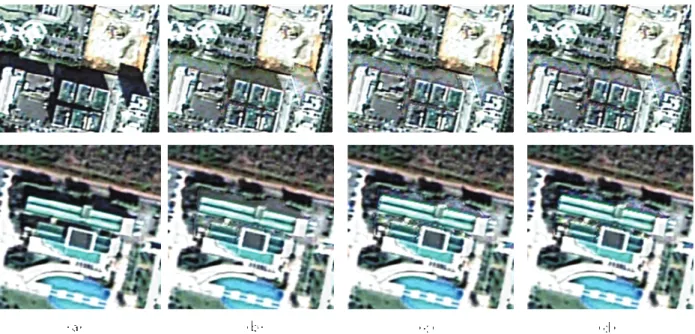
To evaluate our method, the result was compared with a representative shadow recovery algorithm like the linear stretch algorithm based on mean values and standard deviation and the simple linear regression method. Figure 4 shows the comparative results of radiometric restoration. With our algorithm the initially shadowed area was more similar to neighbouring land cover than with other methods. The linear stretching method and linear regression method showed that restored shadow areas are a little dark or have distorted colour. In shadow boundaries, modified coefficients improved image quality.
5. CONCLUSION
In this paper, a radiometric restoration method by using morphological filtering and iterative linear regression method is proposed. Through a morphological filtering algorithm, we can get non-shadow areas and shadow boundary objects. The iterative linear regression method is applied to calculate the linear transformation between the shadow and non-shadow area. In the experiments, the restored shadows obtained with our algorithm show a more similar colour to neighbouring ground. Therefore, it is concluded that recovery of shadows using our method leads to improved image quality.
Figure 3. Result of non-shadow objects and shadow boundaries extraction:
(a) labelled shadow image, (b) dilation operation, (c) erosion operation, (d) pixels of non-shadow object, (e)
pixels of shadow boundary Acknowledgements
The authors wish to acknowledge the financial support of the SNU SIR BK21 research program funded by the Ministry of Education & Human Resources Development , Korea Aerospace Research Institute and Engineering Research Institute.
References
Paul M. Dare, 2005, Shadow Analysis in High- Resolution Satellite Imagery of Urban Areas, PE&RS, 71(2), pp. 169-177.
P. Sarabandi, 2004, Shadow Detection and Radiometric Restoration in Satellite High Resolution, IEEE.
R. C. Gonzalez, and R. E. Woods, 2002, Digital Image Processing, Prentice Hall, pp. 523-527.
Hong-Gyoo Sohn and Kong-Hyun Yun, 2008, Shadow- Effect Correction in Aerial Color Imagery, PE&RS, 74(5), pp. 611-618.
Q. Zhan, W. Shi, and Y. Xiao, 2005, Quantitative Analysis of Shadow Effects in High-Resolution Images of Urban Areas, ISPRS Conference.
Q. Zhan, 2003, A Hierarchical Object-Based Approach for Urban Land-Use Classification from Remote Sensing Data, PhD Dissertation, Wageningen University/ITC, The Netherlands, Enschede, The Netherlands, 271 pp.
Y. Chen, D. Wen, L. Jing, and P. Shi, 2007, Shadow Information Recovery in Urban Areas from Very High Resolution Satellite Imagery, International Journal of Remote Sensing, 28(15), pp.3249-3254.
Figure 4. Results of radiometric restoration in shadow area
(a) original pan-sharpened image, (b) linear correlation correction result, (c) linear regression result, (d) our algorithm result