JKSCI
Verification of Human Error Factors for Access Control of Bodyguards through Multiple Risk Case Analysis
1)
Jin-Hwan Kim*, Sang-Jin Kim*
*Professor, Dept. of Security Service, Yongin University, Yongin, Korea
*Professor, Dept. of Security Service, Yongin University, Yongin, Korea
[Abstract]
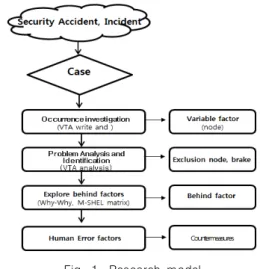
The purpose of this study is to investigate the human error of bodyguards caused in the process of performing access control activities between security missions, focusing on multiple risk cases, and to suggest countermeasures accordingly. To verify this, after arranging the sequence of events in a time series, the VTA technique and Why-Why analysis technique that can easily identify the problem centered on the variable node were used. In addition, environmental factors and personal factors that cause human errors were extracted through M-SHEL Metrix. As a result of analyzing multiple risk cases through such a method, the security environment factors that cause access control accidents include lack of time (impatience), prejudice against visitors, intensive work methods, lack of security management, unattended travel, and familiar atmosphere. (Relaxation), formal work activities, convenience provision, and underestimation were surveyed. In addition, human errors caused by personal security guards were investigated as low alertness , formal work, negligence of inspection, and comfortable coping.
▸Key words: Bodyguard, Multiple case analysis, Human error, Access control, Hazardous cases
[요 약]
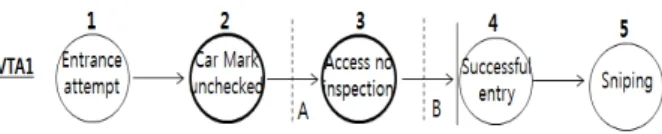
본 연구는 다중위해사례를 중심으로 경호임무수행 간 출입통제 활동을 실시하는 과정에서 유발 되는 경호원의 휴먼에러가 무엇인지 규명하고 그에 따른 대책을 제시하는데 목적이 있다. 이를 검증하고자 사건의 순서를 시계열로 배열한 뒤 변동노드를 중심으로 문제점을 파악할 수 있는
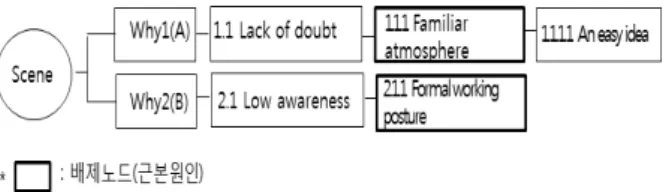
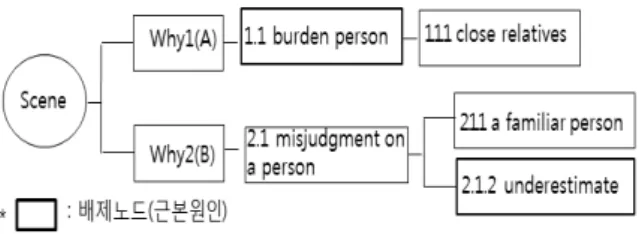
‘VTA 기법’과 ‘Why-Why 분석 기법’을 활용하였으며, 추가적으로 ‘M-SHEL Matrix’를 통하여 휴먼 에러를 유발하는 환경요인과 개인요인을 추출하였다. 분석결과, 출입통제 사고를 유발하는 경호환 경요인으로는 시간부족(조급함), 방문자에 대한 편견, 편중된 근무방법, 보안 관리미흡, 무사안일주 의 , 익숙한 분위기(긴장이완), 형식적인 근무활동, 편의제공, 과소평가 등으로 조사되었다. 그리고 경호원 개인적 측면에서 유발되는 휴먼에러는 낮은 경계의식, 형식적인 근무, 검측소홀, 안일한 대처 등으로 조사되었다.
▸주제어: 경호원(신변보호), 다중사례분석, 휴먼에러, 출입통제, 위해사례
∙First Author: Jin-Hwan Kim, Corresponding Author: Sang-Jin Kim
*Jin-Hwan Kim ([email protected]), Dept. of Security Service, Yongin University *Sang-Jin Kim ([email protected]), Dept. of Security Service, Yongin University
∙Received: 2020. 08. 10, Revised: 2020. 09. 09, Accepted: 2020. 09. 10.
Copyright ⓒ 2020 The Korea Society of Computer and Information http://www.ksci.re.kr pISSN:1598-849X | eISSN:2383-9945