Study Objectives: The aim of this study was to investigate the prevalence and characteristics of periodic limb movements during sleep (PLMS) in Korean patients with restless legs syndrome (RLS).
Methods: Unmedicated adult patients with idiopathic RLS (n = 354) who underwent polysomnography at three major sleep centers in tertiary hospitals were included. Characteristics of PLMS in RLS were analyzed using the time structure of polysomnographically recorded leg movements and periodicity indices (PIs). RLS severity and subjective sleep quality were assessed.
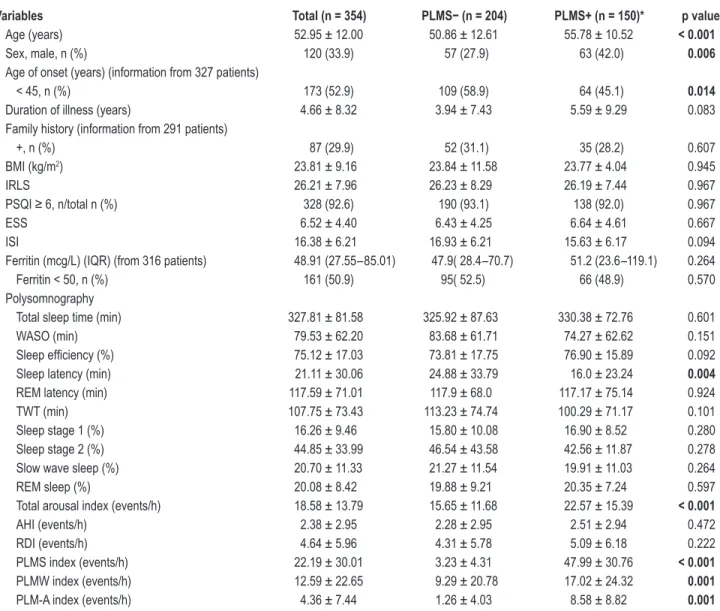
Results: Out of 354 patients with idiopathic RLS (mean age: 52.9 ± 12.0 years), 150 patients (42.3%) had RLS with a PLMS index greater than 15 events/h, and 204 (57.9%) had a PLMS index greater than 5 events/h. The distribution of inter-LM intervals was bimodal, and high PIs (0.86 ± 0.10) were observed in patients with RLS and PLMS (PLMS index > 15 events/h). The PLMS index was positively correlated with age (r = 0.228; p < 0.001), the periodic limb movements in wakefulness index (r = 0.455, p < 0.001) and arousal index (r = 0.174, p = 0.014), but not with RLS severity and parameters of sleep quality. In multivariate analysis, age and male gender were independently associated with PLMS > 15 events/h.
Conclusions: The prevalence of PLMS in Korean patients with RLS was lower than that observed in Western countries, but the characteristics of PLMS were not different. Ethnic differences and/or different genetic backgrounds may contribute to the varying prevalence of PLMS in RLS.
Keywords: restless legs syndrome, periodic limb movements in sleep, periodicity index, prevalence, sleep quality
Citation: Shin JW, Koo YS, Lee BU, Shin WC, Lee SK, Cho YW, Jung KY. Prevalence and characteristics of periodic limb movements during sleep in Korean adult patients with restless legs syndrome. J Clin Sleep Med 2016;12(8):1089–1097.
INTRODUCTION
Periodic limb movements during sleep (PLMS) are a sleep- related phenomenon, with periodic episodes of repetitive ste- reotypical movements of the extremities.
1Based on a study in North America, 80% to 90% of patients with restless legs syn- drome (RLS) have PLMS
2; hence, PLMS is closely associated with RLS.
3The therapeutic effects of dopamine agonists on RLS and PLMS support the hypothesis that RLS and PLMS are associated with similar alterations in the dopaminergic system.
4,5Therefore, PLMS may be an endophenotype of RLS, and the presence of PLMS may improve the diagnostic accu- racy of RLS.
6The prevalence of PLMS has been reported to differ between ethnic groups; indeed, PLMS has been shown to be signifi- cantly more prevalent among Caucasian children than among African American children.
7A genome-wide association study showed a significant association between an intron of BTBD9 on chromosome 6p and PLMS in the Icelandic population.
8These data suggest that the presence of PLMS in RLS may be influenced by ethnic or genetic factors. In a small study involv- ing Korean adult patients with RLS, we found that only 41.8%
of subjects had a PLMS index greater than 15;
9this prevalence is lower than that previously reported.
SCIENTIFIC INVESTIGATIONS
Prevalence and Characteristics of Periodic Limb Movements during Sleep in Korean Adult Patients with Restless Legs Syndrome
Jung-won Shin
1,2; Yong Seo Koo
3; Byeong Uk Lee
1; Won Chul Shin
4; Sang Kun Lee
1; Yong Won Cho, MD, PhD
5; Ki-Young Jung, MD, PhD
11
Department of Neurology, Seoul National University Hospital, Seoul National University College of Medicine, Seoul, Republic of Korea,
2Department of Neurology, CHA Bundang Medical Center, CHA University, Seongnam, Republic of Korea,
3Department of Neurology, Korea University Medical Center Anam Hospital, Korea University College of Medicine, Seoul, Republic of Korea,
4Department of Neurology, Kyung Hee University Hospital at Gangdong, Kyung Hee University College of Medicine, Seoul, Republic of Korea,
5