• 검색 결과가 없습니다.

A Study on Frequency Analysis of Websites Quality Evaluation Factors

N/A
N/A
Protected

Academic year: 2021

Share "A Study on Frequency Analysis of Websites Quality Evaluation Factors"

Copied!
12
0
0

로드 중.... (전체 텍스트 보기)

전체 글

(1)

웹사이트 품질평가 요인들의 빈도분석에 관한 연구

(A Study on Frequency Analysis of Websites Quality Evaluation Factors)

권 영 직1)*

(Kwon, Youngjik)

요 약 본 논문에서는 79편의 문헌연구를 통하여 99개의 웹사이트 품질평가 요인을 도출하였으며, 이들 중에서 7개 이상의 문헌에서 인용된 요인 19개를 요약하여 두었는데, 이들은 다음과 같다. ①신뢰성(도),

②사용의 편리성, ③디자인(시각적/미학적), ④응답속도(시간), ⑤정보품질, ⑥학습성, ⑦접근성(정보접근 의 용이성), ⑧유용성, ⑨항해성, ⑩감성(감정모습), ⑪정확성, ⑫콘텐츠, ⑬심미성, ⑭완전성, ⑮공감성, ⑯보 안성, ⑰전달성, ⑱상호작용성, ⑲책임성

핵심주제어 : 웹사이트 품질평가 요인

Abstract In this paper, 99 evaluation factors for website quality were derived from 79 research papers. Among them, 19 factors which are quoted in more than 7 research papers are summarized.

The followings show such summarized factors: (1) Reliability (2) Ease of use (3) Design (4) Response time (5) Information Quality (6) Learnability (7) Accessibility (8) Effectiveness (9) Navigation (10) Sensibility (11) Accuracy (12) Contents (13) Aesthetic Impression (14) Completeness (15) Sympathy (16) Security (17) Delivery (18) Interaction (19) Responsibility

Key Words : Websites Quality Evaluation Factors, Frequency Analysis

1. 서 론1)

일반적으로 품질은 “소비자들의 욕구(Needs)를 어떻게 충족시킬 것인가를 반영하는 제품 또는 서비스의 특성”이다[1]. 이러한 측면에서 Madu and Madu[2]는 e-품질(e-quality)의 차원은 전통

* Corresponding Author: [email protected]

†이 논문은 2014학년도 대구대학교 학술연구비 지원에 의하여 연 구되었음

Manuscript receivrd Aug 12, 2016 / revised Aug 22 ,2016 / accepted Aug 30, 2016

1) 대구대학교 컴퓨터IT공학부

적인 품질의 실제(Practice)와는 다르다고 제안하 였다. Lee, Kyung-Jin et al.[3]는 웹사이트는 시 스템 품질과 관련하여 안정적이고 정확하게 작동 을 하면서도 신속한 응답속도와 편리한 기능들을 제공해 줌으로써 이용자들의 구매활동을 지원해 줄 수 있어야 한다고 하였다.

그러나 소매상 웹사이트에 대한 품질은 소매상

웹사이트에 대해 고객들이 인지하는 것을 의미하

며, 정보, 엔터테인먼트, 거래능력, 디자인, 심미성

과 같은 속성에 대해 고객들이 반응하는 것을 의

미한다[4,5,6]. 웹사이트 방문객들이 직접 웹사이트

(2)

를 방문해서 즐거움을 찾는 것은 웹사이트의

“Stickiness”와 관련이 있다. “Stickiness”는 웹사 이트 방문객들이 오랫동안 해당 웹사이트에 머무 르게 하는 웹사이트에 대한 어떤 것을 의미한다 [7]. “Sticky website”는 방문자로 하여금 오랫동안 머무르게 해야 할뿐만 아니라, 그들로 하여금 해당 웹사이트로 자주 돌아오게 해야 한다. 그러므로 웹 사이트를 좀 더 흥미롭게 하기 위해서 웹사이트 개발자들은 고객들로 하여금 해당 웹사이트에 오 랫동안 머무르게 해야 하고, 또한 종종 돌아오도록 해야 한다. 이러한 촉진책은 구매 행위를 유발하 고, 궁극적으로는 브랜드 충성도를 높인다[8].

또한 웹사이트는 속도가 빨라야하고, 쉬운 항 해구조와 정보검색의 편리성, 금융 및 정보 교환 으로부터의 안전성 및 양질의 고객 서비스를 제 공해야 한다[4]. 또한 이들은 웹사이트 품질에 있 어서 “디자인”요인이 중요하다고 하였다. 웹사이 트에 대한 심미성은 고객들의 만족도를 결정하고, 고객들의 행동에 영향을 미치는 감정과 구매 결 정을 유발한다. 그러므로 웹사이트는 매력적이고, 창의적이며 미적으로 즐거워야 된다고 하였다.

Aladwani and Palvia[9]는 이와 같이 웹사이트 품질요인들은 아주 다양하기 때문에 본질적으로 평가하기가 복잡하고 다차원적이라고 하였다. 그 러나 웹사이트 품질평가는 다양한 요인들을 고려 해야하기 때문에[10], 본 논문에서는 이들 품질평 가 요인들을 문헌연구를 통해 도출한 후, 이들 요인들의 인용되는 빈도수를 분석하고, 7±2

*)

(7±2 는 마법의 수라고도 하는데, 주로 심리학에서 많 이 인용되며, 이는 인간이 작업메모리에 기억할 수 있는 평균 객체의 수이고 Miller의 법칙이라 고도 한다. 출처: Wikipedia (Miller, G. A.(1956),

“The magical number seven, plus or minus two: Some limits on our capacity for processing information”, Psychological Review, Vol.63. No.2, pp.81-97))에 근거하여 빈도수가 7 개 이상인 요인들을 도출하고자 한다.

2. 웹사이트 품질의 유형

보통 웹사이트의 품질 유형으로는 “정보 품질

(Information quality), 시스템 품질(System quality) 및 서비스 품질(Service quality)”로 대 별되며[11,12], 이들 3개의 웹사이트 품질 요인들 은 사용자들의 인식을 감동시키는데 중요한 역할 을 한다고 하였다[13]. 그러므로 이들 3개의 요인 들에 대해 아래에 좀 더 구체적으로 고찰하여 두 었다.

2.1 시스템 품질(System quality)

시스템 품질은 “정보처리 시스템 자체에 대한

평가뿐만 아니라 공학에 기반을 둔 성과

(Engineering-oriented performance characteristic) 에 대한 특성도 평가”한다[14,15]. 시스템 품질 요인으로는 “사용의 편리성(Convenience), 사생 활 보호(Privacy) 및 빠른 응답속도(Faster responses), 접근성(Accessibility), 항해성 (Navigability), 유용성(Usability), 사생활 보호 (Privacy)”요인 등을 활용하여 평가할 수 있다 [10].

2.2 정보 품질(Information quality)

정보 품질은 시스템에 의하여 생산되고 배송되 는 정보에 대한 품질이다[16]. 만약 시스템이 필 요한 정보를 제공하지 않는다면 사용자들은 불만 족을 느낄 것이며, 다른 웹사이트로 떠날 것이다 [17].

그러나 유용하고 업데이트(Update)된 정보를 가진 웹사이트는 고객들로 하여금 해당 웹사이트 를 방문하게 한다[18]. 사용자들로 하여금 재방문 을 유혹하기 위해서 웹사이트는 적절하고, 완전하 며 분명한 정보를 제공할 필요성이 있다[19]. 전 형적인 정보 품질요인으로는 “관련성(Relevance), 이해성(Understandability), 풍부성(Richness) 및 전달성(Currency)”등이 있다[10].

2.3 서비스 품질(Service quality)

서비스 품질은 “웹사이트에서 인도되는 전반적

인 지원”을 의미 한다. 즉, 인도된 서비스 수준을

어떻게 하면 고객의 기대와 잘 조화(Matches)시

(3)

키느냐하는 것이다[14,16]. 서비스 품질요인으로 는 “책임성(Responsiveness), 신뢰성(Reliability), 확실성(Assurance), 공감성(Empathy)”등이 있다.

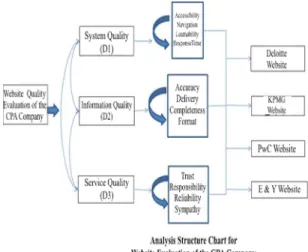
이들 3개의 웹사이트 품질유형에 속하는 세부 적인 품질평가 요인은 아주 다양한데, 이들 세부 적인 요인들을 중심으로 CPA회사의 웹사이트를 평가한 사례는 아래 Fig. 1과 같다.

Fig. 1 Analysis Structure Chart for Website Evaluation of the CPA Company

3. 웹사이트 품질평가 요인에 관한 선행연구

소비자 평가에 영향을 미치고 구매 의도를 유 발하는 웹사이트 품질평가 요인에 대해서 그동안 많은 선행 연구들이 이루어져 왔다[20].

이러한 웹사이트 품질평가 요인들에는 “고객맞 춤화(Customisation), 상호작용성(Interactivity), 세련 또는 우아함(Cultivation), 주의 또는 관심사 항(Care), 동호회(Community), 선택(Choice), 사용 의 편리성(Convenience) 및 글자체(Character)”

[21], “콘텐츠(Content), 정황 또는 배경(Context), 기반구축 품질(Infrastructure quality)”[22], “복잡 성(Complexity), 참신성(Novelty), 상호작용성 (Interactivity)”[23], “동호회(Community), 사용의 편리성(Convenience), 무료 서비스(Free services), 개인화 및 기술적 통합(Individualisation and technical integration)”[24], “연결성(Connectivity),

정보품질(Information quality), 상호작용성 (Interactivity), 명랑성 및 학습(Plaufulness and Learning)”[25], “외형(Appearance), 콘텐츠 품질 (Content quality), 특수 콘텐츠(Specific content), 기술적 적합성(Technical adequacy)”[26], “웹사 이트 디자인(Website design), 고객의 주문처리 과정(Order fulfilment), 의사소통(Communication), 상품화계획(Merchandising), 보안(Security), 사생 활 보호( Privacy), 판매촉진책(Promotion)”[27],

“정보품질((Information quality), 거래처리 속도 (Transaction speed), 사용자 친밀감(User- friendliness), 보안(Security)”[28]등이 포함된다.

Bai et al.[17]은 웹사이트 품질평가 요인으로

“웹사이트 디자인 요인”을 강조하였으며, “시스 템 품질”과 “정보 품질”은 인터넷 쇼핑몰의 고객 만족도에 중요한 역할을 한다고 하였다. Jan Hartmann et al.[29]는 웹사이트 품질평가를 위 해 “사용성(Usability), 보고 느끼는 것(Look &

Feel), 콘텐츠 및 서비스 품질(Contents &

Service quality)”요인을 이용하였다. John D. et al.[30]은 웹사이트 품질평가를 위해 “보안 (Security), 다운로드 지연 또는 속도(Download delay or time), 항해성(Navigability), 시각적인 흥미 또는 디자인(Visual Appeal or Design)”요 인을 이용하였다.

웹사이트 품질은 소비자들에게 유용하게 공헌 하는 웹사이트의 속성이다. 선행연구에서 웹사이 트 품질평가 요인은 “정보품질(Information quality), 사용의 편리성(Ease-of-use), 유용성 (Usability), 심미성(Aesthetics), 신뢰도(구축 기 술에 대한 신뢰도(Trust building technologies)) 및 감성(감정적인 매력(Emotional appeal))”으로 인식되었다[9,31,32,33,34,35,36]. 또한 웹사이트 품 질은 온라인 상거래에 있어서 신뢰도에 상당한 영향을 받는다는 것을 발견하였다[37,38,39,40,41, 42,43].

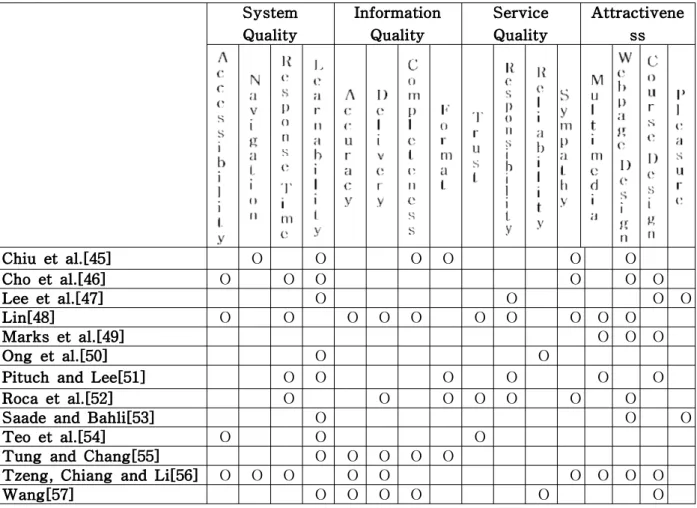
Lin[44]은 학습자의 외부 및 내부의 동기적 관 점에서 웹사이트 품질평가 요인의 기준으로 4가 지 측면 즉, “시스템 품질”, “정보 품질”, “서비스 품질”, “흥미(Attractiveness)”측면을 강조하였다.

문헌 연구로부터 이들 웹사이트 품질평가 요인의

기준을 아래 Table 1에 요약하여 두었다.

(4)

System Quality

Information Quality

Service Quality

Attractivene ss

Chiu et al.[45] O O O O O O

Cho et al.[46] O O O O O O

Lee et al.[47] O O O O

Lin[48] O O O O O O O O O O

Marks et al.[49] O O O

Ong et al.[50] O O

Pituch and Lee[51] O O O O O O

Roca et al.[52] O O O O O O O

Saade and Bahli[53] O O O

Teo et al.[54] O O O

Tung and Chang[55] O O O O O

Tzeng, Chiang and Li[56] O O O O O O O O O

Wang[57] O O O O O O

Table 1 Criteria for Evaluating Website Quality 한편 여러 선행연구를 토대로 아래와 같이 품

질평가 요인을 도출하였다.

Chatterjee and Sambamurthy[58]는 웹사이트 품질평가 요인으로 “사용성”과 “기능성”을 제안 하였고, Bailey and Pearson[59], DeLone and McLean[60]는 “시스템의 유용성(Availability), 편리한 접근성(Convenient access), 적시성 (Timeliness) 및 시스템의 융통성(Flexibility)”을 제안하였다. 또한 웹사이트 품질평가 요인으로

“접근성(Accessibility)[54,69], 항해성(Navigability) [61], 응답시간(Responce time)[51], 및 학습성 (Learnability)[62]”을 제안하였다.

DeLone and McLean[19], Nelson et al.[63]는

“정확성(Accuracy), 전달성(Currency), 완전성 (Completness), 포맷(Format: 형식)”을 그리고 Cao et al.[13], Negash et al.[15]는 “정보 콘텐

츠”를 제안하였다. Barnes and Vidgen[31], Pitt,

Watson and Kavan[64]는 웹사이트 품질평가 요인 으로 “믿음(Reliability), 책임성(Responsiveness), 신뢰도(Trust), 공감성(Empathy)”을, Ranganathan and Ganapathy[32]는 “그래픽 디자인(Graphic design), 레이아웃(Layout) 및 콘텐츠(Contents)”

를 제안하였다. Chou and Cheng[10]은 웹사이트 품질평가 요인의 상위 5개의 중요한 요인으로

“풍부성(Richness), 이해성(Understandability), 확 실성(Assurance), 타당성 또는 관련성(Relevance), 신뢰성(Reliability)”을 발견하였다.

Clikeman et al.[65]은 회계회사의 웹사이트를

대상으로 웹사이트 품질을 평가하였는데, 흥미롭고

효과적인 웹사이트는 “사명감(Mission statement),

서비스와 고용기회의 기재, 동반자에 대한 전기

기록, 무료정보제공, 조회 양식, 항해의 편리성”

(5)

등의 요인임을 발견하였다. Roxas et al.[18]는 346개의 회계 전문회사의 웹페이지에 대한 콘텐 츠를 분석하였는데, 웹사이트 품질평가 요인으로는

“검색엔진(Search engines), 뉴스레터(Newsletters) 와 같은 무료 정보제공, 관련 웹사이트와의 링 크”등을 발견하였다. Janvrin et al.[66]는 웹사이 트 품질을 평가하기 위해 12개의 전문 회계 웹사 이트와 대학생들을 대상으로 “사용자 만족도 (User satisfaction)”요인에 대해 고찰하였다.

Loiacono et al.[67]는 웹사이트 품질을 평가하기 위해 WebQual도구를 이용하였는데, 여기에는 다 음과 같은 12개의 품질요인으로 구성되어 있다.

①정보의 과업에 대한 적합성(Informational Fit-To-Task), ②목적에 맞는 정보(Tailored Information), ③신뢰도(Trust), ④응답시간(Response Time), ⑤이해성(Ease of Understanding), ⑥직 관적인 운영(Intuitive Operations), ⑦시각적인 모습(Visual Appeal), ⑧혁신성(Innovativeness),

⑨감정적인 모습(Emotional Appeal), ⑩일관된 이미지(Consistent Image), ⑪온라인 완전성 (On-line Completeness), ⑫상대적인 이점(Relative Advantage) 등이다. Nicolae-George Dragulanescu [68]은 웹사이트 품질평가 요인을 “정확성”, “권 위”, “적용범위”, “현실성”, “밀집도”, “상호작용 성”, “객관성”, “적시성”으로 설정하였다.

Ons Al-shamaileh, Alistair Sutcliffe, and Antonella De Angeli[69]는 웹사이트 품질평가 요인으로 “심미성(Aesthetics), 유용성(Usability), 서비스 품질(Service quality), 즐거운 상호작용 (Pleasrable interaction), 콘텐츠(Contents), 웹사 이트 고유성(Website identity), 웹사이트에 대한 전반적인 견해(Overall judgment)”를 이용하였다.

Liu and Arnett[70]는 성공적인 웹사이트의 품질 평가 요인으로 “매력도(Attractiveness), 신뢰도 (Confidence and Trust), 고객의 만족도(Customer satisfaction)”를, Au Yeung and Law[71], Chung and Law[72] 및 Law and Hsu[73]는 “기능성”과

“사용의 편리성”을 제안하였다.

DeLone and McLean[19]는 쇼핑몰 웹사이트의 품질평가 요인으로 “사용의 편리성(Usability), 기 능성(Functionality), 신뢰성(Reliability), 유연성 (Flexibility), 데이터의 품질(Quality of data), 통

합성(Integrate), 이용가능성(Availability), 안정성 또는 신뢰성(Reliability), 적응성(Adaptability), 응 답시간(Response time)”을 제시하였고, Mckinney et al.[74]는 “접근성(Accessability), 사용성 (Usability), 항해성(Navigation)”을 제시하였다.

이 이외에도 쇼핑몰 웹사이트의 품질평가 요인으 로 “시스템 및 전송속도, 안정성, 즉시 접속성, 사용의 편의성”등이 제시되었다. 웹사이트의 품 질에 대한 초기의 연구에서는 “속도, 안정성, 접 근성”이 중요시 되었다. 그러나 최근에 와서는

“사용의 편리성”이 중요시 되고 있다. 따라서 오 늘날 웹사이트의 품질평가 요인은 사용자로 하여 금 서비스를 선택하는 중요한 요소로 자리 잡고 있다[3].

한편, Olsina[75]는 웹사이트의 품질평가 요인 으로 “접근성(Accessibility), 속도(Speed), 항해성 (Navigability), 콘텐츠(Contents)”등 4가지 요인 을 이용하였다. Madu and Madu[2]는 “웹사이트 구조의 편리성, 시각적 매력성, 신뢰성, 이용정보 의 저장성, 보안성, 시스템의 무결성”등을 고려하 였다. 여기서 신뢰성은 웹사이트의 지속적인 업 데이트와 제공되는 정보의 정확성을 의미한다.

Liu and Arnett[70]는 “정확성, 완전성, 적절성, 보안성, 신뢰성, 고객화(Customization), 상호작용 성(Interaction), 사용의 편리성(Usability), 시스템 속도, 탐색 기능성”등을 웹사이트 품질평가 요인 으로 고려하였다. Misic and Johnson[76]은 웹사 이트 품질평가 요인으로 “정보접근의 용이성, 웹 사이트의 접근성, 시스템 속도, 기능의 독창성(참 신성), 항해의 용이성, 정확성, 문장표현법, 웹페 이지의 색상과 스타일”등을 제시하고 있다.

Donthu[77]은 SITEQUAL의 실증연구에서 웹사

이트 품질평가 요인으로 웹사이트 관련 요인과

공급자 관련 요인 두 가지로 구분하였다. 웹사이

트 관련 요인으로는 “사용의 편리성, 미학적 디

자인, 시스템 처리 속도, 개인정보 안전성과 보안

성”등을 제시하였다. Huizingh[78]는 웹사이트 성

공의 4가지 요인으로 “웹사이트의 접근성, 웹사

이트의 디자인, 제공물의 시각성, 실현 가능성”을

제시하였다. Liang and Chen[20]는 웹사이트 품

질평가 요인으로 “고객맞춤화, 상호작용성, 세련

성, 관심성, 동호회(Community), 선택, 사용의 편

(6)

리성, 고유성, 콘텐츠, 정황, 기반구축의 품질, 복 잡성, 충성심, 연결성, 정보품질, 학습성, 기술성, 디자인, 편리한 주문, 의사소통, 상업성, 보안성, 판매촉진, 응답속도, 사용자 친밀감”등을, Bai, Law and Wen[17]는 “응답시간, 사용의 편리성, 콘텐츠, 상품의 집합성, 인적요인, 정확성, 데이터 의 현실성, 총 경과시간, 신뢰성, 완전성, 유연성”

등을 제시하였고, Christie Jones and Soyoung Kim[4]은 “검색속도, 항해성, 보안성, 고객만족도, 감성, 의사소통”등을 제시하였다. Jan Hartmann et al.[29]는 “사용성”을, Dawn G. Gregg, Steven Walczak[79]는 “정보품질, 사용의 편리성, 유용 성, 심미성, 신뢰성, 감성”등을 제시하였다.

Hsiu-Fen Lin[44]는 웹사이트 품질평가 요인으 로 “접근성, 항해성, 응답시간, 학습성”을, Chou and Cheng[10]은 “사용의 편리성, 사생활보호(프 라이버시), 응답시간, 접근성, 항해성, 유용성”등 을 제안하였다.

4. 웹사이트 품질평가 요인들의 빈도 분석

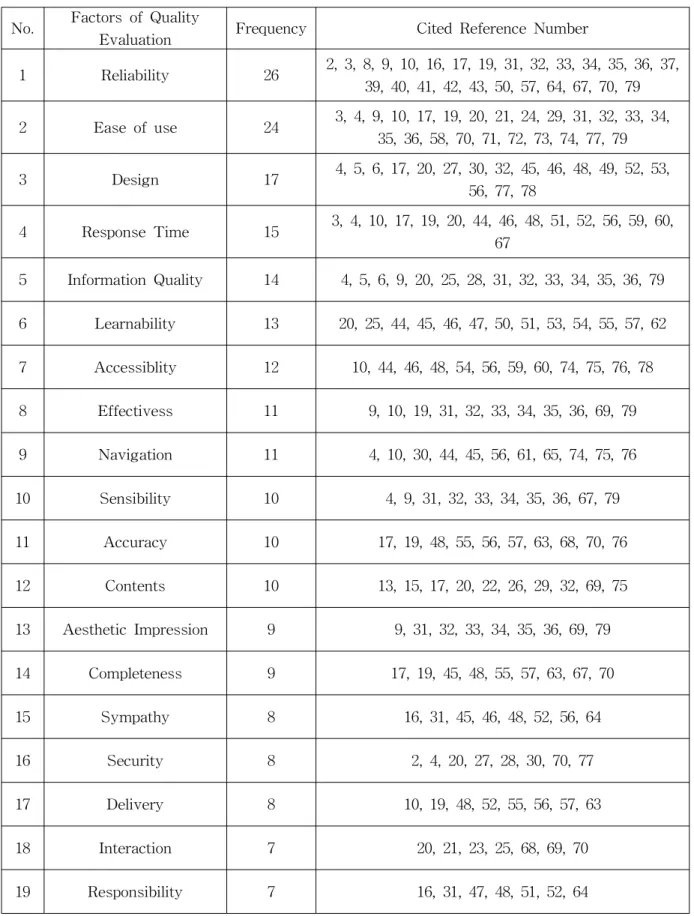
이상 고찰한 선행연구를 토대로 “감성”요인을 포함하여 총 99개의 품질평가 요인을 도출하였으 나, 본 논문에서는 이들 요인 모두를 기술하지 않았으며, 이들 중에서 참고문헌에서 인용된 빈 도수가 7개 이상인 요인들을 아래 Table 2에 요 약하여 두었다.

5. 결 론

본 논문에서는 총 79편의 선행연구를 참조하여 99개의 웹사이트 품질평가 요인을 도출하였다.

그러나 웹사이트의 품질을 평가하기 위해서 이들 요인들을 모두 고려한다면 효과적일수도 있겠으 나, 비용이나 시간적 제약사항 등 여러 가지 비 효율적일 수도 있어 본 논문에서는 7±2에 근거 하여 참고문헌에서 인용된 빈도수가 7개 이상인 요인들을 아래와 같이 도출하였다.

①신뢰성(도), ②사용의 편리성, ③디자인(시각

적/미학적), ④응답속도(시간), ⑤정보품질, ⑥학 습성, ⑦접근성(정보접근의 용이성), ⑧유용성, ⑨ 항해성, ⑩감성(감정모습), ⑪정확성, ⑫콘텐츠,

⑬심미성, ⑭완전성, ⑮공감성, ⑯보안성, ⑰전달 성, ⑱상호작용성, ⑲책임성 이상인 요인들을 아 래와 같이 도출하였다.

따라서 향후 웹사이트 품질을 평가할 시에는 이들 요인들이 중요한 지침서가 될 것이며, 웹기 반 개발 시에도 좋은 참고자료가 될 것으로 사료 된다.

본 논문의 한계점으로는 개발하고자 하는 문제 의 유형이나 조직의 특성에 따라서 미적 요인이 나 기능적 요인을 강조해야 될 부분이 있기 때문 에 일률적으로 이들 요인들을 적용하기에는 한계 점이 있을 것이다. 그러므로 향후 웹기반으로 개 발 할 시에는 이들 요인 이외에 조직이나 문제의 유형 등을 고려하여야할 것이다.

References
[1] Nagel, P. J. A., & Cilliers, W. W.,

“Customer satisfaction: A comprehensive approach”, International Journal of Physical Distribution and Logistics Management, Vol. 20, No. 6, pp. 2-46, 1990.

[2] Madu, C. N., & Madu, A. A., “Dimensions of e-quality”, International Journal of Quality and Reliability Management, Vol.

19, No. 3, pp. 246-258, 2002.

[3] Lee, Kyung-Jin, Kim, Chang-Su, and Ryu, Hei-In, “An Empirical Study of the Factors Affecting the Usage of the Mobile Commerce”, Journal of KECRA, Vol. 12, No. 1, pp. 62, 2011.

[4] Christie Jones and Soyoung Kim,

“Influences of retail brand trust, off-line patronage, clothing involvement and website quality on online apparel shopping intention”, International Journal of Consumer Studies 34(ISSN 1470-6423), pp.

627-637, 2010.

(7)

No. Factors of Quality

Evaluation Frequency Cited Reference Number

1 Reliability 26 2, 3, 8, 9, 10, 16, 17, 19, 31, 32, 33, 34, 35, 36, 37, 39, 40, 41, 42, 43, 50, 57, 64, 67, 70, 79 2 Ease of use 24 3, 4, 9, 10, 17, 19, 20, 21, 24, 29, 31, 32, 33, 34,

35, 36, 58, 70, 71, 72, 73, 74, 77, 79 3 Design 17 4, 5, 6, 17, 20, 27, 30, 32, 45, 46, 48, 49, 52, 53,

56, 77, 78

4 Response Time 15 3, 4, 10, 17, 19, 20, 44, 46, 48, 51, 52, 56, 59, 60, 67

5 Information Quality 14 4, 5, 6, 9, 20, 25, 28, 31, 32, 33, 34, 35, 36, 79 6 Learnability 13 20, 25, 44, 45, 46, 47, 50, 51, 53, 54, 55, 57, 62 7 Accessiblity 12 10, 44, 46, 48, 54, 56, 59, 60, 74, 75, 76, 78 8 Effectivess 11 9, 10, 19, 31, 32, 33, 34, 35, 36, 69, 79 9 Navigation 11 4, 10, 30, 44, 45, 56, 61, 65, 74, 75, 76 10 Sensibility 10 4, 9, 31, 32, 33, 34, 35, 36, 67, 79 11 Accuracy 10 17, 19, 48, 55, 56, 57, 63, 68, 70, 76 12 Contents 10 13, 15, 17, 20, 22, 26, 29, 32, 69, 75 13 Aesthetic Impression 9 9, 31, 32, 33, 34, 35, 36, 69, 79 14 Completeness 9 17, 19, 45, 48, 55, 57, 63, 67, 70 15 Sympathy 8 16, 31, 45, 46, 48, 52, 56, 64

16 Security 8 2, 4, 20, 27, 28, 30, 70, 77

17 Delivery 8 10, 19, 48, 52, 55, 56, 57, 63 18 Interaction 7 20, 21, 23, 25, 68, 69, 70 19 Responsibility 7 16, 31, 47, 48, 51, 52, 64

Table 2 Factors of Website Quality Evaluation Which Are Cited More Than 7 Times

(8)

[5] Kim, S. and Stoel, L., “Dimensional hierarchy of retail website quality”, Information and Management, Vol. 41, pp.

619-633, 2004.

[6] Kim, S. and Lee, Y., “Glibal online marketplace: a cross-cultural comparision of website quality”, International Journal of Consumer Studies, Vol. 30, pp. 533-543, 2006.

[7] Lin, J. C. C., “Online stickiness: its antecedents and effect on purchasing intention”, Behavior and Information Technology, Vol. 26, pp. 507-516, 2007.

[8] Soltani, I. and Gharbi, J. E., “Determinants and consequences of the website perceived value”, Journal of Internet Banking and Commerce, Vol. 13, pp. 1-13, 2008.

[9] Aladwani, A. M., & Palvia, P. C.,

“DevelopIng and validating an instrument for measuring user-perceived web quality”, Information and Management, Vol. 39, No.

6, pp. 467-476, 2002.

[10] Wen-Chin Chou, Yi-Ping Cheng, “A hybrid fuzzy MCDM approach for evaluating website quality of professional accounting firms”, Expert Systems with Applications, Vol. 39, pp. 2783-2793, 2012.

[11] Lin, H. F., “The impact of website quality dimensions on customer satisfaction in the B2C E-commerce context”, Total Quality Management, Vol. 18, No. 4, pp. 363-378, 2007.

[12] Shih, H. P., “An empirical study on predicting user acceptance of e-shopping on the web”, Information & Management, Vol. 41, pp. 351-368, 2004.

[13] Cao, M., Zhang, Q., & Seydel, J., “B2C e-commerce web site quality: An empirical examination”, Industrial Management and Data Systems, Vol. 105, No. 5, pp. 645-651, 2005.

[14] Ahn, T., Ryu, S., & Han, I., “The impact

of Web quality and playfulness on user acceptance of online retailing”, Information

& Management, Vol. 44, No. 3, pp.

263-275, 2007.

[15] Negash, S., Ryan, T., & Igbaria, M.,

“Quality and effectiveness in web-based customer support systems”, Information and Management, Vol. 40, No. 8, pp.

757-768, 2003.

[16] ee, Y., & Kozar, K. A., “Investigating the effect of website quality on e-business success: An analytic hierarchy process (AHP) approach”, Decision Support Systems, Vol. 42, No. 3, pp. 1383-1401, 2006.

[17] Billy Bai, Rob Law & Ivan Wen, “The impact of website quality on customer satisfaction and purchase intentions:

Evidence from Chinese online visitors”, International Journal of Hospitality Management, Vol. 27, No. 3, pp. 391-402, 2008.

[18] Roxas, M. L., Peek, L., Peek, G., &

Hagemann, T., “A preliminary evaluation of professional accounting services;

Directing marketing on the Internet”, Journal of Service Marketing, Vol. 14, No.

7, pp. 595-606, 2000.

[19] DeLone, W. H. & McLean, E. R., “The DeLone and McLean model of information systems success: A ten-year update”, Journal of Management Information Systems, Vol. 19, No. 4, pp. 9-30, 2003.

[20] Chiung-Ju Liang & Hui-Ju Chen, “A Study of the impacts of website quality on customer relationship performance”, Total Quality Management & Business Excellence, Vol. 20, No. 9, September 2009, pp. 971-988, 2009.

[21] Srinivasan, S. S., Anderson, R., &

Ponnavolu, K., “Customer loyalty in

e-commerce: An exploration of its

(9)

antecedents and consequences”, Journal of Retailing, Vol. 78, pp. 41-50, 2002.

[22] Lu, H., & Lin, J. C., “Predicting customer behavior in the market-space: A study of Rayport and Sviokla’s framework”, Information & Management, Vol. 40, pp.

1-10, 2002.

[23] Huang, M. H., “Designing website new alternatives”, Structural Education Modeling, Vol. 6, No. 1, pp. 1-55, 2003.

[24] Wirtz, B. W., & Lihotzky, N., “Customer retention management in the B2C electronic business”, Long Range Planning, Vol. 36, pp. 517-532, 2003.

[25] Chiu, H. C., Hsieh, Y. C., & Kao, C. Y.,

“Website quality and customer’s behavioral intention: An exploratory study of the role of information asymmetry”, Total Quality Management, Vol. 16, No. 2, pp. 185-197, 2005.

[26] Liao, C., Palvia, P., & Lin, H. N., “The role of habit and website quality in e-commerce”, International Journal of Information Management, Vol. 26, pp.

469-483, 2006.

[27] Jin, B., & Park, J. Y., “The moderating effect of online purchase experience on the evaluation of online store attributes and the subsequent impact on market response outcomes”, Advances in Consumer Research, Vol. 33, pp. 203-211, 2006.

[28] Shih, Y. Y., & Fang, K., “Effects of network quality attributes on customer adoption intentions of Internet banking”, Total Quality Management, Vol. 17, No. 1, pp. 61-77, 2006.

[29] Jan Hartmann, Antonella De Angeli, Alistair Sutcliffe, “Framing the User Experience: Information Biases on Website Quality Judgement”, CHI 2008 Proceeding, Florence, Italy, April 5-10, pp. 857, 2008.

[30] John D. Wells, Joseph S. Valacich, and Traci J. Hess, “What Signal are You Sending? How Website Quality Influences Perceptions of Product Quality and Purchase Intentions”, MIS Quarterly, Appendices/June 2011, Vol. 35, No. 2, pp.

A1-A18, 2011.

[31] Barnes, S. J.,& Vidgen, R. T., “An evaluation of cyber-bookshops: the WebQual method”, International Journal of Electronic Commerce, Vol. 6, No. 1, pp.

11-30, 2001.

[32] Ranganathan, C., & Ganapathy, S., “Key dimensions of business-to-consumer Web sites”, Information Management, Vol. 39, No. 6, pp. 457-465, 2002.

[33] Vishwanath, A., & Barnett, G. A., “An empirical investigation into the structure of bidding in online auction”, Electronic Markets, Vol. 15, No. 3, pp. 261-268, 2005.

[34] Iwaarden, J. V., Wiele, T. V. D., Ball, L.,

& Millen, R., “Perceptions about the quality of web sites”, a survey amongst students at Northeastern University and Erasmus University, Information &

Management, Vol. 14, No. 8, pp. 947-959, 2004.

[35] Loiacono, E. T., Watson, r. t., & Goodhue, D. L., “WebQual: an instrument for consumer evaluation of web sites”, International Journal of Electronic Commerce, Vol. 11, No. 3, pp. 51-87, 2007.

[36] Zhang, P., & Von Dran, D. M., “User expectations and rankings of quality factors in different Web site domains”, International Journal of Electronic Commerce, Vol. 6, No. 2, pp. 9-33, 2001/2002.

[37] Pavlou, P. A., & Gefen, D., “Building

effective online marketplaces with

institution-based trust”, Information

Systems Research, Vol. 15, No. 1, pp.

(10)

37-59, 2004.

[38] Belanger, F. Hiller, J. S., & Smith, W. J.,

“Trustworthness in electronic commerce:

the role of privacy, security, and site attributes”, Journal of Strategic Information Systems, Vol. 11, No. 3/4, pp.

245-270, 2002.

[39] McKnight, D. H., Kacmar, C. J., &

Choudhury, V., “Shifting factors and the ineffectiveness of third party assurance seals: a two-stage model of initial trust in a web business”, Electronic Markets, Vol.

14, No. 3, pp. 252-266, 2004.

[40] Roy, M. C., Dewit, O., & Aubert, B. A.,

“The impact of interface usability on trust in Web retailers”, Internet Research Electronic Networking Applications and Policy, Vol. 11, No. 5, pp. 388-398, 2001.

[41] Shneiderman, B., “Design trust into online experiences”, Communications of the ACM, Vol. 43, No. 12, pp. 57-59, 2000.

[42] Koufaris, M., & Hampton-Sosa, W., “The development of initial trust in an online company by new customers”, Information Management, Vol. 41, No. 3, pp. 377-397, 2004.

[43] Gefen, D. Karahanna, E., & Straub, D. W.,

“Trust and TAM in online shopping: an integrated model”, MIS Quarterly, Vol. 27, No. 1, pp. 51-90, 2003.

[44] Hsiu-Fen Lin, “An application of fuzzy AHP for evaluating course website quality”, Computers & Education, Vol. 54, pp. 877-888, 2010.

[45] Chiu, C. M., Hsu, M. H., Sun, S. Y., Lin, T. C., and Sun, P. C., “Usability, quality, value and e-learning continuance decisions”, Computers & Education, Vol.

45, No. 4, pp. 399-416, 2005.

[46] Cho, V., Cheng, T. C. E., & Lai, W. M.

J., “The role of perceived user-interface design in continued usage intention of

self-paced e-learning tools”, Computers &

Education, Vol. 53, No. 2, pp. 216-227, 2009.

[47] Lee, M. K. O., Christy, M. K., & Chen, Z.,

“Acceptance of Internet-based learning medium; The role of extrinsic and intrinsic motivation”, Information and Management, Vol. 42, No. 8, pp.

1095-1104, 2005.

[48] Lin, H. F., “Measuring online learning systems success; Applying the updated DeLone and McLean’s model“, Cyberpsychology and Behavior, Vol. 10, No. 6, pp. 817-820, 2007.

[49] Marks, R. B., Sibley, S. D., & Arbaugh, J.

B., “A structural equation model of predictors for effective online learning”, Journal of Management Education, Vol. 29, No. 4, pp. 531-563, 2005.

[50] Ong, C. S., Lai, J. Y., & Wang, Y. S.,

“Factors affecting engineers’ acceptance of asychoronous e-learning systems in high-tech companies”, Information and Management, Vol. 41, No. 6, pp. 795-804, 2004.

[51] Pituch, K. A., & Lee, Y. K., “The influence of system characteristics on e-learning use”, Computers & Education, Vol. 47, No. 2, pp. 222-244, 2006.

[52] Roca, J. C., Chiu, C. M., & Martinez, F.

J., “Understanding e-learning continuance intention; An extension of the technology acceptance model”, International Journal of Human-Computer studies, Vol. 64, No. 8, pp. 683-696, 2006.

[53] Saade, R., and Bahli, B., “The impact of cognitive absorption on perceived usefulness and perceived ease of use in on-line learning: An extension of the technology acceptance model”, Information and Management, Vol. 42, No. 2, pp.

317-327, 2005.

(11)

[54] Teo, H. H., Chan, H. C., Wei, K. K., &

Zhang, Z., “Evaluating information accessibility and community adaptivity features for sustaining virtual learning communities”, International Journal of Human-Computer studies, Vol. 59, No. 5, pp. 671-697, 2003.

[55] Tung, F. C., & Chang, S. C., “Nursing students’ behavioral intention to use online course; A questionaire survey”, International Journal of Nursing Studies, Vol. 45, No. 9, pp. 10299-1309, 2008.

[56] Tzeng, G. H., Chiang, C. H., & Li, C. W.,

“Evaluating intertwined effects in e-learning programs; A novel hybrid MCDM model based on factor analysis and DEMATEL”, Expert Systems with Applications, Vol. 32, No. 4, pp. 1028-1044, 2007.

[57] Wang, Y. S., “Assesment of learner satisfaction with asynchronous electronic learning systems”, Information and Management, Vol. 41, No. 1, pp. 75-86, 2003.

[58] Chatterjee, D., & Sambamurthy, V.,

“Business implications of web technology;

An insight into the usage of the world wide web by U.S. companies”, Electronic Markets, Vol. 9, No. 1, pp. 126-131, 1999.

[59] Bailey, J. E., & Pearson, S. W.,

“Development of a tool for measuring and analyzing computer user satisfaction”, Management Science, Vol. 29, No. 5, pp.

530-545, 1983.

[60] DeLone, W. H. & McLean, E. R.,

“Information system success; The quest for the dependent variable”, Information Systems Research, Vol. 3, No. 1, pp.60-95, 1992.

[61] Huizingh, E., “The content and design of web sites: An empirical study”, Information and Management, Vol. 37, No.

3, pp. 123-134, 2000.

[62] Palmer, J. W., “Web site usability, design, and performance metrics”, Information Systems Research, Vol. 13, No. 2, pp.

151-167, 2002.

[63] Nelson, R. R., Todd, P. A., & Wixom, B.

H., “Antecedents of information and system quality: An empirical examination within the context of data warehousing”, Journal of Management Information Systems, Vol. 21, No. 4, pp. 199-235, 2005.

[64] Pitt, L. F., Watson, R. T., & Kavan, C.

B., “Service quality; A measure of information systems effectiveness”, MIS Quarterly, Vol. 19, No. 2, pp. 173-187, 1995.

[65] Clikeman, P. M., Smith, L. M., & Walden, W. D., “Designing an accounting firm website”, the CPA Journal, Vol. 68, No.

11, pp. 24-28, 1998.

[66] Janvrin, D. J., Gary, R. F., & Clem, A.

M., “College students perceptions of AICPA and state association accounting career information websites”, Issues in Accounting Education, Vol. 24, No. 3, pp.

377-392, 2009.

[67] E. T. Loiacono, R. T. Watson, and D. L.

Goodhue, “WebQual: An Instrument for Consumer Evaluation of Web Sites”, International Journal of Electronic Commerce, Vol. 11, No. 3, pp. 51-87, Spring, 2007.

[68] Nicolae-George Dragulanescu, “Website Quality Evaluation: Criteria and Tools”, Intl, Inform, & Libr. Rev., Vol. 34, pp. 253, 2002.

[69] Ons Al-shamaileh, Alistair Sutcliffe, and Antonella De Angeli, “The Effect of Religious Identity on User Judgment of Website Quality”, INTERACT 2011, Part

Ⅵ, LNCS 6949, pp. 620-623, 2011.

[70] Liu, C., & Arnett, K. P., "Exploring the

(12)

factors associated with Website success in the context of electronic commerce", Information Management, Vol. 38, No. 1, pp. 23-33, 2000.

[71] Au Yeung, T., and Law, R., “Extending the modified heuristic usability evaluation technique to chain and independent hotel websites”, International Journal of Hospitality Management, Vol. 23, No. 3, pp. 307-313, 2004.

[72] Chung, T., and Law, R., “Developing a performance indicator for hotel websites”, International Journal of Hospitality Management, Vol. 22, No. 1, pp. 119-125, 2003.

[73] Law, R., and Hsu, C. H. C, “Customer’s perceptions on the importance of hotel website dimensions and attributes”, International Journal of Contemporary Hospitality Management, Vol. 17, No. 6, pp. 493-503, 2005.

[74] Mckinney, V. K. Yoon & F. Zahedi, “The measurement of Web-customer satisfaction: An expectation and disconfirmation approach”, Information System Research, Vol. 13, No. 2, pp.

296-315, 2002.

[75] Olsina, L.G.D. Lafuente & G. Rossi.,

“Specifying Quality Characteristics and Attributes for Websites”, Paper Presented at the First ICSE Workshop on Web Engineering(Web E-99), Los Angeles, USA, pp. 266-278, 1999.

[76] Misic, M. M. and Johnson, K.,

“Benchmarking: A Tool for Web Site Evaluation and Improvement, Internet Research, Vol. 9, No. 5, pp. 383-392, 1999.

[77] Donthu, Naveen, Does Your Web Site Measure Up?, Marketing Management, (November-December), pp. 29-32, 2001.

[78] Huizingh, Elko K. R. E., “The Content and Design of Web Site: An Empirical

Study”, Information and Management, Vol.

37, No. 3, pp. 123-134, 2000.

[79] Dawn G. Gregg, Steven Walczak, “The relationship between website quality, trust and price premiums at online auctions”, Electron Commer Res(2010) Vol. 10, No.

24, pp. 5, 2010.

[80] Qin Yang, Young-Chan Lee, “The Effects of Self-Congruity and Functional Congruity on e-WOM: The Moderating Role of Self-Construal in Tourism”, The Journal of Information Systems, Vol. 25, No. 1, 2016. 03, pp. 01-23.

권 영 직 (Kwon, Youngjik)

∙종신회원

∙1976년 2월 : 경북대학교 수학과 (이학사)

∙1980년 2월 : 영남대학교 경영 학과 (경영학석사)

∙1991년 2월 : 계명대학교 경영학과 (경영학박사)

∙1980년 3월 ~ 현재 : 대구대학교 컴퓨터IT공 학부 교수

∙2000년 1월 ~ 2001년 1월 : Washington Staet University 방문교수

∙관심분야 : 소프트웨어공학, 웹공학

수치

Fig. 1 Analysis Structure Chart for Website Evaluation of the CPA Company
Table 1 Criteria for Evaluating Website Quality한편 여러 선행연구를 토대로 아래와 같이 품
Table 2 Factors of Website Quality Evaluation Which Are Cited More Than 7 Times

참조

관련 문서

S.(2008), A study on the relationship between business plan components and corporate performance, International Journal of Entrepreneurship and Innovation Management,

This study examines the effect of previous work experience on the long-lived venture firm called 'Good Quality startup'. The research explores entrepreneurs of

Thirdly, it appeared that social support had meaningful effect on self-efficacy and the quality of life, and in the case of the difference analysis by

and Gold, F.(1985), Bank Branch Operating Efficiency: Evaluation with Data Envelopment Analysis, Journal of Banking and Finance , Vol.. F.(1992), Quantifying Management Role

• 기회주의에 기반한 이론이 높은 수준의 거래 특유의 투자를 이유로 수직적 통합의 필요성을 주장할 때. – 능력에 기반한 이론이 수직적 통합에 필요한 자원과

1 John Owen, Justification by Faith Alone, in The Works of John Owen, ed. John Bolt, trans. Scott Clark, "Do This and Live: Christ's Active Obedience as the

Quality An SNA user’s perception of the quality of functions (of the focal SNA) for the purposes of social networking, information exchange, identity management,

The purpose of this study is to investigate the effect of online shopping mall characteristics on direct purchasing satisfaction of foreign consumers and purchase