103 This is an Open-Access article distributed under the terms of the Creative Commons Attribution Non-Commercial License (http://
creativecommons.org/licenses/by-nc/3.0) which permits unrestricted non-commercial use, distribution, and reproduction in any medium, provided the original work is properly cited.
J. Mushrooms 2018 June, 16(2):103-110 http://dx.doi.org/10.14480/JM.2018.16.2.103 Print ISSN 1738-0294, Online ISSN 2288-8853
© The Korean Society of Mushroom Science
*Corresponding author E-mail : [email protected] Tel : +82-31-290-7806 Received February 27, 2018 Revised March 26, 2018 Accepted June 26, 2018
목이버섯의 항비만 효과
박건희1 · 김길자2 · 장갑열3 · 박기문1
1성균관대학교 식품생명공학과
2전라남도 농업기술원 식량작물연구소
3농촌진흥청 국립원예특작과학원 버섯과
Anti-obesity effect of Auricularia spp.
Kun Hee Park1, Kil-ja Kim2, Kab Yeul Jang3, and Kimoon Park1
1Department of Food science and Biotechnology, Sungkyunkwan University, Suwon, 16419, Korea
2Crop Research Division, Jeollanamdo Agricultural Research & Extension Services, Naju, 58213, Korea
3Mushroom Research Division, National Institute of Horticultural & Herbal Science, Rural Development Administration, Chungbuk Eumsung, 27709, Korea
ABSTRACT: The purpose of this study is to discover a food material having anti-obesity effects and to disseminate information on the effects of the material to people who are interested in anti-obesity. For this study, 11 kinds of Auricularia (wood ear) spp., including 8 strains of Auricularia auricula-polytricha, and 3 strains of A. auricula-judae, were presented by the Jeollanamdo Agricultural Research & Extension Services. 3T3-L1 (preadipocyte cell) was used for identifying the inhibition effect on adipocyte differentiation. As a result, this study found that all the extracts had slightly different degrees of inhibition effects on adipocyte differentiation. Among the A. auricula-polytricha strains, strain 21001 showed the most significant effect (4.58%), and the inhibition effect of strain 21002 (4.43%) was the greatest among A. auricula-judae strains. Overall, the inhibition effect of A. auricula-polytricha strains was greater than that of A. auricula-judae strains. The results of mRNA and protein analysis also demonstrated that the inhibition effect of A. auricula-polytricha 21001 was superior to that of any other strains. An in vivo study using 56 ICR mice (6w, male), was performed for 4 weeks. A. auricula-polytricha 21001, which exhibited the most significant effect in the in vitro study was used to compose six different types of feeds. Daily body weight gain of the high-fat diet containing 0.2% 21001 extract feeding group was 0.22±0.08 g (*p < 0.05), and it was 31.25% lower than that of the high-fat diet feeding group (0.32±0.06). Internal organ weight measurement and blood analysis were performed immediately after animal sacrifice. The results proved that treatment with more than 0.1% of A. auricula-polytricha strain 21001 could significantly reduce (more than *p < 0.05) the weight of liver and epididymal fat, and levels of glucose, total cholesterol, AST, and ALT in blood.
KEYWORDS: Auricularia auricula-polytricha, Auricularia auricula-judae, anti-obesity
서 론
일반적으로 체질량지수(BMI)를 기준으로 30이상을 비 만 그리고 25-29를 과체중으로 정의하고 있으며 세계보건 기구에서는 2016년 전 세계적으로 18세 이상 성인 약 19 억 명이 과체중이고 6억 5천만 명이 비만으로 추정된다고 발표하였다(WHO, 2018). 또한, 경제협력개발기구(OECD) 보고서에서도 평균 비만율이 19.5%로 성인 5명 가운데 1 명은 비만인 것으로 나타났으며 우리나라의 경우 만 15세 이상 성인 비만율은 5.3%로 35개 회원국 가운데 두 번째 로 낮게 나타났지만 비만율이 빠르게 늘어날 것으로 예상 되는 국가로 보고하고 있다(OECD 비만 업데이트, 2017).
비만은 유전적 및 영양적, 환경적, 사회적 요인 등 다양한 원인들이 관여하는 복합적 증후군으로 그 자체로도 일상 생활의 지장을 초래하는 것은 물론 심혈관계 질환, 2형 당뇨병, 고혈압, 고지혈증, 고콜레스테롤증, 암, 천식, 관 절염 등의 발생 위험의 증가와 깊은 관련이 있기 때문에 장기적인 관리와 치료가 필요하다(Chua, 1997; Dattilo et al., 1992).
최근 식품을 통해 자연적으로 기능성 물질을 섭취하려 는 요구의 증가와 함께 버섯에 대한 관심이 높아지고 있 다. 비만 및 심혈관계 질환, 암 등의 성인병 예방 및 치료 를 위해 천연의 생리활성 조절물질을 탐색하는 연구가 진 행되고 있으며, 그 중에서도 버섯류로부터 생리활성 물질 의 탐색연구가 다수 보고되고 있다(Cheung et al., 2003;
Mau et al., 2002; Yang et al., 2002; Lie et al., 1997;
Lee et al., 2003). 일부 항비만 활성을 보유한 것으로 알 려진 목이버섯류는 분류학적으로 목이목(Auriculariales), 목이과(Auriculariaceae), 목이속(Auricularia)에 속하는 목 이(Auricularia auricula) 및 털목이(Auricularia polytricha) 와 흰목이목(Tremellales), 흰목이과(Tremellaceae), 흰목 이속(Tremella)에 속하는 흰목이(Tremellafuciformis)로 분류되어 진다. 목이버섯은 각종 활엽수의 고사목이나 반 고사목에서 생장하며 사람 귀 모양에 젤리 질감을 지녔다 하여 일명 Jelly ear fungus로도 부르고 있다(Kim, 2007).
항비만 활성을 포함한 목이버섯류의 기능성 연구로는 흑 목이버섯이 복부비만 여성의 체지방 및 골밀도 및 혈청 지질 농도에 미치는 영향(Jung, 2010)과 털목이버섯 추 출물의 항비만 활성(Zaho et al., 2013), 목이버섯 품종별 영양성분 및 생리활성(Jo et al., 2012), 그리고 흑목이 메 탄올 추출물이 마우스의 지질과산화 및 간 손상 억제에 미치는 영향(Jang et al., 1998) 등이 보고되어 있다. 본 연구에서는 국내 버섯산업의 활성화 대책의 일환으로 소 규모로 생산되는 목이버섯 품종별 항비만 활성을 비교하 였다.
재료 및 방법
버섯 시료의 제조
털목이(Auricularia auricula polytricha) 8개 균주 (91 및 110, 189, 249, 21001, 21008, 21013, 농가수집균주) 와 흑목이(Auricularia auricula-judae) 3개 균주 (181 및 194, 21002)를 재배하여 얻어진 버섯 자실체를 전남농업 기술원으로부터 제공받아 사용하였다. 제공받은 자실체는 세척 후 50oC에서 24시간 열풍건조하고 조분쇄한 다음, 건조 시료 50g과 이의 20배에 해당하는 1L의 50% EtOH 을 첨가하여 40oC에서 12시간 교반 추출하였다. 추출물은 Whatman filter(No. 3)로 여과하고 진공 농축, 동결 건조 하여 냉동고에 보관하면서 실험에 사용하였다.
지방세포 분화 억제 시험 1. 세포생존율
세포생존율의 측정을 위한 methylthiazolyldiphenyltetrazolium bromide(MTT) assay는 Sladowski 등(Sladowski et al., 1993)의 방법에 따라 3T3-L1 세포(American Type Culture Collection, Rockville)를 96 well plate에 1×10⁵ cells/well 로 분주하고 16~18시간 배양한 후 농도별로 희석한 목이 버섯 추출물(2 μL) 을 24시간 처리하였다. MTT용액을 첨 가한 후 5% CO2, 37oC에서 3시간 배양하고 배양액을 제 거한 뒤 각 well에 DMSO 200μL를 첨가하여 20분간 교 반한 다음 ELISA reader로 595 nm에서 흡광도를 측정하 였다.
2. 3T3-L1 adipocyte 배양
지방세포 분화유도는 Jang 등(Jang et al., 2011)의 방법 을 참고하여 세포가 100% confluent되고 24시간 경과 후 진행하였으며, 분화를 위해 DMEM(Dulbecco’s modified Eagle’s medium)에 10% FBS(Fatal bovine serum)와 DMI (1 μM Dexamethason 과 0.5 mM isobutyl-1- Methylxanthine, 5 μg/mL Insulin 함유)가 포함된 adipogenic cocktail을 사용하였다. Adipogenic cocktail을 포함한 adipogenic media로 분화를 유도하고 2일 후에 DMEM과 10% FBS, insulin을 포함한 배양액으로 교체하고, 이후에는 3일 간 격으로 동일한 배양액으로 교체하였으며, 분화차이가 최 대가 되는 4~7일 동안 분화시켰다.
3. Oil Red O 염색
분화가 완료된 세포들은 Phosphate buffer saline(PBS) 로 1회 세척한 후, 4% formaldehyde solution으로 1시간 동안 고정시키고 남아있는 고정액을 제거한 후 0.2% Oil Red O (Sigma) solution에서 1시간 동안 세포를 염색하였 다. 염색이 된 세포는 현미경(K23008948, Olympus)으로 관찰하였으며, 관찰 후 well당 500 μL의 isopropyl alcohol 로 지방세포 내 염색된 염색약을 추출하여 spectrophotometer (SpectraMax, molecular devices)로 520 nm에서 OD값을 측정하였다.
4. 유전자 발현
유전자 발현은 Song(2016)의 방법을 참고하여 발현량 은 36B4로 조정하였으며 모든 real-time PCR은 최소 2회 수행하였다. ΔCT값은 각 샘플의 CT값과 control(36B4) 간의 차이에 대하여 계산하고 상대적인 발현수준은 2- ΔCT으로 계산하였으며 유전자 발현 분석을 위해 사용한 oligonucleotide primer의 sequence는 다음과 같다. 즉, Peroxisome proliferator-activated receptor γ (PPARγ), F, 5’-CCATTCTGGCCCACCAAC-3’와 PPARγ, R, 5’- AATGCGAGTGGTCTTCCATCA-3’; Fatty acid-binding protein 4 (FABP4(aP2)), F, 5’-CGTCTCCAGTGAGAACTTCG-
3’와 FABP4(aP2), R, 5’-TCATGACACATTCCACCACC- 3’; Cluster of differentiation 36 (CD36), F, 5’-GGCCAA- GCTATTGCGACAT-3’와 CD36, R, 5’-CAGATCCGAA- CACAGCGRTAGA-3’; CCAAT/enhancer binding protein α (C/EBPα), F, 5’-AGAACAGCAACGAGTACCGG-3’
와 C/EBPα, R, 5’-TTGACCAAGGAGCTCTCAGG-3’를 사용하였다.
5. Western Blot
Western Blot을 통한 3T3-L1 adipocyte 내의 발현 단백 질 분석은 Song(2016)의 방법을 참고하여 PVDF membrane (Amersham Bioscience, Picataway, NJ)에 transfer한 다음, Tween 20과 1% skim milk가 첨가된 TBS로 30분 동안 상온에서 blocking하고, 4종의 primary antibody(PPARγ, FABP4(aP2), CD36, C/EBPα)를 각각 4oC에서 overnight 동안 면역반응 시켰다. 마지막으로 secondary antibody (Zymed Laboratories, CA)를 상온에서 1시간 반응시킨 후 ECL detection system(GE Healthcare)으로 band를 확인하 였다. 동물실험 완료 후 적출한 간 조직은 lysis buffer 800µl를 넣고 homogenizer로 분쇄한 후 4oC, 13,000rpm 에서 15분간 원심분리하여 상등액을 취한다음 단백질을 추출하였고, 이후의 과정은 세포실험과 동일하게 진행하 였다.
동물실험 1. 실험동물
동물 구입에 앞서, 성균관대학교로부터 동물실험 승인 (SKKUIACUC2017-06-11-2)을 받았고, 6주령의 ICR mouse 56수를 (주)대한바이오링크로부터 구입하여 일반식이로 1 주일간 적응시킨 다음 사용하였다.
2. 식이조성
일반식이(normal control, NC)는 AIN-93G(Philip et al., 1993)를 기본으로 하여 제조하였으며 고지방식이 (high-fat control, HFC)는 AIN-93G를 기본으로 전체 식 이 중 총 지방함량은 40% (w/w)가 되도록 배합하였다.
그리고 3T3-L1 세포실험 결과 가장 우수하다고 판단된 목이버섯을 사용하여 그 분말이 함유된 고지방식이(high- fat with Auricularia spp. powder, HFP)는 HFC와 동일한 식이조성을 갖되 목이버섯 분말과 셀룰로오스 조성의 합 이 전체의 5%가 되도록 조절하여 배합하였으며 목이버섯 분말 비율이 각각 0.1%(HFP 0.1), 0.5%(HFP 0.5), 1%
(HFP 1.0)가 되도록 배합하였다. 목이버섯 추출물을 함유 한 고지방식이(high-fat with Auricularia spp. 50% EtOH extract, HFE)는 HFP의 목이버섯 분말 대신에 목이버섯 추출물을 0.05%(HFE 0.05), 0.1%(HFE 0.1), 0.2%(HFE 0.2)가 되도록 배합하였으며 모든 식이는 pellet 형태로 제 조한 후, 60oC에서 열풍 건조시켜 4oC에서 보관하면서 급
여하였다.
3. 동물사육
일반식이로 1주일간 적응시킨 후, 체중에 따라 난괴법 에 의해 8개 군으로 구분하여 한 마리씩 cage내에서 4주 동안 사육하였다. 실험군은 일반 식이를 섭취시키는 정상 대조군(NC), 고지방식이를 섭취시키는 실험대조군(HFC), 목이버섯 분말을 첨가한 HFP 0.1, 0.5. 1.0군, 목이버섯 추출물을 첨가한 HFE 0.05, 0.1, 0.2군으로 구분하여 각 군당 7마리씩 사육하였다. 식이 및 물은 ad libitum으로 공급하였으며 온도 22~25oC 및 습도 55±5%, 12시간 간 격으로 점등 및 소등하였고 실험동물의 체중은 주 3회, 식이 섭취량은 매일 측정하였다.
4. 동물 희생 및 시료수집
희생 전 16시간 절식시킨 생쥐를 ether로 마취시키고 개복한 후 하대정맥에서 채혈하여 3,000rpm에서 15분간 원심분리하여 혈청을 분리한 다음 분석에 사용하였다.
간 및 신장, 비장, 고환, 부고환 등의 장기는 적출 후 0.9% 생리식염수에 세척하고 여과지로 수분을 완전히 제거한 후 무게를 측정한 다음 -70oC deep freezer에 보 관하였다.
5. 생화학 분석
혈청 내 glucose 및 중성지방, 총콜레스테롤, Glutamic- oxaloacetic transaminase(GOT), Glutamic- pyruvic transaminase(GPT) 등은 실험동물 전문 분석기관인 ㈜노 터스에 분석하였다.
6. 통계분석
In vitro 실험결과는 3회 반복하여 실험군당 평균과 표 준오차를 계산하였고, in vivo 실험결과는 군당 7개체씩 분석하여 평균과 표준오차를 계산하였다. SPSS (ver. 10, Statistical Package for Social Science, Chicago, IL, USA) 통계프로그램의 one-way ANOVA를 실시한 후 Duncan's multiple range test에 의하여 각 실험구의 평균 치 간의 유의성을 검정하였다.
결과 및 고찰
세포생존율
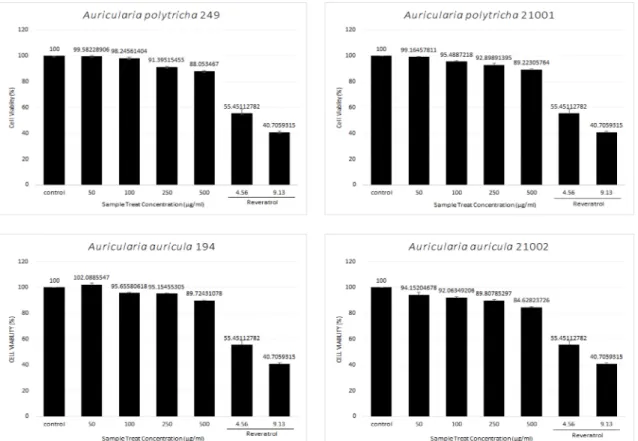
3T3-L1 adipocyte에 대해 지방세포 분화억제 효과가 우 수한 것으로 밝혀진 털목이 strain 249 및 21001, 그리고 흑목이 strain 194 및 21002의 50% EtOH 추출물의 세 포 독성을 측정한 결과는 Fig. 1과 같다. 대조군으로는 지방세포 분화 억제 효과를 가지고 있다고 보고된 (Srujana et al., 2008) Resveratrol(Sigma-aldrich, Korea)을 4.56 μg/ml (20 μM)와 9.13 μg/ml(40 μM)의 농도로 각각 희석하여
사용하였다. 목이버섯 50% EtOH 추출물을 50~500 μg/ml 농도로 처리한 결과 최고 처리농도인 500 μg/ml에서도 세 포생존율을 80% 이상을 나타내어 모든 버섯시료에서 세 포독성이 없음을 확인할 수 있었다.
목이버섯 추출물의 지방세포 분화 억제 효과
3T3-L1 cell을 지방세포로 분화시키면서 목이버섯 추출 물의 분화억제 효과를 확인한 결과는 Fig. 2와 같다. 즉, 분화가 완료된 3T3-L1 cell의 지방세포를 ORO 염색 한 뒤 isopropanol를 사용하여 spectrophotometer로 정량한 결과 분화유도 시약만 처리한 control군에 비해 털목이 균
주 중에서는 21001 strain(P<0.005)과 249 strain(p<0.05) 이, 흑목이 중에서는 21002 strain(p <0.05)과 194 strain (p<0.05)이 유의하게 지방세포의 분화를 억제하는 것으로 나타났다. 이와 같이 목이버섯의 종별 그리고 동일 품종 내에서도 strain에 따라 지방세포 분화 억제효과가 다르게 나타났으며 전반적으로 흑목이에 비해 털목이의 효과가 우수한 것으로 나타났다. 목이버섯의 생리활성을 비교 연 구한 논문 (Jo et al., 2012) 에 따르면 목이버섯 품종에 체지방 감소효과가 있는 수용성 식이섬유인 β-glucan 함 량이 다른 버섯들에 비해 상대적으로 높았고, 이는 흑목 이보다 털목이에서 약 2.18배 가량 더 많이 존재하였다.
Fig. 1. 3T3-L1 cell viability after treatment of 50% ethanol extracts from Auricularia spp.
Fig. 2. Inhibition effects of the extracts of Auricularia spp. on adipocyte differentiation in 3T3-L1 (*P<0.05, **P<0.005)
이를 통해 목이버섯에 함유된 β-glucan이 3T3-L1 cell의 지방세포 분화를 억제하였을 것으로 사료된다.
발현량
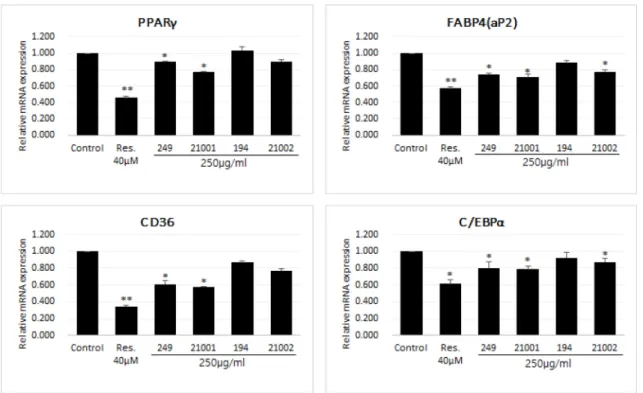
Real-time PCR을 통해 4종의 지방세포 분화를 나타내 는 유전 마커들의 발현량을 측정한 결과 그림 3과 같이 Resveratrol 9.13 μg/ml(40 μM)을 포함하여 흑목이 버섯 인 194 strain을 제외한 나머지 3종의 목이버섯 strain 추 출물 250 μg/ml 처리에서 지방분화 마커 유전자의 발현이 억제됨을 확인할 수 있었다. 특히, 털목이 버섯 249와 21001 strain의 경우 지방세포 분화를 촉진하는 PPAR-γ 및 FABP4(aP2), CD36, C/EBPα유전자의 발현을 유의차
있게 감소시키는 것으로 나타났다(p<0.05). 흑목이의 경 우 21002 strain 추출물에서만 FABP4 (aP2)와 C/EBPα의 발현을 유의차 있게 억제하였다(p<0.05).
Western blot을 이용한 지방세포 분화 단백질 마커 발 현 조사
지방전구세포인 3T3-L1은 지방세포를 형성하는 다양 한 전사인자와 호르몬에 의해 세포 내 중성지방을 축적한 다. PPARγ는 nuclear hormone receptor 중 하나로 지방 세포에서 고농도로 발현되어 지방조직의 형성과 축적에 중요한 역할을 하고, C/EBPα는 PPARγ와 같이 분화 초기 에 발현이 유도되며 지방세포가 분화되는 동안 발현이 크 게 증가한다. 또한 이들 유전자는 fatty acid synthase (Fas) 및 aP2, resistin, CD36과 같은 지방세포 특이적 유 전자의 발현을 조절하는 것으로 알려져 있다(Lee et al., 2017). 지방전구세포인 3T3-L1에 대해 지방세포 분화 억 제효과가 우수한 것으로 나타난 털목이 21001 strain과 흑목이 21002 strain을 사용하여 western blot을 통해 단 백질 마커들의 발현을 나타낸 결과는 그림 4와 같다. 즉, 2개 strain 모두 control에 비해 4종의 마커 단백질 발현을 억제하는 것을 확인할 수 있었다. 특히 털목이 21001 strain의 경우, 9.13 μg/ml(40 μM) Resveratrol의 억제효과 에는 다소 못 미치지만, 4.56 μg/ml(20 μM) Resveratrol의 결과와 비교했을 때 동등수준의 효과를 나타내는 것을 볼 수 있었다.
Fig. 3. Relative mRNA expression of the four adipocyte differentiation marker genes encoding PPAR-γ, FABP4(aP2), CD36 and C/EBPα (*P<0.05, **P<0.005).
Fig. 4. Western blot analysis of protein expression of PPAR- γ, FABP4(aP2), CD36, and C/EBPα.
동물실험
1. 체중 증가 및 식이효율
항비만 효과가 가장 우수한 것으로 밝혀진 털목이버섯 21001 strain을 사용하여 4주 사육 후 ICR mice의 체중 변화를 확인한 결과는 Table 1과 같이 초기 체중은 31.34
±1.44~32.11±1.04 g에서 4주 사육 후에는 36.27±2.06~
40.60±4.23 g으로 8개 군 모두 체중이 증가한 것으로 나 타났다. 1일 증체량을 살펴보면 일반식이를 급여한 NC군 은 0.18±0.002 g, 고지방식이를 공급한 HFC군은 0.32±0.06 g, 목이버섯 분말 1.0%를 첨가하여 급여한 HFP 1.0군은 0.28±0.05 g, 목이버섯 추출물 0.2%를 첨가하여 급여한 HFE 0.2군은 0.22±0.08 g씩 증가하였다. 이를 통해 HFE 0.1군과 HFE 0.2군이 고지방식이 섭취군 HFC에 비해 체 중 증가를 유의하게 억제하는 것이 확인되었다(p<0.05).
사료섭취량 대비 체중증가량을 나타내는 식이효율의 경우 고지방식이만 급여한 HFC군이 0.32±0.01 g으로 가장 높 았고 일반식이를 급여한 NC군이 0.16±0.01 g으로 가장 낮았다. 고지방식이에 털목이버섯 21001 분말 및 50%
EtOH 추출물을 혼합하여 급여한 HFP 및 HFE군의 경우 NC군에 비해서는 식이효율이 높았으나 HFC군에 비해서 는 낮게 나타났으며 HFE 0.2(p<0.05), HFE 0.1(p<0.05), HFE 0.05, HFP 1.0, HFP 0.5, HFP 0.1군 순으로 식이효 율이 높아짐을 알 수 있었다. 즉, 목이버섯 분말 또는 추
출물 섭취군들은 고지방식이 대조군인 HFC군과 거의 비 슷한 양의 사료 섭취량을 나타냈지만, 체중증가량이 적어 비교적 낮은 식이효율을 보였고 특히 HFE 0.2군의 식이 효율은 0.21±0.02(p<0.05)로 HFC군과 비교해 가장 유의 한 효과를 나타냈다.
2. 장기별 무게 측정
동물희생 후 간 및 비장, 신장, 고환, 부고환 지방조직을 적출한 뒤 세척하여 무게를 측정한 결과는 Table 2와 같 다. Jo 등(Jo et al., 2012)이 보고한 목이버섯 품종별 분 말을 급여한 동물실험 결과와 유사하게 신장, 비장, 고환 의 무게에 있어서는 유의적인 차이가 나타나지 않았다.
그러나 부고환지방의 경우 HFP 및 HFE 모든 처리군에서 유의차 있게 무게가 감소함을 알 수 있었고 특히 50%
EtOH 추출물을 급여한 HFE 0.1 및 HFE 0.2군에서는 간 (p<0.05)과 부고환 지방조직(p<0.005)의 무게에서 HFC군 과 비교해 유의한 차이를 나타냈다. 특히 HFE 0.2군의 경 우 평균 부고환 지방조직 무게는 1.18±0.09 g으로 HFC군 에 비해 23.87% 낮은 수치를 나타냈다.
3. 혈청 생화학 분석
혈청의 생화학적 분석 결과는 Table 3과 같다. 즉, 혈당 의 경우 NC군(134.86±6.49) 다음으로 낮은 혈당량을 보 Table 1. Body weight gain and food efficiency ratio among dietary groups
Performance Dietary groups
NC HFC HFP 0.1 HFP 0.5 HFP 1.0 HFE 0.05 HFE 0.1 HFE 0.2
Initial body weight(g) 31.34±1.44 32.03±1.02 32.11±1.04 31.72±0.98 31.62±1.10 31.80±0.97 31.93±0.67 31.48±1.31 Final body weight(g) 36.27±2.06 40.60±4.23 40.20±2.95 39.77±1.85 39.17±2.87 38.42±2.44 37.92±3.97 37.34±3.35 Body weight gain(g/day) 0.18± 0.002 0.32± 0.06 0.30± 0.05 0.30± 0.04 0.28± 0.05 0.25± 0.05 0.22± 0.05* 0.22± 0.08*
Food efficiency ratio(g/day) 0.16± 0.01 0.32± 0.01 0.28± 0.02 0.28± 0.02 0.29± 0.02 0.26± 0.02 0.24± 0.02* 0.21± 0.02*
NC : Normal diet control, HFC : High fat diet control, HFP0.1 : High fat diet containing 0.1% of dried Auricularia strain 21001 mushroom, HFP0.5 : High fat diet containing 0.5% of dried Auricularia strain 21001 mushroom, HFP1.0 : High fat diet containing 1% of dried Auricularia strain 21001 mushroom, HFE0.05 : High fat diet containing 0.05% of Auricularia strain 21001 mushroom extract, HFP0.1 : High fat diet con- taining 0.1% of Auricularia strain 21001 mushroom extract, HFP0.2 : High fat diet containing 0.2% of Auricularia strain 21001 mushroom extract (*P<0.05).
Table 2. Internal organ weight of dietary groups Organ
weight(g)
Dietary groups
NC HFC HFP0.1 HFP0.5 HFP1.0 HFE0.05 HFE0.1 HFE0.2
Liver 1.46± 0.10 1.65± 0.06 1.65± 0.07 1.65± 0.14 1.63± 0.07 1.62± 0.06 1.56± 0.09* 1.52± 0.06*
Kidneys 0.49± 0.05 0.61± 0.08 0.60± 0.03 0.60± 0.03 0.60± 0.03 0.60± 0.08 0.57± 0.06 0.57± 0.04 Spleen 0.11± 0.01 0.13± 0.01 0.13± 0.01 0.12± 0.01 0.11± 0.01 0.12± 0.01 0.12± 0.02 0.10± 0.01 Testis 0.26± 0.03 0.28± 0.02 0.25± 0.01 0.28± 0.02 0.24± 0.02 0.26± 0.02 0.23± 0.02 0.23± 0.01 Epididymal fat 1.13± 0.12 1.55± 0.10 1.42± 0.07* 1.42± 0.05* 1.41± 0.07* 1.23± 0.06* 1.19± 0.05** 1.18± 0.09**
NC : Normal diet control, HFC : High fat diet control, HFP0.1 : High fat diet containing 0.1% of dried Auricularia strain 21001, HFP0.5 : High fat diet containing 0.5% of dried Auricularia strain 21001, HFP1.0 : High fat diet containing 1% of dried Auricularia strain 21001, HFE0.05 : High fat diet containing 0.05% of Auricularia strain 21001 extract, HFP0.1 : High fat diet containing 0.1% of Auricularia strain 21001 extract, HFP0.2 : High fat diet containing 0.2% of Auricularia strain 21001 extract (*P<0.05, **P<0.005)
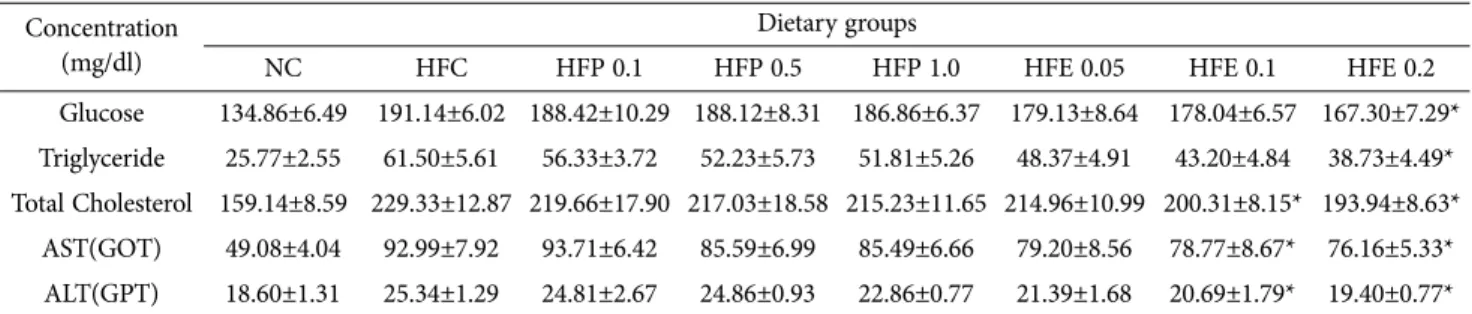
인 HFE 0.2군(167.30±7.29)은 HFC군(191.14±6.02)에 비 해 약 8.75% 낮게 나타났으며, 총 콜레스테롤(p<0.05)과 중성지방(p<0.05)에서도 HFE 0.2군의 경우 HFC군에 비 해 유의한 차이를 나타냈다. 간 질환을 진단하는 중요한 효소로 활용되는 AST와 ALT는 수치가 증가할수록 사망 률과 위험도가 증가하는 경향을 나타낸다(Lee et al., 2016). 털목이버섯 21001 strain 50% EtOH 추출물 섭취군 (HFE 0.1, HFE 0.2)에서 AST와 ALT의 수치 역시 HFC군 에 비해 유의하게 감소한 것을 확인할 수 있었으며 이를 통해 간 손상 억제효과도 존재함을 유추할 수 있었다.
4. Western blot을 통한 지방세포 분화 마커들의 발현 실험
털목이버섯 21001 strain 분말 또는 50% EtOH 추출물 이 함유된 고지방식이를 먹은 마우스들의 간 조직에서 4 종의 adipocyte protein(PPARγ, FABP4(aP2), CD36, C/
EBPα) 발현량을 분석한 결과 Fig. 5와 같이 이 HFC군에 비해 상대적으로 감소하는 것을 확인할 수 있었다. 이와 같이 목이버섯을 섭취한 마우스의 간 조직에서 추출한 단 백질을 사용한 western blot 실험 결과와 3T3-L1 cell의 지방분화를 통해 얻은 adipocyte cell을 사용한 in vitro에 서의 western blot 실험 결과(Fig. 4)가 거의 동일한 결과 로 나타나 항비만 효과를 확인할 수 있었다.
적 요
11 종의 목이버섯 자실체로부터 얻은 50% EtOH추출물 을 사용하여 지방전구세포인 3T3-L1의 지방세포 분화억 제 효과를 확인한 모든 strain에서 억제효과가 존재하였다.
털목이에서는 21001 균주가 가장 우수하였고 흑목이에서 는 21002 균주가 억제효과가 우수하였다. 전반적으로 털 목이가 흑목이에 비해 지방세포 분화억제 효과가 우수하 였다. 또한 Adipocyte RNA 발현량과 protein 발현량 측 정 실험에서도 털목이 21001 균주가 지방세포 분화억제 효과에 있어서 가장 우수하였다. 털목이 21001 버섯을 사 용하여 동물실험을 진행한 결과 털목이 자실체 분말이나 50% EtOH 추출물을 급여한 실험에서 체중 감소효과가 나타났으며, 특히 EtOH 추출물 0.2%를 급여한 군에서 유 의하게 감소함을 확인하였다(*P<0.05). 동물 희생 후 적 출한 간 중량 및 부고환지방량과 혈청 내 중성지방 및 총 콜레스테롤, 혈당, ALT, AST 등도 털목이버섯 21001 EtOH 추출물 0.1% 이상 급여 시 고지방식이만을 급여 한 군에 비해 유의차(*P<0.05 이상) 있게 감소함을 확인 하였다.
감사의 글
본 연구는 농촌진흥청 공동연구사업(PJ010223)의 지원 에 의해 수행된 연구결과로 지원에 감사드립니다.
REFERENCES
Chang JS, Lee KR, Kim HJ, Bae JT, Park SH, Lee SH, Kim OM.
1998. Inhibition effects of Auricularia auricula-judae methanol extract on lipid peroxidation and liver damage in benzo(a)pyrene-Treated mice. Kor J Food Sci Nutr. 27:712- 717.
Cheung LM, Cheung PCK, Ooi VEC. 2003. Antioxidant activity and total phenolics of edible mushroom extracts. Food Chem.
Table 3. Effects of dietary A. auricula-polytricha 21001 on the levels of serum Concentration
(mg/dl)
Dietary groups
NC HFC HFP 0.1 HFP 0.5 HFP 1.0 HFE 0.05 HFE 0.1 HFE 0.2
Glucose 134.86±6.49 191.14±6.02 188.42±10.29 188.12±8.31 186.86±6.37 179.13±8.64 178.04±6.57 167.30±7.29*
Triglyceride 25.77±2.55 61.50±5.61 56.33±3.72 52.23±5.73 51.81±5.26 48.37±4.91 43.20±4.84 38.73±4.49*
Total Cholesterol 159.14±8.59 229.33±12.87 219.66±17.90 217.03±18.58 215.23±11.65 214.96±10.99 200.31±8.15* 193.94±8.63*
AST(GOT) 49.08±4.04 92.99±7.92 93.71±6.42 85.59±6.99 85.49±6.66 79.20±8.56 78.77±8.67* 76.16±5.33*
ALT(GPT) 18.60±1.31 25.34±1.29 24.81±2.67 24.86±0.93 22.86±0.77 21.39±1.68 20.69±1.79* 19.40±0.77*
NC : Normal diet control, HFC : High fat diet control, HFP0.1 : High fat diet containing 0.1% of dried Auricularia strain 21001 mushroom, HFP0.5 : High fat diet containing 0.5% of dried Auricularia strain 21001 mushroom, HFP1.0 : High fat diet containing 1% of dried Auricularia strain 21001 mushroom, HFE0.05 : High fat diet containing 0.05% of Auricularia strain 21001 mushroom extract, HFP0.1 : High fat diet con- taining 0.1% of Auricularia strain 21001 mushroom extract, HFP0.2 : High fat diet containing 0.2% of Auricularia strain 21001 mushroom extract (*P<0.05).
Fig. 5. Protein expression of PPAR-γ, FABP4(aP2), CD36, and C/EBPα in the livers of the sacrificed mice
80:1-7.
Chua SC Jr. 1997. Monogenic models of obesity. Behavior Genetics 27:277-284.
Dattilo AM, Kris-Etherton PM. 1992. Effects of weight reduction on blood lipid and lipoprotein: a meta-analysis. Am J Clin Nutr. 56:320-328.
Gang Chen, Yang-Chao Luo, Bao-Ping Ji, Bo Li, Wei Su, Zhen- Lei Xiao, Gui-Zhi Zhang. 2011. Hypocholesterolemic effects of Auricularia auricula ethanol extract in ICR mice fed a cholesterol-enriched diet. J Food Sci. Technol. 48:692-698.
Gang Chen, Yang-Chao Luo, Bao-Ping Ji, Bo Li, Wei Su, Zhen- Lei Xiao, 2008. Effect of polysaccharide from Auricularia auricula on blood lipid metabolism and lipoprotein lipase activity of ICR mice fed a cholesterol-enriched diet. J Food Sci. 73:H103-8.
Jang YS, Jeong JM. 2011. Anti-obesity effects of black bean Chungkugjang extract in 3T3-L1 adipocytes and obese mice induced by high fat diet. Kor J Food Sci Nutr. 40:1235-1243.
Ham SS, Kim DH, Lee DS. 1997. Antimutagenic effects of methyl alcohol extracts from Auricularia auricula and Gyrophora esculenta. Korean J Food Sci Technol. 29:1281-1287.
Jo SH, Kim TH, Yu YB, Oh JN, Jang MH, Park KM, 2012. A comparative study on the physiological activities of Auricularia spp, Korean J. Food Sci. Technol. 44:350-355.
Jung EK, 2010, The Effects of Auricularia auricula-judae Supplement on Body Fat, Bone density and concentration of serum lipid of abdominal obese women. M.S. Thesis.
Kyonggi University.
Kim DA, 2007. Antioxidative action and effect on dried skin in rat of Auricularia auricula U. extracts. M.S. Thesis. Daegu Catholic University.
Kim HM, Hur W, Lee SY. 2011. Polysaccharide extraction and comparison of free radical scavenging activities from Tremella fuciformis and Auricularia auricula fruit body. Food Engineering Progress. 15:6-14.
Lee BC, Bae JT, Pyo HB, Choe TB, Kim SW, Hwang HJ, Yun JW.
2003. Biological activities of the polysaccharides produced from submerged couture of the edible Basidimycete Grifola frondosa Enz Microb Technol. 6274:1-8.
Lee JA, Park YJ, Jeong WS, Hong SS, Ahn EK. 2017. Anti-obesity effect of Amomum taso-ko ethanol extract in 3T3-L1 adipocyte. J Appl Biol Chem 60:23-28.
Lee TY, Ryu HS, Park CS. 2016. Association between liver enzyme and risk of all-cause mortality - use of Korean genome and epidemiology study (KoGES) data. J Korea Academia-Industrial Cooperation Society 17:94-103.
Lie F, Ooi VEC, Chang ST. 1997. Free radical scavenging activities of mushroom polysaccharide extracts. Life Sci.
60:763-771.
Luo Y, Chen G, Li B, Ji B, Guo Y, Tian F. 2009. Evaluation of antioxidative and hypolipidemic properties of a novel functional diet formulation of Auricularia auricula and Hawthorn, Innov Food Sci Emerg Technol 10:215-221.
Mau JL, Lin HC, Song SF. 2002. Antioxidant properties of several speciality mushroom. Food Res Int. 35:519-526.
Philip GR, Forrest HN, George CF. 1993, AIN-93 purified diets for laboratory rodents: final report of the American Institute of Nutrition Ad Hoc Writing Committee on the Reformulation of the AIN-76A Rodent Diet. Nutr. 123:1939- 1951.
Sladowski D, Steer SJ, Clothier RH, Balls M. 1993. An improved MTT assay. J Immunol Methods 157:203-207.
Song NJ. 2016. Butein inhibits adipocyte differentiation and counteracts obesity by induction of white adipocyte browning. Ph. D. Thesis. Sungkyunkwan University.
Srujana R, Jeong‐Yeh Y, Suresh A, Mary AD, Clifton AB. 2008.
Resveratrol induces apoptosis and inhibits adipogenesis in 3T3‐L1 adipocytes. Phytother Res. 1367-1371.
Takeuchi, H, He, P, Mooi, L. Y, 2004. Reductive effect of hot- water extracts from woody ear, J Nutri Sci Vitaminol. 50:300- 304.
WHO Report, 2018. Obesity and overweight, http://www.who.int/
mediacentre/factsheets/ fs311/en/
Yang JH, Lin HC, Mau JL. 2002. Antioxidant properties of several commercial mushroom. Food Chem. 77:229-2357.
Zhao S, Liu Y, Xu F, Wang S, Chen J, Geng X, 2013.
Hypolipidemic function of Auricularia polytricha protein extract, Modern Food Sci Technol. 2013-05