637
Copyright © 2019 The Korean Society of Fisheries and Aquatic Science pISSN:0374-8111, eISSN:2287-8815
서 론
참다슬기
(Semisulcospira coreana)
는연체동물문 복족강흡 강목다슬기과에속하는종으로하천이나호수등에서쉽게발 견되는고동류이며,
강원도를비롯하여지역축제의소재로사 용되고있을정도로인기있는수산물이다.
국내다슬기류의양 식총생산량은2018
년기준742
톤으로(KOSIS, 2018)
생산량 이낮기때문에양식을통한생산성확대로안정적인공급필요 성이증대되고있다.
최근에다슬기관련연구가다수수행되어 왔지만,
대부분이생태(Kim et al., 2012)
및식품영양학적연 구(Lim et al., 2009; Kim et al., 2009; Lee et al., 2010)
에대해기술하고있으며배합사료에대한자료는매우부족하다
.
따라 서아직은다슬기양식을위한전용상품배합사료가개발되어 있지않아다슬기를사육하는양어가는전복또는타어종사료 를구입하여공급하고있는실정이다.
이처럼타어종사료를사 용하게되면영양소불균형으로인한사료효율저하및성장의 감소로인하여양식생산비용을증가시키는요인이될수있다.
또한양어장에서배합사료로사육된다슬기들은자연산다슬 기보다패각및가식부에청록색의색소가잘축적되지않는등 외견상으로차이를보이고있다.
색은소비자가품질을인지하 는데영향을미치는중요한요소이며(Francis, 1995),
다슬기의 경우소비자들은진한청록색을원하고,
이에영향을주는색소배합 사료내 녹색 원료 첨가에 따른 참다슬기(Semisulcospira coreana)의 성장 및 가식부 색소 함량 변화
박지훈·김에스더
1·정성목
1·유상권
2·이상민
1*
수협사료 연구개발부, 1강릉원주대학교 해양생물공학과, 2강릉원주대학교 해양식품공학과
Effects of Dietary Supplementation of Green Pigment Sources on the Growth and Pigment Contents of Semisulcospira coreana
Ji-Hoon Park, Esther Kim1, Seong-Mok Jeong1, Sang-Guan You2 and Sang-Min Lee1*
Research and Development Department, Ssuhyupfeed, Uiryeong 52159, Korea
1Department of Marine Biotechnology, Gangneung-Wonju National University, Gangneung 25457, Korea
2Department of Marine Food Science and Technology, Gangneung-Wonju National University, Gangneung 25457, Korea
Three separate feeding trials were performed to evaluate the dietary inclusion of pigments on growth and pigmenta- tion of Semisulcospira coreana . In the first trial (Exp-1), snails (80 mg/snail) were fed diets containing green laver Enteromorpha intestinalis , seaweed fulvescens Capsosiphon fulvescens , chlorella Chlorella vulgaris , green tea, mug- wort, kale, broccoli, sea tangle, dried laver Pyropia yezoensis , a synthetic edible dye, and a diet containing no pig- ment (control) for 12 weeks. Results showed that dietary treatments had no significant effects on growth performance.
However, total chlorophyll and chlorophyll a contents of the snail’s edible portion were markedly affected and the highest values were found in snails fed green laver. In the second (Exp-2) and third (Exp-3) experiments, the effect of green laver and chlorella were examined in diets for relatively smaller (35 mg/snail) and bigger (139 mg/snail) snails than those examined in the Exp-1, respectively. Feeding the bigger snails with chlorella significantly enhanced their growth rates compared to control group. Total chlorophyll and chlorophyll a contents of the edible portions of snails were significantly increased by dietary chlorella supplementation. These findings suggest that dietary green laver or chlorella could improve the pigmentation of S. coreana without any adverse effects on growth.
Key words: Snail, Semisulcospira coreana , Chlorophyll, Green laver, Chlorella
*Corresponding author: Tel: +82. 033. 640. 2414 Fax: +82. 033. 640. 2417 E-mail address: [email protected]
This is an Open Access article distributed under the terms of the Creative Commons Attribution Non-Commercial Licens (http://creativecommons.org/licenses/by-nc/3.0/) which permits unrestricted non-commercial use, distribution, and reproduction in any medium, provided the original work is properly cited.
Received 19 November 2019; Revised 6 December 2019; Accepted 10 December 2019 저자 직위: 박지훈(연구원), 김에스더(연구원), 정성목(대학원생), 유상권(교수), 이상민(교수)
https://doi.org/10.5657/KFAS.2019.0637
Korean J Fish Aquat Sci 52(6), 637-643, December 2019
는엽록소
(chlorophyll)
로추정된다. Chlorophyll
은조류,
해조 류및식물의엽록체내에존재하는청록색을나타내는주된색 소이다.
녹색식물내에서chlorophyll
은다양한형태로존재하 며,
그중에서도chlorophyll a
가차지하는비중이높다고보고 되었다(Chernomorsky and Segelman, 1988; Jeon et al., 2009).
다슬기가식부색채변화에대한연구는다슬기전용사료개 발의중요한부분이될수있다
.
따라서본연구는녹색색소가 함유된다양한원료들을선정하여,
다슬기배합사료의색소원 료의효능을평가하고자수행되었다.
재료 및 방법
실험사료
본연구에서는총
3
회의사육실험을실시하였는데,
실험1
에 서는다양한색소원료를선정하여실험배합사료에첨가하였 다.
실험1
에서참다슬기가식부chlorophyll
함량및성장이우 수했던원료를선정하여실험2
와3
에적용하였는데,
실험2
와 실험3
에서는각각각고0.5 cm
전후의참다슬기치패와1.0- 1.5 cm
의참다슬기를대상으로가식부chlorophyll
함량및성 장에미치는영향을연구하였다.
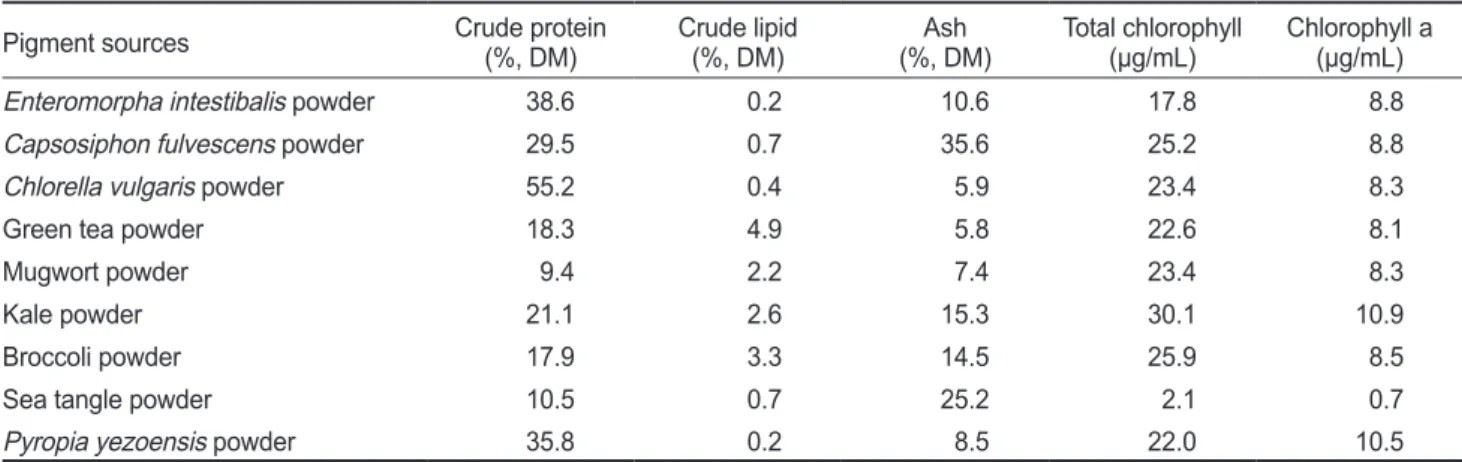
실험사료제조에사용된색소 원료의일반성분및chlorophyll
함량을Table 1
에나타내었다.
실험사료에사용된모든색소원료는시중에서식품원료로판 매되고있는제품을구매하여사용하였다.
실험사료의원료조성
,
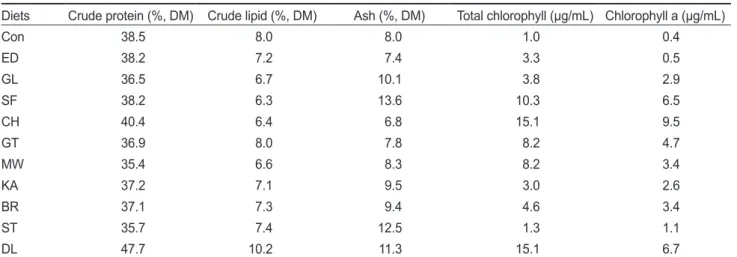
일반성분및chlorophyll
함량을Table 2
와3
에각각나타내었다.
주단백질원으로전갱이어분및대 두박을사용하였으며,
지질원으로대두유와 아마인유를혼합 하여사용하였다.
색소원료첨가에따른성장및가식부chlo- rophyll
함량의변화를조사하기위하여녹조류3
종[
클로렐라(Chrlorella vulgaris, CH),
파래(Enteromorpha instestinalis, GL),
매생이(Capsosiphon fulvescens, SF),
갈조류1
종[
다 시마(sea tangle, ST),
육상식물4
종[
녹차(green tea, GT),
쑥(mugwort, MW),
케일(kale, KA),
브로콜리(broccoli, BR)]
및식용녹색색소
(edible dye, ED)
를각각20%
및2%
를대조사료(con)
의대두박과소맥분대신첨가한총11
개의배합사료를설계하였다
.
실험2
및실험3
은실험1
에서성장및chlorophyll
함량이높았던실험사료(
클로렐라및파래)
를대상으로사육실 험을실시하였다.
위와같이설계된원료들을잘혼합한후
,
원료1 kg
당물300 g
을첨가하여moist pellet
제조기로성형후에직경1-2 cm
의 크기로절단하여건조하였고,
건조된사료는-24°C
냉동고에보 관하면서사용하였다.
다슬기 사육 및 관리
사육실험에 사용된 참다슬기는 개인 양어장
(Sabdarisusan,
Yesan, Korea)
에서생산된 치패를강릉원주대학교내사육시설로운반하여상품사료를
1
일1
회공급하면서1
주간적응시 켰다.
실험
1
은외형적으로건강한다슬기치패(
실험시작시평균체 중80 mg)
를총22
개의60 L
사각유리수조에각수조마다100
마리씩2
반복으로수용하여12
주간사육하였다.
실험2 (
평균 체중35 mg)
와실험3 (
평균체중139 mg)
은60 L
사각유리수 조에각각80
마리및100
마리씩2
반복으로수용하여8
주간사 육하였다.
실험사료는각수조에수용된다슬기총체중의5%
씩 을1
일1
회(13:00 h)
공급하였으며,
사료공급후사육수공급을1
시간중단하여다슬기의사료섭취가가능하도록하였다.
사육 조는순환여과장치를이용하였으며,
사육수온은온도조절장치를이용하여평균수온이
21°C
가되도록조절하였다.
사료공급전수조바닥에쌓인노폐물을사이펀으로제거하였으며
,
여 과시스템내에부족한사육수는매일보충하여주었다. 개체 측정 및 성분분석
개체측정은실험 개시시와종료시 측정전일절식시킨 후 각 실험수조에수용된다슬기전체무게를측정하였다
.
성분 분석을위하여사육된모든다슬기의패각을제거한후가식 부를실험수조별로혼합하여분쇄하였으며,
가식부에패각이Table 1. Nutrient composition of the tested pigment sources
Pigment sources Crude protein
(%, DM) Crude lipid
(%, DM) Ash
(%, DM) Total chlorophyll
(μg/mL) Chlorophyll a (μg/mL)
Enteromorpha intestibalis powder 38.6 0.2 10.6 17.8 8.8
Capsosiphon fulvescens powder 29.5 0.7 35.6 25.2 8.8
Chlorella vulgaris powder 55.2 0.4 5.9 23.4 8.3
Green tea powder 18.3 4.9 5.8 22.6 8.1
Mugwort powder 9.4 2.2 7.4 23.4 8.3
Kale powder 21.1 2.6 15.3 30.1 10.9
Broccoli powder 17.9 3.3 14.5 25.9 8.5
Sea tangle powder 10.5 0.7 25.2 2.1 0.7
Pyropia yezoensis powder 35.8 0.2 8.5 22.0 10.5
Table 2. Formulation and ingredient contents of the experimental diets
Ingredients (%) Diets
Con ED GL SF CH GT MW KA BR ST DL
Mackerel meal1 10.0 10.0 10.0 10.0 10.0 10.0 10.0 10.0 10.0 10.0 10.0
Soybean meal 30.0 30.0 20.0 25.0 15.0 25.0 25.0 25.0 25.0 30.0 20.0
Wheat gluten meal 10.0 10.0 10.0 10.0 10.0 10.0 10.0 10.0 10.0 10.0 10.0
Wheat flour 40.0 38.0 30.0 25.0 37.0 25.0 25.0 25.0 25.0 20.0 30.0
Soybean+linseed oil 5.0 5.0 5.0 5.0 3.0 5.0 5.0 5.0 5.0 5.0 5.0
Edible dye (green) 2.0
Enteromorpha intestinalis powder 20.0
Capsosiphon fulvescens powder 20.0
Chlorella vulgaris powder 20.0
Green tea powder 20.0
Mugwort powder 20.0
Kale powder 20.0
Broccoli powder 20.0
Sea tangle powder 20.0
Pyropia yezoensis powder 20.0
Vitamin premix2 2.0 2.0 2.0 2.0 2.0 2.0 2.0 2.0 2.0 2.0 2.0
Mineral premix3 2.5 2.5 2.5 2.5 2.5 2.5 2.5 2.5 2.5 2.5 2.5
Vitamin C (Stay-C) 0.2 0.2 0.2 0.2 0.2 0.2 0.2 0.2 0.2 0.2 0.2
Vitamin E (25%) 0.2 0.2 0.2 0.2 0.2 0.2 0.2 0.2 0.2 0.2 0.2
Choline (50%) 0.1 0.1 0.1 0.1 0.1 0.1 0.1 0.1 0.1 0.1 0.1
1Mackerel meal from Chile supplied by Suhyupfeed. 2Vitamin mix contained the following amount which were diluted in cellulose (g/kg mix): DL-α-tocopheryl acetate, 20; thiamin hydrochloride, 5; riboflavin, 8; pyridoxine hydrochloride, 2; nicin, 40; Ca-D-pantothenate, 12;
myo-inositol, 200; D-biotin, 0.4; folic acid (98%), 1.5; p-aminobenjoic acid, 20; menadione, 4; retinyl acetate, 1.5; cholecalciferol, 0.003;
cyanocobalamin, 0.003. 3Mineral mix contained the following ingredients (g/kg mix): NaCl, 10, MgSO4·7H2O, 150; NaH2PO4·2H2O, 250;
KH2PO4, 320; CaH4 (PO4)2·H2O, 200; Ferriccitrate, 25; ZnSO4·7H2O, 4; Ca-lactate, 38.5; CuCl, 0.3; AlCl3·6H2O, 0.15; KIO3, 0.03; Na2S- e2O3,0.01; MnSO4·H2O,2; CoCl2·6H2O, 0.1·Con, control; ED, edible dye; GL, Enteromorpha intestinalis; SF, Capsosiphon fulvescens; CH, Chlorella vulgaris; GT, green tea; MW, mugwort; KA, kale; BR, broccoli; ST, sea tangle; DL, Pyropia yezoensis.
Table 3. Proximate composition and chlorophyll content of the experimental diets
Diets Crude protein (%, DM) Crude lipid (%, DM) Ash (%, DM) Total chlorophyll (μg/mL) Chlorophyll a (μg/mL)
Con 38.5 8.0 8.0 1.0 0.4
ED 38.2 7.2 7.4 3.3 0.5
GL 36.5 6.7 10.1 3.8 2.9
SF 38.2 6.3 13.6 10.3 6.5
CH 40.4 6.4 6.8 15.1 9.5
GT 36.9 8.0 7.8 8.2 4.7
MW 35.4 6.6 8.3 8.2 3.4
KA 37.2 7.1 9.5 3.0 2.6
BR 37.1 7.3 9.4 4.6 3.4
ST 35.7 7.4 12.5 1.3 1.1
DL 47.7 10.2 11.3 15.1 6.7
Con, control; ED, edible dye; GL, Enteromorpha intestinalis; SF, Capsosiphon fulvescens; CH, Chlorella vulgaris; GT, green tea; MW, mugwort; KA, kale; BR, broccoli; ST, sea tangle; DL, Pyropia yezoensis.
혼입되지않도록증류수로씻어서분석용으로사용하였다
.
실 험사료의일반성분은AOAC (1995)
의방법에따라조단백질(N×6.25)
은auto Kjeldahl system (Buchi B-324/435/412, Switzerland; Metrohm 8-719/806, Swizerland)
를 사용하여 분석하였고,
조지방은ether
를 사용하여 추출하였으며,
수분 은105°C dry oven
에서6
시간건조후측정하였다.
조회분은600°C
회화로에서4
시간동안태운후측정하였다.
실험
1
에서색소원료,
실험사료및다슬기가식부의chloro- phyll
추출및측정은Hiscox and Israelstram (1979)
의방법을 이용하였다. Dimethyl sulfoxide (DMSO)
를추출용매로이용 하였으며,
시험관에DMSO 10 mL
를넣은후색소원료,
실험 사료및다슬기가식부0.1 g
을측정하여시험관에넣고, 65°C
조건의항온기에서8
시간동안chlorophyll
을추출하였으며,
추 출액은분광광도계(V-550, Jasco, Japan)
를사용하여645 nm
와
663 nm
의파장에서흡광도를측정하여다음의식을이용하여
chlorophyll
함량을측정하였다(Arnon, 1949; Mackinney, 1941).
Chlorophyll a (μg/mL)=(12.7A
663-2.69A
645) Total Chlorophyll (μg/mL)=(8.02A
663+20.20A
645)
실험2
및 실험3
의다슬기가식부chlorophyll
추출및측 정은Chappelle et al. (1992)
의방법을이용하였다.
시험관에DMSO 10 mL
을넣은후다슬기가식부0.5 g
을측정하여시험 관에넣고, 30°C
조건의항온기에서48
시간동안chlorophyll
을 추출하였다.
추출액은분광광도계(Lambda 3B, Perkin Elmer, USA)
를사용하여470, 648
및664 nm
에서흡광도를측정하여다음의식을이용하여
chlorophyll
및carotenoids
함량을측 정하였다.
Chlorophyll a (μg/mL)=12.25A
664-2.79A
648Chlorophyll b (μg/mL)=21.50A
648-5.10A
664Total chlorophyll (μg/mL)=Chlorophyll a+Chlorophyll b Carotenoids (μg/mL)=(1000A
470-1.82chl a-85.02chl b)/198 통계 분석
결과의통계처리는
SPSS Version 25.0 (SPSS Inc, Chicago IL, USA)
을 사용하여One-way ANOVA-test
를 실시한 후, Duncan’s multiple range test (Duncan, 1955)
로평균간의유의 성(P<0.05)
을검정하였다.
결과 및 고찰
실험
1 (
시작시평균체중80 mg)
에서참다슬기치패를12
주 간사육한결과,
참다슬기의최종체중은13 g-23 g/tank
의범 위로모든실험구간에유의적인차이가없었다(P>0.05).
실험2 (
시작시평균체중35 mg)
에서참다슬기를8
주간사육한결 과(Table 4),
생존율및성장효과는색소원료첨가에따른영 향을받지않았다(P>0.05).
실험3 (
시작시평균체중139 mg)
에서참다슬기를8
주간사육한결과(Table 5),
성장은사료내 색소원료첨가따른영향을받았다.
다슬기의최종평균무게(final weight),
체중증가(weight gain)
및일간성장률(specific
Table 5. Growth performance of the Semisulcospira coreana fed the experimental diets for 8 weeks (Exp-3)
Diets Final weight (mg/snail) Weight gain (mg/snail) SGR (%/day)1 Survival (%)
Con 267.10±8.70a 129.60±10.79a 1.19±0.09a 66.5±2.5ns
GL 351.75±21.75ab 212.98±26.48ab 1.66±0.17ab 57.5±5.5
CH 405.40±31.70b 263.30±30.75b 1.87±0.13b 50.5±1.5
Values (mean±SE of two replicate) in the same column not sharing a common superscript are significantly different (P<0.05). 1SGR (specific growth rate, %)=[(ln (Wf)-ln (Wi))/days of feeding]×100, where ln (Wf)=natural log of the final mean weight of snail and ln(Wi)=natural log of the initial mean weight of snail. nsNot significant (P>0.05). Con, Control; GL, Enteromorpha intestinalis; CH, Chlorella vulgaris.
Table 4. Growth performance of the Semisulcospira coreana fed the experimental diets for 8 weeks (Exp-2)
Diets Final weight (mg/snail) Weight gain (mg/snail) SGR (%/day)1 Survival (%)
Con 79.27±6.44ns 44.15±6.07ns 1.45±0.13ns 68.2±1.9ns
GL 97.45±6.00 63.01±7.31 1.86±0.18 74.4±5.6
CH 85.22±12.66 49.91±11.72 1.55±0.22 62.6±13.8
Values (mean±SE of two replicate) in the same column not sharing a common superscript are significantly different (P<0.05). 1SGR (specific growth rate, %)=[(ln(Wf)-ln(Wi))/days of feeding]×100, where ln(Wf)=natural log of the final mean weight of snail and ln(Wi)=natural log of the initial mean weight of snail. nsNot significant (P>0.05). Con, Control; GL, Enteromorpha intestinalis; CH, Chlorella vulgaris.
growth rate, SGR)
은클로렐라(Chlorella vulgaris, CH)
첨가 실험구가대조구보다유의적으로높았으며(P<0.05),
파래(En- teromorpha intestinalis, GL)
첨가구와는차이가없었다.
클로 렐라는유산균성장촉진물질인CGF (chlorella growth factor)
뿐만아니라항산화작용,
중금속축적억제등과같은생리활성 물질을포함하고있고(Shibata et al., 2003; Shim et al., 2008;),
파래는무기질,
비타민이풍부하기때문에(Hong et al., 1991;
Lim, 2008)
본연구에서다슬기성장에긍정적인영향을준것으로판단된다
.
사료내클로렐라와파래를각각첨가하면gibel carp (Wei X et al., 2014)
와은어(Jeong et al., 2004)
의성장이 개선된다는결과가보고된바있다.
클로렐라및파래는섭취된 후장내에서소화가어려워세포벽파쇄및열수추출등추가적 인공정을통하여소화및흡수율을개선하고있다.
해조류및 식물의세포벽은주로cellulose
로구성되어있으며,
이는구조 성다당류로β-1,4-glycosidic
결합으로이루어진식물체세포 벽의주요구성성분으로보고되었다(Saha et al., 2006; Nishida et al., 2007; Park et al., 2012). Cellulose
가수분해효소인cel-
lulase
는달팽이를포함한연체동물의소화맹낭에존재하는것으로알려져있다
.
본연구의결과로실험에사용된클로렐라및파래를배합사 료내첨가하는것이다슬기성장개선에긍정적인영향을미 치는것으로판단된다
.
하지만사육환경및해당종의상태등 에따라사료첨가제의이용성이다를수있기에(Lindsay et al., 1984; Shiau and Yu, 1999),
클로렐라및파래에대한다슬기 의원료이용성에대해서는추가적인상세한연구가필요하다.
실험1
의참다슬기치패가식부chlorophyll
함량분석결과 를Table 6
에 나타내었다. Total chlorophyll
함량과chloro-
phyll a
함량은사료색소원료의종류에따른영향을받았다.
Total chlorophyll
함량은0.18-2.46 μg/mL
수준으로나타났 으며,
이중파래(GL)
첨가실험구가2.46 μg/mL
으로다른사 료구에비해유의적으로높은결과값을나타내었다(P<0.05).
Chlorophyll a
함량은0.04-0.83 μg/mL
의수준으로나타났으며
,
파래(GL)
첨가실험구가 다른실험구에비해유의적으로높은결과값을나타내었다
(P<0.05).
실험2
와실험3
의참다슬 기치패가식부chlorophyll
및carotenoids
함량분석결과를 각각Table 7
및8
에나타내었다.
실험2
의참다슬기치패가식 부total chlorophyll
및chlorophyll a
함량은클로렐라(CH)
첨Table 8. Chlorophyll and carotenoid contents of the edible portion of the Semisulcospira coreana fed the experimental diets for 8 weeks (Exp-3)
Diets Chlorophyll a (μg/mL) Chlorophyll b (μg/mL) Total chlorophyll (μg/mL) Carotenoids (μg/mL)
Con 0.47±0.00b 0.81±0.01ns 1.28±0.01a 0.09±0.00a
GL 0.44±0.01a 0.86±0.03 1.31±0.04a 0.07±0.00a
CH 0.75±0.00c 0.82±0.03 1.56±0.03b 0.15±0.01b
Values (mean±SE of three replicate) in the same column not sharing a common superscript are significantly different (P<0.05). nsNot signifi- cant (P>0.05). Con, Control; GL, Enteromorpha intestinalis; CH, Chlorella vulgaris.
Table 7. Chlorophyll and carotenoid contents of the Semisulcospira coreana fed the experimental diets for 8weeks (Exp-2)
Diets Chlorophyll a (μg/mL) Chlorophyll b (μg/mL) Total chlorophyll (μg/mL) Carotenoids (μg/mL)
Con 0.48±0.00a 0.82±0.02ns 1.30±0.02a 0.08±0.01a
GL 0.48±0.03a 0.85±0.04 1.33±0.07a 0.11±0.01ab
CH 0.75±0.01b 0.81±0.02 1.55±0.02b 0.15±0.02b
Values (mean±SE of three replicate) in the same column not sharing a common superscript are significantly different (P<0.05). nsNot signifi- cant (P>0.05). Con, Control; GL, Enteromorpha intestinalis; CH, Chlorella vulgaris.
Table 6. Chlorophyll content of the edible portion of the Semisul- cospira coreana fed the experimental diets for 12 weeks (Exp-1) Diets Total chlorophyll (μg/mL) Chlorophyll a (μg/mL)
Con 1.45±0.09d 0.47±0.05e
ED 0.70±0.08bc 0.21±0.04bcd
GL 2.46±0.08e 0.83±0.05f
SF 0.44±0.01abc 0.09±0.02abc
CH 0.47±0.07abc 0.13±0.04abc
GT 1.14±0.15d 0.35±0.07de
MW 0.19±0.02a 0.04±0.01a
KA 0.78±0.05c 0.24±0.03cd
BR 0.35±0.02ab 0.08±0.01ab
ST 0.18±0.09a 0.04±0.03a
DL 1.31±0.27d 0.39±0.09e
Values (mean±SE of two replicate) in the same column not sharing a common superscript are significantly different (P<0.05). Con, control; ED, edible dye; GL, Enteromorpha intestinalis; SF, Cap- sosiphon fulvescens; CH, Chlorella vulgaris; GT, green tea; MW, mugwort; KA, kale; BR, broccoli; ST, sea tangle; DL, Pyropia yezoensis.
가실험구가대조구
(Con)
및파래(GL)
첨가실험구보다유의 적으로높은값을나타냈다(P<0.05).
실험3
의참다슬기가식부 의total chlorophyll, chlorophyll a
및carotenoids
함량은클 로렐라(CH)
첨가실험구가대조구(Con)
및파래(GL)
첨가실 험구보다유의적으로높은값을나타냈다(P<0.05).
본연구의 크기가다른다슬기를대상으로한사육실험결과에서가식부chlorophyll
함량이실험에따라변화경향이다르게나타나고있어
,
이에대한상세한검토가필요하다.
전복(Lee et al., 1998;
Lim and Lee, 2003; Cho et al., 2006; Ju et al., 2017)
및쉬리(Kim et al., 2006)
를대상으로한기존의연구에서어체의색상 이사료색소에영향을받았지만,
사료의색소가어체및패각 색개선에영향을미치지않았다는연구결과도보고되어있다(Lee and Lee, 2008).
이러한결과들에서나타나는차이들로부 터종합적으로판단해보면,
어체의체색변화에영향을미치는 요인으로사용된원료의종류,
사료조성의차이,
어체크기에따 른원료이용성및사육환경의변화등이있으며,
이러한차이로 인해사료의색소이용성이달라질있을수있을것으로판단된 다.
또한,
실험에사용된참다슬기의어미대의교배차이로인 한유전적인요인도실험결과에영향을미칠수있을것으로짐 작된다.
본연구에서사용된치패의어미가양식으로생산된것 인지,
자연에서생산된것인지에따라유전적인요인에의해가 식부chlorophyll
함량이달라질수있으므로이에대한금후상 세한연구가요구된다.
이상의결과를고려할때
,
참다슬기배합사료내클로렐라및 파래를첨가한사료가색소를첨가하지않은사료보다성장및 가식부chlorophyll
함량이우수하였다.
또한본연구에서제시 한배합사료의이용성을실질적으로평가하기위해서는다양 한조건을갖춘현장에서의사육실험이진행되어야 할것으 로판단된다.
사 사
본연구는해양수산부재원으로한국해양과학기술진흥원지 원
(
다슬기대량양식기술개발을위한시설개선과기능성사 료개발, 20160332)
으로연구되었으며,
이에감사드립니다.
또 한,
다슬기를제공해주신삽다리수산김성락대표님께감사드 립니다.
References
AOAC (Association of Official Analytical Chemists). 1995. Of- ficial methods of analysis.16th edn. Association of Official Analytical Chemists, Arlington, Virginia, VA, U.S.A.
Arnon DI. 1949. Copper enzymes in isolated chloroplasts.
Polyphenoloxidase in Beta vulgaris. Plant physiol 24, 1-15.
https://doi.org/10.1104/pp.24.1.1.
Chappelle EW, Kim MS and McMurtrey JE. 1992. Ratio analy- sis of reflectance spectra (RARS): An algorithm for remote
estimation of the concentration of chlorophyll a, chlorophyll b, and carotenoids in soybean leaves. Remote Sens Environ 39, 239-247. https://doi.org/10.1016/0034-4257(92)90089-3.
Chernomorsky SA and Segelman AB. 1988. Biological activi- ties of chlorophyll derivatives. N J Med 85, 669-673.
Cho SH, Park JE, Kim CI, Yoo JH, Lee SM and Choi CY. 2006.
Effect of the various sources of dietary additives on growth, body composition and shell color of Abalone Haliotis discus
hannai. J Aquacult 19, 275-280.
Duncan DB. 1955. Multiple-range and multiple F tests. Biomet- rics 11, 1-42.
Francis FJ. 1995. Quality as influenced by color. Food Qual Prefer 6, 149-155. https://doi.org/10.1016/0950-3293(94)00026-r.
Hiscox JD and Israelstam GF. 1979. A method for the extraction of chlorophyll from leaf tissue without maceration. Can J Bot 57, 1332-1334. https://doi.org/10.1139/b79-163.
Hong JS, Kwon YJ, Kim YH, Kim YH, Kim MK, Park IW and Kang KH. 1991. Fatty acid composition of Miyeok undaria
pinnatifida and Pare Enteromorpha compressa. J Korean
Soc Food Nutr 20, 376-380.Jeon HY, Jeong KK, Seo DB and Lee SJ. 2009. Effects of chlo- rophyll a on UVB-induced cellular responses and type 1 pN collagen synthesis in vitro. Food Sci Biotechnol 41, 700- Jeong WG, Moon SK, Jeong BY, Jang WS, Kim IS, Maita M, 705.
Lim DH and Lee SM. 2004. Effects of dietary perilla oil and Enteromorpha compressa meal on growth, fatty acid composition and hematology of the cultured sweet smelt
Plecoglossus altivelis. J Fish Sci Tech 7, 1-9. https://doi.
org/10.5657/fas.2004.7.1.001.
Ju ZY, Deng DF, Viljoen C and Forster IP. 2017. Effects of al- gae and shell pigment extract-supplemented diets on shell pigmentation and growth performance of pacific abalone,
Haliotis discus hannai. J World Aquacult Soc 48, 93-102.
https://doi.org/10.1111/jwas.12343.
Kim DH, Bang IC, Lee WO and Baek JM. 2012. Reproduc- tive ecology of the freshwater melania snail, Semisulcospira
coreana (v. martens) in bukhan river. Korean J Malacol 28,
175-185. https://doi.org/10.9710/kjm.2012.28.2.175.Kim SR, Lee CR and Lee SM. 2006. Effect of dietary supple- mentation of paprika and spirulina on pigmentation of swiri
Coreoleuciscus splendidus. J aquacult 19, 261-266.
Kim YK, Moon HS, Lee MH, Park MJ, Lim CW, Park HY, Park JI, Yoon HD and Kim DH. 2009. Biological activities of seven melania snails in Korea. Korean J Fish Sci 42, 434- 441. https://doi.org/10.5657/kfas.2009.42.5.434.
KOSIS (Korean Statistical Information Service). 2018. Survey on the status of fish culture. Retrieved from http://kosis.kr/
statHtml/statHtml.do?orgId=101&tblId=DT_1EW0005&c onn_path=I2 on Oct 31, 2019.
Lee CR and Lee SM. 2008. Effect of dietary supplementa- tion of pigment sources on pigmentation of round tailed
paradise fish Macropodus chinensis and pale chub Zacco
platypus. J Aquacult 21, 213-217. https://doi.org/10.5713/
ajas.2010.90462.
Lee MH, Kim YK, Moon HS, Kim YA, Yoon NY, Lim CW, Park HY and Kim DH. 2010. Antioxidant activities of five melania snails of the genus Semisulcospira in Korea. Ko- rean J Fish Aquat Sci 43, 188-194. https://doi.org/10.5657/
kfas.2010.43.3.188.
Lee SM, Lim YS, Moo YB, Yoo SK and Rho S. 1998. Effects of supplemental macroalgae and spriullina in the diets on growth performance in Juvenile abalone Haliotis discus
hannai. J aquacult 11, 31-38.
Lim CW, Kim YK, Kim DH, Park JI, Lee MH, Park HY and Jang MS. 2009. Comparison of quality characteristics of melania snails in Korea. Korean J Fish Aquat Sci 42, 555- 560. https://doi.org/10.5657/kfas.2009.42.6.555.
Lim EJ. 2008. Quality characteristics of cookies with added en- teromorpha intenstinalis. Korean J Food Nutr 21, 300-305.
Lim T and Lee SM. 2003. Effect of dietary pigment sources on the growth and shell color of abalone Haliotis discus
hannai. J Aquacult 36, 601-605. https://doi.org/10.5657/
kfas.2003.36.6.601.
Lindsay GJH, Walton MJ, Adron JW, Fletcher TC, Cho CY and Cowey CB. 1984. The growth of rainbow trout Salmo gaird-
neri given diets containing chitin and its relationship to chi-
tinolytic enzymes and chitin digestibility. Aquaculture 37, 315-334. https://doi.org/10.1016/0044-8486(84)90297-7.Mackinney G. 1941. Absorption of light by chlorophyll solu- tions. J Biol Chem 140, 315-322.
Nishida Y, Suzuki KI, Kumagai Y, Tanaka H, Inoue A and Oji- ma T. 2007. Isolation and primary structure of a cellulase from the Japanese sea urchin Strongylocentrotus nudus.
Biochimie 89, 1002-1011. https://doi.org/10.1016/j.bio- chi.2007.03.015.
Park EY, Jeong SM, Kim YJ and Lee DH. 2012. Review on hydrolysis methods of the macroalgae for production of bio- ethanol. J Korea Soc Waste Manage 29, 323-333.
Saha S, Roy R, Sen SK and Ray AK. 2006. Characterization of cellulase-producing bacteria from the digestive tract of tilapia, Oreochromis mossambica (Peters) and grass carp,
Ctenopharyngodon idella (Valenciennes). Aquac Res 37,
380- 388. https://doi.org/10.1111/j.1365-2109.2006.01442.x.Shiau SY and Yu YP. 1999. Dietary supplementation of chitin and chitosan depresses growth in tilapia, Oreochromis ni -
loticus × O. aureus. Aquaculture 179, 439-446. https://doi.
org/10.1016/s0044-8486(99)00177-5.
Shibata S, Natori Y, Nishihara T, Tomisaka K, Matsumoto K, Sansawa H and Nguyen VC. 2003. Antioxidant and anti- cataract effects of Chlorella on rats with streptozotocin-in- duced diabetes. J Nutr Sci Vitaminol 49, 334-339. https://
doi.org/10.3177/jnsv.49.334.
Shim JY, Shin HS, Han JG, Park HS, Lim BL, Chung KW and
Om AS. 2008. Protective effects of Chlorella vulgaris on liver toxicity in cadmium-administered rats. J Med Food 11, 479-485. https://doi.org/10.1089/jmf.2007.0075.
Wei X, Gao Z, Qi Z, Qiu M, Peng JQ and Shao R. 2014. Ef- fect of dietary chlorella on the growth performance and physiological parameters of gibel carp Carassius auratus