725
서 론난류성어류인복어
(pufferfish)
는우리나라및일본근해에 약40
여종이서식하고있으며
,
이가운데식용복어는주로복 어목복어과에속하는자주복을비롯하여황복,
까치복,
흑밀 복,
은밀복,
검자주복,
검복,
매리복,
졸복및복섬등20
여종이 있다(Kim et al, 2001; KORDI, 2004; NFFC, 2000).
년간국 내에서생산된자연산복어의양은약2,200-3,800
톤,
양식산 은60-120
톤으로수요또한수입산(5,800-9,300
톤)
을포함하여10,000
톤이상소비되는국내최고인기어종중의하나이다.
복어는맛이시원담백하며영양학적으로도우수하며
,
그열수추출물은숙취후간해독효과등기능특성을지니고있는것으로 알려져있다
(Kim et al., 1994).
현재까지복어와관련된연구는tetrodotoxin
및tetrodotoxin
에의한식중독발생특성에관한 것이대부분으로국내외에서여러연구자에의해다수보고되 어있다(Jeong et al., 1994; Jeon et al., 2000; Kim et al., 2003;
Kim et al., 2007; Noguchi et al., 1991; et al., 2003; Tsubone et
al., 1988).
식용복어의식품성분에대한연구로는복어지방질의성분특성
(Jeong et al., 1999),
복어열수추출물의정미성분 및영양성분의조성(Yang et al., 1990; Yun et al., 2009)
에관한 연구,
음주후숙취해소기능등복어추출물의기능성에관한연 구(Kim et al., 1994)
가수행되어있다.
또한,
복어의효율적활Article history;
Received 29 October 2013; Revised 20 November 2013; Accepted 25 November 2013
*Corresponding author: Tel: +82. 55. 772. 9144 Fax: +82. 55. 772. 9149 E-mail address: [email protected]
Kor J Fish Aquat Sci 46(6) 725-732, December 2013 http://dx.doi.org/10.5657/KFAS.2013.0725 pISSN:0374-8111, eISSN:2287-8815
ⓒ The Korean Society of Fishereis and Aquatic Science. All rights reserved
자연산과 양식산 식용복어의 성분 비교
황석민·오광수
1*
창신대학교 외식조리학과, 1경상대학교 해양식품공학과/농업생명과학연구원
Comparisons of Food Component Characteristics of Wild and Cultured Edible Pufferfishes in Korea
Seok-Min Hwang and Kwang-Soo Oh1*
Department of Food Service Mgmt and Culinary, Changshin University, Changwon 630-764, Korea
1
Department of Seafood Science and Technology/Institute of Agriculture and Life Science, Gyeongsang National University, Tongyeong 650-160, Korea
To identify the food component characteristics of seven edible pufferfishes (five wild pufferfishes including striped puffer Takifugu xanthopterus; eyespot puffer Takifugu chinensis; purple puffer Takifugu porphyreus; rough-backed puffer Lagocephalus wheeleri;
and grass puffer Takifugu niphobles; and two cultured pufferfishes including yellow puffer Takifugu obscurus, and tiger puffer Takifugu rubripes) in Korea, the proximate, fatty/amino acid, chemical and taste compositions were investigated. The proximate compositions were not significantly different among the sampled pufferfishes, whereas grass puffer had lower moisture and crude lipid levels contents, and higher crude protein and ash contents than the other species. The total amino acid levels in wild and cul- tured pufferfishes were 14,941.6-16,427.9 mg/100 g, and the major amino acids were aspartic acid, glutamic acid, glycine, alanine, leucine, lysine and arginine. Regarding the fatty acid and mineral compositions, the major fatty acids included 22:6n-3, 16:0, 18:1n- 9, 20:5n-3, 18:0, 20:4n-3, and 22:5n-3 in that order, and there was a little difference among the sampled pufferfishes. Grass puffer had a higher monoenes ratio, i.e., 16:1n-7 and 18:1n-9, and a lower polyenes ratio than the other pufferfishes. The main minerals detected K, P, Na, S and Ca. Regarding the taste-active compounds, the free amino acid contents of pufferfish extracts were 236.4- 428.1 mg/100 g, consisting primarily of taurine, lysine, proline, glycine, alanine and arginine in that order. The amino nitrogen content of the pufferfishes was 84.5-156.4 mg/100 g, and there was a little difference among the species. As for taste intensity, the total taste value of the purple puffer was higher than that of the other pufferfishes.
Key words: Cultured and wild, Food component, Lagocephalus wheeleri, Pufferfish, Takifugu chinensis
용을위한가공에관한연구로복어내장지질의활용및안전성
(Choi, 2003; Lee, 1997),
복어통조림의가공및열처리에의한 감독(減毒)
효과(Kim et al., 2000),
무독성황복을이용한건강 보조식품의제조방법(Un, 2005)
등복어의식품성분조성과가 공에관한연구및특허출원이부분적으로진행된바있다.
그러 나현재까지국내연안에서서식하고있는자연산및양식산식 용복어류의식품성분특성을종합적으로분석비교한연구는 아직까지보고된바없다.
따라서본연구는국내자연산식용 복어의가치증진및향후대량생산이기대되는양식복어의효 율적인활용을위한식품학적자료를얻기위해연안에서어획 되는까치복,
검자주복,
검복,
은밀복및복섬등자연산복어5
종과황복및자주복등양식산복어2
종의영양성분및정미성 분특성을분석비교하였다.
재료 및 방법
재 료
실험에사용한식용복어는복어가연중가장맛이있는시
기인
2011
년1
월말에 국내 연안에서 어획한 자연산 까치복(striped puffer, Takifugu xanthopterus),
검자주복(eyespot puffer, Takifugu chinensis),
검복(purple puffer, Takifugu porphyreus),
은밀복(rough-backed puffer, Lagocephalus wheeleri)
및복섬(grass puffer, Takifugu niphobles)
을살아있 는상태또는선상동결직후의선도가극히양호한것으로구입 하였다.
이때개체차이를줄이기위해최대한비슷한크기의개 체를각각10
마리씩(
복섬의경우100
마리)
구입하였으며,
이 를복어조리기능사자격증을소지한전문가가물리적제독처리를한후육부분만을취해
-20℃
동결고에저장하여두고실험에사용하였다
.
한편,
황복(yellow puffer, Takifugu obscurus)
과자주복
(tiger puffer, Takifugu rubripes)
은경남통영시한산 도인근양식장에서양식한것을동일한시기에각각10
마리씩 살아있는상태로구입하였다.
이들역시복어조리기능사가물 리적제독처리를한후육부분만을취해-20℃
동결고에저장 하여두고실험에사용하였다.
실험에사용한자연산복어5
종과 양식산복어2
종의평균체장과체중은Table 1
과같다. 실험 방법
일반성분
일반성분의조성은상법
(KSFSN, 2000a)
에따라수분함량 은상압가열건조법,
조단백질함량은semi-micro Kjeldahl
법,
조지방함량은
Soxhlet
법,
회분함량은건식회화법으로측정하였다
.
pH, 산도, 휘발성염기질소 및 아미노질소
pH
는시료를균질화한다음pH meter (Accumet Basic, Fish- er Sci. Co., USA)
로측정하였고,
산도(acidity)
는pH
와염도를 측정한시료용액의pH
가8.3
이될때까지적정하고,
이때소모 된0.1 N NaOH
용액의mL
수로나타내었다(JSSRI, 1985).
휘 발성염기질소(volatile basic nitrogen, VBN)
는Conway unit
를 사용하는미량확산법(KSFSN, 2000b)
으로,
아미노질소(NH
2- N)
함량은Formol
적정법(Ohara, 1982a)
으로측정하였다. 색 조
색조는직시색차계
(Color difference meter ZE-2000, Nippon Denshoku Ltd., Japan)
를사용하여시료육표면의색조에대 한L
값(
명도), a
값(
적색도), b
값(
황색도)
및ΔE
값(
색차)
을측 Table 1. Length and weight of seven kinds of cultured and wild edible pufferfishes(g/100 g) Sample
code Korean name Common
name Scientific name Length
(cm) Weight
(g)
C1 Hwangbok
(Cultured) Yellow puffer Takifugu obscurus 27.5~30.5 302~358
C2 Jajubok
(Cultured) Tiger puffer Takifugu rubripes 35.2~38.0 765~974
W3 Ggachibok
(Wild) Striped puffer Takifugu xanthopterus 32.5~34.0 751~795
W4 Geomjajubok
(Wild) Eyespot puffer Takifugu chinensis 28.5~30.5 493~563
W5 Geombok
(Wild) Purple puffer Takifugu porphyreus 27.5~30.0 305~325
W6 Eunmilbok
(Wild) Rough-backed
puffer Lagocephalus wheeleri 29.5~30.7 336~386
W7 Bokseom
(Wild) Grass puffer Takifugu niphobles 11.0~11.7 29~31
정하였다
.
이때표준백판(standard plate)
의L, a
및b
값은각각99.98, 0.01
및0.01
이었다.
총아미노산
총아미노산함량은시료와
6.0 N HCl
용액을혼합하여heat- ing block (HF 100, Yamato Co., Japan)
으로24
시간분해시킨 후감압건조하고, sodium citrate buffer (pH 2.20, 0.20 M)
로정 용한후아미노산자동분석기(Biochrom 30, Biochrom. LTD, England)
로측정하였다.
지방산
Bligh and Dyer (1959)
의방법에준하여시료의총지질을추 출하고, AOCS Official Method (AOCS, 1990)
에따라검화및methylester
화시킨다음, iso-octane
을가해지방산을분리후capillary column (Supelcowax-320, Supelco Japan Ltd., Ja- pan)
이장착된GC (GC-17A, Shimadzu Co., Japan)
로분석하 였다.
이때GC
의분석조건은Kim et al. (1994)
의분석방법과 같고,
각구성지방산의동정은표준품과의머무름시간비교및equivalent chain length
법(Ackman, 1989)
에의해동정하였다. 무기질
무기질은시료에진한
HNO
3을가해습식분해(Ohara, 1982b)
시킨후ashless filter paper (Toyo 5B, Toyo Co., Japan)
로여과 하여일정량으로정용한다음, ICP (Inductively Coupled Plas- ma Atomic Emission Spectrometer, Atomscan 25, TJA Co., USA)
로Na, K, P, Ca, Mg, Fe, S, Zn, Cu
등의무기이온과Hg, Cd, Pb
등의유해중금속함량을분석하였다(Yoo et al., 1984).
정미성분
시료에
3
배량의70% ethanol
용액을 가하여 균질기(Ultra Turrax T25, IKA, Janke & Kunkel GmbH & Co., Germany)
로균질화한후17,000×g
에서15
분간원심분리하였다.
이조 작을2
회더 반복하여얻은상층액을모아감압농축한후증 류수로써일정량으로정용하였고,
여기에5‘-sulfosalicylic acid
를
10%
정도첨가하여하룻밤방치및여과한후정미성분분석용엑스분으로사용하였다
.
유리아미노산및관련화합물은 시료 엑스분을 일정량 취해감압건조한 다음lithium citrate buffer (pH 2.20, 0.20 M)
로정용한후 아미노산자동분석기(Biochrom 30, Biochrom. LTD, England)
로분석하였다.
그 리고,
시료복어엑스분맛의강도에미치는각유리아미노산 의영향은각각의유리아미노산함량을Kato et al.(1989)
이제 시한정미성유리아미노산의역치(threshold)
로나누어얻어진taste value
로나타내었다.
트리메틸아민옥사이드(TMAO)
및 트리메틸아민(TMA)
함량은Hashimoto and Okaichi (1957)
의방법,
총크레아티닌(total creatinine)
은Sato and Fukuyama (1958)
의방법에따라측정하였다.
결과 및 고찰
일반성분
국내양식산복어
2
종및자연산복어5
종육의일반성분조성 을분석한결과를Table 2
에나타내었다.
양식및자연산복어의 수분함량은78.4-80.4%,
조단백질함량은15.3-17.4%,
조지방 은0.7-1.6%,
그리고회분함량은1.0-2.3%
로서복섬을제외하 고,
종류에따른일반성분조성차이는거의없었는데,
이러한 식용복어의일반성분조성은대체로타해산백색육어류와비 Table 2. Proximate composition in muscle of cultured and wildedible pufferfishes
(g/100 g) Sample
Code*
Proximate composition
Moisture Crude protein Crude lipid Ash C1 80.0±0.1 16.1±0.2 1.5±0.3 1.0±0.1 C2 80.4±0.3 16.0±0.1 1.5±0.1 1.1±0.1 W3 79.0±0.1 15.3±0.2 1.6±0.1 1.5±0.1 W4 80.0±0.1 15.7±0.3 1.4±0.1 1.3±0.0 W5 79.2±0.2 15.9±0.1 1.3±0.1 1.3±0.1 W6 79.8±0.3 16.3±0.3 1.5±0.2 1.0±0.1 W7 79.0±0.2 16.8±0.3 0.7±0.1 2.3±0.1
*Refer to the comment in Table 1.
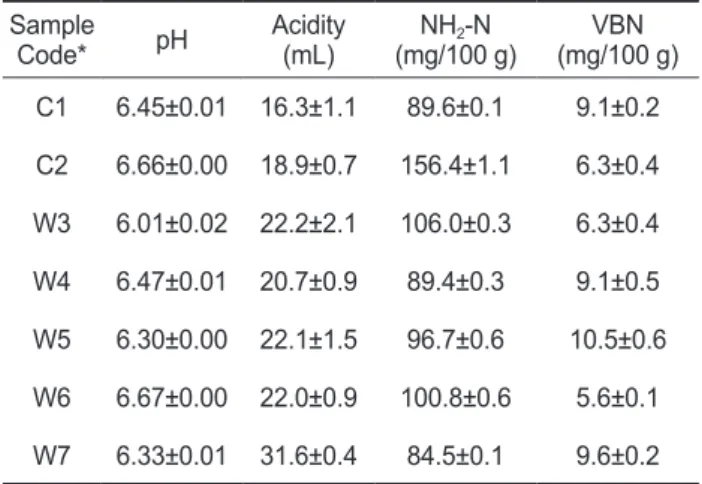
Table 3. pH, acidity, amino-N (NH
2-N) and volatile basic nitrogen (VBN) contents in muscle of cultured and wild edible pufferfishes
Sample
Code* pH Acidity
(mL) NH2-N
(mg/100 g) VBN (mg/100 g) C1 6.45±0.01 16.3±1.1 89.6±0.1 9.1±0.2 C2 6.66±0.00 18.9±0.7 156.4±1.1 6.3±0.4 W3 6.01±0.02 22.2±2.1 106.0±0.3 6.3±0.4 W4 6.47±0.01 20.7±0.9 89.4±0.3 9.1±0.5 W5 6.30±0.00 22.1±1.5 96.7±0.6 10.5±0.6 W6 6.67±0.00 22.0±0.9 100.8±0.6 5.6±0.1 W7 6.33±0.01 31.6±0.4 84.5±0.1 9.6±0.2
*
Refer to the comment in Table 1.
슷한경향을보였다
(NFRDI, 2009).
한편,
소형복어인복섬은 다른시료복어에비해수분과조지방함량은다소낮은반면,
조단백질과회분함량이약간많았다.
pH, 산도, 아미노질소 및 휘발성염기질소
국내양식산및자연산복어육의
pH,
산도,
아미노질소및휘 발성염기질소함량을측정한결과는Table 3
과같다.
양식및자 연산복어의pH
는6.0-6.7
로까치복의경우만약간낮았을뿐 종류에따른차이는거의없었고,
사후육의산성화도거의인지 되지않았다.
육중의유기산함량을간접적으로알수있는산 도는양식산인황복과자주복이대체로자연산복어들에비해 낮았으며,
복섬은31.6 mL
로타시료복어에비해월등히높았 다.
어패류의맛에관여하는아미노질소함량의경우자주복이156.4 mg/100 g
으로가장많았으며,
다음이까치복,
은밀복순 이었고,
복섬이84.5 mg/100 g
으로가장적었다.
색 조
국내양식산및자연산복어의보통육표면색조를직시색차 계로써측정한결과는
Table 4
와같다.
양식산황복과자주복,
그리고자연산까치복은명도(L
값)
가높고적색도a
값)
및색 차(ΔE
값)
가낮아육색이다른시료복어육에비해희고밝은 색조를띠고있으며,
이들간에색조의차이가거의없음이확 인된반면,
자연산검복과은밀복의경우는대체로L
값이낮고a
값과ΔE
값이높아육색이약간어둡고적갈색을띠는것으로나타났고
,
이는육안으로도확인되었다.
따라서국내산식 용복어의경우어종에따라육색이약간씩차이가있음을알 수있었다.
총아미노산
국내양식산및자연산복어육의총아미노산조성과함량을
분석한결과는
Table 5
와같다.
양식및자연산복어육의아미 노산총함량은14,941-16,427 mg/100 g
으로복섬의총아미노 산함량이가장많았고,
까치복이가장적었으나,
종류에따른 총함량차이는거의없었다.
주요아미노산으로는양식및자연 산복어모두약간씩의차이는있으나aspartic acid, glutamic acid, glycine, alanine, leucine, lysine
및arginine
의함량이많 았고,
그외다른아미노산들도고루함유되어있었다.
어종에 따라각구성아미노산의함량은다소차이를보였지만총함량 에대한조성비율은대체로비슷하였다.
지방산
국내양식산및 자연산복어육에서추출한총지질의 구성 지방산조성을분석한 결과는
Table 6
과 같다.
양식 및자연 산복어의주요지방산은16:0 (16.5-19.9%), 18:0 (6.6-8.4%),
Table 4. Color values in ordinary muscle of cultured and wildedible pufferfishes Sample
Code* Color values
L a b ΔE
C1 45.26±0.01 -3.49±0.02 0.90±0.02 51.80±0.01 C2 44.50±0.14 -2.68±0.18 -0.31±0.15 52.51±0.17 W3 46.80±0.02 -2.72±0.01 1.92±0.01 50.23±0.02 W4 41.92±0.01 -1.95±0.01 0.41±0.01 54.77±0.02 W5 37.30±0.02 -1.88±0.04 0.56±0.02 58.72±0.04 W6 30.63±0.01 -1.08±0.04 0.66±0.00 59.39±0.01 W7 43.30±0.02 -2.08±0.01 0.510±0.01 55.00±0.07
*Refer to the comment in Table 1
Table 5. Total amino acid contents in muscle of cultured and wild edible pufferfishes
(mg/100 g) Amino
acids Sample code*
C1 C2 W3 W4 W5 W6 W7
Asp 1,648.3 1,692.1 1,619.2 1,566.5 1,392.5 1,501.7 1,543.7 Thr 790.4 821.5 777.8 743.4 648.4 493.2 805.4 Ser 727.5 729.1 731.0 713.4 655.7 611.2 710.5 Glu 2,560.4 2,582.3 2,477.7 2,345.4 2,227.9 2,368.6 2,490.5 Pro 384.8 297.2 493.0 807.4 915.3 946.8 530.5 Gly 1,076.5 1,191.5 1,155.3 1,205.4 1,701.6 1,341.7 1,276.4 Ala 995.0 1,035.2 1,020.6 1,027.6 1,266.6 1,283.2 1,158.3 Cys 43.2 56.9 21.2 35.6 88.8 70.8 tr
Val 824.4 852.7 909.1 840.9 799.3 769.2 998.2 Met 483.7 517.2 368.5 485.3 344.1 388.5 366.5 Ile 718.0 774.5 723.9 693.1 620.7 762.7 807.3 Leu 1,330.0 1,382.9 1,296.0 1,241.9 1,172.7 1,209.9 1,313.0 Tyr 381.3 414.8 230.1 214.4 194.4 213.8 161.5 Phe 684.4 710.2 705.7 658.7 694.4 643.8 779.7 His 405.3 431.5 193.4 430.0 329.5 342.4 589.0 Lys 1,478.1 1,455.8 1,450.7 1,349.7 2,170.6 2,287.6 1,905.8 Arg 1,000.5 1,006.3 765.4 970.7 738.5 812.3 991.6 Total 15,531.8 15,951.7 14,941.6 15,333.4 15,961.0 16,047.4 16,427.9
*Refer to the comment in Table 1.
18:1n-9 (9.0-16.8%), 20:4n-3 (4.0-7.8%), 20:5n-3 (7.1-8.6%), 22:5n-3 (3.5-8.7%)
및22:6n-3 (18.9-29.5%)
등으로복어종류 에따라약간의조성차이를보였다.
특히,
복섬의경우다른복 어에비해20:5n-3
및22:6n-3
의조성비가낮은반면에16:1n-7
및
18:1n-9
등모노엔산의조성비가높은점이특징적이었는데,
이는복섬의서식환경및식이의차이에기인한것으로생각된 다
.
한편,
기능성지방산인20:5n-3, 22:5n-3
및22:6n-3
등n-3
계고도불포화지방산(n-3 PUFA)
의조성비는38.0-47.9%
로매 우높아국내산식용복어의근육지질은건강기능학적으로매우우수하다고생각된다
. 무기질
국내양식산및자연산복어육의무기이온및유해중금속함 량을분석한결과를
Table 7
에나타내었다.
양식및자연산복 어육의주요무기이온은K (125.2-188.0 mg/100 g), P (120.2- 140.6 mg/100 g), Na (79.7-112.1 mg/100 g), S (55.8-113.2 mg/100 g)
및Ca (23.0-34.4 mg/100 g)
등으로복어종류별및 각구성원소에따라다소의차이를보였으나,
총함량에대한 조성비는대체로비슷하였다.
이중S
의경우함황화합물의역 치가0.02-0.33 ppb
로매우낮기때문에조리시유리되어복어 의구수한향미생성에영향을미치며(Oda, 1981; Park et al., 1994a), Na
+, K
+, Cl
-및PO
43- 등무기이온이자숙게육의주된 정미발현성분(Hayashi et al., 1981)
이라는점을고려할때이 들성분들은복어의맛에크게기여할것으로보인다.
한편, Hg,
Cd
와같은유해성중금속은검출되지않았으며, Pb
의경우일부시료복어육에서검출되었으나기준치이하로위생상의문 제점은없었다
.
정미성분
국내양식산및자연산복어육에서추출한엑스분의
taste-
active compounds
인유리아미노산조성과함량을분석한결과는
Table 8
과같다.
양식및자연산복어엑스분의유리아미 노산총함량은236.4-428.1 mg/100 g
으로,
다른해산어류와비 교해볼때일반백색육어류와는유리아미노산총함량이거의 비슷한반면,
비교적맛이농후한적색육어류에비하면함량 이적은것으로나타났다(Park et al., 1994b).
까치복의유리아 Table 6. Fatty acid composition of total lipid separated frommuscle of cultured and wild edible pufferfishes
(Area %) Fatty
acid Sample code*
C1 C2 W3 W4 W5 W6 W7
14:0 0.7 0.8 0.9 1.1 1.7 0.5 1.7
15:0 0.2 0.2 0.3 0.4 1.2 0.5 0.4
16:0 19.0 18.8 19.1 19.9 16.5 18.7 19.0
18:0 6.9 7.6 6.6 7.4 7.8 8.0 8.4
20:0 0.2 0.2 0.2 0.3 0.1 0.3 0.1
22:0 tr 0.1 tr tr 1.2 0.1 0.2
14:1n-5 0.1 0.2 tr 0.1 0.1 0.1 0.1 15:1n-5 1.6 0.5 2.9 1.4 0.5 1.5 0.3 16:1n-7 2.6 0.4 3.0 1.9 2.5 2.3 7.2 18:1n-7 3.6 0.2 3.2 3.3 2.7 2.5 4.1 18:1n-9 10.6 16.8 11.2 10.4 9.0 8.6 12.3 20:1n-9 0.9 1.3 0.7 0.4 1.7 0.3 1.5 20:1n-7 0.3 0.3 0.2 0.2 1.1 0.2 0.7 22:1n-11 0.1 0.3 0.4 0.1 2.3 0.1 1.0 16:2n-4 0.3 0.3 0.7 1.0 1.2 1.2 0.2 16:3n-4 0.2 0.3 0.3 0.3 0.4 0.5 0.6 16:4n-1 0.6 0.3 0.9 1.0 0.1 0.7 0.8 18:2n-6 3.3 2.6 1.9 2.7 1.3 1.5 1.1 18:3n-6 0.2 0.2 0.2 0.2 0.4 0.7 0.1 18:3n-3 0.4 0.6 0.4 0.8 0.3 0.5 0.5 18:4n-3 tr 0.2 0.2 0.5 0.3 0.1 0.6 20:2n-6 0.3 0.3 0.2 0.2 0.2 0.4 0.3 20:3n-6 0.2 0.1 0.1 0.1 0.1 0.2 0.1 20:3n-3 tr 0.1 0.0 0.1 0.1 0.1 0.2 20:4n-3 6.7 5.6 4.7 4.5 5.5 7.8 4.0 20:5n-3 7.3 7.1 7.8 8.2 7.5 7.3 8.6 22:4n-6 0.5 0.3 0.6 0.4 0.7 1.7 0.2 22:5n-6 0.9 0.6 1.1 1.0 0.5 1.5 1.6 22:5n-3 8.7 6.2 5.1 4.5 3.5 4.7 5.2 22:6n-3 23.6 27.5 27.1 27.6 29.5 27.4 18.9 Saturates 27.0 27.7 27.1 29.1 28.5 28.1 29.8 Monoenes 19.8 20.0 21.6 17.7 19.9 15.6 27.2 Polyenes 53.2 52.3 51.3 53.1 51.6 56.3 43.0 n-3PUFA 46.7 47.3 45.3 46.2 46.7 47.9 38.0
*Refer to the comment in Table 1.
Table 7. Mineral and heavy metal contents in muscle of cultured and wild edible pufferfishes
(mg/100 g) Sample code*
C1 C2 W3 W4 W5 W6 W7
Na 79.7 102.2 93.3 112.1 108.4 92.7 98.0 K 125.2 137.5 144.0 132.9 188.0 128.7 145.1 P 120.2 130.4 135.8 137.8 137.2 124.5 140.6 Ca 23.0 34.4 28.1 25.8 26.7 31.4 30.5 Mg 5.9 5.8 10.0 9.1 14.7 9.1 8.0 Fe 6.4 13.9 18.2 8.4 3.4 8.0 4.7 S 82.7 95.3 113.2 103.8 67.3 67.9 55.8
Zn tr tr tr tr 1.0 0.7 0.5
Cu tr tr tr tr tr tr tr
Hg ND ND ND ND ND ND ND
Pb tr tr 0.3 tr 0.9 tr 0.7
Cd ND ND ND ND ND ND ND
*Refer to the comment in Table 1.
tr : trace, ND: not detected.
미노산총함량이가장적은반면
,
검복의유리아미노산함량이 가장많았다.
주요유리아미노산으로는taurine
이69.5-131.0
mg/100 g
으로가장많았고,
검복과복섬에많이함유되어있었다
. Taurine (Park et al., 2000a)
은삼투압조절등물질대사에관여하는기능성함황아미노산의일종으로복어조리시생기는
냄새의형성에일부기여할것으로생각된다
.
다음으로lysine
의함량이많았으며
(34.9-77.4 mg/100 g),
정미성아미노산인proline, glycine, alanine
및arginine (Kim, 1985)
도비교적많 이함유되어있는반면,
감칠맛의주성분으로수산물엑스분의 맛에크게관여하는glutamic acid
의함량이적은점이특이하였다
. Arginine
은쓴맛을지니나적당량함유되면진한맛을내게하여전체적으로맛을강화시킨다는것이밝혀져있다
(Park et al., 2000a).
복어종류에따라이들유리아미노산개별함량 은다소의차이를보였으나,
조성비는대체로비슷하였다.
아미 노산중glutamic acid, proline, glycine
및alanine
은대표적정미성아미노산
(Kim, 1985)
으로알려져있고,
유리아미노산이수산물의가장중요한맛성분
(Park et al., 2000b)
이란점을고 려할때이러한유리아미노산의함량차이는식용복어의맛특 성에상당한영향을미칠것으로생각되었다.
양식및자연산복어의유리아미노산분석결과값
(Table 8)
을Kato et al. (1989)
이제시한맛의역치로나누어나타낸taste value
는Table 9
와같다.
정미성아미노산맛의강도를나타내 는total taste value
는검복이9.31
로가장높았고,
다음이복섬,
은밀복,
황복,
까치복,
검자주복및자주복순으로엑스분의강 도가강함을알수있었다.
한편,
본taste value
및정미특성으로 보아복어엑스분의맛에크게영향을미치는아미노산으로는 복어종류에관계없이대부분glutamic acid, alanine, glycine, aspartic acid
및arginine
등일것으로생각되었다.
양식및자연산복어엑스분의트리메틸아민옥사이드
(TMAO)
Table 9. Taste values of free amino acids in muscle extract of cultured and wild edible pufferfishesAmino acid
Taste threshold1 (mg/100 g)
Sample code2
C1 C2 W3 W4 W5 W6 W7
Asp 3 0.07 - - - 0.20 0.30 0.87
Thr 260 0.01 0.01 0.01 - 0.04 0.03 0.03 Ser 150 0.02 0.03 0.03 0.01 0.02 0.04 0.04 Glu 5 0.56 0.68 0.90 - 5.72 0.64 1.40 Pro 300 0.09 0.02 0.02 0.04 0.01 0.02 0.03 Gly 130 0.27 0.16 0.14 0.12 0.8 0.23 0.11 Ala 60 0.53 0.15 0.37 0.21 0.29 0.36 0.35 Val 140 0.01 0.02 0.05 0.02 0.05 0.02 0.04 Met 30 0.06 0.04 0.12 0.05 0.13 0.06 0.12 ILe 90 0.01 0.02 0.05 0.02 0.05 0.02 0.09 Leu 190 0.02 0.02 0.04 0.02 0.03 0.02 0.04 Phe 90 0.01 0.02 0.05 0.02 0.04 0.04 0.05 Lys 50 0.81 1.31 0.70 1.44 1.54 1.46 0.70 His 20 0.12 0.06 0.12 0.06 0.24 0.10 0.09 Arg 50 0.35 0.16 0.18 0.27 0.15 0.43 0.19 Total 2.94 2.70 2.78 2.28 9.31 3.77 4.15
1The data were quoted from Kato et al.
2Refer to the comment in Table 1.
Table 8. Free amino acid contents in muscle extract of cultured and wild edible pufferfishes
(mg/100 g) Amino
acids Sample code*
C1 C2 W3 W4 W5 W6 W7
Phser 0.4 0.8 0.9 0.8 1.0 1.3 2.1
Tau 95.8 106.2 69.5 115.6 124.6 70.4 131.0
Phea 1.2 tr tr tr 4.0 2.3 3.2
Urea 15.6 13.4 6.3 10.0 23.4 13.3 14.6
Asp 0.2 tr tr tr 0.6 0.1 2.6
Hypro 5.0 tr 2.2 5.2 tr 5.8 tr
Thr 3.6 2.2 3.0 tr 9.6 6.4 7.3
Ser 5.0 3.8 5.1 1.4 2.8 6.5 5.5
Glu 2.8 3.4 0.9 tr 28.6 3.2 7.0
Sar 5.8 8.2 4.5 15.6 29.4 5.5 tr
AAAA tr tr tr 0.2 1.0 tr 1.2
Pro 25.8 4.4 5.7 11.6 3.4 6.5 10.4 Gly 35.6 21.4 18.1 15.8 23.8 30.6 14.0 Ala 20.0 9.4 21.9 12.6 17.2 22.0 20.7
Citr 1.4 1.4 tr 2.0 2.4 tr 2.1
AABA 0.2 tr tr 0.2 0.8 0.1 tr
Val 1.6 2.6 6.3 2.4 7.0 2.6 5.9
Cys tr 0.2 tr tr 0.2 tr tr
Met 1.8 1.2 3.6 1.4 3.8 1.8 3.7
Cysth 0.8 0.2 0.9 0.2 5.0 1.3 2.2
ILe 0.8 1.6 4.2 1.4 4.8 1.6 7.7
Leu 3.6 3.2 8.1 3.4 6.2 3.8 8.2
Tyr 1.0 2.0 4.5 2.0 8.6 3.1 4.7
β-ala 2.5 5.6 2.1 5.0 9.8 2.1 tr
Phe 1.0 2.0 4.2 2.0 4.0 3.4 4.6
GABA tr 1.4 0.6 tr 2.0 0.9 0.3
Ethamin 3.2 2.8 4.5 3.6 5.4 2.0 2.5
Hylys 0.6 0.4 tr 2.4 0.5 2.1 1.3
Orn 2.8 2.4 0.9 2.8 3.0 tr 2.3
Lys 40.6 65.6 35.3 72.2 77.4 73.1 34.9
1-MHis tr 0.6 tr 1.4 0.8 2.6 tr
His 2.4 1.2 2.4 1.2 4.8 1.9 1.8
3-MHis tr tr tr tr 0.6 0.7 tr
Ans 9.2 3.3 11.7 7.6 4.2 2.9 tr
Arg 17.6 7.8 9.0 13.6 7.4 21.6 9.5 Total 307.9 278.7 236.4 313.6 428.1 301.5 311.3
*Refer to the comment in Table 1.
Phser: phosphoserine, Tau: taurine, Phea: phosphoethanolamine, Sar: sarcosine AAAA: α-amino adipic acid, Citr: citrulline, AABA:
α-aminobutyric acid, Cysth: cystathionine, GABA: γ-aminobutyric acid, Ethamin: ethanolamine, Hylys; hydroxylysine, Orn:
ornithine, Ans: anserine.