주요어: 수술 후 합병증, 호흡기 치료, 실무지침, 근거기반간호 Corresponding author:Kim, Kyeong Sug
Department of Nursing, Samsung Medical Center, 81 Irwon-ro, Gangnam-gu, Seoul 06351, Korea.
Tel: 82-2-3410-2909, Fax: 82-2-3410-2920, E-mail: [email protected]
* 본 연구는 2019년 삼성서울병원 간호본부에서 연구비를 지원받아 진행한 연구임.
투고일: 2021년 1월 30일 / 심사의뢰일: 2021년 6월 3일 / 게재확정일: 2021년 6월 29일
수용개작방법을 활용한 전신마취 수술 후 폐합병증 예방 간호실무지침 개발
최 진 주1)⋅ 김 현 정2)⋅ 강 혜 민1)⋅ 추 희 영1)⋅ 김 경 숙3)
1)삼성서울병원 간호사, 2)삼성서울병원 파트장, 3)삼성서울병원 간호교육팀장
Development of the Nursing Practice Guidelines for Preventing Postoperative Pulmonary Complications using the Guideline
Adaptation Process
Choi, Jin Ju
1)Kim, Hyeon Jeong
2)Kang, Hye Min
1)Chu, Hee Young
1)Kim, Kyeong Sug
3)1)RN, Department of Nursing, Samsung Medical Center
2Unit Manager, Department of Nursing, Samsung Medical Center
3)Team Manager, Department of Nursing, Samsung Medical Center
Purpose: This study aimed to develop an evidence-based nursing practice guideline for preventing postoperative
pulmonary complications (PPCs). Methods: The guideline adaptation process was conducted through the 24 steps based on the guideline adaptation manual of Korean Hospital Nurses Association. Results: The newly developed guideline to prevent PPCs consisted of four domains and 30 recommendations. The number of recommendations in each domain was 7 for assessment of PPCs, 17 for nursing interventions to prevent PPCs after general anesthesia, 4 for education (intended for patients and medical staff), and 2 for monitoring and recording. Conclusion: The developed guidelines will contribute in standardization of nursing practice and PPCs prevention and management. We recommend the dissemination and utilization of these guidelines nationwide to improve the quality of postoperative pulmonary complication prevention.Key words: Postoperative Complications, Respiratory Therapy, Guideline, Evidence-Based Nursing
I.
서 론1. 연구의 필요성
수술 후 폐합병증은 수술 후 발생하는 호흡기의 이상 또는 기능부전에 의해 환자의 치료에 영향을 미치는 것을 통칭한다 [1]. 즉, 임상결과에 악영향을 끼치는 수술 후 폐의 기능 이상이 라고 할 수 있는데, 무기폐, 기관지경련, 흉수 등과 같은 경증 합병증과 수술 후 48시간 이내 기계적 환기치료가 필요한 급 성 또는 악화된 호흡부전, 기관지염, 폐렴, 저산소증 등과 같은 중증 합병증을 포함한다[2].
전신마취 수술 후 폐합병증은 수술의 종류에 따라 차이는 있으나 2.0~33.4%에 이르는 발생빈도를 보인다[3-5]. 또한 수 술 후 폐합병증의 발생은 회복을 지연시키고 사망의 주요 요 인으로 작용하며[3], 수술 후 재원기간 연장, 중환자실 재실 연 장, 퇴원 30일 이후 재입원 증가 등으로 인한 경제적 측면에도 부정적인 영향을 미치는 합병증으로 분류된다[4]. 전신마취 수술 후 폐합병증은 수술 중 인공환기, 마취약물로 인한 호흡 중추의 억압, 호흡근육의 약화, 흉벽기능의 장애, 환자의 기저 질환 등과 관련이 있어 폐합병증 발생의 원인이 되는 위험요 인을 사전에 평가하여 이를 최소화하고 적절한 예방 간호중재 를 하는 것이 필요하다[5].
그러나 실제 임상현장에서는 폐합병증 예방 중재에 대한 의사의 처방이 다양하거나 없는 경우가 많고, 예방 중재에 대 한 표준화된 지침 또한 명확하지 않아 간호사는 근거가 불확 실한 지침이나 담당간호사의 경험과 판단에 따라 중재를 수행 하고 있다. 이는 간호사의 전문적 간호수행의 만족도를 저하 시키고, 간호사마다 다른 교육을 제공하게 됨으로써 환자의 혼란을 야기하기도 한다. 일례로 전신마취 수술 후 폐합병증 을 예방하기 위해 흔히 사용되고 있는 비약물적 중재로 체위 배액, 흉부물리요법, 유발성 폐활량계 등이 있는데 이 방법들 의 효과에 대한 근거는 제한적이고, 수행에 대한 지침은 미비하 다[6]. 이에 대해 심호흡 운동의 효과에 대한 체계적 고찰 연구 에서도 대상 연구마다 적용된 심호흡 운동의 방법, 중재 적용의 기간 및 빈도가 일관적이지 않은 것으로 나타나 심호흡 중재가 표준화 될 필요가 있음을 지적한 바 있다[7,8]. 따라서 수술 후 폐합병증을 효과적으로 예방하기 위해서는 간호사가 쉽게 이 해하고 수행하며, 환자에게 교육할 수 있도록 중재에 대한 구체 적이고 표준화된 간호실무지침이 필요하다.
전신마취 수술 후 폐합병증 예방과 관련된 임상실무지침 개발 현황을 살펴보면 미국 호흡기관리학회에서 2013년 입 원 환자를 대상으로 효과적인 비약물적 기도청결요법에 대한 임상실무지침을 발표하였고[9], 미국 마취과의사협회에서 발표한 2013년 마취 후 관리에 대한 임상지침[10]과 2018년 중등도 시술 시 진정과 마취 지침[11]에 폐합병증 예방에 대한 내용이 일부 포함되어 있다. 이처럼 학회나 협회 수준에서 발 표된 폐합병증 예방에 대한 지침은 매우 부족한 상황이고, 국 내의 경우도 2017년 학위논문으로 발간한 복부 수술 후 폐합 병증 예방을 위한 간호실무지침 개발[12] 외에 국내 의료환경 에 맞춘 지침이 미흡한 상황이다.
따라서 본 연구의 목적은 전신마취 수술 후 폐합병증 예방 에 대한 기존 임상실무지침을 기반으로 국내 실정에 맞는 간 호실무지침을 개발하고자 하며, 이를 통해 임상간호사가 전신 마취 수술 후 환자의 폐합병증 예방을 위한 근거기반의 표준 적인 간호를 수행할 수 있도록 하고자 한다.
Ⅱ
.
연 구 방 법1. 연구설계
본 연구는 간호분야 실무지침 수용개작 방법[13]에 따라 국 내 의료기관에서 사용할 전신마취 수술 후 폐합병증 예방을 위한 간호실무지침을 개발하는 방법론적 연구이다.
2. 연구도구
1) 실무지침의 질 평가도구
수용개작의 대상 실무지침을 선정하기 위해 실무지침의 질 평가도구로 Appraisal of Guidelines for Research and Evaluation Collaboration II (AGREE II)[14]를 사용하였다.
이 도구는 영역 1. 범위와 목적 3문항, 영역 2. 이해당사자의 참 여 3문항, 영역 3. 개발의 엄격성 8문항, 영역 4. 명확성과 표현 3문항, 영역 5. 적용성 4문항, 영역 6. 편집 독립성 2문항 등 6개 영역의 23개 문항과 진료지침의 전반적인 질 평가 1문항 및 진 료지침 사용의 추천 여부 1문항을 포함하여 2개의 전반적 평가 문항으로 이루어져 있다. 본 도구는 7점 척도이며, ‘전혀 동의 안함’ 1점에서 ‘매우 동의함’ 7점으로 평가한다. AGREE II 평 가결과에 따라 ‘개발의 엄격성’ 영역의 표준화 점수가 50.0%
이상이거나, 질 점수가 중앙값보다 큰 경우 실무지침을 수용할 수 있다. 그러나 점수가 낮더라도 다른 지침에서 검토되지 않았 던 핵심질문이 존재하거나 지역 유사성이 있으면 실무지침을 선택할 수 있다[14].
2) 실무지침 권고안 평가도구
실무지침 초안의 권고안 내용에 대해 전문가가 지각하는 권 고안의 적절성과 적용가능성에 대한 평가는 RAND/UCLA Appropriateness Method (RAM) 의사결정방법 도구[15,16]
를 사용하였다. 권고안의 적절성은 대상자의 경험 및 지식에 기반하여 해당 권고가 적절한지를 평가하도록 하였고, 적용가 능성은 임상실무에서 해당 권고의 실행가능성을 평가하도록 하였다. 본 도구는 9점 척도로 구성되어 있으며 적절성은 ‘매 우 부적절’ 1점, ‘중립이다’ 5점, ‘매우 적절’ 9점으로 평가하 고 적용가능성은 ‘적용가능하지 않다’ 1점, ‘중립이다’ 5점,
‘적용가능하다’ 9점으로 평가한다. 전문가의 평가결과에 따 른 적정성의 분류는 RAM 의사결정방법에 따라 시행하여 부 적정한(inappropriate), 불확실한(uncertain), 적정한(appro- priate)으로 분류된다. 상세한 분류기준은 ‘부적정’은 불일치 없이 패널의 중앙값이 1~3사이, ‘불확실’은 불일치이거나 패널 의 중앙값이 4~6사이, ‘적정’은 불일치 없이 패널의 중앙값이 7~9사이이다[15].
3. 연구진행절차
본 연구는 2019년 1월 1일부터 2020년 1월 31일까지 수행되었 으며, Gu 등[13]의 간호분야 실무지침 수용개작 방법론에 따라 24단계를 거쳐 진행되었다. 구체적인 진행절차는 다음과 같다.
1) 1단계: 개발 그룹-운영위원회 구성
운영위원회는 근거기반실무 지식과 수행 경험이 있는 간호 학 박사와 석사인 간호관리자 2명과 보건학 석사와 간호학 석 사과정생인 간호사 2명으로 구성하였다. 운영위원회는 간호 실무지침의 수용개작 과정 전체를 총괄하며 수용개작할 간호 실무지침의 선정, 수용개작의 범위와 방법론, 실무위원회의 구성, 수용개작 계획의 수립 등을 담당하였다.
2) 2단계: 간호실무지침의 주제 선정
운영위원회는 간호실무지침의 주제로 대상자의 수가 비교 적 많고, 간호사들이 자주 수행하는 중재이지만 각 병원마다 또는 각 간호단위마다 지침이 통일되지 않아 다양한 형태로 수행되고 있는 전신마취 수술 후 폐합병증 예방 간호로 선정 하였다.
3) 3단계: 기존 실무 지침의 검토
수용개작 계획 단계인 2019년 1월 1일부터 3월 31일까지 본 연구에 참여한 간호사 3명이 실무지침을 제공하는 국내외의 웹 사이트에서 postoperative period, postoperative complica- tions, breathing exercises, spirometry, chest physiotherapy, guidelines를 검색어로 사용하여 검색한 5개의 문헌을 운영 위원회에서 검토하였다.
4) 4단계: 개발 방법의 결정
3단계에서 전신마취 수술 후 폐합병증 예방을 위한 중재와 관련된 지침을 검색한 결과 관련 주제에 대한 국외 지침이 있 고, 실무지침 내용이 국내에서 적용했을 때 수행 가능할 것으 로 판단되어 수용개작하기로 결정하였다.
5) 5단계: 개발그룹-실무위원회 구성
실무위원회는 수용개작을 수행하는 그룹으로 기존 운영위 원 4명이 실무위원을 겸했으며, 임상의 요구를 반영한 지침을 개발하기 위해 임상경력 5년 이상의 외과 간호사 1명을 실무 위원으로 추가하였다. 간호관리자 1명과 간호사 3명은 S병원 에서 시행한 근거기반간호 일반 및 심화 교육과정과 수용개작 방법론에 대한 교육을 이수하였다.
6) 6단계: 기획업무 수행
실무위원회에서는 이해관계 선언, 합의과정, 승인기구 선 정, 저자됨 결정, 보급 및 실행전략을 결정하였다.
이해관계 선언은 본 연구에 참여한 실무위원 모두 이해관 계 선언문을 작성하였으며 이해관계가 없는 것으로 확인하였
다. 합의과정은 실무위원이 발표하고 논의하여 결정된 안건에 대해 위원들 간에 의견을 교환하고 전체 참여자의 의견을 수 렴하여 전원 합의를 도출하는 방법으로 진행하기로 하였다. 승인기구는 실무지침 수용개작 과정과 결과를 연구자가 속한 병원 간호본부 근거기반 실무위원회에 보고하여 승인을 득하 는 것으로 하였다. 연구참여자 합의 하에 저자됨을 결정하였 고, 보급 및 실행전략은 병원 내 간호실무위원회의 심의를 거 쳐 간호본부 내 간호사에게 공지하고 교육하여 지침을 원내에 적용 및 확산하는 것으로 계획하였다.
7) 7단계: 범위와 핵심질문의 결정
실무지침의 범위는 임상진료지침 수용개작 매뉴얼 version 2.0 [17]에서 권고하는 Patient/population, Intervention, Professionals, Outcomes, Healthcare setting (PIPOH)양식 에 따라 실무지침의 범위를 결정하였다. 본 실무지침은 의료 기관에 입원하여 전신마취 하에 수술을 받는 성인 환자(P)를 대상으로 한다. 실무지침에 담긴 근거기반 의사결정과 표준화 된 실무를 수행할 수 있도록 하는 간호중재(I) 내용을 바탕으 로 의료기관에 근무하는 간호사(P)가 전신마취 수술 환자의 폐합병증 발생률을 감소(O)시킬 수 있도록 작성되었다. 지침 의 주요 사용처는 의료기관(H)으로 하였다.
실무지침의 범위는 핵심질문으로 구체화하였다. 외과병동 에서 근무 중인 간호사를 대상으로 전신마취 수술 후 폐합병 증 예방 간호와 관련된 질문을 취합하여 실무위원회에서 각 질문의 적용성, 적용범위, 적용효과에 대해 검토 후 핵심질문 을 채택하였다. 수술 전 환자 상태 사정, 전신마취 수술 후 폐합 병증 발생 고위험군 관리, 전신마취 수술 후 폐합병증 예방을 위한 간호중재, 교육, 모니터링 및 기록을 포함한 6개의 핵심 질문을 최종 결정했다.
핵심질문은 1) 전신마취 수술 후 폐합병증 고위험군을 인지 할 수 있는 사정방법은 무엇인가? 2) 전신마취 수술 후 폐합병 증 고위험군은 누구인가? 3) 전신마취 수술 후 폐합병증 고위 험군은 수술 전 어떤 관리를 해야 하는가? 4) 전신마취 수술 후 폐합병증 예방을 위한 간호중재와 그 구체적인 방법은 무엇인 가? 5) 전신마취 수술 후 폐합병증 예방을 위해 환자와 의료진 에게 필요한 교육내용과 방법은 무엇인가? 6) 전신마취 수술 후 폐합병증 예방 중재에 대한 기록은 어떻게 하는가?로 구성 되어 있다.
8) 8단계: 수용개작 계획의 문서화
실무위원회에서는 수용개작 과정을 확정하고 수용개작 진 행계획표를 작성하였다.
9) 9단계: 실무지침 검색
실무지침 검색을 위하여 실무지침의 범위와 핵심질문에 기 초하여 검색전략을 수립하였다. 검색대상 기간은 최신 지침을 선정하기 위하여 출판기간을 최근 5년 이내인 2015년 1월 1일 부터 2019년 9월 30일까지로 하였으나, 1차 검색 결과 수용개 작에 적합하다고 생각되는 관련 지침의 수가 3개 이하로 적어 검색대상기간의 시작시점을 2010년 1월 1일부터로 확대하였 다. 문헌검색은 2019년 3월 31일부터 9월 30일까지 수행하였 고, 연구자 3명이 독립적으로 실시한 후 합의하여 선별하였다.
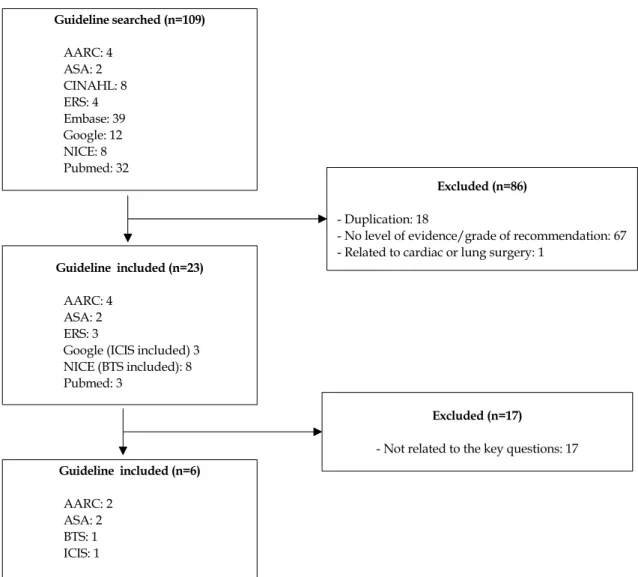
국외 데이터베이스로는 PubMed, MEDLINE, Embase, Cumulative Index to Nursing and Allied Health Literature (CINAHL), Cochrane library, CENTRAL을, 국내 데이터베 이스는 한국학술정보(Korean Information Service System, KISS), 학술정보 통합서비스(DBpia), 학술연구정보서비스 (The Korea Education and Research Information Service, KERIS)를 검색하였다. 포괄적인 검색을 위해 Google 검색을 포함하였다. 또한 실무지침을 제공하는 Guideline Interna- tional Network (GIN), National Institute for Clinical Excel- lence (NICE), Scottish Intercollegiate Guidelines Network (SIGN), Canadian Medical Association (CMA), Registered Nurses Association of Ontario (RNAO)와 같은 국외 지침 관련 웹사이트와 본 주제와 관련한 미국호흡기관리학회(The American Association for Respiratory Care, AARC), 미국 마취과의사협회(The American Society of Anesthesiologists, ASA), 미국내과학회(The American College of Physicians, ACP), 유럽호흡기학회(European Respiratory Society, ERS) 의 온라인 사이트 및 국내 임상진료지침정보센터를 검색하였 다(Figure 1).
검색어로는 postoperative period [MeSH], anesthesia re- covery period [MeSH], postoperative complications [MeSH], respiratory therapy [MeSH], breathing exercises [MeSH], airway management [MeSH], spirometry [MeSH], drainage, postural [MeSH], guideline [MeSH], respiratory care prac- tice, 전신마취 수술, 호흡기합병증, 폐합병증, 흉부물리요법, 지침, 실무지침, 임상실무지침, 근거기반 실무지침을 사용하 였다.
10) 10단계: 검색된 실무지침에 대한 선별
검색된 109개의 문헌에서 중복문헌, 근거와 권고안이 명확 하게 제시되지 않은 문헌, 흉부외과 수술 환자 대상 문헌을 제 외하여 1차로 23개를 선별 하였고, 이 중 핵심질문을 충족하지 못하는 문헌 17개를 제외하여 최종 6개의 실무지침을 선정하
였다(Figure 1). 흉부외과 수술 환자 대상 문헌은 흉부외과 수 술 후 폐합병증 발생이 일반 전신마취 수술 환자의 폐합병증 발생과 비교할 때 원인과 예방에 있어 질환에 특화된 양상을 보일 것이라 판단되어 제외하였다[18]. 지침의 선별은 연구자 2명이 짝을 이루어 독립적으로 시행하였고, 합의되지 않은 경 우는 실무위원회의 조정을 거쳐 선별하였다(Table 1).
11) 11단계: 실무지침의 질 평가
실무지침의 질 평가는 Appraisal of Guidelines for Re- search and Evaluation Collaboration II (AGREE II)[14] 도 구를 사용하여 연구자 4명이 시행하였다. AGREE II 도구는 최소 2명 이상의 평가자가 평가하는 것을 권장하며, 4명의 평 가자가 평가를 할 경우 평가의 신뢰도를 향상시킬 수 있다 [14]. 평가 결과는 영역별 표준화 점수 산출방식에 따라 점수 화 하였는데, ‘개발의 엄격성’ 영역의 점수가 50.0% 이상이거 나 중앙값보다 큰 지침을 수용개작 대상으로 선정하기로 하였 다. 6개의 지침을 평가한 결과 6개 모두 ‘개발의 엄격성’ 영역 이 50.0% 이상으로 나타나 수용개작 대상 지침으로 선정하였 다(Table 2).
12) 12단계: 실무지침의 최신성 평가
검색된 가이드라인 중에서도 최신성 반영을 위해 동일한 핵심질문에 대해 권고가 다른 경우 가장 최근 발행된 지침의 권고 내용을 반영하였다.
13) 13단계: 실무지침의 내용 평가
선정된 지침의 내용을 평가하기 위해 실무위원회에서 핵심 질문에 따라 지침의 권고내용 비교표를 작성하여 실무지침의 내용을 평가하였다.
14) 14단계: 권고의 수용성과 적용성 평가
6개 지침의 수용성과 적용성을 평가하였다. 수용성은 의료 기관에 근무하는 간호사가 권고를 받아들일 수 있는지 여부를 의미하는 것이고, 적용성은 권고안을 실제 간호실무에 적용할 수 있는지 여부를 의미하는 것이다[17].
실무위원회 위원들이 토의를 통해 권고의 수용성과 적용성 을 평가하고 합의하였으며, 수용성은 원 진료지침의 대상 인 구집단과 수용개작 진료지침의 대상 인구집단이 일치하는지, 중재와 관련된 환자의 관점 및 선호도가 유사한지, 근거의 강 도와 효과의 크기가 권고의 등급을 지지하는지, 다른 대체 중 재와 비교해도 해당 중재가 충분한 이득이 있는지, 권고가 문 화, 가치에 부합되는지에 대해 평가하였다. 6개 실무지침 모두
Guideline searched (n=109) AARC: 4
ASA: 2 CINAHL: 8 ERS: 4 Embase: 39 Google: 12 NICE: 8 Pubmed: 32
Guideline included (n=23) AARC: 4
ASA: 2 ERS: 3
Google (ICIS included) 3 NICE (BTS included): 8 Pubmed: 3
Excluded (n=86) - Duplication: 18
- No level of evidence/grade of recommendation: 67 - Related to cardiac or lung surgery: 1
Excluded (n=17)
- Not related to the key questions: 17 Guideline included (n=6)
AARC: 2 ASA: 2 BTS: 1 ICIS: 1
AARC=American association for respiratory care; ASA=American society of anesthesiologists; BTS=British thoracic society;
CINAHL=cumulative index to nursing and allied health literature; ERS=European respiratory society; ICIS=institute for clinical systems improvement; NICE=national institute for clinical excellence.
Figure 1. Process of the guideline selection.
수용 가능하다는 의견으로 일치했다. 적용성의 경우 중재가 환자에게 적용 가능한지, 중재/기기가 이용 가능한지, 필수적 인 전문지식이 이용 가능한지, 법률적, 제도적 장벽이 없는지 에 대해 평가하였다. 평가결과 6개의 실무지침 모두 적용 가능 하다는 의견으로 합의되었다.
15) 15단계: 평가의 검토
11~15단계에 시행된 실무지침의 질, 근거, 내용, 수용성 및 적용성 평가결과를 실무위원회에서 전반적으로 검토하여 선 별된 6개의 지침을 최종 수용개작에 사용할 지침으로 확정하 였다.
16) 16단계: 권고의 선택과 수정
수용개작 대상 지침 내에서 권고안의 선택과 수정은 실무
위원들의 토의를 거쳐 의견을 수렴하고 전원의 합의를 도출하 는 방법으로 진행하였다.
17) 17단계: 근거 및 권고등급 선택과 결정
본 실무지침의 근거수준과 권고등급을 Clinical practice guidelines for the diagnosis and management of intra- vascular catheter-related infection: 2009 update by the Infectious Disease Society of America에서 사용되고[19], Gu 등[13]이 일부 수정하여 적용한 Infectious Diseases Society of America (IDSA) 등급체계를 적용하여 각 지침들의 등급체계 를 통합하였다.
IDSA는 근거수준을 I, II, III으로, 권고등급을 A, B, C로 구 분한다. 근거수준 I은 1개 이상의 무작위 대조연구에 의한 근 거이고, II는 1개 이상의 잘 설계된 비무작위 대조연구, 코호트
Table 1. Selected Guidelines for Adaptation
Guidelines Title Developer Country/
language
1. AARC
(2013)
AARC clinical practice guideline: effectiveness of nonpharmacologic airway clearance therapies in hospitalized patients
Association for respiratory care USA/
English
2. AARC
(2011)
Incentive spirometry: 2011 Association for respiratory care USA/
English
3. ASA
(2018)
Practice guidelines for moderate procedural sedation and analgesia 2018: a report by the American society of anesthesiologists task force on moderate procedural sedation and analgesia, the American association of oral and maxillofacial surgeons, American College of radiology, American dental association, American society of dentist anesthesiologists, and society of interventional radiology
ASA task force team on moderate procedural sedation and analgesia et al.
USA/
English
4. ASA
(2013)
Practice guidelines for postanesthetic care American society of anesthesiologists task force
USA/
English
5. ICIS
(2014)
Health care guideline: perioperative Institute for clinical systems improvement
USA/
English
6. BTS
(2017)
BTS guideline for oxygen use in adults in healthcare and emergency settings
British thoracic society emergency oxygen guideline development group
UK/
English
AARC=American association for respiratory care; ASA=American society of anesthesiologists; BTS=British thoracic society; ICIS=institute for clinical systems improvement; USA=United States of America; UK=United Kingdom.
Table 2. Results of Quality Assessment Using AGREE II
Guidelines 1. AARC (2013) 2. AARC (2011) 3. ASA (2018) 4. ASA (2013) 5. ICIS (2014) 6. BTS (2017)
1. Scope and purpose (%) 100.0 98.4 96.3 91.1 100.0 100.0
2. Stakeholder involvement (%) 70.3 56.8 85.4 63.1 95.7 91.2
3. Rigour of development (%) 54.3 50.4 82.7 69.2 60.3 85.0
4. Clarity of presentation (%) 94.2 94.2 96.3 93.1 100.0 98.4
5. Applicability (%) 46.8 67.2 18.4 43.7 71.1 47.2
6. Editorial independence (%) 50.3 100.0 89.2 16.3 100.0 83.1
I would recommend this guideline for use
Yes (4) Yes (4) Yes (4) Yes (4) Yes (4) Yes (4)
AGREE II=appraisal of guidelines for research & evaluation II; AARC=American association for respiratory care; ASA=American society of anesthesiologists; BTS=British thoracic society; ICIS=institute for clinical systems improvement.
연구, 환자-대조군 연구, 다수의 시계열 연구, 특징적 결과를 보 이는 비대조 연구를 포함한다. 근거수준 III은 전문가 의견, 임 상적 경험, 기술연구, 전문서적을 포함한다. 권고등급이 A인 경우는 사용을 권장 또는 반대하도록 지지할 좋은 근거가 있 음, B는 사용을 권장 또는 반대하도록 지지할 보통 수준의 근 거가 있음, C는 사용을 권장 또는 반대하도록 지지할 근거가 미약함을 의미한다.
18) 18단계: 수용개작 실무지침 초안 작성
핵심질문에 따라 실무지침 권고안의 초안을 작성하였다.
6개 실무지침의 권고안을 검토하여 일치되는 내용은 권고안
에 포함하였고, 논의가 필요한 내용은 실무위원회에서 합의를 통해 채택하는 방식으로 진행하였다. 작성된 권고안 초안은 실무위원 전원의 합의를 통해 확정되었다.
19) 19단계: 외부검토
작성된 수용개작 지침의 외부 검토 과정으로 일반 간호사 10명을 대상으로 권고안의 이해도를 평가하였고, 전문가 10 명을 대상으로 권고안의 적절성과 적용 가능성을 평가하였다.
(1) 권고안의 이해도 평가
권고안의 이해도 평가는 임상경력 10년 이상 또는 외과 간
Table 3. Composition of Postoperative Pulmonary Complication Prevention Guideline
Domain Contents
I. Assessment of postoperative pulmonary complications
I-1. Physical assessment I-2. Diagnostic test
I-3. Assessment and management of high-risk groups for pulmonary complications II. Nursing intervention to prevent
pulmonary complications after general anesthesia surgery
II-1. Airway Clearance Therapy (ACT) II-2. Deep breathing
II-3. Incentive spirometry II-4. Oxygen application II-5. Early walking II-6. Smoking cessation
III. Education III-1. Education for patients
III-2. Education for medical staff IV. Monitoring and recording IV-1. Monitoring and recording 호경력 5년 이상의 간호사 10명을 모집하여 시행하였다. 평가
자의 평균 연령은 38.3±3.6세이며, 임상경력은 14.2±3.7년, 외과 임상경력은 5.1±1.6년이었다.
설문은 실무지침의 각 권고안에 대해 ‘이해하기 어렵다’ 1 점부터 ‘이해하기 쉽다’ 9점까지 평가하도록 하였고, 이해하 기 어렵거나 수정 의견이 있는 경우 별도 기입하도록 하였다. 평가결과 1명의 평가자만이 흉부 방사선 촬영, 기도청결요법, 산소요법, 생리식염수 네블라이저 등 4개의 권고안에 대해서
‘이해하기 어렵다’라고 의견을 제시하였다. 이해도 평가 기준 에 따르면 ‘이해하기 어렵다’고 답한 응답자의 비율이 평가자 의 30.0%가 넘는 경우 권고안의 보완, 변경이 필요하다고 하 였는데[16], 본 조사에서는 10명 중 1명(10.0%)이 이에 해당하 므로 보완, 변경이 필요한 권고안은 없었다. 단, 평가자가 비고 란에 의견을 작성한 경우 이를 반영하여 내용을 이해하기 쉽 게 수정하는 과정을 거쳤다.
(2) 권고안의 적절성과 적용 가능성 평가
권고안의 적절성과 적용 가능성 평가는 연구자가 속한 병원 의 호흡기내과 교수 1명, 외과 교수 2명, 일반외과 전문의 3명, 호흡기 전문간호사 3명, 외과병동 간호파트장 1명으로 총 10 명을 대상으로 실시하였다. 설문지는 전문가가 지각하는 권 고안의 적절성과 적용 가능성을 평가하도록 개발된 RAND/
UCLA Appropriateness Method인 RAM 의사결정방법 [15,16]을 이용하였고, 9점 척도로 평가하였다.
RAND 방법 사용 시 패널수가 8~10인 경우 일치는 2명 이 하 패널들이 세 구간(1~3, 4~6, 7~9) 밖의 관측점을 체크한 경 우이고, 불일치는 적어도 3명 이상의 패널들이 1~3점 사이 또 는 7~9점 사이를 평가한 경우를 말한다[15]. 본 연구의 패널은 10명이고, 모든 권고안에서 불일치 없이 중앙값이 7~9 사이로 나타나 ‘적정’한 것으로 평가되었다.
20) 20단계: 최종 권고안 확정
외부검토에서 제시된 전문가의 판단과 다양한 수정의견들 을 종합하여 최종 권고안 30개를 확정하였다.
21) 21단계: 관련단체의 승인 요청
연구자가 속한 병원 간호본부의 근거기반실무 위원회에 보 고하여 승인을 득하였다.
22) 22단계: 관련 문서와 참고문헌 정리
간호실무지침에 관련된 문서, 즉 이해관계 선언문을 포함 하여 수용개작을 위해 사용된 문헌을 참고문헌으로 정리하였 다.
23) 23단계: 실무지침 개정 계획
실무지침의 개정은 3년마다 또는 지침이 변경되었을 때 연 구자가 속한 병원의 근거기반실무 위원회에서 개발팀을 구성 하여 수행할 계획이다.
24) 24단계: 최종 실무지침 작성
최종 실무지침을 작성하였고 정리된 권고들과 배경문을 포 함하여 전신마취 수술 후 폐합병증 예방 간호실무지침을 확정 하였다.
Ⅲ
.
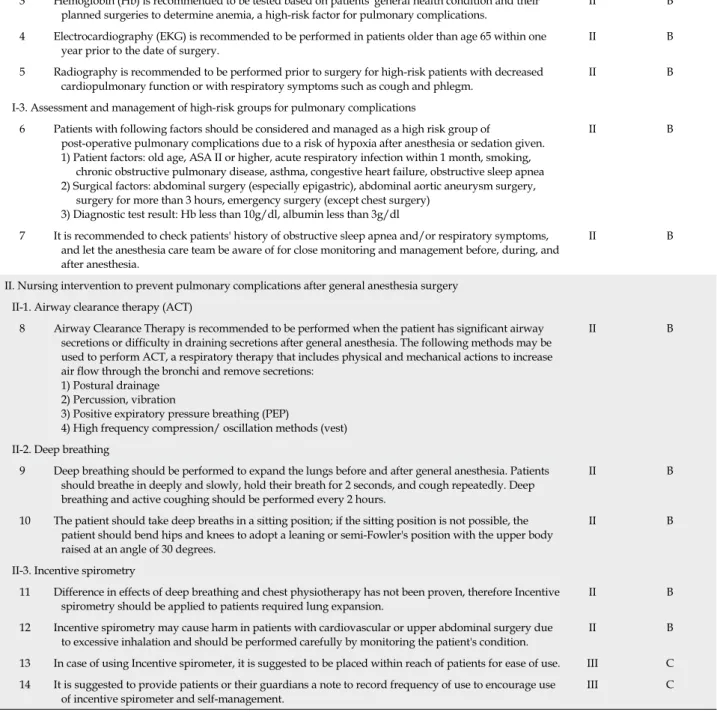
연 구 결 과본 연구에서 수용개작한 전신마취 수술 후 폐합병증 예방 간 호실무지침은 4개의 영역과 30개의 권고안으로 구성되어 있다 (Table 3). 권고안은 영역별로 수술 전 환자 상태 사정 7개, 전 신마취 수술 후 폐합병증 예방을 위한 간호중재 17개, 교육 4 개, 모니터링 및 기록 2개로 구분된다. 각 권고안의 근거수준
Table 4. Recommendations for Postoperative Pulmonary Complication Prevention Guideline
Recommendations Level of
evidence
Grade of recommendation I. Assessment of postoperative pulmonary complications
I-1. Physical assessment
1 Physical health assessment is suggested to be performed prior to general anesthesia to identify high-risk groups.
1) underline disease; cardiovascular system, respiratory system, nervous system, metabolic/endocrine system
2) obstructive sleep apnea, etc.
3) smoking/drinking history 4) abnormal vital signs
III C
I-2. Diagnostic test
2 Perioperative diagnostic tests are suggested to be performed on each patient differently as per patient's general health status and a surgery planned for the patient.
III C
3 Hemoglobin (Hb) is recommended to be tested based on patients' general health condition and their
planned surgeries to determine anemia, a high-risk factor for pulmonary complications. II B 4 Electrocardiography (EKG) is recommended to be performed in patients older than age 65 within one
year prior to the date of surgery. II B
5 Radiography is recommended to be performed prior to surgery for high-risk patients with decreased cardiopulmonary function or with respiratory symptoms such as cough and phlegm.
II B
I-3. Assessment and management of high-risk groups for pulmonary complications
6 Patients with following factors should be considered and managed as a high risk group of
post-operative pulmonary complications due to a risk of hypoxia after anesthesia or sedation given.
1) Patient factors: old age, ASA II or higher, acute respiratory infection within 1 month, smoking, chronic obstructive pulmonary disease, asthma, congestive heart failure, obstructive sleep apnea 2) Surgical factors: abdominal surgery (especially epigastric), abdominal aortic aneurysm surgery,
surgery for more than 3 hours, emergency surgery (except chest surgery) 3) Diagnostic test result: Hb less than 10g/dl, albumin less than 3g/dl
II B
7 It is recommended to check patients' history of obstructive sleep apnea and/or respiratory symptoms, and let the anesthesia care team be aware of for close monitoring and management before, during, and after anesthesia.
II B
II. Nursing intervention to prevent pulmonary complications after general anesthesia surgery II-1. Airway clearance therapy (ACT)
8 Airway Clearance Therapy is recommended to be performed when the patient has significant airway secretions or difficulty in draining secretions after general anesthesia. The following methods may be used to perform ACT, a respiratory therapy that includes physical and mechanical actions to increase air flow through the bronchi and remove secretions:
1) Postural drainage 2) Percussion, vibration
3) Positive expiratory pressure breathing (PEP)
4) High frequency compression/ oscillation methods (vest)
II B
II-2. Deep breathing
9 Deep breathing should be performed to expand the lungs before and after general anesthesia. Patients should breathe in deeply and slowly, hold their breath for 2 seconds, and cough repeatedly. Deep breathing and active coughing should be performed every 2 hours.
II B
10 The patient should take deep breaths in a sitting position; if the sitting position is not possible, the patient should bend hips and knees to adopt a leaning or semi-Fowler's position with the upper body raised at an angle of 30 degrees.
II B
II-3. Incentive spirometry
11 Difference in effects of deep breathing and chest physiotherapy has not been proven, therefore Incentive
spirometry should be applied to patients required lung expansion. II B
12 Incentive spirometry may cause harm in patients with cardiovascular or upper abdominal surgery due
to excessive inhalation and should be performed carefully by monitoring the patient's condition. II B 13 In case of using Incentive spirometer, it is suggested to be placed within reach of patients for ease of use. III C 14 It is suggested to provide patients or their guardians a note to record frequency of use to encourage use
of incentive spirometer and self-management.
III C
ASA=American society of anesthesiologists.
Table 4. Recommendations for Postoperative Pulmonary Complication Prevention Guideline (Continued)
Recommendations Level of
evidence
Grade of recommendation II. Nursing intervention to prevent pulmonary complications after general anesthesia surgery
II-3. Incentive spirometry
15 It is not suggested to use incentive spirometry in the following situations.
1) When no one is available to supervise the proper use of the tool 2) If the patient does not understand the use of the tool
3) Confusion or delirium, sedation or coma
4) When deep breathing is impossible due to pain at the surgical site, damage to the diaphragm, or narcotic analgesic
III C
16 Incentive spirometry is recommended to perform in conjunction with deep breathing, active coughing, and
early walking as it could be less effective when used alone. Use a proper pain reliever to manage pain. I A 17 In case of incentive spirometer, use of volume-incentive spirometry is recommended because of its efficacy
of expanding collapsed lungs by reducing the effort to breathe and improving the movement of the diaphragm.
* Flow type: Abruptly exerts negative pressure into chest during inspiration and help expand the lungs.
* Volume type: Piston gradually goes up to maximum volume
II B
18 Incentive spirometry should be discontinued when targeted inhalation volume reached or improvement in
patient's pulmonary function present (e.g., improvement in inhalation time and volume of inhalation). II B II-4. Oxygen application
19 During a phase of recovery after general anesthesia, oxygen should be provided to maintain oxygen saturation target.
* Oxygen saturation target: 88~92% in high-risk groups and 94–98% in others.
II B
20 It is recommended to apply a continuous positive pressure device which prevents narrowing of the airways by applying positive pressure to airways during sleep to prevent the occurrence of pulmonary complications under anesthesia and sedation for patients with obstructive sleep apnea.
II B
21 If expectoration is difficult while applying oxygen, a saline nebulizer is suggested to be used for
humidification III C
22 If patients on high volume of oxygen (i.e., 5L/min or more) continuously for more than 24 hours, a large
volume nebulizer is suggested to be used for humidification to prevent mucosal dryness. III C II-5. Early walking
23 Early walking promotes efficient discharge of secretion by stimulating active coughing and deep breathing, and it should be performed to reduce risks of postoperative lung complications and to improve airway clearance.
II B
II-6. Smoking cessation
24 Patients must stop smoking at least 8 weeks prior to surgery; Smoking cessation is recommended to be
continued after surgery. II B
III. Education
III-1. Education for patients
25 It is suggested to provide patients and their family members with education on importance of prevention
of postoperative pulmonary complications using brochures and videos. III C
26 Patients diagnosed with obstructive sleep apnea and in use of an intraoral device or CPAP (continuous positive pressure device) should bring their own equipment upon admission to adjust well during the anesthesia and recovery phase.
II B
III-2. Education for medical staff
27 Education based on guidelines regarding oxygen therapy should be provided by online or offline for
medical staff who administer oxygen. II B
28 Education based on guidelines is suggested to be provided by online or offline for nurses regarding interventions to prevent pulmonary complications, required skills for use of devices and proper management for possible side effects followed by the interventions.
III C
IV. Monitoring and recording
29 Postoperatively, it is recommended to monitor patient's oxygen saturation (SpO2) while in recovery phase,
and check respiratory rate and opening of an airway. I A
30 Nurses may monitor and record patients' progress on postoperative interventions to prevent pulmonary complications, interventions such as deep breathing, active coughing, incentive spirometry, and early ambulation.
III C
은 I 수준 2개(6.7%), II 수준 18개(60.0%), III 수준 10개(33.3%) 로 구성되어 있고, 권고등급은 A등급 2개(6.7%), B등급 18개 (60.0%), C등급 10개(33.3%)로 구성되어 있다(Table 4).
Ⅳ
.
논 의본 연구는 전신마취 수술 후 폐합병증 예방에 대한 간호중 재를 표준화하고, 중재에 대한 근거를 제시하기 위해 국외 관 련 지침을 수용개작하여 간호실무지침을 개발하였다.
수술 후 폐합병증 예방 간호는 오랜 기간 임상에서 시행해 온 중재이지만 지침이 표준화되지 않았고[7], 수행의 근거도 다소 논란이 있는 상황이기 때문에[20] 본 지침의 개발은 임상 간호사들이 전신마취 수술 후 환자간호에 직접 적용할 수 있 는 간호수행의 표준이 될 수 있다는 점에서 의의가 있다.
본 지침은 미국 호흡기관리학회에서 2011년[21]과 2013년 [9]에 발간한 지침 2종과 미국 마취과의사협회에서 2013년[10]
과 2018년[11]에 발간한 지침 2종, 영국흉부협회에서 2017년 에 발간한 지침 1종[22], 미국의 임상시스템개선 연구소에서 2014년에 발간하고 2019년에 업데이트한 지침 1종[23], 총 6 종을 기반으로 개발하였는데, 이 중 최근 5년 이내 개발된 지 침은 3종에 불과하고, 6종 모두 의학자에 의해 개발된 지침들 이다. 이는 앞서 언급한 바와 같이 2010년~2019년까지 10년 동안 학회나 협회 같은 공적기관에서 발간된 전신마취 후 폐 합병증 예방에 대한 지침은 부족하고, 더욱이 간호학회나 협 회에서 발간된 지침은 전무한 상황과 관련이 있다.
본 지침의 개발 목적은 전신마취 수술 후 폐합병증 예방을 위한 간호중재의 표준을 수립하여 간호업무 수행 시 간호사 간의 수행의 혼동을 줄이고, 환자에게도 구체적이고 실행하기 쉬운 표준화된 교육을 제공하도록 도움을 주고자 하였다. 다 만 본 연구에서 선별된 6개의 지침이 폐합병증 예방에 대한 간 호중재표준이 명확하지 않은 현 상황에서 간호중재로 적용할 근거기반 지침을 제시할 수는 있었으나 모두 의학자에 의해 개발된 지침으로 간호수행의 세부적인 측면에서의 내용은 다 소 부족하다는 아쉬움이 있었다. 예를 들어 임상에서 간호사 나 환자들이 폐합병증 예방 중재를 수행할 때 원하는 정보는 어떤 방법으로, 얼마나 자주, 한 번에 어느 정도를 수행해야 하 는지 등의 구체적인 방법에 대한 내용이지만 선정된 지침에는 이러한 수행 측면의 세부적 제시가 부족하였다. 이에 본 지침 에는 임상에서 간호중재로 적용할 수 있는 권고안을 최대한 선별하여 수록하였고, 근거가 부족하거나 불확실하여 권고안 에 포함시킬 수 없는 중재들은 배경문에 상세히 기술하여 간 호사들이 실무 수행에 참고할 수 있도록 하였다.
또, 본 지침은 현재 임상에서 사용하고 있는 다양한 중재에 대한 권고와 근거를 포함하고자 하였는데, 총 30개의 권고안 중 56.6%에 해당하는 17개가 전신마취 수술 후 폐합병증 예방 을 위한 직접적인 간호중재이고, 그 세부내용과 항목으로는 기도청결요법 1개(권고안 8), 심호흡 2개(권고안 9~10), 유발 성 폐활량계 8개(권고안 10~17), 산소 적용 1개(권고안 18), 지 속적 양압기 1개(권고안 19), 네블라이저 사용 2개(권고안 20~21), 조기 보행 1개(권고안 21), 금연 유지 1개(권고안 22) 를 포함하고 있다.
수술 후 폐합병증 예방 중재에 대한 선행연구[24]결과를 살 펴보면 인공관절치환술 환자 대상 일개 연구에서 폐합병증 예 방 중재로 산소포화도 모니터링, 산소 제공, 머리 올리기, 유 발성 폐활량계 사용, 조기이상 등을 제시하였다. 심장 흉부 외 수술 환자 대상 연구[1]에서는 조기보행, 심호흡과 기침 격 려, 체위배액, 타진법과 진동법 등 흉부물리요법, 흡인, 유발성 폐활량계 사용, 경비적 지속기도양압호흡 등을 제시하였고, Branson [25]은 유발성 폐활량계 사용, 지속양압호흡, 양압호기 호흡, 두드리기 및 체위배액 등의 흉부물리요법 등을 제시하였 다. 미국의 일개 병원에서는 I COUGH (incentive spirometry, coughing and deep breathing, oral care, understanding, getting out of bed frequently, and head-of-bed elevation) 라는 폐합병증 예방 프로그램[6]을 개발하여 적용한 결과 수 술 후 폐렴의 발병률과 계획되지 않은 삽관의 발생률이 유의 하게 감소한 것으로 보고하였는데, I COUGH 프로그램의 간 호중재로는 유발성 폐활량계 사용, 머리 올리기, 조기이상, 조 기보행, 기침과 심호흡 격려 등이 포함되어 있다. 이상의 선행 연구들에서 제시한 예방 중재들을 본 지침이 모두 포함하고 있음을 확인할 수 있었다.
본 지침의 권고안 중 그 효과에 대해 논란이 있는 중재도 있 는데, 유발성 폐활량계 사용은 Cochrane의 체계적 고찰[20]
결과 유발성 폐활량계 적용군과 비적용군 간의 유의미한 차이 가 없어 효과가 불확실하다고 보고되었지만 실제 임상에서는 가시적인 심호흡 격려 방법 중의 하나로 많이 사용되고 있고, 일부 연구에서는 임상에서 사용할 수 있는 가장 간편하고 비 용이 적은 방법으로 추천하고 있어[1,6,8] 본 지침에서는 권고 안으로 포함하였다. 아울러 유발성 폐활량계 사용은 간호사와 환자 모두 수행 지침에 대한 요구가 높은 항목이었기에 8개 항 목에 걸쳐 사용 시 주의 사항과 금기, 사용중단 시점 등을 제시 하였다. 그러나 유발성 폐활량계 사용은 효과에 대한 다양한 평가 근거를 참고하여 기관과 사용자가 임상에서의 사용 여부 를 신중하게 결정할 것을 권고한다.
권고와 임상현장에서의 수행과 차이가 있는 항목들도 있는
데, 호흡기 합병증 발생 위험요인인 빈혈을 판별하기 위한 진단 적 검사인 헤모글로빈 검사(권고안 3)는 본 지침에서는 환자의 기본 건강상태와 수술명을 고려하고, 이에 따라 선별하여 시행 하는 것을 권고하였다. 그러나 대부분의 국내 병원에서는 헤모 글로빈 검사가 수술 직전 시행해야 하는 필수 검사 중 하나로 포함되어 있어 권고안과 실제 임상에서의 수행과의 차이가 있 었다. 또, 본 지침에서 심전도 검사(권고안 4)는 65세 이상의 환 자에서 수술이나 시술 전 1년 이내 시행되었는지 확인하도록 권고하였고, 흉부 방사선 촬영(권고안 5) 또한 심폐기능 저하 가 있는 고위험군이나 기침, 가래 증상이 있는 환자에게 시행하 도록 권고하였으나 2016년 건강보험 심사평가원의 포괄수가 적정성 평가[26]에 따르면 혈액검사의 경우 전신마취 및 국소 마취 수술 전 30일 이내, 심전도와 흉부방사선 촬영의 경우 90 일 이내의 검사결과를 적정성 평가기준으로 제시하고 있다. 이처럼 국내에서의 엄격한 마취 전 검사기준은 수술 합병증으 로 인해 발생할 수 있는 법적인 문제를 최소화하고자 하는 안 전 중시 문화와 연관이 있다고 하였다[27]. 이에 국내 실정에 맞게 권고안을 수정하고자 하였으나 국내 수행기준에 대한 근 거가 불분명하고, 본 지침에 대한 전문가의 적절성과 적용 가능 성 조사에서 3항목 모두 적절성 및 적용 가능성이 적정으로 평 가되어 수용개작한 권고안을 그대로 유지하였다.
본 연구는 폐합병증 예방 간호가 임상에서 수술 환자를 대상 으로 자주 수행하고 교육하는 중재이지만 근거에 기반한 표준 화된 지침이 부족하다는 임상현장의 요구에서 시작하였기 때 문에 개발자로 다양한 전문가 그룹을 포함하지 못하고 임상간 호사 중심으로 개발되었다는 제한점이 있다. 아울러 기존 개발 된 지침도 소수이고 앞서 언급했던 바와 같이 간호영역의 지침 은 전무하기 때문에 임상에서 간호사들이 요구하는 핵심질문 에 대한 대답으로 충분하지 않을 수 있다는 한계도 있다. 그러나 간호사가 실무를 수행할 때 필요로 했던 폐합병증 예방 간호에 대한 중재를 표준화하고 중재의 근거를 제공하였다는 점에서 중요한 의미가 있고, 이를 통해 간호사와 환자의 수행의 혼돈을 줄이고 간호중재의 질을 높이는데 기여할 것이라 생각한다. 또, 폐합병증 예방 중재에 대한 지침과 근거가 부족한 상황을 많은 간호전문가와 임상간호사들이 인식하게 되어 간호학 측면에서 의 연구가 활발하게 이루어지는 계기가 되기를 기대한다.
Ⅴ
.
결 론 및 제 언전신마취 수술 후 폐합병증은 수술 후 환자 상태의 악화와 불필요한 의료비용을 발생시킬 수 있는 임상문제로 예방이 중 요하다. 그러나 폐합병증 예방 간호에 대한 개발된 지침이나 관
련 연구가 부족한 상태이고, 특히, 간호영역에서 개발된 지침 은 없는 것으로 파악되어 임상간호사들의 폐합병증 예방 간호 에 대한 표준화된 근거기반 간호실무지침에 대한 요구가 높은 상황이다.
본 연구에서 개발한 전신마취 수술 후 폐합병증 예방 간호 실무지침이 간호사들이 필요로 하는 간호중재의 권고와 근거 를 제공하기에는 충분하지 않을 수 있지만 임상에서 표준화된 근거기반의 예방 간호를 수행하는데 도움이 되고, 이를 통해 간호실무의 질과 환자 만족을 향상시킬 수 있을 것이라 기대 한다. 아울러 간호실무지침의 질적 향상을 위해 지속적인 보 완과 개정이 필요함을 제언한다.
CONFLICTS OF INTEREST
The authors declared no conflict of interest.
참 고 문 헌
1. Davies OJ, Husain T, Stephens RC. Postoperative pulmonary complications following non-cardiothoracic surgery. BJA Education. 2017;17(9):295-300.
https://doi.org/10.1093/bjaed/mkx012
2. Diaz-Fuentes G, Hashmi HR, Venkatram S. Perioperative evaluation of patients with pulmonary conditions under- going non-cardiothoracic surgery. Health Services Insights.
2016;9(Suppl 1):9-23. https://doi.org/10.4137/HSI.S40541 3. Brueckmann B, Villa-Uribe JL, Bateman BT, Grosse-Sundrup
M, Hess DR, Schlett CL, et al. Development and validation of a score for prediction of postoperative respiratory complica- tions. Anesthesiology. 2013;118(6):1276-1285.
https://doi.org/10.1097/ALN.0b013e318293065c
4. Fernandez-Bustamante A, Frendl G, Sprung J, Kor DJ, Subramaniam B, Martinez Ruiz R, et al. Postoperative pulmo- nary complications, early mortality, and hospital stay follow- ing noncardiothoracic surgery: A multicenter study by the perioperative research network investigators. JAMA Surgery.
2017;152(2):157-166.
https://doi.org/10.1001/jamasurg.2016.4065
5. Miskovic A, Lumb AB. Postoperative pulmonary complica- tions. British Journal of Anaesthesia. 2017;118(3):317-334.
https://doi.org/10.1093/bja/aex002
6. Cassidy MR, Rosenkranz P, McCabe K, Rosen JE, McAneny D. I COUGH: Reducing postoperative pulmonary complica- tions with a multidisciplinary patient care program. JAMA Surgery. 2013;148(8):740-745.
https://doi.org/10.1001/jamasurg.2013.358
7. Lee WS, Yang YL, Oh EG. Effectiveness of deep breathing ex- ercise for postoperative pulmonary complications pre- vention: A systematic review. Journal of Korean Academy of Fundamentals of Nursing. 2014;21(4):423-432.
https://doi.org/10.7739/jkafn.2014.21.4.423
8. Eltorai AEM, Baird GL, Eltorai AS, Pangborn J, Antoci V Jr, Cullen HA, et al. Perspectives on incentive spirometry utility and patient protocols. Respiratory Care. 2018;63(5):519-531.
https://doi.org/10.4187/respcare.05872
9. Strickland SL, Rubin BK, Drescher GS, Haas CF, O'Malley CA, Volsko TA, et al. AARC clinical practice guideline: Effectiveness of nonpharmacologic airway clearance therapies in hospitalized patients. Respiratory Care. 2013;58(12):2187-2193.
https://doi.org/10.4187/respcare.02925
10. Apfelbaum JL, Silverstein JH, Chung FF, Connis RT, Fillmore RB, Hunt SE, et al. Practice guidelines for postanesthetic care:
An updated report by the American Society of Anesthesiolo- gists Task Force on Postanesthetic Care. Anesthesiology.
2013;118(2):291-307.
https://doi.org/10.1097/ALN.0b013e31827773e9
11. Practice guidelines for moderate procedural sedation and an- algesia 2018: a report by the American society of anesthesiolo- gists task force on moderate procedural sedation and analge- sia, the American association of oral and maxillofacial sur- geons, American college of radiology, American dental associ- ation, American society of dentist anesthesiologists, and soci- ety of interventional radiology. anesthesiology. 2018;128(3):
437-479. https://doi.org/10.1097/ALN.0000000000002043 12. Shin SM, Choi HR. Practice guideline to prevent post-
operative pulmonary complications for abdominal surgery.
Evidence and Nursing. 2017;5(1):27-37.
13. Gu MO, Cho MS, Cho YA, Eun Y, Jeong JS, Jeong IS, et al.
Adaptation process of nursing practice guideline and stand- ardization of nursing practice guideline adaptation, research report [Internet]. Seoul: Korean Hospital Nurses Association;
2011 [cited 2019 Jan 2] Available from:
https://khna.or.kr/home/data/khna_guide04.pdf.
14. AGREE next steps consortium. AGREE II: appraisal of guide- lines for research and evaluation II instrument [Internet].
Ontario(CA): AGREE research trust; c2009-2017 [cited 2019 March 19]. Available from:
https://www.agreetrust.org/resource-centre/agree-ii.
15. Choi BR. RAM(RAND/UCLA Appropriateness Method) ap- plied to decision making method. HIRA Policy Trends. 2010;4 (1):58-62.
16. Fitch K, Bernstein SJ, Aguilar MD, Burnand B, LaCalle JR, Lazaro P, et al. The RAND/UCLA appropriateness method user's manual. Santa Monica(CA): RAND Corporation; 2001.
17. Kim SY, Kim NS, Shin SS, Gi SM, Lee SJ, Kim SH, et al. Manual for guideline adaptation. Version 2.0. Seoul: National Evidence- based Healthcare Collaborating Agency; 2011.
18. García-Delgado M, Navarrete-Sánchez I, Colmenero M.
Preventing and managing perioperative pulmonary compli- cations following cardiac surgery. Curr Opin Anaesthesiol.
2014 Apr;27(2):146-152.
https://doi.org/10.1097/ACO.0000000000000059
19. Mermel LA, Allon M, Bouza E, Craven DE, Flynn P, O'Grady NP, et al. Clinical practice guidelines for the diagnosis and management of intravascular catheter-related infection: 2009 update by the Infectious Diseases Society of America. Clinical Infectious Diseases. 2009;49(1):1-45.
https://doi.org/10.1086/599376
20. do Nascimento Junior P, Módolo NS, Andrade S, Guimarães MM, Braz LG, El Dib R. Incentive spirometry for prevention of postoperative pulmonary complications in upper abdomi- nal surgery. Cochrane Database of Systematic Reviews. 2014;
2014(2):CD006058.
https://www.cochranelibrary.com/cdsr/doi/10.1002/1465 1858.CD006058.pub3/full.
21. Restrepo RD, Wettstein R, Wittnebel L, Tracy M. Incentive spirometry: 2011. Respiratory Care. 2011;56(10):1600-1604.
https://doi.org/10.4187/respcare.01471
22. O'Driscoll BR, Howard LS, Earis J, Mak V. BTS guideline for oxygen use in adults in healthcare and emergency settings.
Thorax. 2017;72(Suppl 1):ii1-ii90.
https://doi.org/10.1136/thoraxjnl-2016-209729
23. Card R, Sawyer M, Degnan B, Harder K, Kemper J, Marshall M, et al. Perioperative Protocol. 5th ed. Institute for Clinical Systems Improvement; 2014 Mar [cited 2019 Mar 10].
Available from:
https://www.icsi.org/wp-content/uploads/2019/01/Perio p.pdf.
24. Grau L, Orozco FR, Duque AF, Post ZD, Ponzio DY, Ong AC.
A simple protocol to stratify pulmonary risk reduces compli- cations after total joint arthroplasty. Journal of Arthroplasty.
2019;34(6):1233-1239.
https://doi.org/10.1016/j.arth.2019.01.048
25. Branson RD. The scientific basis for postoperative respiratory care. Respiratory Care. 2013;58(11):1974-1984.
https://doi.org/10.4187/respcare.02832
26. Health Insurance Review and Assessment Service. 2016(4th) Appropriateness evaluation of 7 diagnosis related group [Internet]. Wonju: Health Insurance Review & Assessment Service; 2017 Nov [cited 2019 Sep 11]. Available from:
https://biz.hira.or.kr/cms/PC/notice01/__icsFiles/afieldfil e/2017/11/10/1.pdf.
27. Sung TY, Cho CK. Preoperative assessment of geriatric patients.
Journal of the Korean Medical Association. 2017;60(5):364-370.
https://doi.org/10.5124/jkma.2017.60.5.364