Address for correspondence : Ho Cheol Kim, M.D.
Department of Internal Medicine, College of Medicine, Gyeongsang National University. 92 Chilam Dong, Jinju, 660-751, Korea
Phone : 055-750-8068 Fax : 055-750-8618 E-mail : [email protected]
Received : Mar. 21. 2005 Accepted : Jul. 4. 2005
경상대학교 의과대학 내과학교실
김휘종, 함현석, 조유지, 김호철, 이종덕, 황영실
Usefulness of Cardiac Troponin I as a Prognostic Marker in Non
cardiac Critically Ill Patients
Hwi Jong Kim, M.D., Hyoun Seok Ham, M.D., Yu Ji Cho, M.D., Ho Cheol Kim, M.D., Jong Deok Lee M.D., Young Sil Hwang M.D.
Department of Internal Medicine, College of Medicine, Gyeongsang National University, Jinju
Background : Cardiac troponin I (cTnI) is a specific marker of myocardial injury. It is known that a higher level of cTnI is associated with a poor clinical outcome in patients with acute coronary syndrome. An elevation in cTnI is also observed in various noncardiac critical illnesses. This study evaluated whether cTnI is useful for predicting the prognosis in noncardiac critically ill patients.
Methods : From June 2003 to July 2004 at Gyeongsang National University Hospital, we enrolled 215 patients (male:142, female:73, mean age:63±15 years ) who were admitted for critical illness other than acute coronary syndrome at the medical intensive care unit(ICU). The severity score of critical illness (SAPS Ⅱ and SOFA) was determined and serum cTnI level was measured within 24 hours after admission to the ICU. The mortality rate was compared between the cTnI‐positive (≥0.1µg/L) and cTnI‐negative (cTnI<0.1µg/L) patients at the 10th and 30th day after admission to the ICU. The mean cTnI value was compared between the survivors and non‐survivors at the 10th and 30th day after admission to the ICU in the cTnI‐positive patients. The correlation between cTnI and the severity of the critical illness score (SAPS Ⅱ and SOFA) was also analyzed in cTnI‐positive patients.
Results : 1) The number of cTnI‐negative and positive patients were 95(44%) and 120(56%), respectively. 2) The mortality rate at the 10th and 30th day after admission to the ICU was significantly higher in the cTnI‐positive patients (29%, 41%) than in the cTnI‐negative patients (12%, 21%)(p<0.01). 3) In the cTnI‐positive patients, the mean value of the cTnI at the 10th and 30th day after admission to the ICU was significantly higher in the non‐survivors (4.5 ± 9.2 μg/L, 3.5 ± 7.9 μg/L) than in the survivors( 1.8 ± 3.6 μg/L, 2.0 ± 3.9 μg/L) (p < 0.05). 4) In the cTnI‐positive patients, the cTnI level was significantly correlated with the SAPS Ⅱ score (r=0.24, p<0.001) and SOFA score (r=0.30, p<0.001).
Conclusion : The cTnI may be a useful prognostic marker in noncardiac critically ill patients.
(Tuberc Respir Dis 2005; 59: 53-61)
Key words : Cardiac troponin I, Prognostic marker, Critically ill, Noncardiac patients
서 론
중환자실에 입원한 환자는 신속한 진단과 치료가 요구되며, 이를 위해서는 고가의 장비와 고급 인력의 집중 투여가 요구된다. 그리고 이러한 비용과 인력의 효율적인 사용을 위해서 여러 가지 예후의 예측 인자 들이 사용되어왔다1-3.
중환자의 예후 예측 지표로 현재 가장 많이 쓰이는 것으로는 중증도 평가 체계로 사용하는 Acute Phy
siology And Chronic Health Evaluation (APACHE)4-6, Simplified Acute Physiology Score (SAPS)7,8, Mor
tality Probability Model (MPM)9 등이 있고 장기부전 의 평가 체계로 사용하는 Logistic Organ Dysfunction System (LODS)10, Multi-organ Dysfunction Score (MODS)11 그리고, Sequential Organ Failure Assess
ment (SOFA)12등이 있다. 그리고 최근 많이 연구되고 있는 생화학 지표로서 C-reactive protein13, procalci
tonin14, lactate15, cardiac troponin I16-18, B-type na
triuretic peptide19 등이 있다.
이 중에서 Cardiac troponin I (cTnI)는 24-kDa의
단백질로서 심근의 수축작용을 억제하는 기능이 있 다. 대개 심근 손상 후 3-4시간 이내에 혈중에서 상승 하며 10-24시간에 정점을 이루고20 4-10일간 증가 상 태로 지속된다21. 또한 심근 특수성을 가지고 있어서 급성 관상동맥 증후군에서 진단적인 효용성을 갖고 있고, 예후와도 관계가 있다22-24.
Guest 등16은 중환자에서 혈청 cTnI 에 대한 연구에 서 급성 심근 경색증뿐만 아니라 심근의 허혈 증상이 없는 환자에서도 혈청 cTnI가 증가함을 보고하였다.
이후 여러 연구 등에서 혈청 cTnI가 급성 관상동맥 증 후군뿐만 아니라 급성 폐 색전증, 만성 폐쇄성 폐질 환, 패혈증, 만성 신부전 등과 같이 비순환기계 질 환에서도 증가되고 예후와도 관련이 있다고 보고 되고 있다25-28. 그러나 이는 대상환자가 개별적 질환 만을 가진 환자들이었으며, 중환자들을 대상으로 한 연구는 많지 않았고16,17,29,30
, 국내에서는 보고된 바가 없었다.
이에, 저자들은 비순환기계 중환자에서 혈청 cTnI 가 예후 인자로서 유용한지를 알아보고자 하였다.
대상 및 방법 1. 대상환자
2003년 6월부터 2004년 7월까지 경상대학교 병원 내과계 중환자실에 입원하여 치료한 환자를 대상으로 하였다. 대상 환자 중에서 흉통이 있고 관상동맥 질환 이 의심되는 소견(심전도에서 1 mm이상의 ST분절 상승이나 하강, Creatine kinase수치가 상한의 2배 이 상 증가 중 적어도 한 가지 이상)을 보이는 경우, 최근 21일 이내에 심장수술을 받은 경우, 관상동맥 질환의 과거력이 있었던 경우는 제외하였다. 총 215명(남: 142 명, 여: 73명, 평균 나이: 62.9 ± 14.7년)의 환자를 추적 관찰하였다.
2. 방 법
대상환자의 중환자실 입원 24시간 이내 중증도와 장기부전의 정도를 평가하기 위하여 제 1병일 SAPS
Ⅱ, SOFA 점수를 산출하였다. 혈청 cTnI측정은 전혈 을 채취하여 원심분리기로 혈장을 분리하여, cTnI에 특정한 단일클론항체 2개를 이용한 sandwich 면역측 정법 (ADVIA Centaur immunoassay system, Bayer Diagnostics, Germany)을 이용하여 측정하였다. cTnI 의 분별 한계치를 0.1µg/L로 하여 0.1µg/L이상이면 양 성군으로 0.1µg/L미만이면 음성군으로 분류하였고, 각 군에서 병일 10일째와 30일째의 사망률을 구하여 비교하였다. 또한 cTnI양성군에서 병일 10일째와 30 일째의 생존군과 비생존군에서 cTnI 수치를 각각 비 교하였다. cTnI의 사망에 대한 민감도, 특이도, 양성 예측도, 그리고 음성 예측도를 구하였다. cTnI 양성군 중에서 패혈증, 중증 패혈증, 패혈성 쇽 군으로 나누어 각 군간에 cTnI 수치를 비교하였다. 그리고 중증도 평 가지표와의 관계를 알아보기 위해 cTnI 수치와 SAPS
Ⅱ, SOFA 점수간의 상관계수를 구하였다. 패혈증, 중 증 패혈증, 패혈성 쇽의 정의는 ACCP/SCCM consensus conference31에서 정한 기준에 따랐다.
3. 자료의 분석
본 연구에 쓰인 통계 분석은 윈도우용 SPSS 10.00 version을 이용하였다. 연속성 변수에 대해서는 독립 표본 t-검정을 사용하였고 평균 ± 표준편차로 표시하 였다. 비연속변수는 chi-square test를 이용하였다.
cTnI와 SAPS Ⅱ, SOFA 점수와의 상관관계는 이변 량 상관관계를 이용하였다. cTnI 양성군과 음성군간 의 누적 생존확률 곡선은 Kaplan-Meier 방법을 이용 하였고 log-rank test로 비교 분석하였다. Receiver operating characteristic (ROC) curve 분석으로 cTnI 를 이용하여 사망률을 예측할 수 있는 민감도와 특이 도 및 양성 예측도와 음성 예측도를 측정하였다.
결 과
1. cTnI 음성군과 양성군의 임상적 특성
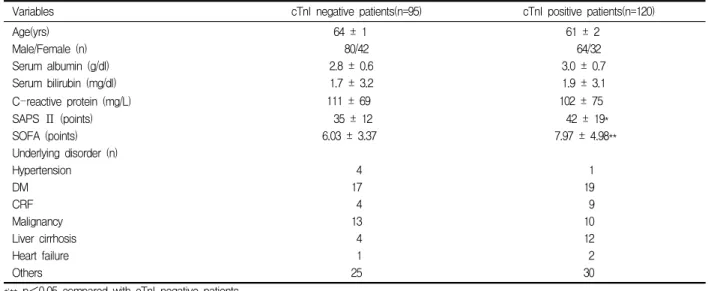
cTnI 음성군은 95명이고 cTnI 양성군은 120명이었 다. 양군 간의 연령(64±1세, 61±2세)및 남/여 성별 빈
Variables cTnI negative patients(n=95) cTnI positive patients(n=120)
Age(yrs) 64 ± 1 61 ± 2
Male/Female (n) 80/42 64/32
Serum albumin (g/dl) 2.8 ± 0.6 3.0 ± 0.7
Serum bilirubin (mg/dl) 1.7 ± 3.2 1.9 ± 3.1
C-reactive protein (mg/L) 111 ± 69 102 ± 75
SAPS Ⅱ (points) 35 ± 12 42 ± 19*
SOFA (points) 6.03 ± 3.37 7.97 ± 4.98**
Underlying disorder (n)
Hypertension 4 1
DM 17 19
CRF 4 9
Malignancy 13 10
Liver cirrhosis 4 12
Heart failure 1 2
Others 25 30
*,** p<0.05 compared with cTnI negative patients
Data are presented as the mean value ± SD or number of patients.
Definition of abbreviations : SAPS Ⅱ = Simplified acute physiology score Ⅱ; SOFA= Sequential organ failure assessment;
DM=Diabetes mellitus; CRF=Chronic renal failure. Others include chronic obstructive pulmonary disease and cerebral vascular accident
Table 1. Clinical characteristics
Diagnosis on admission No. of cTnI negative patients (%) No. of cTnI positive patients (%) Pneumonia
COPD exacerbation ARDS
Asthma attack Drug intoxication Acute pancreatitis Acute renal failure Rhabdomyolysis Diabetic ketoacidosis Empyema
Septic shock of unknown origin Others
50 ( 23) 10 ( 4) 0 ( 0) 3 ( 1) 9 ( 4) 1 (0.4) 0 ( 0) 1 (0.4) 0 ( 0) 4 ( 1) 3 ( 1) 14 ( 6)
42 (19) 13 ( 6) 2 ( 0.9) 0 ( 0) 24 (11)
3 ( 1) 3 ( 1) 6 ( 2) 3 ( 1) 1 ( 0.4) 5 ( 2) 18 ( 8) Definition of abbreviations : COPD = Chronic obstructive pulmonary disease; ARDS = Acute respiratory distress syndrome.
Table 2. Diagnosis upon admission to the IC
도(80/42명, 64/32명)는 유의한 차이가 없었다. 그러나 SAPS Ⅱ(35 ± 12, 42 ± 19), SOFA 점수(6.30 ± 3.37, 7.97 ± 4.98)는 cTnI 양성군이 cTnI 음성군에 비해 유 의하게 높았다(Table 1)(p<0.05). 입원 당시 진단명은 폐렴, 만성 폐쇄성 폐질환의 급성 악화, 약물 중독 등 의 순서로 많았다(Table 2).
2. cTnI 음성군과 양성군에서의 사망률 비교
제 10병일째 cTnI 양성군의 사망률은 29%, 음성군 은 12%이었고, 제 30병일째 cTnI양성군의 사망률은 41%, 음성군은 21%로 cTnI 양성군에서 병일 10일째
와 30일째 사망률이 cTnI 음성군에 비해 유의하게 높 았다(p<0.01) (Figure 1). 또한 cTnI 양성군의 누적 생 존률이 cTnI 음성군보다 유의하게 낮았다(p<0.001) (Figure 2).
3. cTnI 양성군에서 생존 여부에 따른 cTnI 수치 비교
cTnI 양성군에서 제10병일째 사망군의 cTnI 수치 (4.5±9.2μg/L)가 생존군의 cTnI 수치(1.8±3.6μg/L)보 다 유의하게 높았고(p<0.05), 제30병일째 사망군의 cTnI 수치(3.5±7.9μg/L)도 생존군의 cTnI 수치(2.0± 3.9μg/L)보다 유의하게 높았다(p<0.05) (Figure 3).
12
21 29
41
0 10 20 30 40 50
ICU 10th day ICU 30th day
Mortality rate(%)
cTnI-negative patients cTnI-positive patients
* **
Figure 1. Comparison of the mortality rate between the cTnI positive and negative patients at the 10th and 30th day after admission to the ICU. *, ** p < 0.01
12
21 29
41
0 10 20 30 40 50
ICU 10th day ICU 30th day
Mortality rate(%)
cTnI-negative patients cTnI-positive patients
* **
Figure 2. Comparison of the Kaplan - Meier survival cu
rves between the cTnI-negative and cTnI-positive patients.
Figure 3. Comparison of the cTnI level between the survivors and non-survivors at 10th and 30th day after admission of to the ICU in the cTnI-positive patients.
*,** p < 0.05
4. cTnI의 중환자실 30일째 사망에 대한 민감도와 특이도 및 양성 예측도와 음성 예측도
중환자실 사망과 cTnI 사이의 receiver operating characteristics(ROC) curve에서 area under the curve (AUC)는 0.612였고, cTnI가 0.75 μg/L일때, 민감도 55.1%, 특이도 59.2%, 양성 예측도 48.2%, 음성 예측 도 73.6%로 사망률을 예측할 수 있었다(Figure 4).
5. cTnI 수치와 질환의 중증지수와의 상관관계
cTnI 수치와 질환의 중증지수인 SAPS Ⅱ(r=0.25, p<0.001), SOFA (r=0.30, p<0.001)와는 유의한 상관 관계를 보였다(Figure 5).
6. cTnI 양성군에서 패혈증의 중증도에 따른 cTnI 수치 비교 및 패혈성 쇽과 패혈증 간의 cTnI 양성 율 비교
cTnI 양성군에서 패혈증, 중증 패혈증, 패혈성 쇽 군 간에 cTnI 수치는 각각 1.20 ± 1.03 μg/L, 2.48 ± 3.55 μg/L, 4.29 ± 9.13 μg/L로 패혈성 쇽 군이 패혈증 및 중증 패혈증 군에 비해 높은 경향을 보였으나 통계 적으로 유의하지는 않았다(p>0.05) (Figure 6). 그러
1 - SPECIFICITY
1.00 .75 .50 .25 0.00
SENSITIVITY
1.00
.75
.50
.25
0.00
SAPS II cTn I
Figure 4. ROC curve of cTnI and SAPS II for the ICU mortality.
ROC curve: receiver operating characteristic curve SAPS II: simplified acute physiology score II cTnI: cardiac troponin I
Figure 5. Correlation between the cTnI level and the SAPS Ⅱ(A) and SOFA score(B) in the cTnI positive patient,
p<0.001
79
41
0 50 100 150
cTnI positive patients (%)
*
Septic shock(n=51) Sepsis (n=71)
Figure 7. Proportion of cTnI positive patients in septic shock and sepsis.
* p<0.001
Figure 6. Comparison of the cTnI level according to the severity of sepsis.
*, **, † p > 0.05
나 패혈성 쇽 환자 51명중 cTnI 양성 환자는 40명 (78.4%)이었고, 패혈증 및 중증 패혈증 환자 71명중 cTnI 양성 환자는 29명(40.8%)으로 패혈성 쇽 환자에 서 cTnI 양성율이 유의하게 높았다(p<0.001) (Figure 7).
고 찰
cTnI는 심근 손상의 매우 특이한 표지자로서, 심근 경색이나 불안정성 협심증 같은 급성 관상동맥 증후 군 환자에서 매우 민감하게 증가한다. 또한 예후와도 관련이 있다는 것은 그 동안의 연구에서 잘 알려진 사 실이다22-24.
중환자에서 심장의 기능이상은 독립적인 예후인자 로 알려져 있다30. 따라서 심근손상의 특이 지표인 cTnI는 중환자의 초기 예후인자로 유용할 가능성이 있다. 본 연구에서 215명의 비순환기계 중환자 중 120 명 (55.8%)에서 혈청 cTnI가 증가하였고, cTnI 양성 군의 사망률이 cTnI 음성군보다 높았다. 그리고, 혈청 cTnI의 수치는 중증도 점수와 양의 상관관계가 있었 다. 이는cTnI가 비순환기계 중환자의 예후인자로 사 용할 수 있음을 시사하는 결과라 할 수 있겠다.
최근 여러 연구에서 cTnI는 급성 관상동맥 증후군 뿐만 아니라 패혈증, 급성 폐 색전증, 만성 폐쇄성 폐 질환, 만성 신부전 등과 같이 비순환기계 환자에서도 증가한다고 보고되고 있다32,33. Guest등16은 비순환기 계 환자 209명의 환자 중에서 15%인 32명이 cTnI가 증가하였고(cTnI > 3.6ng/ml), Ammann등17은 58명 의 비순환기계 중환자 중에서 55%인 32명의 환자에 서 cTnI가 증가함을 보고하였다(cTnI > 0.1ng/mL).
본 연구에서는 215명의 비순환기계 중환자 중 56%인 120명의 환자들이 cTnI 증가를 보여 비교적 높은 cTnI 양성률을 보였다. cTnI의 양성률은 연구마다 차이가 있는데, 이는 cTnI의 측정체계가 아직 표준화되어 있 지 않아 cTnI의 분별 한계 수치가 연구마다 다르기 때 문이다. 본 연구에서는 cTnI의 분별 한계 수치를 0.1ng/
ml로 하여 Ammann등17의 연구결과에서 보이는 cTnI 양성률과 비슷한 결과를 보였다.
패혈증의 경우, 본 연구에서 122명의 환자 중 57%
인 69명이 혈청 cTnI의 증가를 보였다. 지금까지 여러 연구에서 패혈증 환자의 31%-80%정도가 혈청 cTnI 가 증가한다고 보고되고 있는데16,34,35, 패혈증 환자에 서 혈청 cTnI의 증가 원인은 아직 정확하게 알려지지 않고 있다. 다만 가능하다고 생각되는 기전으로는 Tumor necrosis factor-α17,36나 활성산소(reactive oxygen species)와 같은 매개체들에 의해 유발되는 심근 독성, 박테리아의 내독소에 의한 심근손상, 미세순환 장애 에 의한 심근의 허혈과 재관류 손상 등이 있다37.
만성 폐쇄성 폐질환의 경우, 215명의 대상 환자 중 23명이 만성 폐쇄성 폐질환의 급성 악화로 입원하였으 며 이중에서 13명(57%)에서 cTnI이 증가하였다. Baillard 등26은 71명의 만성 폐쇄성 폐질환의 급성악화를 보인
환자의 18%에서 cTnI 증가를 보였다고 보고하였고 그 기전으로 급성 악화에 의한 호흡일과 산소 소비의 증가, 흉곽 내 압력의 감소로 인한 좌심실 후부하의 증가, 폐 고혈압의 악화, 그리고 저산소증과 고탄산혈 증 등이 심근 손상을 유발할 것으로 추측하였다. 이처 럼 혈청 cTnI는 관상동맥질환이 아닌 비순환기계 질 환에서도 증가한다는 것을 볼 수 있다.
본 연구에서는 cTnI가 0.75 ng/ml일 때 민감도가 55.1%, 특이도가 59.1%로, 비록 높지는 않았다. 그러 나 본 연구에서 cTnI 양성군이 음성군에 비해 제10병 일째와 제30병일째 모두 사망률이 높았으며, 제10병 일째와 제30병일째 사망군의 혈청 cTnI 수치가 생존 군보다 높았다. 그리고 혈청 cTnI와 제1병일째 SAPS
Ⅱ, SOFA 점수와 유의한 상관관계가 있었다. 이는 cTnI가 유용한 예후 예측 인자로 사용할 수 있다는 것 을 시사하는 소견이다. Wright등18과 Mehta등38은 cTnI가 독립적인 예후인자로 작용한다고 보고하였고, 그 동안의 여러 연구에서 cTnI는 중환자 예후와 관련 이 있다고 보고되고 있다. 하지만 Gunnerwiek등29은 34명의 중환자에서 cTnI 음성군과 양성군 간에 사망 률의 차이를 찾지 못하였다고 보고하였지만 이 연구 는 조사대상의 환자수가 적은 제한점이 있었다.
패혈증 환자들에서의 cTnI 수치 증가여부에 관한 연구는 비교적 많이 보고가 되고 있다. 그러나 패혈증 의 중증도에 따른 cTnI수치의 차이 비교에 관한 연구 는 거의 없다27. 본 연구에서는 cTnI 양성군 환자에서 음성군 환자에 비해 패혈성 쇽의 비율이 유의하게 높 았다. 패혈증의 중증도는 사망률과 관계가 있고30,39, cTnI수치가 질환의 중증도 및 사망률과 관계가 있으 므로 cTnI가 패혈증에서 질환의 중증도와 예후의 지 표로 사용할 수 있으리라 추측할 수 있다.
본 연구의 제한점으로는 첫째, 대상환자에서 혈청 cTnI를 연속적으로 측정하지 않았다는 것이다. 심장 에서 분비되는 효소나 표지자의 측정은 시간에 따라 서 기저값과 연결되어 평가되어야 한다32. 하나의 정 상 혹은 비정상의 값보다는 연속적인 값이 표지자의 농도 변화의 역동성을 반영하고 환자의 진전되는 변 화를 포착할 수 있기 때문이다40. 둘째, 대상환자에서 급성 관상동맥 증후군을 배제하는데 심장 초음파나
관상동맥 조영술과 같이 적극적인 검사를 시행하지 않은 점이다. 급성 관상동맥 증후군에는 불안정 협심 증과 비 ST분절 상승 심근경색증이 포함되어 있기 때 문에 심전도가 정상 소견이라 할지라도 상기 질환을 배제할 수 없다. 향후 상기와 같은 제한점을 고려하여, 독립 예후 인자로서 cTnI의 유용성에 대한 더 많은 연 구가 필요할 것으로 사료된다.
요 약
배 경 :
cTnI는 심근손상의 특이 표시자로서 급성관상동맥 질환에서 높은 증가는 나쁜 예후와 상관이 있다. cTnI 의 증가는 여러 가지 비심장성 중증질환에서도 관찰 할 수 있다. 연구자 등은 비순환기계 중환자의 예후인 자로서 cTnI의 유용성을 조사하였다.
대상 및 방법 :
2003년 1월부터 2004년 7월까지 경상대학교 병원 내과계 중환자실에 급성 관상동맥 증후군 이외의 중 증 질환으로 입원한 215명의 환자(남:142명, 여:73명, 평균 나이:63±2세)를 대상으로 하였다. 환자들은 중환 자실 입원 24시간 이내에 SAPS Ⅱ와 SOFA점수를 산출하였고 혈청 cTnI를 측정하였다. cTnI 양성군(≥
0.1µg/L)과 음성군(<0.1µg/L) 환자의 중환자실 제 10 병일째와 30병일째 사망률을 비교하였다. cTnI 양성 군에서 중환자실 제 10병일째와 30병일째에 혈청 cTnI의 평균수치를 비교하였다. cTnI 양성군에서 혈 청 cTnI 수치와 SAPS Ⅱ와 SOFA점수와의 상관관계 를 조사하였다.
결 과 :
1) cTnI양성군 환자는 120명(56%)이었고 음성군 환자는 95명(44%)였다. 2) 중환자실 제 10병일째와 30 병일째의 사망률은 cTnI 양성군(29%, 41%)이 음성군 (12%, 21%)보다 유의하게 높았다(p<0.01). 3) cTnI 양성군에서 중환자실 제 10병일째와 30병일째의 cTnI 평균 수치는 비생존군(4.5 ± 9.2 μg/L, 3.5 ± 7.9 μg/L) 이 생존군(1.8 ± 3.6 μg/L, 2.0 ± 3.9 μg/L)보다 유의하 게 높았다(p<0.05). 4) cTnI 양성군에서 cTnI 수치는 SAPS Ⅱ 점수(r=0.24, p<0.001)와 SOFA 점수(r=0.30,
p<0.001)와 유의한 상관관계가 있었다.
결 론 :
혈청 cTnI는 비순환기계 중환자의 유용한 예후인 자가 될 수 있을 것으로 사료된다.
참 고 문 헌
1. Keene AR, Cullen DJ. Therapeutic intervention sco
ring system: update 1983. Crit Care Med 1983;11:
1-3.
2. Lemeshow S, Teres D, Avrunin JS, Pactides H. A comparison of methods of predict mortality of inten
sive care unit patients. Crit Care Med 1987;15:715-22.
3. Bone RC, McElwee NE, Eubanks DH, Gluck EH.
Analysis of indication for early discharge from the intensive care unit: clinical efficacy assessment. Chest 1993;104:1812-7.
4. Knaus WA, Draper EA, Lawrence DE, Wagner DP, Zimmerman JE. APACHE acute physiology and chr
onic health status evaluation: a physiologically based classification system. Crit Care Med 1981;9:591-7.
5. Knaus WA, Draper EA, Wagner DP, Zimmerman JE. APACHE Ⅱ: a severity of disease classification system. Crit Care Med 1985;13:818-29.
6. Knaus WA, Draper EA, Wagner DP, Zimmerman JE, Bergner M, Bastos PG, et al. The APACHE Ⅲ prognostic system: risk prediction of hospital mortality for critically ill hospitalized adults. Chest 1991;100:
1619-36.
7. Le Gall JR, Loirat P, Alperovitch A, Glaser P, Gr
anthil C, Mathieu D, et al. A simplified acute phy
siology score for ICU patients. Crit Care Med 1984;
12:975-7.
8. Le Gall JR, Lemeshow S, Saulnier F. A new sim
plified acute physiology score (SAPS Ⅱ) based on Eu
ropean/North American multicenter study. JAMA 1993
;270:2957-63.
9. Lemeshow S, Klar J, Teres D, Avrunin JS, Gehlbach SH, Rapoport J, et al. Mortality probability models for patients in the intensive care unit for 48-72 hours:
prospective multicenter study. Crit Care Med 1994;22:
1351-8.
10. Le Gall JR, Klar J, Lemeshow S, Saulnier F, Alberti C, Artigas A, et al. The logistic organ dysfunction system: a new way to assess organ dysfunction in the intensive care unit. JAMA 1996;276:802-10.
11. Weiler T, Baldering HJ, Heinrichs W, Schmitz JE.
Qualitatssicherung in der intensivemedizine: ergebnisse einer multicenterstudie in deutschland. Anasthesiol Intensivemed Notfallmed Schmerzther 1997;32:372-5.
12. Vincent JL, Moreno R, Takala J, Willatts S, de Me
ndonca A, Bruining H, et al. The SOFA(Sepsis-re
lated Organ Failure Assessment) score to describe organ dysfunction/failure. Intensive Care Med 1996;
22:707-10.
13. Lobo SM, Lobo FR, Bota DP, Lopes-Ferreira F, Sol
iman HM, Melot C, et al. C–reactive protein levels correlate with mortality and organ failure in criti
cally ill patients. Chest 2003;123:2043-9.
14. Clec’h C, Ferriere F, Karoubi P, Fosse JP, Cupa M, Hoang P, et al. Diagnostic and prognostic value of procalcitonin in patients with septic shock. Crit Care Med 2004;32:1166-9.
15. Husain FA, Martin MJ, Mullenix PS, Steele SR, Elliot DC. Serum lactate and base deficit as pr
edictors of mortality and morbidity. Am J Surg 2003;
185:485-91.
16. Guest TM, Ramanathan AV, Tuteur PG, Schechtman KB, Ladenson JH, Jaffe AS. Myocardial injury in critically ill patients: a frequently unrecognized complication. JAMA 1995;273:1945-9.
17. Ammann P, Maggiorini M, Bertel O, Haenseler E, Joller-Jemelka HI, Oechslin E, et al. Troponin as a risk factor for mortality in critically ill patients wit
hout acute coronary syndrome. J Am Coll Cardiol 2003;41:2004-9.
18. Wright RS, Williams BA, Cramner H, Gallahue F, Willmore T, Lewis L, et al. Elevations of cardiac tr
oponin I are associated with increased short-term mortality in noncardiac critically ill emergency de
partment patients. Am J Cardiol 2002;90:634-6.
19. Wallen T, Landahl S, Hedner T, Nakao K, Saito Y.
Brain natriuretic peptide predicts mortality in the elderly. Heart 1997;77:264-7.
20. Bertinchant JP, Larue C, Pernel I, Ledermann B, Fabbro-Peray P, Beck L, et al. Release kinetics of serum cardiac troponin I in ischemic myocardial in
jury. Clin Biochem 1996;29:587-94.
21. Katus HA, Remppis A, Scheffold T, Diederich KW, Kuebler W. Intracellular compartmentation of cardiac troponin T and its release kinetics in patients with reperfused and nonreperfused myocardial infarction.
Am J Cardiol 1991;67:1360-7.
22. Hamm CW. Acute coronary syndromes: the diagnostic role of troponins. Throm Res 2001;103: S63-9.
23. Heidenreich PA, Alloggiamento T, Melsop K, Mc
Donald KM, Go AS, Hlatky MA. The prognostic value of troponin in patients with non-ST elevation acute coronary syndromes: a meta-analysis. J Am Coll Cardiol 2001;38:478-85.
24. Antman EM, Tanasijevic MJ, Thompson B, Schact
man M, McCabe CH, Cannon CP, et al. Cardiac
specific troponin I levels to predict the risk of mor
tality in patients with acute coronary syndromes. N Engl J Med 1996;335:1342-9.
25. Mehta NJ, Jani K, Khan IA. Clinical usefulness and prognostic value of elevated cardiac troponin I levels in acute pulmonary embolism. Am Heart J 2003;
145:821-5.
26. Baillard C, Boussausar M, Fosse JP, Girou E, le Toumelin P, Cracco C, et al. Cardiac troponin I in patients with severe exacerbation of chronic obstruc
tive pulmonary disease. Intensive Care Med 2003;29:
584-9.
27. Ammann P, Fehr T, Minder EI, Gunter C, Bertel O.
Elevation of troponin I in sepsis and septic shock.
Intensive Care Med 2001;27:965-9.
28. Freda BJ, Tang WH, van Lente F, Peacock WF, Fr
ancis GS. Cardiac troponins in renal insufficiency. J Am Coll Cardiol 2002;40:2065-71.
29. Klein Gunnewiek JMT, van de Leur JJ. Elevated troponin T concentrations in critically ill patients.
Intensive Care Med 2003;29:2317-22.
30. Kollef MH, Ladenson JH, Eisenberg PR. Clinically recognized cardiac dysfunction: an independent de
terminant of mortality among critically ill patients:
is there a role for serial measurement of cardiac tro
ponin I ? Chest 1997;111:1340-7.
31. Bone RC, Balk RA, Cerra FB, Dellinger RP, fein AM, Knaus WA, et al. Definitions for sepsis and organ failure and guidelines for the use of innovative therapies in sepsis: The American College of Chest Physicians / Society of Critical Care Medicine (ACCP/
SCCM) Consensus Conference Committee. Chest 1992;101:1644-55.
32. Higgins JP, Higgins JA. Elevation of cardiac tro
ponin I indicate more than myocardial ischemia.
Clin Invest Med 2003;26:133-47.
33. Turner A, Tsamitros M, Bellomo R. Myocardial cell injury in septic shock. Crit Care Med 1999;27:1775- 80.
34. Ruiz Bailen M. Reversible myocardial dysfunction in critically ill, noncardiac patients: a review. Crit Care Med 2002;30:1280-90.
35. Fernandes CJ Jr, Akamine N, Knobel E. Cardiac troponin: a new serum marker of myocardial injury in sepsis. Intensive Care Med 1999;25:1165-8.
36. Kumar A, Thota V, Dee L, Olson J, Uretz E, Parrillo JE. Tumor necrosis factor alpha and interleukin 1 beta are responsible for in vitro myocardial cell de
pression induced by human septic shock serum. J Exp Med 1996;183:949-58.
37. Roongsritong C, Warraich I, Bradley C. Common causes of troponin elevations in the absence of acute
myocardial infarction: incidence and clinical signi
ficance. Chest 2004;125:1877-84.
38. Mehta NJ, Khan IA, Gupta V, Jani K, Gowda RM, Smith PR. Cardiac troponin I predicts myocardial dysfunction and adverse outcome in septic shock. Int J Cardiol 2004;95:13-7.
39. Lee SB, Lee WC, Jung HC, Song SH, Lee DW, Kim
YB, et al. Clinical characteristics and prognostic factors of bacteremia and sepsis. Korean J Med 1999;56:347-58.
40. Sobel BE, LeWinter MM. Ingenuous interpretation of elevated blood levels of macromolecular markers of myocardial injury: a recipe for confusion. J Am Coll Cardiol 2000;35:1355-8.