• 검색 결과가 없습니다.

Bilateral acromial stress fractures in a patient with a massive rotator cuff tear

N/A
N/A
Protected

Academic year: 2021

Share "Bilateral acromial stress fractures in a patient with a massive rotator cuff tear"

Copied!
4
0
0

로드 중.... (전체 텍스트 보기)

전체 글

(1)

Stress fractures of the acromion and scapular spine are well-known complications following reverse total shoulder arthroplasty (RTSA) [1]. However, stress fractures of the acromion and scapular spine in patients without any previous surgeries are extremely rare and have only been described in case reports in which the possible causes included repetitive subcritical trauma in healthy popula- tions [2-4], massive rotator cuff tear (MRCT) or cuff tear arthropa- thy (CTA) [5-9], and RTSA [1]. Especially, stress fractures of the acromion and scapular spine in patients with MRCT or CTA are poorly understood for their pathogenesis, clinical features, diagno- sis, and treatment because of their rarity. We report a case of bilat- eral stress fracture of the posterior acromion in a patient with MRCT and discuss the pathogenesis, clinical manifestation, and treatment with a review of the literature.

Bilateral acromial stress fractures in a patient with a massive rotator cuff tear

Du-Han Kim, Sang-Soo Na, Chung-Sin Baek, Chul-Hyun Cho

Department of Orthopedic Surgery, Dongsan Medical Center, Keimyung University School of Medicine, Daegu, Korea

Stress fractures of the acromion and scapular spine are well-known complications following reverse total shoulder arthroplasty. However, these fractures in patients with massive rotator cuff tear or cuff tear arthropathy are extremely rare, and the pathogenesis, clinical features, di- agnosis, and treatment of these fractures are poorly understood. We report a case of bilateral stress fracture of the posterior angle of the acro- mion in a patient with massive rotator cuff tear and discuss the pathogenesis, clinical manifestation, and treatment with a review of the litera- ture.

Keywords: Scapula; Acromion; Fracture; Rotator cuff tear

Case Report

Clin Shoulder Elbow 2020;23(2)105-108 https://doi.org/10.5397/cise.2020.00080

Received: February 23, 2020 Revised: March 14, 2020 Accepted: March 17, 2020 Correspondence to: Chul-Hyun Cho

Department of Orthopedic Surgery, Dongsan Medical Center, Keimyung University School of Medicine, 56 Dalseong-ro, Jung-gu, Daegu 41931, Korea Tel: +82-53-258-4772, Fax: +82-53-258-4773, E-mail: [email protected], ORCID: https://orcid.org/0000-0003-0252-8741

IRB approval: None.

Financial support: None.

Conflict of interest: None.

CASE REPORT

An 80-year-old woman visited Keimyung University Dongsan Medical Center with severe pain and limited motion of the right shoulder for 2 weeks. There was no history of acute trauma. She was an orchard farmer with long-standing pain in both shoulders for 10 years. One year ago, she was diagnosed with irreparable MRCT on her right shoulder, and RTSA was recommended by a physician at the local clinic if her pain and disability worsened.

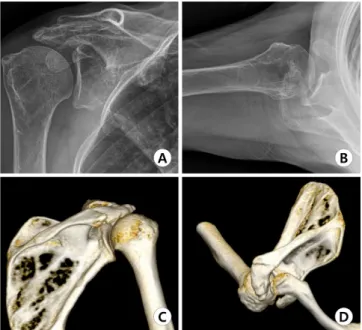
Physical examination of the right shoulder revealed overall ten- derness on the superior and posterior area without swelling or red- ness. The active range of motion (ROM) was not able to be as- sessed due to severe pain. The t-score of bone mineral density was –4.9. Plain radiographs and computed tomography (CT) on the right shoulder revealed a slightly displaced fracture of the posterior eISSN 2288-8721

Copyright © 2020 Korean Shoulder and Elbow Society. All Rights Reserved.

This is an Open Access article distributed under the terms of the Creative Commons Attribution Non-Commercial License (http://creativecommons.org/licenses/by-nc/4.0/) which permits unrestricted non-commercial use, distribution, and reproduction in any medium, provided the original work is properly cited.

www.cisejournal.org

105

(2)

angle of the acromion and superior migration of the humeral head (Fig. 1). Magnetic resonance imaging revealed chronic MRCT in- volving the supraspinatus, infraspinatus, and subscapularis (Fig. 2).

The torn supraspinatus and infraspinatus tendons were retracted at the level of the glenoid with moderate muscle atrophy and fatty infiltration.

Because the patient also had long-standing symptoms in the left shoulder, plain radiographs of the left shoulder were obtained and revealed nonunion of the posterior part of the acromion and supe- rior migration of humeral head (Fig. 3). On physical examination of the left shoulder, there was no specific tenderness on the acro- mion and active ROM was 140

o

of forward flexion, 130

o

of abduc- tion, 60

o

of external rotation at the side, and internal rotation of the third lumbar vertebra level. She vaguely remembered a history of

sudden onset pain and limited motion in the left shoulder several years ago. The symptoms improved by conservative treatment from the local clinic. However, she didn’t remember the exact diag- nosis of the left shoulder at that time.

Despite conservative treatment including immobilization and medication for 2 weeks after initial presentation, the patient com- plained of unbearable right shoulder pain, and ROM had not im- proved. Therefore, the patient opted for open reduction and inter- nal fixation (ORIF) and provided consent. After induction of gen- eral anesthesia, the patient was placed in the 60

o

beach chair posi- tion. An incision was made along the scapular spine towards the lateral edge of the acromion. After soft tissue dissection, the trape- zius and deltoid fascia were opened towards the spine, and the fracture site was exposed. After the fracture was reduced using re- duction forceps, two cannulated screws were fixed in a direction perpendicular to the fracture line. Then, a lateral clavicle anatomi- cal plate (Acumed, Hillsboro, OR, USA) was bent along the acro- mial bony contour and fixed.

After surgery, the patient experienced immediate pain relief and started passive ROM exercise 2 weeks later. Two years after sur- gery, plain radiographs revealed complete healing of the fracture (Fig. 4). The active ROM was 130

o

of forward flexion, 120

o

of ab- duction, 50

o

of external rotation at the side, and internal rotation of the second lumbar vertebra level. Her visual analogue scale for

Fig. 1. Plain radiographs (A, B) and three-dimensional computed tomography (C, D) scan showed a slightly displaced acromial frac- ture through the posterior to the acromioclavicular joint and superi- or migration of the humeral head.

Fig. 2. (A, B) Magnetic resonance imaging demonstrated chronic massive rotator cuff tear involving the supraspinatus, infraspinatus, and subscapularis.

Fig. 3. (A, B) Plain radiographs revealed nonunion of the posterior part of the acromion and superior migration of the humeral head.

Fig. 4. Plain radiographs (A, B) 2 years after surgery showed com- plete union of the fracture.

106 https://doi.org/10.5397/cise.2020.00080

Clin Shoulder Elbow 2020;23(2)105-108

(3)

pain, American Shoulder and Elbow Surgeons score, and Subjec- tive Shoulder Value were 1, 82, and 70%, respectively.

DISCUSSION

Stress fractures of the acromion and scapular spine in patients with MRCT or CTA are extremely rare and poorly understood. To date, there have been 11 cases reported in five studies of stress fractures of the acromion and scapular spine in patients with CTA (Table 1) [5-9].

Previous studies proposed the mechanism of stress fracture ac- cording to fracture location [5,8,9]. Dennis et al. [5] reported acro- mial stress fractures caused by superior migration of the humeral head in patients with MRCT or CTA. Abnormal pressure from the humeral head on the acromion in patients with CTA leads to acro- mial thinning and subsequent fracture of the anterior or lateral ac- romion [8]. Meanwhile, the mechanism for stress fractures of the acromial base or scapular spine in patients with CTA may be dif- ferent. Shindle et al. [9] reported that scapular spine stress fractures are the result of altered mechanics about the shoulder compensat- ing for the lack of a rotator cuff. They reported two cases of scapu- lar spine stress fracture due to an indirect mechanism of a bending moment created by the trapezius and deltoid [9]. In the present study, our case had bilateral stress fractures of the posterior angle

of the acromion in patient with MRCT, not CTA. Although superi- or migration of both humeral heads was evident, the acromiohu- meral interval was preserved to more than 5 mm. Therefore, the pathomechanism in our case may be consistent with that proposed by Shindle et al. [9].

Patients with CTA who experienced stress fractures of the acro- mion or scapular fractures had sudden onset shoulder pain with- out a history of trauma, although the pain occurred insidiously as well [5]. If these fractures are suspected from history taking and physical examination, plain radiographs (especially, the axillary lateral view) and CT are useful to confirm the diagnosis. It is im- portant that plain radiographs of the unaffected shoulder be taken, because these fractures can be confused with os acromiale [5].

Stress fracture of the acromion or scapular spine should be consid- ered in the differential diagnosis when patients with MRCT or CTA complain of sudden onset severe shoulder pain and limited motion without a history of trauma.

Previous studies reported that most acromial stress fractures were minimally displaced fractures and healed with conservative treatment, such as immobilization for a few weeks followed by gradual motion [3-5]. Groot et al. [6] reported two cases in pa- tients with CTA and oral steroid therapy who had a scapular spine stress fracture managed by conservative treatment. Although good clinical outcomes were not obtained in another report, conserva-

Table 1. A review of literature

Study No. of fractures Age (yr) Sex Location of factures Treatment Outcome

Dennis et al. [5] 4 65 F Anterior acromion CT Reduced pain

65 F Anterior acromion CT failed → fragment excision Slight pain c sustained LOM 64 F Anterior acromion CT failed → fragment excision+RCR Satisfactory pain relief; FF, 60°

77 F Anterior acromion Fragment excision & RCR & TSA Mild pain; FF, 70°

Roy et al. [8] 1 82 F Acromial base CT No pain at 6 months

Shindle et al. [9] 2 80 F Scapular spine CT failed → ORIF Finally union, no pain

78 F Scapular spine CT failed → RTSA MRSA infection, death by

COPD

Groot et al. [6] 2 72 F Scapular spine CT Stiff shoulder; tolerable pain

controlled by analgesics

86 F Scapular spine CT No pain but acceptable func-

tional disability; ABD, 60°;

ER, 0°

Karthik et al. [7] 2 61 M Scapular spine CT Good clinical & radiographic

outcomes

61 M Scapular spine CT failed → ORIF Good clinical & radiographic outcomes

This study 2 80 F Posterior acromion CT failed → ORIF VAS, 1; ASES, 82; SSV, 70%

80 F Posterior acromion CT VAS, 1; ASES, 85; SSV, 80%

CT: conservative treatment, LOM: limitation of motion, RCR: rotator cuff repair, FF: forward flexion, TSA: total shoulder arthroplasty, ORIF: open reduction and internal fixation, RTSA: reverse total shoulder arthroplasty, MRSA: methicillin-resistance Staphylococcus aureus, COPD: chronic ob- structive pulmonary disease, ABD: abduction, ER: external rotation, VAS: visual analog scale, ASES: American Shoulder and Elbow Surgeons, SSV:

subjective shoulder value.

https://doi.org/10.5397/cise.2020.00080 107

Du-Han Kim, et al. Acromial stress fracture in massive rotator cuff tear

(4)

tive treatment seemed a reasonable alternative considering the risk of operative treatment in elderly patients [6]. On the other hand, several studies reported that acromial stress fractures in patients with CTA may need surgical treatment [5,7-9]. Karthik et al. [7]

reported that fracture healing either by conservative or operative treatment is associated with a good functional outcome. Dennis et al. [5] reported four cases describing stress fracture of the anterior acromion associated with CTA. One patient had conservative treatment. Three cases had operative treatment, including two with fragment excision and one with total shoulder arthroplasty and fragment excision. They described the fracture site bathed in synovial fluid, which may make union less likely due to the associ- ated rotator cuff tear [5]. They recommended surgical excision of the fragment rather than internal fixation, as the healing potential is thought to be poor. In previously reported cases, two patients with failed conservative treatment for scapular spine stress fracture underwent ORIF and experienced good clinical outcomes with fracture healing after surgery [7,9]. Considering the previously re- ported cases and our cases, we recommend initial conservative treatment in patients with stress fracture of the acromion or scapu- lar spine. If conservative treatment fails, we recommend ORIF rather than fragment excision and rotator cuff repair, or RTSA may be not necessary.

ORCID

Du-Han Kim https://orcid.org/0000-0002-6636-9340 Sang-Soo Na https://orcid.org/0000-0001-6086-2815 Chung-Sin Baek https://orcid.org/0000-0002-4184-2568 Chul-Hyun Cho https://orcid.org/0000-0003-0252-8741

REFERENCES

1. Mayne IP, Bell SN, Wright W, Coghlan JA. Acromial and scapu- lar spine fractures after reverse total shoulder arthroplasty.

Shoulder Elbow 2016;8:90-100.

2. Malavolta EA, Assunção JH, Sunada EE, Gracitelli ME, Ferreira Neto AA. A stress fracture of the base of the acromion: a case re- port. BMC Musculoskelet Disord 2014;15:302.

3. Taneja AK, Negromonte FP, Skaf A. Stress injury of the acromi- on: case report and literature review. Eur J Orthop Surg Trauma- tol 2013;23 Suppl 2:S189-92.

4. Ward WG, Bergfeld JA, Carson WG Jr. Stress fracture of the base of the acromial process. Am J Sports Med 1994;22:146-7.

5. Dennis DA, Ferlic DC, Clayton ML. Acromial stress fractures associated with cuff-tear arthropathy: a report of three cases. J Bone Joint Surg Am 1986;68:937-40.

6. Groot D, Giesberts AM, van Mourik JB. Spontaneous scapular spine fracture related to rotator cuff pathology: a report of two cases. Strategies Trauma Limb Reconstr 2012;7:105-7.

7. Karthik K, Lau J, Sinha J, Tavakkolizadeh A. Scapular spine stress fractures: to fix or not to fix, our experience in a patient with bi- lateral fractures and review of the literature. Int J Shoulder Surg 2014;8:90-3.

8. Roy N, Smith MG, Jacobs LG. Stress fracture of base of the acro- mion. Ann Rheum Dis 2002;61:944-5.

9. Shindle MK, Wanich T, Pearle AD, Warren RF. Atraumatic scap- ular fractures in the setting of chronic rotator cuff tear arthropa- thy: a report of two cases. J Shoulder Elbow Surg 2008;17:e4-8.

108 https://doi.org/10.5397/cise.2020.00080

Clin Shoulder Elbow 2020;23(2)105-108

수치

Fig. 1. Plain radiographs (A, B) and three-dimensional computed  tomography (C, D) scan showed a slightly displaced acromial  frac-ture through the posterior to the acromioclavicular joint and  superi-or migration of the humeral head.
Table 1. A review of literature

참조

관련 문서

Coexisting rotator cuff tear was found with 15% incidence in this large se- ries, suggesting that further radiographic study to evaluate rotator cuff tear might be needed

Among twelve patients who had rotator cuff tears, 8 cases had massive, 3 cases had medium and one case had a small sized tear.. Results: All the tears of the rotater

It has been demonstrated that several factors are associated with re-tear after rotator cuff repair, including age, tear size, tendon quality, muscle atrophy and fatty

We reported Traditional Korean Treatment for pain relief and better movement of acute traumatic rotator cuff tear.. Methods: Shoulder MRI was used to confirm the diagnosis of tear

광범위 회전근 개 파열(massive rotator cuff tear)이란 일반적으로 2개 이상의 건의 전층 파열 또는 파열된 단면 부위의 최대 직경이 5 cm 이상인 경우로 정의되고 있다.

The present study showed that the ROM of the shoulder joint (anterior elevation), pain, and patient satisfaction results were better with SCR than with PR for massive rotator

26) Ko SH, Cho SD, Choe SW et al.: The evaluation for the usefulness of arthroscopic miniopen repair which related with large and massive sized full-thickness rotator cuff tear

03) Gonzalez D and Lopez RA: Concurrent rotator cuff tear and brachial plexus palsy associated with anterior dislocation of the shoulder. A report of two cases. J Bone Joint