• 검색 결과가 없습니다.

Case Report of Acute Traumatic Rotator Cuff Tear Treatment in Traditional Korean Medicine

N/A
N/A
Protected

Academic year: 2021

Share "Case Report of Acute Traumatic Rotator Cuff Tear Treatment in Traditional Korean Medicine"

Copied!
6
0
0

로드 중.... (전체 텍스트 보기)

전체 글

(1)

Case Report of Acute Traumatic Rotator Cuff Tear Treatment in Traditional Korean Medicine

Jeong-Hwan Lee

1

*, Min-Kyung Ko

1

*, Kwang-Shik Yoon

2

*, Chang-Woo Lee

2

*, Young-Il Kim

2

*, Jung-Ho Kim

1

**

1

Cheong-ju Oriental Hospital of Daejeon University, Cheong-ju, Korea

2
Department of Acupuncture & Moxibustion, Daejeon University College of Oriental Medicine, Daejeon, Korea

KEY WORDS:

Rotator cuff tear;

Traumatic tear; Korean Traditional Medicine;

Shoulder MRI

Received : Oct 19, 2011 Revised : Nov 29, 2011 Accepted : Dec 8, 2011

I

. 서론

50

Abstract

Objectives: There is no report on treatment of acute traumatic rotator cuff tear in Traditional Korean Medicine. We reported Traditional Korean Treatment for pain relief and better movement of acute traumatic rotator cuff tear.

Methods: Shoulder MRI was used to confirm the diagnosis of tear of rotator cuff. The patient was treated with Traditional Korean Methods (Acupuncture, Herbal medicine, Pharmacopuncture) for 6 months. We evaluated the patient through VAS (Visual Analogue Scale), UCLA shoulder scale, ROM (Range of motion) and Shoulder MRI.

Results: After 6 months of treatment, the patient's VAS was decreased whereas UCLA score and Shoulder ROM were increased. Rotator cuff tear was repaired on Shoulder MRI images.

Conclusions: In acute traumatic rotator cuff tear, Korean Traditional Treatment is good method for pain relief and better movement.

외상성 급성 회전근개 파열 환자의 한방치료 1례

2011 Korean Pharmacopuncture institute http://pharmacopuncture.co.kr

This is an Open-Access article distributed under the terms of the Creative Commons Attribution Non-Commercial License (http://cre- ativecommons.org/licenses/by-nc/3.0/) which permits unrestricted non- commercial use, distribution, and reproduction in any medium, provid- ed the original work is properly cited.

Corresponding Author

Jung-Ho Kim, Cheong-ju Oriental Hospital of Daejeon University, Yongdam-dong, Sangdang-gu, Cheongju, Chungbuk, Korea

Tel : +82-43-229-3707, Fax: 82-43-253-8757 E-mail : [email protected]

cc

(2)

2011 2 19 2011 7 20

II

. 증례

1

(M/28)

2

2011 2 19 2011 7 20 38

3

4

5

2011.2.17

6

7

8

28

local 2

9

Neer s Test Hawkins Test Drop Arm Test

10

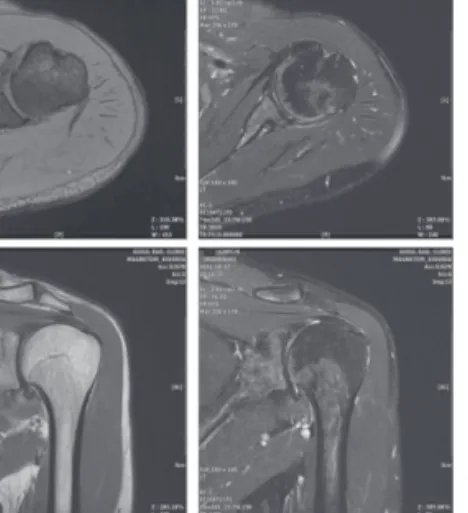
10.1 Lt. shoulder MRI 2011-03-14 (Fig. 1) Partial to nearly complete tear, supraspinatus ten- don, Lt. shoulder joint.

Anterior inferior labral tear. Lt. shoulder joint.

Bone contusion, posterolateral aspect of the humeral head., Lt

Fig. 1. 2011-03-14 Lt. shoulder MRI

(3)

III

. 방법과 평가

1.

1.1

1 0.2 30mm, 0.3 60mm

stainless steel

10-20 15-40mm

2~3 20

1.2

Point F-3 Japan

1 2

Mixed 3Hz frequency 20

1.3

(1cc, 3cc) 26G 1/2, 23G 1

1-2cc

1.4

6g 4g 4g 4g

2

2.1 (VAS)

VAS

0 10

VAS

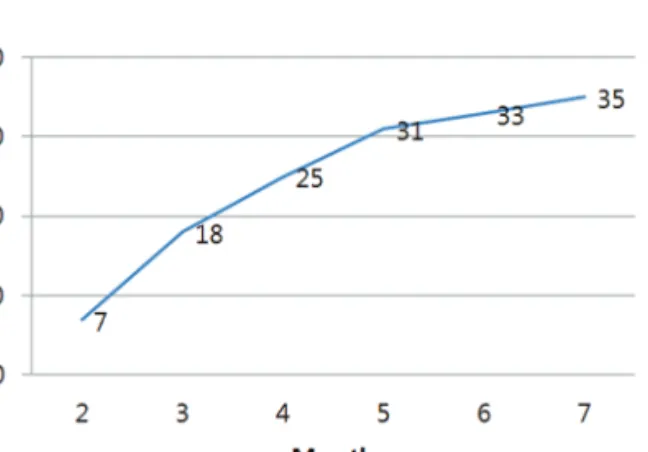
(Fig. 3)

2.2

(Table 1)

Fig. 2. 2011-10-17 Lt. shoulder MRI

Fig. 3. Pain progress

2 3 4 5 6

45 90 120 150 180

10 30 10 1030

30 90 45 30

45 100

60 60

45 120

80 60

45 180

80 60 Table 1. Lt. Shoulder Range of Movement

Month

Flexion

Extention

Abduction

Internal rotation

External rotation

(4)

2.3 UCLA Shoulder rating scale

10

5 35

(Fig.

4)

2.4 Shoulder MRI (MRI)

2011 3 14 8 2011 10

17

3

3.1 2

ROM 45 10 30

10

3.2 3

ROM 90 30 90

45 30

(Fig. 1)

3.3 4-5

ROM 120-

150 45 100-120 60-80

60

3.4 6

ROM

180 45 180 80

60

IV

. 고찰

95% 40

Fig. 4. UCLA Shoulder rating scale

(5)

(Taraxaci Herba) (Lonicerae Flos) (Rehmanniae Radix) (Forsythiae Fructus) (Coptidis Rhizoma) (Scutellariae Radix) ( Phellodendri Cortex) (Gardeniae Fructus)

2011 2 19

2011 2 21 9 9 1 3 3

2011 2 17

45 10 30 10

1

90 30 90

45 30

(Shoulder MRI)

(Supraspinatus tendon tear) (Anterior inferior labral tear) (Humeral head bone contusion) 7

180 45 180

80 60

2011 10 17

2011 10 17

1

V

. 결론

2011 2 19 2011 7 20

6 ROM

45 10 30 10

10 180 45 180

80 60

VAS 9, 7 VAS 0

UCLA shoulder rating scale 7 35

(6)

References

1. Oh KJ. Comparison of Muscular Strength and Range of Motion & Pain according to the Tear Size after a Rotator Cuff Repair when a 12- Week Rehabilitation Program is Applied.

Seoul: Dept. of Sports Medicine Graduate school of Biomedical Science Korea Univer- sity. 2011:1-38.

2. The Korean orthopaedic association.Orthopa- edics 6th. Seoul: The New medical. 2006:498- 503.

3. Kwon OS, Kim YS, Lee KY. Clinical Features and Arthroscopic Fingdings of Partial Thick- ness Rotator Cuff Tears. J Korean orthop Assoc. 2007;42(2):177-83.

4. John M. Eisenberg Center for Clinical Decisions and Communications Science.

Comparative Effectiveness of Interventions for Rotator Cuff Tears in Adults. Baylor College of Medicine, Houston, Texas. 2010 Oct 29.

5. Bae KT, Kim HK, Kim JS, Nam SS, Kim YS.

Case Report of Shoulder Impingement Syndrome with Acute Bursitis and Supra- spinatus Tendinopathy. J Korean Acupuncture

& Moxibustion Society. 2005; 22(5): 175-82.

6. Kim JO, Sim SD, Noh KH, Shon SJ, Kim SJ, Yang YH. Pain Recovery Pattern According to the Integrity after an Arthroscopic Rotator Cuff Repair. J Korean Arthroscopy Soc.2009;

13(2):155-60.

7. Choi CH, Um DH, Kim SK. Pain & Motion Recovery Patterns After Rotator Cuff Repair According to Tear Size. J Korean orthopaedic

association. 2005;40(7):826-31.

8. Heo SY. Assessment of Pain in Patients with Low Back Pain. J east-west medicines. 1999;

24(3):17-29.

9. Ellman H, Hanker G, Bayer M. Repair of the rotator cuff. End-result study of factors influ- encing reconstruction. J Bone Joint Surg Am.

1986 Oct;68(8):1136-44.

10. Han TR, Bang MS. Rehabilitation Medicine 3rd. Seoul: Koonja. 2008:135-8, 811-4.

11. Neviaser RT., and Neviaser JJ. Observation on impingement. Clin Orthop. 1990; 254:60-3.

12. DeOrio JK and Cofield RH. Results of a sec- ond attompt at surgical repair of a failed initial rotator-cuff repair. J Bone Joint Surg. 1984;66- A:563-567.

13. Hattrup SJ. Rotator cuff repair: relevance of patient age. J Shoulder Elbow Surg. 1995;4:95- 100.

14. Choi SH, Ahn KS, Lee GH. Study on the Effects of Dangguixusan on Experimental Blood Stasis Model Induced by Compression.

Journal of KyungHee Oriental Medicine College. 1999;22(1):22-38.

15. The Korean Acupuncture & Moxibustion Society. The Acupuncture & Moxibustion.

Paju: Jipmoon. 2008:24-42.

16. Kim EH, Oh MS. The clinical observation of 1 case of Supraspinatus Tendinosis and subdel- toid bursitis. Journal of Daejeon Oriental medicine College. 2009;18(1):43-8.

17. Shin HW, Kang JH, Lee H. Efficacy of Soyeom Pharmacopuncture on Postauricular Pain Accompanied with Peripheral Facial Paralysis. J Korean Acupuncture & Moxibus- tion Society. 2009;26(6):41-9.

18. Yeo NH, Lee HY. The Effect of Dangkwisoo- San on Blood Enzyme Activity in Brusied Rats. J Korean Physical education.2002;

41(3):333-40.

수치

Fig. 2. 2011-10-17 Lt. shoulder MRI
Fig. 4. UCLA Shoulder rating scale

참조

관련 문서

Objectives : The purpose of this study is to report the effect of Korean medical treatment on 4 patients with acute traumatic meniscal tear, presenting severe knee pain

After 6 months from the onset, she underwent an arthroscopic hemostasis for the active bleeding point from the massive rotator cuff tear and the synovium

나이가 들어갈수록 회전근 개는 maximal stress와 ultimate tensile strength가 약해지면서 퇴행 및 외 상성 파열의 가능성이 높아진다 4). 만성 광범위 회전근 개

Purpose: We wanted to assess the short term clinical outcomes and the effectiveness of reverse total shoulder replacement for massive rotator cuff tears with cuff tear arthropathy

Purpose: The purpose of this study was to evaluate the recovery patterns of pain and motion as well as final outcomes after rotator cuff repair according to tear size.. Materials

03) Gonzalez D and Lopez RA: Concurrent rotator cuff tear and brachial plexus palsy associated with anterior dislocation of the shoulder. A report of two cases. J Bone Joint

Methods Forty-seven patients who underwent rotator cuff repair prospectively completed the visual analog scale (VAS) pain score, the UCLA Scale, the American Shoulder and

Materials and Methods: Between January and December of 2008, 90 patients who had persistant pain and shoulder adhesion 4 weeks after rotator cuff repair were treated with