아하회지 제 30권 저j 2 호 87〜95 (1986) Yakhak Hoeji Vol. 30, No. 2
클로로프로파미 드와 싸이 클로덱스트린과의 包接 화합물에 관한 연구
정 경 헤 • 김 길 수 • 구 영 순
이화여자대학교 약학대학 (Received April 2,1986)
Inclusion Complexation of Chlorpropamide w ith Cyclodextrins
Kyeong Hye Jeong, K il Soo Kim and Young Soon Ku College o f Pharmacy, Ewha Womans University, Seoul 120,Korea
A bstract——Inclusion complexation of a-cyclodextrin(a-CD), y3-cyclodextrin ()3-CD) and tri-O- methyl-卢一cyclodextrin(tri-0-methyl-卢一CD) with chlorpamide(CPA) in aqueous solution and in the solid state were studied by the solubility method, spectroscopy (UV, IR ), differential scanning calorimetry (DSC) and powder X-ray diffractometry, and all their molar ratios were found to be 1:1. The solid complexes of CPA with three kinds of cyclodextrins were prepared by a freeze- drying method, and their dissolution behaviors were examined. As a result, the release of CPA from the inclusion complexes was significantly improved. The intrinsic dissolution rate of CPA in cyclodextrin inclusion complexes was about 51 times (a-CD inclusion complex) and 12 tmies (/3- CD inclusion complex) larger than that of intact CPA.
생체에 경구투여된 난용성 약물의 위장관 흡수
에 있어서 약물의 용출속도가 율속단계인 경우,
제제로부터의 약물의 용출속도는 bioavailability
에 큰 영향을 미치며 따라서 난용성 약물의 용
출속도 및 용해도는 약물의 제제설계에 있어서 주요 연구과제로 되고 있다-
용해도 증가는 계면활성제의 이용1,2) 결정형 의 변화3) solid solution형성 4J 이나 분산기법 5} 에
의한 입자도 감소 및 화합물化 등의 방법으로
할 수 있으며 그 중 화합물化에 의해 형성되는
포접 화합물은 host분자가 가지고 있는 空洞내
에 guest분자를 넣어 만든 일종의 화학적 복합
체6>이다. monomolecular 포접 화합물은 단일 host분자와 단일 guest분자의 포접 화합물을 의
미하며 단일 host분자로서 수용성이며 광범위한
포접능을 갖고 있는 cyclodextrin (CD) 이많이 이 용되고 있다 .내
포접 화합물은 약제학적인 면에서 액상약물의 분체화,9,10) 약효발현의 조절,1u 의약품의 안정
화,12,13> 용해성의 개선,14,15) 국소자극성 경감,16,
17) 橋昧 • 橋臭,18) 휘발성의 감소,19) bioavaila- bility의 개선20' 등 에 이용될 수 있다.
Uekama등25〜32) 은 benzodiazepines, aralkylalco- hols, 스테로이드 홀몬,proscillaridin, cinnamic acid 유도체,alkylparabens, 푸로스타글라딘류 및 페니토인과 CD와의 포접 화합물을 조제하고
용출속도 증대에 관한 연구보고를 하였다.
본 연구에서는 경구당뇨병치료약으로 사용되
는 난용성 약물인 CPA의 용해도를 증가시킴으
로써 bioavailability를 향상시킬 목적으로 CPA- a-CD계, CPA-/3-CD계 및 CPA-tri-0-methyl- 卢-CD계를 조제하고 그 용출특성을 검토하였다.
실 험 방 법
시료 및 시약一시료로는 chlorpropamide(한국 화이자, USP 규격품), a 및 卢-cyclodextrin (東京 化 成 ), tri-O-methyl-^-cyclodextrin (Funakoshi
88 CPA 와 CD의 포접 화한鲁
약품)을 사용했으며 기타 시약은 Hayshi pure chem•의 일급시약을 사용하였다.
7| 7|— Freeze dryer (Labconco, model 7500) , U V spectrophotometer (shim adzu, UV- 240), pH meter (Beckman, Model 3500), Infrar ed spectrophotometer (Perkin Elmer, 599B), Differential scanning calorimeter (D u Pont Ins
trum ents, 910 D S C ), X-ray diffractometer(Diano X R D , 8300) 및 U SP X X dissolution apparatus
(Erw eka, DT-D) 를 사용하였다.
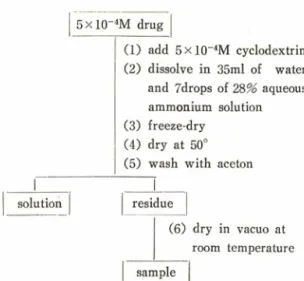
S o lid 포접 화합물의 조제一K urozum i 등의 방 법33>에 따라 Scheme I과 같이 조제하였다. 같 은 몰비로 약물과 a- C D,/3-CD 및 tri-0-m ethyl -卢- CD를 각각 5% 암모니아수 중에 넣어 용해 하고 동결건조한 후,50oC에서 건조하여 포접
고체화합물을 조제하고 여분의 약물을 아세톤으
로 세척한 후 실온에서 진공건조하였다.
5x 10_4M drug
(1) add 5x 10_4M cyclodextrin (2) dissolve in 35ml of water
and 7drops of 28% aqueous ammonium solution (3) freeze-dry
(4) dry at 50°
(5) wash with aceton
solution residue
(6) dry in vacuo at room temperature sample
Scheme I-Preparation of inclusion complex by freeze- drying method.
U V S p e c tro s co p yᅳJohnson등34>의 방법에 준 해서 측정했다. C P A lOO.Omg을 칭량하여 0 . 1M 인산염완충액 (pH 7 .0 ) 으로 용해하고 2,4, 6,8, 및 10//g/ml의 농도로 하고 228nm에서 흡광도를 측정하여 최소자승법으로 검량곡선 Y = 0 .0 4 5 1 X 롤 얻었다. 고체 화합물중의 C P A 함량은 앞에 서 구한 검량곡선에 의해 구하고 C P A와 각 C D와의 결합비를 계산하였다. 또한 포접 화합물
형성시의 U V스펙트럼의 변화를 관찰하였다.
IR SpectroscopyᅳIR 스펙트럼은 KP IV브 롬화칼륨 정제법에 따라 측정하였다.
Differential Scanning Calorinetry (DSC)—- 20o/m in의 scanning 속도로 측정하였다.
X- ray D iffr a c to m e tr yᅳ분말 X-ray 회절패던 의 조작조건은 X-ray는 Ni-filtered Cu-Ka radia
tion, 電壓은 30kV,시간 상수는 2sec, scanning 속도는 10 /m in로 하여 측정하였다.
용출 실험ᅳUSP XX의 회전검체통법에 의해
용출용매로900ml의증류수를 사용하였고, CPA- tri-0-methyl-/3-CD계의 경우에는 900ml의 증류 수에 polysorbate 80을 2% 첨가하여 사용하였다. 그리고 회전속도는 lOOrpm으로 하였다. 80〜100 mesh 범위의 C P A 30mg에 상당하는 시료를 검 체통에 넣고 용매의 온도를 37.,0土0.1oC로유지
하면서 직접 흡광도를 측정할 수 있도록 스펙트
로포토메타가 부착된 용출실험기기를 사용하여
용출되는 C P A롤 측정하였다. Intrinsic 용출속 도정수를 구하기 위해 시료를 9,000kg/cm2의 압 력으로 지름 1.3cm의 disc를 만들고 이 disc의
한면을 제외하고 shellac으로 입힌 후 검체통에
넣고 37.0土0.1oC를 유지하면서 홉광도를 측정 하였다.
실험결과 및 고찰
UV 홉광도를 측정하여 구한 포접 화합물의
결합비는 Table I과 같다.
Table I-Inclusion complex ratio of chlorprolamide to cyclodextrin.
chlorpropamide : a-cyclodextrin 1 chlorpropamide I 卢-cyclodextrin 1 chlorpropamide I tri-0-methyl-과-cyclodextrin 1
C P A와 a-CD, ^3-CD 및 tri-O-methyl-卢-CD는
모두 1:1의 몰비로 포접 화합물을 형성하였다.
IR spectroscopy—Fig. 1-1 은 CPA, CPA와
a C D의 같은 몰비의 물리적 혼합물 및 포접 화
합물의 IR 스펙트럼이다. CPA와 물리적 혼합 물의 스펙트럼에서는 1,660cm-1 의 C = 0 stret
ching band, 1,550cm-1 의 N - H bending band, 1,470cm_1의 C H 2 bending band, 1,345cm_1 의
J. Pharm. Soc. Korea
셩 경 혜 • 김 길 수 • 구영순 89
S=0 asymmetric stretching band 및 1,150cm-1 의 S = 0 symmetric stretching band를 볼 수 있 으나 화합물의 스펙트럼에서는 S = 0 symmetric stretching band를 제외하고는 모두 소실되었고,
그림에는 나타내지 않았으나 750cm-1 의 1,4-치 환 벤젠은 모든 IR 스펙트럼에 나타났다. 이 스 펙트렴의 변화로 C P A 의 - S 0 2N H C 0 N H C H 2C H 2 C H 3 가 포접된 것으로 추정된다. Fig. 1-2 는 C P A , C P A 와 卢-C D 물리 적 혼합물 및 화합물의 I R 스펙트럼을 비교한 것인데 C P A -a -C D 계와 유사한 결과였다. Fig. 3은 C P A , C P A 와 tri-0 _ methyl-/3-CD의 물리적 혼합물 및 화합물의 IR 스펙 트럼이 다. C P A 와 물리 적 혼합물에 나타난 1,550cm_1 의 N - H bending band가 화합물의 스 펙트럼에서는 소실되었고, C P A 의 C = 0 stre
tching band인 1, 660cm-1의 피 이 크는 1,715cm-1
로 이동하였다. 이 스펙트럼의 변화로 C P A 의 - N H C H 2C H 2C H 3 가 포접된 것으로 추정되며,
C P A 가 tri-0-m ethyl-^S-CD과 포접 화합물을 형 성 함으로써 C P A 가 고형상태 에 서 분자간 수소결 합으로 회 합되어 있던 것이 C D 에 포접됨으로써 단분자상태로 되고 C = 0 의 결합에너지가 증가 되어 C = 0 stretching band가 high field로 shift 된 것으로 추정할 수 있다.
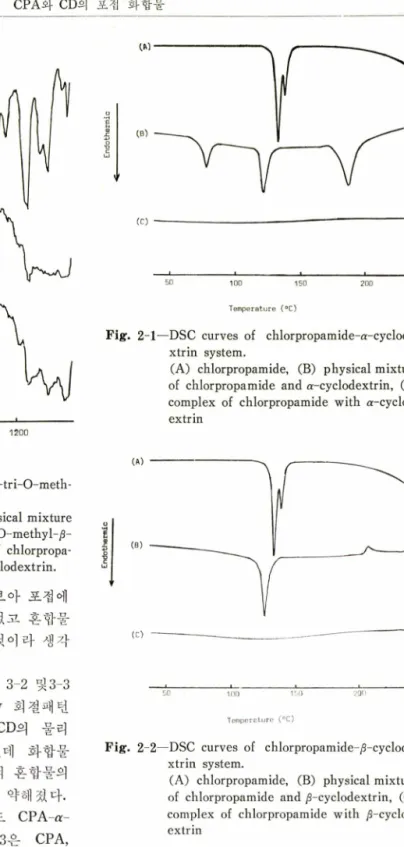
D S C —Fig. 2-1,2-2 및 2-3은 C P A -C D 의 50
〜 200oC 에서의 DSC 곡선이 다. C P A 의 융점에 해당하는 1250C 부근의 endothermic peak는 혼 합물이 됨으로써 공융등으로 인한 약간의 차이 는 있으나 거의 비슷한 온도에서 융점을 나타내 고 있다. 화합물에 있어서는 혼합물에서 나타난 endothermic peak는 완전히 소실되 었으며 tri- O -m ethyl-^ -CD 인 경우에는 전혀 새로운 endo-
(A)
( b )
Unue num ber (cm )
F ig. 1-1—IR spectra of chlorpropamide-a-cyclodext- rin system.
(A) chlorpropamide, (B) physical mixture of chlorpropamide and a-cyclodextrin, (C) complex of chlorpropamide with a-cyclod- extrin
(c)
1 8 0 0 1 6 0 0 1 4 0 0 1 2 0 0
U a v o num ber (c m ^ )
F ig. 1-2—IR spectra of chlorpropamide-/3-cyclodext- rin system.
(A) chlorpropamide, (B) physical mixture of chlorpropamide and p-cyclodextrin,(C) complex of chlorpropamide with /5-cyclod- extrin
90 CPA 와 CD의 포접 화한볼
50 100 150 200
Temperature (°C)
Fig. 2-1—DSC curves of chlorpropamide-a-cyclode- xtrin system.
(A) chlorpropamide, (B) physical mixture of chlorpropamide and a-cyclodextrin, (C) complex of chlorpropamide with a-cyclod- extrin
50 100 1L0 2011
Fig. 2-2——DSC curves of chlorpropamide-卢-cyclode- xtrin system.
(A) chlorpropamide, (B) physical mixture of chlorpropamide and 卢-cyclodextrin,(C) complex of chlorpropamide with 卢-cyclod- extrin
약해지기 때문이라 생각된다.
U V Spectroscopy—용액중에서 포접 화합물 을 형성할 때 UV 스펙트럼의 변화를 Fig. 4-1, 4-2 및 4-3에 나타내었다. Fig. 4-1,4-2 및 4-3
J. Pharm. Soc. Korea
1800 1600 1400 1200
Ua\/e number (cm )
F ig. 1-3—IR spectra of chlorpropamide-tri-O-meth- yl-卢-cyclodextrin
(A) chlorpropamide, (B) physical mixture of chlorpropamide and tri-O-methyl-卢- cyclodextrin, (C) complex of chlorpropa
mide with tri-O-methyl-卢-cyclodextrin.
thermic peak를 나타내는 것으로 보아 포접에
의해 endothermic peak가 안정화되었고 혼합물
질이 아닌 결합된 물질로 단일화된 것이라 생각
된다.
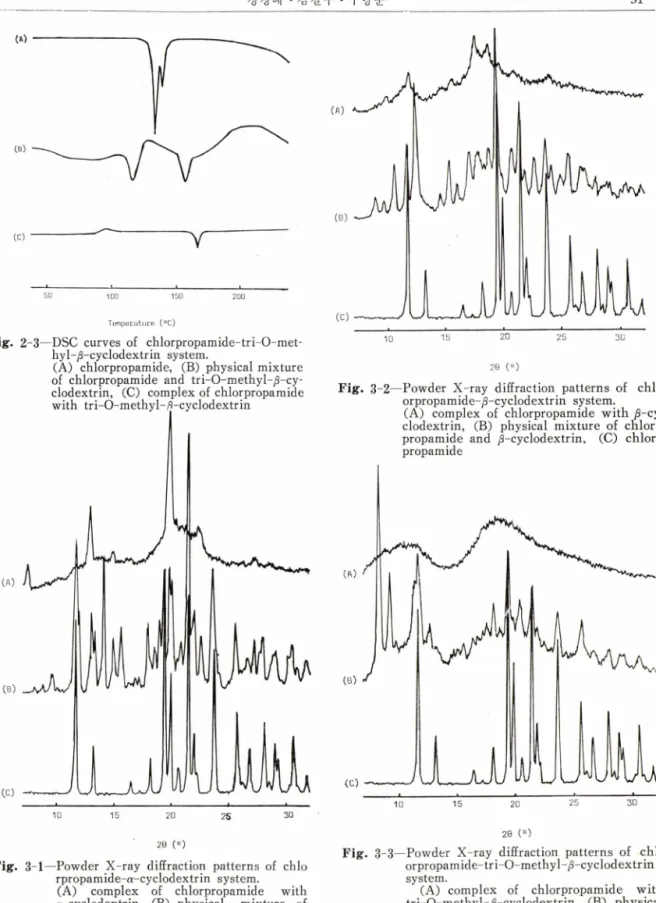
X - ray D iff r a c t o m e t r y — Fig. 3-1, 3-2 및 3-3 은 CPA -CD계의 7-32°에서의 X-ray 회절패턴 이다. Fig. 3-1 은 C P A , C P A와 a- C D의 물리
적 혼합물 및 화합물을 비교한 것인데 화합물
의 X-ray 회절패턴은 CPA 및 물리적 혼합물의 경우와 비교할 때 결정성이 현저히 약해졌다. Fig. 3-2의 CPAᄀ3-CD계의 경우에도 CPA-a- CD계의 결과와 유사하다. Fig. 3-3은 CPA, CPA와 tri-O-methyl-^S-CD의 물리적 혼합물 및
화합물의 X-ray 굴절패턴인데 화합물은 무정형
의 X-ray 굴절패턴을 보여준다. 이것은 결정의 CPA가 무정형의 CD에 포접됨으로써 결정성이
(B)
정 경 혜 • 김 길 수 • 구영순 91
Temperature (°C)
Fig. 2-3― DSC curves of chlorpropamide-tri-O-met- hyl-/3-cyclodextrin system.
(A) chlorpropamide, (B) physical mixture of chlorpropamide and tri-0-methyl-^3-cy- clodextrin, (C) complex of chlorpropamide
20 ( ° )
chl- Fig. 3-2—Powder X-ray diffraction patterns of
orpropamide-卢-cyclodextrin system.
(A) complex of chlorpropamide with p-cy clodextrin, (B) physical mixture of cnlor- propamide and 力-cyclodextrin, (C) chlor
propamide
Fig.
20 ( ° )
3-1—Powder X-ray diffraction patterns of chlo rpropamide-a-cyclodextrin system.
(A) complex of chlorpropamide with a-cyclodextrin, (B) physical mixture of chlorpropamide and a-cyclodextrin, (C) chlorpropamide
2B ( ° )
Fig. 3-3ᅳPowder X-ray diffraction patterns of chl- orpropamide-tri-O-methyl-yS-cyclodextrin
system. . .
(A) complex of chlorpropamide with tri-O-methyl-卢-cyclodextrin,(B) physical mixture of chlorpropamide and tri-O-me- thyl-卢-cyclodextrin, (C) chlorpropamide
,
乂
j J U (A
■Y
UP J J aJ os -D-
u ul
92 CPA와 CD의 포접 화합물
190.0 250.0
U a v / e l e n g t h ( n m ) F ig . 4-2—U V
卢-cyclodextrin system.
Key:--- chlorpropamide, complex of chlorpropamide w ith 卢-cyclodextrin
1 .0 0 0
결과이다.
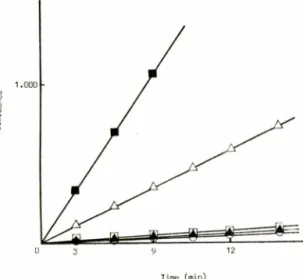
이 결과로 구한 intrinsic 용출속도는 Table
I I에 나타내었다. 그 결과에서 대조에 비해 CPA
1.000 • 은 각각 C P A , C PA -a-C D 화합물, CPA-i3-CD
화합물 및 CPA-tri-O-m ethyl-가-C D 화합물의 UV 스펙트럼이다. 포접 화합물을 형성했을 때 최대흡광도에서의peak (228nm) 는 hypsochromic shift했다. 이것은 C = 0기의 결합상태에 변화가
온 것을 의미하며 IR 스펙트럼의 결과와 종합
해 볼 때 C P A가 포접되면서 분자중의 C = 0기
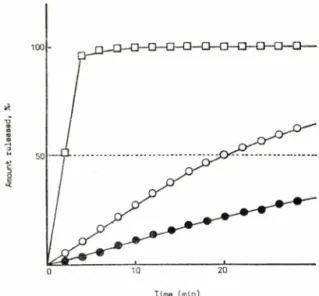
가 CD와과 결합되었다고 추정할 수 있다. 용출실험ᅳFig. 5-1,5-2 및 5-3은 CPA-CD 계의 용출 패턴이다. Fig. 5-1,5-2 및 5-3에서 볼 수 있는 바와 같이 a-CD, 0-CD 및 tri-O- methyl-^-CD가 CPA와 화합물을 형성할때 CPA 및 CPA와 세종류 CD와의 물리적 혼합물에 비 해 용출속도가 현저히 증가하였다. Fig. 5-4는 CPA의 a-CD, 卢-CD 및 tri-0-methyl-j(3-CD과의 포접 화합물의 용출속도를 비교한것이다. CPA- tri-0-metiyl-卢-CD화합물에서의 CPA의 용출은 CPA-a-CD 화합물 및 CPA-0-CD 화합물에 비 해 지연되었다. 이것은 i3-CD의 hydroxyl기에 methyl기 3개가 치환되어 소수성이 증가하였기 때문이라 생각된다. CPA-ar-CD 화합물 및 CPA -/3-CD 화합물의 용출속도는 유사하였다. Fig.
6은 용줄표면적을 일정하게 하여 행한 용줄실험
1.000 ■
190.0 250.0
U a v e l e n q t h ( n m )
F ig . 4-3—U V absorption spectra of chlorpropamide- tri-O-methyl-卢-cyclodextrin system.
Key:--- chlorpropamide, ...complex of chlorpropamide w ith tri-O-methyl- /3-cyclodextrin
1 9 0 .0 2 5 0 .0
U a u e l e n g t h (n m )
F ig . 4-1ᅳ U V absorption spectra of chlorproamide- a-cyclodextrin system.
K e y ! chlorpropamide, complex of chlorpropamide w ith a-cyclodextrin
a u u (o xl.
QI (o\ /c;
a u u (o JJM o (o<q
« a:
a u u (oC
I. oI cn\ /c;
J. Pharm. Soc. Korea
정 경 혜•김 길 수 • 구영순 93
T i me (min)
Fig. 5-1——Dissolution profiles of chlorpropabmide-a- cyclodextrin system in water at 37° C by powder method.
Key: • chlorpropamide, o physical mixture of chlorproamide and a-cyclodextrin, a complex of chlorpropamide with a-cyclodextrin.
T i me (min)
Fig. 5 3一Dissolution profiles of chlorpropamide-tri- 0-methyl-^3-cyclodextrin system in 2%
Tween 80 aqueous solution at 37°C by powder method.
Key: • chlorpropamide, o physical mix
ture of chlorpropamide and tri-O- methyl-/3-cyclodextrin, □ complex of chlorpropamide with tri-0-methyl-j3- cyclodextrin
Fig. 5-2—Dissolution profiles of chlorpropamide-卢一 cyclodextrin system in water at 37°C by powder method.
Key: • chlorpropamide, o physical mix
ture of chlorpropamide and 卢-cyclo- dextrin, □, complex of chlorpropami de with /3-cyclodextrin.
Time (min)
Fig. 5-4ᅳDissolution profiles of chlorproamide-cyclo- dextrin complexes in water at 37° C by powder method.
Key: o complex of chlorpropamide with a-cyclodextrin, □ complex of chlor
propamide with p-cyclodextrin, ▲ complex of chlorpropamide with tri- O-methyl-^-cyclodextrin
94 CPA와 CD의 포접 화합물
T i me (min)
F ig . 6—Dissolution profiles of chlorpropamide-cyclo- dextrin systems in water at 37°C by constant surface method.
Key: o chlorpropamide, 口physical mixture of chlorpropamide and a-cyclodextrin,
▲ physical mixture of chlorpropamide and 卢-cyclodextrin,■ complex of chl
orpropamide with a-cyclodextrin, ^ complex of chlorpropamide with 卢-cyc- lodextrin.
Table I I —Intrinsic rate of dissolution, G at 37°C, lO O rp m .
Intrinsic rate
Compound of dissolution
_______________________________________ (mg/cm2/m in)
chlorpropamide 8. 4 X10"3
chloropropamide-a-cyclodextrin complex 4. 3 X 1으1 chlorpropamide-卢-cyclodextrin complex 1.0x1으1
-a-CD 화합물의 용줄속도는 약 51배 증가하였
고 CPA-/3-CD 화합물은 약 12배로 증가하였다.
시료를 분말로 했을 때와 disc룰 찍었을 때의
결과가 다른 점 및 시료를 분말로 했을 때의 결
과가 Vekama등의 propylparaben과 CD와의 화 합물 연구결과30>와 다른 점은 앞으로 계속 연구 해야 할 과제라고 생각된다.
결 론
CPA와 CD와의 포접 화합물에 관한 연구에서
다음과 같은 결론을 얻었다.
1. CPA와 a-CD, 갖-CD 및 tri-O-methyl-卢-
CD룰 같은 몰비로 포접 화합물을 만들어 spe-
ctrescopy(UV, IR), DSC 및 X-ray 회절에 의해 검토한 결과,1:1의 몰비로 결합한 포접 화합물 을 형성함을 확인할 수 있었다.
2. 포접 화합물중의 C P A의 용출속도는 대조 에 비해 현저히 증가하였다.
3. CPA-a-CD화합물, CPA-卢-CD화합물 및 CPA-0-methyl-卢-CD화합물의 용줄속도를 비교 했을 때 CPA-a-CD화합물 및 CPA-)3-CD화합물 에 비해 CPA-tri-0-methyl-卢-CD화합물의 용출 은 지연되었고 CPA-a-CD화합물과 CPA-f-CD
화합물의 경우는 유사하였다.
4. intrinsic 용출속도는 대조에서 8 .4 X 1 0 -3 mg/cm2/min, CPA-a-CD화합물은 ^
cm2/min, CPA-卢-CD화합물은 1. OX 10_1mg/cm2 /min로,대조에 비해 CPA-a-CD화합물는 51배 증가하였고 CPA-/3-CD화합물은 12배 증가하였 다-
문 헌
1) Bates, T.,Gibaldi, M. and Kanig, J.L.: Nature 210, 1331 (1966).
2) Kakemi, K.,Arita, T. and Muranishi, S.: Chem.
Pharm. Bull. 13,976 (1965).
3) Mullins, J.D. and Macek, T.J.: J. Am. Pharm.
Assoc. {Sci. Ed.) 49,245 (1960).
4) Goldberg, A.H., Gibaldi, M., Kanig, J.L.: J.
Pharm. Sci. 55, 487 (1966).
5) Mayersohn, M. and Gibaldi, M .: ibid. 55, 1323 (1966).
6) Uekama, K .: Yakugaku Zasshi 101, 857 (1981).
7) Frank, S.G.: J. Pharm. Sci. 64, 1585 (1975).
8) Blender, M.L. and Komiyama, M .: Cyclodextrin Chemistry, Springer-Verlag Berlin Heidelberg,
(1978).
9) Uekama, K .,Hirayama, F.,Yamada, Y .,Inaba, K. and Ikeda, K .: J. Pharm. Sci. 68, 1059 (1979).
10) Tokumura, T.,Ueda, H., Tsushima, Y., Kasai, J. Pharm. Soc. Korea
정 경 혜•김 길 수 • 구영순
M. , Kayano, M ., Amada, I., and Nagai, T.:
Chem. Pharm. Bull. 32,4179 (1984).
11) Uekama, K., Matsuo, N., Yamaguchi, Y., Imamura, T. and Ichibagase, H .: ibid. 27, 398 (1979).
12) Uekama, K., Narisawa, S., Hirayama, F., Otagiri, M.,Kawano, K., Ohtani, Y. and Ogino, H.: Int. J. Pharm. 13,253 (1983).
13) Ikeda, Y .,Matsumoto, K.,Kumihiro, K.,Fuwa, T. and Uekama, K .: Yakugaku Zasshi 102, 83 (1982).
14) Thakkar, A.L., Kuehn, P.B.,Derrin J.H., and W ilham, W .L .: J. Pharm. Sci. 61, 1841 (1972).
15) Hamada, Y., Nambu, N. and Nagai, T .: Chem.
Pharm. Bull. 23,1205 (1975).
16) Irie, T., Hinji, S., Otagiri, M., Uekama K., and Iwamasa, T .: J. Pharm. Dyn. 6, 790 (1983).
17) Sato, Y., Matsumaru, H .,Irie, T., Otagiri, M.
and Uekama, K .: Yakugaku Zasshi 102, 874 (1982).
18) Uekama, K.,Oh, K., Otagiri, M.,Seo, H. and T suruoka, M .: Pharmaceutic a Acta Helvetiae 12, 3 (1983).
19) Uekama, K., Hirayama, F., Esaki, K. and Inoue, M .: Chem. Pharm. B ull., 27,76 (1979).
20) Seo, H.,Tsuruoka, M .,Hashimoto, 丁.,Fujnaga, T., Otagiri, M. and Uekama, K .: ibid. 31,286
(1983).
21) Uekama, K., Otagiri, M .,Uemura, Y .,Fujinaga, T.,Arimori, K., Matsuo, N.,Tasaki, K. and Sugii, A.: J. Pharm. Dyn. 6, 124 (1983).
22) Uekama, K., Fujinaga, T., Hirayama, F.,Otagiri,
M., Yamasaki, M .,Seo, H., Hashimoto, T. and Tsuruoka, M.: J. Pharm. Sci., 72, 1338 (1983).
23) Uekama, K.,Fujinaga, T., Hirayama, F., Otagiri, M., Seo, H. and Tsuruoka, M .: I. Int. Symp. on Cyclodextrins 399 (1981).
24) Uekama, K .,Matsuo, N., Hirayama, F .,Ichib
agase, H .,Arimori, K., Tsubaki, K. and Satake, K .: Yakugaku Zasshi 100,903 (1980).
25) Uekama, K.,Narisawa, S., Hirayama F., and Otagiri, M .: Int. J. Pharm. 16, 327 (1983).
26) Uekama, K .,Oh, K., Hirayama, F., Otagiri, M., Shibata, M ., Ohtani, Y., Yamada Y ., and Sugiyama, Y .: Yakugaku Zasshi 102, 1141 (1982).
27) Uekama, K.,Fujinaga, T., Hirayama, F., Otagiri, M. and Yamasaki, M .: Int. J. o f Pharm. 10,1
(1982).
28) Uekama, K., Fujinaga and T .,Otagiri, M.: Acta Pharm. Suec. 20,287 (1983).
29) Uekama, K., Hirayama, F .,Esaki, K .,Inoue, M.: Chem. Pharm. Bull. 27,76 (1979).
30) Uekama, K .,Ikeda, Y .,Hirayama, F., Otagiri, M. and Shibata, M.: Yakugaku Zasshi 100,994
(1980).
31) Uekama, K.,Hirayama, F.,Yamada, Y. and Ikeda, K.: J. Pharm. Sci. 68, 1059 (1979).
32) Tskuruoa, M., Hashimoto, T., Seo, H., Ichim- asa, S., Ueno, O.,Fujinaga T., Otagiri, M. and Uekama, K .: Yakugaku Zasshi 101,360 (1981).
33) Kurozumi, M .,Nambu, N. and Nagai, T .: Chem.
Pharm. B u ll 23,3062 (1975).
34) Johnson C. A., and Thornton-Jones, A .D .: Drug identification, The Pharmaceutical Press (1966).
,