김치에서 분리된 Lactobacillus buchneri의 젖산 생산 특성
심현수, 김명동*
강원대학교식품생명공학과
Received: June 22, 2015 / Revised: July 22, 2015 / Accepted: July 22, 2015
김치는배추, 무, 열무, 오이, 갓등의주재료와마늘, 파, 생강, 고춧가루, 젓갈등의부재료를이용하는우리나라의대 표적인전통발효식품이다[9, 10]. 김치의발효에는호기성및 혐기성세균과효모가관여하며, Leuconostoc속, Lactobacillus 속, Lactococcus속, Pediococcus속, Weissella속등의젖산 균이김치의발효를주도하는것으로보고되었다[11, 16]. 젖 산균은 발효과정중 젖산, 초산 등의 유기산, 박테리오신 (bacteriocin)을 비롯한 유해 미생물 생육억제물질 및 γ- aminobutyric acid (GABA) 등의생리활성물질을생성하는 것으로알려져있다[4, 8]. 또한젖산균은식품의맛, 향, 조 직감및보존성을향상시킬뿐만아니라유당불내증과변비 의완화, 혈중콜레스테롤의감소, 골다공증예방, 항암및 면역기능증진효과등을지닌것으로보고되었다[7, 13, 15, 22].
김치유래젖산균중 Lactobacillus buchneri는통성혐기
성균으로 GABA를생산하는것으로보고되었으며[4], 식품
이나사료의저장성을증진시키는기능을갖는것으로보고
되었다[5]. 또한내산성, 내염성및콜레스테롤감소효과가
뛰어나프로바이오틱스로서(probiotics)의가치가기대되는 젖산균이다[23].
젖산(lactic acid)은의약품, 화장품, 식품방부제등각종 유기화합물의원료로널리사용되고있으며[3], 최근에는생 분해성플라스틱, 약물전달소재, 생체대체소재등의원료로 사용되는 polylactic acid에대한관심이높아짐에따라그수
요가급증하고있다[6, 17]. 젖산을화학적합성법으로생산
할경우, L-lactic acid와D-lactic acid의혼합물형태로생산 되기때문에목적하는젖산을순수하게생산하기어려우므
로[3], 산업적으로이용되는젖산은주로미생물발효로생
산하고있다[1, 21]. 기존에는주로포도당을기질로이용하
였으나, 최근에는식물유래바이오매스를이용하여젖산을
생산하는시도가점차증가하고있다[1, 21]. 식물유래바이
오매스는 90% 이상이셀룰로오스, 헤미셀룰로오스, 리그닌
등으로구성되어있으며, 상당량의자일로스(xylose)를함유
하고있다[14, 21]. 따라서식물유래바이오매스를기질로이
용하여젖산을생산하기위해서는포도당뿐만아니라자일 로스를효율적으로대사할수있는미생물의선발이매우중 요하다[17].
본연구에서는전통발효식품인김치로부터젖산생산능 이우수한젖산균을분리하고자일로스를이용한젖산생산 특성에대하여조사하였다.
Characteristics of Lactic Acid Production by Lactobacillus buchneri Isolated from Kimchi Hyun-Su Sim and Myoung-Dong Kim*
Department of Food Science and Biotechnology, Kangwon National University, Chuncheon 200-701, Republic of Korea Lactic acid is a useful platform chemical for a wide range of food and industrial applications such as pharmaceuticals and cosmetics. Among 313 strains of lactic acid bacteria isolated from different traditional Korean fermented foods, eight Lactobacillus strains effectively utilized xylose as a carbon source to produce lactic acid. A lactic acid bacterium identified as Lactobacillus buchneri produced the highest amount of lactic acid from xylose under anaerobic conditions. The optimum xylose concentration and incubation temperature were 50 g/l and 37oC, respectively; under these conditions, 22.3 g/l lactic acid was produced.
Keywords: Lactobacillus buchneri, kimchi, xylose, lactic acid, fermented foods
*Corresponding author
Tel: +82-33-250-6458, Fax: +82-33-259-5565 E-mail: [email protected]
© 2015, The Korean Society for Microbiology and Biotechnology
젖산생산능이우수한균주를확보하기위하여전국에서 44점의전통발효식품을수집하였다. 젖산균을순수분리하기 위하여채취된시료를멸균된생리식염수(0.85% NaCl)에현 탁한 후, 적정 농도로 희석하여 자일로스(Sigma-Aldrich, USA)가 20 g/l의농도로함유된 MRS (proteose peptone 10 g/l, yeast extract 5 g/l, beef extract 10 g/l, polysorbate 80 g/l, ammonium citrate 2 g/l, sodium acetate 1 g/l, manganese sulfate 0.05 g/l, dipotassium phosphate 1.83 g/l, xylose 20 g/l) 평판배지에도말한후 30oC에서 48시간배양 하여단일집락을확보하였다.
분리한젖산균의염색체 DNA는 5 ml의 MRS 액체배지 에서 48시간배양한 후 Park 등의방법[12]으로추출하였 다. 분리한젖산균의 16S rRNA 유전자의증폭은 518F(5'- CCAGCAGCCGCGGTAATACG)와 800R(5'-TACCAGGGT ATCTAATCC) 프라이머를이용하였다[2]. 증폭한 16S rRNA 유전자의 염기서열을 확보한 후 National Center for Biotechnology Information (NCBI, USA)의 BLAST를 사 용하여타균주와의유전자단편의상동성을근거로동정하 였다[12].
고농도의자일로즈에서젖산생산능이우수한균주를선별 하기위하여분리한젖산균을자일로스가 50 g/l로함유된 5 ml의 MRS배지에접종하고 30oC에서 96시간동안배양한 후, 젖산생산능을평가하였다. 젖산생산능이우수하였던 8점 의젖산균을선발하여이후의실험을진행하였다.
자일로스가 50 g/l 농도로첨가된 5 ml의 MRS 배지에 1차 선별한 8점의균주를접종하고, 진탕배양기(Hanbaek Scientific Co., Korea)를이용하여 30oC에서 200 rpm으로 24시간 동안 전배양하였다. 흡광광도계(GE Healthcare,
Sweden)를사용하여 600 nm에서흡광도를측정하고원심
분리하여적정량의세포를회수한후멸균증류수로 3회세 척하고 50 g/l의자일로스가첨가된 100 ml의 MRS 배지에 초기 흡광도가 0.1이 되도록 접종하였다. 호기적 배양은 baffled flask(DURAN, Germany)를사용하여 200 rpm으로 교반하였고, 혐기적 배양은 oxyrase (bioWORLD, USA)를 2% (v/v)의농도로 첨가된배지를 screw cap baffled flask (SPL, Korea)에넣어밀봉한후 50 rpm으로교반하였다.
최적배양온도를설정하기위하여 25, 30, 37, 42oC에서 50 g/l의자일로스가첨가된 200 ml의 MRS 배지를사용하 여 Lactobacillus buchneri를혐기적으로배양하고젖산생산 량을측정하였다. 자일로스농도에따른젖산생산량을비교 하기위하여자일로스가각각 20, 50, 100, 150 g/l의농도로
첨가된 MRS 배지를사용하였으며일정시간마다배양액을
회수하여균체농도및젖산농도를측정하였다.
젖산및자일로스농도는 Rezex ROA-Organic Acid H+
(Phenomenex, USA) 컬럼이 장착된 HPLC (Shimadzu,
Japan)를사용하였다. 이동상은 0.005 N 황산용액을 0.6 ml/
min의유속으로 사용하였으며, 굴절률 검출기(Refractive Index Detector, Shimadzu, Japan)를사용하였다. 모든측 정은 3회반복하였으며통계처리는 SPSS 21 (IBM, USA)을 이용하였으며, Duncan의다중범위검정법(Duncan’s multiple range test)으로유의성을검정하였다.
전국에서수집한전통발효식품으로부터 313점의젖산균 을분리및동정하였다. 동정된젖산균중에서 5 ml 배양규
모에서젖산생산량이우수한것으로나타난 Lactobacillus
rhamnosus MBE907, L. buchneri MBE909, L. brevis
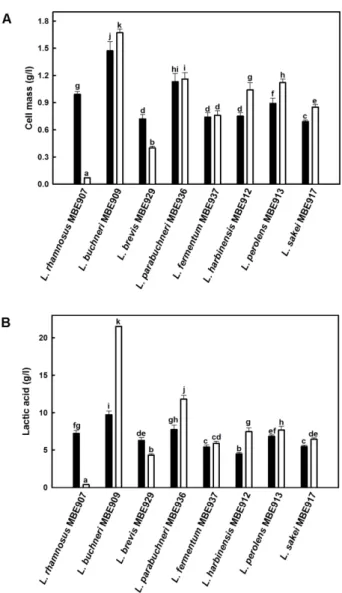
Fig. 1. Cell growth (A) and lactic acid production (B) of lactic acid bacteria isolated from Kimchi. Cells were grown in 5 ml MRS medium containing 50 g/l xylose at 30oC. Black (■) and white (□) bars indicate aerobic and anaerobic conditions, respectively.
Averages and standard errors from three independent cultures were shown.Different letters indicate significant difference between means (p < 0.05).
MBE929, L. parabuchneri MBE936, L. fermentum MBE937, L. harbinensis MBE912, L. perolens MBE913, 및 L.
sakei MBE917로명명된균주들의젖산생산량을평가하였다.
선발된젖산균을자일로스가 50 g/l 농도로첨가된 MRS 를사용하여호기적또는혐기적조건에서의균체성장과젖 산생산량을조사하였다(Fig. 1). 시험에사용한 8점의젖산 균중에서 L. buchneri MBE909는혐기적배양조건에서가 장우수한젖산생산량(21.52±0.05 g/l)을나타냈으며, 균체 성장또한 1.67±0.04 g/l로가장우수하였다. L. rhamnosus
MBE907은혐기적배양조건에서균체의성장정도가상대
적으로미미하였으며다른젖산균과비교하여상대적으로 낮은젖산생산량(0.38±0.01 g/l)을나타내었다. 그외의균 주들은호기적, 혐기적조건모두균체성장및젖산생산수 준이 유사하였다. 젖산생산량이가장 우수한 L. buchneri
MBE909를이용하여이후의실험을진행하였다.
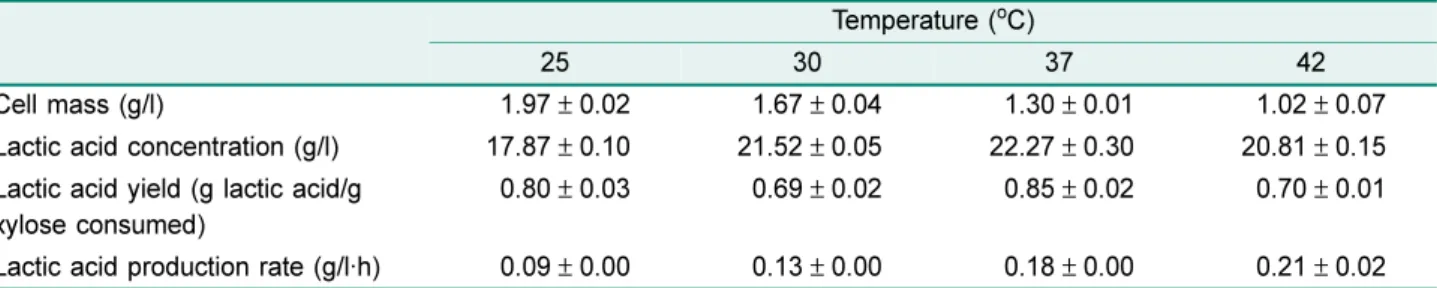
자일로스가 50 g/l의농도로첨가된 MRS 배지를사용하 여배양온도를 25, 30, 37, 42oC로설정하고혐기적인조건 에서 배양하면서 균체성장및 젖산 생산량을비교하였다 (Table 1). 배양온도가 25oC인경우균체성장이 1.97±0.02 g/l로가장높게나타났으나젖산생산량은 17.87±0.10 g/l 로실험구중가장낮은수준을나타내었다. 이러한결과는 자일로스가젖산생산보다는균체성장에주로사용되었기때 문인것으로사료된다. 배양온도를 30oC로증가시키면젖산 생산량(21.52±0.05 g/l)은유의적으로증가하였으나균체성
장(1.67±0.04 g/l)은감소하였다. 배양온도 37oC에서는젖 산생산량이 22.27±0.30 g/l로서상대적으로가장우수한결 과를나타내었다. 배양온도 30oC와 37oC에서유사한수준의 젖산이생산되었지만소모한자일로스에대한젖산의수율 을고려하면 37oC에서배양한경우가 30oC에서배양한결
과대비약 15% 정도높은값을나타내었다. 이러한결과는
Taniguchi 등[19]의자일로스에서젖산을생성할수있는 L.
vaccinostercus NRIC 1075 균주가 30oC에서최대의젖산을 생성하였다는연구결과와는 다소차이가 있었다. 이는 L.
vaccinostercus의최적성장온도가 L. buchneri의최적성장 온도와다르기때문으로사료된다. 배양온도가 42oC인경우 는균체성장과젖산생산모두상대적으로가장낮은수준을 나타내었다. Thomas [20]의연구결과에따르면 L. delbrueckii 균 주는 45oC에서배양하였을때, 50 g/l의자일로스로부터약
25.1 g/l로가장높은농도의젖산을생성하여고온에서도높
은젖산생산능을보였다.
젖산생산을위한최적의자일로스농도를결정하기위하 여혐기적인조건에서배양온도를 37oC로설정하고자일로 스농도를 20, 50, 100, 150 g/l로첨가한 MRS 배지를이용 하여균체성장과젖산생산성을조사하였다(Table 2). 자일로
스를 20 g/l 농도로첨가한경우배양초기에주입한자일로
스는 균체에 의하여 모두 소모되었으며 젖산생산량은 15.57±0.20 g/l로서상대적으로가장낮은값을나타났다. 자일로스가 50 g/l의농도로첨가되었을 시, 젖산생산량은
Table 1. Effects of cultivation temperature on growth and lactic acid production by Lactobacillus buchneri MBE909.
Temperature (oC)
25 30 37 42
Cell mass (g/l) 1.97± 0.02 1.67± 0.04 1.30± 0.01 1.02± 0.07
Lactic acid concentration (g/l) 17.87± 0.10 21.52± 0.05 22.27± 0.30 20.81± 0.15 Lactic acid yield (g lactic acid/g
xylose consumed)
0.80± 0.03 0.69± 0.02 0.85± 0.02 0.70± 0.01
Lactic acid production rate (g/l·h) 0.09± 0.00 0.13± 0.00 0.18± 0.00 0.21± 0.02
*Each value shown is the average± standard error from three independent batch cultivations performed with 50 g/l xylose for 96 h.
Table 2. Effects of initial xylose concentrations on growth and lactic acid production by Lactobacillus buchneri MBE909.
Xylose (g/l)
20 50 100 150
Cell mass (g/l) 1.22± 0.05 1.30± 0.01 1.23± 0.06 1.22± 0.04
Lactic acid concentration (g/l) 15.57± 0.20 22.27± 0.30 22.05± 0.13 17.97± 0.21 Lactic acid yield (g lactic acid/g
xylose consumed)
0.78± 0.05 0.85± 0.02 0.88± 0.01 0.74± 0.02
Lactic acid production rate (g/l·h) 0.13± 0.01 0.18± 0.03 0.19± 0.01 0.15± 0.03
*Each value shown is the average± standard error from three independent cultivations performed at 37°C for 96 h.
22.27±0.30 g/l로가장우수하였으며 31.84±1.28 g/l의자 일로스를소모하여약 85%의수율을나타내었다. 초기자일 로스농도를 100 g/l로증가시킨경우젖산생산량이 22.05± 0.13 g/l, 젖산생산성이 0.19±0.01 g/l·h로서높은수준을나 타내었으나균체에의하여이용되지않은자일로스잔류량 이 75.69±0.34 g/l로나타났다. 초기자일로스농도가 150 g/l 인경우는젖산생산량이 17.97±0.21 g/l로 50 g/l, 100 g/l의 자일로스를사용하였을때보다감소하였으며소모한자일로 스대비생산된젖산의수율이약 74%로서모든실험구중 가장낮게나타났다. 균체성장은사용한초기자일로스농도
에따라유의적인차이가없었다. Tanaka [18]의연구에서
Lactococcus lactis IO-1 균주는 5 g/l의자일로스가포함된 배지에서젖산을거의생성하지못하였으나 70 g/l의자일로 스가첨가되었을때는약 33.3 g/l의젖산을생성하여자일 로스농도에따라다른발효양상을나타내었다.
기존의 L. buchneri 관련연구는신경전달물질인 GABA 의생산[4]과사료에균을직접첨가하여저장성을향상시키 는것[5]이주를이루었으나본연구에서는김치에서분리된
L. buchneri 균주를이용하여오탄당인자일로스를탄소원
으로이용하여유용물질인젖산을생산하는기초연구를수 행하였다. 본연구를통해 L. buchneri MBE909는자일로스 를효율적으로대사하여젖산을생성한다는것을확인하였 으며, 혐기적인조건의배양온도 37oC에서초기자일로스농
도가 50 g/l일때상대적으로가장우수한젖산생성능을나
타내었다. 배지최적화및균주개량을통하여젖산생산성이 추가적으로향상된다면생물산업적관점에서높은활용성이 기대된다.
요 약
전국에서수집한전통발효식품으로부터젖산균을분리및 동정하였으며, 그중에서 8점의 Lactobacillus 속젖산균을 이용하여젖산생산능을평가하였다. 자일로스가 50 g/l 첨가
된 MRS 배지를이용하여호기또는혐기배양을실시한결
과 L. buchneri MBE909로명명된균주가혐기적인배양조 건에서가장우수한젖산생산량을나타내었다. 혐기적인조 건에서젖산생산을위한 L. buchneri MBE909 균주의최적 배양온도는 37oC이었으며, 초기자일로스농도가 50 g/l일 때젖산생산량(22.3±0.3 g/l)이가장우수하였다. 본연구를
통해 L. buchneri MBE909 균주는자일로스를효율적으로
대사하여젖산을생성할수있다는것을확인하였다.
Acknowledgments
This work was carried out with the support of “Cooperative Research Program for Agriculture Science & Technology Develop-
ment (Project No. PJ009993)” Rural Development Administration, Republic of Korea.
References
1. Ahn SJ, Cayetano RD, Kim TH, Kim JS. 2015. Lactic acid pro- duction from hydrolysate of pretreated cellulosic biomass by Lactobacillus rhamnosus. Korean Chem. Eng. Res. 53: 1−5.
2. Anzai Y, Kudo Y, Oyaizu H. 1997. The phylogeny of the gen- era Chryseomonas, Flavimonas, and Pseudomonas supports synonymy of these three genera. Int. J. Syst. Bacteriol. 47:
249−251.
3. Cho KH, Cho YK, Hong SS, Lee HS. 1995. Isolation of micro- organism with high productivity and cultivation optimization for lactic acid production. Korean J. Appl. Microbiol. Biotechnol.
23: 6−11.
4. Cho YR, Chang JY, Chang HC. 2007. Production of γ-amino- butyric acid (GABA) by Lactobacillus buchneri isolated from kimchi and its neuroprotective effect on neuronal cells. J.
Microbiol. Biotechnol. 17: 104−109.
5. Holzer M, Mayrhuber E, Danner H, Braun R. 2003. The role of Lactobacillus buchneri in forage preservation. Trends Biotech- nol. 21: 282−287.
6. Ilmen M, Koivuranta K, Ruohonen L, Suominen P, Penttila M.
2007. Efficient production of L-lactic acid from xylose by Pichia stipitis. Appl. Environ. Microbiol. 73: 117−123.
7. Jang MH, Kim MD. 2011. β-1,4-xylosidase activity of Leuco- nostoc lactic acid bacteria isolated from kimchi. Korean J.
Food Sci. Technol. 43: 169−175.
8. Kim KA, Kim MG, Jang KL, Jun HK. 2003. Production of L-lac- tic acid from soluble starch by Enterococcus sp. JA-27.
Korean J. Microbial. Biotechnol. 31: 250−256.
9. Kim MJ, Oh YA, Kim MH, Kim MK, Kim SD. 1993. Fermenta- tion of chinese cabbage kimchi soaked with L. acidophilus and cleaned materials by ozone. J. Korean Soc. Food Sci.
Nutr. 22: 165−174.
10. Lee CW, Ko CY, Ha DM. 1992. Microfloral changes of the lac- tic acid bacteria during kimchi fermentation and identification of the isolates. Korean J. Appl. Microbiol. Biotechnol. 20: 102−
109.
11. Lee MK, Park WS, Kang KH. 1996. Selective media for isola- tion and enumeration of lactic acid bacteria from kimchi. J.
Korean Soc. Food Sci. Nutr. 25: 754−760.
12. Park EH, Lee DH, Seo JH, Kim MD. 2011. Cloning and char- acterization of a glyoxalase I gene from the osmotolerant yeast Candida magnoliae. J. Microbiol. Biotechnol. 21: 277−
283.
13. Saarela M, Lahteenmaki L, Crittenden R, Salminen S, Mattila- Sandholm T. 2002. Gut bacteria and health foods-the Euro- pean perspective. Int. J. Food Microbiol. 78: 99−117.
14. Saha BC. 2003. Hemicellulose bioconversion. J. Ind. Micro- biol. Biotechnol. 30: 279−291.
15. Seo JH, Lee H. 2007. Characteristics and immunomodulating
activity of lactic acd bacteria for the potential probiotics.
Korean J. Food Sci. Technol. 39: 681−687.
16. So MH, Kim YB. 1995. Cultural characteristics of psychro- trophic lactic acid bacteria isolated from kimchi. Korean J.
Food Sci. Technol. 27: 506−515.
17. Tamakawa H, Ikushima S, Yoshida S. 2012. Efficient produc- tion of L-lactic acid from xylose by a recombinant Candida uti- lis strain. J. Biosci. Bioeng. 113: 73−75.
18. Tanaka K, Komiyama A, Sonomoto K, Ishizaki A, Hall SJ, Stanbury PF. 2002. Two different pathways for D-xylose metabolism and the effect of xylose concentration on the yield coefficient of L-lactate in mixed-acid fermentation by the lactic acid bacterium Lactococcus lactis IO-1. Appl. Microbiol. Bio- technol. 60: 160−167.
19. Taniguchi M, Tokunaga T, Horiuchi K, Hoshino K, Sakai K,
Tanaka T. 2004. Production of L-lactic acid from a mixture of xylose and glucose by co-cultivation of lactic acid bacteria.
Appl. Microbiol. Biotechnol. 66: 160−165.
20. Thomas S. 2000. Production of lactic acid from pulp mill solid waste and xylose using Lactobacillus delbrueckii (NRRL B445). Appl. Biochem. Biotechnol. 84-86: 455−468.
21. Wang J, Wang Q, Xu Z, Zhang W, Xiang J. 2015. Effect of fer- mentation conditions on L-lactic acid production from soybean straw hydrolysate. J. Microbiol. Biotechnol. 25: 26−32.
22. Yu MH, Im HG, Lm NK, Hwang EY, Choi JH, Lee EJ, et al.
2009. Anti-hypertensive activities of Lactobacillus isolated from kimchi. Korean J. Food Sci. Technol. 41: 428−434.
23. Zeng XQ, Pan DD, Guo YX. 2010. The probiotic properties of Lactobacillus buchneri P2. J. Appl. Microbiol. 108: 2059−
2066.