1. INTRODUCTION
Employee turnover in the food service industry is costly for companies. Moreover, turnover intention reflects the desire of employees for a better job (Lee & Yoon, 2017). For this reason, employees are valued human resource in the food service industry (Yu, 2016). There have been many studies about in- ternal causes of organization such as relationship with co- workers and working conditions. In previous studies, there have been studied about relationships servant leadership and co-workers trust also, trust is related with job satisfaction (Goo, 2014). Working conditions affect job satisfactions, high job satisfaction tends to decrease turnover intention (Ham, 2016).
Meanwhile, many studies have focused on external causes of organization about turnover intention. Especially, personality is one of many external causes of organization and, persona- lity factor showed that difference of attitude and activity of
individual also, personality psychologist wanted to know cha- racteristic of personality factors (Kim, 2005). Moreover, neu- roticism of Big-5 personality factors had positive impact to job satisfaction of employees. Lee, Haek, Oh, and Jeon (2017) showed that employees having high conscientiousness and agreeableness of Big-5 personality factors were more perfor- mance of work.
In addition, parent-child relationship is closely related to one’s personality and, parent-child relationship is one of the many factors to affects one’s personality (Lee, 2013). While there have been many studies about relationship parent-child relationship and one’s school life in education, there are few study of the parent-child relationship in hospitality manage- ment. Students who are close to their parents have high levels of self- directed learning (Lee, 2013). Park’s (2013) study showed that the parent-child relationship significantly influences stu- dent’s creativity. There have been numerous studies of the Information available at the Culinary Society of Korea (http://www.culinary.re.kr/)
Culinary Science & Hospitality Research
Journal & Article Management System: https://cshr.jams.or.kr/
21-28
http://dx.doi.org/10.20878/cshr.2018.24.2.011
The Moderating Effects of Parent-Child Relationship on The Relationship Big-5 Personality Factors and Turnover Intention
CheolWoo Park & Gumkwang Bae
Dept. of Restaurant & Foodservice Management, Dong-eui University, Busan 614-714, South Korea
KEYWORDS ABSTRACT
Big-5 personality factors, Turnover intention, Satisfaction of
parent-child relationship.
This study investigates the relationship between Big 5 personality factors of food service employees and turnover intention and identifies the moderating effects of satisfactory parent-child relationship.
A total of 179 data were subjected to frequency analysis and regression analysis. Participants were instructed to take an on-line survey which is google survey from August to October in 2017. The results of this study demonstrated that Big-5 personality factors excepted openness to experience influence on turnover intention. Furthermore, the parent-child relationship affects the relationship between Big-5 personality factors and turnover intention. This study may contribute to new data to human resource management.
Corresponding author: Gumkwang Bae, Dept. of Restaurant & Foodservice Management, Dong eui University, Busan 614-714, South Korea, Tel.
+82-51-890-2098/1401, Fax. +82-505-182-6863, E-mail: [email protected]
personality factors of employees.
This study will measure the effects of food service em- ployees’ personality on their turnover intention. The value of this study is that it provides moderating effects of satisfaction of parent-child relationship between Big-5 personality factors and turnover intention. Moreover, employees with a good relationship with their parents would have lower turnover in- tention than employees who have a poor relationship with them. Thus, human resource managers could focus on contro- lling employees having low satisfaction of parent-child re- lationship and, this study might contribute to provide funda- mental data to human resources managers to manage better.
2. LITERATURE REVIEW
2.1. Big-5 Personality Factor
According to a definition provided by Kim (2005), perso- nality factor is difference of one's and activity of individual, and personality psychologist was interested in knowing cha- racteristic of personality factors that showed mind of indivi- dual. Moreover, personality factor shows traits of people, and researchers who studied traits about showing activity of peo- ple have studied for many times (Goldberg, 1990).
On the previous studies, in order to know about ways of developing Big-5 personality factor, psychological hypothesis showed that the best high common and frequency factor is extraversion (Lee, 1994). Moreover, Lee’s (2011) study showed that the higher extraversion of Big-5 personality of hotel ba- kery employees in Seoul is more performance their work. On the recently research, Big-5 personality factors of university students who study tourism as their major helped to have motivation their career (Yun, 2016).
Big-5 personality factors have used in the social sciences to evaluate one's personality. Especially, understanding em- ployees’ personality factors are principal points in food service management because of having much interaction with custo- mers. However, there were a few studies in hospitality ma- nagement. Therefore, this study assumes that Big-5 person- ality factor influence turnover intention.
2.2. Turnover Intention
Turnover intention is defined as a tendency to search for a different job and unstable feelings about one’s job (Lee &
Yun, 2017). Furthermore, turnover intention is activity to change one’s job when workers have problems with their
co-workers. Turnover intention is a reflection of dissatisfaction with one’s job (Kim, Kim & Koo, 2013).
According to Kim (2015) who described relationships among self-efficacy or mentoring function and turnover intention among food service employees, high self-efficacy does not in- fluence turnover intention and, mentoring is not related with turnover intention. Moon and Park (2014) showed that organi- zational trust influenced turnover intention, and leader trust had a significantly effect on organizational trust and turnover intention.
Given the literature, turnover intention is related with many factors of organization also, protecting turnover of employees and focusing on factors that effect on turnover intention of employees is important because it is expensive (Yu, 2016).
Thus, this study posits that Big-5 personality factors influence turnover intention.
2.3. Satisfaction of Parent-Child Relationship
Kang (2010) describes the parent-child relationship as inter- action developing people's personality factors and intellectual factors in family relations during lifetime also, warmth and control is important factors with parent-child relationship.
Moreover, parent-child relationship has important role from childhood, and when children become adult, the parent-child relationship influences on the social life. Thus, parent-child re- lationship is related with people's all life. (Ann, 2004). Satisfac- tion of parent-child relationship is defined as mind and think- ing about parents, and when parents talk with their children, they have stable feeling (Sim, 2015). Furthermore, understan- ding parents and children helps to improve the parent-child relationship, and good parent-child relationship is related to the home environment (Hong & Kim, 2015).
When parents and children communicated well, children tended to become more confident, When parents and chil- dren did not communicate, children lost confidence in them- selves, and suffered academically (Kang, 2010). Moreover, Kim (2012) showed relationships between parent-child relationship and appearance satisfaction, and supposed that these rela- tionships influence romantic relationship so, high parent-child relationship strongly influence on the romantic relationship.
The parent-child relationship affects children’s personality (Lee, 2013). Especially, food service employees are related with one's personality and, investigating parent-child relation- ship which affects feelings of employees is good meanings in food service management. However, the parent-child rela-
tionship has been studied in pedagogy, while there were a few studies in hospitality management. Thus, this study as- sumes that satisfaction of parent-child relationship influences on the relationship between Big-5 personality factors and turnover intention.
3. METHODOLOGY
3.1. Research InstrumentThe questionnaire was utilized based on previous studies, and 25 questions about Big-5 personality factors adopted from Park (2015)’s study, and McCrae and Costa (1987)’s study.
In addition, 4 questions of turnover intention were adopted from Jung (2012)’s study, and 14 questions of satisfaction of parent-child relationship were adopted from Lee (2013)’s study.
3.2. Data and Sample
A total of 202 people who have job related with food ser- vice industry, and people who had job related with food ser- vice industry within 1 years were recruited from a university located in Busan and employees of food service industry in Busan to be served as subjects. Participants were instructed to take an on-line survey which is google survey from August to October in 2017. 23 questionnaires were removed due to incomplete responses. As a result, 179 respondents were fi- nally used to frequency analysis and regression analysis. This study uses SPSS WIN 22.0 and verify a hypotheses through regression analysis.
3.3. Research Model and Hypothesis
Given the research instrument, the research model and hy- potheses were utilized to achieve research objectives.
H1: Big-5 Personality factors will affect turnover intention.
H1-1: Neuroticism will affect turnover intention.
Fig. 1. Research model.
H1-2: Agreeableness will affect turnover intention.
H1-3: Conscientiousness will affect turnover intention.
H1-4: Extraversion will affect turnover intention.
H1-5: Openness to Experience will affect turnover intention.
H2: Satisfaction of parent-child relationship will affect the relationship between Big-5 per sonality factors and turn- over intention.
H2-1: Satisfaction of parent-child relationship will affect the relationship between Neuroticism and turnover intention.
H2-2: Satisfaction of parent-child relationship will affect the relationship between Agreeableness and turn- over intention.
H2-3: Satisfaction of parent-child relationship will affect the relationship between Conscientiousness and turnover intention.
H2-4: Satisfaction of parent-child relationship will affect the relationship between Extraversion and turnover intention.
H2-5: Satisfaction of parent-child relationship will affect the relationship between Openness to Experience and turnover intention.
4. RESULTS
This study conducts reliability analysis and factor analysis to validity verification. Each variables of Big-5 personality fac- tors has eigenvalue greater than 1.0 and, factor loading value is over 0.50. The table 1 shows that KMO of Big-5 personality factors is 0.829. In addition, cronbach α of Big-5 personality factors is over 0.6. Therefore, this study has validity and reli- ability of Big-5 personality factors.
Each variables of turn over intention has eigenvalue greater than 1.0 and a factor loading of 0.50 or greater. The Table 2 shows that KMO of turnover intention is 0.768. In addition, reliability of turnover intention has cronbach α greater than 0.6. Therefore, this study has enough validity and reliability estimating turnover intention.
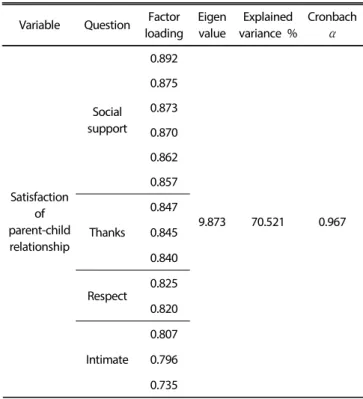
Variables of satisfaction of parent-child relationship has ei- genvalue greater than 1.0 and a factor loading of 0.50 or greater. The Table 3 shows that KMO of satisfaction of pa- rent-child relationship factor is 0.943. Furthermore, reliability of satisfaction of parent-child relationship has cronbach α greater than 0.6. Therefore, this study has enough validity and reliability estimating satisfaction of parent-child relationship.
This study assumes that neuroticism of food service em- ployees significantly affect turnover intention and, satisfaction of parent-child relationship influence on the relationship be- tween neuroticism and turnover intention. The Table 4 reveals main effects of neuroticism(adjusted R square=0.086 and F=
Table 1. Big-5 personality factor-Factor analysis and reliabi- lity analysis
Variable Question Factor loading
Eigen value
Explained variance %
Cronbach α
Neuroticism
Angry 0.906
2.840 71.011 0.864 Nervous 0.861
Excitement 0.848 Emotion 0.748
Agreeable- ness
Adventure 0.779
2.096 52.409 0.692 Insistence 0.751
Outgoing 0.716 Brave 0.642
Conscien- tious-
ness
Neat 0.822
1.954 65.145 0.732 Systematic 0.815
Cautious 0.784
Extraversion
Generous 0.782
2.699 53.977 0.785
Kind 0.774
Sympathy 0.748 Understanding 0.684 Gentle 0.680
Openness to experience
Thinking 0.813
2.236 55.903 0.731 Sharp 0.768
Introspection 0.729 Innovative 0.673
KMO=0.829, Approx-χ²=1,490.948, df=190, p=.000.
Table 2. Turnover intention-factor analysis and reliability analysis
Variable Question Factor loading
Eigen value
Explained variance %
Cronbach α
Turnover intention
Self development 0.900
2.693 67.318 0.836 Authority 0.873
Different jobs 0.773 Interesting 0.724
Turnover intention: KMO=0.768, Approx-χ²=305.995, df=6, p=.000.
Table 3. Satisfaction of parent-child relationship- Factor analysis and reliability analysis
Variable Question Factor loading
Eigen value
Explained variance %
Cronbach α
Satisfaction of parent-child relationship
Social support
0.892
9.873 70.521 0.967 0.875
0.873 0.870 0.862 0.857
Thanks
0.847 0.845 0.840
Respect
0.825 0.820
Intimate 0.807 0.796 0.735
KMO=0.943, Approx-χ²=2,723.058, df=91, p=.000.
16.494) and satisfaction of parent-child relationship (adjusted R square=0.072 and F=14.931) and, the Table 4 shows the moderating effect of satisfaction of parent-child relationship on the relationship between neuroticism and turnover inten- tion (adjusted R square=0.001, F=0.153).
This study assumes that agreeableness of food service em- ployees significantly influence on turnover intention and, sa- tisfaction of parent-child relationship influence on the relation- ship between agreeableness and turnover intention. The Table 5 shows main effects of agreeableness (adjusted R square=
0.006 and F=1.135) and satisfaction of parent-child relation- ship (adjusted R square=0.122 and F=24.435) and, the Table 5 shows the moderating effect of satisfaction of parent-child relationship on the relationship between agreeableness and turnover intention (adjusted R square=0.005 F=1.073).
This study assumes that conscientiousness of food service employees significantly influence on turnover intention and, satisfaction of parent-child relationship influence on the rela- tionship between conscientiousness and turnover intention.
The Table 6 reveals main effects of conscientiousness (adjusted R square=0.021 and F=3.717) and satisfaction of parent-child relationship (adjusted R square=0.093 and F=18.304) and, the Table 6 shows the moderating effect of satisfaction of parent-
Table 4. Neuroticism and satisfaction of parent-child relationship
1 2 3
B β B β B β
Neuroticism .293 .293 .228 .229 .229 .229
Satisfaction of parent-child relationship -.275 -.276 -.276 -.277
NeuroticisM satisfaction of parent-child relationship .024 .027
F 16.494*** 14.931*** .153
R2 .086 .072 .001
R2 .086 .158 .159
*** p<0.001.
Table 5. Agreeableness and satisfaction of parent-child relationship
1 2 3
B β B β B β
Agreeableness .080 .080 .144 .144 .141 .141
Satisfaction of parent-child relationship -.354 -.355 -.347 -.348
Agreeableness satisfaction of parent-child relationship .076 .073
F 1.135 24.435*** 1.073
R2 .006 .122 .005
R2 .006 .128 .133
*** p<0.001.
Table 6. Conscientiousness and satisfaction of parent-child relationship
1 2 3
B β B β B β
Conscientiousness -.144 -.144 -.075 -.075 -.083 -.083
Satisfaction of parent-child relationship -.311 -.312 -.312 -.313
Conscientiousness satisfaction of parent-child
relationship .067 .071
F 3.717 18.304*** .976
R2 .021 .093 .005
R2 .021 .113 .118
*** p<0.001.
child relationship on the relationship between conscientious- ness and turnover intention (adjusted R square=0.005, F=
0.976).
This study assumes that extraversion of food service em- ployees significantly affect turnover intention and, satisfaction of parent-child relationship influence on the relationship be-
tween extraversion and turnover intention. The Table 7 shows main effects of extraversion (adjusted R square=0.023 and F=
4.140) and satisfaction of parent-child relationship (adjusted R square=0.091 and F=17.897) and, the Table 7 shows the moderating effect of satisfaction of parent-child relationship on the relationship between extraversion and turnover in-
Table 7. Extraversion and satisfaction of parent-child relationship
1 2 3
B β B β B β
Extraversion -.153 -.152 -.077 -.076 -.094 -.094
Satisfaction of parent-child relationship -.309 -.310 -.305 -.306
Extraversion satisfaction of parent-child relationship .071 .070
F 4.140* 17.897*** .917
R2 .023 .091 .005
R2 .023 .114 .118
* p<0.05 *** p<0.001.
tention (adjusted R square=0.005, F=0.917).
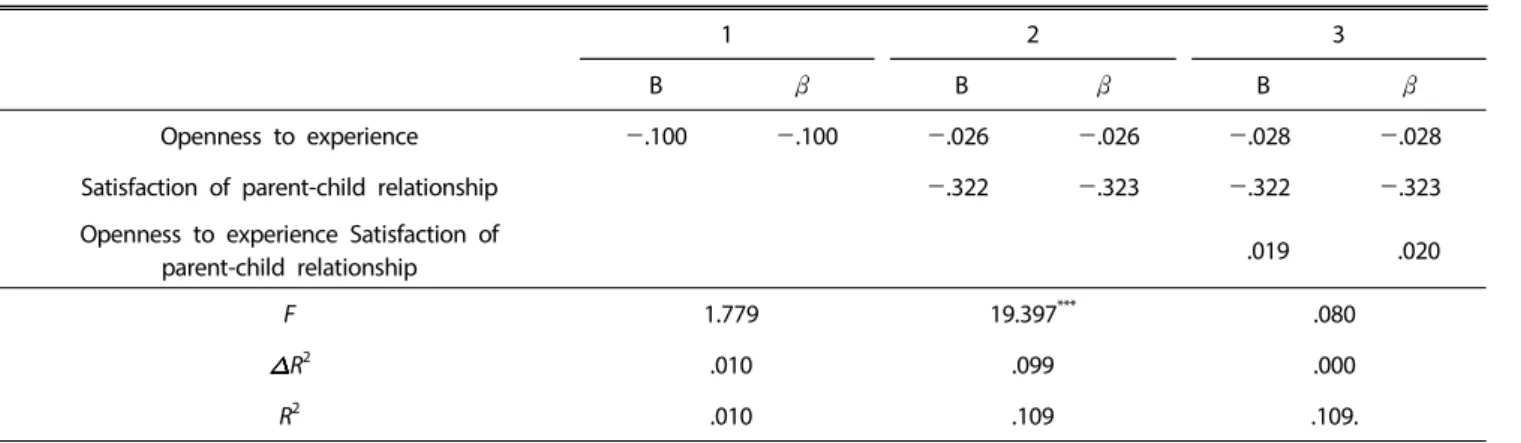
This study assumes that openness to experience of food service employees significantly influence on turnover intent- ion and, satisfaction of parent-child relationship influence on the relationship between openness to experience and turn- over intention. The Table 8 reveals main effects of openness to experience (adjusted R square=0.010 and F=1.779) and sa- tisfaction of parent-child relationship (adjusted R square=0.099 and F=19.397). However, the table 8 did not show the moder- ating effect of satisfaction of parent-child relationship on the relationship between openness to experience and turnover in- tention (adjusted R square=0.000, F=0.080).
5. CONCLUSION
This study assumes that all Big-5 personality factors of em- ployees in food service industry significantly influence on turnover intention. Satisfaction of parent-child relationship in- fluences the relationship between Big 5 personality factors
Table 8. Openness to experience and satisfaction of parent-child relationship
1 2 3
B β B β B β
Openness to experience -.100 -.100 -.026 -.026 -.028 -.028
Satisfaction of parent-child relationship -.322 -.323 -.322 -.323
Openness to experience Satisfaction of
parent-child relationship .019 .020
F 1.779 19.397*** .080
R2 .010 .099 .000
R2 .010 .109 .109.
*** p<0.001.
and turnover intention. As a result, this study shows that all Big-5 personality factors of food service employees influence turnover intention and, there are the moderating effects of the parent-child relationship on between Big-5 personality fac- tors and turnover intention. However, the moderating effects of the parent-child relationship on the relationship between openness to experience and turnover intention, while there is the main effect of parent-child relationship on turnover intention.
Given those results regarding the moderating effect of sa- tisfaction of parent-child relationship, this study shows that parent-child relationship is related to one’s personality and tendency also, openness to experience is related with in- dependence, innovation, changeable, challenge. Thus, satisfac- tion of parent-child relationship may negatively influence on relationship between openness to experience and turnover in- tention and, it provides facts that employees having openness to experience is not affected by the parent-child relationship.
With the meaningful findings, turnover intention has been
studied with working condition and organization. However, this study shows that studying relationship between person- ality factor which dealt in pedagogy and sociology and turn- over intention and, it would help future researchers to have potential studies about relationship one's personality factors and turnover intention. Moreover, parent-child relationship has been studied in pedagogy. This study shows that a good parent-child relationship which affects personality in hospital- ity management.
These findings will be helpful to human resource managers.
Based on parent-child relationship they could hire employees easily. To be specific, employees having good parent-child re- lationship have low turnover intention. Moreover, this study can apply consulting data of employees to increase job satis- faction through improved parent-child relationships. Efficient human resources management might decrease expenses.
Limitations of this study are that Big-5 personality factors do not explain essential reasons about turnover intention of employees in food service industry. Thus, future studies may use other dependent variables such as relationship with co- workers and working condition. Moreover, future studies may require other independent variables related to personality fac- tors such as Myers-Briggs Type Indicator, Holland because these show one’s personality factors. Satisfaction of parent- child relationship does not explain specific reasons about turn- over intention of employees in food service industry. Thus, fu- ture studies may use other moderating variables of romantic relationship which affect one’s personality.
REFERENCES
Ann, H. J. (2004). A meta-analysis of the variables related to parent-child communication (Master’s thesis). Department of Child Welfare and Studies The Graduate School of Sook myung Women's University.
Furman, W., & Shaffer, L. (2003). The role of romantic relation- ships in adolescent development. Adolescent Romantic Re- lations and Sexual Behavior: Theory, Research, and Practical Implications, 3-22.
Goldberg, L. R. (1990). An alternative "description of person- ality": The big-five factor structure. Journal of Personality and Social Psychology, 59(6), 1216.
Goo. J. D. (2014). A study on the relationship between servant leadership and co-worker trust, cooperation in the food service industry. Journal of Agricultural Extension & Com-
munity Development, 21(2), 57-80.
Ham, H. M. (2016). A study on job satisfactions and measures to improve the working conditions of school food service employees : Focused on Gyunggi province school food service employees. International Joual of Tourism and Hos- pitality Research, 30(2), 167-179.
Hong, D. S. (2000). Characteristics related to satisfaction and commitment of dating relationships. The Korean Journal of Social and Personality Psychology, 14(1), 223-262.
Hong, E. J., & Kim, E. J. (2015). Analysis of life satisfaction do- mains that determine the quality of parent-child relation- ships in Korea. Korea Society for Child Education, 24(4), 351-366.
Jang, C. M. (2001). The effects of stress on marital satisfaction:
Focused on marital support and conflict resolution behavior (Doctoral dissertation). Department of Educational Psycho- logy The Graduate School of Seoul Women's University.
Jeon, E. S. (2000). A study on foodservice industry employee’s job satisfaction level (Master’s thesis). Department of Tou- rism Management Graduate School of Kyonggi University.
Jeon, Y. H. (2002). A study on the education and training pro- grams of employees for the service delivery and customer satisfaction in the food service industry. Korea of Tourism Service Association, 2(1), 159-182.
Jung, H. W., Choi, E. K., & Kim, H. S. (2012). A study on the relationships among training motivation factors, employ- ees` training satisfaction, and job satisfaction in foodser- vice operations. The Korean Journal of Culinary Research, 18(5) 165-175.
Jung, J. H. (2011). Strategic human resource management.
Booknet.
Jung, K. S. (2012). A study on the effect of job stress on turnover intention of restaurant employees: Focused on the moder- ation effect of the attractiveness of alternatives (Master’s thesis). Department of Hotel, Tourism and Restaurant Ma- nagement Graduate School of Business Administration Hansung University.
Kang, K. A. (2010). The effect of participation on parents educa- tion on parental attitudes and relationship between parents and children (Master’s thesis). Department of Lifelong Education, Korea National Open University Graduate School.
Kim, H. S., Kim. M. S., & Koo, D. W. (2013). The effect of general manager's transformational leadership in hotel on food service employee's job engagement, job performance, and turnover intention. Food Service Industry Journal, 9(3),
29-43.
Kim, H. Y. (2016). The personal impact on the organization and competence of hotel cook employees: Focused on the mediating effect of trust boss. The Korean Journal of Culi- nary Research, 22(4), 170-180.
Kim, J. M. (2016). The influence of covert naricissism on roman- tic relationship satisfaction in university students : The medi- ating effect of relationship authenticity (Master’s thesis).
Department of Counselling Psychology Graduate School of Social Education, Myongji University.
Kim, J. M., & Hong, H. Y. (2016). The influence of covert narcis- sism on romantic relationship satisfaction among uni- versity students: The mediating effect of relationship authenticity. Korea Institute of Youth Facility & Environ- ment, 14(3), 37-49.
Kim, K. H. (2005). Personality & music preference - study relating big 5 of personality and sensation seeking to preference for classical music (Master's thesis). Department of musicology Graduate school of Seoul National University.
Kim, M. H. (2012). The effects of the parent-child relationships and appearance satisfaction on dating relationship satisfac- tion: the mediating role of self-esteem (Master’s thesis).
Interdisciplinary programs in Child Development & Inter- vention, The Graduate School of Ewha Womans University.
Kim, N. R. (2002). The effect of attachment on conflict manage- ment strategy in college students' romantic relationship : mediated by negative mood regulation (Master’s thesis).
Department of Psychology The Graduate School of Yonsei University.
Kim, S. Y., & Choi, N. Y. (2011). The effects of psychological separation from parents on conflict solving strategies for dating relationship and relationship satisfaction among male and female university students. Family and Environ- ment Research, 49(9), 35-45.
Kim, W. J. (2015). The effect of self efficacy and mentoring function on organizational socialization and turnover in- tention of foodservice company’s employees. Journal of Foodservice Management, 18(2), 65-83.
Lee, H. J. (2005). The effects of personality traits on job perform- ance of hotel service employees (Unpublished doctoral dis- sertation). Gachon University, Korea.
Lee, H. S. (2013). The effects of parent-child relationships on self-directed learning attitude and satisfaction of school life (Master’s thesis). Major in Counselling Education Graduate School of Education Chungnam National University.
Lee, J. H. (2017). The influence of restaurant employees' job characteristics on emotional dissonance and turnover in- tention. Korean Employment & Career Association, 7(1), 75-94.
Lee, J. J. (2000). A study on the job satisfaction of diner out company employee. The Korean Journal of Culinary Re- search 6(2), 79-95.
Lee, J., & Yoon, H. H. (2017). Effects of workplace harassment on organization commitment and turnover intention of foodservice employees: Mediating effects of burnout. Ko- rean Journal of Hospitality Administration, 26(1), 57-76.
Lee, K. I. (1994). The development of big five structure in the personality. Student Guidance Center Pusan National Uni- versity, 29(1), 39-68.
Lee, K. M., Baek, S. R., Oh, H. S., & Jeon, M. S. (2017). The relationship between the emotional exhaustion and cus- tomer orientation of service employees by the big five personality factors - Focusing on the food service industry.
Korean Journal of Human Ecology, 26(3), 227-243.
Lee, S. Y. (2010). Development and validation of a happiness scale for the Korean college students. The Korean Journal of School Psychology, 7(2), 107-122.
Lee, W. S. (2011). Effect of the character type of the hotel bakery workers on the subjective performance of the company -With a center of control effect of a sense of self-efficacy and the job stress (Doctoral dissertation). Department of Foodservice Industry Management The Graduate School of Tourism & Hospitality, Kyong gi University.
McCrae, R. R., & Costa, P. T. (1985). The NEO personality in- ventory: Manual, form S and form R. Psychological Assess- ment Resources.
Moon, H. W., & Park, M. H. (2014). The impact of organizational justice of employees on trust and turnover intention in the foodservice franchise industry: Focused on trust trans- fer theory. Journal of Foodservice Management, 17(4), 7-32.
Na, T. K., Choi, M. Y. (2011). Hotel, food service : The effects of workplace bullying on job attitude of kitchen employee in foodservice industry: Focused on the moderating ef- fects of big 5 personality. The Academy of Korea Hospitality
& Tourism, 41, 186-203.
Park, K. H. (2013). The relations between the parent-child rela- tionship, children's school life adjustment, and creative per- sonalities (Master’s thesis). Department of Education Gra- duate School, Kangwon National University.
Park, S. B. (2015). A study on the effect of HMR and attitude
and purchasing on big five-personality (Master’s thesis).
Department of Foodservice & Culinary Management Gra- duate School, Kyonggi University.
Russell, R. J., & Wells, P. A. (1994). Personality and quality of marriage. British Journal of Psychology, 85(2), 161-168.
Sim, T. Y., & Park. K. Y. (2015). The effects of intellectually dis- abled children’s participation in swimming class with pa- rents on parent-child relationship satisfaction. Korean Journal of Physical Education 54(3), 617-627.
Yu, S. C. (2016). The effect of training and reward of food service company employees on self-efficacy and turnover intention
(Master’s thesis). The Graduate School of Business Admini- strative Hansung of University.
Yun, S. Y. (2016). The Influence of personality traits (Big5) on job search behavior of tourism-related university students (Master's thesis). Department of Tourism Management Gra- duate School, Joongbu University.
Received:
Revised:
Accepted:
27 December, 2017 14 February, 2018 22 February, 2018