무인자동차 원격운행 및 모니터링을 위한 효율적인 사거리 교차로 무선랜 자동차통신망
조준모*
Efficient Crossroad Wireless LAN Vehicular Communication Network for Remote Driving and Monitoring Autonomous Vehicle
Jun-Mo Jo
*요 약
최근에 전기자동차의 상용화가 머지않은 상황에서 운전자를 위한 다양한 전자적 기능들이 개발되어지고 있 다. 특히, 뇌파(EEG)를 통하여 운전자의 상태를 모니터링하면서 졸음방지나 건강상태를 실시간으로 점검하는 기능들이 있다. 자동차 운전자의 뇌파를 의료기관 서버에 전송하여 관련 기능들을 제공할 수 있는데 이때 자 동차간 또는 자동차와 노변장치간의 원활한 통신기능이 필수적이다. 따라서 본 논문에서는 도심의 교차로환경 에서 원활한 EEG 통신기능을 제공하는 라우팅 프로토콜을 제시하기 위해 AODV, DSR, GRP, OLSR, TORA 와 같은 5가지의 라우팅 프로토콜로 운영되는 무선통신망을 각각 설계하고 이를 OPnet 네트워크 시뮬레이션 을 통하여 성능을 평가하고 결과를 제시하고자 한다.
ABSTRACT
Now a days, there are various application functions to transmit from vehicles to the Internet and vice versa. And the communication can be operated through a roadside infrastructure including with possible use of routing protocols. Specifically, autonomous vehicles for remote driving and monitoring requires transmitting of high depth of multimedia such as video. Especially in a populated urban area, an efficient network is vital because of handling a great amount of the data. Therefore, in this paper, efficient network topology for a crossroad in urban area is suggested by performance evaluation of vehicular networks using a wireless LAN and a routing protocol. For the performance evaluation, various vehicular network topologies are designed and simulated in OPNet simulator.
키워드
Wireless LAN, Routing, Vehicular Network, Autonomous Vehicle, Network Performance Analysis 무선랜, 라우팅, 자동차 네트워크, 자율자동차, 네트워크 성능분석
* 교신저자(corresponding author) : 동명대학교 전자공학과([email protected])
접수일자 : 2013. 12. 15 심사(수정)일자 : 2014. 02. 25 게재확정일자 : 2014. 03. 10
Ⅰ. Introduction
The DARPA ‘Urban Challenge’ there has been a considerable increase in the interest in the control of autonomous vehicles in the real roads in urban
area[1]. Engineering the complete vehicle requires
decisions to be made over the types of sensors to be
employed, their location, sensor data pre-processing
and process-ing, sensor fusion, map building, motion
planning, motion control, etc. [2], [3].
Also, there are domestic researches related on that subjects are under going such as head up display that supports some vital information to the drivers, and self-control systems of car[4-6].
The Controller Area Network (CAN) can be used for this application to remote control of the vehicle or monitoring. The CAN is a contention- based serial communication bus with high perfo- rmance, high speed, high reliability, and low cost for distributed real-time control applications. Incre- asing use of several CAN networks in modern industrial plants results in need for internetworking.
There are some difficulties in a traditional wired backbone is deployed to provide this type of required interconnection functions. For example, when an existing plant, in which cable laying would be quite difficult. It requires installation of new communication systems. Having a wireless backbone as an alternative in such environments to interconnect CAN networks would be exceptionally valuable[7].
In a populated urban area, an efficient network is vital because of handling a great amount of the data. So an efficient network topology is required.
In this paper, four types of wireless vehicular LAN topologies are designed and simulated in a OPNet simulator to obtain an efficient wireless vehicular network. In section II, the basic issues related to an autonomous vehicle system is discussed. In section III, basic wireless vehicular network adopted in this paper is illustrated, then the specific network topologies designed in this paper is described. Then the simulation results and evaluation is summarized in section IV. Finally, the conclusion is made in section V.
Ⅱ. Application of Autonomous Vehicle
Autonomous vehicles may very well be on our streets and highways by the end of the decade. As
of September 2013, Google had logged over 500,000 miles driven on public roadways using cars equipped with self-driving technology. California, Nevada and Florida have issued enabling auto- nomous vehicle legislation, with Washington, D.C.
and nine other states following close behind.
This new technology has the power to dra- matically change the way in which transportation systems operate. While autonomous vehicle impacts for traffic safety and congestion have been pre- dicted in some detail, potential behavioral shifts and resulting environmental impacts have received little attention[8].
There are many applications related to auto- nomous vehicles such as remote parking system developed by the Ford in this year. This company also developed an avoidance system that avoids the obstacles on the road. The company claims it can be done with the distance of 199meters from the obstacle.
Ⅲ. Wireless Vehicular LAN Topology
3.1 Wireless Vehicular LAN
VANET is an innovative technology that inco- rporates the capabilities of new generation wi- reless technology into vehicles. The edge is to provide:
(i) Continuous connectivity to mobile consumers whilst they are on the road but linked with others who are at their homes or offices and using different networks. This type of VANET arch- itecture is known as Vehicle-to-Infrastructure (V2I) communication and can be effectively integrated into heterogeneous wireless technologies such as 3G cellular systems, Long term evolution (LTE), LTE advance, IEEE 802.11, and IEEE 802.16e [9-10].
(ii) Effective wireless connection among vehicles
without logging on to any fixed sub structured
technologies which is called Vehicle-to-Vehicle (V2V) communication.
Fig. 1 The facilities of VANETs technology[11]
Many routing protocols have been devised for MANETs and a few of them can be integrated into VANETs. Nevertheless, the results of this inte- gration showed that the performance is not ove- rwhelming because of the high speed of vehicles which caused high topology changes are dissimilar to MANETs[11]. This concept provided in this paper is basically related to the VANET based on the MANET. However, the various routing protocols will not be applied in this simulation but only the AODV will be applied for comparing with the basic wireless LAN through the various topologies.
3.2 Wireless Vehicular LAN Topology
Four types of wireless vehicular LAN topologies are designed and simulated. For the details of network topologies are explained as follows. Every node is considered as a mobile node on the road. A node such as the ‘mobile_node_3’ is actually a LAN device installed with an Ad-Hoc routing features.
The LAN device has a transmit power of 0.005W, packet reception-power threshold of –95dBm, AP Beacon interval of 0.02secs with 256,000bits of buffer size. Every topology has the same amount of vehicles but has different numbers of the roadside infrastructures. The four topologies are as follows:
‘eight road side many’, ‘four road side many’, ‘one
road side many’, and ‘one road side many routing’.
The specification set in the four topologies are exactly the same except the first 3 topologies do not use any routing protocols but the last one has a AODV.
Each topology is designed as a round trip 2 lanes crossroad in urban area and there are 4 groups of vehicles in a row driving through the crossroad. Every vehicles has the same speed.
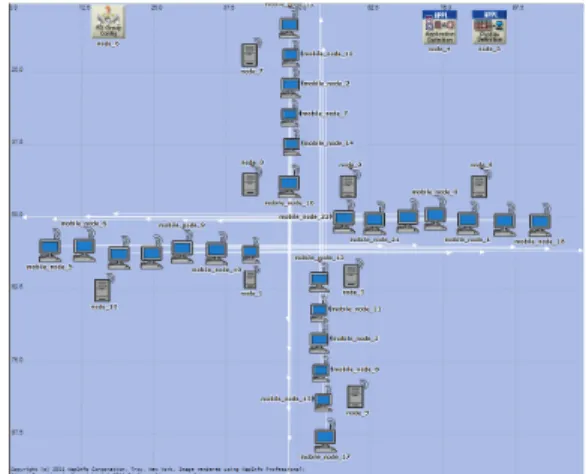
For example, The Fig. 2 shows the ‘eight road side many’ topology. The ‘mobile_node_16’ shown in Fig. 2 is a vehicle heading to the crossroad, and the ‘node_0’ is a fixed roadside infrastructure. All the vehicles in the same vertical line along with the ‘mobile_node_16’ are meant to transmit to either
‘node_0’ or ‘node_7’ since other roadside infras- tructures are out of the network range.
Fig. 2 A topology of wireless vehicular LAN
Each vehicles transmits of the video data approximately 1,500,000bits/sec for various appli- cation functions such as remote driving or monitoring.
IV. Simulation Result and Analysis
The four network topologies explained in the
previous chapter are designed and simulated in the
OPNet simulator for a performance evaluation.
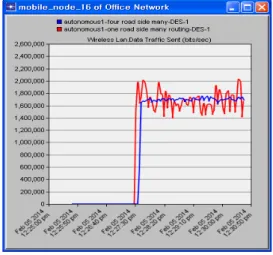
The traffic sent from the ‘mobile_node_16’ is shown in Fig. 3. We can verify the data difference between the ‘four road side many’ and the ‘one road side many routing’. The ‘one road side many routing’ has little bit of fluctuation but it shows the almost same level of the ‘four road side many’.
Fig. 3 Data traffic sent from nodes
The Fig. 4 shows the data drop for global performance. There are two elements to drop data transmission. One is buffer overflow and the other is threshold excess.
Fig. 4 Data dropped by buffer overflow and threshold excess
There is big difference between ‘four road side many’ and ‘one road side many’ in data drop shown in Fig. 5. The reason is that the ‘one road side many’ topology did not have chance to transmit data through the road side before passing through the road infrastructure. So there is a great data dropping is taking place. We can also verify with the graphs shown in Fig. 6 that the ‘four road side many’ has great retransmission of data.
Fig. 5 Comparison of data dropped
Fig. 6 Retransmission attemps
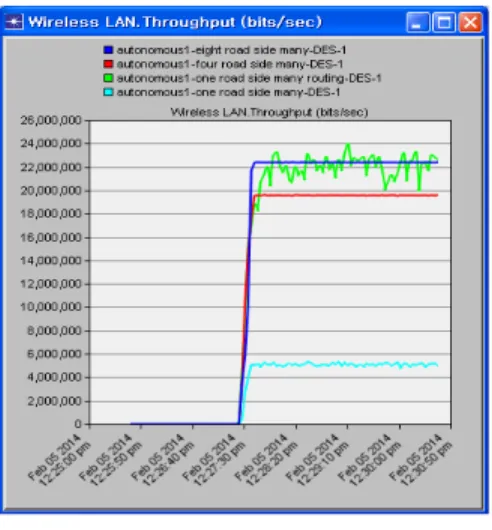
The comparison of the global throughput is
shown in Fig.7. It is obvious that the more of the
roadside infrastructure the better the throughput.
However, the vehicular inter communication using routing protocol is a great benefit to improve the network performance. The result of ‘one road side many’ is located between the ‘eight road side many’ and ‘four road side many’.
Fig. 7 Comparison of throughput
The comparison of the global delay is shown in Fig.8. The delay result of ‘eight road side many’
and ‘four road side many’ are fairly good. Even though the good throughput of the ‘one road side
Fig. 8 Comparison of delay
many’ shown in Fig. 8, there is a disadvantage has delay problem. However, the delay will not affect too much degradations on the network performance since it showed the high rate of the global throughput. So, we can conclude that the delay is fairly acceptable for reducing the costs of installing roadside facilities.
Therefore, for the main conclusion, the wireless vehicular LAN using routing protocol in the crossroad has a great benefit on the network performance to reduce the numbers of the roadside infrastructure.
V. Conclusion
Autonomous vehicles for remote driving and monitoring requires transmitting of high depth of multimedia. Especially, the populated urban area requires an efficient network topology and perf- ormance is vital. To gain the efficient network, four types of wireless vehicular LAN topologies have been designed and simulated. As we expected, the ‘eight road side many’ has the best result because of the many numbers of road side infrastructure, however, with few numbers of the road side infrastructure the ‘one road side many routing’ showed a great performance just installing a routing protocol. There was some amount of the delay, but overall performance was satisfied.
For the further study, the suggested topology in this paper with various routing protocols will be designed and simulated for examining superior routing protocol.
Reference
[1] M. Buehler, K. Iagnemma, and S. Singh, “The
Darpa Urban Challenge: AutonomousVehicles
in City Traffic,” Springer-Verlag, Berlin, Hei-
delberg, 2009.
[2] S.-S. Ge and F.-L. Lewis, Autonomous Mobile Robots, Sensing: Control, Decision Making and Applications. CRC Press, 2006.
[3] M. Montemerlo, J. Becker, S. Bhat, H.
Dahlkamp, D. Dolgov, S. Ettinger, D. Haehnel, T. Hilden, G. Hoffmann, B. Huhnke, D. John- ston, S. Klumpp, D. Langer, A. Levandowski, J. Levinson, J. Marcil, D. Orenstein, J. Paefgen, I. Penny, A. Petrovskaya, M. Pflueger, G.
Stanek, D. Stavens, A. Vogt, and S. Thrun,
“The Stanfordentry in the urban challenge,” J.
Field Rob., 25, 2008, pp. 569–597.
[4] S.-H. Yun, H.-B. Son, and Y.-C. Rhee, “A Study of Head Up Display System for Next Generation Vehicle,” J. of The Korea Institute of Electronic Communication Sciences, vol. 6, no. 3, pp. 439–444.
[5] J.-G. Park, J.-D. Choi, and Y.-C. Bae,
“Scientometric Analysis of Autonomous Ve- hicle through Paper Analysis of each Nation,”
J. of The Korea Institute of Electronic Commu- nication Sciences, 2013, pp. 321-328.
[6] K.-S. Kim, G.-C. Kim, and J. Lee, “Embedded Linux System for Self-Control System of Car,”
J. of The Korea Institute of Electronic Commu- nication Sciences, vol. 2, no. 1, pp. 62-66, 2007.
[7] G. Cena, A. Valenzano, and S. Vitturi, “Adva- nces in automotive digital communications,”
Computer Standards & Interfaces, pp. 665–678, 2005.
[8] D.-J. Fagnant and K.-M. Kockelman, “The travel and environmental implications of sha- red autonomous vehicles, using agent based model scenarios,” Transportation Research Part C, 1-13, 2014.
[9] I. Akyildiz, D. Gutierrez-Estevez, and E. C.
Reyes, “The evolution to 4G cellular systems:
LTE Advanced,” Physical Communication, vol.
3, pp. 217-244, 2010.
[10] Z.-T. Sharef, A. E. Alaradi, and B.-T. Sharef,
“Performance Evaluation for WiMAX 802.16e OFDMA Physical layer,” In Computational Inte- lligence, Communication Systems and Networks (CICSyN), Fourth International Conf. on, 2012, pp. 351-355.
[11] B.-T. Sharefa, R. A. Alsaqour, and M. Ismail
“Comparative Study of Variant Position-Based VANET Routing Protocols,” Procedia Technology
11, Elsevier, 2013, pp. 532–539.
저자 소개
조준모(Jun-Mo Jo)