효율적인 EEG 전송을 위한 센서노드기반의 무선통신시스템에 관한 연구
조준모*
A Study on the Sensor Node Based Wireless Network Communication System for Efficient EEG Transmission
Jun-Mo Jo
*요 약
뇌파 건강관리 시스템의 태동은 산업과 연구분야에서 요즘 중요한 쟁점으로 여겨지고 있다. 실시간으로 간 질병이나 뇌경색의 환자들의 의료응급서비스를 지원하기 위해서는 EEG신호 감지가 필수적이다. 이러한 시스 템을 위하여 효과적인 네트워크를 지원하는 것이 필수적이기 때문에 센서노드 기반의 무선통신 토폴로지를 제안하며 시뮬레이트한다. 마지막으로 이러한 네트워크의 효과적인 토폴로지를 위하여 옵넷 시뮬레이터의 결 과를 평가한다.
ABSTRACT
Advent of the brain wave health care system is considered as an important issues in the industrial and research area in these days. It is necessary to detect EEG signals in real-time in order to support the medical emergency service for the epileptic or braininfarct patients. Since the efficient network support is an essential factor for the system, several topologies using sensor node based wireless body area network is suggested and simulated in this paper. Finally the Opnet simulation result is evaluated for the efficient topology of the body area network.
키워드
EEG, Brain Wave Transmission, Sensor Network, Network Performance Analysis EEG, 뇌파전송, 센서네트워크, 네트워크성능분석
* 동명대학교 공과대학 전자공학과([email protected])
접수일자 : 2013. 04. 05 심사(수정)일자 : 2013. 04. 25 게재확정일자 : 2013. 05. 20
Ⅰ. Introduction
To reduce the healthcare cost, it is a necessary to deploy self organized, brain wave monitoring system. Telemedicine platform based on body area network interconnection of tiny EEG sensors is called a medical ad hoc sensor network. It can provide a promising approach for performing
low-cost, real-time, remote cardiac patient monitoring at any time[1].
This minimizes the need for medical workers
and helps the chronically ill and elderly to survive
an independent life. Although having significant
benefits, the area has still major challenges. The
efficiency of the sensor networks that transmits
EEG signals from patients to the server located in
the medical center is an important factor for emergencies. Wireless body-area network (WBAN) is a special purpose wireless-sensor network that incorporates different networks and wireless devices to enable remote monitoring for various environments. One of the targeted applications of WBAN is in medical environments where con- ditions of a large number of patients are continuously being monitored in real-time. Wireless monitoring of physiological signals of a large number of patients is one of the current needs in order to deploy a complete wireless sensor network in healthcare system. Such an application presents some challenges in both software and hardware designs. A sensor based wireless body area medical network system when implemented in medical centers has significant advantages over the traditional wired-based patient-data collection schemes by providing better rehabilitation and improved patient’s quality of life. In addition aWBAN system has the potential to reduce the healthcare cost as well as the workload of medical professions, resulting in higher efficiency. There is already a number of monitoring systems developed or being used in medical centers. The available medical monitoring systems are generally bulky and thus uncomfortable to be carried by patients. Most of the current effort has mainly been focused on the devices that are monitoring one or few physiological signals only. When multiple sensors are involved, wires are used to connect the sensors to a wearable wireless transmitter. Wired systems restrict patients’ mobility and comfort level, especially during sleep studies. Future implementation of medical monitoring necessitates the use of small, low-power sensor nodes with wireless capability[2].
Especially, the wireless network technology for this area is important and some researches are underway such as a pulse measurement system using optical sensor, an improved message
broadcast over wireless sensor networks, and an efficient computation of node position on mobile sensor network[3-5].
In this paper, the various sensor node based body area network topologies are provided and simulated with Opnet simulator to obtain an efficient network.
In section II, the basic issues related to the EEG and sensor node based body area network are described. Then in section III, the suggested various body area networks consists of sensor nodes are described. Then the simulation results and evaluation is summarized in section IV. Finally, the conclusion is described in section V.
Ⅱ. Wireless Medical Sensor Network
An application-dependent characteristic of a WSN is the type of data traffic generated by the nodes. The model that represents the aggregate packet traffic in the network or a cluster of the network can be used to determine the maximum stable throughput, expected delay and the packet loss characteristics. Furthermore, the effects of parameters such as node density and target velocity can be investigated in depth once an appropriate data traffic model is available. When communication protocols are developed without taking into account the properties of the data traffic, they may behave inefficiently[6].
For improving the quality of life, wireless sensor network technologies are considered as one of the key research areas in wireless network communication and healthcare application industries.
The pervasive wireless healthcare systems provide rich contextual information and alerting mechanisms against odd conditions of patients in hospitals[7].
The overview of a simple wireless sensor network application scenario is depicted in Fig. 1.
Based on this observation, in a typical scenario,
there are four different categories of actors other than the power users of the systems such as administrators and developers[7].
Fig. 1 Overview of a simple WSN application scenario for healthcare[7]
Wireless modules find a great field of appli- cations. Such applications are those found in wireless sensors networks, whose methodology is to acquire data from sensors through wireless modules, temporarily store the data, and send it by radio-frequency to an external station for further processing. RF modules have been used with success in the monitoring of human-body information, where the biomedical data of individuals is wirelessly transmitted to a central processing unit[8].
Ⅲ. Topology of the EEG Sensor Body Area Network
3.1 EEG Signal
So if there are the more patients, the more traffic latencies would be expected. The collected EEG signals from each sensor node transfers to the server located in the center through the adjacent nodes. As soon as the server gets the signals from the node, it examines the EEG for the odd symptoms in real time.
The electrical activity of the brain can be described in spatial scales from the currents within a single dendritic spine to the relatively gross
potentials. Neurons or nerve cells, are electrically active cells that are primarily responsible for carrying out the brain's functions. Neurons create action potentials, which are discrete electrical signals that travel down axons and cause the release of chemical neuro-transmitters at the synapse, which is an area of near contact between two neurons. This neurotransmitter then activates a receptor in the dendrite or body of the neuron that is on the other side of the synapse, the post-synaptic neuron. The neurotransmitter, when combined with the receptor, typically causes an electrical current within the dendrite or body of the post-synaptic neuron. Thousands of post-synaptic currents from a single neuron's dendrites and body then sum up to cause the neuron to generate an action potential. This neuron then synapses on other neurons, and so on[9].
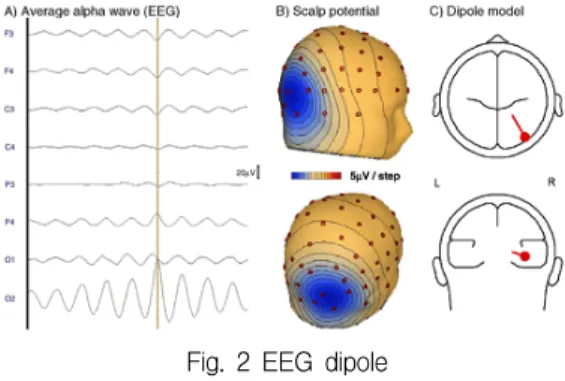
Fig. 2 EEG dipole
Fig. 2 shows an example of average alpha wave peak using a software BESA.(A) shows that an event triggered average of the EEG signal centered on the negative peaks of alpha waves that exceeded a threshold of –50µV in channel O2 for this typical subject and experiment. Generally, there are 63 channels but shows just 8 channels. (B) shows EEG scalp potential maps corresponding to the averaged alpha wave peak marked in (A).
Picture (C) shows that fitting the model of a single
current dipole (dot with arrow) to the EEG data[9].
3.2 Sensor Based Body Area Network Top- ology
The suggested sensor based body area network topology is shown as Fig. 3. For example, the
‘mobile_node_4’ is considered as a patient and it has mobility to transmit EEG signals to the server(mobile_node_0) through the adjacent mobile sensor nodes or the fixed router such as ‘node_0’.
There are four sections considered as four areas in a medical center or a hospital. In this topology, a patient in a specific section does not migrate to other sections. So each patient stays in their section but continuously and randomly moves around. The Opnet simulator supports the random mobility shown as the Fig. 3.
Fig. 3 A Topology of sensor based Body Area Network
The simulation topologies are categorized with the various number of sensor nodes and fixed routers. In this paper, three categorized topologies are designed and simulated such as node_few _router_4, node_mid_router_4, and node_many_
router_4. For instance, the node_few_router_4 means the topology is composed of few numbers of mobile nodes with 4 of routers and so on. Every topology has exact 4 routers.
IV. Simulation Result and Analysis
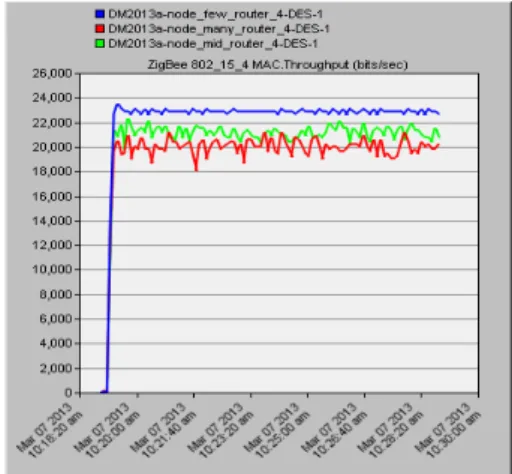
For the performance evaluation, the three topologies are simulated and analyzed as shown in Fig. 4. The ranges of the sensor node to the router is fairly enough to transmit the EEG signals. The packet reception power threshold is set to –85dBm since the packets with a power less than the threshold are not sensed and decoded by the receiver. Hence, such packets don not change the receiver's status to busy and they are not detected by the 802.15.4 MAC through its physical sensing mechanism. The status of such packets are set to noise and so they cause interference and possibly bit errors if they collide with valid packets at the receiver.
The packets whose received power is higher than threshold are considered as valid packets.
They are sensed by the MAC and they can be received successfully unless they get bit errors due to interference, background noise and/or colliding with other valid packets.
The transmission bands are set to 2450MHz for the nodes located in the topology. We might consider for a topology that has too many sensors degrading the performance of the network.
Therefore, as shown in Fig. 4, many nodes degrade the performance of the network.
Fig. 4 Comparison of router throughput
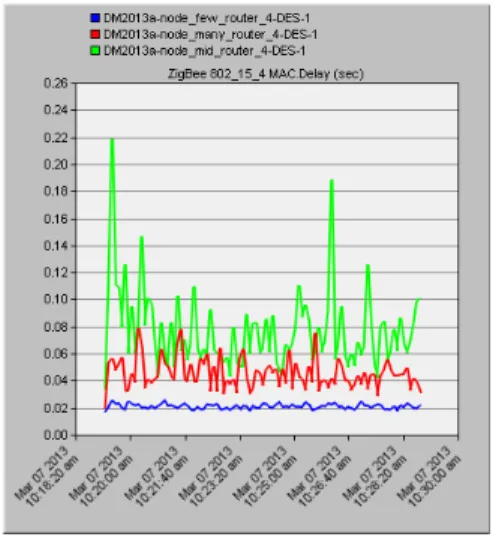
The comparison of router delay is shown in Fig.
5. Unlike the case of the throughput, the node_mid_router_4 topology showed the worst delay performance. The reason of this is because of the adjacent sensor nodes which helps to propagate the EEG signals through the network. So to speak, in the node_mid_router_4, there are not enough sensor nodes to help propagating EEG signals and still have much to send EEG signals. But in the node_many_router_4 topology, there are more EEG signals to send, but many adjacent nodes supports to propagate the data to the server.
Fig. 5 Comparison of router delay
V. Conclusion
The sensor network is known as an efficient and economical technology in the ubiquitous era.
Especially, for the medical industry, it is intriguing aspects to adopt the technology. So the sensor node adopted wireless body area network is an important trend these days and the network efficiency is important as well. Therefore in this paper, several network topologies are designed and simulated. The sensor nodes placed in the topologies transmits the brain wave(EEG) to the server located in a medical
center. The EEG has specific characteristics and it affects to the network performance. The simulation result is as follows. In the suggested network and specific EEG communication fashion, I have verified that the numbers of the sensor node degrades the performance of the network with the throughput.
However, the midium numbers of sensor node topology showed the worst delay performance. The reason is the adjacent sensor nodes helps to propagate the EEG signals through the network.
Threfore, the numbers of the sensor node do not always increase in proportion to the degradation.
For the further study, the topology designed for a globally inter-connected medical centers is needed to be simulated for the network performance.
감사의 글
“This Research was supported by the Tongmyong University Research Grants 2012”
Reference
[1] Fei Hu, Meng Jiang, Laura Celentano, Yang Xiao, “Robust medical ad hoc sensor networks (MASN) with wavelet-based ECG data mi- ning”, Ad hoc networks 6, Elsevier, pp.
986-1012, 2008
[2] Mehmet R. Yuce, “Implementation of wireless body area networks for healthcare systems”, Sensors and Actuators, Elsevier, pp. 116-129, 2010
[3] Sung-Hwan Bae, Ik-Hyun Lim, “A Study on 3G Networked Pulse Measurement System Using Optical Sensor”, The Journal of the Korea Institute of Electronic Communication Sciences, Vol. 7, No. 6, pp. 1555-1560, 2012.
[4] Kwan-woong Kim, et al., "An Improved Message Broadcast Scheme over Wireless Sensor Networks", The Journal of the Korea Institute of Electronic Communication Sciences, Vol. 5, No. 6, pp. 588-594, 2010.
[5] Na-yeon Park, Cheol-su Son, Won-jung Kim,
"The Efficient Computation of Node Position on Mobile Sensor Network", The Journal of the Korea Institute of Electronic Commu- nication Sciences, Vol. 5, No. 4, pp. 391-398, 2010.
[6] Ilker Demirkol, Cem Ersoy, Fatih Alagoz, Hakan Delic, “The impact of a realistic packet traffic model on the performance of surv- eillance wireless sensor networks”, Computer Networks 53, pp. 382-399, 2009
[7] Hande Alemdar, Cem Ersoy, “Wireless sensor networks for healthcare : A survey”, Computer Networks, Elsevier, pp. 2688-2710, 2010
[8] Nuno Sergio Diasa,b, Joao Paulo Carmoc, Paulo Mateus Mendesc, Jose Higino Correiac,
“Wireless instrumentation system based on dry electrodes for acquiring EEG signals”, Medical Engineering & Physics 34, pp.
972-981, 2012
[9] http://en.wikipedia.org/wiki/Brainwave
Author
조준모(Jun-Mo Jo)