167
고혈압 환자의 혈압강하제 처방양상 - 외래 처방전을 중심으로 -
성예나1·장선미1·임도희3·신숙연1·송현종1·이숙향2
1건강보험심사평가원, 2숙명여자대학교 임상약학대학원, 3숙명여자대학교 통계학과
(2009년 10월 20일 접수·2009년 12월 10일 수정·2009년 12월 20일 승인)
Prescribing Patterns of Antihypertensive Drugs by Outpatients with Hypertension in 2007
Yena Sung
1, Sunmee Jang
1, Dohee Lim
2, Suk-youn Shin
1, Hyun-Jong Song
1, and Sukhyang Lee
21Health Insurance Review and Assessment Service,
2Graduate School of Clinical Pharmacy, Sookmyung Women's University,
3College of Mathematics and Statistics, Sookmyung Women's University (Received October 20, 2009·Revised December 10, 2009·Accepted December 20, 2009)
Hypertension is one of the most common chronic diseases and it causes cardiovascular and cerebrovascular disease.
While antihypertensive drug use increased, it took 15% of national health insurance drug expenditure. This study aimed to examine the pattern of antihypertensive drug prescription using National Health Insurance claims database and com- pare it with recommendations of Korea Hypertension Treatment Guidelines. Among the antihypertensive drugs, cal- cium channel blocker(64.4%) was most commonly prescribed class, and diuretics(44.6%), angiotensin II receptor blocker(33.3%), angiotensin converting enzyme inhibitor(11.7%) was followed. Approximately 81% of antihyperten- sives prescription were without cardiovascular or cerebrovascular disease, and among the comorbid conditions, diabe- tes(10.7%) was most common. calcium channel blocker(62.3%) was mostly prescribed class for hypertension with angina pectoris, angiotensin receptor blocker(45.3%) with myocardial infarction, diuretics(70.2%) and calcium channel blocker(49.5%) with congestive heart failure. For Hypertension with cerebrovascular disease, calcium channel blocker(68.0%) and angiotensin receptor blocker(43.3%) were prescribed mainly. When it comes to diabetes, calcium channel blocker(57.2%) was still mostly prescribed and angiotensin receptor blocker(45.9%) followed. But in hospitals and tertiary hospitals, angiotensin receptor blocker(65.7, 66.1%) was mostly prescribed for the patients with diabetes.
For Hypertension with chronic renal disease, angiotensin receptor blocker(59.5%), calcium channel blocker(56.5%), diuretics(54.6%) were mainly used. Average number of classes per prescribing was 1.89±0.89 class, average days per prescribing was 33±19 day. Among the hypertension without comorbidity, 40.5% of prescription was monotherapy and 58.8% of polytherapy included diuretics. Among the outpatient prescriptions, calcium channel blocker was the most commonly used class, and the prescription pattern in clinic did not closely followed recommendations of Hypertension Treatment Guidelines.
□ Key words - Hypertension, Antihypertensive medication, Prescribing pattern
고혈압은 유병률이 높은 대표적인 만성질환의 하나이다.
2005년 기준으로 우리나라 20세 이상 성인의 고혈압 유병률 은 23.9%에 이르고 있으며1)인구노령화가 진행됨에 따라 고
혈압 환자는 계속 증가하고 있다2). 이에 따라 고혈압을 주상 병 또는 부상병으로 하여 의료서비스를 이용하는 환자수도 늘어나고 있으며3)혈압강하제 처방도 급격히 증가하고 있다.
2007년 건강보험 약품비 중 혈압강하제가 차지하는 비중은 15%정도로서 항생제와 (15.3%)에 이어 두 번째로 큰 비중을 차지하는 약제이다.4)
고혈압은 유병상태에 있을 때에는 증상이 없고 생활에 별 다른 지장을 주지 않는다고 한다. 하지만 장기간 혈압 관리 가 제대로 되지 않았을 때는 뇌혈관질환, 허혈성심장질환,
Correspondence to : 장선미
건강보험심사평가원 심사평가정책연구소 서울특별시 서초구 서초3동 1451-34 서초평화빌딩 9층
Tel: +82-2-2182-2561, Fax: +82-2-585-6918
E-mail: [email protected]
신장질환 등과 같은 심각한 질병으로 발전할 수 있다. 이 때 문에 주요 고혈압 관리지침에서는 식이요법, 운동요법, 약물 요법 등 여러 가지 방법을 병행하여 평소에 적극적으로 혈 압을 관리하도록 권고하고 있다. 특히 식이요법과 운동요법 만으로 혈압이 잘 조절되지 않는 경우에는 빠른 시일내에 적절한 혈압강하제를 투여하도록 제안하고 있다.5,6,7,8,9) 그러 나 혈압강하제를 복용하는 환자중에서도 상당수가 혈압 조절 에 어려움을 겪는 것으로 알려져 있다. 혈압 조절이 어려운 이유는 환자의 특성 및 동반 질병, 복약순응도 등 여러 가지 가 있을 수 있으며 대책 또한 다양하게 제시될 수 있다. 하 지만 먼저 가장 효과적인 혈압관리 방법으로 알려진 혈압강 하제의 처방양상을 다각도로 파악하고, 환자 특성과 동반 질 병 등을 고려할 때 효과적인 혈압강하제가 처방되고 있는지 에 대해 우선적으로 살펴볼 필요가 있다. 이에 본 연구는 전 국민 대표성을 갖는 건강보험청구자료를 이용하여 외래에서 의 혈압강하제 약제처방을 의료기관의 종류 및 동반질병에 따라 체계적으로 파악하기 위한 목적으로 수행되었다. 또한 실제 임상에서의 혈압강하제 처방이「2004년도 우리나라 고 혈압 진료지침」5)의 내용과 어느 정도 부합되는지에 대해서 도 살펴보았다.
연구방법
분석대상
최근의 혈압강하제 처방양상을 분석하기 위해 건강보험심 사청구데이터를 이용하여 2007년도에 발행된 원외처방전을 분석대상으로 선정하였다. 우선 2007년에 의료기관에서 발행 된 전체 원외처방전 437,761,162건 중 1%를 임의표본추출 (random selection)한 후, 다시 만 18세 이상 성인에게 혈압
강하제가 처방된 처방전만을 골라내었고, 이 중에서 상병테 이블에 고혈압(I10-I13, I15) 코드가 없는 처방전은 분석에서 제외하였다. 최종적으로 분석에 포함된 원외처방전은 445,854건이었다 (Fig. 1).
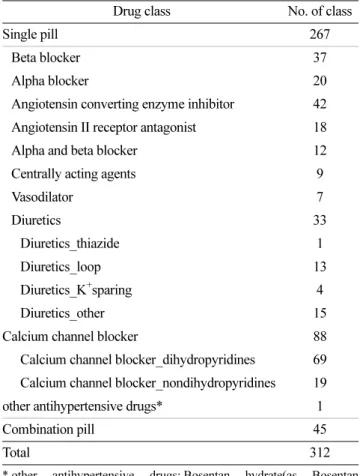
분석대상 혈압강하제는 2008년 1월 1일 기준으로 건강보 험에 등재된 모든 성분 중에서 혈압강하 효과를 갖는 312개 성분이다. 이들을 전문가 자문회의를 거쳐 약리작용 기전에 따라 14개 성분군으로 분류하였다 (Table 1).
또한 혈압강하제는 동반 질병에 따라 달라질 수 있으므로 혈압강하제 선택에 영향을 미치는 심뇌혈관계 질환과 신질환, 당뇨 등의 동반상병을 가지고 있는지에 대해서도 파악하였다.
동반 질병 유무는 처방전이 발행된 해당 명세서에 주진단명 으로 해당 질병코드가 기입되어 있으면 해당 질병이 있다고 정의하였으며, 해당 KCD 코드는 Table 2에 제시된 바와 같 다 (Table 2).
분석방법
특정시점에서 고혈압 유병자에게 처방된 혈압강하제의 종 류와 다제병용 양상 등을 파악하기 위해 2007년 발행된 원 외처방전을 의료기관 종별로 구분하여 단면 분석을 실시하였 다. 또한 실제 처방양상이 「2004년도 우리나라 고혈압 진료 Table 1. Therapeutic classes of antihypertensive drugs
Drug class No. of class
Single pill 267
Beta blocker 37
Alpha blocker 20
Angiotensin converting enzyme inhibitor 42 Angiotensin II receptor antagonist 18
Alpha and beta blocker 12
Centrally acting agents 9
Vasodilator 7
Diuretics 33
Diuretics_thiazide 1
Diuretics_loop 13
Diuretics_K+sparing 4
Diuretics_other 15
Calcium channel blocker 88
Calcium channel blocker_dihydropyridines 69 Calcium channel blocker_nondihydropyridines 19 other antihypertensive drugs* 1
Combination pill 45
Total 312
* other antihypertensive drugs: Bosentan hydrate(as Bosentan 62.5 mg).
Fig. 1. Identification of study sample
지침」5)에서의 처방 권고사항과 어떤 차이가 있는지를 비교, 분석하였다. 대한고혈압학회의 진료지침에서는 동반질병이 없는 경우 55세를 기준으로 55세 미만과 55세 이상의 연령 군에서 각기 다른 혈압강하제를 추천하며, 동반질병이 있는 경우에는 동반질병에 따른 추천 혈압강하제를 제시하고 있다 (Fig. 2, Table 3).
모든 분석결과는 종합전문병원, 종합병원, 병원, 의원의 4 가지 종별로 제시하여 의료기관 종별로도 처방양상을 비교할 수 있도록 하였다.
본 분석에서는 혈압강하 효과를 가진 두 가지 성분이 하 나의 제품에 담겨있는 복합제의 경우, 복합제의 두 가지 성 분을 각각 하나의 성분으로 인정하여 분석하였고, 이 때문에 복합제의 처방분률은 나타내지 않았다. 처방분률은 퍼센트 (%)로, 성분수와 처방일수는 평균±표준편차로 결과값을 표기 하였고, 의료기관 종별로 평균 성분수의 차이가 통계적으로 Fig. 2. Choosing hypertension drugs for patients without
comorbidity
* Source: The Korean Society of Hypertension,「Practice Guideline for Hypertension in Korea, 2004 」
Table 3. Drug recommendation with compelling indication *(Korea Society of Hypertension)
Compelling indication Diuretics BB ACE inhibitor ARB CCB Aldosteroneantagonist AB
Systolic hypertension in elderly 0 0(DHP)
Heart failure 0 0 0 0 0
Post MI 0 0 0
Coronary artery disease 0 0 0 (nonDHP)
Nephropathy 0 (type1) 0 (type2)
Chronic renal disease 0 (loop) 0 0
Stroke 0 0
Atherosclerosis 0(DHP)
Prostatic hypertrophy 0
ACE inhibitor: Angiotensin converting enzyme inhibitor, ARB: Angiotensin II receptor blocker , AB: Alpha Blocker, BB: Beta Blocker, CCB: Calcium channel blocker
*Source: The Korean Society of Hypertension, 「2004 Korean Hypertension Treatment Guidelines」 , 2004
Table 2. Diagnostic indicators for comorbidity identificationComorbidity KCD-5 code
Angina pectoris I20.x
Myocardial infarction(post)† I21.x, I22.x , I25.2, I23.x Left ventricular hypertrophy I51.7
Congestive heart failure I11.0, I13.0, I13.2, I42, I42.0-42.5, I42.8, I42.9, I50.x Ischemic heart disease I24.x, I25.x
Cerebrovascular disease I60.x, I61.x, I62.x, I63.x, I64.x, I65.x, I66.x, I67.x, I69.x
Peripheral arterial disease I70.x, I71.x, I73.1, I73.8, I73.9, I77.1, I79.0, I79.2, K55.1, K55.8, K55.9, Z95.8, Z95.9
Chronic renal disease I12.0, I13.1, N03.2-N03.7, N05.2-N05.7, N18, N19, N25.0, Z49.0-Z49.2, Z94.0, Z99.2, I12, I12.9
Diabetes mellitus
E10, E11, E12, E13, E14, E10.0, E10.1, E10.6, E10.8, E10.9, E11.0, E11.1, E11.6, E11.8, E11.9, E12.0, E12.1, E12.6, E12.8, E12.9, E13.0, E13.1, E13.6, E13.8, E13.9, E14.0, E14.1, E14.6, E14.8, E14.9, E10.2, E10.3, E10.4, E10.5, E10.7, E11.2, E11.3, E11.4, E11.5, E11.7, E12.2, E12.3, E12.4, E12.5, E12.7, E13.2, E13.3, E13.4, E13.5, E13.7, E14.2, E14.3, E14.4, E14.5, E14.7
Above KCD-5 code were used to identify the comorbidity.
In case all the 4 digit sub-code were included, we substitute it with 3digit code with ‘.x’ (e.g., I21.x included I21.0, I21.1, I21.2, I21.3, I21.4, I21.9)
†
Both myocardial infarction and post myocardial infarction were included.
유의한지를 검증하기 위하여 ANOVA분석을 시행하였다. 통 계 프로그램은 SAS 9.1을 이용하였다.
연구결과
일반적 특성
혈압강하제가 포함된 분석 대상 원외처방전을 받은 고혈압 환자의 평균 연령은 약 62±12세였으며, 의료기관 종별 간에 평균연령은 유사하였다. 65세 이상 노인에게 발행된 처방전
이 차지하는 비중은 모든 의료기관 종별에서 약 45% 정도 였다. 45세 미만은 의원과 병원에서 7%내외였으나 종합전문 병원은 약 9%에 이르러 상대적으로 젊은 고혈압 환자가 종 합전문병원에서 더 많이 혈압강하제를 처방 받는 것으로 나 타났다. 의료보장형태는 의료보호에 해당하는 처방건수가 전 체의 9% 정도였으며, 처방전이 발행된 의료기관의 소재지는 농촌이 16.1%, 도시가 83.9%를 차지하였다. 원외처방전 중 심뇌혈관계 등의 동반질병이 없는 고혈압은 전체적으로 약 81%였으나 의료기관종별로 차이가 컸다. 의원에서는 86.2%
Table 4. General characteristics of study sample (unit: N, %) Characteristics All Tertiary hospital Secondary hospital Hospital Clinic
n % n % n % n % n %
Gender
Male 189,145 42.42 13,804 49.74 22,083 47.40 11,198 45.00 142,060 40.98 Female 256,709 57.58 13,951 50.26 24,505 52.60 13,689 55.00 204,564 59.02 Age, average 62.25±11.93 61.48±12.39 62.62±12.26 62.67±12.47 62.23±11.80 Age, group
18~34 4,350 0.98 772 2.78 702 1.51 245 0.98 2,631 0.76
35~44 26,921 6.04 1,681 6.06 2,794 6.00 1,524 6.12 20,922 6.04
45~54 91,517 20.53 5,232 18.85 8,465 18.17 5,208 20.93 72,612 20.95 55~64 118,897 26.67 7,522 27.10 12,829 27.54 6,493 26.09 92,053 26.56 65~74 134,485 30.16 8,790 31.67 13,681 29.37 6,717 26.99 105,297 30.38
≥75 69,684 15.63 3,758 13.54 8,117 17.42 4,700 18.89 53,109 15.32 Coverage status
Health insurance 405,153 90.87 25,846 93.12 40,305 86.51 20,640 82.93 318,362 91.85 Medicaid 40,041 8.98 1,903 6.86 5,822 12.50 4,143 16.65 28,173 8.13
Veteran 660 0.15 6 0.02 461 0.99 104 0.42 89 0.03
Location of hospitals prescription issued
Metropolitan 203,135 45.56 23,419 84.38 20,742 44.52 8,764 35.22 150,210 43.34 City 170,761 38.30 4,336 15.62 23,530 50.51 10,648 42.79 132,247 38.15
Rural area 71,958 16.14 - - 2,316 4.97 5,475 22.00 64,167 18.51
Comorbidity
Angina pectoris 8,665 1.94 3,434 12.37 3,392 7.28 162 0.65 1,677 0.48 Myocardial infarction 1,305 0.29 763 2.75 471 1.01 13 0.05 58 0.02 Left ventricular hypertrophy 45 0.01 5 0.02 11 0.02 3 0.01 26 0.01 Congestive heart failure 11,039 2.48 806 2.90 1,975 4.24 1,261 5.07 6,997 2.02 Ischemic heart disease 2,169 0.49 943 3.40 692 1.49 70 0.28 464 0.13 Cerebrovascular disease 12,320 2.76 3,143 11.32 5,231 11.23 1,682 6.76 2,264 0.65 Peripheral arterial disease 801 0.18 171 0.62 151 0.32 36 0.14 443 0.13 Chronic renal disease 2,354 0.53 693 2.50 631 1.35 33 0.13 997 0.29 Diabetes mellitus 47,865 10.74 3,122 11.25 6,885 14.78 2,808 11.28 35,050 10.11 No comorbidity 359,291 80.58 14,675 52.87 27,149 58.27 18,819 75.62 298,648 86.16
인데 반해 종합병원에서 58.3%였으며 종합전문병원에서는 52.9%에 불과했다. 심뇌혈관계 등의 동반질병이 있는 고혈압 환자의 원외처방전 분포는 의료기관 종별로 차이를 보였는데 종합전문병원에서는 협심증, 뇌혈관질환, 당뇨가 많았으나 의 원급에서는 당뇨가 대부분으로 그 외 동반질병을 가진 경우 는 미미하였다. 전체적으로 보면 당뇨가 가장 많았고(약 11%) 다음으로 뇌혈관질환, 울혈성심부전의 순으로 나타났다 (Table 4).
성분군별 처방행태 분석
성분군별 처방행태를 살펴보면, 칼슘채널차단제가 포함된 원외처방전이 64%로 압도적으로 많은 것으로 나타났으며 칼 슘채널차단제 중 거의 대부분은 디하이드로피리딘계 칼슘채널 차단제였다. 다음으로 이뇨제(44.6%), 안지오텐신 수용체 차단 제(33.3%), 베타차단제(21.6%), 안지오텐신 전환효소 억제제 (11.7%)의 순으로 많이 처방되었다. 일부 성분군들은 종별간의 차이를 보였는데, 종합병원급 이상의 의료기관에서는 안지오 텐신 수용체 차단제와 안지오텐신 전환효소 억제제, 알파 및 베타차단제의 처방이 상대적으로 많았고, 칼슘채널차단제, 이 뇨제는 의원급에서 더 많이 처방되었다. 이뇨제 중에서는 종 합병원, 종합전문병원에서 의원이나 병원에 비해 loop계 이뇨 제를 상대적으로 더 많이 처방한 것으로 나타났다 (Table 5).
동반질환에 따른 혈압강하제 처방행태 1. 관상동맥질환
관상동맥질환은 협심증(불안정성협심증 포함), 심근경색(심 근경색 후 포함), 좌심실비대, 심부전증, 허혈성심질환으로 나누어 처방분률을 계산하였다.
협심증(불안정성협심증 포함)은 관동맥 질환의 일종으로서
「우리나라 고혈압 진료지침」에서 관동맥 질환에는 우선적 으로 베타차단제, 안지오텐신 전환효소 억제제, 칼슘채널차단 제 중 non DHP계를 처방하도록 권유하고 있다 (Table 3).
분석결과 협심증이 있는 고혈압 환자의 원외처방전에서는 모 든 의료기관종별에서 칼슘채널차단제가 포함된 처방이 62.3%로 가장 높았으며 이중 DHP계(38.4%)가 non DHP (27.7%)계에 비해 많이 처방된 것으로 나타났다. 다음으로 병원 및 의원에서 발행된 처방전에는 이뇨제가 두 번째로 많이 처방되었으나 종합전문병원 및 종합병원에서 발행된 처 방전에는 안지오텐신 수용체 차단제(angiotensin receptor blocker), 이뇨제의 순이었다. 기타 허혈성심질환도 칼슘채널 차단제 51.5%, 안지오텐신 수용체 차단제 45.2%, 이뇨제 41.2%의 순으로 협심증과 마찬가지 순이었다 (Table 6).
심부전증을 동반한 경우에는 이뇨제, 베타차단제, 안지오텐 신 전환효소 억제제, 안지오텐신 수용체 차단제를 추천하고 있는데, 실제 임상에서도 이뇨제가 포함된 원외처방전이 약 70%로 가장 많았다. 또한 칼슘채널차단제가 포함된 처방은 Table 5. Prescribing pattern of antihypertensive drugs in outpatients (2007) (unit: %)
Antihypertensive Drug Class All(%) tertiary hospital secondary hospital hospital clinic
Diuretics 44.642 37.493 42.063 47.472 45.362
thiazide diuretics 36.10 23.45 29.30 39.22 37.81
loop diuretics 3.75 10.87 10.04 5.59 2.20
K+sparing diuretics 1.91 4.86 4.63 3.35 1.20
other diuretics 5.13 3.63 3.31 3.33 5.63
Beta Blocker 21.62 19.34 16.62 16.30 22.86
Alpha Blocker 1.92 2.06 2.47 2.94 1.77
Angiotensin converting enzyme inhibitor 11.70 16.93 15.27 12.64 10.73 Angiotensin II Receptor Blocker 33.333 49.642 50.442 39.733 29.273 Calcium channel blocker 64.431 53.961 56.921 62.561 66.411
Calcium channel blocker_DHP 62.04 46.47 52.16 60.34 64.73
Calcium channel blocker_NDHP 2.77 8.47 5.62 2.51 1.95
α, β-blocker 6.99 13.69 12.83 7.50 5.63
Centrally acting agents 0.01 - 0.01 0.00 0.01
Vasodilator 0.06 0.13 0.14 0.03 0.05
Other agents 0.00 0.00 - 0.00 -
Total n=445,854 n=27,755 n=46,588 n=24,887 n=346,624
If a prescription has a combination pill, both classes in combination pill were included in analysis.
Sum of prescription percent(%) exceeds 100% as one patient may be prescribed two or more classes of antihypertensive agent.
Number of footnote is the ranking of prescribing percentage within the hospital type.
Table 6. Prescribing pattern of antihypertensive drugs in patients with coronary artery disease (unit: %) Comorbidity / Antihypertensive drug class All(%) tertiary hospital secondary hospital hospital clinic
Angina pectoris 1.94 12.37 7.28 0.65 0.48
(n=8,665) (n=3,434) (n=3,392) (n=162) (n=1,677)
Diuretics 36.583 31.953 38.213 43.212 42.162
Beta blocker 30.14 28.80 29.27 31.48 34.533
Alpha blocker 1.56 1.14 1.59 1.85 2.33
Angiotensin converting enzyme inhibitor 16.86 19.39 17.45 15.43 10.61 Angiotensin II receptor blocker 40.182 41.992 43.012 37.043 31.07 Calcium channel blocker 62.271 61.361 61.441 51.851 66.851
Calcium channel blocker_DHP 38.45 35.47 39.53 30.25 43.17
Calcium channel blocker_NDHP 27.67 29.67 26.09 24.07 27.13
α, β-blocker 21.38 22.71 23.44 19.14 14.73
others 0.02 0.06 - - -
Myocardial infarction(post) 0.29 2.75 1.01 0.05 0.02
(n=1,305) (n=763) (n=471) (n=13) (n=58)
Diuretics 36.783 35.393 38.853 - 39.662
Beta blocker 27.89 30.80 22.93 - 29.31
Alpha blocker 0.92 0.92 0.85 - 1.72
Angiotensin converting enzyme inhibitor 34.41 35.12 34.82 - 25.86 Angiotensin II receptor blocker 45.291 46.131 44.801 - 36.213
Calcium channel blocker 33.03 31.72 32.70 - 51.721
Calcium channel blocker_DHP 21.30 18.74 23.57 - 34.48
Calcium channel blocker_NDHP 13.33 14.02 11.25 - 22.41
α, β-blocker 37.622 35.652 42.892 - 22.41
others 0.08 - 0.21 - -
Left ventricular hypertrophy 0.01 0.02 0.02 0.01 0.01
(n=45) (n=5) (n=11) (n=3) (n=26)
Diuretics 57.781 - - - -
Beta blocker 17.78 - - - -
Alpha blocker - - - - -
Angiotensin converting enzyme inhibitor 17.78 - - - -
Angiotensin II receptor blocker 57.781 - - - -
Calcium channel blocker 40.002 - - - -
Calcium channel blocker_DHP 35.56 - - - -
Calcium channel blocker_NDHP 4.44 - - - -
α, β-blocker 37.783 - - - -
others - - - - -
Heart failure 2.48 2.90 4.24 5.07 2.02
(n=11,039) (n=806) (n=1,975) (n=1,261) (n=6,997)
Diuretics 70.231 71.961 76.761 70.901 68.071
Beta blocker 19.19 18.36 16.96 15.62 20.55
Alpha blocker 2.53 2.48 2.53 3.89 2.29
Angiotensin converting enzyme inhibitor 16.76 25.93 19.24 16.49 15.05 Angiotensin II receptor blocker 43.193 54.092 53.222 41.483 39.423
약 50%에 이르렀으며 안지오텐신 수용체 차단제의 처방률도 43.2%로 높게 나타났다. 종합전문병원 및 종합병원에서는 안 지오텐신 수용체 차단제가 이뇨제 다음으로 많이 처방되었고
병원 및 의원에서는 칼슘채널차단제가 이뇨제 다음으로 처방 이 많았다 (Table 6).
심근경색(후)가 동반된 경우에는 베타차단제나 안지오텐신 Table 6. Prescribing pattern of antihypertensive drugs in patients with coronary artery disease (continued) (unit: %) Calcium channel blocker 49.492 36.353 42.733 50.202 52.782
Calcium channel blocker_DHP 44.67 27.42 34.78 46.31 49.15
Calcium channel blocker_NDHP 5.51 10.42 9.01 4.44 4.14
α, β-blocker 15.30 28.66 22.48 14.99 11.79
others 0.14 0.12 0.35 0.08 0.10
Ischemic heart disease 0.49 3.40 1.49 0.28 0.13
(n=2,169) (n=943) (n=692) (n=70) (n=464)
Diuretics 41.223 35.953 46.242 54.292 42.462
Beta blocker 28.03 30.01 25.72 18.57 28.88
Alpha blocker 1.89 1.70 1.88 - 2.59
Angiotensin converting enzyme inhibitor 21.35 22.59 23.12 20.00 16.38 Angiotensin II receptor blocker 45.232 48.252 48.991 44.293 33.623 Calcium channel blocker 51.501 52.391 45.093 62.861 57.541
Calcium channel blocker_DHP 35.22 34.25 33.38 38.57 39.44
Calcium channel blocker_NDHP 18.58 20.25 13.87 25.71 21.12
α, β-blocker 26.88 27.47 32.51 17.14 18.75
others 0.23 - 0.72 - -
a) The following claim codes were used to detect myocardiac infarction in KCD-5: I21.x, I22.x, I25.2, I23.x b) The following claim codes were used to detect other heart failure in KCD-5: I24.x, I25.x
Comorbidities under 30 cases were not presented.
If a prescription has a combination pill, both classes in combination pill were included in analysis.
Sum of prescription percent(%) exceeds 100% as one patient may be prescribed two or more classes of antihypertensive agent.
Number of footnote is the ranking of prescribing percentage within the hospital type.
Table 7. Prescribing pattern of antihypertensive drugs in patients with cerebrovascular disease (unit: %) Comorbidity / Antihypertensive drug class All(%) tertiary hospital secondary hospital hospital clinic
Cerebrovascular disease 2.76 11.32 11.23 6.76 0.65
(n=12,320) (n=3,143) (n=5,231) (n=1,682) (n=2,264)
Diuretics 34.903 28.603 33.763 39.772 42.672
Beta blocker 12.65 11.26 9.69 15.40 19.35
Alpha blocker 2.65 1.30 2.24 5.17 3.62
Angiotensin converting enzyme inhibitor 14.72 14.41 14.51 16.35 14.44 Angiotensin II receptor blocker 43.252 52.942 45.332 35.493 30.793 Calcium channel blocker 68.001 67.421 67.771 68.071 69.261
Calcium channel blocker_DHP 66.10 66.02 66.32 66.47 65.42
Calcium channel blocker_NDHP 2.34 1.78 1.70 2.02 4.81
α, β-blocker 7.34 6.08 8.76 4.93 7.60
others 0.05 0.03 0.04 0.06 0.09
If a prescription has a combination pill, both classes in combination pill were included in analysis.
Sum of prescription percent(%) exceeds 100% as one patient may be prescribed two or more classes of antihypertensive agent.
Number of footnote is the ranking of prescribing percentage within the hospital type.
전환효소 억제제를 우선 처방하도록 권유하고 있는데, 실제 임상에서 가장 많이 처방된 것은 안지오텐신 수용체 차단제 (45.3%)였다. 다음으로 알파 및 베타 차단제(37.6%), 이뇨제 (36.8%)의 순으로 나타났다. 그런데 다른 의료기관종별과 달 리 의원에서는 심근경색(후)가 동반된 경우에도 칼슘채널차 단제(51.7%)가 가장 많이 처방되었으며, 이뇨제(40%), 안지 오텐신 수용체(36.2%)의 순으로 나타났다 (Table 6).
2. 뇌혈관질환
뇌혈관질환을 동반한 고혈압에는 이뇨제와 안지오텐신 전 환효소 억제제를 추천하고 있는데, 실제 가장 많이 처방된 혈압강하제는 칼슘채널차단제(68.0%)이었다. 다음으로 안지
오텐신 수용체 차단제(43.3%), 이뇨제(34.9%)로 나타났다. 의 료기관 종별로 나누어 보아도 성분군별 처방 분포가 거의 차이가 없었다 (Table 7).
3. 당뇨 및 신질환
당뇨를 동반한 고혈압에서는 칼슘채널차단제(57.2%)가 여 전히 가장 많이 처방된 성분군이었으며, 안지오텐신 수용체 차단제(45.9%), 이뇨제(43.0%)의 순으로 처방되었다. 그러나 병원급 이상의 의료기관에서는 안지오텐신 수용체 차단제가 가장 많이 처방되었으며, 의원에서는 칼슘채널차단제가 포함 된 처방이 60%에 이르렀다 (Table 8).
만성신질환이 있는 환자에서는 이뇨제, 베타차단제, 안지오
Table 8. Prescribing pattern of antihypertensive drugs in patients with diabetes and renal disease (unit: %) Comorbidity / Antihypertensive drug class All(%) tertiary hospital secondary hospital hospital clinic
Diabetes 10.74 11.25 14.78 11.28 10.11
(n=47,865) (n=3,122) (n=6,885) (n=2,808) (n=35,050)
Diuretics 43.013 35.463 40.103 49.323 43.752
Beta blocker 12.49 7.50 8.98 9.94 13.83
Alpha blocker 2.24 2.63 2.59 2.71 2.11
Angiotensin converting enzyme inhibitor 20.41 23.00 20.80 19.91 20.14 Angiotensin II receptor blocker 45.902 66.051 65.661 54.491 39.543 Calcium channel blocker 57.231 44.522 49.062 53.992 60.221
Calcium channel blocker_DHP 55.31 42.95 46.49 51.99 58.41
Calcium channel blocker_NDHP 2.21 1.83 2.99 2.14 2.09
α, β-blocker 5.94 7.62 9.08 7.30 5.06
others 0.07 0.10 0.19 - 0.05
Chronic renal disease 0.53 2.50 1.35 0.13 0.29
(n=2,354) (n=693) (n=631) (n=33) (n=997)
Diuretics 54.633 49.353 52.143 57.582 59.781
Beta blocker 14.91 8.95 12.20 9.09 20.96
Alpha blocker 5.31 6.06 6.18 12.12 4.01
Angiotensin converting enzyme inhibitor 19.03 24.82 18.54 12.12 15.55 Angiotensin II receptor blocker 59.521 68.251 72.111 48.483 45.843 Calcium channel blocker 56.502 52.672 55.782 69.701 59.182
Calcium channel blocker_DHP 54.84 51.37 54.36 66.67 57.17
Calcium channel blocker_NDHP 2.29 1.44 2.85 3.03 2.51
α, β-blocker 16.48 20.92 21.55 21.21 10.03
others 0.76 1.30 1.11 - 0.20
Peripheral artery disease 0.18 0.62 0.32 0.14 0.13
(n=801) (n=171) (n=151) (n=36) (n=443)
Diuretics 38.832 28.65 36.423 50.002 42.662
Beta blocker 26.09 40.353 21.85 16.67 22.80
Alpha blocker 2.62 1.75 4.64 5.56 2.03
텐신 전환효소 억제제를 주로 추천하고 있는데, 실제 처방된 것을 보면 안지오텐신 수용체 차단제(59.5%), 칼슘채널차단제 (56.4%), 이뇨제(54.6%)가 높은 처방률을 나타냈다 (Table 8).
말초동맥질환을 동반한 고혈압에는 칼슘채널차단제 (62.9%), 이뇨제(38.8%), 안지오텐신 수용체 차단제(35.5%)의 순으로 많이 처방된 것으로 나타났다. 특이한 것은 종합전문 병원에서만 베타차단제 처방률이 40.4%로 높았다 (Table 8)
4. 심뇌혈관계등의 동반질병이 없는 고혈압
Table 9는 동반질병이 없는 고혈압 처방전 36만여 건에 대 해, 만 55세 미만과 55세 이상의 두 연령군으로 나누어 처 방양상을 분석한 결과이다. 55세 미만의 심뇌혈관계 등의 동 반질병이 없는 고혈압에는 안지오텐신 전환효소 억제제/안지
오텐신 수용체 차단제 또는 베타수용체 차단제를 추천하고 있는데, 실제로 가장 많이 처방된 것은 칼슘채널차단제 (62.9%) 였다. 또한 이뇨제(43.9%), 안지오텐신 수용체 차단 제(37.2%)의 순으로 처방률이 높았다. 이에 비해 55세 이상 연령군에서는 칼슘채널차단제와 이뇨제가 권고되는데, 환자 에게 처방된 것에서도 칼슘채널차단제가 67.3%, 이뇨제가 45.1%에 이르는 것으로 나타났다. 반면에 안지오텐신 수용체 차단제의 처방률(27.8%)은 55세 미만 연령군(37.2%)보다 낮 았다 (Table 9).
병용요법
혈압강하제 병용투여 양상을 파악하기 위해 심뇌혈관계 등 의 동반질병이 없는 고혈압 환자에게 처방된 처방전 중 약 Table 8. Prescribing pattern of antihypertensive drugs in patients with diabetes and renal disease (continued) (unit: %) Angiotensin converting enzyme inhibitor 12.48 13.45 17.22 8.33 10.84 Angiotensin II receptor blocker 35.463 41.522 43.712 47.223 29.353 Calcium channel blocker 62.921 57.891 61.591 52.781 66.141
Calcium channel blocker_DHP 59.80 53.80 58.28 50.00 63.43
Calcium channel blocker_NDHP 4.24 6.43 4.64 2.78 3.39
α, β-blocker 12.48 21.05 15.23 2.78 9.03
others 0.12 - 0.66 - -
If a prescription has a combination pill, both classes in combination pill were included in analysis.
Sum of prescription percent(%) exceeds 100% as one patient may be prescribed two or more classes of antihypertensive agent.
Number of footnote is the ranking of prescribing percentage within the hospital type.
Table 9. Prescribing pattern of antihypertensive drugs by age group (unit: %) Age group / Antihypertensive drug class All(%) tertiary hospital secondary hospital hospital clinic
Age under 55 23.55 16.88 17.11 23.19 24.97
(n=104,991) (n=4,686) (n=7,969) (n=5,772) (n=86,564)
Diuretics 43.382 34.103 37.223 45.152 44.332
Beta blocker 23.90 20.93 20.04 19.28 24.72
Alpha blocker 0.78 0.94 1.12 1.09 0.72
Angiotensin converting enzyme inhibitor 9.89 14.68 12.45 9.48 9.42 Angiotensin II receptor blocker 37.183 49.081 50.732 42.533 34.933 Calcium channel blocker 62.851 47.722 53.731 62.471 64.531
Calcium channel blocker_DHP 61.73 44.20 51.45 61.26 63.66
Calcium channel blocker_NDHP 1.29 3.84 2.69 1.40 1.02
α, β-blocker 7.20 10.41 11.53 7.95 6.57
others 0.07 0.26 0.14 0.03 0.06
Age over 55 57.04 35.99 41.17 52.42 61.19
(n=254,300) (n=9,989) (n=19,180) (n=13,047) (n=212,084)
Diuretics 45.092 41.243 43.773 46.832 45.292
Beta blocker 22.61 20.14 17.16 16.33 23.61
Alpha blocker 2.26 2.79 3.12 3.43 2.08
리기전이 다른 2개의 혈압강하 성분이 처방된 것만 별도로 구분하여 분석하였다. 심뇌혈관계 등의 동반질병이 없는 고 혈압 처방전 중 2개의 혈압강하 성분이 처방된 것은 약 38%( 137,491건)였다. 분석결과 이뇨제와 안지오텐신 수용체 차단제가 가장 많이(23.0%) 처방된 병용요법이었고, 그 뒤로
는 이뇨제와 칼슘채널차단제(22.7%), 디하이드로피리딘계 칼 슘채널차단제와 베타차단제(15.0%) 순으로 많이 처방되었다.
병용요법의 58.8%는 이뇨제가 포함된 병용요법이었으며 종 합전문병원(40.9%)에서 의원(60.8%)으로 갈수록 이뇨제를 포 함한 병용요법의 비율이 증가하였다 (Table 10).
Table 9. Prescribing pattern of antihypertensive drugs by age group (continued) (unit: %) Angiotensin converting enzyme inhibitor 9.99 12.91 12.97 11.56 9.49 Angiotensin receptor blocker 27.823 45.242 46.812 35.653 24.803 Calcium channel blocker 67.341 56.371 59.801 65.101 68.681
Calcium channel blocker_DHP 65.31 50.65 55.93 62.83 67.00
Calcium channel blocker_NDHP 2.36 6.37 4.53 2.55 1.96
α, β-blocker 5.80 11.61 11.20 6.71 4.98
others 0.06 0.08 0.10 0.05 0.05
If a prescription has a combination pill, both classes in combination pill were included in analysis.
Sum of prescription percent(%) exceeds 100% as one patient may be prescribed two or more classes of antihypertensive agent.
Number of footnote is the ranking of prescribing percentage within the hospital type
Table 10. Polytherapy of patients without any comorbidity (unit: %) Polytherapy regimen All(%) tertiary hospital secondary hospital hospital clinic
Diuretics+Beta blocker‡ 8.83 3.35 3.30 4.80 9.78
Diuretics+Angiotensin converting enzyme inhibitor† 3.49 3.86 3.31 3.46 3.49 Diuretics+Calcium channel blocker‡ 22.732 8.20 11.153 20.462 24.461 Diuretics+Angiotensin receptor blocker‡ 23.011 21.461 25.521 27.891 22.562
Diuretics+Diuretics 0.57 3.84 1.69 1.14 0.30
Diuretics+Alpha blocker† 0.15 0.14 0.28 0.07 0.15
Diuretics+Vasodilators 0.00 - - - 0.01
Polytherapy including diuretics 58.78 40.85 45.25 57.82 60.75
Beta blocker+Angiotensin converting enzyme inhibitor† 0.73 1.61 1.08 0.79 0.66 Beta blocker+ Angiotensin receptor blocker† 1.10 3.76 2.68 1.25 0.84 Angiotensin converting enzyme inhibitor+Calcium chan-
nel blocker_DHP 6.67 6.93 7.59 7.61 6.52
Angiotensin converting enzyme inhibitor+Calcium chan-
nel blocker_NDHP 0.20 0.57 0.60 0.17 0.15
Angiotensin converting enzyme inhibitor+Angiotensin II
receptor blocker 0.15 1.74 0.59 0.04 0.06
Calcium channel blocker_DHP+Angiotensin receptor
blocker‡ 8.11 19.462 19.572 11.583 6.45
Calcium channel blocker_DHP+Beta blocker‡ 15.043 9.323 8.44 10.98 16.093
Other polytherapy 9.21 15.76 14.22 9.74 8.48
Total 38.3 33.3 35.9 38.1 38.7
n=137,491 n=4,893 n=9,739 n=7,174 n=115,685
If a prescription has a combination pill, both classes in combination pill were included in analysis.
Number of footnote is the ranking of prescribing percentage within the hospital type.
‡
Polytherapy which is recommended. (source: 2004 Korean Hypertension Treatment Guideline, 2004)
†
Polytherapy which is not recommended (source: 2004 Korean Hypertension Treatment Guideline, 2004)
혈압강하제 평균 성분수
2007년에 발행된 원외처방전 당 평균 혈압강하제 성분수 는 1.89±0.89개이며, 의원(1.85±0.86)에서 가장 적고 종합병원 (2.04±1.01)에서 가장 많아 유의한 차이를 보였다(p<.0001). 심 뇌혈관계 등의 동반질병 유무로 나누어 보면, 동반질병이 없
는 경우 1.85±0.86개, 동반질병이 있는 경우 2.02±0.98개로 나타나 동반질병이 있는 고혈압에서 처방전 당 성분수가 더 많았다(p<.0001). 또한 1개의 혈압강하성분이 처방된 경우가 약 40%로 가장 많았으며, 2개 성분이 처방된 것은 37.8%였 다. 원외처방전 중 3개 이상의 혈압강하 성분이 처방된 것은 Table 11. Average number of antihypertensive drug classes prescribed (unit: N, %)
Comorbidity status / Type of hospital Mean no. of classes
N=1 N=2 N=3 N≥4
mean P-value#
Overall
Tertiary hospital 2.01±1.01 <.0001 37.54 34.13 19.69 8.64
Secondary hospital 2.04±1.01 35.44 35.36 20.53 8.67
Hospital 1.95±0.92 37.05 37.82 19.52 5.61
Clinic 1.85±0.86 40.45 38.50 17.27 3.78
Total 1.89±0.89 39.55 37.86 17.89 4.70
n=445,854 n=176,345 n=168,803 n=79,760 n=20,946 Hypertension without comorbidity
Tertiary hospital 1.94±0.99 <.0001 40.73 33.34 18.66 7.26
Secondary hospital 1.98±0.96 37.21 35.87 19.75 7.16
Hospital 1.91±0.89 38.35 38.12 18.79 4.73
Clinic 1.83±0.84 40.95 38.74 16.86 3.45
Total 1.85±0.86 40.52 38.27 17.26 3.95
n=359,291 n=145,597 n=137,491 n=62,003 n=14,200 Hypertension with comorbidity
Tertiary hospital 2.17±1.01 <.0001 33.96 35.02 20.84 10.18
Secondary hospital 2.26±1.06 32.96 34.65 21.62 10.77
Hospital 2.10±1.02 32.99 36.88 21.79 8.34
Clinic 2.12±0.99 37.30 37.01 19.82 5.87
Total 2.02±0.98 35.52 36.17 20.51 7.79
n=86,563 n=30,748 n=31,312 n=17,757 n=6,746
If a prescription has a combination pill, both classes in combination pill were included in analysis.
#p-value of ANOVA analysis for the difference between the type of hospitals.
Table 12. Average day of antihypertensive drug prescribed (unit: day) Type of hospital Overall Hypertension with comorbidity Hypertension without comorbidity
P-value*
mean±S.D P-value# mean±S.D P-value# mean±S.D P-value#
Tertiary hospital 65.19±36.48 <.0001 65.53±34.78 <.0001 64.88±37.93 <.0001 <.0001 Secondary hospital 42.34±24.38 42.36±23.66 42.33±24.89 <.0001
Hospital 29.07±14.94 26.98±13.04 29.74±15.45 <.0001
Clinic 29.10±13.20 26.83±12.22 29.46±13.31 <.0001
Overall 32.73±19.47 36.18±24.42 31.89±17.98 <.0001