To whom corresponding should be addressed.
Division of Automotive and Mechanical Engineering, Kongju
National University
Tel : 041-521-9287 E-mai : [email protected]
EMISSION ANALYSIS OF A MEDIUM CAPACITY DIESEL ENGINE USING MAHUA OIL BIODIESEL
Ajay Kumar Sharma
* L.M.Das
** S.N.Naik
** Bhupendra Singh Chauhan
*** Haeng Muk Cho
****
*
Department of Mechanical Engineering, Anand Engineering College, Agra. India.
**
Indian Institute of Technology (IIT Delhi), Delhi. India.
***
Department of Mechanical Engineering, Delhi Technological University, Delhi. India.
****
Division of Automotive and Mechanical Engineering, Kongju National University. South Korea (Received 19 March 2013, Revised 5 June 2013, Accepted 5 June 2013)
Abstract
The stringent emission norms cannot be met through engine design and exhaust after treatment alone. Use of oxygenated fuel like biodiesel as a alternative to diesel may be the best way to reduce emissions today.
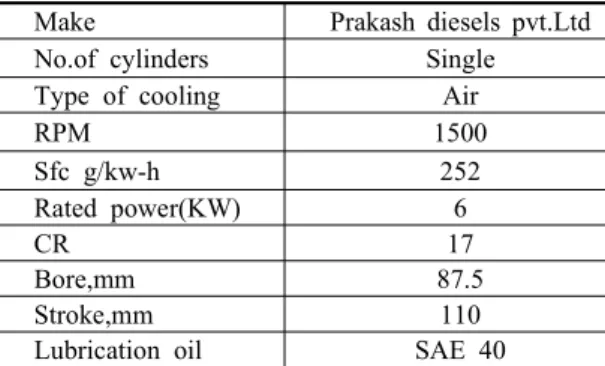
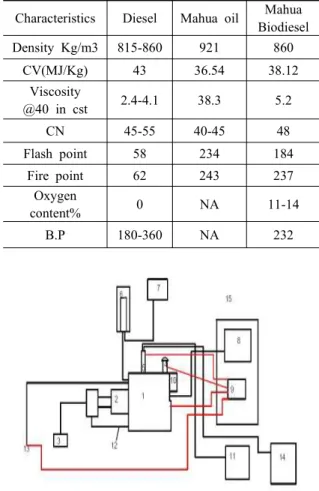
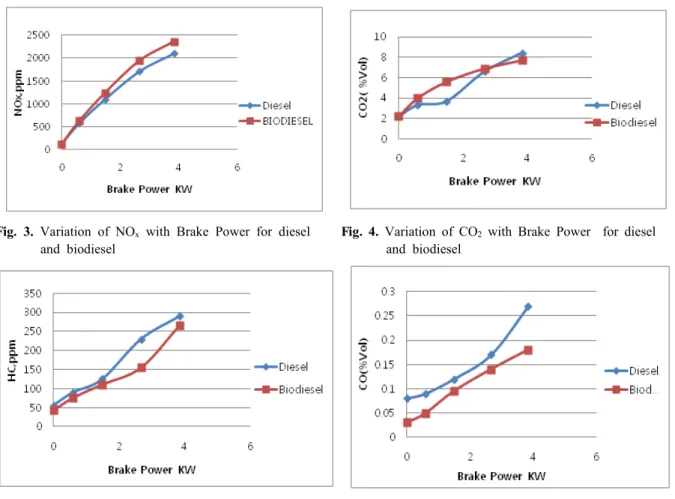
In this study, Diesel fuel and pure biodiesel (mahua oil) were tested on a single cylinder naturally-aspirated direct-injection diesel engine. The study aims to investigate the effects of the mahua oil biodiesel on existing diesel engine emissions. The effect of test fuels on engine emissions like CO, HC, CO2, NOx and smoke emissions was investigated with respect to the load on engine. Smoke opacity of Diesel engine was lower in case of biodiesel of mahua oil as compare to mineral diesel. NOx emissions was little higher during the whole range of loading, which is a typical characteristic of biodiesel. However the increments are within in the narrow range. CO2 emissions was bit higher which is the indication of better combustion due to presence of rich oxygen in the mixture, it results in the low values of CO and HC during the whole range of experiments. Thus considering environmental norms most of the engine emissions, it can be concluded and biodiesel derived from mahua oil could be used in a conventional diesel engine without any modification.
Key words : Diesel engine, Transesterification, Biodiesel (mahua oil), emissions, etc
1. INTRODUCTION
Though diesel engines have several advantages like high thermal efficiency, torque capacity, low CO and HC emissions, reliability, adaptability and economical in operation, they suffer from high concentration of NOx , smoke and particulate emissions. Reduction of exhaust emissions is extremely important for diesel engine development
in view of increasing attention regarding environmental protection and emission norms.
Bio-fuels made from agricultural products
(oxygenated by nature), may not only offer benefits
in terms of exhaust emissions, but also reduce the
world’s dependence on oil imports. Among these,
vegetable oils or their derived bio-diesels(methyl or
ethyl esters) are considered as very promising
fuels[1]. Due to its reproducibility and non-toxicity,
biodiesel has been considered as a potential
substitution of diesel fuel. Furthermore, due to its
similar properties with diesel fuel, there is no need
to modify the engine when it is fueled with
biodiesel or its blends [2].