• 검색 결과가 없습니다.

The Effect of Gait Pattern in Hemiplegia Patients through Progressive Speed Increase Treadmill Training

N/A
N/A
Protected

Academic year: 2021

Share "The Effect of Gait Pattern in Hemiplegia Patients through Progressive Speed Increase Treadmill Training"

Copied!
12
0
0

로드 중.... (전체 텍스트 보기)

전체 글

(1)

The Effect of Gait Pattern in Hemiplegia Patients through Progressive Speed Increase Treadmill Training

Lee Hyoungsoo, RPT, Ph.D

ǂ

Dept. of Physical Therapy, Gwangju Health University

점진적인 속도증진 트레드밀 훈련이 뇌졸중 환자의 보행패턴에 미치는 영향

이형수

ǂ

광주보건대학교 물리치료과

Abstract

연구목적 : 본 연구의 목적은 8주간의 점진적인 속도증진 훈련이 뇌졸중환자의 족저압, 보행주기, 보행대칭성에 어떠 한 영향을 주는지 알아보는 것이다.

연구방법 : 연구에 참여한 대상자들은 뇌졸중으로 진단 받고 N병원에 입원한 편마비환자 20명(실험군 10명, 대조군 10명)을 대상으로 하였다. 이들은 모두 물리치료와 작업치료를 받았고, 실험군은 주3회, 8주간의 트레드밀 보행훈련를 받았고, 대조군은 받지 않았다. 실험전, 후에 F-scan을 이용하여 보행주기, 보행대칭성을 검사하였다.

연구결과 : 8주 후, 보행주기는 실험군의 양하지지지기Ⅰ·Ⅱ, 단하지지지기에서 모두 유의하게 증가하였으나, 대조군

에서는 양하지지지기 Ⅱ, 단하지지지기에서 유의하게 증가하였다. 유각기는 실험군과 대조군 모두 유의하지는 않았다.

보행대칭성은 입각기 대칭성에서 대조군과 비교하여 실험군에서 유의하게 증가하였으나, 유각기 대칭성은 실험군과 대 조군 모두 유의하지 않았다.

결론 : 뇌졸중 환자에 있어 보행훈련은 보행주기과 보행대칭성과 를 개선시키며, 특히 점진적인 속도 증진훈련은 양

하지지지기, 단하지지지기, 입각기 보행대칭성에 효과적인 방법으로 사용될 수 있을 것으로 보인다.

Key Words : 보행대칭성, 보행주기, 보행훈련, 족저압, 편마비

ǂ
Corresponding author:

Lee Hyoungsoo, [email protected], 010-5385-7420

접수일 2013년 12월 28일 | 수정일 2014년 01월 24일 | 게재확정일 2014년 02월 14일

(2)

. Introduction

Restoration of gait is one of the goals in the rehabilitation of hemiplegia patients. To reach that goal, therapists apply either a traditional, functional approach with strengthening and practicing of single movements or various neurofascilitation techniques, such as the Brunnstrom technique with synergistic movements, proprioceptive neuromuscular facilitation with spiral and diagonal movements, and neurodevelo- pmental(Bobath) therapy with reflex inhibitory movements(Dewald, 1987). However, these methods are complex and do not stress gait practice perse (Hesse, 1995; Liston, 2000).

The use of treadmill training with partial body weight support has been a promising investigational therapy in the rehabilitation of patients with hemiparesis(Hesse et al, 1994; Visintin et al, 1998) and impaired gait(Visintin & Barbeau, 1989; Wernig

& Muller, 1992; Dietz et al, 1994). It is a task- specific therapy enabling wheelchair-bound subjects to practice complex gait cycles repeatedly. The theoretical background to this therapy involves entrainment of spinal and supraspinal pattern generators(Lovely et al, 1986; Asanuma & Keller, 1991; Carr & Shepherd, 1998).

Since higher-level gait disorder is a type of motor programming failure(Nutt et al, 1993), it is reasonable to anticipate that these damaged programs might be re-activated by training, especially since there is now considerable evidence of plasticity in the damaged adult nervous system, which may be influenced by sensory input, particularly that from normal activity(Kidd et al, 1992). One way of

creating input for more normal walking is in the 'forced' of 'assisted' walking situation of a treadmill.

Animal studies have shown that the adult spinal cord can recover a near-normal walking pattern after a period of interactive locomotors training in which weight support for the hindquarters is provided, hence facilitating stepping on a treadmill(Smith et al, 1982;

Rossignol et al, 1986; Barbeau et al, 1987). In paraplegic patients, Dietz et al(1994) observed that coordinated stepping movements were induced by standing on a moving treadmill and that with daily training the amplitude of electromyographic activity increased. This strongly supports the idea of induced plastic change normalizing neuronal activity as a result of activation of spinal locomotors centers. These spinal locomotors centers or central pattern generators(CPG) are closely involved in the regulation of movement. There is evidence that training can modify the interaction between the central pattern generator programs and peripheral reflex activity (Armstrong, 1988). Normally, descending influences from the motor cortex, cerebellum, and brainstem activate these central pattern generators.

In the patient with higher-level gait disorder, who has sustained extensive damage to supraspinal control, it may be assumed that descending drive is attenuated to the point where the threshold of activation is not exercised. The rationale of treadmill re-training is that inputs from the periphery would act to reinforce or recalibrate existing but degraded programs, permitting them to be more easily activated(Pohl, 2002).

Smith et al(1999) reported that the progressive

treadmill aerobic exercise training improved volitional

torque and torque/time generation and reduced

(3)

reflexive torque/time production in the affected limb.

Pohl et al(2002) demonstrated that gait therapy with structured speed-dependent treadmill training(STT) was and effective approach, resulting in a superior walking ability in ambulatory hemiplegia patients in comparison with the Bobath or PNF and LTT strategies.

As a supplement to conventional therapies, treadmill training can significantly improve the results of gait training(Dobkin, 1999; Hesse, 1999). Whether treadmill training is actually superior to other gait therapies is disputed(Hesse, 1999; Davies, 1999).

With seriously afflicted patients, who cannot walk under their own power, treadmill training with body weight support is recommended(Visintin et al, 1998;

Dobkin, 1999). However, the most effective combin- ation of training parameters(e.g. amount and timing of body weight support during the gait cycle, belt speed, and acceleration) is still unknown.

Drawing on principles of training, we have developed a gait training program(PSITT: progressive speed increase treadmill ambulation training) suitable for ambulatory Hemiplegia patients.

The purpose of the present study was to determine if there was a difference in the gait cycle, gait symmetry, and foot pressure of Hemiplegia patients with and without 8 weeks PSITT(progressive speed increase treadmill ambulation training) in order to evaluate the effectiveness of the PSITT program.

We hypothesized that there would be differences between PSITT group and non-PSITT(CPT) group in the % gait cycle of single support phase, in the gait symmetry of single support(support phase in affected side/support phase in non-affected side) and swing phase(swing phase in affected side/swing phase in

non-affected side), and in the displacement of COP after 8 weeks treadmill training.

. Methods

1. Subjects

We recruited 20 hemiparesis from the Korean National Rehabilitation Center. Hemiparesis was caused by ischemic stroke or intracerebral hemorrhage. Eligible subjects had to be at least 12 weeks from their first supratentorial stroke. Further inclusion criteria included: (1) ambulatory, all of them were able to walk without personal assistance (functional ambulation categories=3), (2) no evidence of heart failure, absence of ischemia or during exercise, appropriate rise in systolic blood pressure during exercise, and the absence of non-sustained or sustained ventricular tachycardia, (3) no other orthopedics or neurological diseases impairing mobility, and (4) able to understand at least simple instructions and the meaning of the study. The average age of the group was 55.35 years(range: 40 - 73 years), and 45% were women.

2. Experimental and Control Groups

The 20 subjects were randomized into one of two

groups: the experimental group(PSITT, n=10), and

the control group(non-PSITT, n=10) by block

randomization on the basis of the initial time required

to walk 45 meters without assistance(Table 1). The

experimental group received gait training on a

treadmill while full weight bearing on their lower

(4)

extremities for 8 weeks at a frequency of three times a week(20 minutes duration), and also received the conventional physical therapy for 20 minutes, three times a week. The conventional physical therapy following the Neurodevelopmental or 'Bobath'(NDT) concept, included gait-preparatory maneuver’s while sitting and standing and the practice of gait itself either on the floor or on the stairs. The control group only received the conventional physical therapy for 40 minutes, three times a week.

3. Training Programs and Strategies

The strategy focused on a straight trunk and limb alignment with proper weight shift and weight bearing onto the Hemiplegia limb during the loading phases of gait, as well as stepping to advance the limb forward. Training programs are shown in Table 2. The special training strategies are described below.

4. PSITT (Progressive Speed Increase Treadmill Ambulation Training)

All subjects wore a safety belt and assisted during the treadmill training by a physical therapist. The therapist gave no assistance in the actual performance of the movements. The comfortable over ground walking speed(Vi) was determined before the first training phase. In the first training phase(2 weeks), treadmill speed set up at Vi, and the treadmill speed was increased by 25% at each training phase(2 weeks) passed. The treadmills were run at 10%

incline.

5. CPT (Conventional Physical Therapy)

Physiotherapeutic gait therapy based on the latest description of the principles of the proprioceptive neuromuscular facilitation(PNF) and Bobath concepts(Lennon, 2001; Wang, 1994) was performed by experienced and skilled therapists with qualifi- cation in the PNF and Bobath techniques. Strategies followed in these sessions emphasized general bilateral and 3-dimensional movements required for turning, rolling, kneeling, sitting, standing, and so on;

facilitation of selective movement on the paretic side of the body; integration of the selective movement in functional activity; exercise for improving balance;

and so forth. Overground walking was an integral part of conventional therapy but with less emphasis on distance walked than on gait quality(eg, equilibrium, stability during stance phase, foot clearance during swing phase, prepositioning of the foot, heel contact, body weight transfer)(Mayr et al, 2007).

6. Measurement Tools and Variables

All subjects were evaluated before commencement of training and again at the completion of the 8-week training period. The outcome variables(gait cycle, gait symmetry, and foot pressure) were measured using the F-scan(Foot-scan, ver. 3.623) during which subjects walked at preferred and increasing velocities.

The experimental group(PSITT) and the control group

(non-PSITT; CPT) were compared in terms of gait

cycle, gait symmetry, and foot pressure

(5)

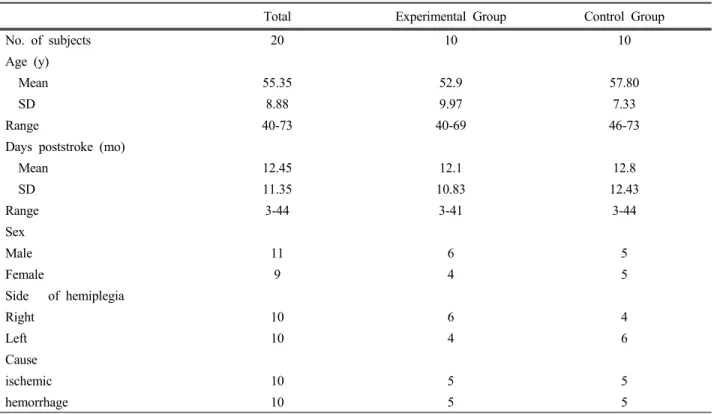
Total Experimental Group Control Group

No. of subjects 20 10 10

Age (y)

Mean 55.35 52.9 57.80

SD 8.88 9.97 7.33

Range 40-73 40-69 46-73

Days poststroke (mo)

Mean 12.45 12.1 12.8

SD 11.35 10.83 12.43

Range 3-44 3-41 3-44

Sex

Male 11 6 5

Female 9 4 5

Side of hemiplegia

Right 10 6 4

Left 10 4 6

Cause

ischemic 10 5 5

hemorrhage 10 5 5

Table 1. Demographic Data of Study Subjects

Group Program

Experimental (n=10)

CPT (30min, 3 times/week):

gait-preparatory maneuvers (sitting and standing conditions) Practice of gait itself (one the floor or the stairs)

PSITT (20min, 3 times/week):

progressive speed increase treadmill ambulation training (increasing by 25% per 2 weeks) Control

(n=10)

CPT (30min, 3 times/week):

gait-preparatory maneuvers (sitting and standing conditions) Practice of gait itself (one the floor or the stairs)

Table 2. Training Programs 7. Statistical Analysis

A paired t-test was used to determine differences in the change of outcome variables(gait cycle, gait symmetry, and foot pressure) within each group during the training period. An independent t-test was

used to determine differences of mean in the outcome

variables between two groups(experimental and

control group). For all tests, and α-level of 5% was

assumed. We used the standard software package

SPSS 10.0 for Windows.

(6)

Fig 1. The % cycle of double support Ⅰphase in gait cycle Fig 2. The % cycle of single support phase in gait cycle variables Group

Pre-test (Baseline)

Post-test

(after 8weeks) Different within groups Different between groups

Mean SD Mean SD Mean SD p Value Mean SD p Value

Double support Ⅰphase (% cycle)

EG 22.80 3.41 16.58 2.79 6.22 3.34 .0001

3.93 4.52 .023 CG 22.22 4.16 19.93 3.00 2.29 2.45 .016

Single support phase ( % cycle)

EG 22.57 2.49 34.12 2.72 -11.55 2.65 .0001

-6.05 4.64 .003 CG 22.63 4.73 27.53 3.75 -4.90 1.94 .0001

Double support Ⅱphase (% cycle)

EG 22.31 2.89 14.74 2.85 7.57 3.89 .0001

4.82 3.79 .003 CG 22.44 4.16 20.09 2.76 2.35 2.23 .009

Swing phase (% cycle)

EG 32.52 3.19 34.56 2.54 -2.04 3.41 .091

-2.46 3.70 .065 CG 32.67 4.21 32.45 3.48 .22 1.91 .724

*EG: Experimental Group(PSITT+CPT)

*CG: Control Group(CPT)

*NS: Non-significant

Table 3. Change of gait cycle in affected side

(Unit: % cycle)

. Results

The 10 subjects were randomized into the PSITT group and the other 10 subjects were randomized into the non-PSITT(CPT) group. All completed the entire study protocol.

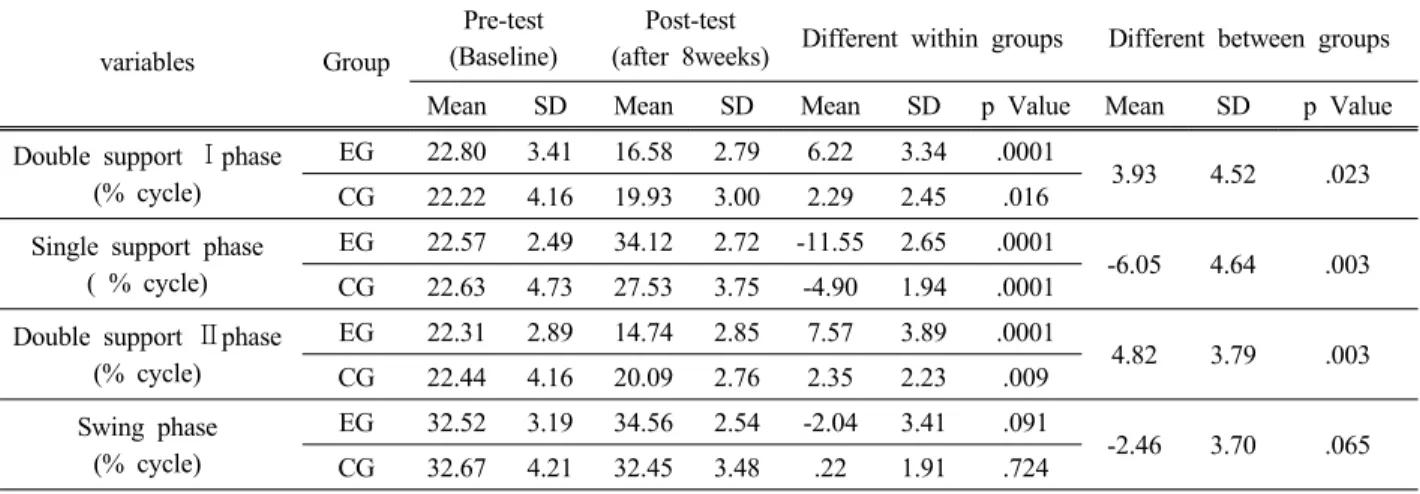
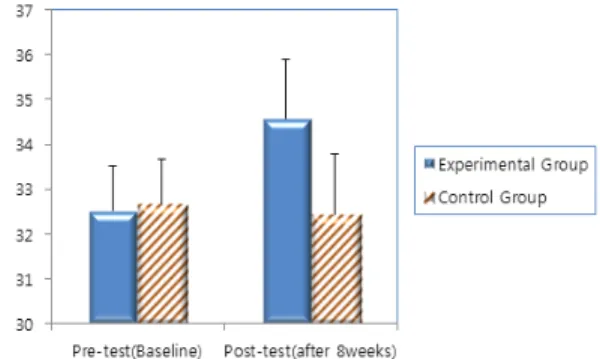
Table 3 shows the % gait cycle of each phase(double support Ⅰ, single support, double support Ⅱ, and swing phase). The % gait cycle values of double support

Ⅰ phase and double support Ⅱ phase decreased

significantly, single support phase at affected side increased significantly in the both group. An independent t-test revealed significant differences between the PSITT and non-PSITT(CPT) groups on the mean difference of double support Ⅰ phase(6.22±3.34 versus 2.29±2.45; p<.05), single support phase (-11.55

±2.65 versus -4.90±1.94; p〈.01) and double support

Ⅱ phase(7.57±3.89 versus 2.35± 2.23; p<.01).

However, there were no significant differences between

the two groups for the swing phase.

(7)

Fig 3. The % cycle of double support Ⅱ phase in gait cycle Fig 4. The % cycle of swing phase in gait cycle

Fig 5. Change of gait cycle symmetry in support phase Fig 6. Change of gait cycle symmetry in swing phase variables Group

Pre-test (Baseline)

Post-test

(after 8weeks) Different within groups Different between groups

Mean SD Mean SD Mean SD p Value Mean SD p Value

Single support phase symmetry

EG .70 .11 .99 .01 -.29 .10 .0001

-13 .15 .003

CG .71 .19 .86 .17 -.15 .06 .0001

Swing phase symmetry

EG 1.46 .25 1.01 .02 .45 .24 .0001

.15 .36 .15

CG 1.50 .38 1.20 .29 .30 .19 .001

* Single support phase symmetry: support phase in affected side / support phase in non-affected side

* Swing phase symmetry: swing phase in affected side / swing phase in non-affected side Table 4. Change of gait cycle symmetry

Table 4 shows the gait symmetry in single support phase(support phase in affected side/support phase in non-affected side) and swing phase(swing phase in affected side/swing phase in non-affected side). The gait symmetry in single support phase and swing phase increased significantly in the both group

(p<.01). An independent t-test revealed non-significant

differences between the PSITT and non-PSITT(CPT)

groups on the mean difference in the single support

phase(-.29±.10 versus -.15±.06; p<.01). However,

there were no significant differences between the two

groups for the swing phase symmetry.

(8)

Fig 7. Change of displacement of COP in affected side Fig 8. Change of displacement of COP in non-affected side

variables Group

Pre-test (Baseline)

Post-test

(after 8weeks) Different within groups Different between groups

Mean SD Mean SD Mean SD p Value Mean SD p Value

Affected side EG 18.29 4.02 23.26 3.05 4.97 1.36 .0001

1.81 2.07 .005 CG 18.45 5.97 21.61 6.01 3.16 1.18 .0001

Non-affected side EG 29.61 4.64 24.39 4.50 -5.22 1.95 .0001

2.35 1.86 .004 CG 29.83 3.72 26.96 3.70 -2.87 .53 .0001

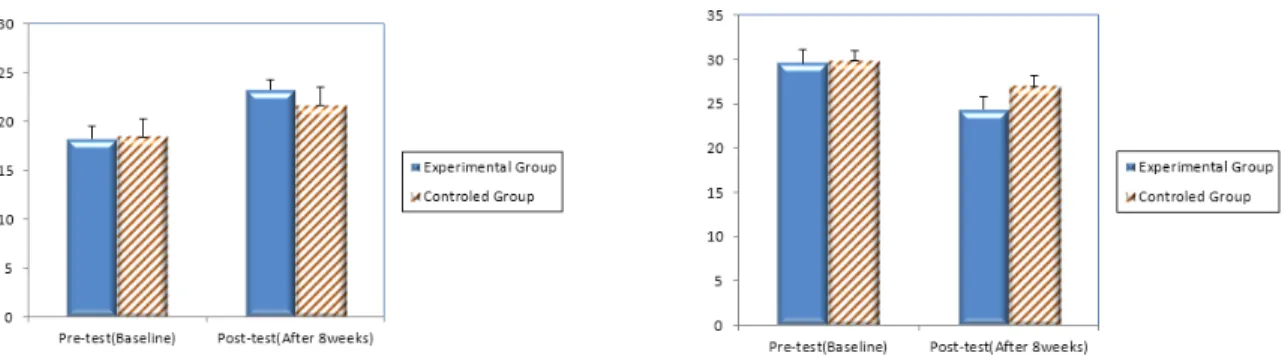
Table 5. Change of displacement of COP(anterior - posterior direction) Table 5 shows the displacement of COP(anterior -

posterior direction) in affected and non-affected side of each group. The displacement of COP(anterior - posterior direction) in affected side of the PSITT group and CPT group increased significantly after 8 weeks of training(p<.001). However, in the non-

affected side of the PSITT group and CPT group, the displacement of COP decreased significantly(p<.0001).

An independent t-test revealed significant differences between the PSITT and non-PSITT(CPT) groups on the mean difference in all of two sides(p<.01).

Ⅳ. Discussion

The locomotor training was based on neuromuscular principles of locomotion from animal and human research studies(Lovely et al, 1986; Harkema et al, 1997;

de Leon et al, 1998; Patel et al, 1998). Given the response of the cases reported here, there appear to be several factors that are key to maximizing the locomotor

capacity of individuals after a stroke. First, maximum

weight bearing of the lower limbs is important during

stance. Second, when the speed of locomotion replicated

normal walking speeds(Craik and Dutterer, 1995), less

manual assistance and greater independence while

stepping were observed. Third, by ensuring sufficient

hip extension and unloading of the limb at the end of

stance, the swing phase of the step cycle was facilitated.

(9)

Fourth, weight bearing on the arms appeared to inhibit rhythmic stepping with the lower extremities, but a reciprocating arm swing, in a natural, coordinated form, facilitated stepping(Werner, 2002).

Traditionally, the physical rehabilitation of individuals typically ended within several months after stroke because it was believed that most if not all recovery of motor function occurred during this interval. Nevertheless, recent research studies have shown that aggressive rehabilitation beyond this time period, including treadmill exercise with or without body weight support, increases aerobic capacity and sensorimotor function(Hesse et al, 1994; Smith et al, 1999; Macko et al, 1997).

Kwakkel et al(1999) reported that greater intensity of leg rehabilitation improved gait ability and activities of daily living in acute stroke victims.

Further, Richards et al(1993) had shown that an additionally applied, task-specific program including treadmill training without body weight support resulted in a larger gait velocity in acute stroke victims 6 weeks after study onset as compared with a conventionally treated group who received less therapy. Conventional gait rehabilitation following stroke usually is designed to emphasize facilitation of recovery through strengthening and endurance training of the unaffected muscles and compensation for nonremediable deficits by using braces and assistive devices for support(Somers, 1992; Atrice et al, 1995). Together, these therapeutic strategies are designed to promote maximum functional capacity of muscles and to compensate for the absence of volitional lower limb muscle contractions or for weakness. Given the generally accepted assumption that repair and recovery of the damaged brain is not

possible(Basso, 1998), successful mobility is dependent on learning new behavioral strategies (Finger, 1988), requiring either a wheelchair and/of bracing with assistive devices.

One of the important goals in the rehabilitation of hemiplegia patients is to improve the gait symmetry.

To achieve this goal, we have developed a gait training program(PSITT: progressive speed increase treadmill ambulation training) suitable for ambulatory Hemiplegia patients. To evaluate the effects of 8 weeks of 'task-oriented' treadmill exercise, we measured outcome variables(gait cycle, gait symmetry, and displacement of COP).

We found support for 3 of our 3 hypotheses. The three hypotheses that were supported were that there would be differences between PSITT group and non-PSITT(CPT) group in the % gait cycle of double support Ⅰ phase and double support Ⅱ phase, single support phase and the gait symmetry in single support phase that there would be differences between PSITT group and non-PSITT(CPT) group in the displacement of COP after 8 weeks of treadmill training. The hypothesis that was not supported was that there would be differences between PSITT group and non-PSITT(CPT) group in the gait symmetry of swing phase after 8 weeks treadmill training. Instead, we found that the gait symmetry in swing phase increased significantly, but the fait symmetry in swing phase decreased significantly in the PSITT group(p<.05).

In each gait cycle, there were two periods of double support and two periods of single support.

The stance phase usually lasts about 60% of the

cycle, the swing phase about 40%, and each period

of double supports about 10% in a normal person's

(10)

gait(Michael, 1996). However, this varies with the speed of walking, the swing phase becoming proprotionately longer, and the stance phase and double support phases shorter, as the speed increases (Murray, 1967). We showed herein that the 8 weeks PSITT(progressive speed increase treadmill ambulation training) program decreased the % cycle values of double support Ⅰphase(EG: 6.22±3.34 versus CG: 2.29±2.45; p<.05), double support Ⅱ phase(EG: 7.57±3.89 versus CG: 2.35±2.23; p<.01) of the PSITT group significantly(p<.05), and the % cycle of single support phase at affected side increased significantly in both groups(EG:

-11.55±2.65 versus CG: 4.90±1.94; p<.01). These results indicated that the PSITT group resembled a normal person's gait pattern than the non-PSITT(CPT) group.

The gait symmetry in single support phase(support phase in affected side/support phase in non-affected side) increased significantly in the both group(p<.01).

However, the gait symmetry in swing phase(swing phase in affected side/swing phase in non-affected side) decreased significantly in the both group(p<.01).

An independent t-test revealed non-significant differences between the PSITT and non-PSITT(CPT) groups on the mean difference in the single support phase(-.29±.10 versus -.15±.06; p<.01). However, there were no significant differences between the two groups for the swing phase symmetry.

The center of pressure is the point on the ground through which a single resultant force appears to act, although in reality the total force is made up of innumerable small force vectors spread over a finite area on the surface. In this study, the displacement of COP means the displacement from the position of

COP at initial contact(the beginning of the loading response, which is the first period of the stance phase) to the position of COP at toe off(the point at which the stance phase ends and the swing phase begins).

The displacement of COP(anterior - posterior direction) in affected side of the PSITT group increased significantly after 8 weeks training(p<.05).

The PSITT group revealed larger increasement than non-PSITT(CPT) group in the displacement of COP.

This would imply that the PSITT program result in a larger supporting phase in affected side and enlarged the step length.

There were two main limitations of our research design. First, only 20 hemiplegia patients in the Korean National Rehabilitation Center were used in this study.

Second, because the investigators collecting the data were aware of group membership of the participants, our expectations may have influenced their performance.

Further research is needed to continue perfecting this strategy. It is important to investigate “What is the most effective timing, intensity, and duration of the PSITT training?”, and “What is PSITT training's long-term effects on other areas of physical performance and fitness?”

. Conclusion

This study demonstrates that gait therapy with the

PSITT is an effective approach because it results in

better gait ability(normal gait patten, gait symmetry,

larger supporting phase in affected side and

enlargement of step length) in ambulatory hemiplegia

(11)

patients in comparison with the CPT(Bobath of PNF).

However, the timing, intensity, and duration of the PSITT training, as well as its long-term effects on other areas of physical performance and fitness, require further investigation in more rigorous, randomized controlled studies.

Acknowledgment

The Research has been conducted by the Research Grant of Gwangju Health University in Gwangju (3012014).

Refferences

Armstrong DM(1986). Supraspinal contributions to the initiation and control of locomotion in the cat.

Prog Neurobiol, 26(4), 273–361.

Asanuma H, Keller A(1991). Neurobiological basis of motor learning and memory. Concepts Neuroscience, 2, 1-30.

Atrice M, Gonter M, Griffin D, et al(1995). Traumatic spinal cord injury. In: Umphred D, (Ed.).

Neurological Rehabilitation. St Louis, Mosby Co.

Barbeau H, Rossignol S(1987). Recovery of locomotion after chronic spinalization in the adult cat. Brain Res, 412(1), 84-95.

Basso DM(1998). Neuroplasticity of descending and segmental systems after spinal cord contusion.

Neurol Report, 2, 48-53.

Craik RL, Dutterer L(1995). Spatial and temporal characteristics of foot fall patterns. In: Craik RL,

Oatis CA (Eds.). Gait analysis: theory and application. St Louis, Mosby-Year Book.

Dietz V, Colombo G, Jensen L(1994). Locomotor activity in spinal man. Lancet, 344(8932), 1260- 1263.

Dobkin BH(1999). An overview of treadmill locomotor training with partial body weight support: a neurophysiologically sound approach whose time has come for randomized clinical trials. Neurorehabil Neural Repair, 13(3), 157-166.

Dewald JPA(1987). Sensorimotor neurophysiology and the basis of neurofascilitation therapeutic techniques. In: Brandstater ME, Basmajian JV, (Eds.). Stroke Rehabilitation. 1st (Ed.). Baltimore, Williams & Wilkins.

Finger S(1988). Brain injury and recovery theoretical and controversial issues. New York, Plenum Press.

Hesse S, Bertelt C, Jahnke MT, et al(1995).

Treadmill training with partial body weight support compared with physiotherapy in nonambulatory hemiparetic patients. Stroke, 26(6), 976-981.

Hesse S, Bertelt C, Schaffrin A, et al(1994).

Restoration of gait in nonambulatory hemiparetic patients by treadmill training with partial body- weight support. Arch Phys Med Rehabil, 75(10), 1087-1093.

Hesse S(1999). Treadmill training with partial body weight support in hemiparetic patients-further research needed. Neurorehabil Neural Repair, 13(3), 179-182.

Harkema SJ, Hurley SL, Patel UK, et al(1997).

Human lumbosacral spinal cord interprets loading

during stepping. J Neurophysiol, 77(2), 797-811.

(12)

Kidd G, Musa I, Lawes N(1992). Understanding neuromuscular plasticity. London, Edward Arnold.

Kwakkel G, Wagenaar RC, Twisk JW, et al(1999).

Intensity of leg and arm training after primary middle-cerebral-artery stroke: a randomized trial.

Lancet, 354(9174), 191-196.

Liston R, Mickelborough J, Harris B, et al(2000).

Conventional physiotherapy and treadmill re-training for higher-level gait disorders in cere- brovascular disease. Age Ageing, 29(4), 311-318.

Lovely RG, Gregor RJ, Roy RR, et al(1986). Effect of training on the recovery of full-weight bearing stepping in the adult spinal cat. Exp Neurol, 92, 421-435.

Macko RF, DeSouza CA, Tretter LD, et al(1997).

Treadmill aerobic exercise training reduces the energy expenditure and cardiovascular demands of hemiparetic gait in chronic stroke patients. A preliminary report. Stroke, 28(2), 326-330.

Mayr A, Kofler M, Quirbach E, et al(2007). Pro- spective, blinded, randomized crossover study of gait rehabilitation in stroke patients using the Lokomat gait orthosis. Neurorehabil Neural Re- pair, 21(4), 307-314.

Nutt JG, Marsden CD, Thompson PD(1993). Human walking and higher-level gait disorders, particularly in the elderly. Neurol, 43(2), 268-279.

Patel UK, Dobkin BH, Edgerton VR, et al(1998).

The response of neural locomotor circuits to changes in gait velocity (abstract). Soc Neurosci, 24, 2104.

Pohl M, Mehrholz J, Ritschel C, et al(2002).

Speed-dependent treadmill training in ambulatory hemiparetic stroke patients: A randomized controlled trial. Stroke, 33(2), 553-558.

Richards CL, Malouin F, Wood-Dauphinee S, et al(1993). Task-specific physical therapy for optimizaton of gait recovery in acute stroke patients. Arch Phys Med Rehabil, 74(6), 612-620.

Rossignol S, Barbeau H, Julien C(1986). Locomotion of the adult chronic spinal cat and its modific- ation by plasticity of the Mammalian Spinal Cord.

Spoleto, Italy: Springer-Verlag.

Somers MF(1992). Spinal cord injury: functional rehabilitation. Norwalk, Conn: Appleton & Lange.

Smith JL, Smith LA, Zernicke RF, et al(1982).

Locomotion in exercised and nonexercised cats cordotomized at two and twelve weeks of age.

Exp Neurol, 76(2), 393-413.

Smith GV, Silver KH, Goldberg AP, et al(1999).

“Task-oriented” exercise improves hamstring strength and spastic reflexes in chronic stroke patients. Stroke, 30(10), 2112-2118.

Visintin M, Barbeau H(1989). The effects of body weight support on the locomotor pattern of spastic paretic patients. Can J Neurol Sci, 16(3), 315-325.

Visintin M, Barbeau H, Korner-Bitensky N, et al(1998). A new approach to retrain gait in stroke patients through body weight support and treadmill stimulation. Stroke, 29(6), 1122-1128.

Werner C, Bardeleben A, Mauritz KH, et al(2002).

Treadmill training with partial body weight support and physiotherapy in stroke patients: a preliminary comparison. Eur J Neurol, 9(6), 639- 644.

Wernig A, Muller S(1992). Laufband locomotion with body weight support improved walking in persons with severe spinal cord injuries.

Paraplegia, 30(4), 229-238.

수치

Table 1. Demographic Data of Study Subjects
Table 3. Change of gait cycle in affected side
Fig 3. The % cycle of double support Ⅱ phase in gait cycle  Fig 4. The % cycle of swing phase in gait cycle
Fig 7. Change of displacement of COP in affected side Fig 8. Change of displacement of COP in non-affected side

참조

관련 문서

Purpose: The aim of this study was to evaluate the effect of progressive body weight decrease combined with increasing level of overground walking speed training for

Comparison of Robotic Tilt-table Training and Body Weight Support Treadmill Training on Lower Extremity Strength, Balance, Gait, and Satisfaction with Rehabilitation,..

Purpose: The purpose of this study was both to examine the effects of proprioceptive neuromuscular facilitation (PNF) lower leg taping and treadmill training on the gait

However, control group shows a significant improvement the cadence, velocity, step length and stride length in gait (p&lt;.05), but shows no significant differences in

In the present study, the effects of a combination of modified speed-dependent treadmill walking exercise (MSTWE) and body weight support treadmill training (BWS) on the gait

RESULTS: As for the gait variables that showed significant differences in comparison between the groups over the training period, the dual motor circuit task training group

Effect of Single Leg Stance Training According to Different Support Surfaces on Walking Speed and Balance in Patients with Chronic Hemiplegia.. Kim Myungchul, PT, Ph.D 1